Grant of Share Awards
Bull 0
Bear 0
Routine
|
Standard Chartered is a global bank that connects corporate, institutional, and affluent clients to growth opportunities across Asia, Africa, and the Middle East. The company operates through two primary business segments: Corporate & Investment Banking, which provides risk management, advisory, and financing solutions to large corporations, development organizations, governments, and financial institutions; and Wealth & Retail Banking, which serves clients across the wealth continuum through Private, Priority, and Personal Banking, as well as small and medium-sized enterprises. The bank also maintains a Ventures division that invests in disruptive financial technology and digital banking platforms, including Mox and Trust. Founded in 1858, the institution serves markets in Asia, Africa, the Middle East, Europe, and the Americas, leveraging its network to facilitate cross-border trade and investment. Summarised from the company's own disclosures, fiscal year ended Dec 2025 |
Industry Banks - Diversified | Homepage sc.com |
| Sector Financial Services | IR page sc.com/en/investors | |
|
Tags
corporate banking, investment banking, wealth management, retail banking, private banking, small and medium enterprises, cross-border trade, fintech ventures, digital banking, advisory services, Mox, Trust, Priority Banking, Personal Banking
|
Press page sc.com/en/media/press-releases |
Metrics
| Valuation | |
|---|---|
| Market cap | £ 51.421B |
| Market cap (USD) | $ 68.426B |
| P/E | 13.45 |
| PEG | 0.68 |
| P/BV | 1.24 |
| P/S | 3.31 |
| P/OCF | 1.88 |
| P/FCF | 1.90 |
| Dividend yield | — |
| Turnover / mcap | — |
| Returns | |
|---|---|
| ROE | 9.6% |
| ROI | 9.3% |
| ROIC | 10.2% |
| Profit margin | 24.3% |
| Growth | |
|---|---|
| Revenue growing | Yes |
| Profits growing | Yes |
| Revenue up 3y | Yes |
| Revenue up 5y | No |
| Earnings growth 3y (net profit CAGR) | 19.9% |
| Quality | |
|---|---|
| Profitable | Yes |
| Margin expanding | Yes |
| Buying back stock | Yes |
| Diluting (TTM) | No |
| Debt/Equity | — |
| Podcast bulls (TTM) | Sign up |
| Podcast bears (TTM) | Sign up |
| Podcast sentiment (TTM) | Sign up |
| Podcast sentiment % (TTM) | Sign up |
| News sentiment (TTM) | 49 |
| Quality score | 55.6% |
| Insiders | |
|---|---|
| Buys, 1w | Sign up |
| Buys, 1m | Sign up |
| Buys, 1y | Sign up |
| Sells, 1w | Sign up |
| Sells, 1m | Sign up |
| Sells, 1y | Sign up |
Podcast Mentions
Results, director/PDMR dealings and voting-rights totals announced to the FCA's National Storage Mechanism, newest first. The link opens the announcement on the NSM. Announcements and reports published on HKEXnews, newest first, monthly and next-day returns, proxy forms and board-meeting notices included. The link opens the announcement on HKEXnews. Press releases from the company's own website, newest first.
Transaction in own shares
Bull 1
Bear 0
Capital return
Director/PDMR Shareholding
Bull 0
Bear 0
Routine
Director/PDMR Shareholding
Bull 0
Bear 0
Routine
Transaction in own shares
Bull 0
Bear 0
Routine
STANDARD CHARTERED PLC ANNOUNCES CHANGES TO ITS BOARD
Bull 0
Bear 0
Routine
Voting Rights and Capital
Bull 0
Bear 0
Routine
Transaction in own shares
Bull 1
Bear 0
Capital return
real-estate-refinancing-early-movers-gain-advantage
Bull 0
Bear 0
Not a release
-
-
Your local website
-
-
Login and Contact
Login and Contact
-
Online banking
Online banking
-
Your local website
-
-
Menu
-
-
Login and Contact
Login and Contact
-
Online banking
Online banking
-
Your local website
-
-
Menu
About Standard Chartered
About Standard Chartered
Discover our strategy, business model, people and where we operate.
Third quarter results 2026
We've released our Q3’26 results.
-
Who we are
Who we are
-
Our purpose and culture
Our purpose and culture
-
Sustainability
Sustainability
-
-
-
Login and Contact
Login and Contact
-
Online banking
Online banking
-
Your local website
-
-
Menu
Our businesses
Our businesses
Our business model reflects our strategy of combining cross-border capabilities with wealth management expertise.
Global Market Outlook H2 2026
Explore the forces reshaping markets and investment opportunities.
-
Corporate & Investment Banking
Corporate & Investment Banking
Corporate & Investment Banking
-
Wealth & Retail Banking
Wealth & Retail Banking
We serve the local and international banking needs of affluent clients across the full wealth continuum via Private, Priority and Personal Banking, as well as Small and Medium Enterprises.
-
-
-
Login and Contact
Login and Contact
-
Online banking
Online banking
-
Your local website
-
-
Menu
Serving our investor community
Serving our investor community
Stay updated on our latest financial and performance information, news, upcoming investor events and more
Q3 2026
See our third-quarter results.
Serving our investor community
-
Financial results
Financial results
-
Events
Events
-
-
-
Login and Contact
Login and Contact
-
Online banking
Online banking
-
Your local website
-
-
Menu
Insights
Insights
Tap into deep local expertise with global insights designed to help you grow across borders.
-
-
-
Login and Contact
Login and Contact
-
Online banking
Online banking
-
Your local website
-
-
Menu
Global careers
Global careers
If you’re looking for a career with purpose and want to work for a bank making a difference, we’d love to hear from you.
-
Early Careers
Early Careers
-
Experienced Careers
Experienced Careers
-
Search for: Search
The real estate reset: resilience, refinancing and returns
How real estate corporates can navigate refinancing pressures, strengthen capital structures and create value in a shifting market.
30 October 2026
3 mins
Corporate & investment banking Commercial real estate Industries

Share
(Opens in a new window) (Opens in a new window) (Opens in a new window) (Opens in a new window) (Opens in a new window)
Fragile and uneven sector backdrop
Long before the current crisis, corporates were grappling with constrained bank liquidity and diminishing access to long-tenor funding at attractive rates, prompting a shift towards alternative sources of capital. The recent escalation in geopolitical tensions has added a further layer of uncertainty to an already challenging environment.
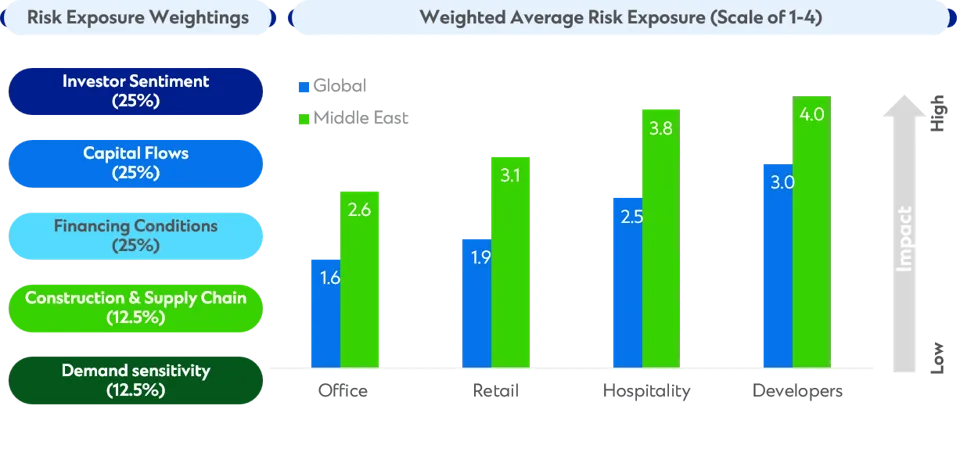
Developers and hospitality companies are particularly exposed to the resulting slowdown in regional recovery momentum. Whilst operational disruption remains localised, rising funding costs and a potentially higher cost of capital are reshaping financing decisions and placing greater emphasis on capital structure discipline, refinancing strategy and funding diversification.
Winners have gone back to basics
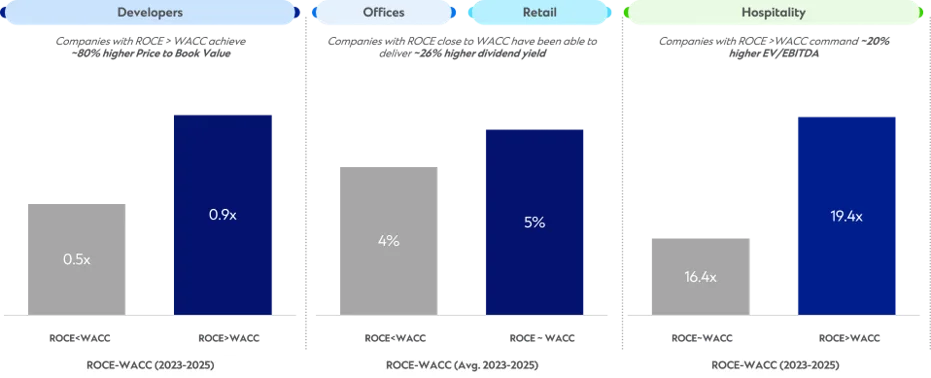
Corporates prioritising strong operating fundamentals and optimising leverage are best positioned to unlock differentiated valuations at around 10-30 per cent above average across sub-sectors, and even higher for developers.
At the same time, sector balance sheets remain broadly resilient. They are currently sitting on more than USD80 billion of current rating debt capacity, with at least 30 per cent of corporates maintaining high headroom even under stress.
This positions corporates well to absorb shocks, but also places greater emphasis on how that capacity is used.
The refinancing clock is ticking
With this backdrop, a more immediate pressure point is approaching.
A wall of approximately USD150bn in debt maturities through 2028, coupled with constrained bank lending capacity, presents a critical refinancing window for real estate corporates.
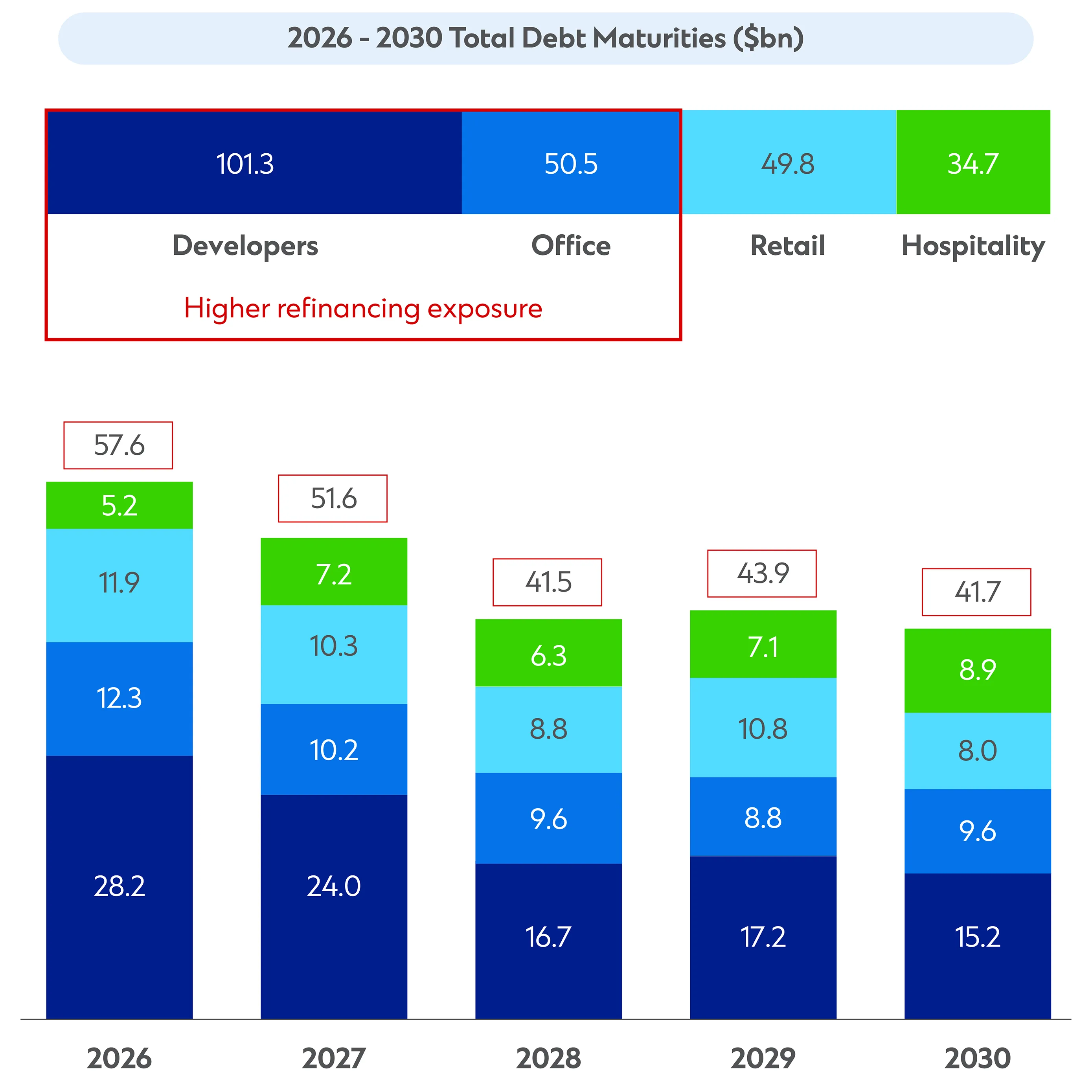
Access to capital is no longer the challenge. Securing funding on acceptable terms is. Higher borrowing costs, tighter credit conditions, and selective investor appetite are driving corporates to diversify liquidity sources, with private credit increasingly complementing traditional financing.
Returns above cost, value above peers
The strongest valuations are earned, not given. Real estate corporates that consistently generate returns above their cost of capital command a valuation premium, placing capital structure and capital allocation discipline at the heart of value creation.
Early movers hold the advantage
The refinancing cycle presents both risk and opportunity.
Companies that act early by revisiting leverage, diversifying funding sources and aligning capital structure with long-term strategy, will be better positioned to navigate volatility and unlock value. Those that delay may face higher costs, reduced flexibility and increasing rating pressure.
Our Capital Structure & Rating Advisory team supports real estate corporates in navigating refinancing, optimising capital structures and diversifying funding strategies.
If you are approaching refinancing decisions or reassessing your capital strategy, speak to our team to explore the options available.
Related insights
Understanding risk in restrictive markets
Learn how to measure, monitor and mitigate risk to make informed investment decisions in restrictive markets.
20 Oct 2026
Turbulence ahead: Fuel shock deepens the returns challenge
14 Aug 2026
Building materials: Defending margins through uncertainty
24 Jul 2026
Capital Structure & Rating Advisory
Enabling clarity in capital structure decisions with corporate finance insight and deep sector expertise.
Site footer
Footer Menu 0
Footer Menu 1
-
Manage cookies
Social Menu
© Standard Chartered 2026.
All Rights Reserved.
Corridors in focus: Our People – Lape Seriki
Bull 0
Bear 0
Routine
Lape Seriki, Executive Principal, FI, BBDs, shares how trusted relationships and global connectivity help clients pursue cross-border growth.
30 October 2026
4 mins
Corporate & investment banking Global banking Trade corridors

Share
(Opens in a new window) (Opens in a new window) (Opens in a new window) (Opens in a new window) (Opens in a new window)
When people talk about Africa, they talk about opportunity. But opportunity on its own is not enough. What matters is connecting opportunity to the right markets, the right relationships and the right insight at the right time.
Lape Seriki
Executive Principal, FI, BBDs

Watch Lape’s story and discover how she connects clients in Nigeria with opportunities across global markets.
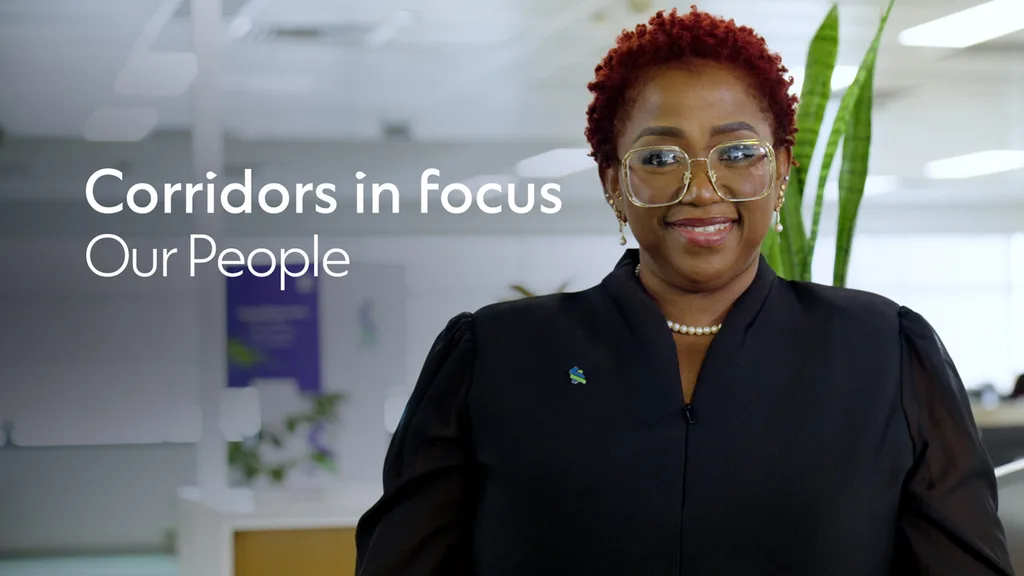
For Lape, that belief took shape early. Growing up, she would visit her mother at work and watch her help banking clients solve problems and identify opportunities to grow.
“I saw her interacting with her clients,” Lape recalls. “The clients come with problems, and she provides solutions and creates opportunities for them.”
That lesson has stayed with her: understand the client’s ambition, build the trust to have the important conversations, then connect the expertise that can help move their strategy forward.
Trust before the transaction
“Any bank can provide products, but what clients are really looking for are trusted advisors,” Lape says. “Someone that will listen to the strategies they’re trying to implement and provide solutions for them.”
That distinction matters when clients look beyond their home markets. Many know where they want to grow. The harder question is how to get there.
Cross-border growth requires an understanding of the client’s strategy alongside relevant market insight, relationships and specialist expertise. Trust allows those conversations to move beyond an immediate transaction towards where the client wants to go next, the challenges ahead and the connections needed to make progress.


Nigeria’s expanding global connections
Lape sees Nigeria playing an important role as trade flows expand across Asia, Europe and the Middle East, with its financial institutions increasingly equipped to support cross-border transactions.
She points to economic reforms that have increased market transparency and enhanced foreign-exchange liquidity, alongside international investor interest. She also sees the recapitalisation of Nigerian financial institutions as supporting their ability to compete globally.
For financial institutions, deeper connections with international markets can create new avenues to support clients, participate in cross-border flows and pursue growth.
Many clients already know where they want to go. The challenge is understanding how to get there.
Lape Seriki
Executive Principal, FI, BBDs
Connecting ambition with execution
This is where Standard Chartered’s international network comes into play.
Lape Seriki connects Nigerian financial institution clients with relevant expertise across Standard Chartered’s markets, product teams and geographies, connecting them with international perspectives and capabilities as they pursue opportunities beyond their home market.


When ambitions span several markets, the relationships, insight or expertise needed to advance them may sit elsewhere. The commercial value lies in bringing those elements together around the client’s objective, creating a clearer path from ambition to execution.
“That is how ideas become opportunities and opportunities become growth,” Lape says.
Passing opportunity forward
Lape’s belief in the power of relationships extends to the next generation. Drawing on more than 26 years in banking, she mentors younger professionals, including women building careers in the industry, sharing the experience and values she has acquired throughout her career.
It brings her story full circle.
As a child, Lape saw how relationships could create opportunities. Today, she applies that principle across borders, connecting Nigerian financial institutions with expertise and opportunities across Standard Chartered’s network.
“The great thing about working in Standard Chartered Bank is that I’m able to connect Nigeria to the rest of the world,” she says.
For clients looking beyond their home market, that connectivity can turn the question of where next into a clearer route forward.
Related insights
-
Corridors in focus: Our People – Chonawut Mick Prasatsak
Singapore-based coverage banker Mick Prasatsak explains how connected ex…
30 Sep 2026
-
Corridors in focus: Our People – Sonia Wentzel
"Building bridges between East and West isn’t just my job, it’s my purpo…
15 Apr 2026
-
Corridors in focus: Our People – Christine Chan
"Twenty years ago, I was working at the docks as a management trainee. T…
10 Feb 2026
Explore Corporate & Investment Banking
-
What we offer
We act as a global superconnector for flows from corporates and financial institutions.
-
Tailored solutions
Learn how we can support your business to grow across markets with our wide range of tailored products.
-
Global network
Discover our global footprint and how we deliver seamless cross-border solutions for clients worldwide.
Site footer
Footer Menu 0
Footer Menu 1
-
Manage cookies
Social Menu
© Standard Chartered 2026.
All Rights Reserved.
Cookie preferences
We care about your experience online, that’s why we use cookies to make sure our website runs smoothly while personalising your visit for your ease of use and convenience. To choose what cookies you want to accept, select “Manage Cookies”. To reject all cookies (except essential cookies), select “Accept essential cookies only”. To accept all cookies for the best possible experience, select “Accept all”. If you’d like to learn about how we use cookies and to manage your selection, visit ourcookie policy
Manage cookies Reject All Accept all

Cookie preferences
Tell us which cookie categories you consent to by using the sliders below. You can change your preferences any time by clicking the “Manage cookies” footer link on any page. To learn more, visit our cookie policy
Strictly necessary cookies (Always on)
Always Active
Your security and privacy are our top priority, that’s why these cookies are always on to ensure the safest and smoothest online experience.
Functionality cookies
Functionality cookies
For your ease of use and convenience, these cookies remember the choices you made (e.g. language and region) and personalise our website to make it most relevant for you.
Performance cookies
Performance cookies
To create the best and most relevant experience for you, these cookies help us analyse and understand what areas need to be improved and refined.
Advertising cookies
Advertising cookies
To make sure we only send what’s most relevant to your needs, these cookies help us and our partners understand what matters most to you. The data collected can be shared with third parties, such as advertisers or platforms, to create an ecosystem that is always relevant to you.
Back Button
Cookie List
Search Icon
Filter Icon
Clear
- checkbox label label
Apply Cancel
Consent Leg.Interest
checkbox label label
checkbox label label
checkbox label label
Confirm preferences

The key to investing: Balancing attack and defence
Bull 0
Bear 0
Other
For wealth builders, the equivalent to staying in the game is staying invested. This, above all else, distinguishes the winners and the losers.
29 October 2026
24 mins
by:
Steve Brice Global Chief Investment Officer
Wealth & retail banking Wealth insights

There is a saying in football: Goals win games, defences win leagues. It is the same in investing, with the strategy relying on balancing how aggressive you want to be with how much risk you can stomach. To use a football analogy, a reasonable starting point may be a 4-4-2 formation.
Ask any 10-year-old football fan who their favourite player is. Chances are it is somebody who scores a lot of goals – Messi, Ronaldo, Salah or Haaland. A similar concept is true across other team sports – for instance quarterbacks, wide receivers or running backs in American football, backs in rugby and batsmen or all-rounders in cricket.
As we mature, the appreciation of other aspects of the game rise in our consciousness – we shift our focus from goals to appreciating tackles, saves, turnovers and yes, even cumulative dot balls.
My investing journey
I have been on a similar journey when it comes to investing. After graduating, I consumed book after book about investing. Most of them fell into two categories – stock picking or market timing. I was trying to figure out whether I wanted to be Warren Buffett or Peter Lynch.
However, over time I have come to the view that a diversified portfolio should be the starting point for every investor, including myself. There are many reasons for this, but the main one is to stay in the game.
In football, you concede three early goals and the chances of you coming back from that are extremely low. Therefore, having a clean sheet is a great starting point. And, of course, in a league format there is always the game next week. In tennis, the analogy is staying in the point. Sometimes this is all you can hope for, but it opens the possibility of the other player making a mistake, letting you win the point.
Staying in the game
For wealth builders, the equivalent to staying in the game is staying invested. This, above all else, distinguishes the winners and the losers. But this is much harder than it sounds when equity markets are down 50%, or a sector loses 90%, and the news headlines make it feel like the world is falling apart. Companies go bust, industries and sectors go through boom-bust cycles, as do equity markets more broadly. It is here that the strength of your defence becomes critical as it helps to smooth out the ride and helps you stay in the game.
There is a lot of academic literature that shows that the pain of losing money is much more than the joy of making money. Therefore, the idea that you should put all your eggs in one basket is really risky, especially if the basket is very small and has a high degree of risk.
If you are young and have invested 10,000 dollars only to see it halve in value, maybe you will be able to tide over the volatility as you have much more time to see it recover and can take advantage of markets going on sale. However, if you are older and have invested a million dollars, losing half of it is probably much harder to take given its potential implications for long-term financial security. It can even impact the relationship you have with your other half.
Attack vs. defence
This leads us to the point that you need to balance attack, midfield and defence.
If you think about it, strikers take greater risks because the upside – a goal – is much larger than the downside – losing possession a long way from your goal. From an investment perspective, your attack would be through equities or some areas of private market investments – most obviously private equity, but also potentially private credit and real assets, such as infrastructure.
These investments are the ones that grab the imagination and the headlines. Your attack is meant to drive significant long-term capital growth in your portfolio, well ahead of inflation. And they can propel your portfolio to new heights that you probably never imagined – we all underestimate the power of compounding over long periods of time because our brains are programmed to think linearly. However, just like strikers, they may experience a barren spell or some investments may even fail to perform at all (which is why most top clubs have multiple attackers in their team).
This is where your midfield and defence come in. The defence keeps you in the game while the midfield may even nick a goal or two to offset the challenges up front. Therefore, the more diversification you have in a portfolio, the less likely you are to lose your shirt and give up on investing entirely.
In investing, your goalkeeper and defence are effectively cash and high-quality bonds. Cash is there to bail you out when the rest of the team lets you down, while high-quality bonds provide significant ballast when the going gets tough.
The midfield can be assets in between equities and high-quality bonds, such as the riskier parts of the bond market, gold and hedge fund strategies.
Finding the right balance
The exact balance in your portfolio depends on how aggressive you want to be and your ability to weather short-term losses. However, a useful starting point might be investing’s equivalent of football’s 4-4-2 formation: 40% in equities, 40% in bonds and 20% in alternatives (private assets, liquid alternatives and gold). Of course, you can always tweak this formation, by adding or reducing your equity exposure should you want to increase or reduce your long-term expected returns in exchange for higher or lower peak-to-trough declines along the way.
Whatever you decide, it is important to remember that each player has its role in the team. While one set of players might shine in certain games and situations, just because other players are not shining does not mean that you do not need them. They each have their time in the sun. The key is to focus on the power of the collective and maintain a balance between attack and defence to smooth out the ride as much as possible. This strategy should help you achieve your long-term goal of winning the investment league.
Disclaimers
This document is confidential and may also be privileged. If you are not the intended recipient, please destroy all copies and notify the sender immediately. This document is being distributed for general information only and is subject to the relevant disclaimers available at our Standard Chartered website under Regulatory disclosures. It is not and does not constitute research material, independent research, an offer, recommendation or solicitation to enter into any transaction or adopt any hedging, trading or investment strategy, in relation to any securities or other financial instruments. This document is for general evaluation only. It does not take into account the specific investment objectives, financial situation or particular needs of any particular person or class of persons and it has not been prepared for any particular person or class of persons. You should not rely on any contents of this document in making any investment decisions. Before making any investment, you should carefully read the relevant offering documents and seek independent legal, tax and regulatory advice. In particular, we recommend you to seek advice regarding the suitability of the investment product, taking into account your specific investment objectives, financial situation or particular needs, before you make a commitment to purchase the investment product. Opinions, projections and estimates are solely those of SCB at the date of this document and subject to change without notice. Past performance is not indicative of future results and no representation or warranty is made regarding future performance. Any forecast contained herein as to likely future movements in rates or prices or likely future events or occurrences constitutes an opinion only and is not indicative of actual future movements in rates or prices or actual future events or occurrences (as the case may be). This document must not be forwarded or otherwise made available to any other person without the express written consent of the Standard Chartered Group (as defined below). Standard Chartered Bank is incorporated in England with limited liability by Royal Charter 1853 Reference Number ZC18. The Principal Office of the Company is situated in England at 1 Basinghall Avenue, London, EC2V 5DD. Standard Chartered Bank is authorised by the Prudential Regulation Authority and regulated by the Financial Conduct Authority and Prudential Regulation Authority. Standard Chartered PLC, the ultimate parent company of Standard Chartered Bank, together with its subsidiaries and affiliates (including each branch or representative office), form the Standard Chartered Group. Standard Chartered Private Bank is the private banking division of Standard Chartered. Private banking activities may be carried out internationally by different legal entities and affiliates within the Standard Chartered Group (each an “SC Group Entity”) according to local regulatory requirements. Not all products and services are provided by all branches, subsidiaries and affiliates within the Standard Chartered Group. Some of the SC Group Entities only act as representatives of Standard Chartered Private Bank and may not be able to offer products and services or offer advice to clients. ESG data has been provided by Morningstar and Sustainalytics. Refer to the Morningstar website under Sustainable Investing and the Sustainalytics website under ESG Risk Ratings for more information. The information is as at the date of publication based on data provided and may be subject to change.
Copyright © 2023, Accounting Research & Analytics, LLC d/b/a CFRA (and its affiliates, as applicable). Reproduction of content provided by CFRA in any form is prohibited except with the prior written permission of CFRA. CFRA content is not investment advice and a reference to or observation concerning a security or investment provided in the CFRA SERVICES is not a recommendation to buy, sell or hold such investment or security or make any other investment decisions. The CFRA content contains opinions of CFRA based upon publicly-available information that CFRA believes to be reliable and the opinions are subject to change without notice. This analysis has not been submitted to, nor received approval from, the United States Securities and Exchange Commission or any other regulatory body. While CFRA exercised due care in compiling this analysis, CFRA, ITS THIRD-PARTY SUPPLIERS, AND ALL RELATED ENTITIES SPECIFICALLY DISCLAIM ALL WARRANTIES, EXPRESS OR IMPLIED, INCLUDING, BUT NOT LIMITED TO, ANY WARRANTIES OF MERCHANTABILITY OR FITNESS FOR A PARTICULAR PURPOSE OR USE, to the full extent permitted by law, regarding the accuracy, completeness, or usefulness of this information and assumes no liability with respect to the consequences of relying on this information for investment or other purposes. No content provided by CFRA (including ratings, credit-related analyses and data, valuations, model, software or other application or output therefrom) or any part thereof may be modified, reverse engineered, reproduced or distributed in any form by any means, or stored in a database or retrieval system, without the prior written permission of CFRA, and such content shall not be used for any unlawful or unauthorized purposes. CFRA and any third-party providers, as well as their directors, officers, shareholders, employees or agents do not guarantee the accuracy, completeness, timeliness or availability of such content. In no event shall CFRA, its affiliates, or their third-party suppliers be liable for any direct, indirect, special, or consequential damages, costs, expenses, legal fees, or losses (including lost income or lost profit and opportunity costs) in connection with a subscriber’s, subscriber’s customer’s, or other’s use of CFRA’s content.
Market Abuse Regulation (MAR) Disclaimer
Banking activities may be carried out internationally by different branches, subsidiaries and affiliates within the Standard Chartered Group according to local regulatory requirements. Opinions may contain outright “buy”, “sell”, “hold” or other opinions. The time horizon of this opinion is dependent on prevailing market conditions and there is no planned frequency for updates to the opinion. This opinion is not independent of Standard Chartered Group’s trading strategies or positions. Standard Chartered Group and/or its affiliates or its respective officers, directors, employee benefit programmes or employees, including persons involved in the preparation or issuance of this document may at any time, to the extent permitted by applicable law and/or regulation, be long or short any securities or financial instruments referred to in this document or have material interest in any such securities or related investments. Therefore, it is possible, and you should assume, that Standard Chartered Group has a material interest in one or more of the financial instruments mentioned herein. Please refer to our Standard Chartered website under Regulatory disclosures for more detailed disclosures, including past opinions/ recommendations in the last 12 months and conflict of interests, as well as disclaimers. A covering strategist may have a financial interest in the debt or equity securities of this company/issuer. This document must not be forwarded or otherwise made available to any other person without the express written consent of Standard Chartered Group.
Country/Market Specific Disclosures
Botswana: This document is being distributed in Botswana by, and is attributable to, Standard Chartered Bank Botswana Limited which is a financial institution licensed under the Section 6 of the Banking Act CAP 46.04 and is listed in the Botswana Stock Exchange.
Brunei Darussalam: This document is being distributed in Brunei Darussalam by, and is attributable to, Standard Chartered Bank (Brunei Branch) | Registration Number RFC/61 and Standard Chartered Securities (B) Sdn Bhd | Registration Number RC20001003. Standard Chartered Bank is incorporated in England with limited liability by Royal Charter 1853 Reference Number ZC18 and Standard Chartered Securities (B) Sdn Bhd, which is a limited liability company registered with the Registry of Companies with Registration Number RC20001003 and licensed by Brunei Darussalam Central Bank as a Capital Markets Service License Holder with License Number AMBD/R/CMU/S3-CL and authorised to conduct Islamic investment business through an Islamic window.
China Mainland: This document is being distributed in China by, and is attributable to, Standard Chartered Bank (China) Limited which is mainly regulated by China Banking and Insurance Regulatory Commission (CBIRC), State Administration of Foreign Exchange (SAFE), and People’s Bank of China (PBOC).
Hong Kong: In Hong Kong, this document, except for any portion advising on or facilitating any decision on futures contracts trading, is distributed by Standard Chartered Bank (Hong Kong) Limited (“SCBHK”), a subsidiary of Standard Chartered PLC. SCBHK has its registered address at 32/F, Standard Chartered Bank Building, 4-4A Des Voeux Road Central, Hong Kong and is regulated by the Hong Kong Monetary Authority and registered with the Securities and Futures Commission (“SFC”) to carry on Type 1 (dealing in securities), Type 4 (advising on securities), Type 6 (advising on corporate finance) and Type 9 (asset management) regulated activity under the Securities and Futures Ordinance (Cap. 571) (“SFO”) (CE No. AJI614). The contents of this document have not been reviewed by any regulatory authority in Hong Kong and you are advised to exercise caution in relation to any offer set out herein. If you are in doubt about any of the contents of this document, you should obtain independent professional advice. Any product named herein may not be offered or sold in Hong Kong by means of any document at any time other than to “professional investors” as defined in the SFO and any rules made under that ordinance. In addition, this document may not be issued or possessed for the purposes of issue, whether in Hong Kong or elsewhere, and any interests may not be disposed of, to any person unless such person is outside Hong Kong or is a “professional investor” as defined in the SFO and any rules made under that ordinance, or as otherwise may be permitted by that ordinance. In Hong Kong, Standard Chartered Private Bank is the private banking division of Standard Chartered Bank (Hong Kong) Limited, a subsidiary of Standard Chartered PLC.
Ghana: Standard Chartered Bank Ghana Limited accepts no liability and will not be liable for any loss or damage arising directly or indirectly (including special, incidental or consequential loss or damage) from your use of these documents. Past performance is not indicative of future results and no representation or warranty is made regarding future performance. You should seek advice from a financial adviser on the suitability of an investment for you, taking into account these factors before making a commitment to invest in an investment. To unsubscribe from receiving further updates, please send an email to [email protected]. Please do not reply to this email. Call our Priority Banking on 0302610750 for any questions or service queries. You are advised not to send any confidential and/or important information to the Bank via e-mail, as the Bank makes no representations or warranties as to the security or accuracy of any information transmitted via e-mail. The Bank shall not be responsible for any loss or damage suffered by you arising from your decision to use e-mail to communicate with the Bank.
India: This document is being distributed in India by Standard Chartered Bank in its capacity as a distributor of mutual funds and referrer of any other third party financial products. Standard Chartered Bank does not offer any ‘Investment Advice’ as defined in the Securities and Exchange Board of India (Investment Advisers) Regulations, 2013 or otherwise. Services/products related securities business offered by Standard Charted Bank are not intended for any person, who is a resident of any jurisdiction, the laws of which imposes prohibition on soliciting the securities business in that jurisdiction without going through the registration requirements and/or prohibit the use of any information contained in this document.
Indonesia: This document is being distributed in Indonesia by Standard Chartered Bank, Indonesia branch, which is a financial institution licensed, registered and supervised by Otoritas Jasa Keuangan (Financial Service Authority).
Jersey: In Jersey, Standard Chartered Private Bank is the Registered Business Name of the Jersey Branch of Standard Chartered Bank. The Jersey Branch of Standard Chartered Bank is regulated by the Jersey Financial Services Commission. Copies of the latest audited accounts of Standard Chartered Bank are available from its principal place of business in Jersey: PO Box 80, 15 Castle Street, St Helier, Jersey JE4 8PT. Standard Chartered Bank is incorporated in England with limited liability by Royal Charter in 1853 Reference Number ZC 18. The Principal Office of the Company is situated in England at 1 Basinghall Avenue, London, EC2V 5DD. Standard Chartered Bank is authorised by the Prudential Regulation Authority and regulated by the Financial Conduct Authority and Prudential Regulation Authority. The Jersey Branch of Standard Chartered Bank is also an authorised financial services provider under license number 44946 issued by the Financial Sector Conduct Authority of the Republic of South Africa. Jersey is not part of the United Kingdom and all business transacted with Standard Chartered Bank, Jersey Branch and other SC Group Entity outside of the United Kingdom, are not subject to some or any of the investor protection and compensation schemes available under United Kingdom law.
Kenya: This document is being distributed in Kenya by, and is attributable to Standard Chartered Bank Kenya Limited. Investment Products and Services are distributed by Standard Chartered Investment Services Limited, a wholly owned subsidiary of Standard Chartered Bank Kenya Limited (Standard Chartered Bank/the Bank) that is licensed by the Capital Markets Authority as a Fund Manager. Standard Chartered Bank Kenya Limited is regulated by the Central Bank of Kenya.
Malaysia: This document is being distributed in Malaysia by Standard Chartered Bank Malaysia Berhad. Recipients in Malaysia should contact Standard Chartered Bank Malaysia Berhad in relation to any matters arising from, or in connection with, this document.
Nigeria: This document is being distributed in Nigeria by Standard Chartered Bank Nigeria Limited (“the Bank”), a bank duly licensed and regulated by the Central Bank of Nigeria. The Bank accepts no liability for any loss or damage arising directly or indirectly (including special, incidental or consequential loss or damage) from your use of these documents. You should seek advice from a financial adviser on the suitability of an investment for you, taking into account these factors before making a commitment to invest in an investment. To unsubscribe from receiving further updates, please send an email to [email protected] requesting to be removed from our mailing list. Please do not reply to this email. Call our Priority Banking on 01-2772514 for any questions or service queries. The Bank shall not be responsible for any loss or damage arising from your decision to send confidential and/or important information to the Bank via e-mail, as the Bank makes no representations or warranties as to the security or accuracy of any information transmitted via e-mail.
Pakistan: This document is being distributed in Pakistan by, and attributable to Standard Chartered Bank (Pakistan) Limited having its registered office at PO Box 5556, I.I Chundrigar Road Karachi, which is a banking company registered with State Bank of Pakistan under Banking Companies Ordinance 1962 and is also having licensed issued by Securities & Exchange Commission of Pakistan for Security Advisors. Standard Chartered Bank (Pakistan) Limited acts as a distributor of mutual funds and referrer of other third-party financial products.
Singapore: This document is being distributed in Singapore by, and is attributable to, Standard Chartered Bank (Singapore) Limited (Registration No. 201224747C/ GST Group Registration No. MR-8500053-0, “SCBSL”). Recipients in Singapore should contact SCBSL in relation to any matters arising from, or in connection with, this document. SCBSL is an indirect wholly owned subsidiary of Standard Chartered Bank and is licensed to conduct banking business in Singapore under the Singapore Banking Act, 1970. Standard Chartered Private Bank is the private banking division of SCBSL. IN RELATION TO ANY SECURITY OR SECURITIES-BASED DERIVATIVES CONTRACT REFERRED TO IN THIS DOCUMENT, THIS DOCUMENT, TOGETHER WITH THE ISSUER DOCUMENTATION, SHALL BE DEEMED AN INFORMATION MEMORANDUM (AS DEFINED IN SECTION 275 OF THE SECURITIES AND FUTURES ACT, 2001 (“SFA”)). THIS DOCUMENT IS INTENDED FOR DISTRIBUTION TO ACCREDITED INVESTORS, AS DEFINED IN SECTION 4A(1)(a) OF THE SFA, OR ON THE BASIS THAT THE SECURITY OR SECURITIES-BASED DERIVATIVES CONTRACT MAY ONLY BE ACQUIRED AT A CONSIDERATION OF NOT LESS THAN S$200,000 (OR ITS EQUIVALENT IN A FOREIGN CURRENCY) FOR EACH TRANSACTION. Further, in relation to any security or securities-based derivatives contract, neither this document nor the Issuer Documentation has been registered as a prospectus with the Monetary Authority of Singapore under the SFA. Accordingly, this document and any other document or material in connection with the offer or sale, or invitation for subscription or purchase, of the product may not be circulated or distributed, nor may the product be offered or sold, or be made the subject of an invitation for subscription or purchase, whether directly or indirectly, to persons other than a relevant person pursuant to section 275(1) of the SFA, or any person pursuant to section 275(1A) of the SFA, and in accordance with the conditions specified in section 275 of the SFA, or pursuant to, and in accordance with the conditions of, any other applicable provision of the SFA. In relation to any collective investment schemes referred to in this document, this document is for general information purposes only and is not an offering document or prospectus (as defined in the SFA). This document is not, nor is it intended to be (i) an offer or solicitation of an offer to buy or sell any capital markets product; or (ii) an advertisement of an offer or intended offer of any capital markets product. Deposit Insurance Scheme: Singapore dollar deposits of non-bank depositors are insured by the Singapore Deposit Insurance Corporation, for up to S$75,000 in aggregate per depositor per Scheme member by law. Foreign currency deposits, dual currency investments, structured deposits and other investment products are not insured. This advertisement has not been reviewed by the Monetary Authority of Singapore.
Taiwan: Standard Chartered Bank (“SCB”) or Standard Chartered Bank (Taiwan) Limited (“SCB (Taiwan)”) may be involved in the financial instruments contained herein or other related financial instruments. The author of this document may have discussed the information contained herein with other employees or agents of SCB or SCB (Taiwan). The author and the above-mentioned employees of SCB or SCB (Taiwan) may have taken related actions in respect of the information involved (including communication with customers of SCB or SCB (Taiwan) as to the information contained herein). The opinions contained in this document may change, or differ from the opinions of employees of SCB or SCB (Taiwan). SCB and SCB (Taiwan) will not provide any notice of any changes to or differences between the above-mentioned opinions. This document may cover companies with which SCB or SCB (Taiwan) seeks to do business at times and issuers of financial instruments. Therefore, investors should understand that the information contained herein may serve as specific purposes as a result of conflict of interests of SCB or SCB (Taiwan). SCB, SCB (Taiwan), the employees (including those who have discussions with the author) or customers of SCB or SCB (Taiwan) may have an interest in the products, related financial instruments or related derivative financial products contained herein; invest in those products at various prices and on different market conditions; have different or conflicting interests in those products. The potential impacts include market makers’ related activities, such as dealing, investment, acting as agents, or performing financial or consulting services in relation to any of the products referred to in this document.
UAE: DIFC – Standard Chartered Bank is incorporated in England with limited liability by Royal Charter 1853 Reference Number ZC18.The Principal Office of the Company is situated in England at 1 Basinghall Avenue, London, EC2V 5DD. Standard Chartered Bank is authorised by the Prudential Regulation Authority and regulated by the Financial Conduct Authority and Prudential Regulation Authority. Standard Chartered Bank, Dubai International Financial Centre having its offices at Dubai International Financial Centre, Building 1, Gate Precinct, P.O. Box 999, Dubai, UAE is a branch of Standard Chartered Bank and is regulated by the Dubai Financial Services Authority (“DFSA”). This document is intended for use only by Professional Clients and is not directed at Retail Clients as defined by the DFSA Rulebook. In the DIFC we are authorised to provide financial services only to clients who qualify as Professional Clients and Market Counterparties and not to Retail Clients. As a Professional Client you will not be given the higher retail client protection and compensation rights and if you use your right to be classified as a Retail Client we will be unable to provide financial services and products to you as we do not hold the required license to undertake such activities. For Islamic transactions, we are acting under the supervision of our Shariah Supervisory Committee. Relevant information on our Shariah Supervisory Committee is currently available on the Standard Chartered Bank website in the Islamic banking section For residents of the UAE – Standard Chartered Bank UAE does not provide financial analysis or consultation services in or into the UAE within the meaning of UAE Securities and Commodities Authority Decision No. 48/r of 2008 concerning financial consultation and financial analysis.
Uganda: Our Investment products and services are distributed by Standard Chartered Bank Uganda Limited, which is licensed by the Capital Markets Authority as an investment adviser.
United Kingdom: Standard Chartered Bank is incorporated in England with limited liability by Royal Charter 1853 Reference Number ZC18. The Principal Office of the Company is situated in England at 1 Basinghall Avenue, London, EC2V 5DD. Standard Chartered Bank is authorised by the Prudential Regulation Authority and regulated by the Financial Conduct Authority and Prudential Regulation Authority. Standard Chartered Bank (trading as Standard Chartered Private Bank) is an authorised financial services provider (license number 45747) in terms of the South African Financial Advisory and Intermediary Services Act, 2002.
Vietnam: This document is being distributed in Vietnam by, and is attributable to, Standard Chartered Bank (Vietnam) Limited which is mainly regulated by State Bank of Vietnam (SBV). Recipients in Vietnam should contact Standard Chartered Bank (Vietnam) Limited for any queries regarding any content of this document.
Zambia: This document is distributed by Standard Chartered Bank Zambia Plc, a company incorporated in Zambia and registered as a commercial bank and licensed by the Bank of Zambia under the Banking and Financial Services Act Chapter 387 of the Laws of Zambia.
Share
(Opens in a new window) (Opens in a new window) (Opens in a new window) (Opens in a new window) (Opens in a new window)
Explore more wealth insights
Defensive diversification – a bulwark against shifting sands
With increased market volatility and two months before the year ends, defensive diversification is key to naviga…
22 Oct 2026
Higher bond yields are good for banks, right?
15 Oct 2026
The Formula 1® mindset that can help investors go further
08 Oct 2026
Supporting you at every step
In Asia, the Middle East, Africa and Europe
Site footer
Footer Menu 0
Footer Menu 1
-
Manage cookies
Social Menu
© Standard Chartered 2026.
All Rights Reserved.
Cookie preferences
We care about your experience online, that’s why we use cookies to make sure our website runs smoothly while personalising your visit for your ease of use and convenience. To choose what cookies you want to accept, select “Manage Cookies”. To reject all cookies (except essential cookies), select “Accept essential cookies only”. To accept all cookies for the best possible experience, select “Accept all”. If you’d like to learn about how we use cookies and to manage your selection, visit ourcookie policy
Manage cookies Reject All Accept all
Cookie preferences
Tell us which cookie categories you consent to by using the sliders below. You can change your preferences any time by clicking the “Manage cookies” footer link on any page. To learn more, visit our cookie policy
Strictly necessary cookies (Always on)
Always Active
Your security and privacy are our top priority, that’s why these cookies are always on to ensure the safest and smoothest online experience.
Functionality cookies
Functionality cookies
For your ease of use and convenience, these cookies remember the choices you made (e.g. language and region) and personalise our website to make it most relevant for you.
Performance cookies
Performance cookies
To create the best and most relevant experience for you, these cookies help us analyse and understand what areas need to be improved and refined.
Advertising cookies
Advertising cookies
To make sure we only send what’s most relevant to your needs, these cookies help us and our partners understand what matters most to you. The data collected can be shared with third parties, such as advertisers or platforms, to create an ecosystem that is always relevant to you.
Back Button
Cookie List
Search Icon
Filter Icon
Clear
- checkbox label label
Apply Cancel
Consent Leg.Interest
checkbox label label
checkbox label label
checkbox label label
Confirm preferences
Q3 2026 Pillar 3 Disclosures
Bull 0
Bear 0
Routine
Third quarter 2026 results
Bull 5
Bear 0
Results
28 Oct 2026
|
4 mins
Press Releases Third quarter 2026 results
London – We’ve released our results for the third quarter 2026.
For full details please go to our Financial Results page .
All figures are presented on a reported basis and comparisons are made to 2025 on a constant currency basis, unless otherwise stated.
Selected information on Q3’26 financial performance with comparisons to Q3’25 unless otherwise stated
- Operating income of USD5.8 bn, up 14 per cent, excluding notables.2
- Net interest income1 (NII) up 9 per cent to USD3.0 bn; driven by volumes and improved balance sheet mix.
- Non-interest income1 of USD2.8 bn up 19 per cent; driven by strong momentum in Wealth Solutions and Global Markets.
- Wealth Solutions up 26 per cent, with broad-based growth in Investment Products and Bancassurance.
- Global Markets up 21 per cent, driven by double-digit growth in both flow and episodic income
- Operating expenses of USD3.4 bn increased 9 per cent, also excluding notables2, largely driven by targeted investments for business growth, while maintaining positive cost-to-income jaws.
- Credit impairment charge down USD98 m to USD90 m, reflecting a USD24 m net release in Corporate & Investment Banking (CIB) and a USD114 m charge in Wealth & Retail Banking (WRB), which was broadly flat.
- Profit before tax of USD2.3 bn, up 29 per cent.
- Return on Tangible Equity (RoTE) of 15.7 per cent, up 520bps.
- Balance sheet remains strong, liquid and well diversified with underlying loans and advances to customers up 4.1 per cent and underlying customer deposits were broadly flat quarter-on-quarter.
- Risk-weighted assets (RWA) of USD263.3 bn, up USD1.8bn since 30.6.26; Credit risk RWA up USD2.9 bn, Market risk RWA down USD1.1 bn, and Operational risk RWA flat.
- The Group remains strongly capitalised with Common Equity Tier 1 (CET1) ratio of 13.8 per cent, down 31 bps quarter-on-quarter.
- Tangible net asset value per share of USD17.26, up 2 per cent.
Bill Winters, Group Chief Executive, said:
“We delivered another strong quarter, with broad-based growth across our businesses and year-to-date earnings per share up 27 per cent. We have long believed that the structural shifts in trade, investment and wealth creation would create significant opportunities for Standard Chartered, and our performance this quarter provides further evidence that we are capturing them. The consistency and breadth of our performance reflects the strength of our franchise and disciplined execution across the Group. This gives us confidence to raise our 2026 income guidance, and we now expect to deliver a RoTE of around 14 per cent in 2026.”
Manus Costello, Group Chief Financial Officer, said:
“We’ve delivered another record performance in the third quarter of 2026. The breadth, quality and consistency of this performance gives us the confidence to raise our full-year guidance. We know our clients value our global network, our ability to connect them to opportunities, and the deep expertise and local market knowledge our colleagues provide. Our focus is on building a simpler, faster and more connected bank to better serve our clients as they navigate an increasingly complex world.”
Guidance
Our revised 2026 guidance is as follows:
- Operating income growth year-on-year to be above the 5-7 per cent growth range at constant currency and excluding notable2 items.
- Within which, net interest income1 expected to be up around 4 per cent year-on-year at constant currency.
- Cost-to-income ratio of around 60 per cent excluding notable2 items.
- RoTE to be around 14 per cent.
Key downloads
We will host a virtual presentation at 08:00 UKT/16:00 HKT. You can register to access the webcast . A replay will be available after the event.
Media inquiries
Transaction in Own Shares
Bull 1
Bear 0
Capital return
Corridors in focus: Europe-Africa
Bull 0
Bear 0
Routine
-
-
Your local website
-
-
Login and Contact
Login and Contact
-
Online banking
Online banking
-
Your local website
-
-
Menu
-
-
Login and Contact
Login and Contact
-
Online banking
Online banking
-
Your local website
-
-
Menu
About Standard Chartered
About Standard Chartered
Discover our strategy, business model, people and where we operate.
Third quarter results 2026
We've released our Q3’26 results.
-
Who we are
Who we are
-
Our purpose and culture
Our purpose and culture
-
Sustainability
Sustainability
-
-
-
Login and Contact
Login and Contact
-
Online banking
Online banking
-
Your local website
-
-
Menu
Our businesses
Our businesses
Our business model reflects our strategy of combining cross-border capabilities with wealth management expertise.
Global Market Outlook H2 2026
Explore the forces reshaping markets and investment opportunities.
-
Corporate & Investment Banking
Corporate & Investment Banking
Corporate & Investment Banking
-
Wealth & Retail Banking
Wealth & Retail Banking
We serve the local and international banking needs of affluent clients across the full wealth continuum via Private, Priority and Personal Banking, as well as Small and Medium Enterprises.
-
-
-
Login and Contact
Login and Contact
-
Online banking
Online banking
-
Your local website
-
-
Menu
Serving our investor community
Serving our investor community
Stay updated on our latest financial and performance information, news, upcoming investor events and more
Q3 2026
See our third-quarter results.
Serving our investor community
-
Financial results
Financial results
-
Events
Events
-
-
-
Login and Contact
Login and Contact
-
Online banking
Online banking
-
Your local website
-
-
Menu
Insights
Insights
Tap into deep local expertise with global insights designed to help you grow across borders.
-
-
-
Login and Contact
Login and Contact
-
Online banking
Online banking
-
Your local website
-
-
Menu
Global careers
Global careers
If you’re looking for a career with purpose and want to work for a bank making a difference, we’d love to hear from you.
-
Early Careers
Early Careers
-
Experienced Careers
Experienced Careers
-
Search for: Search
How should treasury navigate the Europe-Africa corridor?
Connecting European treasury priorities with Africa’s local market realities requires a balance of central control and local execution.
23 October 2026
6 mins
Corporate & investment banking Industries Trade corridors

Share
(Opens in a new window) (Opens in a new window) (Opens in a new window) (Opens in a new window) (Opens in a new window)
Key takeaways
- Growth across the Europe-Africa corridor is increasing treasury complexity, placing greater demands on working capital efficiency, funding and risk oversight.
- Treasury leaders face a paradox: they need the governance and control that come with centralisation, while retaining the local insight required to navigate Africa’s currency and regulatory environments.
- Successful regional treasury centres do not centralise everything; they connect regional oversight with local execution, supported by clear decision rights.
- As commercial activity deepens across the corridor, treasury will play a greater role in allocating capital and supporting sustainable expansion.
Europe-Africa corridor by the numbers
Corporate treasurers are shifting towards sharper risk management, liquidity discipline and more deliberate capital deployment.
-

56 per cent
Corporates ranking FX risk management as their top treasury priority
-

49 per cent
Corporates planning to maintain current liquidity levels
-

51 per cent
Corporates deploying surplus cash into growth investment
A corridor shaped by two treasury realities
Treasury teams supporting Europe-Africa expansion face a challenge that technology alone cannot solve: how to maintain central control while operating effectively across markets with different liquidity and banking conditions.
This challenge is playing out across a substantial commercial corridor. EU-Africa trade in goods reached almost EUR355 billion(Opens in a new window) in 2024, while trade in services exceeded EUR110 billion.
European treasury teams are under pressure to make capital work harder across an expanding operational footprint. Treasurers are expected to improve cash visibility, release working capital and direct funding towards the businesses that can deploy it most effectively. Across Europe’s largest non-financial companies, an estimated EUR1.4 trillion(Opens in a new window) is tied up in excess working capital.
These priorities meet a more fragmented execution environment across Africa. Some entities can connect efficiently to central platforms, while others depend more heavily on local processes and banking relationships. As a result, centrally designed policies may need local interpretation before they can be executed effectively.
The corridor question is therefore not simply whether to centralise. It is how to translate European treasury priorities into an operating model that can function across distinct African market conditions without weakening control or slowing the business.
Working capital efficiency is not only about releasing cash. It gives businesses greater flexibility to fund investment, respond to changing conditions and pursue growth with discipline across multiple markets.
Margaret Harwood-Jones
CEO, Europe and UK

The Europe-Africa treasury paradox
Centralisation gives European treasury teams a clearer view of group liquidity and funding needs. It can also support stronger governance and more deliberate capital allocation. Yet, the value of central visibility depends on whether decisions can be executed in each local market.
Across Africa, where more than 40 currencies are in circulation, the same transaction can carry different operational implications. The ability to move surplus cash, convert currency or execute a payment may depend on local regulation and market liquidity. In some markets, automated channels and established liquidity structures may be available. In others, execution may require more manual intervention or closer engagement with local banks.
The tension is reflected in how risk is held: nearly 50 per cent(Opens in a new window) of organisations hold FX exposure at country level, while 35 per cent use a hybrid model in which central purchasing entities hold the risk. The more integrated an organisation becomes, the greater its need for central oversight. But the more diverse its footprint, the more important local intelligence becomes to funding and risk decisions.
Africa’s markets differ in their currency, regulatory and liquidity environments. Treasury models must reflect these differences, combining clear group-wide principles with the local insight and execution capabilities needed in each market.
Dalu Ajene
CEO and Head of Coverage, Africa

Proprietary insights across the Europe-Africa corridor
Across the Europe-Africa corridor, one recurring theme we see is the gap between global treasury visibility and local executability. European-headquartered corporates increasingly seek to centralise liquidity, funding and risk management, but cash visible at group level is not always equally accessible or deployable across African markets.
Currency convertibility, local liquidity and regulatory requirements can influence how quickly surplus cash is redeployed, whether subsidiaries are funded centrally or locally, and which hedging solutions are practically available.
The most efficient group-level solution is therefore not always the most executable locally. Successful models combine central governance with market-specific flexibility, such as maintaining local banking arrangements for domestic collections while centralising visibility, or combining intercompany funding with local borrowing where required.
Standard Chartered’s ability to connect European headquarters with execution across key African markets helps clients identify regulatory, liquidity and FX constraints early. Treasury structures can then be designed around what is practically deployable, creating an operating model that is globally consistent but locally executable.
Designing a regional treasury centre for corridor realities
A resilient regional treasury centre establishes a common control architecture while defining where local judgment is essential. Some 67 per cent(Opens in a new window) of organisations with more than USD10 billion in annual revenue have adopted in-house banks.
- Centralise visibility, policy and capital discipline: Consolidated oversight of cash, funding and capital allocation should remain a central treasury responsibility. Common data standards help decision-makers compare needs across markets and identify idle liquidity.
- Segment markets by execution conditions: A single African operating model is unlikely to be effective. Markets can be grouped according to currency convertibility, regulatory requirements and treasury maturity. This allows decision rights to reflect actual operating conditions.
- Connect central oversight with local execution: Local teams should have clearly defined authority to manage time-sensitive regulatory and liquidity issues, supported by banking relationships that address domestic collections and market-specific execution. Their role is to translate central policy into executable decisions and flag where escalation is required.
- Build governance around decisions, not reporting alone: Effective governance sets out who decides, who executes and when an issue must be escalated. This is especially important when central capital objectives conflict with local constraints.
What a resilient treasury model looks like
A resilient Europe-Africa treasury model is defined less by where activity sits than by how effectively information and authority are connected. It gives central treasury sufficient visibility to manage capital allocation and working capital, while giving local teams the mandate to navigate market-specific conditions.
Technology can improve information, but it does not guarantee visibility or remove differences in regulation and currency liquidity. Some 38 per cent of organisations with more than USD10 billion in revenue still collect forecasting data manually, while 76 per cent cite poor data quality as a challenge. The strongest models therefore combine a common treasury architecture with controls and banking arrangements calibrated to each market.
Treasury as an enabler of corridor growth
As commercial links between Europe and Africa deepen, treasury will play a larger role in determining how confidently organisations can allocate capital and manage risk across the corridor.
Standard Chartered supports corporates through liquidity management, payments and FX solutions, combined with on-the-ground expertise across Europe and Africa. By identifying potential constraints early, the Bank can help treasury teams develop structures that are both centrally governed and locally executable.
The priority is to determine where consistency creates value, where local variation is necessary and how both can operate within one corridor model.
Related insights
-
Corridors in focus: Egypt-Japan
Industrial expansion, supply chain integration and clean energy are tran…
01 Oct 2026
-
Corridors in focus: US-India
As investment flows deepen, the US-India corridor is becoming a platform…
31 Aug 2026
-
Corridors in focus: United States-ASEAN
As two-way investment continues to accelerate, the US-ASEAN corridor is …
31 Jul 2026
Explore Corporate & Investment Banking
-
What we offer
We act as a global superconnector for flows from corporates and financial institutions.
-
Tailored solutions
Learn how we can support your business to grow across markets with our wide range of tailored products.
-
Global network
Discover our global footprint and how we deliver seamless cross-border solutions for clients worldwide.
Site footer
Footer Menu 0
Footer Menu 1
-
Manage cookies
Social Menu
© Standard Chartered 2026.
All Rights Reserved.
Cookie preferences
We care about your experience online, that’s why we use cookies to make sure our website runs smoothly while personalising your visit for your ease of use and convenience. To choose what cookies you want to accept, select “Manage Cookies”. To reject all cookies (except essential cookies), select “Accept essential cookies only”. To accept all cookies for the best possible experience, select “Accept all”. If you’d like to learn about how we use cookies and to manage your selection, visit ourcookie policy
Manage cookies Reject All Accept all
Cookie preferences
Tell us which cookie categories you consent to by using the sliders below. You can change your preferences any time by clicking the “Manage cookies” footer link on any page. To learn more, visit our cookie policy
Strictly necessary cookies (Always on)
Always Active
Your security and privacy are our top priority, that’s why these cookies are always on to ensure the safest and smoothest online experience.
Functionality cookies
Functionality cookies
For your ease of use and convenience, these cookies remember the choices you made (e.g. language and region) and personalise our website to make it most relevant for you.
Performance cookies
Performance cookies
To create the best and most relevant experience for you, these cookies help us analyse and understand what areas need to be improved and refined.
Advertising cookies
Advertising cookies
To make sure we only send what’s most relevant to your needs, these cookies help us and our partners understand what matters most to you. The data collected can be shared with third parties, such as advertisers or platforms, to create an ecosystem that is always relevant to you.
Back Button
Cookie List
Search Icon
Filter Icon
Clear
- checkbox label label
Apply Cancel
Consent Leg.Interest
checkbox label label
checkbox label label
checkbox label label
Confirm preferences
How can we make scarce concessional capital go further?
Bull 0
Bear 0
Other
Why the next generation of development finance may depend on smarter risk-sharing, targeted interventions and private sector participation.
October 23, 2026
6 mins
Corporate & investment banking Industries in Transition, Sustainable & Transition Finance Sustainability

At this year’s World Bank Group and IMF Annual Meetings, Standard Chartered convened discussions on how innovative development finance can be structured and scaled across Africa and Asia to mobilise capital, create fiscal flexibility and deliver measurable development outcomes. Drawing on practical experience from sovereign-led transactions and partnerships, the conversations explored ways to expand the toolkit available to governments, development finance institutions and private investors.
Ahead of COP31, those themes were explored in an article for Convergence(Opens in a new window) by John Murton, Senior Sustainability Advisor and Head of Blended Finance Programmes at Standard Chartered, and colleagues. In this Q&A, John shares his perspective on how blended finance is evolving and why the next generation of development finance solutions may depend on smarter risk-sharing, targeted interventions and broader participation from private sector actors.
Why is blended finance such an important topic right now?
We’re entering a period where demand for sustainable investment, including for infrastructure and the energy transition, continues to grow, but public and concessional capital is increasingly constrained. That means the question is no longer simply how much catalytic capital is available, but how effectively it is deployed.
The challenge for the development finance community is to maximise the mobilisation of private capital from every dollar of concessional funding. Despite the long-term growth opportunities of these markets and sectors, participation for private sector financial institutions must be in line with their fiduciary obligations to investors and regulatory requirements. Blending can help.
Rethinking blended finance
Dive deeper on how smarter blended finance can make scarce catalytic capital go further and mobilise greater private investment.
Download your copy(Opens in a new window)
Has the traditional blended finance model reached its limits?
Traditional approaches remain important, particularly where concessional capital is used to absorb risk within a project or fund structure. But if our objective is to increase mobilisation at scale, we should widen our thinking about how blended finance can be deployed. Rather than looking solely at reducing the cost of financing for a beneficiary, we should also look at where catalytic funding can remove the barriers that prevent private capital from participating in the first place.
What does that look like in practice?
Standard Chartered already works extensively with development banks to finance emerging markets transactions – Convergence ranks us the no. 1 blended finance bank globally. We see three areas which could enable additional private finance to participate at greater scale, particularly in more nascent markets or sectors.
The first is using grants and concessional finance to absorb the early-stage costs of project development. Many promising projects never reach financial close because nobody is willing to fund the feasibility work, legal structuring and transaction preparation needed to make them bankable and where technical assistance facilities are available, they can prove difficult to identify and access, particularly for those less familiar with the provider landscape. Meanwhile, existing facilities that do support project preparation, like the Global Infrastructure Facility, need to be scaled. Supporting project preparation can often unlock far greater volumes of private investment downstream.
The second is expanding the use of commercial providers of credit enhancement, including insurers, reinsurers, philanthropic partners, family offices, foundations and impact-oriented investors. Public institutions do not have to provide all the guarantees themselves. In many cases, concessional capital can be used more efficiently to support commercial risk-sharing mechanisms that bring additional market participants into the transaction.
The third is much more targeted risk allocation. Instead of de-risking an entire transaction, it can be more effective to identify the specific risk that is preventing investment, whether that is price risk, revenue risk or offtake risk, and address it directly through the most appropriate counterparty.
The most effective blended finance structures of the future may not be those that provide the largest subsidy. They are those that deploy limited concessional resources with greater precision, helping build investable markets at scale.
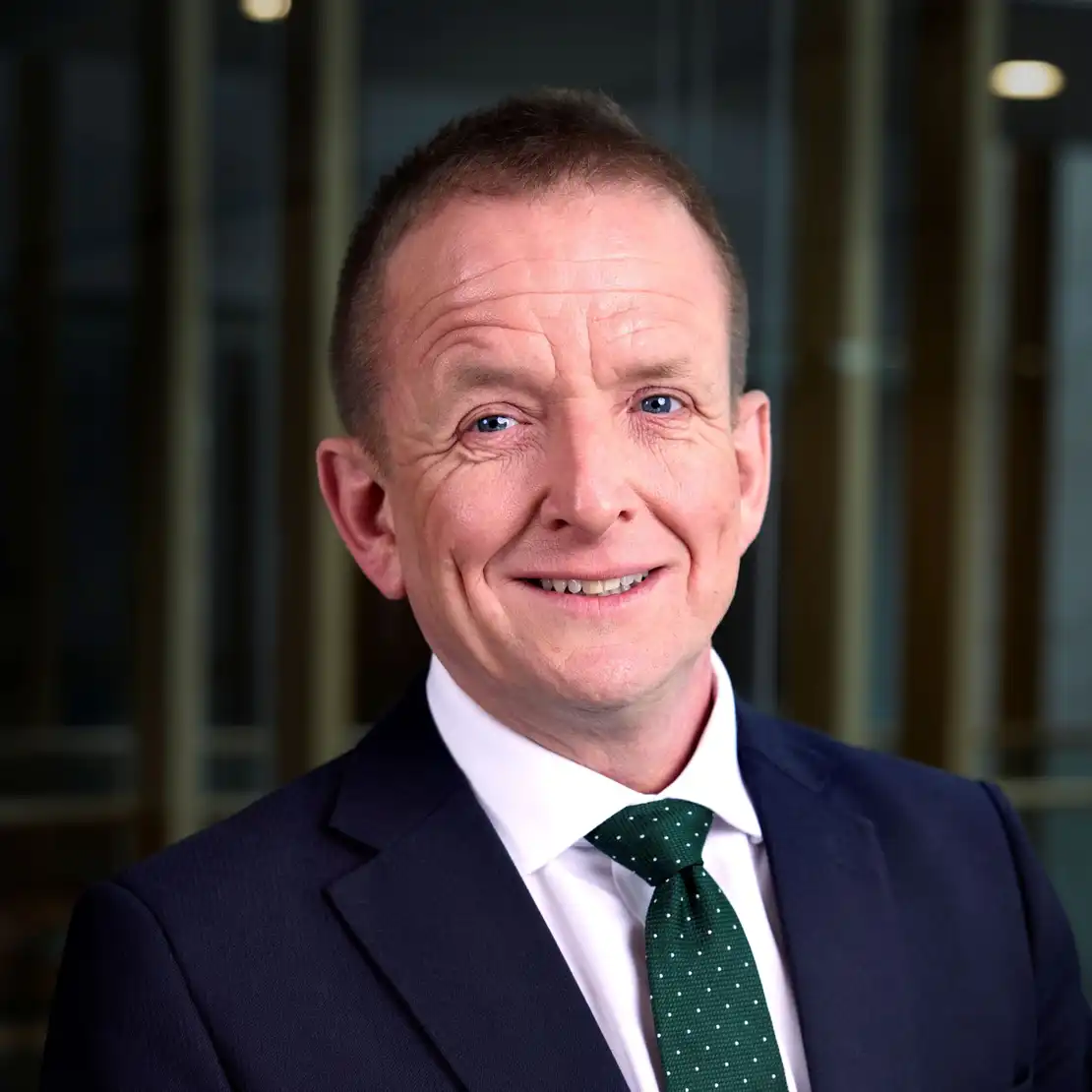
John Murton
Senior Sustainability Advisor and Head of Blended Finance Programmes
Are there examples where this approach is already being applied?
Yes. Recent transactions demonstrate how different forms of catalytic capital can work alongside commercial finance.
In The Bahamas debt-for-nature conversion , multilateral, philanthropic and private insurance partners combined within a layered guarantee structure that supported marine conservation outcomes while mobilising private capital.
In a separate carbon removals transaction, risks were carefully allocated across corporate offtakers, insurers and financiers, enabling financing without relying on a large traditional concessional funding component
What does this mean for policymakers, multilateral development banks and development financial institutions?
The key lesson is that the energy transition will require more than capital. It will require investable markets, innovative risk-sharing arrangements and stronger public-private collaboration.
The most effective blended finance structures of the future may not be those that provide the largest subsidy. They may be those that use limited concessional resources with the greatest precision, targeting specific barriers, attracting new forms of capital and creating the conditions for private investment to scale. That is ultimately how we build investable markets capable of supporting a pragmatic and inclusive transition.
This is where we see a significant opportunity: combining the private sector’s structuring expertise and scale of finance with targeted interventions from concessional capital from public and philanthropic sources and risk-sharing mechanisms needed to mobilise capital at scale across emerging markets and developing economies.
That is a conversation we are looking forward to continuing at the World Bank Group and IMF Annual Meetings, where we will be engaging with partners from across the development finance ecosystem on how innovative development finance can help create fiscal flexibility, crowd in private capital and realise the opportunities which climate transition and development represent in the markets we serve.
Overview of Blended Finance Programmes at Standard Chartered
The Blended Finance Programmes team at Standard Chartered develops and delivers innovative financing solutions that combine concessional, philanthropic, and commercial capital to mobilise private investment into emerging markets. Working with development finance institutions, governments, foundations and investors, the team helps de-risk transactions, close funding gaps and scale investment in climate, infrastructure, and sustainable development projects. By structuring partnerships and pioneering new financing mechanisms, the team seeks to unlock capital at scale and accelerate progress towards sustainable development objectives across the Bank’s footprint markets. Please get in touch with us to discover how we can support your objectives today.
Share
(Opens in a new window) (Opens in a new window) (Opens in a new window) (Opens in a new window) (Opens in a new window)
Site footer
Footer Menu 0
Footer Menu 1
-
Manage cookies
Social Menu
© Standard Chartered 2026.
All Rights Reserved.
Cookie preferences
We care about your experience online, that’s why we use cookies to make sure our website runs smoothly while personalising your visit for your ease of use and convenience. To choose what cookies you want to accept, select “Manage Cookies”. To reject all cookies (except essential cookies), select “Accept essential cookies only”. To accept all cookies for the best possible experience, select “Accept all”. If you’d like to learn about how we use cookies and to manage your selection, visit ourcookie policy
Manage cookies Reject All Accept all
Cookie preferences
Tell us which cookie categories you consent to by using the sliders below. You can change your preferences any time by clicking the “Manage cookies” footer link on any page. To learn more, visit our cookie policy
Strictly necessary cookies (Always on)
Always Active
Your security and privacy are our top priority, that’s why these cookies are always on to ensure the safest and smoothest online experience.
Functionality cookies
Functionality cookies
For your ease of use and convenience, these cookies remember the choices you made (e.g. language and region) and personalise our website to make it most relevant for you.
Performance cookies
Performance cookies
To create the best and most relevant experience for you, these cookies help us analyse and understand what areas need to be improved and refined.
Advertising cookies
Advertising cookies
To make sure we only send what’s most relevant to your needs, these cookies help us and our partners understand what matters most to you. The data collected can be shared with third parties, such as advertisers or platforms, to create an ecosystem that is always relevant to you.
Back Button
Cookie List
Search Icon
Filter Icon
Clear
- checkbox label label
Apply Cancel
Consent Leg.Interest
checkbox label label
checkbox label label
checkbox label label
Confirm preferences
Defensive diversification – a bulwark against shifting sands
Bull 0
Bear 0
Other
With increased market volatility and two months before the year ends, defensive diversification is key to navigating the shifting sands of the macro landscape.
22 October 2026
23 mins
by:
Raymond Cheng Chief Investment Officer, North Asia
Wealth & retail banking Wealth insights

As we look back on Q3 2026, our H2 2026 Global Market Outlook _Navigating shifting sands(Opens in a new window) _ has proven to be more than just a metaphor. It has been the defining characteristic of the investment landscape.
The economic data released of late has indeed been highly volatile. The US non-farm payrolls missed estimates in June, only to surprise significantly to the upside in August. This whipsawing data completely reshaped market expectations, swinging the narrative from anticipated Fed rate cuts to renewed rate hikes. With volatility spiking and two months left in the year, the ability to maintain a diversified portfolio is no longer just a defensive strategy; it is the primary driver of long-term resilience. Below, we explore how defensive diversification can be implemented across gold, equities and bonds to tackle the macro headwinds.
The case for gold despite higher policy rates
Gold prices behaved differently in Q3 2026 compared with the earlier half of the year. Despite the Fed resuming rate hikes in September and the US 10-year government bond yield soaring over 80bps since June, gold prices rose 3.7% during the quarter. This is noteworthy because, in a high-rate environment, the opportunity cost of holding a non-yielding asset such as gold increases. Yet, gold even outperformed global equities, which saw the MSCI All Country World Index rise only 1.3% during the same period.
Why this revival in gold? The market is pricing in a new layer of risk: fiscal sustainability. Major Developed Markets, including the UK, the US, France and Japan, are carrying national debt loads at 100-250% of their respective GDP. This is exacerbated by rising policy rates and upside risks to inflation. Surging term premia led to gold exchange-traded fund net inflows across all regions during Q3 2026, with Europe contributing the most. This broad-based buying is layered on top of sustained structural buying by central banks, which added 170 tonnes year-to-August, according to the World Gold Council.
At this juncture, we see the strategic importance of holding gold at around 5% of a foundation portfolio. It serves as an effective hedge against fiscal, inflationary and geopolitical uncertainties that are becoming increasingly difficult to ignore.
The AI capex and equity dilemma
Moving to equities, rising policy rates are fuelling funding concerns regarding AI capital expenditure (capex). We saw this clearly in South Korea, where the KOSPI Index experienced a roller coaster ride. It climbed 68% in Q2 2026 before subsequently plunging 30%. This illustrates a rapid shift in risk appetite. With the S&P500 volatility index (VIX) on the rise, it is prudent to reduce exposure to high-beta, high-geared equities.
While near-term caution is necessary, we remain constructive on AI capex over the long term. To balance growth potential with volatility, a defensive strategy involves diversifying equity exposure into quality dividend stocks. Historically, dividend equities have exhibited lower volatility than the MSCI All Country World Index, providing much-needed resilience. We see value in Hong Kong-listed high-dividend H-shares, particularly in the banking, energy and telecom sectors, as they generate attractive dividend yields of 5% or above.
Fixed income and the flight to safety
Among the major asset classes, fixed income has experienced the greatest volatility so far this year. The MOVE Index – a measure of US government bond yield volatility – skyrocketed 50% in Q3 2026 to 110. Moreover, the hot September US consumer inflation print initially pushed the US 10-year government bond yield past the 24-year high of 5.3%, before it swiftly retreated to around 5.1% despite a higher producer price inflation print. This pullback reflected growth fears and a notable flight to safety driven by the tech rout and a rotation out of equities.
In the current environment, we favour US Treasury Inflation-Protected Securities (TIPS) to fend off inflation, while locking in elevated yields through a preferred bond duration of 3-7 years.
The path forward amid a volatile landscape
Beyond the twin pressures of stubborn inflation and persistent Middle East tensions, a dangerous spillover of fiscal and political volatility is gaining ground. With instability rising in Europe and the VIX creeping higher ahead of the US midterm elections in November, we are operating in an environment where macroeconomic risks are flaring up across multiple fronts.
In such times, a defensive asset allocation acts as our primary bulwark. By maintaining a diversified portfolio with a defensive tilt towards gold, quality dividend equities and short-to-medium maturity bonds, we believe investors can better safeguard their long-term returns and navigate the shifting sands of the global economy.
Disclaimers
This document is confidential and may also be privileged. If you are not the intended recipient, please destroy all copies and notify the sender immediately. This document is being distributed for general information only and is subject to the relevant disclaimers available at our Standard Chartered website under Regulatory disclosures. It is not and does not constitute research material, independent research, an offer, recommendation or solicitation to enter into any transaction or adopt any hedging, trading or investment strategy, in relation to any securities or other financial instruments. This document is for general evaluation only. It does not take into account the specific investment objectives, financial situation or particular needs of any particular person or class of persons and it has not been prepared for any particular person or class of persons. You should not rely on any contents of this document in making any investment decisions. Before making any investment, you should carefully read the relevant offering documents and seek independent legal, tax and regulatory advice. In particular, we recommend you to seek advice regarding the suitability of the investment product, taking into account your specific investment objectives, financial situation or particular needs, before you make a commitment to purchase the investment product. Opinions, projections and estimates are solely those of SCB at the date of this document and subject to change without notice. Past performance is not indicative of future results and no representation or warranty is made regarding future performance. Any forecast contained herein as to likely future movements in rates or prices or likely future events or occurrences constitutes an opinion only and is not indicative of actual future movements in rates or prices or actual future events or occurrences (as the case may be). This document must not be forwarded or otherwise made available to any other person without the express written consent of the Standard Chartered Group (as defined below). Standard Chartered Bank is incorporated in England with limited liability by Royal Charter 1853 Reference Number ZC18. The Principal Office of the Company is situated in England at 1 Basinghall Avenue, London, EC2V 5DD. Standard Chartered Bank is authorised by the Prudential Regulation Authority and regulated by the Financial Conduct Authority and Prudential Regulation Authority. Standard Chartered PLC, the ultimate parent company of Standard Chartered Bank, together with its subsidiaries and affiliates (including each branch or representative office), form the Standard Chartered Group. Standard Chartered Private Bank is the private banking division of Standard Chartered. Private banking activities may be carried out internationally by different legal entities and affiliates within the Standard Chartered Group (each an “SC Group Entity”) according to local regulatory requirements. Not all products and services are provided by all branches, subsidiaries and affiliates within the Standard Chartered Group. Some of the SC Group Entities only act as representatives of Standard Chartered Private Bank and may not be able to offer products and services or offer advice to clients. ESG data has been provided by Morningstar and Sustainalytics. Refer to the Morningstar website under Sustainable Investing and the Sustainalytics website under ESG Risk Ratings for more information. The information is as at the date of publication based on data provided and may be subject to change.
Copyright © 2023, Accounting Research & Analytics, LLC d/b/a CFRA (and its affiliates, as applicable). Reproduction of content provided by CFRA in any form is prohibited except with the prior written permission of CFRA. CFRA content is not investment advice and a reference to or observation concerning a security or investment provided in the CFRA SERVICES is not a recommendation to buy, sell or hold such investment or security or make any other investment decisions. The CFRA content contains opinions of CFRA based upon publicly-available information that CFRA believes to be reliable and the opinions are subject to change without notice. This analysis has not been submitted to, nor received approval from, the United States Securities and Exchange Commission or any other regulatory body. While CFRA exercised due care in compiling this analysis, CFRA, ITS THIRD-PARTY SUPPLIERS, AND ALL RELATED ENTITIES SPECIFICALLY DISCLAIM ALL WARRANTIES, EXPRESS OR IMPLIED, INCLUDING, BUT NOT LIMITED TO, ANY WARRANTIES OF MERCHANTABILITY OR FITNESS FOR A PARTICULAR PURPOSE OR USE, to the full extent permitted by law, regarding the accuracy, completeness, or usefulness of this information and assumes no liability with respect to the consequences of relying on this information for investment or other purposes. No content provided by CFRA (including ratings, credit-related analyses and data, valuations, model, software or other application or output therefrom) or any part thereof may be modified, reverse engineered, reproduced or distributed in any form by any means, or stored in a database or retrieval system, without the prior written permission of CFRA, and such content shall not be used for any unlawful or unauthorized purposes. CFRA and any third-party providers, as well as their directors, officers, shareholders, employees or agents do not guarantee the accuracy, completeness, timeliness or availability of such content. In no event shall CFRA, its affiliates, or their third-party suppliers be liable for any direct, indirect, special, or consequential damages, costs, expenses, legal fees, or losses (including lost income or lost profit and opportunity costs) in connection with a subscriber’s, subscriber’s customer’s, or other’s use of CFRA’s content.
Market Abuse Regulation (MAR) Disclaimer
Banking activities may be carried out internationally by different branches, subsidiaries and affiliates within the Standard Chartered Group according to local regulatory requirements. Opinions may contain outright “buy”, “sell”, “hold” or other opinions. The time horizon of this opinion is dependent on prevailing market conditions and there is no planned frequency for updates to the opinion. This opinion is not independent of Standard Chartered Group’s trading strategies or positions. Standard Chartered Group and/or its affiliates or its respective officers, directors, employee benefit programmes or employees, including persons involved in the preparation or issuance of this document may at any time, to the extent permitted by applicable law and/or regulation, be long or short any securities or financial instruments referred to in this document or have material interest in any such securities or related investments. Therefore, it is possible, and you should assume, that Standard Chartered Group has a material interest in one or more of the financial instruments mentioned herein. Please refer to our Standard Chartered website under Regulatory disclosures for more detailed disclosures, including past opinions/ recommendations in the last 12 months and conflict of interests, as well as disclaimers. A covering strategist may have a financial interest in the debt or equity securities of this company/issuer. This document must not be forwarded or otherwise made available to any other person without the express written consent of Standard Chartered Group.
Country/Market Specific Disclosures
Botswana: This document is being distributed in Botswana by, and is attributable to, Standard Chartered Bank Botswana Limited which is a financial institution licensed under the Section 6 of the Banking Act CAP 46.04 and is listed in the Botswana Stock Exchange.
Brunei Darussalam: This document is being distributed in Brunei Darussalam by, and is attributable to, Standard Chartered Bank (Brunei Branch) | Registration Number RFC/61 and Standard Chartered Securities (B) Sdn Bhd | Registration Number RC20001003. Standard Chartered Bank is incorporated in England with limited liability by Royal Charter 1853 Reference Number ZC18 and Standard Chartered Securities (B) Sdn Bhd, which is a limited liability company registered with the Registry of Companies with Registration Number RC20001003 and licensed by Brunei Darussalam Central Bank as a Capital Markets Service License Holder with License Number AMBD/R/CMU/S3-CL and authorised to conduct Islamic investment business through an Islamic window.
China Mainland: This document is being distributed in China by, and is attributable to, Standard Chartered Bank (China) Limited which is mainly regulated by China Banking and Insurance Regulatory Commission (CBIRC), State Administration of Foreign Exchange (SAFE), and People’s Bank of China (PBOC).
Hong Kong: In Hong Kong, this document, except for any portion advising on or facilitating any decision on futures contracts trading, is distributed by Standard Chartered Bank (Hong Kong) Limited (“SCBHK”), a subsidiary of Standard Chartered PLC. SCBHK has its registered address at 32/F, Standard Chartered Bank Building, 4-4A Des Voeux Road Central, Hong Kong and is regulated by the Hong Kong Monetary Authority and registered with the Securities and Futures Commission (“SFC”) to carry on Type 1 (dealing in securities), Type 4 (advising on securities), Type 6 (advising on corporate finance) and Type 9 (asset management) regulated activity under the Securities and Futures Ordinance (Cap. 571) (“SFO”) (CE No. AJI614). The contents of this document have not been reviewed by any regulatory authority in Hong Kong and you are advised to exercise caution in relation to any offer set out herein. If you are in doubt about any of the contents of this document, you should obtain independent professional advice. Any product named herein may not be offered or sold in Hong Kong by means of any document at any time other than to “professional investors” as defined in the SFO and any rules made under that ordinance. In addition, this document may not be issued or possessed for the purposes of issue, whether in Hong Kong or elsewhere, and any interests may not be disposed of, to any person unless such person is outside Hong Kong or is a “professional investor” as defined in the SFO and any rules made under that ordinance, or as otherwise may be permitted by that ordinance. In Hong Kong, Standard Chartered Private Bank is the private banking division of Standard Chartered Bank (Hong Kong) Limited, a subsidiary of Standard Chartered PLC.
Ghana: Standard Chartered Bank Ghana Limited accepts no liability and will not be liable for any loss or damage arising directly or indirectly (including special, incidental or consequential loss or damage) from your use of these documents. Past performance is not indicative of future results and no representation or warranty is made regarding future performance. You should seek advice from a financial adviser on the suitability of an investment for you, taking into account these factors before making a commitment to invest in an investment. To unsubscribe from receiving further updates, please send an email to [email protected]. Please do not reply to this email. Call our Priority Banking on 0302610750 for any questions or service queries. You are advised not to send any confidential and/or important information to the Bank via e-mail, as the Bank makes no representations or warranties as to the security or accuracy of any information transmitted via e-mail. The Bank shall not be responsible for any loss or damage suffered by you arising from your decision to use e-mail to communicate with the Bank.
India: This document is being distributed in India by Standard Chartered Bank in its capacity as a distributor of mutual funds and referrer of any other third party financial products. Standard Chartered Bank does not offer any ‘Investment Advice’ as defined in the Securities and Exchange Board of India (Investment Advisers) Regulations, 2013 or otherwise. Services/products related securities business offered by Standard Charted Bank are not intended for any person, who is a resident of any jurisdiction, the laws of which imposes prohibition on soliciting the securities business in that jurisdiction without going through the registration requirements and/or prohibit the use of any information contained in this document.
Indonesia: This document is being distributed in Indonesia by Standard Chartered Bank, Indonesia branch, which is a financial institution licensed, registered and supervised by Otoritas Jasa Keuangan (Financial Service Authority).
Jersey: In Jersey, Standard Chartered Private Bank is the Registered Business Name of the Jersey Branch of Standard Chartered Bank. The Jersey Branch of Standard Chartered Bank is regulated by the Jersey Financial Services Commission. Copies of the latest audited accounts of Standard Chartered Bank are available from its principal place of business in Jersey: PO Box 80, 15 Castle Street, St Helier, Jersey JE4 8PT. Standard Chartered Bank is incorporated in England with limited liability by Royal Charter in 1853 Reference Number ZC 18. The Principal Office of the Company is situated in England at 1 Basinghall Avenue, London, EC2V 5DD. Standard Chartered Bank is authorised by the Prudential Regulation Authority and regulated by the Financial Conduct Authority and Prudential Regulation Authority. The Jersey Branch of Standard Chartered Bank is also an authorised financial services provider under license number 44946 issued by the Financial Sector Conduct Authority of the Republic of South Africa. Jersey is not part of the United Kingdom and all business transacted with Standard Chartered Bank, Jersey Branch and other SC Group Entity outside of the United Kingdom, are not subject to some or any of the investor protection and compensation schemes available under United Kingdom law.
Kenya: This document is being distributed in Kenya by, and is attributable to Standard Chartered Bank Kenya Limited. Investment Products and Services are distributed by Standard Chartered Investment Services Limited, a wholly owned subsidiary of Standard Chartered Bank Kenya Limited (Standard Chartered Bank/the Bank) that is licensed by the Capital Markets Authority as a Fund Manager. Standard Chartered Bank Kenya Limited is regulated by the Central Bank of Kenya.
Malaysia: This document is being distributed in Malaysia by Standard Chartered Bank Malaysia Berhad. Recipients in Malaysia should contact Standard Chartered Bank Malaysia Berhad in relation to any matters arising from, or in connection with, this document.
Nigeria: This document is being distributed in Nigeria by Standard Chartered Bank Nigeria Limited (“the Bank”), a bank duly licensed and regulated by the Central Bank of Nigeria. The Bank accepts no liability for any loss or damage arising directly or indirectly (including special, incidental or consequential loss or damage) from your use of these documents. You should seek advice from a financial adviser on the suitability of an investment for you, taking into account these factors before making a commitment to invest in an investment. To unsubscribe from receiving further updates, please send an email to [email protected] requesting to be removed from our mailing list. Please do not reply to this email. Call our Priority Banking on 01-2772514 for any questions or service queries. The Bank shall not be responsible for any loss or damage arising from your decision to send confidential and/or important information to the Bank via e-mail, as the Bank makes no representations or warranties as to the security or accuracy of any information transmitted via e-mail.
Pakistan: This document is being distributed in Pakistan by, and attributable to Standard Chartered Bank (Pakistan) Limited having its registered office at PO Box 5556, I.I Chundrigar Road Karachi, which is a banking company registered with State Bank of Pakistan under Banking Companies Ordinance 1962 and is also having licensed issued by Securities & Exchange Commission of Pakistan for Security Advisors. Standard Chartered Bank (Pakistan) Limited acts as a distributor of mutual funds and referrer of other third-party financial products.
Singapore: This document is being distributed in Singapore by, and is attributable to, Standard Chartered Bank (Singapore) Limited (Registration No. 201224747C/ GST Group Registration No. MR-8500053-0, “SCBSL”). Recipients in Singapore should contact SCBSL in relation to any matters arising from, or in connection with, this document. SCBSL is an indirect wholly owned subsidiary of Standard Chartered Bank and is licensed to conduct banking business in Singapore under the Singapore Banking Act, 1970. Standard Chartered Private Bank is the private banking division of SCBSL. IN RELATION TO ANY SECURITY OR SECURITIES-BASED DERIVATIVES CONTRACT REFERRED TO IN THIS DOCUMENT, THIS DOCUMENT, TOGETHER WITH THE ISSUER DOCUMENTATION, SHALL BE DEEMED AN INFORMATION MEMORANDUM (AS DEFINED IN SECTION 275 OF THE SECURITIES AND FUTURES ACT, 2001 (“SFA”)). THIS DOCUMENT IS INTENDED FOR DISTRIBUTION TO ACCREDITED INVESTORS, AS DEFINED IN SECTION 4A(1)(a) OF THE SFA, OR ON THE BASIS THAT THE SECURITY OR SECURITIES-BASED DERIVATIVES CONTRACT MAY ONLY BE ACQUIRED AT A CONSIDERATION OF NOT LESS THAN S$200,000 (OR ITS EQUIVALENT IN A FOREIGN CURRENCY) FOR EACH TRANSACTION. Further, in relation to any security or securities-based derivatives contract, neither this document nor the Issuer Documentation has been registered as a prospectus with the Monetary Authority of Singapore under the SFA. Accordingly, this document and any other document or material in connection with the offer or sale, or invitation for subscription or purchase, of the product may not be circulated or distributed, nor may the product be offered or sold, or be made the subject of an invitation for subscription or purchase, whether directly or indirectly, to persons other than a relevant person pursuant to section 275(1) of the SFA, or any person pursuant to section 275(1A) of the SFA, and in accordance with the conditions specified in section 275 of the SFA, or pursuant to, and in accordance with the conditions of, any other applicable provision of the SFA. In relation to any collective investment schemes referred to in this document, this document is for general information purposes only and is not an offering document or prospectus (as defined in the SFA). This document is not, nor is it intended to be (i) an offer or solicitation of an offer to buy or sell any capital markets product; or (ii) an advertisement of an offer or intended offer of any capital markets product. Deposit Insurance Scheme: Singapore dollar deposits of non-bank depositors are insured by the Singapore Deposit Insurance Corporation, for up to S$75,000 in aggregate per depositor per Scheme member by law. Foreign currency deposits, dual currency investments, structured deposits and other investment products are not insured. This advertisement has not been reviewed by the Monetary Authority of Singapore.
Taiwan: Standard Chartered Bank (“SCB”) or Standard Chartered Bank (Taiwan) Limited (“SCB (Taiwan)”) may be involved in the financial instruments contained herein or other related financial instruments. The author of this document may have discussed the information contained herein with other employees or agents of SCB or SCB (Taiwan). The author and the above-mentioned employees of SCB or SCB (Taiwan) may have taken related actions in respect of the information involved (including communication with customers of SCB or SCB (Taiwan) as to the information contained herein). The opinions contained in this document may change, or differ from the opinions of employees of SCB or SCB (Taiwan). SCB and SCB (Taiwan) will not provide any notice of any changes to or differences between the above-mentioned opinions. This document may cover companies with which SCB or SCB (Taiwan) seeks to do business at times and issuers of financial instruments. Therefore, investors should understand that the information contained herein may serve as specific purposes as a result of conflict of interests of SCB or SCB (Taiwan). SCB, SCB (Taiwan), the employees (including those who have discussions with the author) or customers of SCB or SCB (Taiwan) may have an interest in the products, related financial instruments or related derivative financial products contained herein; invest in those products at various prices and on different market conditions; have different or conflicting interests in those products. The potential impacts include market makers’ related activities, such as dealing, investment, acting as agents, or performing financial or consulting services in relation to any of the products referred to in this document.
UAE: DIFC – Standard Chartered Bank is incorporated in England with limited liability by Royal Charter 1853 Reference Number ZC18.The Principal Office of the Company is situated in England at 1 Basinghall Avenue, London, EC2V 5DD. Standard Chartered Bank is authorised by the Prudential Regulation Authority and regulated by the Financial Conduct Authority and Prudential Regulation Authority. Standard Chartered Bank, Dubai International Financial Centre having its offices at Dubai International Financial Centre, Building 1, Gate Precinct, P.O. Box 999, Dubai, UAE is a branch of Standard Chartered Bank and is regulated by the Dubai Financial Services Authority (“DFSA”). This document is intended for use only by Professional Clients and is not directed at Retail Clients as defined by the DFSA Rulebook. In the DIFC we are authorised to provide financial services only to clients who qualify as Professional Clients and Market Counterparties and not to Retail Clients. As a Professional Client you will not be given the higher retail client protection and compensation rights and if you use your right to be classified as a Retail Client we will be unable to provide financial services and products to you as we do not hold the required license to undertake such activities. For Islamic transactions, we are acting under the supervision of our Shariah Supervisory Committee. Relevant information on our Shariah Supervisory Committee is currently available on the Standard Chartered Bank website in the Islamic banking section For residents of the UAE – Standard Chartered Bank UAE does not provide financial analysis or consultation services in or into the UAE within the meaning of UAE Securities and Commodities Authority Decision No. 48/r of 2008 concerning financial consultation and financial analysis.
Uganda: Our Investment products and services are distributed by Standard Chartered Bank Uganda Limited, which is licensed by the Capital Markets Authority as an investment adviser.
United Kingdom: Standard Chartered Bank is incorporated in England with limited liability by Royal Charter 1853 Reference Number ZC18. The Principal Office of the Company is situated in England at 1 Basinghall Avenue, London, EC2V 5DD. Standard Chartered Bank is authorised by the Prudential Regulation Authority and regulated by the Financial Conduct Authority and Prudential Regulation Authority. Standard Chartered Bank (trading as Standard Chartered Private Bank) is an authorised financial services provider (license number 45747) in terms of the South African Financial Advisory and Intermediary Services Act, 2002.
Vietnam: This document is being distributed in Vietnam by, and is attributable to, Standard Chartered Bank (Vietnam) Limited which is mainly regulated by State Bank of Vietnam (SBV). Recipients in Vietnam should contact Standard Chartered Bank (Vietnam) Limited for any queries regarding any content of this document.
Zambia: This document is distributed by Standard Chartered Bank Zambia Plc, a company incorporated in Zambia and registered as a commercial bank and licensed by the Bank of Zambia under the Banking and Financial Services Act Chapter 387 of the Laws of Zambia.
Share
(Opens in a new window) (Opens in a new window) (Opens in a new window) (Opens in a new window) (Opens in a new window)
Explore more wealth insights
The key to investing: Balancing attack and defence
For wealth builders, the equivalent to staying in the game is staying invested. This, above all else, distinguis…
29 Oct 2026
Higher bond yields are good for banks, right?
15 Oct 2026
The Formula 1® mindset that can help investors go further
08 Oct 2026
Supporting you at every step
In Asia, the Middle East, Africa and Europe
Site footer
Footer Menu 0
Footer Menu 1
-
Manage cookies
Social Menu
© Standard Chartered 2026.
All Rights Reserved.
Cookie preferences
We care about your experience online, that’s why we use cookies to make sure our website runs smoothly while personalising your visit for your ease of use and convenience. To choose what cookies you want to accept, select “Manage Cookies”. To reject all cookies (except essential cookies), select “Accept essential cookies only”. To accept all cookies for the best possible experience, select “Accept all”. If you’d like to learn about how we use cookies and to manage your selection, visit ourcookie policy
Manage cookies Reject All Accept all
Cookie preferences
Tell us which cookie categories you consent to by using the sliders below. You can change your preferences any time by clicking the “Manage cookies” footer link on any page. To learn more, visit our cookie policy
Strictly necessary cookies (Always on)
Always Active
Your security and privacy are our top priority, that’s why these cookies are always on to ensure the safest and smoothest online experience.
Functionality cookies
Functionality cookies
For your ease of use and convenience, these cookies remember the choices you made (e.g. language and region) and personalise our website to make it most relevant for you.
Performance cookies
Performance cookies
To create the best and most relevant experience for you, these cookies help us analyse and understand what areas need to be improved and refined.
Advertising cookies
Advertising cookies
To make sure we only send what’s most relevant to your needs, these cookies help us and our partners understand what matters most to you. The data collected can be shared with third parties, such as advertisers or platforms, to create an ecosystem that is always relevant to you.
Back Button
Cookie List
Search Icon
Filter Icon
Clear
- checkbox label label
Apply Cancel
Consent Leg.Interest
checkbox label label
checkbox label label
checkbox label label
Confirm preferences
Rethinking controls for institutional stablecoin adoption
Bull 1
Bear 0
Other
Standard Chartered’s Minli Ng on building stablecoin controls around use cases, risk context and governance.
21 October 2026
7 mins
Corporate & investment banking Digital solutions Transaction banking

Share
(Opens in a new window) (Opens in a new window) (Opens in a new window) (Opens in a new window) (Opens in a new window)
In this article:
1
. Stablecoins in two worlds
2
. Use-based compliance
3
. Why risk context matters
4
. Banking stablecoin-enabled flows
5
. Five actions for adoption
6
. What leaders should ask before adopting stablecoins
The industry has spent years asking: “What transaction monitoring and screening controls should we implement for stablecoins?”
The question should be: “What customer problem are we solving, and what controls are proportionate to that use case?”
As stablecoins move from experimentation to real-world payments, liquidity and treasury workflows, the challenge is determining what trust frameworks are needed to support these use cases at institutional scale. This matters because compliance is increasingly being designed around the technology rather than the economic purpose of the activity. Although regimes differ by jurisdiction, leading regulatory frameworks from the Financial Action Task Force (FATF), Monetary Authority of Singapore (MAS), Hong Kong Monetary Authority (HKMA) and Prudential Regulation Authority (PRA) increasingly combine risk-based financial crime controls with broader expectations for stablecoin issuance and operation. That means understanding the use of the product before determining the controls that govern it.
In short, controls do not define the use case. Use informs risk. Risk informs controls.
Stablecoins sit in two worlds
One of the biggest challenges facing the industry is that stablecoins currently sit in two worlds.They are marketed as digital cash and payment instruments, yet much of today’s activity still resembles asset trading behaviour.
From a compliance perspective, the distinction matters enormously.
A corporate using stablecoins to settle a commodity purchase with a supplier in an emerging market presents a fundamentally different risk profile from a customer actively moving funds between exchanges for investment purposes. A stablecoin used for treasury purposes creates different trust and control requirements from one used for investment activity. Activity linked to investment or digital asset markets may require additional confidence in counterparty transparency, source of funds and settlement arrangements.
The technology may be identical. The customer objective is not. The compliance response should therefore also not be.
Introducing “Use-Based Compliance” – purpose informs controls
A useful principle for the industry is what might be called Use-Based Compliance. The starting point is understanding why the customer is using stablecoins. For example:
- Cross-border B2B payments
- Treasury liquidity movement
- Merchant settlements
- Platform payouts
- Remittances
- Settlement of tokenised assets
- Investment and trading activity
- Wider digital asset market participation
Each use case creates different risks and trust requirements. Each should therefore generate different monitoring scenarios, screening expectations and governance requirements. The mistake is applying the same surveillance framework to every stablecoin transaction irrespective of its underlying economic purpose, the parties involved or the workflows it supports.
Use-based compliance does not mean applying fewer controls. Nor does it displace baseline requirements for issuer, reserve, redemption, custody, network and jurisdictional risk; it determines how those risks should be weighted and controlled for a specific customer journey.
Minli Ng
Executive Director, CFCR, Cash, Transaction Services

Minli also highlighted that it means applying controls that are relevant and proportionate to the activity being undertaken.
Where the operating model and corridor economics support them, the benefits are:
- For FIs: new payment, liquidity, custody and settlement propositions; deeper client relationships; improved relevance in digital ecosystems; and a stronger position as value moves across traditional and on-chain networks.
- For customers: faster availability of funds, extended-hour settlement, greater transaction visibility, more flexible cross-border liquidity and access through a trusted institutional relationship.
Use-Based Compliance starts with understanding the customer’s objective. As the examples below show, different stablecoin-enabled activities require different approaches to risk assessment, monitoring and governance.
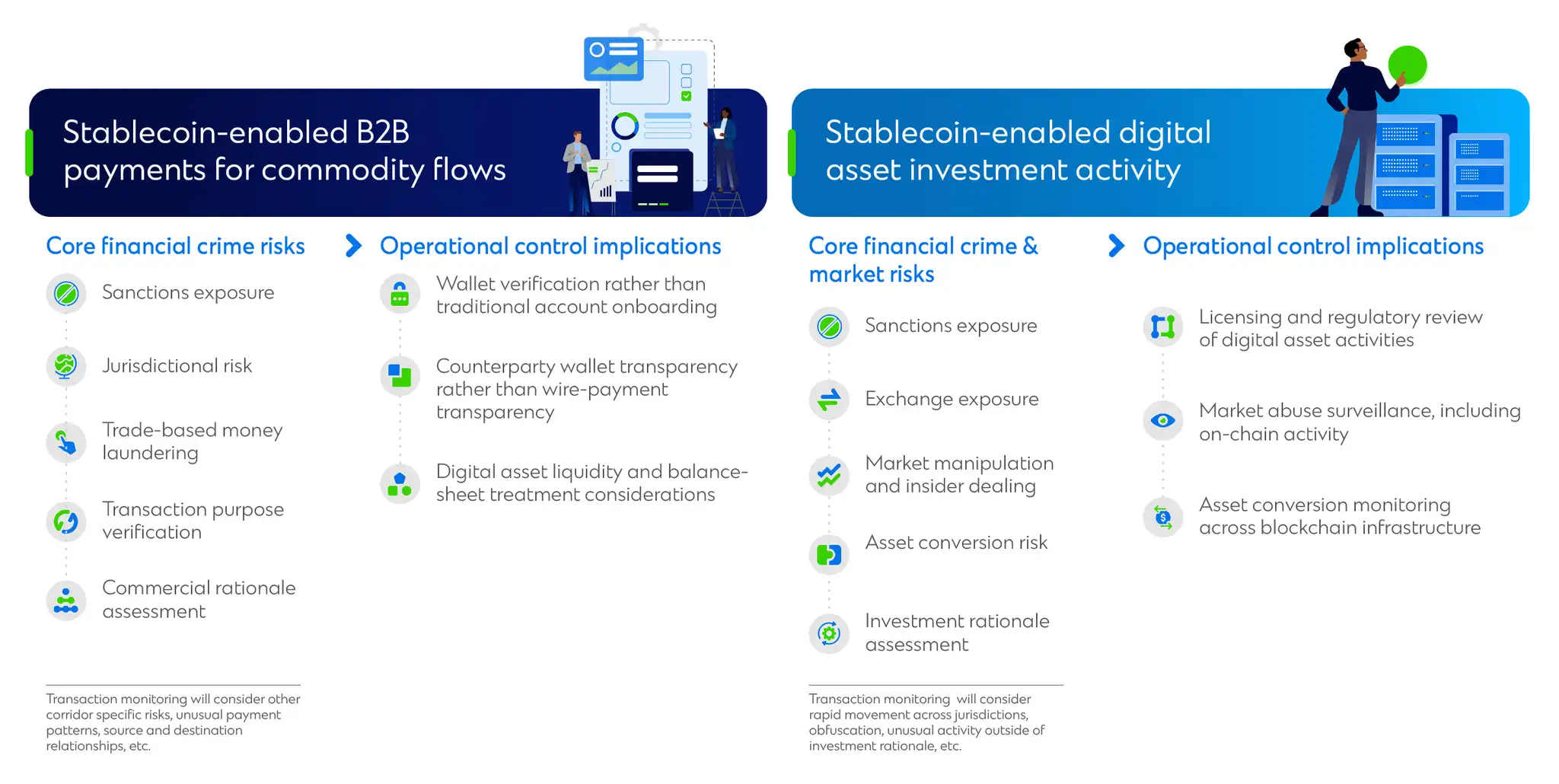
Comparison of control considerations for stablecoin-enabled B2B payments and digital asset investment activities.
The stablecoin is just one part of the risk. The customer’s use of the stablecoin – parties, wallet, model, jurisdiction and transaction behaviour – determines the control implications.
Why risk context matters
Too many institutions start by asking what blockchain monitoring tools can detect. This often results in controls being driven by available technology rather than actual financial crime risk. Use-based compliance should sit within a broader adoption assessment covering the token issuer, reserves, redemption rights, wallet and custody model, network, jurisdiction, counterparties and end-to-end operating resilience.
Transaction monitoring should begin with a the more meaningful question: “What abuse typologies are possible within this product and use case?” Only then should banks determine: Monitoring scenarios; Alert thresholds; Screening requirements; Escalation processes; Investigation workflows.
A stablecoin payment carrying genuine commercial value between two known corporate customers should not necessarily be monitored in the same manner as activity involving multiple self-hosted wallets, exchanges and rapid movement of assets across chains. Risk is contextual. Trust requirements and monitoring should be contextual as well.
For FI leaders, this is also a strategic choice. A differentiated control model can expand the range of customers and corridors an institution can support, shorten the path from pilot to production and protect the client relationship as value moves across traditional and tokenised networks. A blanket approach risks either blocking viable business or accepting risk without sufficient context.
Bringing stablecoin-enabled flows into the banking framework
For banks the strategic opportunity is broader than offering a replication of crypto-native activity. It is to support stablecoin-enabled payments, liquidity and settlement through a governed institutional framework.
Banks already bring established capabilities in customer due diligence, payment controls, governance and accountability, risk management, operational resilience and regulatory oversight. The future winners will not be those who build the largest stablecoin capability. They will be those who most effectively combine stablecoin utility with bank-grade trust and control frameworks designed around genuine payment use cases. That genuinely addresses the clients’ needs.
The future is use-led risk management
As stablecoins mature, regulatory expectations are likely to assess both economic activity and design of stablecoin arrangement.
The key question will not be whether a transaction happened on-chain. But what was the transaction trying to achieve?
Minli Ng
Executive Director, CFCR, Cash, Transaction Services
Once that answer is understood, the appropriate compliance controls become clearer.
Stablecoins should therefore be viewed first as products serving customer use cases, and only second as pieces of technology. The institutions that succeed will be those that design compliance around customer intent, commercial purpose and real-world risk – rather than allowing surveillance tooling to dictate product design.
Governance is the enabling layer. The various stablecoin use cases now represent genuine institutional opportunity. None of them can be executed at institutional scale without governance frameworks designed specifically for digital settlement and built for the characteristics of the underlying stablecoin use.
Good compliance should work like a seatbelt: embedded from the outset, proportionate to the journey and enabling confident progress. Leading institutions will identify where digital assets create genuine customer value, build effective controls and evidence their scalability. FI leaders should now prioritise use cases, assign executive ownership and test controls in practice.
Five actions for stablecoin-enabled services
Banks considering stablecoin-enabled services should take five practical steps:
- Prioritise the customer problem, not the technology: Identify a use case with measurable customer and franchise value.
- Select the best form of digital money: Compare stablecoins with tokenised deposits and existing payment rails.
- Map end-to-end risk: Different activities such as payments, treasury, settlement and investment create different risk profiles and control requirements. Identify the financial crime risks that could arise from each use case. Assess product, client, corridor, wallet, issuer, network and operating-model risks.
- Design and evidence the controls around the activity, not the asset or the available surveillance technology: Define ownership, approvals, limits, monitoring, escalation, testing and management information.
- Pilot, learn, scale: Use institutional-grade control frameworks that can support payments, settlement and treasury activity as adoption expands beyond crypto-native markets. Begin with bounded corridors and customer segments, measure commercial and control outcomes, and expand only when effectiveness is proven.
What leaders should ask before adopting stablecoins?
Strategy
Where does the use case create measurable customer and franchise value, and is a stablecoin superior to existing rails or tokenised deposits?
Compliance and risk
What could go wrong across the customer, issuer, reserves, wallet, counterparties, network, jurisdictions and operating model?
Digital assets and product
What infrastructure, interoperability, liquidity, custody and integration are required to deliver the use case reliably at scale?

Related insights
Treasury’s future: mobility and liquidity
As digital money evolves, the priority is enabling liquidity to move seamlessly across borders, networks and mar…
13 Oct 2026
Stablecoins and the emergence of 24/7 capital markets
23 Sep 2026
Stablecoins: What corporates and FIs need to know
31 Aug 2026
Digital Assets
Unlock secure, scalable solutions to safekeep, trade and tokenise digital assets.
Site footer
Footer Menu 0
Footer Menu 1
-
Manage cookies
Social Menu
© Standard Chartered 2026.
All Rights Reserved.
Air India and Standard Chartered partner to launch travel and wealth proposition for Global Indians
Bull 1
Bear 0
Other
21 Oct 2026
|
5 mins
Press Releases Air India and Standard Chartered partner to launch travel and wealth proposition for Global Indians
Eligible Standard Chartered clients to receive Maharaja Club Gold or Silver status with premium travel benefits
Eligible Air India customers can access international banking and wealth management services
UAE – Air India and Standard Chartered (the “Bank”) today announced a first-of-its-kind partnership that combines Standard Chartered’s international banking and cross-border wealth capabilities with Air India’s premium Maharaja Club loyalty programme. The proposition, available in the coming weeks, is set to deliver travel privileges and access that meet the cross-border lifestyle and wealth needs of Global Indians.
Unlocking travel privileges with Maharaja Club
Standard Chartered will offer Air India’s Maharaja Club Gold or Silver status to eligible Affluent Global Indian clients in Singapore and the UAE. Air India Maharaja Club status offers exclusive travel benefits, including extra baggage allowance, priority check-in and boarding, airport lounge access, upgrade vouchers, and bonus Maharaja Points, with benefits varying incrementally from Silver to Gold tiers.
In particular, Maharaja Club Gold members also enjoy the benefits on eligible Air India journeys[1] , as well as Star Alliance Gold status, which provides access to over 1,000 airport lounges worldwide, priority airport services, and extra baggage benefits, and instant recognition around the world across 25 other Star Alliance member airlines in addition to Air India.
Managing cross-border financial needs
Air India customers who meet Standard Chartered’s eligibility criteria can access the Bank’s international banking and wealth management capabilities through its wealth centres in Singapore and the UAE. Customers would benefit from dedicated relationship management support, market outlook insights from the Bank’s Chief Investment Office, invitations to exclusive thought leadership events, and tailored wealth solutions designed to support their cross-border financial needs.
Rajesh Kannan, Head, Wealth and Retail Banking, UAE & Jersey, and Head, Global Indian Clients, Standard Chartered, said: “This partnership brings together two trusted heritage brands to create a distinctive proposition for Global Indians, whose lives, business and ambitions increasingly span borders. By combining Air India’s expanding global footprint with Standard Chartered’s international network and wealth capabilities, we are delivering exclusive multi-market travel benefits to our affluent clients while supporting their broader global lifestyle, business and wealth management needs.”
Nipun Aggarwal, Chief Commercial Officer, Air India, said: “As Air India continues its transformation into a world-class global airline, we are focused on deepening our engagement with the global Indian community. This partnership with Standard Chartered enables us to expand Maharaja Club across key international markets, offering customers immediate access to premium status, enhanced travel benefits and global recognition. Combined with Standard Chartered’s cross-border banking and wealth management expertise, the proposition supports the increasingly international lifestyles of our customers while strengthening their connection with Air India.”
With a simplified structure, a host of customer-friendly features, renamed tiers, and an updated identity, Maharaja Club has added millions of new members since the programme was redesigned in 2024. Maharaja Club members are now able to earn and redeem Maharaja Points on flights operated by Air India and Air India Express to and from 104 destinations across North America, Europe (including the UK), Australia, Middle East, Africa, Southeast Asia, South Asia, in addition 25 other Star Alliance member airlines. Maharaja Club’s partnerships with over 100 other brands across categories, including hospitality, retail, lifestyle and financial services, also enables members to earn Maharaja Points across a broad range of travel and everyday spends.
— ENDS —
Standard Chartered signs definitive agreements to acquire Zodia Custody
Bull 3
Bear 0
M&A
21 Oct 2026
|
4 mins
Press Releases Standard Chartered signs definitive agreements to acquire Zodia Custody
London – Following the acceptance of its non-binding offer to acquire Zodia Custody, Standard Chartered today announced that it has entered into definitive agreements to acquire Zodia Custody.
Subject to regulatory approvals and customary closing conditions, Standard Chartered I H Limited will acquire 100 per cent of Zodia Custody Limited, the parent company of Zodia Custody’s regulated operating entities in Singapore, Hong Kong, Australia, the United Arab Emirates and Luxembourg.
Post-completion, Zodia Custody’s regulated digital asset custody business will be integrated into Standard Chartered’s existing digital asset custody activities within Securities Services. The move will consolidate Standard Chartered’s digital asset custody businesses and will drive value by unlocking revenue synergies, further strengthening the Group’s digital asset capabilities and supporting its ambition to build a unified client offering that integrates both traditional and digital asset securities services for institutional clients, globally.
As part of the transaction, Zodia Custody will separate its digital asset software and professional services business and transfer the assets relating to that business to Zodia Solutions, an independent entity to be established under SC Ventures. Zodia Solutions will continue to provide bank-grade infrastructure to financial institutions, including Standard Chartered, as they launch and scale digital asset services. Zodia Solutions will be supported by a number of bank investors, including NAB Ventures Pty Limited, Northern Trust Corporation, SBI Ventures Asset Pte. Ltd, Q Studio Restricted Limited (Further Ventures), Emirates NBD Bank (P.J.S.C.), Zodia Investments Limited (Investcorp) and Zodia Holdings Limited (owned by SC Ventures).
Ying Ying Tan, Global Head of Securities Services and Digital Assets at Standard Chartered, said: “We continue to invest in our platform and expand our capabilities to meet the evolving needs of our clients. The acquisition of Zodia Custody further deepens our digital asset custody portfolio and reinforces our position as a leading provider of digital asset services globally. This is in line with our commitment to provide our clients with access to institutional-grade custody supported by the depth, breadth and global connectivity of an international cross-border bank.”
Richard Clark, Chief Executive Officer of Zodia Custody, said: “As institutional adoption of digital assets accelerates, custody is increasingly becoming part of the global banking landscape. Zodia Custody has built a strong business with the specialist expertise and capabilities to meet the needs of institutional clients. Bringing that expertise together with Standard Chartered’s global reach and established banking platform will strengthen its digital asset custody offering and provide institutions with greater access to trusted, regulated custody services worldwide.”
Craig Perrin, Chief Executive Officer of Zodia Solutions, said: “Financial institutions are moving beyond digital asset pilots towards operating services at scale. They need trusted technology partners with the expertise and infrastructure to support them. Zodia Solutions provides bank-grade technology that enables institutions to launch, operate and scale digital asset services.”
There is no expected disruption to clients as a result of the transaction. Existing Zodia Custody custody clients continue to be serviced as usual.
Transaction in own shares
Bull 1
Bear 0
Routine
Understanding risk in restrictive markets
Bull 0
Bear 0
Routine
Learn how to measure, monitor and mitigate risk to make informed investment decisions in restrictive markets.
20 October 2026
3 mins
Corporate & investment banking Capital structure and rating advisory Corporate strategy

Share
(Opens in a new window) (Opens in a new window) (Opens in a new window) (Opens in a new window) (Opens in a new window)
Restrictive markets can offer attractive opportunities, but they also require a more deliberate approach to capital allocation.
For some markets, direct investment is the right answer. Greater control, clearer economics and strategic importance may justify a larger capital commitment. In others, partnering with a local player can be more effective, providing local knowledge, regulatory familiarity, operating capability and an element of risk sharing.
The investment structure can be as important as the opportunity itself.
| Lower strategic importance | Higher strategic importance | |
| Lower country risk | Standard investment | Direct investment |
| Higher country risk | Higher return required | Structured approach: measure, monitor and mitigate |
Understanding country risk
Country risk, FX volatility, transfer restrictions, liquidity constraints and political uncertainty are often discussed qualitatively. A more robust approach is to quantify these risks and incorporate them directly into the cost of capital. Doing so provides a consistent basis for comparing opportunities across markets and assessing whether expected returns adequately compensate for the risks being taken.
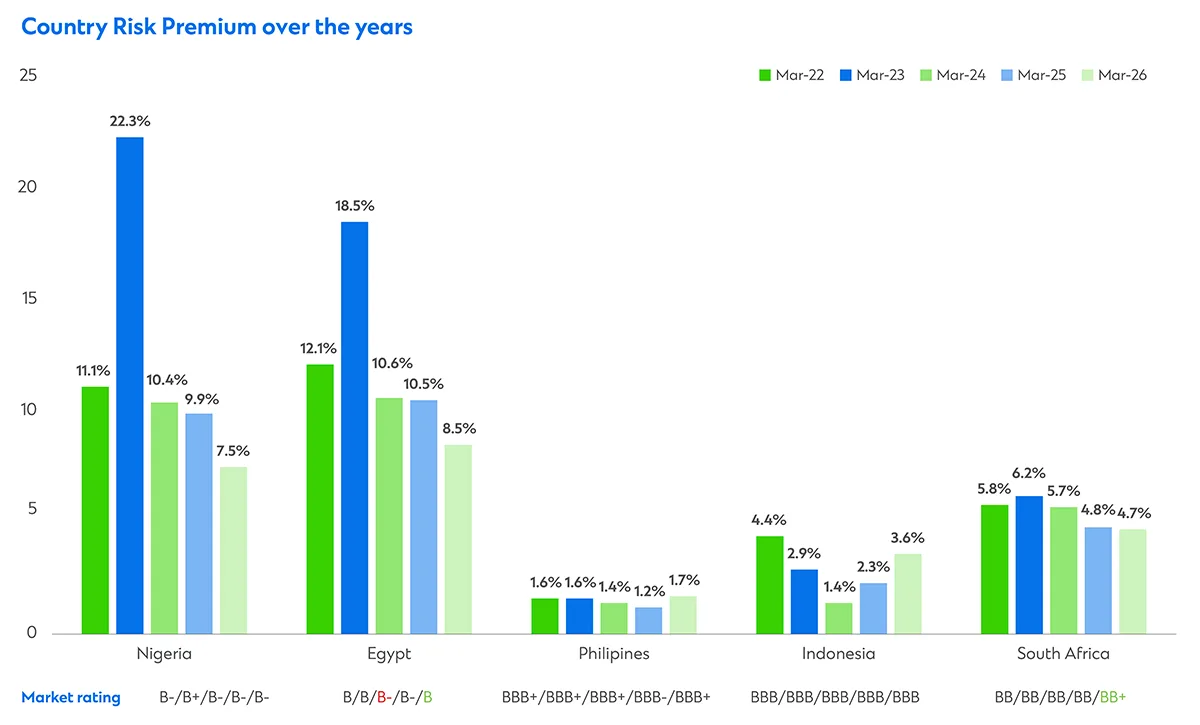
Source: Standard Chartered research
Once risks are identified, they can be monitored and, where appropriate, mitigated.
Market conditions rarely remain the same. Sovereign credit quality, exchange rates, external vulnerabilities and regulatory frameworks can change quickly. Companies entering restrictive markets should therefore treat risk management as an ongoing process rather than a one-off exercise. Early identification of changing conditions allows companies to reassess exposures before they become material.
Planning matters as much as analysis
Depending on the market, companies may need a toolkit spanning funding, liquidity, FX risk management and alternative investment structures. Higher risk does not necessarily make an investment unattractive. The question is whether the expected return adequately compensates for it.
Hedging solutions, funding diversification, local liquidity structures and alternative deployment models can all play an important role when conditions evolve.
| Measure | Monitor | Mitigate |
| Quantify country risk | Track changing conditions | Deploy funding and hedging tools |
| Incorporate into cost of capital | Monitor early warning indicators | Diversify funding |
| Assess investment structure | Reassess risk regularly | Adjust liquidity and plans |
Some of the most attractive opportunities may sit in restrictive markets. The question is whether they are properly reflected in expected returns, funding structures and ongoing monitoring.
Restrictive markets are home for Standard Chartered
For clients considering expansion into restrictive markets, Standard Chartered’s Capital Structure & Rating Advisory team can help assess market-specific risks before entry, understand their impact on cost of capital and evaluate different investment structures.
Combined with Standard Chartered’s local market presence, market-leading Global Research team, funding capabilities and risk management solutions, we can help clients understand markets before entry, transfer capital efficiently, implement mitigation frameworks and monitor changing conditions as they evolve.
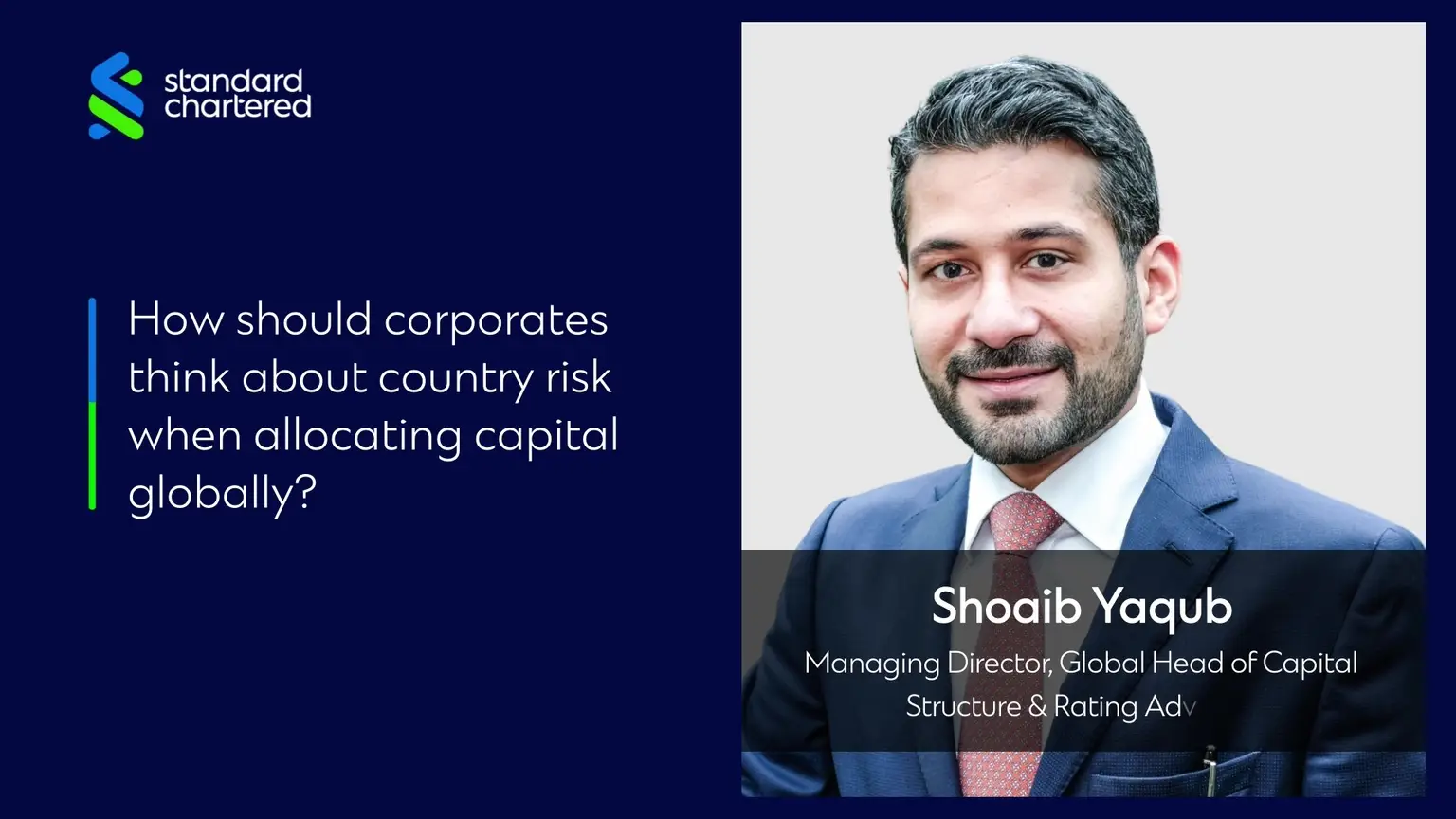
Related insights
The real estate reset: resilience, refinancing and returns
How real estate corporates can navigate refinancing pressures, strengthen capital structures and create value in…
30 Oct 2026
Turbulence ahead: Fuel shock deepens the returns challenge
14 Aug 2026
Airlines: Strong fundamentals, rising pressure from fuel cos…
24 Apr 2026
Capital Structure & Rating Advisory
Strategic financial policy advisory
Site footer
Footer Menu 0
Footer Menu 1
-
Manage cookies
Social Menu
© Standard Chartered 2026.
All Rights Reserved.
Higher bond yields are good for banks, right?
Bull 0
Bear 0
Other
Higher bond yields usually mean bigger bank profits, but recent market moves tell a different story. We see banks’ weakness as an investment opportunity.
15 October 2026
23 mins
by:
Fook Hien Yap Senior Investment Strategist
Wealth & retail banking Wealth insights

“Net, net, it’s a positive for us” – that is how one global bank CFO described the impact of higher interest rates on the bank’s earnings. The same CFO, and many others, would also quantify how sensitive the bank’s income is to a shift in interest rates or the yield curve to estimate the potential uplift in earnings.
In September 2026, the US 10-year government bond yield rose to a 19-year high, posting its sharpest monthly increase since September 2022. Given that rising bond yields typically boost bank income, the recent moves should have ideally provided a strong tailwind. However, instead of rising with the yields, the global financial sector, including banking stocks, came under pressure and underperformed global equities.
This apparent contradiction highlights a more complex story at play. While higher bond yields can support bank revenues, several competing factors also create downside risks. Let us first consider where banks stand to benefit.
The upside from higher bond yields
Higher yields primarily lift bank earnings through wider net interest margins (NIMs). Banks can earn more on each dollar lent, and floating-rate loans can reprice upward quickly. At the same time, sticky deposit bases allow banks to pass on rate rises to savers more slowly, so margins widen.
In addition, a positively sloped yield curve – where longer-dated loans carry higher interest rates than shorter-dated loans – allows banks to fund themselves with short-term liabilities, such as customer deposits, and lend over longer periods through products such as mortgages. When the interest earned on these loans exceeds the cost of funding them, banks earn the margin. Importantly, any steepening of the yield curve can further widen this margin.
On the other hand, higher bond yields can pose risks as well.
The downside from higher bond yields
The most immediate hit is to the value of the bonds held by banks. Banks often invest their excess liquidity in bonds, whose prices fall as yields rise. The resulting mark-to-market losses could weigh on some banks’ capital ratios. These losses remain unrealised until banks sell the bonds – which they might be forced to do if deposit withdrawals surge. The realisation of such losses risk triggering a need for fresh capital – or if capital cannot be raised, it threatens a bank’s viability. Notably, these very dynamics were cited as one of the causes of several US regional bank failures in 2023 – a stark reminder that, for banks, customer confidence is critical.
Higher interest rates also increase borrowers’ debt-servicing burden, which can raise loan-loss provisions and reduce banks’ earnings. Higher rates can also lead to slower economic activity, dampening capital market activity and the demand for loans. Lower loan volumes, in turn, create a drag on banks’ interest income. Finally, if short-term yields rise faster than long-term yields, the yield curve ‘flattens’, narrowing the margin banks earn from borrowing short-term and lending long-term.
The current regional outlook and investment implications
With US bond yields having risen sharply over the past month to near two-decade highs, investors have become increasingly cautious about loan demand, capital buffers and funding costs. Yield curve dynamics have also shifted, with initial yield curve flattening (bad for banks) giving way to recent steepening (good for banks). Meanwhile, Euro area banks have faced additional headwinds from political and fiscal uncertainty in France.
The good news is that major banks remain well capitalised across the US, Europe and Asia. We believe sector fundamentals are largely intact and should continue to support strong earnings growth across the financial sector. We see particularly attractive opportunities in Euro area and Japan banks. For Euro area banks, a ‘higher-for-longer’ rate backdrop should extend the earnings upcycle. We also see earnings growth broadening to fee income. Combined with strong capital ratios and improving profitability, this backdrop supports higher dividends and share buybacks. Solid consensus earnings growth forecasts of 19% in 2026 and 12% in 2027, alongside reasonable valuations, strengthen the case for sustained sector performance.
In Japan, monetary policy normalisation by the Bank of Japan should drive NIM expansion, while a reflating economy boosts nominal loan demand. Corporate governance reforms – driving dividend growth and share buybacks – should enhance return on equity and support a continued valuation re-rating. Consensus earnings growth forecasts of 40% in 2026 and 16% in 2027 should provide further support.
As we embark on the Q3 2026 earnings season, we will continue to assess whether banks’ earnings and underlying fundamentals can sustain their growth momentum into 2027. Results from major US banks so far have been mixed relative to investor expectations but still point to a resilient US economy supported by strong business investments and consumer spending. Capital market activities are growing, although some lofty expectations have to be adjusted. Overall credit quality continues to be manageable.
Key risks to this constructive outlook include unexpected and significant loan losses, a broader slowdown in economic activity and heightened geopolitical tensions.
Disclaimers
This document is confidential and may also be privileged. If you are not the intended recipient, please destroy all copies and notify the sender immediately. This document is being distributed for general information only and is subject to the relevant disclaimers available at our Standard Chartered website under Regulatory disclosures. It is not and does not constitute research material, independent research, an offer, recommendation or solicitation to enter into any transaction or adopt any hedging, trading or investment strategy, in relation to any securities or other financial instruments. This document is for general evaluation only. It does not take into account the specific investment objectives, financial situation or particular needs of any particular person or class of persons and it has not been prepared for any particular person or class of persons. You should not rely on any contents of this document in making any investment decisions. Before making any investment, you should carefully read the relevant offering documents and seek independent legal, tax and regulatory advice. In particular, we recommend you to seek advice regarding the suitability of the investment product, taking into account your specific investment objectives, financial situation or particular needs, before you make a commitment to purchase the investment product. Opinions, projections and estimates are solely those of SCB at the date of this document and subject to change without notice. Past performance is not indicative of future results and no representation or warranty is made regarding future performance. Any forecast contained herein as to likely future movements in rates or prices or likely future events or occurrences constitutes an opinion only and is not indicative of actual future movements in rates or prices or actual future events or occurrences (as the case may be). This document must not be forwarded or otherwise made available to any other person without the express written consent of the Standard Chartered Group (as defined below). Standard Chartered Bank is incorporated in England with limited liability by Royal Charter 1853 Reference Number ZC18. The Principal Office of the Company is situated in England at 1 Basinghall Avenue, London, EC2V 5DD. Standard Chartered Bank is authorised by the Prudential Regulation Authority and regulated by the Financial Conduct Authority and Prudential Regulation Authority. Standard Chartered PLC, the ultimate parent company of Standard Chartered Bank, together with its subsidiaries and affiliates (including each branch or representative office), form the Standard Chartered Group. Standard Chartered Private Bank is the private banking division of Standard Chartered. Private banking activities may be carried out internationally by different legal entities and affiliates within the Standard Chartered Group (each an “SC Group Entity”) according to local regulatory requirements. Not all products and services are provided by all branches, subsidiaries and affiliates within the Standard Chartered Group. Some of the SC Group Entities only act as representatives of Standard Chartered Private Bank and may not be able to offer products and services or offer advice to clients. ESG data has been provided by Morningstar and Sustainalytics. Refer to the Morningstar website under Sustainable Investing and the Sustainalytics website under ESG Risk Ratings for more information. The information is as at the date of publication based on data provided and may be subject to change.
Copyright © 2023, Accounting Research & Analytics, LLC d/b/a CFRA (and its affiliates, as applicable). Reproduction of content provided by CFRA in any form is prohibited except with the prior written permission of CFRA. CFRA content is not investment advice and a reference to or observation concerning a security or investment provided in the CFRA SERVICES is not a recommendation to buy, sell or hold such investment or security or make any other investment decisions. The CFRA content contains opinions of CFRA based upon publicly-available information that CFRA believes to be reliable and the opinions are subject to change without notice. This analysis has not been submitted to, nor received approval from, the United States Securities and Exchange Commission or any other regulatory body. While CFRA exercised due care in compiling this analysis, CFRA, ITS THIRD-PARTY SUPPLIERS, AND ALL RELATED ENTITIES SPECIFICALLY DISCLAIM ALL WARRANTIES, EXPRESS OR IMPLIED, INCLUDING, BUT NOT LIMITED TO, ANY WARRANTIES OF MERCHANTABILITY OR FITNESS FOR A PARTICULAR PURPOSE OR USE, to the full extent permitted by law, regarding the accuracy, completeness, or usefulness of this information and assumes no liability with respect to the consequences of relying on this information for investment or other purposes. No content provided by CFRA (including ratings, credit-related analyses and data, valuations, model, software or other application or output therefrom) or any part thereof may be modified, reverse engineered, reproduced or distributed in any form by any means, or stored in a database or retrieval system, without the prior written permission of CFRA, and such content shall not be used for any unlawful or unauthorized purposes. CFRA and any third-party providers, as well as their directors, officers, shareholders, employees or agents do not guarantee the accuracy, completeness, timeliness or availability of such content. In no event shall CFRA, its affiliates, or their third-party suppliers be liable for any direct, indirect, special, or consequential damages, costs, expenses, legal fees, or losses (including lost income or lost profit and opportunity costs) in connection with a subscriber’s, subscriber’s customer’s, or other’s use of CFRA’s content.
Market Abuse Regulation (MAR) Disclaimer
Banking activities may be carried out internationally by different branches, subsidiaries and affiliates within the Standard Chartered Group according to local regulatory requirements. Opinions may contain outright “buy”, “sell”, “hold” or other opinions. The time horizon of this opinion is dependent on prevailing market conditions and there is no planned frequency for updates to the opinion. This opinion is not independent of Standard Chartered Group’s trading strategies or positions. Standard Chartered Group and/or its affiliates or its respective officers, directors, employee benefit programmes or employees, including persons involved in the preparation or issuance of this document may at any time, to the extent permitted by applicable law and/or regulation, be long or short any securities or financial instruments referred to in this document or have material interest in any such securities or related investments. Therefore, it is possible, and you should assume, that Standard Chartered Group has a material interest in one or more of the financial instruments mentioned herein. Please refer to our Standard Chartered website under Regulatory disclosures for more detailed disclosures, including past opinions/ recommendations in the last 12 months and conflict of interests, as well as disclaimers. A covering strategist may have a financial interest in the debt or equity securities of this company/issuer. This document must not be forwarded or otherwise made available to any other person without the express written consent of Standard Chartered Group.
Country/Market Specific Disclosures
Botswana: This document is being distributed in Botswana by, and is attributable to, Standard Chartered Bank Botswana Limited which is a financial institution licensed under the Section 6 of the Banking Act CAP 46.04 and is listed in the Botswana Stock Exchange.
Brunei Darussalam: This document is being distributed in Brunei Darussalam by, and is attributable to, Standard Chartered Bank (Brunei Branch) | Registration Number RFC/61 and Standard Chartered Securities (B) Sdn Bhd | Registration Number RC20001003. Standard Chartered Bank is incorporated in England with limited liability by Royal Charter 1853 Reference Number ZC18 and Standard Chartered Securities (B) Sdn Bhd, which is a limited liability company registered with the Registry of Companies with Registration Number RC20001003 and licensed by Brunei Darussalam Central Bank as a Capital Markets Service License Holder with License Number AMBD/R/CMU/S3-CL and authorised to conduct Islamic investment business through an Islamic window.
China Mainland: This document is being distributed in China by, and is attributable to, Standard Chartered Bank (China) Limited which is mainly regulated by China Banking and Insurance Regulatory Commission (CBIRC), State Administration of Foreign Exchange (SAFE), and People’s Bank of China (PBOC).
Hong Kong: In Hong Kong, this document, except for any portion advising on or facilitating any decision on futures contracts trading, is distributed by Standard Chartered Bank (Hong Kong) Limited (“SCBHK”), a subsidiary of Standard Chartered PLC. SCBHK has its registered address at 32/F, Standard Chartered Bank Building, 4-4A Des Voeux Road Central, Hong Kong and is regulated by the Hong Kong Monetary Authority and registered with the Securities and Futures Commission (“SFC”) to carry on Type 1 (dealing in securities), Type 4 (advising on securities), Type 6 (advising on corporate finance) and Type 9 (asset management) regulated activity under the Securities and Futures Ordinance (Cap. 571) (“SFO”) (CE No. AJI614). The contents of this document have not been reviewed by any regulatory authority in Hong Kong and you are advised to exercise caution in relation to any offer set out herein. If you are in doubt about any of the contents of this document, you should obtain independent professional advice. Any product named herein may not be offered or sold in Hong Kong by means of any document at any time other than to “professional investors” as defined in the SFO and any rules made under that ordinance. In addition, this document may not be issued or possessed for the purposes of issue, whether in Hong Kong or elsewhere, and any interests may not be disposed of, to any person unless such person is outside Hong Kong or is a “professional investor” as defined in the SFO and any rules made under that ordinance, or as otherwise may be permitted by that ordinance. In Hong Kong, Standard Chartered Private Bank is the private banking division of Standard Chartered Bank (Hong Kong) Limited, a subsidiary of Standard Chartered PLC.
Ghana: Standard Chartered Bank Ghana Limited accepts no liability and will not be liable for any loss or damage arising directly or indirectly (including special, incidental or consequential loss or damage) from your use of these documents. Past performance is not indicative of future results and no representation or warranty is made regarding future performance. You should seek advice from a financial adviser on the suitability of an investment for you, taking into account these factors before making a commitment to invest in an investment. To unsubscribe from receiving further updates, please send an email to [email protected]. Please do not reply to this email. Call our Priority Banking on 0302610750 for any questions or service queries. You are advised not to send any confidential and/or important information to the Bank via e-mail, as the Bank makes no representations or warranties as to the security or accuracy of any information transmitted via e-mail. The Bank shall not be responsible for any loss or damage suffered by you arising from your decision to use e-mail to communicate with the Bank.
India: This document is being distributed in India by Standard Chartered Bank in its capacity as a distributor of mutual funds and referrer of any other third party financial products. Standard Chartered Bank does not offer any ‘Investment Advice’ as defined in the Securities and Exchange Board of India (Investment Advisers) Regulations, 2013 or otherwise. Services/products related securities business offered by Standard Charted Bank are not intended for any person, who is a resident of any jurisdiction, the laws of which imposes prohibition on soliciting the securities business in that jurisdiction without going through the registration requirements and/or prohibit the use of any information contained in this document.
Indonesia: This document is being distributed in Indonesia by Standard Chartered Bank, Indonesia branch, which is a financial institution licensed, registered and supervised by Otoritas Jasa Keuangan (Financial Service Authority).
Jersey: In Jersey, Standard Chartered Private Bank is the Registered Business Name of the Jersey Branch of Standard Chartered Bank. The Jersey Branch of Standard Chartered Bank is regulated by the Jersey Financial Services Commission. Copies of the latest audited accounts of Standard Chartered Bank are available from its principal place of business in Jersey: PO Box 80, 15 Castle Street, St Helier, Jersey JE4 8PT. Standard Chartered Bank is incorporated in England with limited liability by Royal Charter in 1853 Reference Number ZC 18. The Principal Office of the Company is situated in England at 1 Basinghall Avenue, London, EC2V 5DD. Standard Chartered Bank is authorised by the Prudential Regulation Authority and regulated by the Financial Conduct Authority and Prudential Regulation Authority. The Jersey Branch of Standard Chartered Bank is also an authorised financial services provider under license number 44946 issued by the Financial Sector Conduct Authority of the Republic of South Africa. Jersey is not part of the United Kingdom and all business transacted with Standard Chartered Bank, Jersey Branch and other SC Group Entity outside of the United Kingdom, are not subject to some or any of the investor protection and compensation schemes available under United Kingdom law.
Kenya: This document is being distributed in Kenya by, and is attributable to Standard Chartered Bank Kenya Limited. Investment Products and Services are distributed by Standard Chartered Investment Services Limited, a wholly owned subsidiary of Standard Chartered Bank Kenya Limited (Standard Chartered Bank/the Bank) that is licensed by the Capital Markets Authority as a Fund Manager. Standard Chartered Bank Kenya Limited is regulated by the Central Bank of Kenya.
Malaysia: This document is being distributed in Malaysia by Standard Chartered Bank Malaysia Berhad. Recipients in Malaysia should contact Standard Chartered Bank Malaysia Berhad in relation to any matters arising from, or in connection with, this document.
Nigeria: This document is being distributed in Nigeria by Standard Chartered Bank Nigeria Limited (“the Bank”), a bank duly licensed and regulated by the Central Bank of Nigeria. The Bank accepts no liability for any loss or damage arising directly or indirectly (including special, incidental or consequential loss or damage) from your use of these documents. You should seek advice from a financial adviser on the suitability of an investment for you, taking into account these factors before making a commitment to invest in an investment. To unsubscribe from receiving further updates, please send an email to [email protected] requesting to be removed from our mailing list. Please do not reply to this email. Call our Priority Banking on 01-2772514 for any questions or service queries. The Bank shall not be responsible for any loss or damage arising from your decision to send confidential and/or important information to the Bank via e-mail, as the Bank makes no representations or warranties as to the security or accuracy of any information transmitted via e-mail.
Pakistan: This document is being distributed in Pakistan by, and attributable to Standard Chartered Bank (Pakistan) Limited having its registered office at PO Box 5556, I.I Chundrigar Road Karachi, which is a banking company registered with State Bank of Pakistan under Banking Companies Ordinance 1962 and is also having licensed issued by Securities & Exchange Commission of Pakistan for Security Advisors. Standard Chartered Bank (Pakistan) Limited acts as a distributor of mutual funds and referrer of other third-party financial products.
Singapore: This document is being distributed in Singapore by, and is attributable to, Standard Chartered Bank (Singapore) Limited (Registration No. 201224747C/ GST Group Registration No. MR-8500053-0, “SCBSL”). Recipients in Singapore should contact SCBSL in relation to any matters arising from, or in connection with, this document. SCBSL is an indirect wholly owned subsidiary of Standard Chartered Bank and is licensed to conduct banking business in Singapore under the Singapore Banking Act, 1970. Standard Chartered Private Bank is the private banking division of SCBSL. IN RELATION TO ANY SECURITY OR SECURITIES-BASED DERIVATIVES CONTRACT REFERRED TO IN THIS DOCUMENT, THIS DOCUMENT, TOGETHER WITH THE ISSUER DOCUMENTATION, SHALL BE DEEMED AN INFORMATION MEMORANDUM (AS DEFINED IN SECTION 275 OF THE SECURITIES AND FUTURES ACT, 2001 (“SFA”)). THIS DOCUMENT IS INTENDED FOR DISTRIBUTION TO ACCREDITED INVESTORS, AS DEFINED IN SECTION 4A(1)(a) OF THE SFA, OR ON THE BASIS THAT THE SECURITY OR SECURITIES-BASED DERIVATIVES CONTRACT MAY ONLY BE ACQUIRED AT A CONSIDERATION OF NOT LESS THAN S$200,000 (OR ITS EQUIVALENT IN A FOREIGN CURRENCY) FOR EACH TRANSACTION. Further, in relation to any security or securities-based derivatives contract, neither this document nor the Issuer Documentation has been registered as a prospectus with the Monetary Authority of Singapore under the SFA. Accordingly, this document and any other document or material in connection with the offer or sale, or invitation for subscription or purchase, of the product may not be circulated or distributed, nor may the product be offered or sold, or be made the subject of an invitation for subscription or purchase, whether directly or indirectly, to persons other than a relevant person pursuant to section 275(1) of the SFA, or any person pursuant to section 275(1A) of the SFA, and in accordance with the conditions specified in section 275 of the SFA, or pursuant to, and in accordance with the conditions of, any other applicable provision of the SFA. In relation to any collective investment schemes referred to in this document, this document is for general information purposes only and is not an offering document or prospectus (as defined in the SFA). This document is not, nor is it intended to be (i) an offer or solicitation of an offer to buy or sell any capital markets product; or (ii) an advertisement of an offer or intended offer of any capital markets product. Deposit Insurance Scheme: Singapore dollar deposits of non-bank depositors are insured by the Singapore Deposit Insurance Corporation, for up to S$75,000 in aggregate per depositor per Scheme member by law. Foreign currency deposits, dual currency investments, structured deposits and other investment products are not insured. This advertisement has not been reviewed by the Monetary Authority of Singapore.
Taiwan: Standard Chartered Bank (“SCB”) or Standard Chartered Bank (Taiwan) Limited (“SCB (Taiwan)”) may be involved in the financial instruments contained herein or other related financial instruments. The author of this document may have discussed the information contained herein with other employees or agents of SCB or SCB (Taiwan). The author and the above-mentioned employees of SCB or SCB (Taiwan) may have taken related actions in respect of the information involved (including communication with customers of SCB or SCB (Taiwan) as to the information contained herein). The opinions contained in this document may change, or differ from the opinions of employees of SCB or SCB (Taiwan). SCB and SCB (Taiwan) will not provide any notice of any changes to or differences between the above-mentioned opinions. This document may cover companies with which SCB or SCB (Taiwan) seeks to do business at times and issuers of financial instruments. Therefore, investors should understand that the information contained herein may serve as specific purposes as a result of conflict of interests of SCB or SCB (Taiwan). SCB, SCB (Taiwan), the employees (including those who have discussions with the author) or customers of SCB or SCB (Taiwan) may have an interest in the products, related financial instruments or related derivative financial products contained herein; invest in those products at various prices and on different market conditions; have different or conflicting interests in those products. The potential impacts include market makers’ related activities, such as dealing, investment, acting as agents, or performing financial or consulting services in relation to any of the products referred to in this document.
UAE: DIFC – Standard Chartered Bank is incorporated in England with limited liability by Royal Charter 1853 Reference Number ZC18.The Principal Office of the Company is situated in England at 1 Basinghall Avenue, London, EC2V 5DD. Standard Chartered Bank is authorised by the Prudential Regulation Authority and regulated by the Financial Conduct Authority and Prudential Regulation Authority. Standard Chartered Bank, Dubai International Financial Centre having its offices at Dubai International Financial Centre, Building 1, Gate Precinct, P.O. Box 999, Dubai, UAE is a branch of Standard Chartered Bank and is regulated by the Dubai Financial Services Authority (“DFSA”). This document is intended for use only by Professional Clients and is not directed at Retail Clients as defined by the DFSA Rulebook. In the DIFC we are authorised to provide financial services only to clients who qualify as Professional Clients and Market Counterparties and not to Retail Clients. As a Professional Client you will not be given the higher retail client protection and compensation rights and if you use your right to be classified as a Retail Client we will be unable to provide financial services and products to you as we do not hold the required license to undertake such activities. For Islamic transactions, we are acting under the supervision of our Shariah Supervisory Committee. Relevant information on our Shariah Supervisory Committee is currently available on the Standard Chartered Bank website in the Islamic banking section For residents of the UAE – Standard Chartered Bank UAE does not provide financial analysis or consultation services in or into the UAE within the meaning of UAE Securities and Commodities Authority Decision No. 48/r of 2008 concerning financial consultation and financial analysis.
Uganda: Our Investment products and services are distributed by Standard Chartered Bank Uganda Limited, which is licensed by the Capital Markets Authority as an investment adviser.
United Kingdom: Standard Chartered Bank is incorporated in England with limited liability by Royal Charter 1853 Reference Number ZC18. The Principal Office of the Company is situated in England at 1 Basinghall Avenue, London, EC2V 5DD. Standard Chartered Bank is authorised by the Prudential Regulation Authority and regulated by the Financial Conduct Authority and Prudential Regulation Authority. Standard Chartered Bank (trading as Standard Chartered Private Bank) is an authorised financial services provider (license number 45747) in terms of the South African Financial Advisory and Intermediary Services Act, 2002.
Vietnam: This document is being distributed in Vietnam by, and is attributable to, Standard Chartered Bank (Vietnam) Limited which is mainly regulated by State Bank of Vietnam (SBV). Recipients in Vietnam should contact Standard Chartered Bank (Vietnam) Limited for any queries regarding any content of this document.
Zambia: This document is distributed by Standard Chartered Bank Zambia Plc, a company incorporated in Zambia and registered as a commercial bank and licensed by the Bank of Zambia under the Banking and Financial Services Act Chapter 387 of the Laws of Zambia.
Share
(Opens in a new window) (Opens in a new window) (Opens in a new window) (Opens in a new window) (Opens in a new window)
Explore more wealth insights
The key to investing: Balancing attack and defence
For wealth builders, the equivalent to staying in the game is staying invested. This, above all else, distinguis…
29 Oct 2026
Defensive diversification – a bulwark against shifting sands
22 Oct 2026
The Formula 1® mindset that can help investors go further
08 Oct 2026
Supporting you at every step
In Asia, the Middle East, Africa and Europe
Site footer
Footer Menu 0
Footer Menu 1
-
Manage cookies
Social Menu
© Standard Chartered 2026.
All Rights Reserved.
Asian local currency bond markets open new funding frontiers
Bull 0
Bear 0
Other
The size of the market is growing rapidly. With robust momentum, the signs are that this is just the start.
October 14, 2026
7 mins
by:
Charles Corbett Global Head, Public Sector, Financial Institutions, Corporate & Institutional Banking

Share
(Opens in a new window) (Opens in a new window) (Opens in a new window) (Opens in a new window) (Opens in a new window)
In this article
- Asia’s fast-developing bond markets offer SSAs and other issuers a growing source of low-cost funding from largely new investors.
- Issuance is increasing rapidly, especially in Greater China where the Southbound Bond Connect Scheme gives eligible mainland investors access to bonds traded in Hong Kong.
- Asia’s capital markets are likely to become still more important over five to 10 years.
This article was originally published by The Asian Banker on 12 October 2026 and is republished here with permission. Light edits have been made for house style only.
When the International Finance Corporation (IFC) issued its first public green Wonton bond in May 2026, building on its inaugural Wonton issuance in 2025, the transaction was significant not for its size but for the precedent it confirmed. At HKD 6 billion (approximately USD766 million), the three-year issue raised just a fraction of the IFC’s USD20 billion funding programme for fiscal year 2026. Strategically, though, it unlocked a new low-cost liquidity pool.
Local investors represented 87 per cent of the order book, according to the IFC. And the bond’s coupon was a low 2.917 per cent. For local investors, read Hong Kong and China’s substantial pool of banks, as well as life insurers, pension funds and securities houses. Taken together, they’re a sleeping liquidity giant that’s only now awaking.
For borrowers, including sovereign, supranational and agency (SSA) issuers, this is leading to lower borrowing costs, a more diversified group of investors and more efficient use of capital. The size of the market, especially in China and Hong Kong, is growing rapidly. As it does so, tenors are lengthening and investors are beginning to accept lower-rated credits. With robust momentum, the signs are that this is just the start.
In part, this is an overdue reflection of China’s trade clout as a top-three partner for 157 countries and regions. Increasing China trade creates a greater appetite for renminbi. Beyond that, though, borrowers are locking in cheap Chinese funding costs while diversifying their investor base into China and Hong Kong. In the rest of the region, local borrowers are connecting with international investors keen to lift exposure to a region accounting for a growing proportion of global GDP and offering access to an increasingly diverse range of financing markets and products.
For SSAs, this is a chance to use capital more efficiently at a time when funding requirements are increasing. Illustrating just one area of demand for Asian SSAs, the 11 ASEAN countries’ investment needs for expanding and modernising electricity grids are estimated at over USD300 billion from 2025 to 2040, a 72 per cent increase compared with 2009 to 2024.
Fast growth, new investors
In the first half of 2026, bond issuance across Asia, excluding Japan and Australia, in G3 currencies, comprising US dollars, euros and yen, increased by a modest 6.8 per cent to USD120.2 billion. However, issuance in China’s offshore and onshore local currency bond markets exploded, rivalling G3 issuance for the first time. Offshore, renminbi (CNH) issuance grew by 82 per cent to CNY 317 billion (approximately USD47 billion), while HKD issuance grew by 112 per cent to HKD 362 billion (approximately USD46 billion). Both offshore figures exclude certificates of deposit. Onshore, the smaller Panda market grew by 79 per cent to CNY 160 billion (approximately USD24 billion).
While 2026 has seen rapid growth in local currency issuance, 2025 was the breakthrough year, when a series of SSA landmark issues pushed the market’s boundaries, often setting precedents for others to follow. Notably, in February the Asian Infrastructure Investment Bank’s (AIIB) three-year, HKD4 billion (approximately USD514 million) sustainable development Wonton bond, with Standard Chartered as joint lead manager, was a landmark transaction in the development of Hong Kong’s international local currency bond market.
This bond tapped a new investor base, attracting new institutional investors. Many of them were local Hong Kong bank treasuries, eager to buy short-term paper with their surplus liquidity.
Since then, China and Hong Kong’s bond markets have developed still further. For instance, in May 2026 Pakistan issued its first Panda bond. The CNY1.75 billion (approximately USD258 million) three-year sustainable development bond was 95 per cent guaranteed by the Asian Development Bank and AIIB. While Egypt’s 2023 Panda bond had already opened the door to lower-rated international issuers, Pakistan’s issuance demonstrated the growing depth of demand among Chinese investors for international sovereign credits. But the emergence of China’s bond markets is no accident. The Southbound Bond Connect Scheme, launched in 2021, allows mainland Chinese investors to invest in offshore bonds through the Hong Kong bond market. Since then, the channel has developed further, with measures introduced in July 2026 to increase quotas by 60 per cent and develop a repo market covering HKD and RMB bonds.
The types of institutional investors allowed to invest through the scheme have also been widened. Effectively, a small Chinese regional bank or pension fund can now access a broader universe of international issuers through Hong Kong, allowing investors to diversify beyond the domestic bond market.
Gradual innovation outside China
Beyond China, the growth trend is less pronounced, but even so there is an increasing range of currencies and themes, including sustainability bonds and sukuk. Notably, Thailand has established itself as a pioneer in sovereign sustainability-linked financing. In 2024, it became the first sovereign issuer in Asia to launch a sustainability-linked bond, raising THB30 billion (approximately USD880 million) through a 15-year issuance linked to national climate objectives. In September 2026, Thailand followed this with a second sustainability-linked bond, raising THB25 billion (approximately USD750 million) and becoming the first sovereign issuer in Asia to embed biodiversity targets within a sustainability-linked financing framework. These transactions, in which Standard Chartered played a leading role, demonstrate how Asian sovereign issuers are using local currency capital markets not only to raise funding, but also to align financing strategies with long-term sustainability and development goals.
The trend is visible elsewhere in ASEAN. In 2025, Indonesia became the first sovereign in Southeast Asia to issue a CNH-denominated global bond, demonstrating how issuers are increasingly turning to renminbi markets to diversify funding sources and broaden their investor base. Meanwhile, Singapore’s Green Singapore Government Securities (Infrastructure) bond programme illustrates how governments are using domestic capital markets to finance long-term infrastructure investment and sustainability priorities, offering a potential model as countries across the region seek to mobilise capital for major infrastructure requirements.
In July 2026, Malaysia launched a USD1.5 billion global sukuk, with oversubscription from international investors leading to record-low spreads for Malaysia’s global sukuk issuances over US Treasuries. While not a local currency bond, the Islamic bonds connected Malaysia to more than 140 high-quality international investors, many of them Middle Eastern institutions. As joint lead arranger and bookrunner, Standard Chartered helped to connect Malaysia with these international investors. The dual-tranche sukuk had 5.75-year and 10-year tranches, priced at spreads of 15 basis points (bps) and 25 bps respectively.
India is another fast-developing Asian market. The Reserve Bank of India introduced a dollar swap facility in June, designed to encourage borrowers to raise dollar-denominated debt with a lower cost of hedging. Even before this, the country’s Export-Import Bank had opened 2026 with a USD1 billion dual-tranche issue, including the first 30-year USD bond from an Indian institution.
Further growth likely over five years
Just a few years ago, the potential of Asian bond markets for issuers was widely accepted in theory. Over the last two years, though, that theory has become reality far more quickly than anticipated. Given the momentum, ongoing reforms, low borrowing costs and China’s huge pool of investors, these markets are likely to become much more material for borrowers over the next five to 10 years.
Expect SSAs from Asia and elsewhere to continue turning to the region. At a time when they’re under pressure to make more efficient use of capital, issuing in Asia is becoming an important way of doing so.
Your banking partner for ASEAN
We offer Corporate & Investment Banking solutions for corporates and financial institutions across ASEAN and Australia.
Site footer
Footer Menu 0
Footer Menu 1
-
Manage cookies
Social Menu
© Standard Chartered 2026.
All Rights Reserved.
Cookie preferences
We care about your experience online, that’s why we use cookies to make sure our website runs smoothly while personalising your visit for your ease of use and convenience. To choose what cookies you want to accept, select “Manage Cookies”. To reject all cookies (except essential cookies), select “Accept essential cookies only”. To accept all cookies for the best possible experience, select “Accept all”. If you’d like to learn about how we use cookies and to manage your selection, visit ourcookie policy
Manage cookies Reject All Accept all
Cookie preferences
Tell us which cookie categories you consent to by using the sliders below. You can change your preferences any time by clicking the “Manage cookies” footer link on any page. To learn more, visit our cookie policy
Strictly necessary cookies (Always on)
Always Active
Your security and privacy are our top priority, that’s why these cookies are always on to ensure the safest and smoothest online experience.
Functionality cookies
Functionality cookies
For your ease of use and convenience, these cookies remember the choices you made (e.g. language and region) and personalise our website to make it most relevant for you.
Performance cookies
Performance cookies
To create the best and most relevant experience for you, these cookies help us analyse and understand what areas need to be improved and refined.
Advertising cookies
Advertising cookies
To make sure we only send what’s most relevant to your needs, these cookies help us and our partners understand what matters most to you. The data collected can be shared with third parties, such as advertisers or platforms, to create an ecosystem that is always relevant to you.
Back Button
Cookie List
Search Icon
Filter Icon
Clear
- checkbox label label
Apply Cancel
Consent Leg.Interest
checkbox label label
checkbox label label
checkbox label label
Confirm preferences
Standard Chartered appoints Ying Ying Tan as Global Head of Securities Services
Bull 0
Bear 0
Management
14 Oct 2026
|
4 mins
Press Releases Standard Chartered appoints Ying Ying Tan as Global Head of Securities Services
Ying Ying will also drive the execution of the Bank’s digital assets strategy as
Global Head of Digital Assets
Singapore – Standard Chartered today announced the appointment of Ying Ying Tan as Global Head of Securities Services, effective immediately. In her role, she will lead the Bank’s Securities Services business globally, responsible for driving the strategy, growth and continued development of the franchise across custody, fund services, clearing and related securities infrastructure solutions.
Ying Ying succeeds Margaret Harwood-Jones who has taken on the role of CEO, UK & Europe at Standard Chartered.
In addition to her Securities Services role, Ying Ying has also been appointed as Global Head of Digital Assets, effective immediately. In this role, she will be responsible for driving the execution of the Bank’s digital assets agenda working across businesses and functions to scale the development and building of the Bank’s capabilities across custody, tokenisation, digital asset trading, financing and broader ecosystem partnerships. She will continue to report to Ole Matthiessen, Global Head, Transaction Services & Digital Assets, and be based in in Singapore.
In her digital asset role, Ying Ying will work closely with René Michau who has taken on a senior advisory role also reporting to Ole Matthiessen. René who has been instrumental in building and shaping the Bank’s digital assets franchise, will remain closely involved in its next phase of growth. He will continue to support the Bank’s digital assets franchise and contribute his deep expertise as a key member of the Group’s Digital Assets Steering Committee.
The appointment reflects the increasing convergence of traditional and digital finance as clients seek seamless access to a broader range of assets, market infrastructures and investment opportunities. Over the past few years, Standard Chartered has established digital assets capabilities spanning custody, tokenised deposits, trading and tokenised money market funds. The Bank continues to invest in the infrastructure, partnerships and expertise required to support clients as the market evolves.
Ole Matthiessen, Global Head of Transaction Services & Digital Assets, Standard Chartered, said: “Ying Ying brings a unique combination of expertise across securities services, transaction banking and digital assets. She has played a pivotal role in building and commercialising our digital assets custody capabilities while developing the breadth of our Securities Services franchise to meet our clients’ evolving needs. Her appointment reflects the strength of our talent pipeline; her leadership, experience and track record of execution position her exceptionally well to lead the next phase of growth as we continue to strengthen our Securities Services franchise and advance our digital assets agenda.”
Since joining Standard Chartered in 2017, Ying Ying has held a number of senior leadership roles and most recently served as Global Head of Securities Services Product Management and Chief Operating Officer for the business. She has played a key role in building and commercialising the Bank’s digital assets custody business and advancing its securities services broader product management strategy, helping position Standard Chartered at the forefront of the convergence between traditional and digital financial markets.
Prior to joining Standard Chartered, Ying Ying Tan held several regional and global leadership positions at Deutsche Bank across securities services, product management and transaction banking.
Ying Ying Tan, Global Head of Securities Services and Global Head of Digital Assets, Standard Chartered, said: “The boundaries between traditional and digital finance are becoming increasingly interconnected, creating new opportunities for clients and the industry. Standard Chartered continues to build and invest in our capabilities supported by our international network, market expertise and commitment to innovation. I look forward to working with our clients, partners and teams around the world to help shape the next phase of growth of our Securities Services business and our ambitious digital assets agenda.”
Standard Chartered has been at the forefront of driving innovation in securities services and in digital assets with a focus on building institutional grade capabilities while providing the trust, safety and international connectivity needed to support long-term institutional growth. The Bank has built capabilities across custody, tokenisation, trading, financing and market infrastructure, while working closely with clients, regulators, market infrastructures and industry partners to help shape the future of the ecosystem.
Standard Chartered unveils first-of-its-kind cryptocurrency trading solution for affluent clients
Bull 2
Bear 0
Product/operations
14 Oct 2026
|
4 mins
Press Releases Standard Chartered unveils first-of-its-kind cryptocurrency trading solution for affluent clients
Launch marks a global first for Standard Chartered and the UAE’s first cryptocurrency trading offering by an international bank
Singapore – Standard Chartered (“the Bank”) today announced the launch of a new, first-of-its-kind cryptocurrency trading solution, enabling affluent clients to access digital assets securely through the Bank’s platform, marking a step forward in how clients engage with this evolving asset class. The launch marks a global first for Standard Chartered and the first offering of its kind by an international bank in the UAE.
As digital assets continue to mature, supported by greater regulatory clarity globally and growing institutional adoption, they are increasingly being considered by affluent and high-net-worth investors as part of diversified portfolios. The Bank’s new offering is designed to meet this shift, providing clients with a safer, more structured way to access digital assets through a trusted and regulated banking environment.
Enabled through a strategic collaboration between the Bank’s Wealth and Retail Banking (WRB) and Corporate and Investment Banking (CIB) businesses, alongside SC Ventures-backed Zodia Markets, and regulated by the Virtual Assets Regulatory Authority (VARA ), the solution seamlessly integrates institutional-grade custody, liquidity, and client access within a single, end-to-end digital asset ecosystem.
Eligible affluent clients will be able to buy and sell Bitcoin (BTC) and Ether (ETH) directly through their existing Standard Chartered bank accounts, eliminating the need for separate wallets or third-party platforms. Transactions will be executed within the Bank’s ecosystem, with the Bank managing end-to-end custody and settlement through a closed-loop model, reducing exposure to third-party wallet risks. This enables clients to access digital assets through an existing banking relationship while benefiting from institutional-grade custody and operational safeguards.
Samir Subberwal, Global Head, Wealth Solutions, Retail Products, Data & Analytics, Standard Chartered, said:“As client interest in digital assets continues to grow, this launch represents a significant milestone for Standard Chartered as we bring digital assets into our core wealth offering. With digital assets moving into mainstream wealth conversations, clients are increasingly looking not only for access, but also for the security, trust and confidence that comes from investing through a regulated and trusted institution. As a leading international wealth manager, we remain focused on delivering innovative solutions that help clients capture investment opportunities in a rapidly evolving market.”
The Bank has received licencing approval from VARA in the UAE. The offering will first be made available to Professional Investor clients in the UAE, with plans to expand to other markets over time.
Rola Abu Manneh, Chief Executive Officer, UAE, Middle East and Pakistan, Standard Chartered, said: “We are proud to be the first international bank in the UAE to launch a cryptocurrency trading offering. The UAE was a natural choice for this launch, given the country’s forward-looking approach to innovation, strong regulatory environment and growing leadership in digital assets. This also reflects the strategic importance of the UAE within our network as one of our four global wealth hubs.”
Standard Chartered continues innovating and adding to its suite of wealth solutions to deliver bespoke investment opportunities for its affluent clients across key markets. This launch builds on the Bank’s existing capabilities, which include access to cryptocurrency ETFs through its cash equities trading platform, as well as enabling eligible clients to access cryptocurrency market exposure through structured products and OTC derivatives.
The latest UAE capability forms part of Standard Chartered’s broader digital assets proposition, enabled through the combined strengths of its WRB and CIB businesses. The proposition spans digital asset custody, trading and tokenisation capabilities, complemented by the Bank’s ventures ecosystem that extends these capabilities through Zodia Markets and Libeara. Together, these capabilities are designed to support the rising demand from the Bank’s clients for regulated digital assets infrastructure and services.
— ENDS —
Transaction in own shares
Bull 1
Bear 0
Capital return
Standard Chartered launches RLUSD custody and joins planned collateral integration with Ripple and LMAX Group
Bull 2
Bear 0
Product/operations
12 Oct 2026
|
4 mins
Press Releases Standard Chartered launches RLUSD custody and joins planned collateral integration with Ripple and LMAX Group
Standard Chartered’s custody support for Ripple USD (RLUSD) on the XRP Ledger (XRPL) is now live. The Bank is also working with Ripple and LMAX Group to enable RLUSD as eligible collateral and extend Standard Chartered’s collateral mirroring model to LMAX Group.
SINGAPORE – Standard Chartered today announced that it now supports institutional custody of Ripple USD (RLUSD) issued on the XRP Ledger (XRPL)1 , giving eligible clients access to the Bank’s digital asset custody infrastructure. The service is available through Standard Chartered Bank’s DIFC Branch, which is regulated by the Dubai Financial Services Authority (DFSA).
This marks the next phase of their collaboration to support institutional adoption of RLUSD, combining LMAX Group’s institutional-grade market infrastructure and Standard Chartered’s digital asset custody capabilities within a coordinated operating framework. The parties intend to enable RLUSD as eligible collateral for agreed LMAX Group products and solutions across trading and collateral management.
By mirroring the value of eligible collateral to LMAX Group without requiring the underlying RLUSD to be transferred directly to the trading venue, the arrangement is expected to give institutional clients greater flexibility in how they hold and deploy digital assets for trading, helping reduce transfer-related operational risk and optimise counterparty exposure while improving capital efficiency.
Waqar Chaudry, Global Head of Digital Assets, Securities Services, Transaction Services, Standard Chartered, said: “Institutional clients want to participate in digital asset markets without compromising on how their assets are safeguarded or how risk is managed. The ecosystem must therefore make it easier for clients to hold assets securely, access liquidity and deploy collateral efficiently within trusted frameworks. By integrating our capabilities with Ripple and LMAX, we can help clients incorporate digital assets more confidently into their broader financial activities.”
Luke Dorney, Head of Custody, Digital Assets, LMAX Group, said: “RLUSD is an increasingly important component of institutional digital asset markets. By agreeing to adopt Standard Chartered’s collateral mirroring model, we are providing clients with greater flexibility in how they hold and deploy RLUSD across our cross-asset marketplace, while supporting the custody and risk management standards institutions expect.”
Jack McDonald, SVP, Stablecoins, Ripple, said: “RLUSD was built for exactly this kind of institutional use case. Our customers want the efficiency of a regulated stablecoin without giving up the custody standards they already trust. Bringing together RLUSD on the XRP Ledger, Standard Chartered’s custody capabilities and LMAX Group’s institutional trading infrastructure creates a practical path for institutions to put stablecoins to work across global markets.”
The agreed future capabilities remain subject to final documentation, successful testing, applicable laws and regulations, internal approvals and jurisdictional readiness. Further details will be announced as implementation progresses.
1 The XRP Ledger (XRPL) is a public blockchain designed for fast, secure and efficient global financial transactions. Purpose-built for financial applications, the XRPL enables fast, low-cost settlement and provides the underlying infrastructure for RLUSD to move efficiently between institutional counterparties and across trading and collateral workflows.
Standard Chartered advances into digital asset custody offering in Singapore
Bull 1
Bear 0
Product/operations
8 Oct 2026
|
3 mins
Press Releases Standard Chartered advances into digital asset custody offering in Singapore
Supporting growing institutional demand for secure, regulated and bank-grade solutions for select crypto and tokenised real-world assets
Singapore – Standard Chartered Bank (Singapore) Limited (“the Bank”) today announced its plans to provide custody services for selected cryptoassets, stablecoins and tokenised real-world assets to institutional clients and accredited investor corporate clients, subject to applicable regulatory requirements.
This move reflects Standard Chartered’s continued investment in digital asset capabilities, responding to growing demand from institutional and corporate clients for secure, regulated and bank-grade digital asset custody.
The milestone marks another step in Standard Chartered’s continued expansion of digital asset custody capabilities across key international financial centres. Building on its presence in markets including the UAE, Luxembourg and Hong Kong, Standard Chartered is extending its institutional-grade digital asset infrastructure to meet client needs across a growing range of regulated markets. Singapore’s position as a leading financial and innovation hub makes it an important part of this global strategy.
In Singapore, the planned custody service will complement the Bank’s broader Financing & Securities Services capabilities, bringing together traditional asset servicing, tokenisation and digital asset custody. This will enable the Bank to expand its support of institutional clients across wider asset lifecycles – from safeguarding and servicing traditional assets today, to tokenising and safeguarding digital assets within an institutional-grade custody framework – through a connected global proposition.
Patrick Lee, CEO, Singapore and CEO, ASEAN & South Asia, Standard Chartered, said: “Singapore is an important centre for financial innovation, with a strong institutional ecosystem and growing demand for trusted digital asset solutions. Robust infrastructure will be critical to supporting the secure movement, safekeeping, and servicing of tokenised assets at an institutional scale. This marks a significant milestone as we prepare to bring our digital asset custody capabilities to clients in Singapore. It also reinforces our commitment to supporting the development of a secure and well-regulated digital asset ecosystem in the market.”
Sharing a Group perspective, Ole Matthiessen, Global Head, Transaction Services & Digital Assets, Standard Chartered, said: “Secure and regulated custody is a critical foundation of the digital asset ecosystem. As a GSIB we provide the trust, security and institutional safeguards needed to support broader market participation and adoption, and we are pleased to bring this capability to Singapore. As client demand continues to grow, we will continue investing in our digital assets capabilities across key financial centres, connecting clients to opportunities through a secure, integrated and globally connected platform.”
Standard Chartered to rename Global Business Services to Global Capability Centres
Bull 0
Bear 0
Routine
7 Oct 2026
|
2 mins
Press Releases Standard Chartered to rename Global Business Services to Global Capability Centres
The refreshed identity reflects the strategic role these hubs play in driving a simpler, faster and more connected Bank.
London – Standard Chartered (“the Bank”) today announced it will retire the Global Business Services (GBS) name and transition to Global Capability Centres (GCCs). The renamed global hubs will deliver specialised expertise, innovation and enterprise capabilities that support growth across the Bank. This transition in name recognises the evolution of these centres into strategic engines of transformation and value creation for the Bank.
Standard Chartered’s global hubs have supported the Bank’s growth delivering consistently across markets for more than two decades. As client needs, technology and operating models continue to evolve, formally recognising these hubs as GCCs better reflects the strategic role they already play in developing critical capabilities, driving innovation and enabling the delivery of the Bank’s strategy.
Building capabilities for the next phase of growth
Standard Chartered’s GCCs will play an increasingly important role in supporting clients and colleagues by connecting people, improving processes and using technology to create a simpler, faster and more connected Bank. Placed at the centre of the Bank’s operating model, these hubs will continue to accelerate innovation scale solutions and drive operational agility across its global footprint.
As technology reshapes banking, Standard Chartered continues to deepen its investments in data, digital platforms and artificial intelligence (AI) to enhance client experiences and enhance productivity while maintaining the highest standards of operational resilience.
Alongside these technology investments, Standard Chartered remains committed to long-term employability. Through investment in skills development, learning, internal mobility and career growth, the Bank is equipping its employees with the skills required in a rapidly evolving workplace.
Tanuj Kapilashrami, Group Chief Operating Officer, Standard Chartered, said: “This is more than a name change. It reflects how our GBS hubs and colleagues have grown into a critical source of capability, innovation and expertise for the Bank. As GCCs, these hubs will play an even greater role in helping us reimagine work, strengthen enterprise capabilities and deliver better outcomes for our clients, colleagues and communities.”
The name change to GCCs will be implemented in phases across relevant markets, subject to local requirements and approvals.
ENDS
Transaction in own shares
Bull 1
Bear 0
Capital return
Standard Chartered’s VCC platform surpasses $2.6 billion in AUM as it launches its 10th sub-fund with BNY Investments
Bull 1
Bear 0
Product/operations
5 Oct 2026
|
4 mins
Press Releases Standard Chartered’s VCC platform surpasses $2.6 billion in AUM as it launches its 10th sub-fund with BNY Investments
Singapore – Standard Chartered (“the Bank”) today announced the launch of its tenth sub-fund under its Variable Capital Company (VCC) platform, with BNY Investments, part of BNY (NYSE: BNY), a global financial services company, acting as the sub-investment manager. The launch marks a significant milestone for the Bank’s VCC platform, which has raised $2.6 billion[1] in assets under management (AUM) since its inception in 2024 and has become a key pillar of the Bank’s strategy to deliver differentiated investment solutions to affluent and high-net-worth clients.
The Signature Select Premium Cash Reserve Fund is an enhanced cash management solution designed for clients who wish to preserve capital while seeking to generate returns above cash. Managed by Insight Investment, the fixed income specialist within BNY Investments, the fund seeks to outperform the Secured Overnight Financing Rate (SOFR) by investing in a diversified portfolio of high-quality short-term fixed income and money market securities.
The fund will be available to Accredited and Professional Investor clients across Standard Chartered’s Priority, Priority Private and Private Banking segments in Hong Kong, Singapore, the UAE, Jersey, Kenya and Nigeria, with other markets expected to follow.
Sumeet Bhambri, Global Head, Advisory and Managed Investments, Wealth Solutions, Standard Chartered, said: “The launch of our tenth VCC fund is a significant milestone which reflects the continued expansion of our suite of wealth solutions to meet diverse investor needs. We are very pleased with the strong momentum of our VCC platform, which has raised over $2.6 billion since its launch in 2024. As a leading international wealth manager, we continue to expand access to differentiated, institutionally managed investment solutions for our clients, through partnerships with leading asset managers.”
“In today’s environment, many investors are seeking ways to optimise their cash holdings without compromising liquidity or capital preservation. Together with BNY Investments, we are giving clients access to a specialist cash management strategy designed to meet those needs while strengthening our growing suite of VCC solutions.”
Doni Shamsuddin, Head of Asia Pacific, BNY Investments, said: “Cash is playing an increasingly important role in portfolio construction as investors seek greater resilience and flexibility amid evolving market conditions. This strategy has been designed to aim to meet those needs through an enhanced cash management solution offering daily liquidity. We are delighted to support Standard Chartered in broadening the range of investment solutions available to its clients.”
Standard Chartered established its VCC platform in June 2024 to combine the capabilities of leading fund managers with the Bank’s global asset class expertise, delivering curated and differentiated investment strategies exclusively to its clients. Since its launch, the platform has expanded across public and private markets, and across asset classes – including equities, fixed income and multi-asset strategies – through partnerships with leading global asset managers.
The launch of the Signature Select Premium Cash Reserve Fund marks the Bank’s fifth VCC fund launch in 2026 and its tenth sub-fund under the platform.
— ENDS —
Voting Rights and Capital
Bull 0
Bear 0
Routine
Director/PDMR Shareholding
Bull 0
Bear 0
Routine
Director/PDMR Shareholding
Bull 0
Bear 0
Routine
Transaction in own shares
Bull 1
Bear 0
Routine
Standard Chartered launches new global brand campaign, ‘Move Ahead’
Bull 1
Bear 0
Product/operations
28 Sep 2026
|
3 mins
Press Releases Standard Chartered launches new global brand campaign, ‘Move Ahead’
Singapore, 28 September 2026 – Standard Chartered today announced the launch of ‘Move Ahead’, a new global brand campaign inspired by its Formula 1® partnership and the shared belief that success is built long before the defining moment arrives. Building on the Bank’s global brand platform ‘Now Is Your Time’ , the campaign reflects how Standard Chartered helps clients turn ambition into progress and capture growth opportunities across the world’s most dynamic markets.
Inspired by the precision and preparation behind Formula 1®, ‘Move Ahead’ showcases how sustained performance turns opportunity into results. In a sport where success is rarely determined by a single overtake or lap, victory is earned through thousands of decisions, rigorous preparation and the ability to perform when it matters most.
This reflects how Standard Chartered partners with its clients to support their ambitions, whether they are expanding internationally, growing and protecting their wealth, investing for the future or managing risk in an increasingly complex world. By combining its international network, local market knowledge and deep expertise, the Bank connects clients to opportunities and helps them move ahead with confidence.
The campaign was developed through a blend of human creativity, strategic direction and AI-enabled production, bringing a distinctive Formula 1®-inspired world to life. This approach enabled the creative team to produce visual experiences and perspectives that would otherwise have been difficult to film during the racing season.
Sarah Hagan, Global Co-Head, Corporate Affairs, Brand and Marketing, said: “Move Ahead is a powerful expression of what our brand stands for. Success is rarely defined by a single moment; it comes from preparation, insight and the confidence to act when opportunity emerges. That same belief shapes how we help our clients achieve their ambitions across the world’s most dynamic markets. Our partnership with Formula 1® gives us a distinctive platform to bring that story to life. By combining creativity, craft and new production techniques, we’ve created a campaign that feels globally relevant and unmistakably Standard Chartered.”
Eva Ang, Global Co-Head, Corporate Affairs, Brand and Marketing, added: “Move Ahead brings together the strength of our international network with the reach and impact of our Formula 1® partnership. It draws on the precision, teamwork and relentless pursuit of performance that define the sport and connects them to how we help our clients succeed. This gives us a compelling global platform to demonstrate the value of our network and expertise, deepen our relevance with clients and tell a distinctive Standard Chartered story.”
The campaign will roll out globally across digital, social and owned channels from September 2026.

Watch ‘Move Ahead’ now.
Director/PDMR Shareholding
Bull 0
Bear 0
Routine
Grant of Share Awards and Options
Bull 0
Bear 0
Routine
Director/PDMR Shareholding
Bull 0
Bear 0
Routine
Transaction in own shares
Bull 1
Bear 0
Routine
Transaction in own shares
Bull 1
Bear 0
Capital return
Director/PDMR Shareholding
Bull 0
Bear 0
Routine
Prompts
Click prompts to add them under the company line, click again to take one out, then copy the result into your AI chat. Shared by Asian Century Stocks and Uncovered Thai Stocks. Thank you.
Standard Chartered PLC (ticker STAN), listed in United Kingdom.
Copied
ETFs Holding Standard Chartered PLC
Exchange-traded funds whose newest published daily portfolio holds one of the company's listings, largest weight first.
| ETF | Weight in ETF | Shares | Market value | As of |
|---|---|---|---|---|
| PJIO | 3.50% | 67,310 | $ 1.89M | Nov 18, 2026 |
| TINS | 2.66% | 5,749 | $ 155.736K | Jun 30, 2026 |
| IGGY | 2.59% | 3,930 | $ 115.997K | Aug 31, 2026 |
| CGXU | 1.27% | 2,807,687 | $ 81.452M | Nov 16, 2026 |
| DTAN | 1.14% | 8,805 | $ 247.275K | Nov 17, 2026 |
| SEIE | 0.98% | 412,285 | $ 11.168M | Jun 30, 2026 |
| TOUS | 0.86% | 459,198 | $ 13.577M | Jul 31, 2026 |
| ASIA | 0.78% | 16,200 | $ 437.12K | Jun 30, 2026 |
| CGGE | 0.76% | 861,052 | $ 24.979M | Nov 16, 2026 |
| QUIZ | 0.76% | 23,873 | $ 704.183K | Aug 31, 2026 |
| CGNG | 0.71% | 715,100 | $ 20.745M | Nov 16, 2026 |
| CGIE | 0.70% | 586,417 | $ 17.012M | Nov 16, 2026 |
| CGIC | 0.68% | 601,713 | $ 17.456M | Nov 16, 2026 |
| CGGO | 0.65% | 2,631,950 | $ 76.354M | Nov 16, 2026 |
| DFIV | 0.62% | 4,681,780 | $ 138.018M | Nov 12, 2026 |
| DWMF | 0.56% | 7,048 | $ 190.924K | Jun 30, 2026 |
| RINT | 0.48% | 24,807 | $ 671.596K | Jun 30, 2026 |
| AVIV | 0.44% | 315,682 | $ 9.082M | Nov 16, 2026 |
| RCGE | 0.44% | 15,571 | $ 440K | Nov 18, 2026 |
| AVSD | 0.43% | 55,173 | $ 1.587M | Nov 16, 2026 |
| AVDE | 0.36% | 2,418,410 | $ 69.573M | Nov 16, 2026 |
| RGLO | 0.35% | 43,315 | $ 1.173M | Jun 30, 2026 |
| DFSI | 0.33% | 131,788 | $ 3.885M | Nov 12, 2026 |
| NTSI | 0.32% | 58,136 | $ 1.575M | Jun 30, 2026 |
| TIER | 0.30% | 3,498 | $ 103.427K | Jul 31, 2026 |
| GEW | 0.25% | 12,296 | $ 362.71K | Aug 31, 2026 |
| DFIC | 0.24% | 1,263,159 | $ 37.238M | Nov 12, 2026 |
| DFAI | 0.23% | 1,431,600 | $ 42.203M | Nov 12, 2026 |
| DFAX | 0.16% | 664,908 | $ 19.601M | Nov 12, 2026 |
| DXIV | 0.10% | 8,332 | $ 245.627K | Nov 12, 2026 |
| IQSZ | 0.09% | 5,219 | $ 154.084K | Jul 31, 2026 |
| FENI | 0.03% | 132,607 | $ 3.59M | Jun 30, 2026 |