October 20, 2026 Related Topics Financial GE AEROSPACE ANNOUNCES THIRD QUARTER 2026 RESULTS Year-to-date orders, revenue and total engine deliveries up over 20%, raising full-year guidance Third Quarter 2026: Total orders of $19.0B, +49%; Total…
October 20, 2026
Related Topics
GE AEROSPACE ANNOUNCES THIRD QUARTER 2026 RESULTS
Year-to-date orders, revenue and total engine deliveries up over 20%, raising full-year guidance
Third Quarter 2026:
-
Total orders of $19.0B, +49%;
-
Total revenue (GAAP) of $14.1B, +16%; adjusted revenue* $13.3B, +18%;
-
Profit (GAAP) of $2.8B, +12%; operating profit* $3.0B, +30%;
-
Profit Margin (GAAP) of 19.9%, (80) bps; operating profit margin* 22.5%, +220 bps;
-
Continuing EPS (GAAP) of $2.32, +14%; adjusted EPS* $2.25, +36%;
-
Cash from operating activities (GAAP) of $2.2B, (14)%; free cash flow* $2.0B, (14)%
CINCINNATI — Oct 20, 2026 — GE Aerospace (NYSE:GE) announced results today for the third quarter ending September 30, 2026.
GE Aerospace Chairman and CEO H. Lawrence Culp, Jr., said, “We delivered strong results this quarter as solid demand drove orders up 49%, with strength in commercial services up 23%, total revenue up 18% and EPS up 36%. We are raising our 2026 guidance across the board, and we now expect 2027 commercial services to grow low-double-digits supported by our over $170 billion commercial services backlog.”
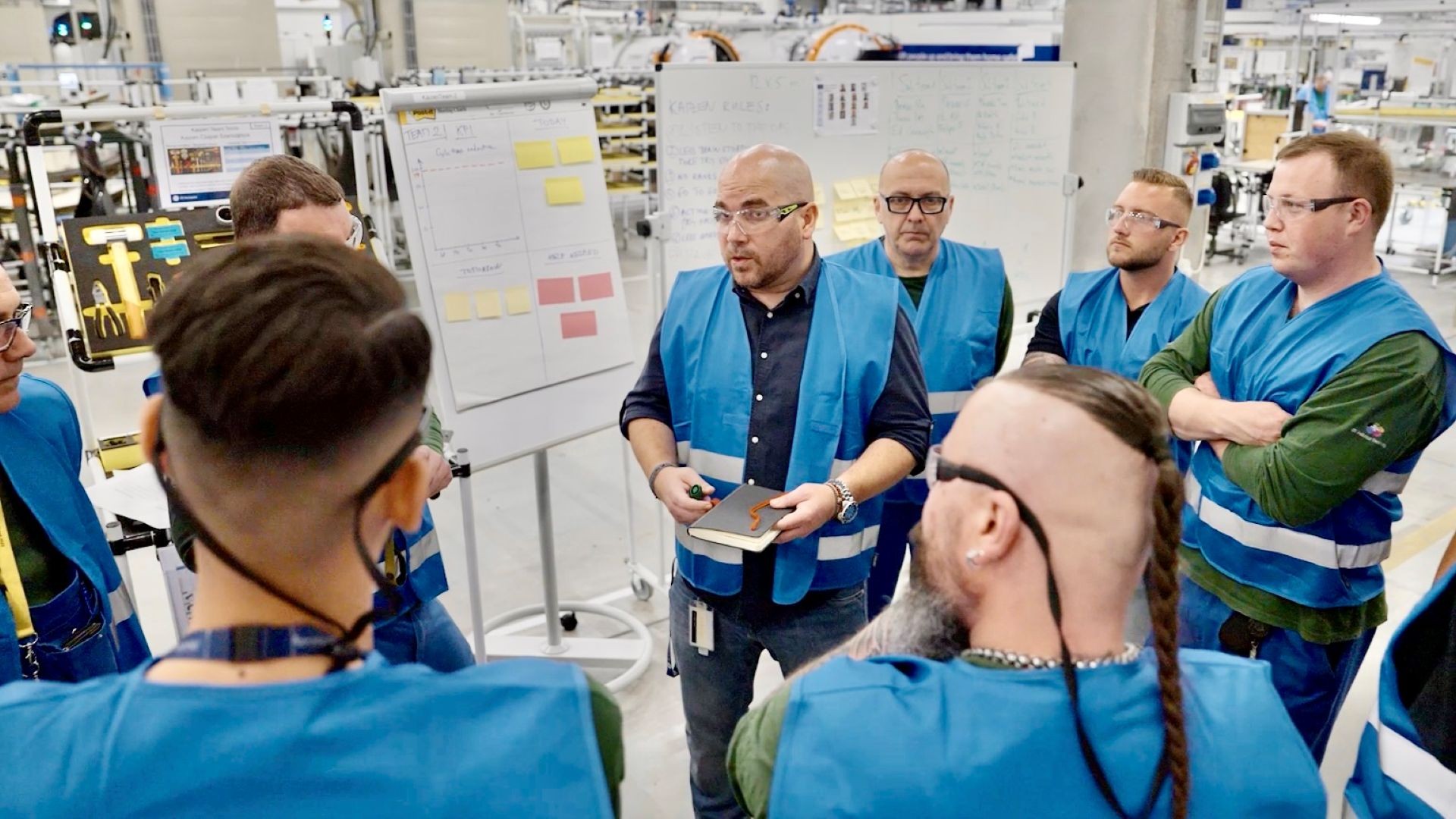
Culp continued, “Thanks to the collaboration of the GE Aerospace team with our supplier partners we continue to build momentum. By leveraging FLIGHT DECK fundamentals, year-to-date commercial services revenue and total engine deliveries were both up over 20%, including another quarter of record internal shop visit output. All the while, we're continuing to invest in our customers' needs with our agreement to acquire CPP to expand capacity, and over
$3 billion in annual R&D to advance current and future technologies."
Recent highlights include:
-
Increased material input from priority suppliers double-digits year-over-year, contributing to strong year-to-date Commercial Engines & Services (CES) services revenue and total engine deliveries, including LEAP growing 26%.
-
Announced commitments for more than 1,800 engines at a historic Farnborough International Airshow
, including the largest LEAP agreement ever for more than 1,000 LEAP-1A
engines with IndiGo and in October, signed an agreement with Turkish Airlines for more than 300 LEAP-1B
engines along with a long-term services agreement covering its entire LEAP-1B fleet of over 600 engines. In Defense, signed a contract worth up to $2.9B to provide ongoing support for the F414's powering the U.S. Navy's F/A-18 and EA-18G fleets.
to expand mission-critical castings capacity for the aerospace industry to meet demand across commercial engines, aftermarket and defense. This acquisition would also accelerate the introduction of new engine technologies to our current fleet and next-generation platforms.
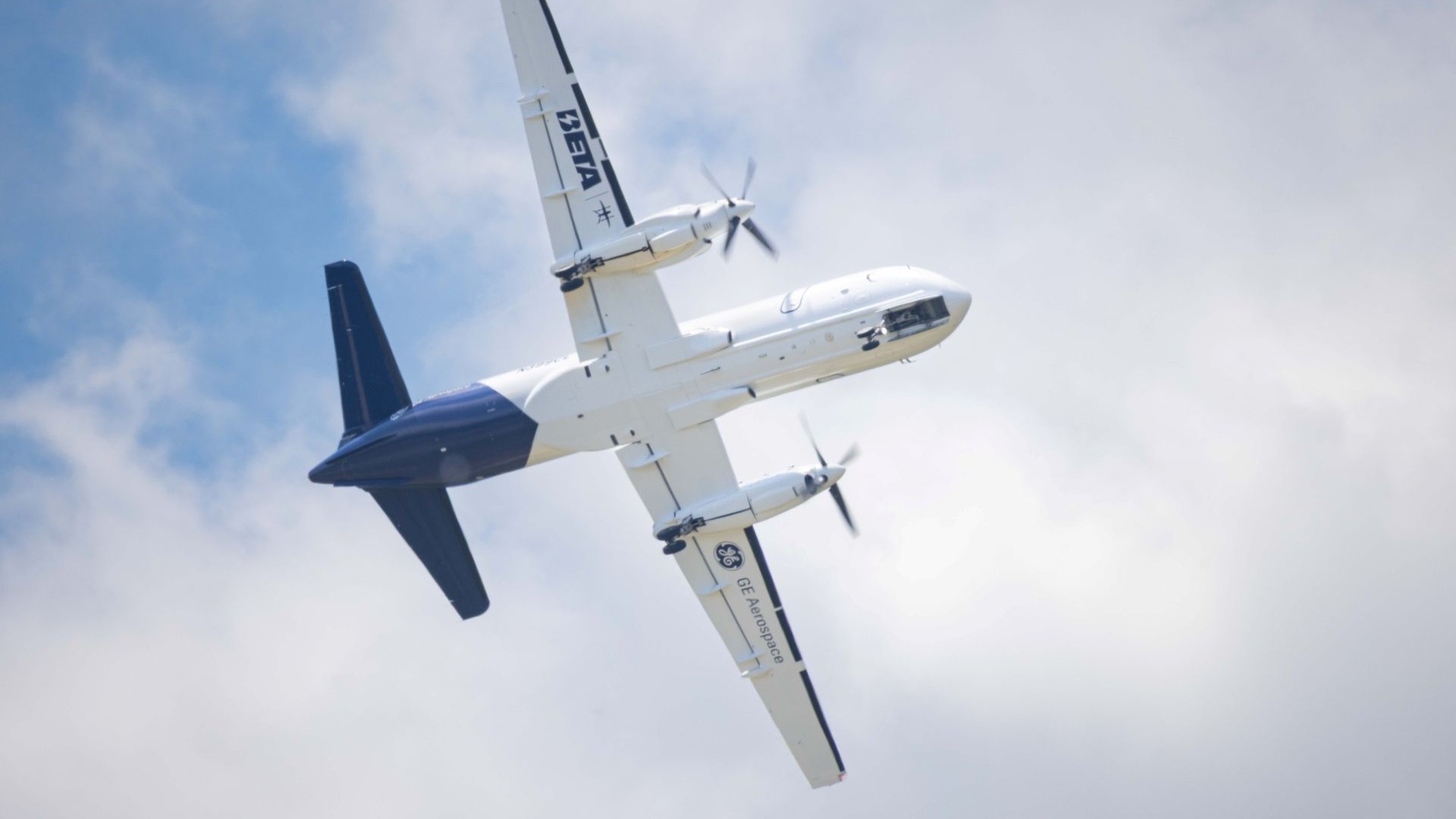
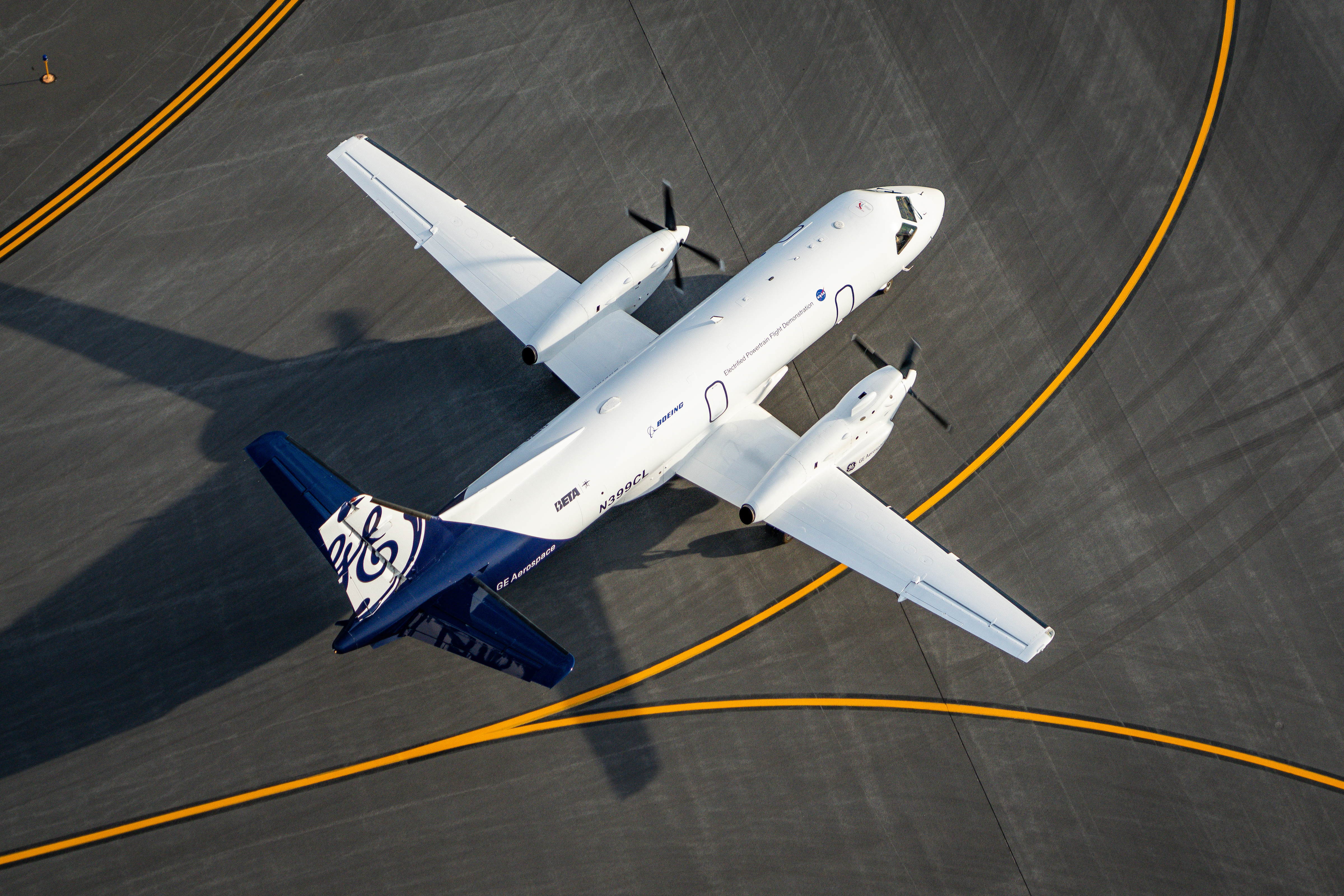
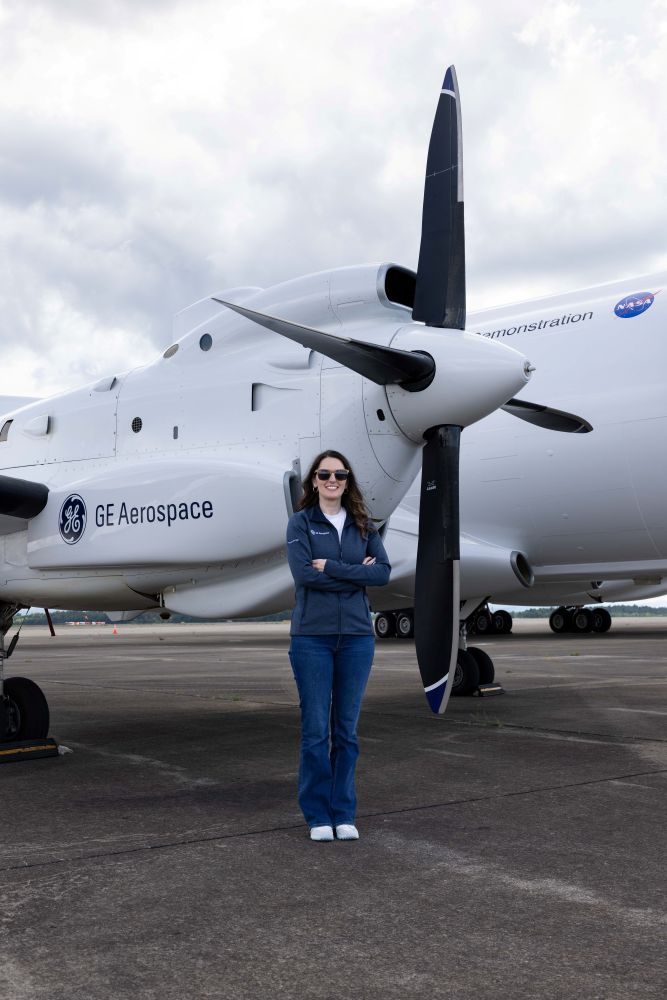
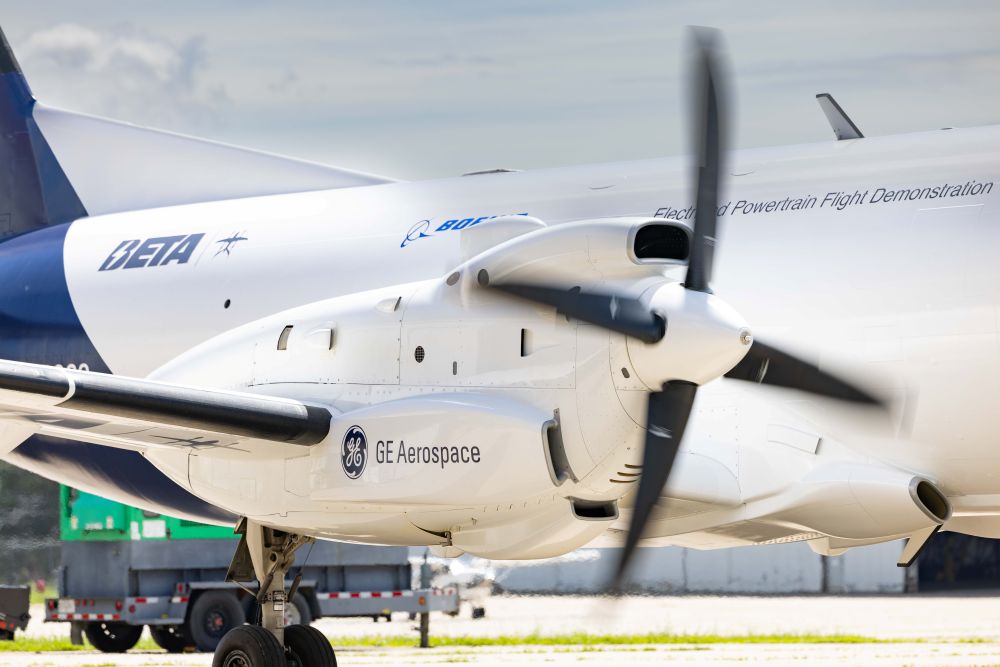
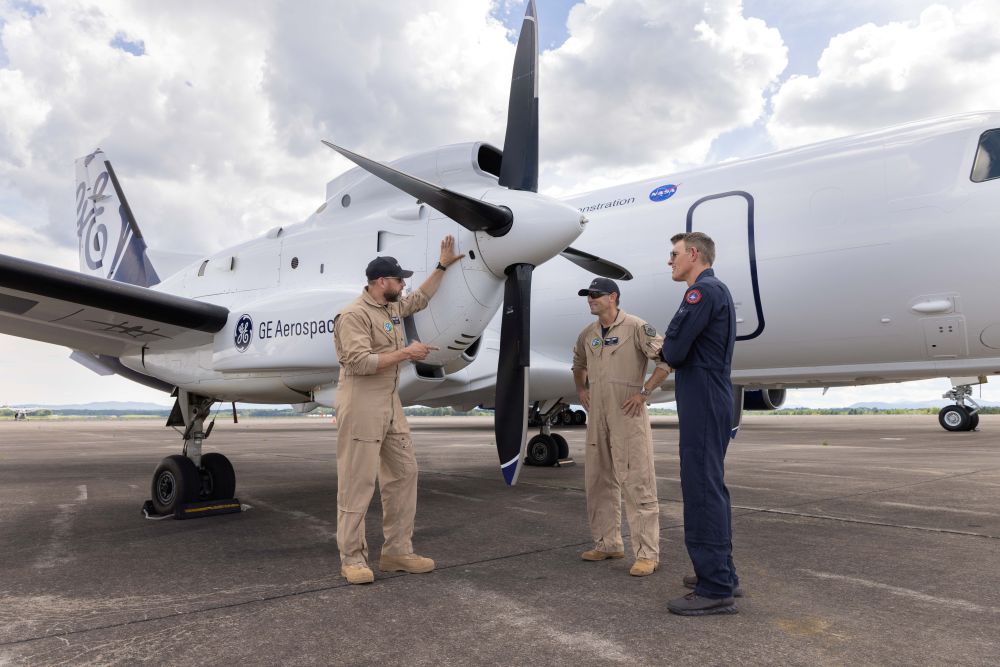
above 30,000 feet in partnership with the National Aeronautics and Space Administration (NASA), BETA Technologies, and Boeing, demonstrating the viability of more electric aircraft engine systems for greater efficiency, durability, and range.
- Advanced key defense programs, including the GEK800
(F143) engine with Kratos being designated as a second-source propulsion solution for the Joint Air-to-Surface Standoff Missile (JASSM) and continued progress on the XA102
adaptive-cycle engine as the U.S. Air Force’s Next Generation Adaptive Propulsion (NGAP) program moves into hardware procurement and subcomponent testing.
GE Aerospace Full-Year 2026 Guidance:
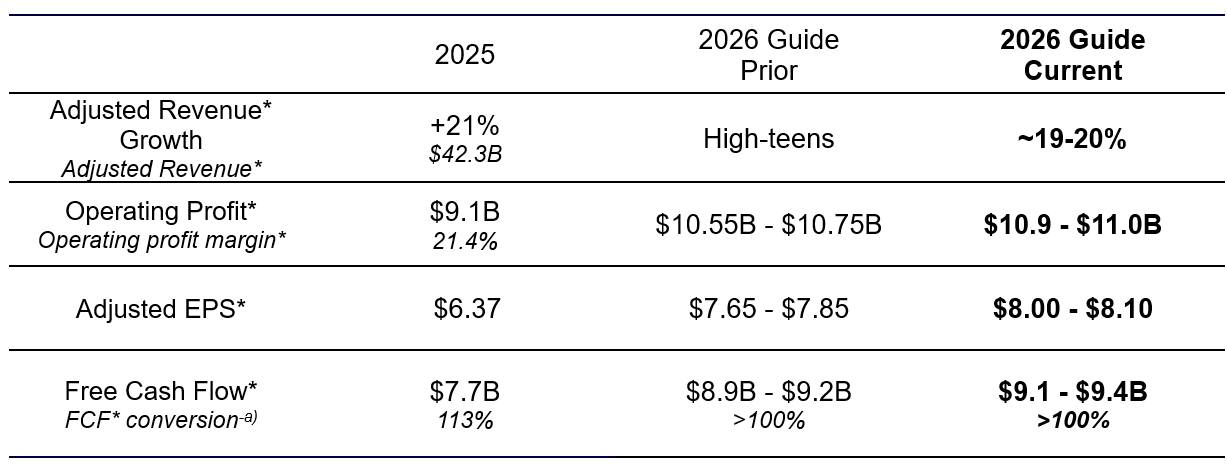
Based on GE Aerospace's year-to-date performance and outlook for the fourth quarter, the company is raising total company guidance across the board and now expects
*Non-GAAP Financial Measure
(a – Adjusted Corporate & Other operating costs* represents the sum of Corporate & other profit (costs) and (Eliminations). In 2026, the company is expecting this to trend toward the lower end of our prior $(1.2)-$(1.3)B guidance range with ~$(500)M Corporate cost, which is ~flat y/y, and ~$(700)M Eliminations, which is up ~$(100)M y/y.
(b – FCF* conversion: FCF* / adjusted net income*
For the quarter, orders of $15.3 billion increased 58%, with services increasing 23% and equipment more than tripling. Revenue of $10.3 billion was up 21%. Services grew 17% with internal shop visit revenue up 12% from higher volume, including LEAP up over 40%, and heavier workscope; spare parts revenue grew over 20%.
Equipment revenue grew 38%, driven by engine deliveries up 8%, including LEAP up 5%, and GEnx growth. While we delivered GE9X engines in the quarter, the impact from these shipments will be recognized post midseal certification. Profit of $2.9 billion was up 21% from higher services volume and price. Margins contracted (10) basis points from mix and inflation.
In 2026, CES now expects revenue growth of low 20s, up from our prior guide of ~20%, driven by higher services revenue, which we now expect to grow at the higher end of our prior guide of low 20s, and equipment revenue growth of low 20s, up from ~20%. Operating profit is expected to be in the range of $10.5-$10.6 billion, up from our prior guide of $10.25-$10.35 billion, driven by higher services growth and reduced GE9X impact.
For the quarter, orders of $4.3 billion were up 18%. Revenue of $3.5 billion grew 7%. Defense & Systems revenue was up 5% driven by growth in both services and equipment, including engine deliveries up 4%. Propulsion & Additive Technologies revenue increased 10% with growth driven by Avio Aero and Unison. Profit of $475 million was up 8% and margins increased 20 basis points from increased volume and price, partially offset by mix and inflation.
In 2026, DPT continues to expect revenue growth of low double digits and operating profit of $1.6-$1.7 billion.
Financial Measures That Supplement GAAP
We believe that presenting non-GAAP financial measures provides management and investors useful measures to evaluate performance and trends of the total company and its businesses. This includes adjustments in recent periods to GAAP financial measures to increase period-to-period comparability following actions to strengthen our overall financial position and how we manage our business.
In addition, management recognizes that certain non-GAAP terms may be interpreted differently by other companies under different circumstances. In various sections of this report we have made reference to the following non-GAAP financial measures in describing our (1) revenue, specifically Adjusted revenue, (2) costs, specifically Adjusted Corporate & other operating costs, (3) profit, specifically Operating profit and Operating profit margin; Adjusted net income (loss) and Adjusted earnings (loss) per share (EPS), (4) cash flows, specifically free cash flow (FCF), (5) guidance, specifically 2026 Operating profit, 2026 Adjusted EPS and 2026 FCF.
The reasons we use these non-GAAP financial measures and the reconciliations to their most directly comparable GAAP financial measures follow. Certain columns, rows or percentages within these reconciliations may not add or recalculate due to the use of rounded numbers. Totals and percentages presented are calculated from the
We believe that adjusting revenue provides management and investors with a more complete understanding of underlying operating results and trends of established, ongoing operations by excluding the effect of revenue from our run-off insurance operations. We believe that adjusting profit to exclude the effects of items that are not closely associated with ongoing operations provides management and investors with a meaningful measure that increases the period-to-period comparability. Gains (losses) and restructuring and other items are impacted by the timing and magnitude of gains associated with dispositions, and the timing and magnitude of costs associated with restructuring and other activities. We also use Adjusted revenue* growth and Operating profit* as performance metrics at the company level for our annual executive incentive plan for 2026.
Adjusted Corporate & Other operating costs* excludes gains (losses) on purchases and sale of business interests, gains (losses) on retained and sold ownership interests and other equity securities, higher-cost restructuring programs, separation costs, our run-off insurance operations, and U.S. tax equity profit (loss). We believe that adjusting Corporate & Other costs to exclude the effects of items that are not closely associated with ongoing operations provides management and investors with a meaningful measure that increases the period-to-period comparability of our ongoing corporate costs.
-
Includes related tax valuation allowances. Tax effect on Insurance net income includes valuation allowances for 2025.
-
Includes tax benefits available to offset the tax on gains (losses) on equity securities.
Earnings-per-share amounts are computed independently. As a result, the sum of per-share amounts may not equal the total.
We believe that Adjusted net income* provides management and investors with useful measures to evaluate the performance of the total company and increased period-to-period comparability, as well as a more complete understanding of underlying operating results and trends of established, ongoing operations by excluding items that are not closely related with ongoing operations. We also use Adjusted EPS* as a performance metric at the company level for our performance stock units granted in 2026.
We believe investors may find it useful to compare free cash flow* performance without the effects of separation cash expenditures and Corporate & Other restructuring cash expenditures (associated with the separation-related program announced in the fourth quarter of 2022 and acquisition-related costs). In addition, we include dispositions of property, plant and equipment, including sale leaseback activity. We believe this measure will better allow management and investors to evaluate the capacity of our operations to generate free cash flow*. We also use FCF* as a performance metric at the company level for our annual executive incentive plan and performance stock units granted in 2026.
2026 GUIDANCE: 2026 OPERATING PROFIT (NON-GAAP)
We cannot provide a reconciliation of the differences between the non-GAAP expectations and corresponding GAAP measure for Operating profit* in 2026 without unreasonable effort due to the uncertainty of timing of any gains or losses related to acquisitions & dispositions, the timing and magnitude of the financial impact related to the mark-to-market of our investment in BETA Technologies, Inc. and the timing and magnitude of restructuring expenses. Although we have attempted to estimate the amount of gains and restructuring charges for the purpose of explaining the probable significance of these components, this calculation involves a number of unknown variables, resulting in a GAAP range that we believe is too large and variable to be meaningful.
2026 GUIDANCE: 2026 ADJUSTED EPS (NON-GAAP)
We cannot provide a reconciliation of the differences between the non-GAAP expectations and corresponding GAAP measure for Adjusted EPS* in 2026 without unreasonable effort due to the uncertainty of timing of any gains or losses related to acquisitions & dispositions, the timing and magnitude of the financial impact related to the mark-to-market of our investment in BETA Technologies, Inc. and the timing and magnitude of restructuring expenses. Although we have attempted to estimate the amount of gains and restructuring charges for the purpose of explaining the probable significance of these components, this calculation involves anumber of unknown variables, resulting in a GAAP range that we believe is too large and variable to be meaningful.
2026 GUIDANCE: 2026 FCF (NON-GAAP)
We cannot provide a reconciliation of the differences between the non-GAAP expectations and corresponding GAAP measure for free cash flow* in 2026 without unreasonable effort due to the uncertainty of timing for capital expenditures and restructuring related cash expenditures.
Caution Concerning Forward Looking Statements:
This release and certain of our public communications and filings we make with the U.S. Securities and Exchange Commission (SEC) may contain statements related to future, not past, events. These forward-looking statements often address our expected future business and financial performance and financial condition, and often contain words such as "expect," "anticipate," "intend," "plan," "believe," "seek," "see," "will," "would," "estimate," "forecast," "target," "preliminary," "range" or similar expressions. Forward-looking statements by their nature address matters that are, to different degrees, uncertain, such as statements about the impacts of macroeconomic and market conditions and volatility on our business operations, financial results and financial position; conditions affecting the aerospace industry, including our customers and suppliers; our expected financial performance, including cash flows, revenue, margins, net income and earnings per share; planned and potential transactions; our credit ratings and outlooks; our funding and liquidity; our cost structures and plans to reduce costs; restructuring, impairment or other financial charges; or tax rates.
For us, particular areas where risks or uncertainties could cause our actual results to be materially different than those expressed in our forward-looking statements include:
-
changes in macroeconomic and market conditions and market volatility (including risks related to recession, inflation, supply chain constraints or disruptions, interest rates, values of financial assets, oil, jet fuel and other commodity prices and exchange rates), and the impact of such changes and volatility on our business operations and financial results;
-
market or other developments that may affect demand or the financial strength and performance of airframers, airlines, suppliers and other key aerospace industry participants, such as demand for air travel, supply chain or other production constraints, shifts in U.S. or foreign government defense programs and other industry dynamics;
-
pricing, cost, volume and the timing of sales, deliveries, investment and production by us and our customers, suppliers or other industry participants;
-
the impact of actual or potential safety or quality issues or failures of our products or third-party products with which our products are integrated, including design, production, performance, durability or other issues, and related costs and reputational effects;
-
operational execution on our business plans, including our performance amidst market growth and ramping newer product platforms, meeting delivery and other contractual obligations, improving turnaround times in our services businesses and reducing costs over time;
-
global economic trends, competition and geopolitical risks, including evolving impacts from tariffs, sanctions or other trade tensions between the U.S. and other countries, or demand or supply shocks from events such as a major terrorist attack, war (including the conflict in the Middle East), natural disasters or actual or threatened public health pandemics or other emergencies;
-
the amount and timing of our income and cash flows, which may be impacted by macroeconomic, customer, supplier, competitive, contractual, financial or accounting (including changes in estimates) and other dynamics and conditions;
-
our capital allocation plans, including the timing and amount of dividends, share repurchases, acquisitions, organic investments and other priorities;
-
our decisions about investments in research and development or new products, services and platforms, and our ability to launch new products in a cost-effective manner, as well as technology developments and other dynamics that could shift the demand or competitive landscape for our products and services;
-
our success in executing acquisitions and other planned and potential transactions, including the timing for such transactions, the ability to satisfy regulatory requirements or any applicable pre-conditions, business integrations and the expected benefits;
-
downgrades of our credit ratings or ratings outlooks, or changes in rating application or methodology, and the related impact on our funding profile, costs, liquidity and competitive position;
-
capital or liquidity needs associated with our run-off insurance operations or mortgage portfolio in Poland (Bank BPH), the amount and timing of any required future capital contributions and any strategic options that we may consider;
-
changes in law, regulation or policy that may affect our business, including policies related to trade, tariffs or capital allocation; government defense priorities or budgets; environmental or climate regulation, incentives and emissions offsetting or trading regimes and the effects of tax law changes or audits;
-
the impact of regulation; government investigations; regulatory, commercial and legal proceedings or disputes; environmental, health and safety matters; or other legal compliance risks, including the impact of shareholder and related lawsuits, Bank BPH and other proceedings that are described in our SEC filings;
-
the impact related to information technology, cybersecurity, artificial intelligence or data security developments or breaches at GE Aerospace or third parties; and
-
the other factors that are described in the "Risk Factors" section in our Annual Report on Form 10-K for the year ended December 31, 2025, as such descriptions may be updated or amended in future reports we file with the SEC.