Energous Corporation develops scalable, over-the-air Wireless Power Network technology that integrates semiconductor chipsets, software controls, and antenna systems to enable radio frequency-based charging for ambient Internet of Things devices. The company’s platform consists of transmitter systems, receiver integrated circuits, and supporting software designed to deliver power and data to battery-free IoT devices, supporting applications such as retail sensors, electronic shelf labels, asset trackers, and air quality monitors. Key products include the PowerBridge transmitter systems, the e-Sense tag, and the e-Compass cloud-based software platform. Energous serves customers in retail, industrial, healthcare, and logistics environments, with deployments in grocery distribution, reverse logistics, and asset tracking. The company partners with technology providers, systems integrators, and value-added resellers, and has established collaborations with e-peas, Wiliot, InPlay, and Veea. Incorporated in 2012, Energous holds a patent portfolio exceeding 300 patents and has received regulatory approvals in multiple countries, including the U.S., Europe, and Asia.

Summarised from the company's own disclosures, fiscal year ended Mar 2026

Industry Electronic Components Homepage energous.com
Sector Technology IR page energous.com
Tags
wireless power, iot, rf charging, ambient sensors, electronic shelf labels, asset tracking, semiconductor chipsets, cloud software, battery-free devices, industrial iot, PowerBridge, e-Sense, e-Compass, PowerBridge PRO+, Wiliot Pixels, e-peas, InPlay, Veea
Press page energous.com/company/newsroom

Metrics

Valuation  
Market cap $ 72.626M
Market cap (USD) $ 72.626M
P/E -10.43
PEG —
P/BV 1.92
P/S 5.76
P/OCF -4.71
P/FCF -4.59
Dividend yield —
Turnover / mcap —
Returns  
ROE -76.8%
ROI -76.2%
ROIC -59.7%
Profit margin -170.4%
Growth  
Revenue growing Yes
Profits growing Yes
Revenue up 3y No
Revenue up 5y No
Earnings growth 3y (net profit CAGR) —
Quality  
Profitable No
Margin expanding Yes
Buying back stock —
Diluting (TTM) —
Debt/Equity —
Podcast bulls (TTM) Sign up
Podcast bears (TTM) Sign up
Podcast sentiment (TTM) Sign up
Podcast sentiment % (TTM) Sign up
News sentiment (TTM) 25
Quality score -31.3%
Insiders  
Buys, 1w Sign up
Buys, 1m Sign up
Buys, 1y Sign up
Sells, 1w Sign up
Sells, 1m Sign up
Sells, 1y Sign up

Sign up to see this company's insider trades

Figure FY 2025 FY 2024 FY 2023 FY 2022 FY 2021 FY 2020 FY 2019 FY 2018 FY 2017 FY 2016 FY 2015 FY 2014 FY 2013
Revenue 5.63M 768K 474.184K 851.321K 756.793K 327.35K 200.143K 514.823K 1.154M 1.452M 2.5M — —
Net profit -9.593M -18.398M -19.367M -26.275M -41.427M -31.832M -38.399M -50.84M -49.377M -45.817M -27.562M -45.603M -5.521M
Free cash flow -12.502M -17.696M -19.436M -23.802M -29.086M -24.928M -26.817M -33.387M -35.248M -34.2M -21.039M -17.226M -3.625M

Figure FY 2025 FY 2024 FY 2023 FY 2022 FY 2021 FY 2020 FY 2019 FY 2018 FY 2017 FY 2016 FY 2015 FY 2014 FY 2013
Share price 3.99 1.01 1.83 0.84 1.25 1.8 1.77 5.79 19.45 16.85 7.91 10.96 —
Price performance 12m 2.95 -0.45 1.19 -0.33 -0.31 0.02 -0.69 -0.7 0.15 1.13 -0.28 — —

Filed figures

Figure Dec 2016 Dec 2017 Dec 2018 Dec 2019 Dec 2020 Dec 2021 Dec 2022 Dec 2023 Dec 2024 Dec 2025
Balance sheet detail
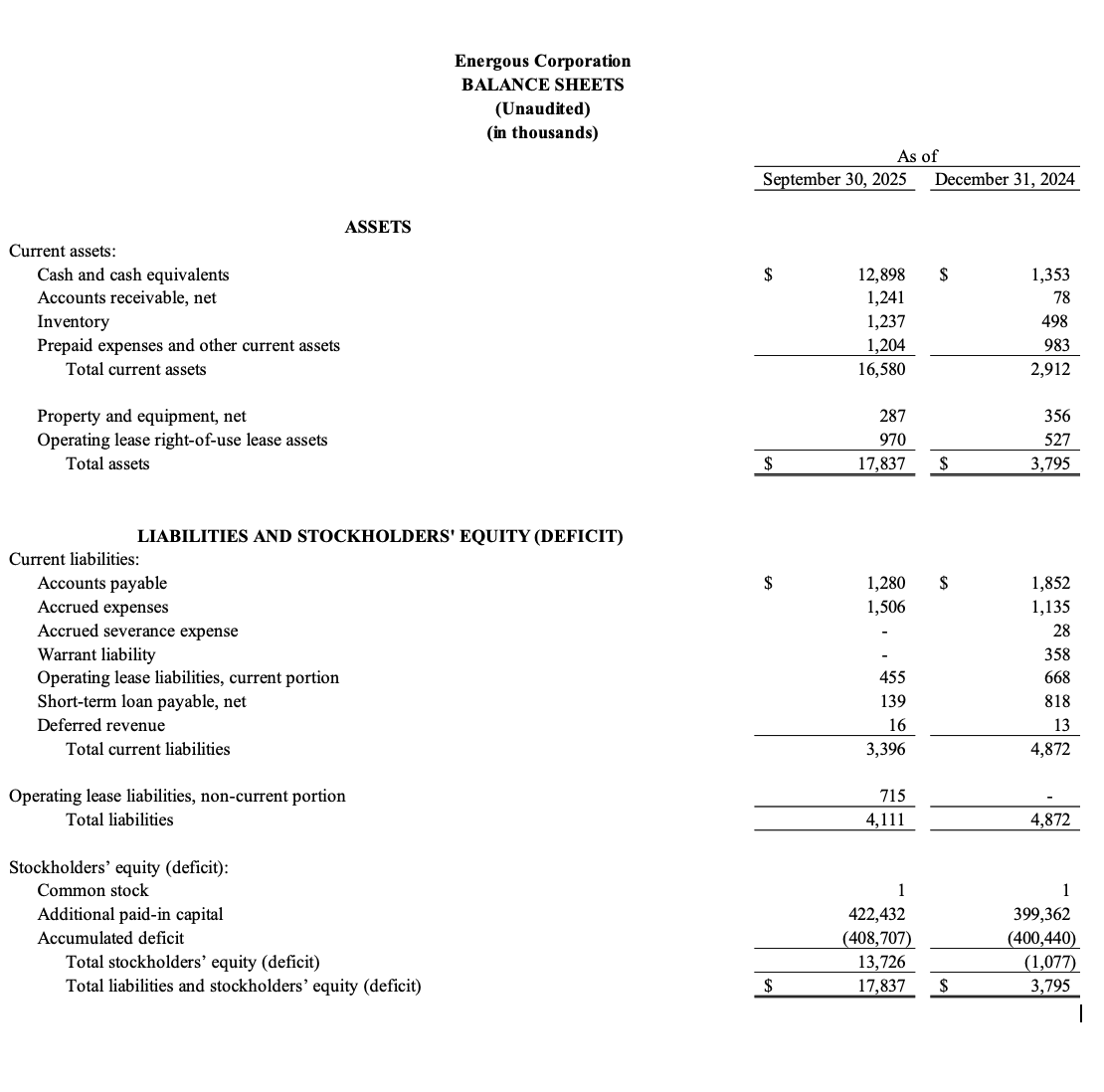
Trade receivables (USD) 149,500 0.00 44,550 63,144 75,850 283,602 143,353 101,554 78,000 2.99M
↳ YoY growth -100.0% +41.7% +20.1% +273.9% -49.5% -29.2% -23.2% +3,730.8%
↳ 5y CAGR +13.7% +17.9% +4.3% +108.5%
Borrowings, current (USD) — — — — — — — — 818,000 88,000
Lease liabilities (USD) — — — 2.12M 1.4M 668,720 1.97M 1.26M 668,000 1.08M
Cash and deposits (USD) 31.3M 12.8M 20.1M 21.7M 50.7M 49.1M 26.3M 13.9M 1.35M 10.4M
Right-of-use assets (USD) — — — 2.06M 1.29M 618,985 1.96M 1.24M 527,000 872,000
Net debt (borrowings + leases - cash) (USD) — — — — — — — — 133,000 -9.23M
Cash flow detail
Operating cash flow (USD) -33.1M -34.4M -32.5M -26.6M -24.8M -28.7M -23.6M -19.2M -17.6M -12.4M
Purchases of property, plant and equipment (USD) -1.14M -817,448 -859,819 -196,199 -136,631 -365,735 -164,994 -187,078 -123,000 -82,000
Change in receivables (cash effect) (USD) -149,500 149,500 -44,550 -53,594 -34,083 -218,602 99,512 54,299 24,000 -2.91M
Change in inventories (cash effect) (USD) — — — — — — -105,821 -491,230 -68,000 -1.01M
Change in payables (cash effect) (USD) 2.38M -2.68M -163,305 -189,866 -574,680 109,118 -305,192 978,569 -27,000 -898,000
Interest paid (cash effect) (USD) — — — — — — — — -140,000 -277,000
Share-based compensation (USD) 9.51M 15.8M 16.8M 10.6M 7.9M 11.9M 2.92M 1.68M 799,000 281,000
Operating cash flow before change in receivables (USD) -32.9M -34.6M -32.5M -26.6M -24.8M -28.5M -23.7M -19.3M -17.6M -9.51M
Free cash flow (OCF - PPE - intangibles) (USD) -34.2M -35.2M -33.4M -26.8M -24.9M -29.1M -23.8M -19.4M -17.7M -12.5M
Income detail
Research and development expense (USD) 32.8M 33.2M 32.9M 23.2M 17.1M 20.6M 12.5M 10.8M 8.28M 4.13M
↳ 5y CAGR +73.2% +13.2% -1.9% -8.9% -17.8% -19.9% -18.7% -24.7%
Provision for credit losses (USD) — — — 35,000 21,377 10,850 40,737 -12,500 — —
Credit cost ratio (credit losses / average receivables) (%) — — — 65.0% 30.8% 6.0% 19.1% 10.2% — —
Reported Mar 16, 2017 May 10, 2018 Feb 28, 2019 Mar 13, 2020 Mar 24, 2021 Mar 23, 2022 Mar 30, 2023 Mar 28, 2024 Feb 27, 2025 Mar 26, 2026

Sign up to see institutional holdings

Sign Up

Podcast Mentions

Sign up to see podcast mentions and sentiment

Sign Up

– Third Quarter Revenue Increases 167% Year over Year, Continuing Streak of Consecutive Quarterly Growth

–Year-to-Date Revenue Exceeds Full-Year 2025 Results

– Conference Call Today at 4:30 p.m. Eastern Time

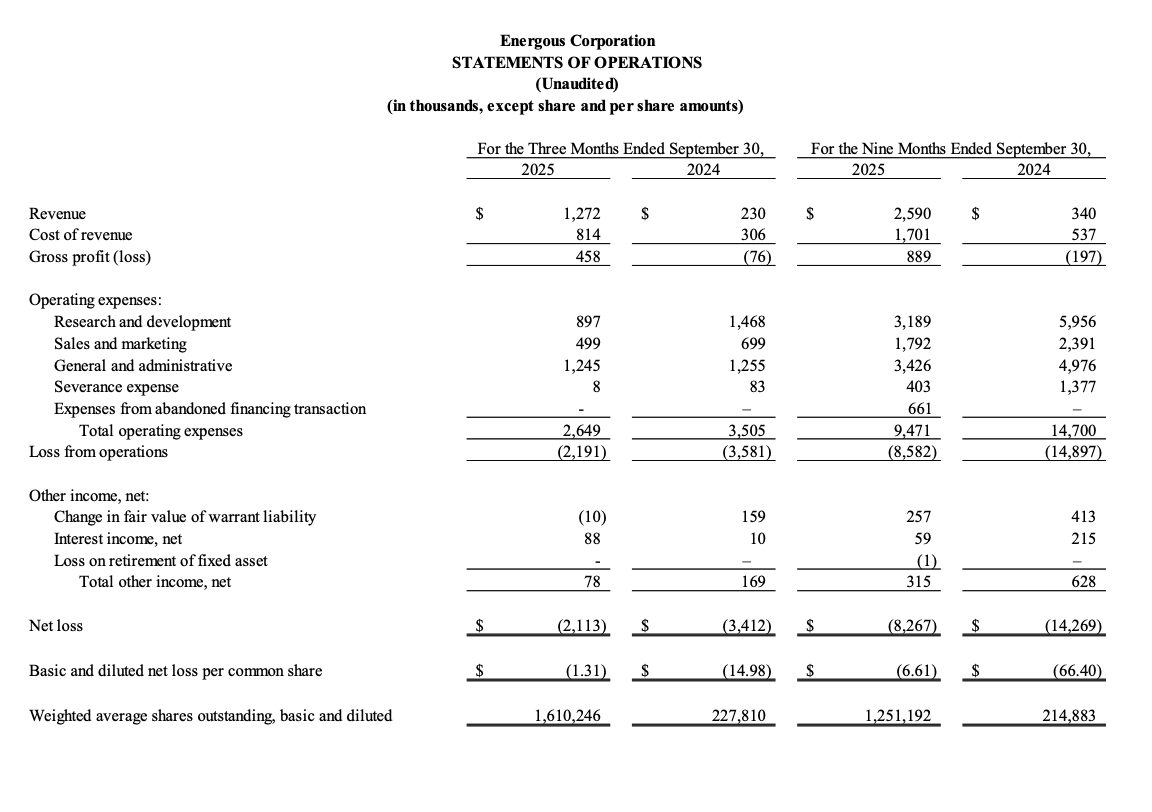
SAN JOSE, CA – November 12, 2026 – Energous Corporation d/b/a Energous Wireless Power Solutions (Nasdaq: WATT) (“Energous,” the “Company,” “we,” or “our”), a pioneer in scalable, over-the-air wireless power networks, today announced financial results for the third quarter ended September 30, 2026, reporting revenue of approximately $3.4 million, more than doubling revenue reported for the same prior year period. Revenue for the nine months ended September 30, 2026 was $9.6 million, a 270% increase over the same prior year period, and exceeding the revenue recorded for the full year of 2025. The Company also provided an update on recent events and Company highlights.

“Our third quarter results reflect continued momentum in the commercial adoption of Energous’ technology, with revenue growing significantly year over year and our year-to-date revenue performance already surpassing full-year 2025.” said Mallorie Burak, CEO and CFO of Energous.

Published: September 14, 2026Author: James Hickey

[display_slideshow_copyright_text]

RFID What Is Ambient IoT Energous’ Giampaolo Marino on How Wireless Power Keeps Battery-Free Sensors Running

Adobe/sajibul35

Key takeaways

  • Battery-free Ambient IoT infrastructure can give enterprises continuous asset and inventory visibility without the labor and downtime tied to charging or replacing batteries.
  • Wireless power turns low-power sensors into an always-on data layer that helps retailers, healthcare providers, logistics teams and manufacturers make faster operational decisions.

The best enterprise technology often goes unnoticed, simply working in the background and giving teams what they need without asking anything in return. Wireless power and Ambient IoT are moving in exactly that direction.

As enterprises look for ways to gather more data from their physical operations without piling on maintenance work, the appeal of infrastructure that runs quietly and continuously keeps growing. That shift matters most when you consider what always-on, battery-free connected devices make possible. When sensors and smart labels can stay powered and communicate on their own, businesses gain a steady stream of information about assets, inventory and equipment. The value comes from persistent visibility that doesn’t require anyone to charge a device or swap a battery.

Energous Chief Strategy & Growth Officer Giampaolo Marino explains how this infrastructure is taking shape and where it’s headed. Marino covers how battery-free wireless power infrastructure reduces the operational burden of managing connected devices at scale, the role of Ambient IoT in enabling continuous, real-time asset visibility across industries, and what a truly always-on enterprise will look like five to 10 years from now.

RFIDJouranl.com: Giampaolo, thanks for taking time to talk with us today. You’ve said the most valuable enterprise technology is the technology employees rarely have to think about. What led you to that view, and why does invisibility signal real value?

rfid-nl-cta

Giampaolo Marino: Glad to join you. For me, it comes down to how technology fits into the workday. If employees have to remember to scan something, charge a device, replace a battery or check whether a sensor is still online, the technology has created another task. Multiply that task across thousands of devices and dozens or hundreds of locations, and what looked like a small requirement at face-value quickly turns into a major operational headache.

The best infrastructure earns its keep by disappearing. Think about Wi-Fi: employees don’t come to work thinking about maintaining the network; they expect it to be there so they can do their jobs. That’s the direction wireless power and Ambient IoT are heading. When connected devices can stay powered and communicate on their own, employees can focus their time on the decisions the data enables rather than maintaining the technology producing it. That’s the real test of whether infrastructure is pulling its weight.

RFIDJouranl.com: When a device runs on its own without anyone charging it or swapping batteries, how does that change the way a business actually operates day to day?

Marino: It gives teams a far more consistent view of what’s happening across their operations throughout the day. With devices remaining active continuously, businesses get a steady flow of information from assets, inventory and equipment that feeds directly into everyday decision-making.

That changes the rhythm of daily operations; a retailer catches an inventory issue before it becomes a stockout. A manufacturer spots an equipment or process problem earlier. A logistics team pinpoints when an asset is sitting somewhere longer than expected. Teams respond as conditions change, make faster calls and keep operations moving with fewer interruptions. Over time, that consistent visibility builds a much more responsive way of running the business.

How Wireless Power and Ambient IoT Work Together to Power Battery-Free Devices

RFIDJouranl.com: Wireless power and Ambient IoT are terms many people still find abstract. In plain language, how do they work together to keep low-power devices running continuously?

Marino: A simple way to think about it is that wireless power provides energy through the environment, and Ambient IoT devices are designed to make use of that energy.

Energous PowerBridge transmitters, for example, deliver RF energy over the air, creating a wireless power layer that battery-free, ultra-low-power devices can access. At the endpoint, energy-harvesting and power-management technology captures that RF energy and converts it into usable power for sensing and communication. So a small BLE tag attached to a pallet, piece of equipment or retail item can remain active without somebody plugging it in or replacing a battery.

Put enough of those devices into a wireless power network, and you create an environment where physical assets can continuously provide information about location, movement or conditions. The power infrastructure is what allows that sensing layer to operate in the background.

RFIDJouranl.com: Battery maintenance is often treated as a minor cost. What hidden expenses and disruptions do companies overlook when their connected devices depend on manual upkeep?

Marino: Battery maintenance carries costs that are easy to underestimate. Someone has to know a battery is running low, locate the device, access it, replace or recharge it, confirm that it’s working again and manage that process across the life of the deployment. In a large warehouse or manufacturing facility, the sensor may be attached to a pallet, piece of equipment or asset that isn’t particularly easy to locate in the first place.

There’s also a data cost. Battery-powered devices are often configured to report less frequently to preserve battery life, which can leave minutes or hours between readings, depending on the application. In that window, conditions can change significantly – a temperature excursion, for example, could begin and persist well before the next reading comes through, leaving teams unaware of the issue until there’s already been an impact on product quality or operations.

Total cost of ownership has to account for labor, downtime and the operational consequences of incomplete data. At enterprise scale, those costs dwarf the price of the battery itself.

RFIDJouranl.com: Retailers are adding sensors and smart labels across their stores. How does always-on infrastructure reshape inventory tracking, shelf management and the customer experience?

Marino: Physical stores have long operated with a lot of gaps between inventory counts, transactions and manual checks. Take a common scenario: A system may say a shirt is in stock, but that doesn’t necessarily help an associate if it’s sitting in the wrong section of the store.

With battery-free BLE smart labels supported by wireless power infrastructure, individual products can become live data points. Retailers can gain a clearer picture of where merchandise is, how it’s moving and when availability is starting to change. That can help a team replenish a fast-moving size before it disappears from the shelf, find misplaced merchandise faster or identify an inventory discrepancy earlier.

For the customer, much of that should be invisible. They’re more likely to find the product they came for, and associates can spend more time helping them instead of combing a stockroom or manually checking inventory. And over time, that same stream of item-level data can also give retailers a clearer understanding of how products are behaving throughout the day, strengthening the information available for allocation, replenishment and planning.

Where Battery-Free Sensors Deliver Real-Time Visibility Across Industries

RFIDJouranl.com: In healthcare, uptime can carry real stakes. Where do you see self-sustaining connected devices making the biggest difference for patients and staff?

Marino: Healthcare is a good example of an environment where the value comes from making information easier to access without adding another manual responsibility for staff. There are many assets moving through hospitals and care environments, and knowing where equipment is and whether critical items are available can directly affect workflows.

Self-sustaining sensors could support persistent visibility into mobile medical equipment, supplies and other high-value assets without requiring staff to maintain batteries across a large sensor fleet. That can reduce time spent searching for equipment and give operations teams a more consistent picture of asset availability.

I also see potential around condition monitoring where appropriate, particularly for items that need to remain within specific environmental ranges. The important principle is reliability: connected infrastructure in healthcare has to directly support the people delivering care without becoming another system they have to constantly manage.

RFIDJouranl.com: Logistics runs on visibility across long, moving supply chains. How does continuous, battery-free tracking change what operators can see and act on?

Marino: A lot of supply-chain visibility still comes from checkpoints. You know when a pallet was scanned at one location and when it appeared at the next, but the journey between those events can remain unclear. Battery-free sensing can fill in more of that journey across warehouses, staging areas and other parts of the logistics network without creating battery replacement cycles for every tracked asset.

That richer data gives operators a clearer view of how assets are moving throughout the journey and where delays or unexpected changes are occurring. When something starts to deviate from plan, teams can see it sooner and intervene while there’s still time to act. That record also helps uncover recurring patterns, which gives operators the insight to address problems before they ripple further through the supply chain.

RFIDJouranl.com: Manufacturing floors are full of equipment that needs monitoring. What becomes possible when sensors never go dark and never need a technician to keep them powered?

Marino: You can start instrumenting parts of the factory that historically haven’t justified the cost or effort of continuous tracking. Even in highly automated production environments, visibility into the movement of everyday assets can remain surprisingly limited.

Battery-free sensors make it practical to extend digital visibility to those everyday assets. A manufacturer can see how work-in-progress moves through production, identify materials spending too long between stages, locate mobile equipment and build a complete view of how the floor is actually operating. Continuous sensing can also support condition monitoring by surfacing equipment or process issues earlier.

Once that data is consistently available, it becomes useful beyond tracking. Manufacturers can use it to better understand factory floor operations as a whole and identify opportunities to improve efficiency, throughput and automation.

Scaling Enterprise IoT: What the Always-On Enterprise Looks Like Next

RFIDJouranl.com: Some leaders worry that adding more connected devices means adding more work for their teams. How does self-sustaining infrastructure flip that assumption?

Marino: That concern is understandable because conventional IoT deployments often do create more endpoints to provision, inspect and maintain. The challenge becomes especially noticeable when a pilot involving a few hundred devices grows into a network involving tens of thousands.

Wireless power removes much of the ongoing power maintenance from that equation. Battery-free endpoints can remain active without routine charging or battery replacement, and the data can feed into systems and workflows teams already use. That makes it possible to increase the number of things you can see without increasing manual work at the same rate.

There’s a useful lesson here for deployment, too: start with one use case where a visibility gap is already costing time or money, prove the value, and expand deliberately. Energous has seen that model apply across inventory accuracy, cold-chain monitoring, and asset tracking among a plethora of other environments. It gives businesses a manageable way to introduce continuous sensing, demonstrate its impact in day-to-day operations, and then build from there as the need compounds.

RFIDJouranl.com: Looking five to 10 years ahead, what does a truly always-on enterprise look like, and what should leaders do now to prepare for it?

Marino: I think an always-on enterprise is one where the physical environment becomes a reliable source of data in the same way digital systems are today. Products, pallets, tools, equipment and other assets can continuously communicate their status and surroundings, with very little human involvement required to keep that information flowing.

That creates a much stronger foundation for analytics, AI and automation. Many enterprise platforms still rely on periodic or incomplete inputs, limiting their awareness of conditions on the ground. Persistent sensing fills in those gaps, and gives businesses richer, more timely information to inform decisions and drive automated processes.

For leaders today, that journey can start by building on what’s already in place. Existing identification infrastructure such as RFID and barcodes can continue to serve their established roles, with Ambient IoT adding a persistent sensing and real-time data layer where greater visibility can deliver measurable value. Starting with a focused use case gives organizations a way to prove the economics before expanding the infrastructure more broadly.

Five to 10 years from now, I expect this infrastructure to become an assumed part of the enterprise technology stack. Always-on enterprises will have a continuous understanding of their physical environments and the ability to put that intelligence to work as conditions change. The technology itself may become almost invisible, but its impact will shape decisions across the business every day.

Related stories: 

Posted in: News

Tagged with: ambient IoT , asset tracking , battery-free sensors , enterprise IoT , healthcare technology , Inventory Management , Logistics , Manufacturing , real-time visibility , RFID , wireless power

ADVERTISEMENT

ADVERTISEMENT

Related Posts

Wireless Broadband Alliance, FIDO Alliance Validate Wi-Fi Onboarding for IoT and Edge Devices
---------------------------------------------------------------------------------------------

Impinj’s Matt Branda on Physical Intelligence, Physical AI and the Data Enterprise AI Needs: The RFID Journal Q&A
-----------------------------------------------------------------------------------------------------------------

Inside the Reinvention: ClarityRFID’s Michael Quimby and Cailee Rye, An RFID Journal Q&A
----------------------------------------------------------------------------------------

Pricer Showcase Shelf Edge As Driver of Grocery Retail Performance
------------------------------------------------------------------

rfid-nl-cta

General

Topics

Awards & Events

About Us

Contact Us

James Hickey, Managing Editor,  RFID Journal
[email protected]

Social:

General

Topics

Resources

About Us

Contact Us

James Hickey, Managing Editor,  RFID Journal
[email protected]

© 2026 Emerald X, LLC. All Rights Reserved

ABOUT CAREERS AUTHORIZED SERVICE PROVIDERS EVENT STANDARDS OF CONDUCT Your Privacy Choices TERMS OF USE PRIVACY POLICY

View All Posts » News Expert Views Ask The Experts Editor's Views Videos Resources FAQ

View All Posts » RFID RTLS Internet of Things BLE Artificial Intelligence NFC LoRaWAN IT/Infrastructure Reports How-To & Best Practices

View All Resources » White Papers Webinars

About Us Advertise Contact Us

Q

You must be logged in as a registered user to access. Not a registered user? Sign up for basic membership for free here .

CLOSE

Company Logo

This website uses cookies to enhance user experience and to analyze performance and traffic on our website. We also share information about your use of our site with our social media, advertising and analytics partners. By continuing, you agree to our use of cookies. You can manage your cookie settings by clicking on "Cookie Preference Center" or find out more in our Privacy Policy

Accept All Cookies

Cookie Preference Center

Company Logo

  • Your Privacy

  • Strictly Necessary Cookies

  • Opt-out of Sale or Sharing

Your Privacy

When you visit our website, we store cookies on your browser to collect information. The information collected might relate to you, your preferences or your device, and is mostly used to make the site work as you expect it to and to provide a more personalized web experience. However, you can choose not to allow certain types of cookies, which may impact your experience of the site and the services we are able to offer. Click on the different category headings to find out more and change your default settings according to your preference. You cannot opt-out of our First Party Strictly Necessary Cookies as they are deployed in order to ensure the proper functioning of our website (such as prompting the cookie banner and remembering your settings, to log into your account, to redirect you when you log out, etc.). If you wish to opt out of the processing of your personal information for any of the above purposes, and your state of residence provides for such opt-out right, please complete this form.

Energous Wireless Power Solutions Reports Second Quarter 2026 Results

– Posting Sixth Consecutive Quarter of Revenue Growth

– Conference Call Today at 4:30 p.m. Eastern Time

SAN JOSE, Calif. – August 12, 2026 – Energous Corporation d/b/a Energous Wireless Power Solutions (Nasdaq: WATT) (“Energous,” the “Company,” “we,” or “our”), a pioneer in scalable, over-the-air wireless power networks, today announced financial results for the second quarter ended June 30, 2026, reporting revenue of approximately $3.1 million, a 217% improvement versus the same prior year period. Revenue for the six months ended June 30, 2026 increased 368% year over year, exceeding the revenue recorded for the full year of 2025. The Company also provided an update on recent events and Company highlights.

“Second quarter revenue growth over the same period last year reflects the commercial transformation this company has undergone over the past two years,” said Mallorie Burak, CEO and CFO of Energous. “Our Fortune 10 deployments are growing in scope and geography, a major federal government agency has initiated what we believe will become a significant multi-stage program, a leading national QSR operator is expanding its proof-of-concept evaluation, and we have initiated a new proof-of-concept of our end-to-end solution with a national grocery chain. Our pipeline enters the second half of 2026 larger and more advanced than at any point in our history, and we look forward to sharing continued progress across these programs.”

**
Second Quarter 2026 Financial Results**

• Revenue for the three and six months ended June 30, 2026 was approximately $3.1 million and $6.2 million versus approximately $1.0 million and $1.3 million in the same periods in 2025, a 217% and 368% improvement, respectively, over the same prior year periods. Second quarter 2026 revenue showed a slight improvement over the first quarter of 2026, marking the sixth consecutive quarter of revenue growth. Year to date 2026 revenue, through June 30, exceeded the full year’s revenue reported for 2025 of $5.6 million and contributed to Energous surpassing $10.0 million in revenue for the trailing twelve months – a historic milestone for the Company.

• For the six months ended June 30, 2026, gross profit was $1.2 million, representing a 176% increase versus the same prior year period. Gross margin was 19% for the six months ended June 30, 2026, reflecting near-term costs associated with ramping production of updated products, as requested by customers, to fulfill Q2 customer demand.

• The Company has maintained its quality performance record, with zero product returns since commercial production of its PowerBridge Pro began in 2024. Ensuring the highest level of product quality remains a key priority for the Company as we work toward widespread adoption of our technology.

• GAAP operating expenses for the second quarter of 2026 totaled $3.3 million versus $3.1 million for the same period in 2025.

• GAAP net loss and GAAP loss per share were approximately $2.9 million, or $0.53 per basic and diluted share, for the second quarter of 2026, versus the net loss and loss per share of approximately $2.8 million, or $2.35 per basic and diluted share, for the second quarter of 2025.

• Non-GAAP operating expenses[1] for the second quarter of 2026 were approximately $3.1 million, increasing from $3.0 million in the same prior year period.

• Non-GAAP net loss[1] was approximately $2.7 million for the second quarter of 2026 versus non-GAAP net loss of approximately $2.6 million for the same prior year period. For the six months ended June 30, 2026, the non-GAAP net loss was $4.3 million versus $5.1 million during the first six months of 2025, a 15% improvement year over year.

[1] See “Non-GAAP Financial Measures” below for additional information.

• Approximately $31.2 million in cash and cash equivalents as of June 30, 2026.

**
Company Highlights and Updates**

• Cash on hand at the end of the second quarter was $31.2 million. The Company does not have plans to use the ATM program in the next twelve months. The Company has not sold any shares under its ATM program since March 19, 2026.

• Since the PowerBridge transmitter began shipping in 2024 through June 30, 2026, Energous has shipped over 56,000 transmitters, primarily driven by demand for the 2W PowerBridge PRO. The pronounced increase in quarterly shipments beginning in the fourth quarter of 2025 clearly demonstrates the shift from supporting market validation to commercial adoption of the Company’s wireless power network solutions for ambient IoT.

• New Regulatory Certification – On July 29, 2026, we announced receiving FCC certification for the PowerBridge PRO+, advancing commercialization of our end-to-end wireless power solution. The PowerBridge PRO+ combines high-power RF wireless power delivery with integrated BLE gateway functionality in a single infrastructure device, delivering over-the-air power to compatible ambient IoT devices, such as our e-Sense battery-free sensor. Integrated with the Energous e-Compass SaaS platform, it enables centralized monitoring, analytics, configuration, and control across enterprise IoT deployments. This significant milestone allows for commercialization of Energous’ end-to-end solution. The press release can be viewed here .

**
Webcast and Conference Call Information**

A call is scheduled for 4:30 p.m. Eastern Time this afternoon, August 12, 2026, to review the second quarter results and provide an update on recent corporate highlights. The call will be via webcast, and interested parties may access the call using this LINK . Information about the call and a webcast replay will be available after the conference call at http://ir.energous.com/ .

**
About Energous Wireless Power Solutions**

Energous Corporation d/b/a Energous Wireless Power Solutions (NASDAQ: WATT) is pioneering scalable, over-the-air wireless power networks that enable unprecedented levels of visibility, control, and intelligent business automation. The Company’s wireless power transmitter and receiver technologies deliver continuous access to wireless power, helping drive a new generation of battery-free devices for asset and inventory tracking and management—from retail sensors, electronic shelf labels, and asset trackers to air quality monitors, motion detectors, and more. For more information, visit http://www.energous.com/ or follow on LinkedIn .

**
Forward-Looking Statements**

This press release contains “forward-looking statements” within the meaning of the Securities Act of 1933, as amended, the Securities Exchange Act of 1934, as amended, and the safe harbor provisions of the Private Securities Litigation Reform Act of 1995. All statements other than statements of historical fact included in this press release are forward-looking statements. Forward-looking statements may describe our future plans and expectations and are based on the current beliefs, expectations and assumptions of Energous. These statements generally use terms such as “believe,” “expect,” “may,” “will,” “should,” “could,” “seek,” “intend,” “plan,” “estimate,” “anticipate” or similar terms. Examples of forward-looking statements in this release include but are not limited to statements about our financial results, expected company growth, and operational initiatives. Factors that could cause actual results to differ from current expectations include: uncertain timing of necessary regulatory approvals; timing of customer product development and market success of customer products; our dependence on distribution partners; and intense industry competition. We urge you to consider those factors, and the other risks and uncertainties described in our most recent Annual Report on Form 10-K as filed with the Securities and Exchange Commission (SEC), any subsequently filed quarterly reports on Form 10-Q as well as in other documents that may have been subsequently filed by Energous, from time to time, with the SEC, in evaluating our forward-looking statements. In addition, any forward-looking statements represent Energous’ views only as of the date of this release and should not be relied upon as representing its views as of any subsequent date. Energous does not assume any obligation to update any forward-looking statements unless required by law.

**
Non-GAAP Financial Measures**

We have provided in this release financial information that has not been prepared in accordance with accounting principles generally accepted in the United States of America (GAAP). We use non-GAAP financial measures internally in analyzing our financial results and believe they are useful to investors, as a supplement to GAAP measures, in evaluating our ongoing operational performance. We believe that the use of these non-GAAP financial measures provides an additional tool for investors to use in evaluating ongoing operating results and trends, and in comparing our financial results with other companies in our industry, many of which present similar non-GAAP financial measures to investors.

Non-GAAP financial measures should not be considered in isolation from, or as a substitute for, financial information prepared in accordance with GAAP. Investors are encouraged to review the reconciliation of these non-GAAP financial measures to their most directly comparable GAAP financial measures below.

Our reported results include certain non-GAAP financial measures, including non-GAAP net loss, non-GAAP operating expenses, non-GAAP sales, marketing, general and administrative expenses (SG&A) and non-GAAP research and development expenses (R&D). Non-GAAP net loss excludes depreciation and amortization, stock-based compensation expense, severance expense, change in fair value of warrant liability, and expenses related to the abandonment of financing transactions. Non-GAAP operating expenses exclude depreciation and amortization, stock-based compensation expense, expenses related to the abandonment of financing transactions, and severance expenses. Non-GAAP SG&A excludes depreciation and amortization and stock-based compensation expense. Non-GAAP R&D excludes depreciation and amortization and stock-based compensation expense. A reconciliation of our non-GAAP financial measures to their most directly comparable GAAP measures has been provided in the financial statement tables included below in this press release.

Prompts

Energous Corporation (ticker WATT), listed in United States.

Company History

Date Change Detail
Jan 10, 2014 Renamed DvineWave Inc. → ENERGOUS CORP

ETFs Holding Energous Corporation

ETF Weight in ETF Shares Market value As of
VFMO 0.05% 78,630 $ 871.22K Aug 31, 2026
AVSC 0.00% 4,507 $ 33.352K Nov 16, 2026