Episode 7 | What Accountability Looks Like When the Stakes Are Orbit High Overview In this episode of Beyond the Balance Sheet, host Vince Coglianese and co-host Patricia Ferrick, President of FVCbank, sit down with Koti Vanga, CEO of Genesis…
Episode 7 | What Accountability Looks Like When the Stakes Are Orbit High

Overview
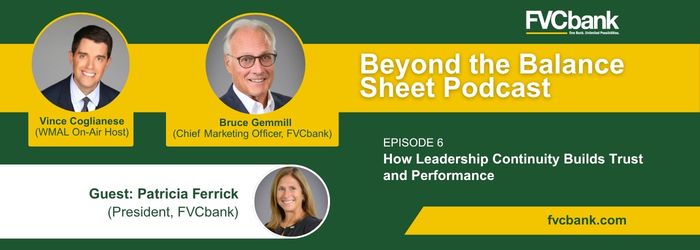
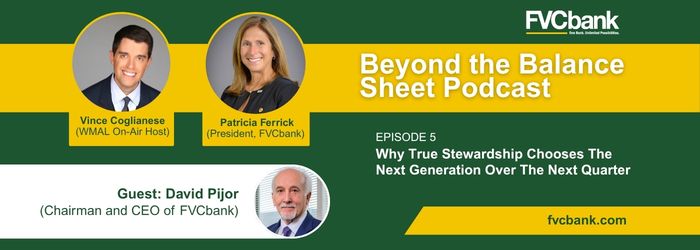
In this episode of Beyond the Balance Sheet, host Vince Coglianese and co-host Patricia Ferrick, President of FVCbank, sit down with Koti Vanga, CEO of Genesis Engineering Solutions, to unpack accountability in an industry where the stakes are, quite literally, orbit high. Through candid stories from missions like the Hubble Space Telescope and James Webb Space Telescope, Koti explains why accountability isn’t just a leadership buzzword at Genesis—it’s the standard that governs every product that leaves the building. He shares how owning outcomes, not just plans, has shaped his first six months leading a company with 33 years of space heritage, and why democratizing information across his team is what makes real accountability possible.
The conversation draws a compelling parallel between the precision required in space engineering and the discipline required to build any lasting institution: both depend on people who execute consistently, take ownership of results, and treat failure as something to solve for, not around. Koti also reflects on the role a strong banking partnership played in his acquisition and scaling of Genesis, underscoring how capital and trust go hand in hand with growth. If you lead a team where the margin for error is thin, or you’re simply curious what it takes to build something that can’t afford to fail, this conversation offers a clear look at accountability in action.
Learn More
Prefer reading over listening? You can read the full transcript of the episode below.
FVCbank’s Beyond the Balance Sheet Podcast – Episode 7
Meet Genesis Engineering Solutions
Vince Coglianese (00:03): Welcome to Beyond the Balance Sheet, where we explore the stories behind the businesses, leaders, and organizations shaping our communities and our economy. I’m Vince Coglianese, and with me, my co-host, Patricia Ferrick, president of FVCbank. As we approach America’s 250th anniversary, our recent episodes have also been reflecting FVCbank’s America 250, 13 Stars initiative, highlighting the leadership principles that have shaped our country and will define its future.
Vince Coglianese (00:33): Today’s conversation fits perfectly with that theme. We’re joined by Koti Vanga, CEO of Genesis Engineering Solutions, an innovative firm supporting critical infrastructure, engineering, and mission-driven projects across both the public and the private sectors. Koti, welcome to the show.
Koti Vanga (00:48): Thank you. Thanks for having me.
Vince Coglianese (00:49): All right, Koti. Tell us all about Genesis Engineering Solutions. What do you do and who do you serve?
Koti Vanga (00:55): Well, to start at the high level, Genesis Engineering Solutions, we are a engineering and manufacturing company. We focus on mission critical hardware and software solutions. We support space, defense, and commercial space, which is booming a lot these days. Anything where you talk about reliability and execution is really matters in terms of the national security and anything to do with the NASA programs, which is no opportunity for failure.
Vince Coglianese (01:30): Yeah, big time. The stakes are very high in space
Space Heritage from Hubble to Webb
Koti Vanga (01:34): Thank you. Yeah, yeah, yeah. We are uh we were part of uh big missions all the way from Hubble space, Hubble missions, uh International Space Station missions, James Webb telescope, uh that’s been part of our lot of heritage for the last 33 years, and now upcoming uh launch called uh Roman Space Telescope, which is going to be looking at into the space and see if there are aliens or not.
Vince Coglianese (01:57): I love that. I love it.
Patricia Ferrick (01:59): What inspired you to start or lead Genesis engineering? Was there a defining moment?
Koti Vanga (02:04): I think it’s hard to pick one moment. I think it’s uh part of the last 15 years of my experience and education. Um I’m an engineer by training and did my MBA from MIT, where we say uh hands, mind, and heart at the same time. That’s our MIT motto. Um, part of that, as I as I keep growing up, I want to do my own thing. And came across Genesis, where I learned uh before coming to Genesis, where I learned like building systems, scaling the programs and companies at the larger organizations, and did the business development M&A space. So part of that I acquired uh Genesis with the help of FVCbank. Thank you for your partnership on there. Um, I took all those learning opportunities to do something my own, and that’s where Genesis came into place.
Vince Coglianese (02:54): Well, you so you’ve got all the right skills. You understand the business environment and you understand the engineering environment. So, what was the breakthrough moment for you? Because that’s the when these these successful companies, they typically have these amazing breakthrough moments where everything defines the trajectory of their company’s future. What was that for you?
Koti Vanga (03:09): Well, honestly, I’ve been here for six months now. Um, but the company’s there for 33 years.
Vince Coglianese (03:15): Yeah.
Koti Vanga (03:15): It’s a lot of space heritage. Uh, there are a lot of mini breakthrough moments across the last 33 years for Genesis, uh, all the way to start the company with the Hubble mission.
Vince Coglianese (03:26): Yep
Koti Vanga (03:26): Uh, and then International Space Station missions. And then for the last 20 years, they worked on James Webb telescope solving some of the complex uh complex problems uh where it’s gonna stay up million miles away from Earth, trying to look out into the space what’s out there.
Vince Coglianese (03:46): Right.
Koti Vanga (03:46): Uh that was a huge success for us. And going into the future, and from my own perspective, when I started this, um the biggest moment for me is to win the customers and the people within my organization, right? That’s that was the key. The last six months, that’s what I’m working on. But uh we are involved in uh many critical missions for national security in defense, and now with the commercial space growing, we’ve been part of a lot of uh critical missions for commercial space companies too. Um so a lot to come, but um one small moment at a time.
What Makes Genesis Different
Vince Coglianese (04:23): That’s so cool. And what differentiates Genesis against other uh uh other people in this space, in the competitive engineering space? How does Genesis stand out?
Koti Vanga (04:31): Uh I would take again like 33 years of space heritage.
Vince Coglianese (04:35): Right.
Koti Vanga (04:35): It’s hard to build uh where there’s no chance for failure. We cannot fail, period, right?
Vince Coglianese (04:40): Yeah.
Koti Vanga (04:41): Um but we also have what differentiates us from other small businesses is like we become a partner, stay close to the execution. Uh part of that, we have both engineering where we design and manufacture under the same roof. Uh with a key, very hard to find key skilled people. I think that’s that’s one of our biggest differentiation. A lot many people either design or manufacture, but we do both. We see real-hand problems, we sit on the manufacturing floor, we react quickly. We our customers heavily, heavily rely on us for that.
Vince Coglianese (05:16): You know, when people hear engineering, they don’t always realize how much it impacts daily life. So, what is Genesis doing that’s making the biggest difference, do you think?
Koti Vanga (05:25): Well, uh the one thing I would say is um think about James Webb telescope. Some of the most complex engineering problems that humanity solved to reach up a million miles away from us and station there. And we played a very big part about it. Uh the engineering goals were solving a problem where the temperature fluctuates from 300 degrees from one side to another side.
Vince Coglianese (05:52): Yes.
Koti Vanga (05:52): We had to solve that and we have to build the systems for it. Um that’s one of our biggest accomplishments, to be honest. When you switch for within one minute going from negative 300 degrees Celsius to positive 500, right?
Vince Coglianese (06:06): Yeah.
Koti Vanga: 06:06): That’s one of the biggest ones.
Vince Coglianese (06:07): It’s massive. I was just looking at that recently with the with the space mission, and you start diving into the details, like not at an engineering level, just a guy who uses the internet. And I’m like, holy crap, the the the differences in temperature in space, that they require real engineering solutions that people like you are thinking through. Right?
Koti Vanga (06:24): Absolutely, absolutely. And it takes a lot of key skill people who works both our people work both at NASA facility and in our building. And we go a lot of back and forth between our these two buildings. Uh, we call ourselves a mini guarded uh guarded NASA uh center. So pretty cool. Yeah.
Infrastructure Investment and Supply Chains
Patricia Ferrick (06:43): From a banking perspective, we see how critical infrastructure investment is to economic growth. What trends are you seeing right now?
Koti Vanga: 06:50): I think the banking point of view, you become a very critical partner for our to scale one. Uh there’s a lot of public-private partnership, and our partnership with you guys touched us not only just to acquisition the company, but growth of the scale who understands the engineering side of the things. Uh, not only the engineering side, not beyond the numbers on the balance sheet, right? That’s what it comes down to. Um I don’t know how many people recognize it. I keep seeing the trends these days, how much valuation these new space commercial startup companies are getting invested into. We’re talking in hundreds and hundreds of million dollars, similar to what AI Space is gaining. That requires a strong partnership from banking, and we are very thankful for you.
Patricia Ferrick (07:38): We’re thankful for you too.
Vince Coglianese (07:39): Now, are we at a turning point in how America invests in infrastructure, do you think?
Koti Vanga (07:43): Absolutely. I hundred percent believe in it. Um starting from a COVID time in 2021, the supply chain disruptions.
Vince Coglianese (07:50): Yep.
Koti Vanga (07:51): Um that’s that’s probably one of the turning points. But beyond that, how much we as a country investing into infrastructure, not only that, into the national security since the Russia-Ukraine war, for example, all the way till the recent uh events in the macroeconomic level, it’s very important to have a fast turnaround supply chain capabilities within this country and who can be who can execute at a fast pace at a lower cost too.
Vince Coglianese (08:22): Yes.
Koti Vanga (08:22): I I think that’s key.
Vince Coglianese (08:23): And there seems like there’s a lot of competition for space infrastructure internationally as well, too.
Koti Vanga (08:28): Absolutely. Absolutely. Uh we are number one, of course, as a country, and we want to maintain that. Uh, but going into when Russia-Ukraine war started, the first image is from space, right? What’s happening on the ground, and that dictates what kind of decisions we’re going to make. So there’s a lot of infrastructure being put in, a lot of investments going into the space.
Leadership Principles and Accountability
Vince Coglianese (08:48): Now, as we approach America’s 250th anniversary, uh FVC Bank has launched what we call the America 250 13 Stars Initiative, highlighting leadership principles that have shaped our country and will define its future.
Patricia Ferrick (09:03): So, Koti, when you think about building the next chapter of America, literally through infrastructure and engineering, what leadership principles stand out most to you?
Koti Vanga (09:12): I think each and every one of them is key. And uh from my point of view, there are a couple of key things that I take it. Innovation is key in the space and defense sector. Uh solving complex problems, that’s one of the big ones. And the precision and reliance on our supply chain and in our capabilities and infrastructure. But most importantly, when I took over this company six months back, accountability became one of the key for me. Um I say that at the end of the day, you have to own the outcome. The outcome of the goals, not just the plan, the results that come out of it.
Vince Coglianese (09:48): Now, how do these principles show up in how you run your company each day? How do how do you how are you thinking about that as you go into the work?
Koti Vanga (09:55): Uh the first thing when I came here six months back is there is a very little information available to me to track and make decisions point of view. Uh when I say accountability, as a CEO, my job is to provide all this information and democratize to all the people so that they can take the information, make the right decision, make accountable for the plans that we put in place and execute it. I think it starts with me, uh, accountable to my people, to my partners, to my investors, and that goes along with my people on the floor executing this.
Patricia Ferrick (10:31): And do you see that mindset being instilled with your team?
Koti Vanga (10:34): Yeah, yeah. I absolutely see it. Uh I see everybody looking at the data points, whatever it is available today. Sometimes all the data is not there. But we have data to a point where we can make decisions quickly that can help our customers meet our deadlines that we planned and promised. And not only that, grow the company, the scalability, the decisions for the investments purposes we need to make, people are the ones who execute it. Yeah, absolutely.
Vince Coglianese (11:02): So you’ve created this culture. What’s the biggest leadership lesson that you’ve gained from this working as the CEO?
Koti Vanga (11:10): It’s a good question. Um I tell myself I don’t have all the answers. I’m sitting with some incredible talented engineers in the building who solved some of the complex problems in the world. Yeah. I don’t have that knowledge. I don’t have that skill set. So I need to acknowledge that fact. And I should not be trying to be that person.
Vince Coglianese (11:30): But you let them know about this weakness? Like you’re not the smartest person in the world.
Koti Vanga (11:35): I absolutely. They know it too. They they know it too. Uh you know, my job is to build the right team, putting the right people in the place and giving them the direction, this is the vision and mission of the company, and we shouldn’t be moving away from it. That’s my job.
Patricia Ferrick (11:50): So as companies grow, culture can be hard to maintain. How have you preserved it, or how do you plan on preserving that as you go forward?
Koti Vanga (11:58): Yeah, I I take one step back to answer this question because uh after 33 years, uh the founder moved into a vice presidential of engineering uh and I took over his role. Uh it’s a transition period uh for everybody, including me and my founder. Um when I say that, it’s it’s uh and there are a lot of people with the multi-generations working in this building. That tells a lot about what culture he built. People were there for 20, 30 years. Um for me, when I come in, um the most important thing for me is to preserve that culture he built and built on top of it. Now I’m adding my leadership principle. One of the principles I talked about is accountability. I’m accountable for myself and I’m accountable for people that I’m working with. And they see that. And um my my belief is when I walk the talk, they will do the same.
Execution in a Zero-Failure Environment
Vince Coglianese (12:52): How in your industry, how do the great companies distinguish themselves from just the good companies? Uh what’s the what’s the distinguishing factor there?
Koti Vanga (13:00): I think all the great comp uh companies, uh, one thing that should uh stand out said they execute. Not one time, not two times, but year after year after year after year.
Vince Coglianese (13:11): Right.
Koti Vanga (13:11): I think that’s execution is key. Um for us as a Genesis, um we have no opportunity for failure. Not a single product or single uh board that goes out of the building. Okay. Because these goes into critical missions. So we need to execute month after month, day after day, year after year. So um we positioned ourselves for the last 33 years in doing that. So consistency and execution.
Vince Coglianese (13:36): How do you how do you safeguard against failure though? I mean, you obviously if it’s a zero failure environment, that kind of um that kind of culture needs to be instilled in all of your conversations, doesn’t it? I mean, is that is that at the top of every conversation, how do we prevent failure?
Koti Vanga (13:52): Absolutely. I mean, part of that is building right people in right positions. Part of that is building systems and processes around them. And we fail when we fail, I want to fail inside the building, developing a product, scrap it out, go back and redo it.
Vince Coglianese (14:09): Right.
Koti Vanga (14:09): But not when it goes to the customer. So failures are an option inside the building, not outside. And the part goes out to the missions.
Vince Coglianese (14:18): Now, uh tell me about how difficult it is to retain talent in a competitive industry like the one you’re in. I mean, obviously you want to keep people around. You just described having uh a multi-almost a was a multi-generational practically uh company. Um how do you keep people? How do you keep the good people?
Koti Vanga (14:33): Well, I’m happy to say nobody left since I took over. That’s good news. Not a single person, believe it or not. Um well, what what it tells is like not just me, the culture beyond my founder built it. Yeah. I’m continuing that forward. It it’s hard. It’s the engineering skill set that solves these kinds of complex problems is hard to find.
Vince Coglianese (14:52): Right.
Koti Vanga (14:52): And when I have an open rec, it’s hard to find the right person. So for me to retain that talent, keeping them in the building, making sure they’re good personally, professionally, and taking care of them matters for most to me.
Talent Retention and Banking Partnership
Patricia Ferrick (15:06): I can imagine. As a growing engineering firm, access to capital and the right banking partner becomes critical. What do you value most in a financial partner?
Koti Vanga (15:15): FVC has been one consistent partner. I call it a wife and husband relationship when it comes to my banking. Uh so FVC has been there since day one when we started this conversation of acquiring this company. And your colleague RT was amazing from day one. Um, right from he understood the business, understood where the growth beyond the numbers can happen for this company, um, the responsiveness, and immediately coming back to if there are any issues or anything, the responsiveness was key, the relationship was key. And uh I think you guys do a great job in terms of that.
Vince Coglianese (15:54): It’s amazing. You know, what advice would you give to other business owners who are trying to navigate growth and financing?
Koti Vanga (16:00): Uh the advice in terms of the capital and the banking partner, like I said, it’s like you need a right partner. Right. Right partner, right line of credit. Um, you know, people who trust and believe in you, in the company and you to take it to the next scalable level. I think that’s going to be very key. And finding that right partner is hard, but you want to go for it, FVC is there.
The Next Five Years in Space
Vince Coglianese (16:20): All right, so tell us what the next couple years look like. With Genesis Engineering, next three to five years, what do you see happening?
Koti Vanga (16:26): Um at a macroeconomic level, the space is growing, like I said. The commercial space and NASA partnerships. There’s a lot of change happening, and then we see those investments. We are in a position with the 30 plus years of space heritage with no failures. We are looking at scaling this company. We are looking at investing in our capabilities uh people and equipment-wise. So we see a lot of growth ahead. We got a backlog to support that growth path and a huge pipeline to invest into. So we are we are looking to grow.
Patricia Ferrick (16:56): It’s exciting. So, what excites you most about the future of engineering in America?
Koti Vanga (17:00): Uh especially in space, uh, the innovation. I mean, we saw what Elon Musk did with this rocket company, and there are like four other rocket companies coming along. The innovation is key here. I mean, that’s been driving this growth in this industry pretty fast, pretty significant levels of growth, and at the same time um keeping the national security in mind. So it’s growing.
Vince Coglianese (17:23): Yeah, I mean, the innovation has led to us being able to do things we never thought was possible, which is kind of the point of innovation. You can catch a rocket now, you can you we can actually retrieve the International Space Station instead of letting it burn up in the atmosphere. These were thought processes that nobody had before because we’ve innovated.
Koti Vanga (17:40): And that’s true. And to follow up on that point, uh, we have uh commercial space companies building international space centers style. There are companies like Vast, um uh and we are building new space suits to support that, landing on the moon. Artemis is one of the biggest accomplishments in recent times, and we are following up by that with the 3-4 and landing on the moon. So there is incredible innovation going to happen over the next five years.
What Most People Miss About Space
Vince Coglianese (18:06): So, in that vein, what should the rest of us be paying attention to right now that we’re probably overlooking?
Koti Vanga (18:11): Ooh, um as much as we keep hearing the buzzword of AI, but space is going to be as similar explosion in growth from my point of view. So, yeah, keep an eye on that. You think that the growth in space technology is going to be similar to what we’re seeing in AI right now? I believe so. I mean, look at the data centers that they want to plant in space because we don’t have enough energy to support the infrastructure that we want to build for data centers. There are companies that is coming out purely based to deploy uh data centers in the space.
Vince Coglianese (18:42): So we can generate power from the sun.
Koti Vanga (18:44): Correct.
Vince Coglianese (18:44): Yeah.
Koti Vanga (18:45): Unlimited energy.
Vince Coglianese (18:46): Yeah, or at least until the sun burns up.
Koti Vanga (18:50): That’s right.
Vince Coglianese (18:51): You’re an engineering guy. You know it’s not
Koti Vanga (18:53): We’ll solve that.
Vince Coglianese (18:53): Listening this thing is unlimited. Well, that’s really cool.
Vince Coglianese (18:57): Uh, Koti this has been a fascinating conversation. Thank you for, for joining us here and for telling us about the work you’re doing to help build and support critical infrastructure all across our country.
Final Takeaways and Thanks
Vince Coglianese (18:57): Uh Cody, this has been a fascinating conversation. Thank you for joining us here and for telling us about the work you’re doing to help build and support critical infrastructure all across our country.
Koti Vanga (19:06): Yeah, thank you. Thank you for having me. Really enjoyed the conversation.
Patricia Ferrick (19:09): Yes, thank you, Koti, and thanks to all of you for listening to Beyond the Balance.
Primary Sidebar
Banking Hours
9am — 5pm EST
Monday — Friday
703.436.3800
If your debit card is lost or stolen after hours, please call us for assistance: 703.436.4740
Contact Us
Branch Locations
Conveniently located in your
neighborhood, we are right
around the corner.
Find a Branch
Footer
Contact Us
Headquarters:
- 11325 Random Hills Road
- Suite 240
- Fairfax, VA 22030
Phone: 703.436.3800
Routing Number: 056009505
Social Icon
Social Icon

Download Our Mobile App
Business


Personal
Business Banking
Personal Banking
Quick Links

© 2026 FVCbank · Powered by 321 Web Marketing