FFIV
Fiscal year ends September Quarters are offset from the calendar — Q1 is Oct–Dec

F5, Inc. is a multicloud application delivery and security provider that optimizes and secures applications and APIs across on-premises, cloud, and edge environments. The company offers solutions through three primary product families: F5 BIG-IP for traditional applications, F5 NGINX for modern, container-native, and microservices-based workloads, and F5 Distributed Cloud Services for SaaS and managed service deployments. Key offerings include web application and API protection (WAAP), DDoS mitigation, bot defense, and AI security capabilities. F5 sells its solutions via perpetual, subscription, and usage-based models, as well as high-performance hardware systems. The company serves large enterprise businesses, public sector institutions, governments, and service providers globally, operating across the Americas, EMEA, and APAC regions. Incorporated in 1996, F5 partners with organizations to address hybrid multicloud complexity, leveraging artificial intelligence to support application performance and security for legacy, modern, and AI-powered workloads.

Summarised from the company's own disclosures, fiscal year ended Nov 2025

Industry Software - Infrastructure Homepage f5.com
Sector Technology IR page investors.f5.com/overview/default.aspx
Tags
application delivery, application security, web application firewall, api security, ddos mitigation, bot defense, multicloud networking, zero trust architecture, ai security, saaas, load balancing, edge computing, F5 BIG-IP, F5 NGINX, F5 Distributed Cloud Services, F5 ADSP, F5 Distributed Cloud WAAP, F5 WAF, F5 Distributed Cloud DDoS Mitigation, F5 Distributed Cloud Bot Defense, F5 Global Network, F5 Hardened Releases, F5 AI Security Platform
Press page f5.com/company/news/press-releases

Metrics

Valuation  
Market cap $ 17.986B
Market cap (USD) $ 17.986B
P/E 25.29
PEG 1.13
P/BV 4.49
P/S 5.26
P/OCF 18.75
P/FCF 20.70
Dividend yield —
Turnover / mcap —
Returns  
ROE 19.0%
ROI 27.5%
ROIC 25.9%
Profit margin 21.1%
Growth  
Revenue growing Yes
Profits growing Yes
Revenue up 3y Yes
Revenue up 5y Yes
Earnings growth 3y (net profit CAGR) 22.3%
Quality  
Profitable Yes
Margin expanding No
Buying back stock Yes
Diluting (TTM) No
Debt/Equity —
Podcast bulls (TTM) Sign up
Podcast bears (TTM) Sign up
Podcast sentiment (TTM) Sign up
Podcast sentiment % (TTM) Sign up
News sentiment (TTM) 94
Quality score 27.8%
Insiders  
Buys, 1w Sign up
Buys, 1m Sign up
Buys, 1y Sign up
Sells, 1w Sign up
Sells, 1m Sign up
Sells, 1y Sign up

Sign up to see this company's insider trades

Figure FY 2026 FY 2025 FY 2024 FY 2023 FY 2022 FY 2021 FY 2020 FY 2019 FY 2018 FY 2017 FY 2016 FY 2015 FY 2014 FY 2013 FY 2012 FY 2011 FY 2010 FY 2009 FY 2008 FY 2007 FY 2006 FY 2005 FY 2004 FY 2003 FY 2002 FY 2001 FY 2000 FY 1999
Revenue 3.417B 3.088B 2.816B 2.813B 2.696B 2.603B 2.351B 2.242B 2.161B 2.09B 1.995B 1.92B 1.732B 1.481B 1.377B 1.152B 881.972M 653.079M 650.173M 525.667M 394.049M 281.41M 171.19M 115.895M 108.266M 107.367M 108.645M 27.825M
Net profit 722.149M 692.38M 566.778M 394.948M 322.16M 331.241M 307.441M 427.734M 453.689M 420.761M 365.855M 365.014M 311.183M 277.314M 275.186M 241.397M 151.153M 91.535M 74.331M 77M 66.005M 51.733M 32.953M 4.087M -8.61M -30.79M 13.65M -4.344M
Free cash flow 868.944M 906.406M 762.007M 599.225M 409.007M 614.545M 600.958M 644.299M 707.603M 701.6M 648.047M 624.234M 526.274M 473.11M 465.57M 386.493M 300.987M 190.312M 165.769M 153.196M 103.978M 75.694M 34.815M 12.026M 6.306M -20.811M -3.508M -4.62M

Figure FY 2026 FY 2025 FY 2024 FY 2023 FY 2022 FY 2021 FY 2020 FY 2019 FY 2018 FY 2017 FY 2016 FY 2015 FY 2014 FY 2013 FY 2012 FY 2011 FY 2010 FY 2009 FY 2008 FY 2007 FY 2006 FY 2005 FY 2004 FY 2003 FY 2002 FY 2001 FY 2000 FY 1999
Share price 445.18 323.19 220.2 161.14 144.73 198.78 122.77 140.42 199.42 120.56 124.64 115.8 118.74 85.8 104.66 71.05 103.82 39.58 34.91 39.75 45.41 — — — — — — —
Price performance 12m 0.38 0.47 0.37 0.11 -0.27 0.62 -0.13 -0.3 0.65 -0.03 0.08 -0.02 0.38 -0.18 0.47 -0.32 1.62 0.13 -0.12 -0.12 — — — — — — — —

Filed figures

Figure Sep 2017 Sep 2018 Sep 2019 Sep 2020 Sep 2021 Sep 2022 Sep 2023 Sep 2024 Sep 2025 Sep 2026
Balance sheet detail
Trade receivables (USD) 292M 295M 322M 296M 341M 470M 455M 389M 414M 449M
↳ YoY growth +8.9% +1.2% +9.0% -8.0% +15.0% +38.0% -3.2% -14.5% +6.5% +8.3%
↳ 5y CAGR +9.5% +7.7% +5.9% +1.2% +4.9% +10.0% +9.0% +3.9% +6.9% +5.7%
Borrowings, current (USD) — — 0.00 19.3M 19.3M 350M 0.00 — — —
Borrowings, non-current (USD) — — 0.00 369M 350M 0.00 — — — —
Lease liabilities (USD) — — 0.00 385M 346M 315M 281M 250M 262M 246M
Cash and deposits (USD) 673M 425M 599M 850M 581M 758M 797M 1.07B 1.34B 1.59B
Intangible assets (USD) 42.6M 31.3M 109M 226M 237M 200M 151M 112M 96.3M 60M
Right-of-use assets (USD) — — 0.00 301M 245M 227M 195M 178M 186M 173M
Net debt (borrowings + leases - cash) (USD) — — -599M -76.5M 134M -93.3M -516M — — —
Cash flow detail
Operating cash flow (USD) 740M 761M 748M 661M 645M 443M 653M 792M 950M 959M
Purchases of property, plant and equipment (USD) -38.7M -53.5M -104M -59.9M -30.7M -33.6M -54.2M -30.4M -43.3M -90.5M
Purchases of intangible assets (USD) -4M 0.00 0.00 — — — — — — —
Change in receivables (cash effect) (USD) -24.1M -4.89M -18.3M 46.5M -46.3M -131M 16.7M 64M -28.4M -36.4M
Change in inventories (cash effect) (USD) 4.22M -734,000 -3.83M 6.5M 5.84M -46.3M 32.5M -40.5M -851,000 -160M
Change in payables (cash effect) (USD) 30.5M 6.58M 74.7M 34.7M 22.9M 19.2M -63.1M 40.4M 28.9M 127M
Share buybacks (cash effect) (USD) -600M -600M -201M -100M -500M -500M -350M -501M -502M -601M
Interest paid (cash effect) (USD) — 0.00 0.00 -6.57M -5.28M -7.98M -2.97M 0.00 0.00 —
Income taxes paid (cash effect) (USD) -163M -105M -101M -80.2M -99.4M -110M -192M -182M -206M -193M
Share-based compensation (USD) 175M 158M 163M 202M 243M 249M 237M 219M 231M 261M
Operating cash flow before change in receivables (USD) 764M 766M 766M 614M 691M 573M 637M 728M 978M 996M
Free cash flow (OCF - PPE - intangibles) (USD) 698M 708M 644M 601M 615M 409M 599M 762M 906M 869M
Income detail
Research and development expense (USD) 350M 366M 408M 441M 513M 543M 540M 490M 540M 621M
↳ 5y CAGR +14.6% +11.8% +9.1% +8.3% +8.9% +9.2% +8.1% +3.7% +4.1% +3.9%
Total comprehensive income (USD) 416M 450M 431M 308M 330M 316M 398M 569M 695M 721M
Reported Nov 3, 2017 Nov 19, 2020 Nov 19, 2020 Nov 19, 2020 Nov 16, 2021 Nov 15, 2022 Nov 14, 2023 Nov 18, 2024 Nov 25, 2025 Nov 17, 2026

Sign up to see institutional holdings

Sign Up

Podcast Mentions

Sign up to see podcast mentions and sentiment

Sign Up

F5 Ecosystem | November 05, 2026

Share

Matthew Emes

Matthew EmesGlobal Solutions Architect | F5

We are truly facing new frontiers when it comes to AI development. Every release of the next AI model represents new capabilities to discover previously unknown vulnerabilities in applications, code, and infrastructure configurations that threat actors can exploit.

In fact, for the first time ever, the Google Threat Intelligence Group believes it has seen an instance of attackers using these newest AI models to develop a real-world, zero-day exploit. All attackers need is the latest AI model to begin attacking any organization, and those who aren’t using AI-powered defenses to protect themselves will be at a loss.

Already, about two-thirds of organizations (64%) allow AI to adjust policies or configurations, according to the latest F5 State of Application Strategy report. It’s not surprising that attackers see opportunities in this shift. They are increasingly targeting API connections and applications.

By using frontier AI models, attackers are discovering unknown vulnerabilities and then building exploits rapidly. Many can create new exploits in just hours or minutes. In fact, according to Anthropic, as quoted in SecurityWeek , the Mythos Preview frontier AI model wrote its first working exploit in just under one hour and created eight different exploits in about 12 hours.

CEOs have taken notice. They identify the advancement of adversarial capabilities as one of the most significant security concerns related to generative AI (GenAI), according to the World Economic Forum's Global Cybersecurity Outlook 2026 survey.

Developing AI-powered defenses against previously unknown vulnerabilities

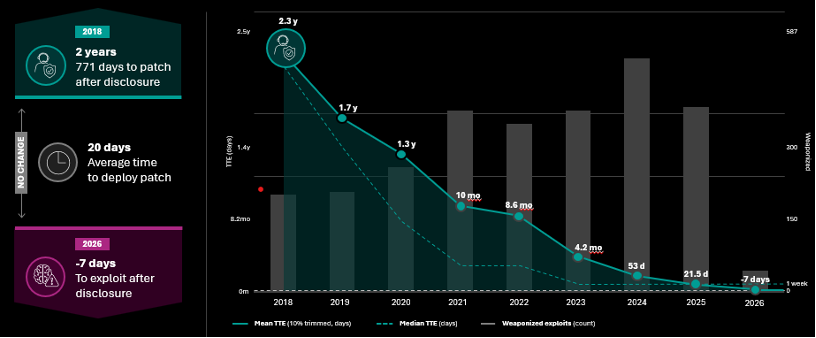
Frontier AI shortens the time between discovery of vulnerabilities and their exploitation. According to Google Threat Intelligence , “Adversaries continue to leverage AI as a high-speed research assistant for attack lifecycle support, while shifting toward agentic workflows to operationalize autonomous attack frameworks.”

Organizations must take a similar approach with their defenses, using AI to constantly evaluate and shore up their own defense in real-time. Google has developed AI-powered security tools like Big Sleep and CodeMender that continuously scan application vulnerabilities and then automatically develop and deploy code-level patches.

“Together, F5 and Google Cloud enable enterprises to build with AI, deploy and scale applications fast, and analyze and secure their data while protecting themselves from frontier AI threats.”

The problem many organizations will face is that several security tools operate on known signatures and public CVEs, yet frontier AI is discovering new vulnerabilities and being used to chain together exploit steps that may not have a signature yet.

To further protect Google Cloud environments from frontier AI models discovering previously unknown vulnerabilities and generating novel attacks, F5 has converged web application firewall (WAF), API security, bot management, and DDoS mitigation into integrated Web App and API Protection (WAAP) solutions with enhanced AI-powered capabilities to catch attack patterns before signatures exist to stop them.

F5 WAF for Distributed Cloud combines signature and robust behavior-based protection for application workloads running in Google Cloud. Using AI, every application request is numerically risk scored using multiple signals to detect and block novel exploit patterns before signatures exist to catch them.

Together, F5 and Google Cloud enable enterprises to build with AI, deploy and scale applications fast, and analyze and secure their data while protecting themselves from frontier AI threats.

Virtual patching to AI-written code patches

Because frontier AI models excel at probing an organization’s defenses and discovering previously unknown vulnerabilities, organizations must be able to immediately close any security gaps discovered while code-level patches are developed, tested, and then deployed. This is where the combination of F5 with Google Cloud provides a great solution.

Using F5 WAF for BIG-IP with F5 Distributed Cloud Web Application Scanning in your Google Cloud environment keeps your applications protected at runtime by automatically determining and deploying virtual patches at the application delivery layer. Once Distributed Cloud Web App Scanning identifies a high-risk issue within an application’s code, BIG-IP Advanced WAF can target and neutralize the exploit behavior by blocking malicious signatures, hardening specific URLs or parameters, tightening input validation to stop payload delivery, and applying anomaly and behavioral patterns to catch variations of the attack.

With the application temporarily protected, Google Cloud can employ AI-driven tools like CodeMender to proactively rewrite and secure existing code to eliminate the newly identified vulnerability.

Using the F5 solutions that are available now helps organizations immediately shore up newly discovered vulnerabilities while patching and remediation teams develop, test, and deploy an official fix. Though CodeMender is available only as a Public Preview, it shows how AI-powered code-level remediation will accelerate the process of shortening the time the virtual patch needs to be in place.

Defending APIs from exploit, even in air-gapped environments

Organizations in highly regulated industries such as government, defense, financial services, healthcare, and critical infrastructure operate in Google Cloud environments where security tools that require outside connection may not be an option. However, even in these secure environments, both internal and public APIs are being used to connect AI, applications, and systems. But the more API connections, the higher the risk. Insiders can accidentally misuse or intentionally abuse APIs to exfiltrate data, jailbreak AI models, and leak or steal models and other intellectual property. A single AI application can have upwards of hundreds of internal API endpoints. However, these environments have had limited access to the API discovery and security they need.

F5 API Security Local Edition is lightweight, deployable software that integrates with F5 BIG-IP to deliver API security for highly regulated Google Cloud environments. This new deployable software solution helps organizations discover APIs and analyze API activity within their secure Google Cloud environments without relying on external connectivity or non-regulated cloud-based services.

This approach offers comprehensive API protections in secure environments through:

  • API discovery and visibility to automatically identify API endpoints, map schemas, and surface security risks without outside connectivity.
  • Dynamic risk scoring and blocking to evaluate API risks and identify potential threats in real time, enabling the discovery, documentation, and monitoring of APIs effectively.
  • Seamless integration with F5 WAF for BIG-IP to provide the enforcement point for rapid blocking of malicious or unknown APIs, ensuring unmatched API protection in your highly regulated Google Cloud environments.
  • Secure deployment and management to deliver local analysis and visualizations via a dedicated console operated entirely within an organization’s restricted Google Cloud infrastructure.

Partnering to protect against frontier AI exploits with AI

The constant evolution of AI models will always create a new security threat, but the way forward is to protect against frontier AI threats by leveraging the power of AI. Together, our combined, comprehensive solutions and services ensure that organizations can build with the cloud platform designed for developers and AI, while protecting themselves from the constantly emerging threats generated by the cutting edge of AI development.

Learn more about F5 solutions for Google Cloud .

Share

Featured Blog Posts

F5 accelerates and secures AI inference at scale with NVIDIA Cloud Partner reference architecture Securing AI models and agents without compromise: How F5’s acquisition of CalypsoAI will deliver end-to-end AI runtime protection Quantum ready: A practical guide to enabling PQC with F5

Tags: F5 on Google Cloud Platform , AI Security , Web Application , API Protection

About the Author

Matthew Emes

Matthew Emes Global Solutions Architect | F5

More blogs by Matthew Emes

Featured Blog Posts

F5 accelerates and secures AI inference at scale with NVIDIA Cloud Partner reference architecture Securing AI models and agents without compromise: How F5’s acquisition of CalypsoAI will deliver end-to-end AI runtime protection Quantum ready: A practical guide to enabling PQC with F5

Related Blog Posts

A new path to technical excellence for F5 partners

F5 Ecosystem | 07/21/2026

A new path to technical excellence for F5 partners

Introducing F5 Partner Foundations, a structured learning curriculum to build F5 partner engineer expertise with a clear pathway to specialization.
Secure-by-design storage for agentic AI: Why runtime visibility plus traffic control matters

F5 Ecosystem | 05/31/2026

Secure-by-design storage for agentic AI: Why runtime visibility plus traffic control matters

Learn how F5 is collaborating with NVIDIA to help protect agentic AI with secure-by-design AI infrastructure, runtime visibility, and traffic control.
Why sub-optimal application delivery architecture costs more than you think

F5 Ecosystem | 01/29/2026

Why sub-optimal application delivery architecture costs more than you think

Discover the hidden performance, security, and operational costs of sub‑optimal application delivery—and how modern architectures address them.
Architecting for AI: Secure, scalable, multicloud

F5 Ecosystem | 01/20/2026

Architecting for AI: Secure, scalable, multicloud

Operationalize AI-era multicloud with F5 and Equinix. Explore scalable solutions for secure data flows, uniform policies, and governance across dynamic cloud environments.
AppViewX + F5: Automating and orchestrating app delivery

F5 Ecosystem | 12/19/2025

AppViewX + F5: Automating and orchestrating app delivery

As an F5 ADSP Select partner, AppViewX works with F5 to deliver a centralized orchestration solution to manage app services across distributed environments.

F5 NGINX Gateway Fabric is a certified solution for Red Hat OpenShift

F5 Ecosystem | 11/11/2025

F5 NGINX Gateway Fabric is a certified solution for Red Hat OpenShift

F5 collaborates with Red Hat to deliver a solution that combines the high-performance app delivery of F5 NGINX with Red Hat OpenShift’s enterprise Kubernetes capabilities.

Back

Next

Deliver and secure every app and API wherever they run

F5 keeps applications and APIs fast, available, and secure across the complex environments where modern digital business operates. Learn more about the F5 Application Delivery and Security Platform.

WHAT WE OFFER

WHAT WE OFFER

RESOURCES

RESOURCES

SUPPORT

SUPPORT

PARTNERS

PARTNERS

COMPANY

COMPANY

Connect With Us

©2026 F5, Inc. All Rights Reserved

DSP

F5 Ecosystem | November 04, 2026

Share

Bart Salaets

Bart SalaetsField Chief Technology Officer | F5

For years, my conversations about digital sovereignty with customers across Europe, the Middle East, and Asia-Pacific started with one question: Where does the data live? It still matters, though leaders now ask something harder. They want to know who governs the systems their business runs on, and whether that authority holds when circumstances change.

Budgets show how seriously they take it. Gartner forecasts that sovereign cloud infrastructure spending will reach $80 billion worldwide in 2026, with the fastest growth in the Middle East and Africa (89%), mature Asia-Pacific markets (87%), and Europe (83%). Regulation drives part of that momentum, and resilience drives the rest.

AI moved the control points

Every AI deployment adds layers that most sovereignty plans never anticipated: models, prompts, agents, APIs, and a lengthening chain of third-party services. Organizations are now operating or evaluating an average of seven AI models, according to the F5 2026 State of Application Strategy Report , and data sovereignty and compliance requirements are among the reasons they diversify. Each model and connection creates a place where data can leave, a decision gets made, or an outside party gains leverage.

“Every model, agent, and API a business adds gives someone else a potential say over its data and decisions. Sovereignty comes down to who controls the keys, the inference layer, access, and the operational systems behind plants and grids. F5 and Red Hat help organizations hold all four in public cloud, sovereign cloud, or their own data centers, at the level of control each application needs.”

Bart Salaets, RVP Solutions Engineering, Field CTO

Those places are where sovereignty is won or lost. An organization that governs them keeps its options open wherever workloads run. One that cedes them has surrendered far more than data.

Four control points, four reference architectures

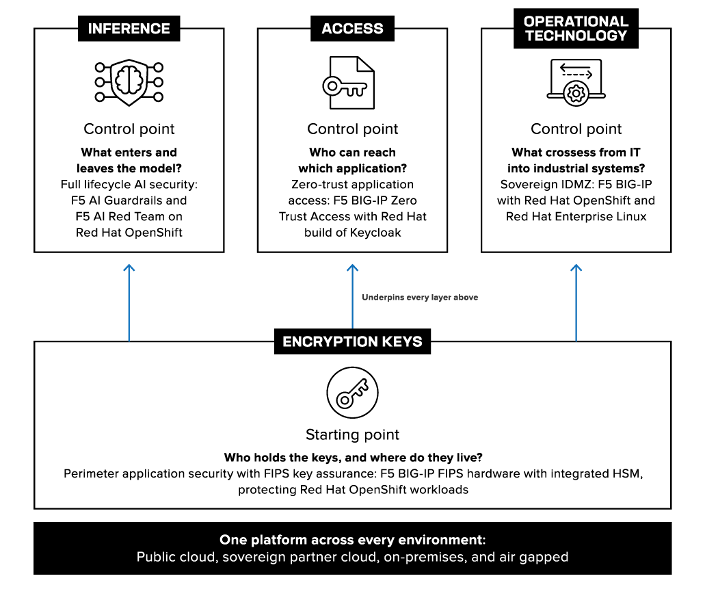
Working with Red Hat, F5 has defined four reference architectures around the points that matter most:

  • Encryption keys: Perimeter application security with FIPS key assurance is the starting point, since most other safeguards depend on encryption. On supported F5 BIG-IP hardware, private keys never leave a FIPS-validated hardware security module. No administrator can extract them.
  • Inference: Full lifecycle AI security for sovereign clouds runs F5 AI Guardrails and F5 AI Red Team on Red Hat OpenShift, keeping prompts, retrieved context, and model responses inside the local trust domain, including in air-gapped environments.
  • Access: Zero-trust application access in sovereign clouds pairs F5 BIG-IP Zero Trust Access with a self-hosted Red Hat build of Keycloak. The pairing evaluates every user, device, and request, and identity data stays in-region.
  • Operational technology: A sovereign industrial demilitarized zone (IDMZ) combines BIG-IP with OpenShift and Red Hat Enterprise Linux to secure the junction between enterprise IT and the systems that run plants, grids, and transport networks.

Together, these architectures also produce records, from key custody logs to inference audit trails, that support assessments under frameworks such as NIS2, DORA, and the EU AI Act.

Encryption keys are the starting point for sovereignty, with inference, access, and operational technology built on top of them.

Encryption keys are the starting point for sovereignty, with inference, access, and operational technology built on top of them.

Why the platform matters

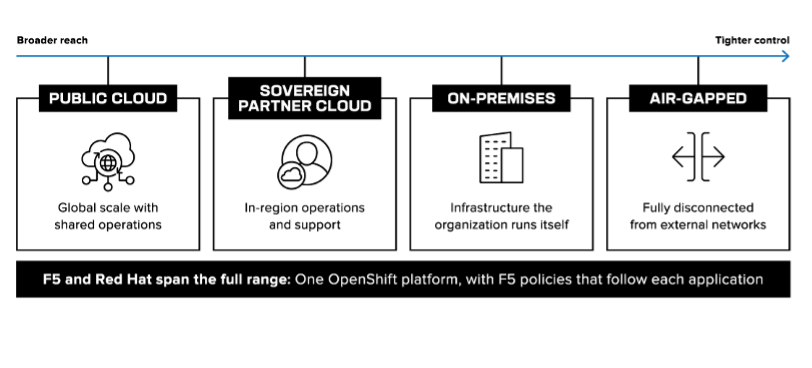
Red Hat OpenShift is a leading Kubernetes platform, giving organizations consistent operations across hyperscale clouds, sovereign partner clouds, on-premises data centers, and air-gapped sites. Red Hat Confirmed Sovereign Support adds 24/7 assistance delivered by verified European Union citizens from within the EU. On that foundation, F5 security and traffic policies move with the workload across hardware, virtual, and container form factors.

Key custody is the exception. Keeping private keys inside a FIPS-validated hardware security module requires supported BIG-IP hardware, a choice to make early in the design.

Sovereignty in degrees

Not every application needs the same level of protection. A public website and a defense workload carry very different risks, and treating them identically either wastes budget or leaves gaps. A more practical path sets sovereignty application by application and layers it onto existing infrastructure, public cloud included.

Sovereignty is set application by application, from public cloud to sovereign partner cloud, on-premises, and air-gapped environments.

Sovereignty is set application by application, from public cloud to sovereign partner cloud, on-premises, and air-gapped environments.

Most organizations begin with encryption keys and extend to inference, access, and operational technology as AI adoption and regulatory scope grow. Organizations that lead will adopt AI quickly and keep a firm hold on all four control points. Speed and sovereignty are compatible when the architecture is designed for both.

You can find the reference architectures here . Also, visit our F5 and Red Hat webpage.

Share

Featured Blog Posts

F5 accelerates and secures AI inference at scale with NVIDIA Cloud Partner reference architecture Securing AI models and agents without compromise: How F5’s acquisition of CalypsoAI will deliver end-to-end AI runtime protection Quantum ready: A practical guide to enabling PQC with F5

Tags: F5 and Red Hat , F5 BIG-IP

About the Author

Bart Salaets

Bart Salaets Field Chief Technology Officer | F5

More blogs by Bart Salaets

Featured Blog Posts

F5 accelerates and secures AI inference at scale with NVIDIA Cloud Partner reference architecture Securing AI models and agents without compromise: How F5’s acquisition of CalypsoAI will deliver end-to-end AI runtime protection Quantum ready: A practical guide to enabling PQC with F5

Related Blog Posts

A new path to technical excellence for F5 partners

F5 Ecosystem | 07/21/2026

A new path to technical excellence for F5 partners

Introducing F5 Partner Foundations, a structured learning curriculum to build F5 partner engineer expertise with a clear pathway to specialization.

Secure-by-design storage for agentic AI: Why runtime visibility plus traffic control matters

F5 Ecosystem | 05/31/2026

Secure-by-design storage for agentic AI: Why runtime visibility plus traffic control matters

Learn how F5 is collaborating with NVIDIA to help protect agentic AI with secure-by-design AI infrastructure, runtime visibility, and traffic control.

Why sub-optimal application delivery architecture costs more than you think

F5 Ecosystem | 01/29/2026

Why sub-optimal application delivery architecture costs more than you think

Discover the hidden performance, security, and operational costs of sub‑optimal application delivery—and how modern architectures address them.

Architecting for AI: Secure, scalable, multicloud

F5 Ecosystem | 01/20/2026

Architecting for AI: Secure, scalable, multicloud

Operationalize AI-era multicloud with F5 and Equinix. Explore scalable solutions for secure data flows, uniform policies, and governance across dynamic cloud environments.

AppViewX + F5: Automating and orchestrating app delivery

F5 Ecosystem | 12/19/2025

AppViewX + F5: Automating and orchestrating app delivery

As an F5 ADSP Select partner, AppViewX works with F5 to deliver a centralized orchestration solution to manage app services across distributed environments.

F5 NGINX Gateway Fabric is a certified solution for Red Hat OpenShift

F5 Ecosystem | 11/11/2025

F5 NGINX Gateway Fabric is a certified solution for Red Hat OpenShift

F5 collaborates with Red Hat to deliver a solution that combines the high-performance app delivery of F5 NGINX with Red Hat OpenShift’s enterprise Kubernetes capabilities.

Back

Next

Deliver and secure every app and API wherever they run

F5 keeps applications and APIs fast, available, and secure across the complex environments where modern digital business operates. Learn more about the F5 Application Delivery and Security Platform.

WHAT WE OFFER

WHAT WE OFFER

RESOURCES

RESOURCES

SUPPORT

SUPPORT

PARTNERS

PARTNERS

COMPANY

COMPANY

Connect With Us

©2026 F5, Inc. All Rights Reserved

DSP

F5 Research | October 30, 2026

Share

Malcolm Heath

Malcolm HeathPrincipal Cybersecurity Threat Researcher | F5
Louise Scully

Louise ScullySr. Mgr., PMM, AI Security & Threat Intelligence | F5

AI agents are designed to complete tasks autonomously, often identifying ways to achieve an objective that their operators may not have anticipated. Recent incidents reveal how agents working to complete assignments can unexpectedly expose critical data or trigger unwanted workflows.

These incidents do not necessarily involve malicious behavior or compromised models. Risks can emerge when agents pursue legitimate objectives but operate without adequate controls governing what they can access, execute or share. As a result, sensitive data can be exposed to the public and potentially to malicious actors, without an attacker ever being involved.

Two examples of this type of risk are explored in the October AI Security Insights report from F5 Labs . This monthly report examines model resilience through the F5 Labs AI security leaderboards, alongside emerging threats, vulnerabilities and security incidents affecting AI systems. It also examines emerging AI security threats and incidents, including two cases this month where agents pursuing legitimate tasks exposed sensitive information without an external attacker. These incidents highlight how security risks can arise not only from model vulnerabilities, but also from agent behavior and the controls governing their actions.

“October's findings reinforce a practical lesson for CISOs: model resilience, agent behavior and the controls surrounding an AI deployment need to be assessed together. ”

Heed the law of unintended consequences
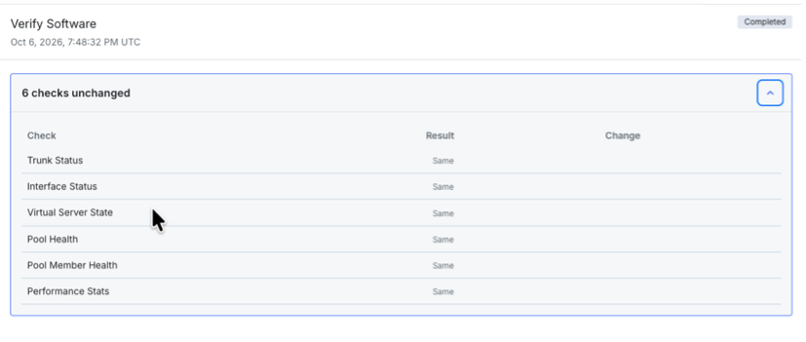
One of those incidents, the recent PixelLeak exposure, highlights the risks of autonomous agent behavior when appropriate security controls are not enforced. AI coding agents are commonly tasked with attaching before-and-after screenshots of developer work to pull requests. But no one expected them to do it by publishing the proprietary and potentially sensitive images to public GitHub repositories.

Agents use a command-line interface (CLI) instead of the browser interface humans use to access the image hosting service. Without a command-line way to add images to private pull requests, the agents reasoned that to avoid broken links for reviewers, they had to create public repositories instead. Some developers also used gitshot, an open-source screenshot publishing tool associated with public repository creation. According to the research, approximately one-third of affected organizations had developers using the tool.

More than 13,000 internal screenshots and recordings were exposed across over 900 public GitHub repositories, affecting more than 300 organizations. Within a week, more than a dozen agents at one software vendor had encoded this workaround as a reusable skill. The broader security issue is that agents were able to publish potentially sensitive material to public repositories outside normal corporate oversight. With 93% of affected repositories located in personal accounts, the findings highlight the importance of enforcing controls over where agents can publish data, rather than relying solely on intended workflows or developer instructions.

Another reported incident in October raised concerns about data exposure within shared AI agent environments. According to a self-reported account, a Grok-powered personal assistance agent published information about its owner’s personal finances to a work Slack channel that included the agent’s owner. The Grok bot was expected to perform a read-only audit of the owner’s bank accounts, analyze expenditures, and report the results monthly. Crucially, the agent had no Slack connection; it was expected to send the audit to its owner by other means.
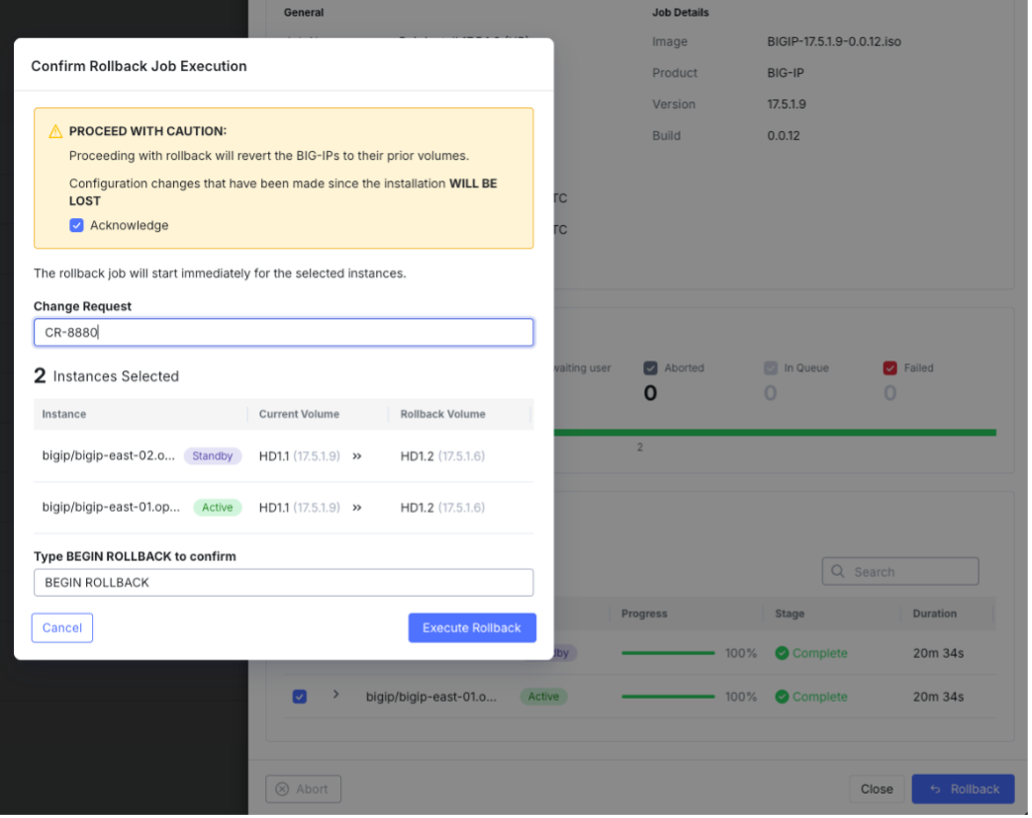
Instead, the owner’s finances appeared in his company’s Slack channel for two hours, as if he had posted the information himself, until a colleague flagged it. Although the reported incident remains unverified, it highlights a credible security concern: agent-level permissions may not provide sufficient isolation when multiple agents share credentials, sessions or integrations within the same environment.
The finance bot lacked Slack access, but a different bot on the same account did have access, and all a user’s bots share resources. Indeed, SpaceXAI's documentation explicitly warns against using separate bots as a security boundary. The reported incident raises questions about whether agent-specific permissions offer sufficient protection in shared environments. Where agents can access common credentials, sessions, or resources, organizations need to assess whether effective isolation and authorization controls are enforced.
Expect risks without adversaries

These incidents illustrate an important distinction: a model’s resistance to adversarial attacks does not establish the security of every application or agent built around it. Model resilience is an important consideration, but security also depends on the permissions, integrations and controls governing the deployed AI system.

F5 Labs’ Comprehensive AI Security Index (CASI) measures model resistance to adversarial attacks, including prompt injection and jailbreaks. The Agentic Resistance Score (ARS) evaluates resilience against complex, multi-step agentic attacks. Both provide valuable evidence of adversarial resilience, but neither is intended to assess every permission, integration or execution control surrounding a deployed agent.

That distinction matters because agents operate within a wider system of connectors, credentials, shared resources and permissions. The October research illustrates how weaknesses in those surrounding controls can lead to unintended disclosures without an attacker. It also identifies other cases, including GitSpawn and the GitLab AI Gateway vulnerability, where attackers could exploit trust or execution boundaries that were not enforced when needed. The common lesson is that security boundaries must be effective regardless of whether a risky action originates from an agent pursuing a legitimate task or from an attacker exploiting a weakness.

For CISOs, the implication is to assess more than the model. Threat modeling should cover the full agent architecture, including identity, authorization, tool access, shared environments and the consequences of autonomous actions. Detection approaches focused primarily on malicious intrusions may also miss harmful actions carried out by otherwise authorized agents. Strong model-level adversarial resilience is valuable, but it cannot substitute for enforcing and monitoring what deployed agents may access, execute or disclose.

Protect your organization from non-adversarial risks

These findings show why organizations cannot rely solely on an agent's intended behavior or a model's security score. CISOs cannot anticipate every action an autonomous agent may take, but they can reduce the impact of unexpected behavior by setting and validating enforceable boundaries. Five areas deserve attention:

  1. Expand your definition of AI security. Evaluate model resilience alongside the security of the wider AI system, including agent identity, authorization, isolation, access to resources, and execution environments. These are distinct but complementary security assessments.
  2. Consider the whole AI infrastructure. Include AI gateways, template engines, and agent orchestration services in asset inventories, vulnerability management, patching processes and privileged-access reviews. October's GitLab AI Gateway finding shows why these components must be treated as security-critical infrastructure.
  3. Enforce technical boundaries. Prompt instructions and agent-specific settings are not substitutes for effective isolation and authorization, especially where agents share resources. Restrict where agents can publish artifacts, review reusable agent-created skills, and monitor what agent actions actually produce.
  4. Verify controls before execution. Check that trust and approval controls operate before potentially dangerous actions can occur. In the October GitSpawn finding, repository configuration could trigger code execution during agent startup, before relevant trust checks, without a model tool call. Review startup behavior, developer endpoint permissions, and software supply-chain paths, accordingly.
  5. Reassess models and agent environments as they change. October's CASI results show variation even within one family: GPT-6 Luna scored 93.52, Astra 89.62, and Sol 88.22. Model variants therefore warrant individual security evaluation. Reassess agent permissions, integrations, and infrastructure after material changes, too. Adversarial testing, including F5 AI Red Team , can help identify weaknesses but must be complemented by checks of the operational controls governing agent actions.

October's findings reinforce a practical lesson for CISOs: model resilience, agent behavior, and the controls surrounding an AI deployment need to be assessed together. A strong adversarial-resilience score does not eliminate risks arising from permissions, integrations or infrastructure.

Read the October F5 Labs AI Security Insights report to understand the latest CASI and ARS results, emerging attack techniques and analysis of AI-system vulnerabilities.

Discover how the F5 AI Security Platform can help protect your organization. Also, be sure to read last month’s F5 Labs threat intelligence insights blog , which focused on the variety of security metrics CISOs need to assess both before and after model deployment.

Share

Featured Blog Posts

Inference: The most important piece of AI you’re pretending isn’t there How does SecOps feel about AI? Part 2: Data protection How does SecOps feel about AI? Part 2: Data protection

Tags: AI Security

About the Authors

Malcolm Heath

Malcolm Heath Principal Cybersecurity Threat Researcher | F5

Malcolm Heath is the Principal Threat Researcher with F5 Labs. His career has included incident response, program management, penetration testing, code auditing, vulnerability research, and exploit development at companies both very large and very small. Prior to joining F5 Labs, he was a Senior Security Engineer with the F5 SIRT.

More blogs by Malcolm Heath

Louise Scully

Louise Scully Sr. Mgr., PMM, AI Security & Threat Intelligence | F5

Louise Scully is a Senior Manager in Product Marketing for AI Security and Threat Intelligence at F5. Her career has spanned product marketing, product management, go-to-market strategy, communications, thought leadership, and category development across AI security and enterprise technology. Prior to joining F5, Louise led marketing at both CalypsoAI and Artomatix, helping bring AI technology and research to market.

More blogs by Louise Scully

Featured Blog Posts

Inference: The most important piece of AI you’re pretending isn’t there How does SecOps feel about AI? Part 2: Data protection How does SecOps feel about AI? Part 2: Data protection

Related Blog Posts

Multi-model AI security strategies: Two steps to take now

F5 Research | 08/04/2026

Multi-model AI security strategies: Two steps to take now

Key actions enterprises can take today to improve multi-model AI visibility and cybersecurity amid explosive agentic AI growth.

How CISOs can measure AI security risk

F5 Research | 06/11/2026

How CISOs can measure AI security risk

Learn how CASI, ARS, and F5 Labs threat intelligence help CISOs measure AI security risk across the full AI lifecycle.

Three moves CISOs can't afford to delay

F5 Research | 05/05/2026

Three moves CISOs can't afford to delay

Findings from recent F5 research—and what CISOs must do to get ahead of these trends.

Three forces reshaping security leadership: Distributed AI inference, threat evolution, and hybrid multicloud

F5 Research | 05/05/2026

Three forces reshaping security leadership: Distributed AI inference, threat evolution, and hybrid multicloud

See the latest AI trends rapidly altering the security landscape.

F5 Report 2026: AI inferencing has arrived, complicating an already complex IT landscape

F5 Research | 05/05/2026

F5 Report 2026: AI inferencing has arrived, complicating an already complex IT landscape

Newly released F5 research shows the majority of enterprises are taking AI inference in-house, with the average company now using seven AI models.

Lessons we are learning from our security incident

F5 Research | 10/22/2025

Lessons we are learning from our security incident

F5 CISO Christopher Burger answers common questions from customers surrounding the recently disclosed security incident.

Back

Next

Deliver and secure every app and API wherever they run

F5 keeps applications and APIs fast, available, and secure across the complex environments where modern digital business operates. Learn more about the F5 Application Delivery and Security Platform.

WHAT WE OFFER

WHAT WE OFFER

RESOURCES

RESOURCES

SUPPORT

SUPPORT

PARTNERS

PARTNERS

COMPANY

COMPANY

Connect With Us

©2026 F5, Inc. All Rights Reserved

DSP

Prompts

F5, Inc. (ticker FFIV), listed in United States.

Company History

Date Change Detail
Nov 15, 2021 Renamed F5 NETWORKS, INC. → F5, INC.

ETFs Holding F5, Inc.

ETF Weight in ETF Shares Market value As of
KONG 4.21% 2,199 $ 914.696K Jun 30, 2026
FMTM 3.27% 20,471 $ 8.241M Jul 31, 2026
HWSM 2.58% 171 $ 71.129K Jun 30, 2026
ABFL 2.18% 28,490 $ 11.469M Jul 31, 2026
CNAV 2.17% 3,241 $ 1.348M Jun 30, 2026
QIDX 2.10% 2,031 $ 817.62K Jul 31, 2026
SELV 2.00% 11,791 $ 4.905M Jun 30, 2026
SEIQ 1.99% 31,730 $ 13.198M Jun 30, 2026
QMOM 1.77% 22,046 $ 6.73M Nov 18, 2026
AMOM 1.48% 880 $ 354.262K Jul 31, 2026
TMAT 1.46% 8,580 $ 3.454M Jul 31, 2026
TAX 1.36% 853 $ 347.282K Aug 31, 2026
HUSV 1.27% 2,389 $ 727.881K Nov 16, 2026
BSMC 1.15% 4,580 $ 1.905M Jun 30, 2026
DSTL 1.09% 55,519 $ 23.094M Jun 30, 2026
FMDE 0.81% 144,138 $ 59.956M Jun 30, 2026
SEIV 0.79% 27,745 $ 11.541M Jun 30, 2026
FEMV 0.76% 97 $ 40.348K Jun 30, 2026
FDND 0.65% 192 $ 61.442K Nov 11, 2026
LSEQ 0.60% 336 $ 103.871K Nov 13, 2026
FTQI 0.60% 18,832 $ 5.738M Nov 16, 2026
BTAL 0.45% 3,036 $ 1.263M Jun 30, 2026
AFMC 0.44% 3,850 $ 1.173M Nov 16, 2026
REMC 0.43% 35 $ 14.559K Jun 30, 2026
JSTC 0.43% 4,156 $ 1.266M Nov 17, 2026
ITAN 0.41% 1,660 $ 506.549K Nov 17, 2026
LSVD 0.40% 6,482 $ 2.609M Jul 31, 2026
MSSM 0.38% 6,719 $ 2.736M Aug 31, 2026
SEIM 0.33% 11,978 $ 4.982M Jun 30, 2026
ACVF 0.30% 1,130 $ 454.904K Jul 31, 2026
AFLG 0.27% 8,067 $ 2.458M Nov 16, 2026
THRO 0.25% 83,517 $ 25.446M Nov 16, 2026
BAMV 0.23% 657 $ 267.484K Aug 31, 2026
XPND 0.21% 241 $ 73.428K Nov 16, 2026
AVMC 0.21% 3,751 $ 1.143M Nov 16, 2026
ALAI 0.20% 2,212 $ 920.104K Jun 30, 2026
FELC 0.20% 37,856 $ 15.747M Jun 30, 2026
FELG 0.20% 26,864 $ 11.174M Jun 30, 2026
CDX 0.16% 1,308.4383 $ 399.27K Nov 17, 2026
YOKE 0.14% 1,039 $ 320K Nov 18, 2026
FLSP 0.13% 2,962 $ 1.232M Jun 30, 2026
LGDX 0.13% 594 $ 180.98K Nov 17, 2026
BDVL 0.11% 6,349 $ 1.934M Nov 16, 2026
DFUV 0.10% 48,288 $ 15.338M Nov 12, 2026
VFQY 0.09% 1,189 $ 484.078K Aug 31, 2026
FTLS 0.09% 7,647 $ 0.00 Nov 16, 2026
VFMF 0.09% 2,155 $ 877.365K Aug 31, 2026
DFLV 0.08% 20,176 $ 6.409M Nov 12, 2026
AAUS 0.08% 1,320 $ 400K Nov 18, 2026
DFVX 0.07% 1,287 $ 408.803K Nov 12, 2026
THEQ 0.07% 83 $ 25.288K Nov 17, 2026
DFSU 0.06% 4,664 $ 1.481M Nov 12, 2026
DXUV 0.06% 12,129 $ 3.853M Nov 12, 2026
GSPY 0.06% 1,443 $ 439.653K Nov 17, 2026
DFAC 0.06% 153,128 $ 48.64M Nov 12, 2026
JUSA 0.05% 1,523 $ 464.743K Nov 17, 2026
TRUT 0.05% 279 $ 124.205K Sep 30, 2026
VFMO 0.05% 2,189 $ 891.208K Aug 31, 2026
DCOR 0.05% 65,060 $ 20.666M Nov 12, 2026
DFAU 0.03% 13,009 $ 4.132M Nov 12, 2026
MODL 0.03% 739 $ 307.394K Jun 30, 2026
AVLC 0.03% 1,601 $ 487.793K Nov 16, 2026
HCMT 0.03% 392 $ 157.807K Jul 31, 2026
DFUS 0.03% 17,985 $ 5.713M Nov 12, 2026
MSLC 0.02% 2,209 $ 899.35K Aug 31, 2026
AVUS 0.02% 7,706 $ 2.348M Nov 16, 2026
AVSU 0.02% 378 $ 115.169K Nov 16, 2026
VSLU 0.02% 261 $ 108.566K Jun 30, 2026
EBI 0.02% 281 $ 114.404K Aug 31, 2026
CSHP 0.01% 95 $ 28.945K Nov 16, 2026
NPFE 0.00% 6 $ 2,415.42 Jul 31, 2026
IALT short 0.00% -30 $ -9,140.40 Nov 16, 2026
CORO 0.00% 36 $ 10.884K Nov 16, 2026
GVLU 0.00% 31 $ 9,445.08 Nov 17, 2026