Hydro's first quarter 2026: Strong results reflect solid operational performance Hydro’s adjusted EBITDA for the first quarter of 2026 was NOK 8,668 million, down from NOK 9,516 million in the same quarter last year. Lower raw material costs,…
Hydro's first quarter 2026: Strong results reflect solid operational performance
Hydro’s adjusted EBITDA for the first quarter of 2026 was NOK 8,668 million, down from NOK 9,516 million in the same quarter last year. Lower raw material costs, higher all in metal prices, and increased alumina and metal sales volumes, were partly offset by lower alumina prices, a stronger NOK, and reduced power production. Hydro delivered strong profitability in the quarter, with adjusted earnings per share increasing from NOK 1.63 in the first quarter 2025 to NOK 2.07 in the first quarter 2026. Operating capital increased due to higher metal prices and sales, giving a free cash flow of negative NOK 4 billion. The twelve month adjusted RoaCE ended at 10.1 percent.

- Continued strong upstream operational performance, increased alumina and aluminium production compared to same quarter last year
- Highest recycling results since 2023, driven by increasing product premiums and stable scrap prices
- Continuing power sourcing to the Norwegian smelters, three new contracts
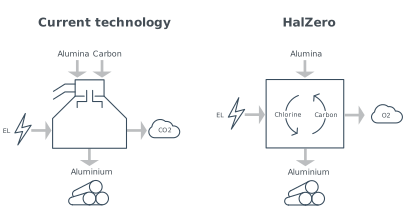
- Successfully commissioned HalZero test facility
The first quarter demonstrated continued strong operational performance in the upstream segments. Alumina production at Alunorte improved compared to the same quarter last year due to improved yield and stable equipment availability. In Aluminium Metal the continued ramp up of the previously curtailed capacity at the Norwegian smelters more than offset the production curtailments in the Middle East, driving a 2.7 percent year on year production increase.
The recycling operations delivered strong results in the first quarter, primarily driven by the North American operations. Increasing value add product premiums compared to aluminium scrap and standard ingot premiums result in very strong margins for the U.S. recyclers.
“Strong operational performance across our upstream and recycling businesses, combined with favorable metal prices, drove a strong first quarter. It underlines the strength of our portfolio and our ability to convert operational excellence into financial results,” says Eivind Kallevik, President and CEO of Hydro.
On March 30, a contractor at the Alunorte alumina refinery in Brazil
suffered a medical emergency, received immediate on site assistance and was transported to the hospital, where he later passed away. The incident is under investigation by the authorities and Hydro has initiated its own internal review.
“I am deeply saddened by the passing of a contractor from our Alunorte plant. Our thoughts are with the family, loved ones and colleagues affected,” says Kallevik.
Securing long-term access to renewable power at competitive pricing is a key priority for Hydro to strengthen long-term competitiveness as well as supporting its low-carbon position. Three new contracts amounting to 14 TWh have been secured year to date.
In March, an agreement was signed with Alpiq
for 0.22 TWh per year from 2031 to 2038 in price area NO3.
In April, two contracts were signed with Statkraft
, one adding 0.88 TWh per year for the period 2029 to 2038 in price area NO2 and one adding 0.44 TWh for the period 2031 to 2038 in price area NO3.
In addition to securing long-term contracts, Hydro is actively developing new renewable power projects as well as upgrading assets in its own captive renewable energy portfolio.
“Securing access to long-term renewable power at competitive pricing is critical for Hydro’s ability to execute on our strategy of pioneering the green aluminium transition. These contracts, in combination with own project developments, support our long-term sourcing position,” says Kallevik.
Hydro has successfully commissioned the HalZero test facility, marking an important milestone on the development of a new aluminium production technology. The facility is now operational, with structured testing activities, including key safety systems, operational control systems, equipment designs and core production processes being ramped up. The facility provides a controlled environment for systematic experimentation and testing, and has been built and brought online without any incidents.
Results and market development per business area
Adjusted EBITDA for Bauxite & Alumina decreased compared to the first quarter of last year, to NOK 747 million from NOK 5,135 million, primarily due to lower alumina prices and adverse currency effects, partially offset by higher sales volumes and reduced costs due to improved bauxite quality.
PAX traded in a narrow range between USD 297 and USD 315 per mt in the first quarter 2026, reflecting Chinese alumina price trends. Alumina production at new refineries in Indonesia and India continued ramping up. Smelter curtailment in the Middle East reduced demand, increasing alumina oversupply in the World ex-China. China's alumina market was essentially balanced in the quarter with prices hovering close to the marginal cash cost of production. Monthly Chinese bauxite imports from Guinea trended up in the first quarter 2026. The government of Guinea is considering restricting bauxite exports to balance the seaborne bauxite market causing prices to increase.
Adjusted EBITDA for Energy decreased in the first quarter compared to the same period last year, to NOK 787 million from NOK 1,180 million. The decrease was mainly due to lower production and a loss on price area differences compared to a gain in the first quarter last year. The loss was mainly driven by higher prices in central Norway, partly offset by improved commercial results.
Average Nordic power prices in the first quarter of 2026 increased compared to both the previous quarter and the same quarter last year. The increase from the previous quarter was mainly driven by stronger seasonal demand due to cold and dry weather, and below normal wind. Price area differences between the south and north of the Nordic market were low compared to both the previous quarter and the same period last year, due to the cold winter. The price area differences increased again in March.
Adjusted EBITDA for Aluminium Metal increased in the first quarter of 2026 compared to the first quarter of 2025, to NOK 5,034 million from NOK 2,546 million, mainly due to higher all-in metal prices and lower alumina cost, partly offset by weaker USD to NOK. Global primary aluminium consumption was slightly higher compared to the first quarter of 2025, driven by a 1.2 percent increase in World ex. China. Primary consumption in China is estimated to be flat compared to the first quarter of 2025. The Middle East crisis has had a substantial impact on the aluminium market and prices during the quarter. The GCC-countries produce above 6mt of primary aluminium on an annual basis and following announced curtailments around half is curtailed. Consequently, the three month aluminium price increased throughout the first quarter of 2026, starting the quarter at USD 2,995 per mt and ending at USD 3,467 per mt.
Adjusted EBITDA for Metal Markets increased in the first quarter of 2026 compared to the same period last year, due to higher results from recyclers, mainly driven by improved recycling margins in the U.S., and from sourcing and trading activities.
Adjusted EBITDA for Extrusions increased in the first quarter of 2026 compared to the same quarter last year, to NOK 1,299 million from NOK 1,174 million, driven by higher margins especially in the U.S. in combination with lower fixed labor and fixed production cost as well as lower energy cost, partly offset by lower sales volume.
Compared to the fourth quarter of 2025 adjusted EBITDA for Extrusions increased, to NOK 1,299 million from minus NOK 62 million due to seasonally higher sales volumes, better recycling margins and lower labor costs, slightly offset by higher energy cost.
European extrusion demand is estimated to have been flat in the first quarter of 2026 compared to the same quarter last year, but increasing 18 percent compared to the fourth quarter driven by seasonality. Demand for building & construction and industrial segments have stabilized at historically low levels with some improvements in order bookings. Automotive demand is starting to improve as production growth of electrical vehicles in Europe is increasing.
North American extrusion demand is estimated to have been decreasing by 4 percent in the first quarter of 2026 compared to the same quarter last year, but increasing 9 percent compared to the fourth quarter, partly driven by seasonality. Demand in the electrical segment has been solid in the quarter, but overall extrusions demand across segments has been subdued due to higher product prices on the back of higher tariffs and duties on aluminium in the U.S. Extrusion demand has continued to be weak in the commercial transport segment driven by low trailer builds. Automotive demand has also been weak due to headwinds in electrical vehicle production.
Other key financials
Compared to the fourth quarter of 2025, Hydro’s adjusted EBITDA increased to NOK 8,668 million from NOK 5,587 million, mainly due to higher all-in metal prices, strong results in Metal Markets, seasonally improved Extrusion volumes and strong recycling margins. This was partially offset by lower Energy results due to power plant maintenance in the first quarter of the year.
Net income (loss) amounted to NOK 4,341 million in the first quarter of 2026. Net income (loss) included unrealized derivative losses, mainly on LME related contracts of NOK 1,480 million, rationalization charges and closure costs of NOK 167 million, transaction related gains of NOK 128 million, and impairment charges of NOK 106 million. The tax effect on these adjustments reflected a standardized tax rate for taxable gains and tax deductible losses. Adjusted net income (loss) for the first quarter ended at NOK 4,062 million.
Hydro’s net debt increased from NOK 9.7 billion to NOK 12.9 billion during the first quarter of 2026. The net debt increase was mainly due to net operating capital build, negative other operating cash flow and investments partly offset by EBITDA contribution.
Adjusted net debt increased from NOK 18.2 billion to NOK 21.6 billion, mainly driven by the increase in net debt. Adjustments increased by NOK 0.2 billion due to increased hedge collateral and other liabilities, partially offset by stronger net pension position.
Reported earnings before financial items and tax (EBIT), and net income include effects that are disclosed in the quarterly report. Adjustments to EBITDA, EBIT, and net income (loss) are defined and described as part of the alternative performance measures (APM) section in the quarterly report.
The information was submitted for publication from Hydro Investor Relations and the contact persons set out above. Certain statements included in this announcement contain forward-looking information, including, without limitation, information relating to (a) forecasts, projections and estimates, (b) statements of Hydro management concerning plans, objectives and strategies, such as planned expansions, investments, divestments, curtailments or other projects, (c) targeted production volumes and costs, capacities or rates, start-up costs, cost reductions and profit objectives, (d) various expectations about future developments in Hydro's markets, particularly prices, supply and demand and competition, (e) results of operations, (f) margins, (g) growth rates, (h) risk management, and (i) qualified statements such as "expected", "scheduled", "targeted", "planned", "proposed", "intended" or similar. Although we believe that the expectations reflected in such forward-looking statements are reasonable, these forward-looking statements are based on a number of assumptions and forecasts that, by their nature, involve risk and uncertainty.
Various factors could cause our actual results to differ materially from those projected in a forward-looking statement or affect the extent to which a particular projection is realized. Factors that could cause these differences include, but are not limited to: our continued ability to reposition and restructure our upstream and downstream businesses; changes in availability and cost of energy and raw materials; global supply and demand for aluminium and aluminium products; world economic growth, including rates of inflation and industrial production; changes in the relative value of currencies and the value of commodity contracts; trends in Hydro's key markets and competition; and legislative, regulatory and political factors. No assurance can be given that such expectations will prove to have been correct. Except where required by law, Hydro disclaims any obligation to update or revise any forward-looking statements, whether as a result of new information, future events or otherwise. This information is considered to be inside information pursuant to the EU Market Abuse Regulation and is subject to the disclosure requirements pursuant to Section 5-12 the Norwegian Securities Trading Act.
This information is subject to the disclosure requirements pursuant to Section 5-12 the Norwegian Securities Trading Act
Published: April 29, 2026
facebook
Linkedin