変更報告書(特例対象株券等)(イーストスプリング・インベストメンツ(シンガポール)リミテッド)
Bull 0
Bear 0
Routine
Fiscal year ends March
Quarters are offset from the calendar — Q1 is Apr–Jun
|
Tekscend Photomask Corp. is a manufacturer and seller of photomasks for the semiconductor industry, established in 2022 through a business split from the TOPPAN Group. The company operates a single business segment focused on photomasks, producing binary masks, phase-shift masks, and EUV masks for logic and memory semiconductor applications. It serves foundries, integrated device manufacturers, and research institutions globally, with manufacturing facilities in Asia, North America, and Europe. The company also develops new business areas, including nanoimprint molds and silicon stencil masks, leveraging its lithography expertise. Notable partnerships include joint development projects with IBM for 2nm EUV mask processes and collaboration with imec. The company's history traces back to 1968 when its predecessor began mass production of transistor masks, and it acquired DuPont Photomasks, Inc. to expand its global footprint. Summarised from the annual report, fiscal year ended Mar 2026 |
Industry Semiconductors | Homepage photomask.com |
| Sector Technology | IR page photomask.com/en | |
|
Tags
photomasks, euv masks, binary masks, phase-shift masks, nanoimprint molds, silicon stencil masks, semiconductor lithography, high-precision manufacturing, Tekscend Photomask Corp., TOPPAN Group, DuPont Photomasks Inc., Chunghwa Precision Electronics Co. Ltd., OMOG, imec, IBM
|
Press page — |
Metrics
| Valuation | |
|---|---|
| Market cap | ¥ 383.638B |
| Market cap (USD) | $ 2.398B |
| P/E | 15.53 |
| PEG | 3.85 |
| P/BV | 2.15 |
| P/S | 2.74 |
| P/OCF | 10.64 |
| P/FCF | 135.75 |
| Dividend yield | 1.5% |
| Turnover / mcap | — |
| Returns | |
|---|---|
| ROE | 17.2% |
| ROI | 14.2% |
| ROIC | 11.7% |
| Profit margin | 19.3% |
| Growth | |
|---|---|
| Revenue growing | Yes |
| Profits growing | Yes |
| Revenue up 3y | Yes |
| Revenue up 5y | — |
| Earnings growth 3y (net profit CAGR) | 4.0% |
| Quality | |
|---|---|
| Profitable | Yes |
| Margin expanding | No |
| Buying back stock | No |
| Diluting (TTM) | — |
| Debt/Equity | — |
| Podcast bulls (TTM) | Sign up |
| Podcast bears (TTM) | Sign up |
| Podcast sentiment (TTM) | Sign up |
| Podcast sentiment % (TTM) | Sign up |
| News sentiment (TTM) | 0 |
| Quality score | 31.3% |
| Insiders | |
|---|---|
| Buys, 1w | Sign up |
| Buys, 1m | Sign up |
| Buys, 1y | Sign up |
| Sells, 1w | Sign up |
| Sells, 1m | Sign up |
| Sells, 1y | Sign up |
Filed figures
Lines the statements and their notes report beside the headline figures, read from the filings' XBRL as filed (no restatement applied), with figures computed from one filing's own lines. Cash-flow lines carry their cash direction: an outflow is negative. Each period links to its filing; a figure's period, report date and tag are in its tooltip.
| Figure | Mar 2025 | Mar 2026 |
|---|---|---|
| Balance sheet detail | ||
| Trade receivables (JPY) | 27.7B | 32.6B |
| ↳ YoY growth | +17.9% | |
| Borrowings, current (JPY) | 399M | 1.46B |
| Borrowings, non-current (JPY) | 399M | — |
| Cash and deposits (JPY) | 27.7B | 51.6B |
| Intangible assets (JPY) | 219M | 170M |
| Net debt (borrowings + leases - cash) (JPY) | -26.9B | -50.1B |
| Cash flow detail | ||
| Operating cash flow (JPY) | 26.2B | 36.1B |
| Purchases of property, plant and equipment (JPY) | -30.7B | -33.2B |
| Purchases of intangible assets (JPY) | -65M | -28M |
| Change in receivables (cash effect) (JPY) | -2.59B | -2.29B |
| Change in inventories (cash effect) (JPY) | -646M | -709M |
| Change in payables (cash effect) (JPY) | -1.08B | 961M |
| Dividends paid (cash effect) (JPY) | -9B | — |
| Share buybacks (cash effect) (JPY) | -18B | — |
| Interest paid (cash effect) (JPY) | -668M | -725M |
| Income taxes paid (cash effect) (JPY) | -12B | -8.62B |
| Operating cash flow before change in receivables (JPY) | 28.8B | 38.4B |
| Free cash flow (OCF - PPE - intangibles) (JPY) | -4.53B | 2.83B |
| Income detail | ||
| Research and development expense (JPY) | 797M | 1.24B |
| Total comprehensive income (JPY) | 5.63B | 38.1B |
| Comprehensive income to owners (JPY) | 5.63B | 38.1B |
| Reported | Jun 24, 2026 | Jun 24, 2026 |
Podcast Mentions
Timely disclosures published on TDnet, newest first, titles as filed in Japanese. The link opens the disclosure on TDnet. Filings with EDINET (periodic reports, extraordinary reports, offerings, holding and buy-back reports), newest first, titles as filed in Japanese. The link opens the filing on EDINET. Press releases from the company's own website, newest first.
2027年3月期第2四半期 決算説明会資料
Bull 5
Bear 0
Results
2027年3月期 第2四半期(中間期)決算短信〔IFRS〕(連結)
Bull 4
Bear 0
Results
Tekscend Photomask to Exhibit and Present at NNT 2026
Bull 1
Bear 0
Other
Showcasing the Latest Nanoimprint Master Mold Manufacturing Technologies for Next-Generation Devices
Tekscend Photomask Corp. (Headquarters: Minato-ku, Tokyo; Representative Director, President and CEO: Teruo Ninomiya; hereinafter "Tekscend Photomask") will exhibit and present at NNT 2026, an international conference hosted by the Nanoimprint Technology Research Association of the Japan Society of Applied Physics.
The conference will be held over four days, from October 13 to 16, 2026, at Sendai Sunplaza in Sendai, Miyagi Prefecture. It brings together universities, research institutions, companies, and other organizations to present their research findings while sharing the latest developments in nanoimprint and nanoprint technologies. The conference covers a wide range of topics, from processes, materials, and equipment to applications in electronics, optics, biotechnology, and energy.


Tekscend Photomask will exhibit and present at the conference. At its booth, the company will showcase nanoimprint master molds enabled by state-of-the-art electron-beam lithography and innovative etching technologies, along with its nanoimprint prototyping and development services.
The presentation will focus on nanoimprint lithography (NIL), which is used to create precise nanoscale features essential for device performance, particularly in AR/VR optical components. It will introduce the master mold manufacturing technologies that underpin NIL, highlighting Tekscend Photomask's technologies for forming complex pattern shapes and profiles directly on master molds. The presentation will also explain how these technologies can simplify the nanoimprint lithography process.
Event Overview
Dates: October 13 (Tue) - October 16 (Fri), 2026
Venue: Sendai Sunplaza (5-11-1 Tsutsujigaoka, Miyagino-ku, Sendai, Miyagi)
Official Website: https://nanoimprint.jp/nnt2026/
*For more details, please visit the official event website.
Exhibition Information
Exhibition Dates: October 14 (Wed) - October 15 (Thu), 2026
Booth No.: 6
Presentation Information
Date & Time: October 15 (Thu), 2026, 12:05 p.m.-
Topic: NIL Mastering: Enabling the Next Generation of Nano Manufacturing

About Tekscend Photomask Corp.
Tekscend Photomask Corp. is a leading manufacturer and supplier of photomasks, which are essential to semiconductor manufacturing.
The company operates nine manufacturing sites across North America, Europe, Asia, and Japan, leveraging its global production network to provide a stable and reliable supply of photomasks.
With its advanced technological development capabilities, the company holds the No. 1 global market share in the merchant photomask market and contributes to the continued development of the semiconductor industry.
In addition, the company is expanding into microfabrication fields, including nanoimprint molds, building on the technologies and expertise cultivated through its photomask business.
※1.
The information contained in this news release is current as of the date of publication and is subject to change without notice.
Be the First Choice,
Always
Tekscend Photomask Corp.
© 2025 Tekscend Photomask
変更報告書(特例対象株券等)(イーストスプリング・インベストメンツ(シンガポール)リミテッド)
Bull 0
Bear 0
Routine
Notice of the Second Quarter Financial Results Briefing for the Fiscal Year Ending March 2027
Bull 0
Bear 0
Routine
Notice of the Second Quarter Financial Results
Briefing for the Fiscal Year Ending March 2027
Thank you for the continued support and we are pleased to announce the details of the briefing
session as follows:
ーーーーーー Overview ーーーーーー
Date and Time 【Live】Wednesday, November. 11 16:00~17:00 (JST)
【On-Demand】Available
Briefing Title Financial Results Briefing for the Second Quarter of the Fiscal Year
Ending March 2027
Presenters Teruo Ninomiya, Representative Director, President and CEO
Seiichi Itoga, Director, Executive Officer and CFO
ーーーーー Registration・Details ーーーーーー
https://nikkoir.smktg.jp/public/seminar/view/44650
(Registration is required)
Tekscend Photomask to Exhibit at SEMICON India 2026
Bull 1
Bear 0
Other
Showcasing Global Manufacturing Network and Technical Expertise Supporting the Growth of India's Semiconductor Industry
Tekscend Photomask Corp. (Headquarters: Minato-ku, Tokyo; Representative Director, President and CEO: Teruo Ninomiya; hereinafter "Tekscend Photomask") will jointly exhibit with HTL Co. India Pvt. Ltd. at SEMICON India 2026, to be held from Thursday, September 17, through Saturday, September 19, 2026, at Yashobhoomi (India International Convention & Expo Centre) in New Delhi, India.HTL Co. India Pvt. Ltd. is a subsidiary of HTL Co. Japan Ltd. and provides advanced technologies, equipment, and technical support to India's semiconductor, photomask, flat panel display, additive manufacturing, and AI software industries.
In recent years, India has accelerated the development of its semiconductor industry through government-led initiatives, leading to continued investment in semiconductor manufacturing facilities and supply chain infrastructure. Leveraging its global manufacturing network of nine production sites and worldwide customer support capabilities, Tekscend Photomask has a global supply network capable of meeting future photomask demand in India.
By closely monitoring these market developments and leveraging its global network, Tekscend Photomask aims to contribute to the continued growth of India's semiconductor industry.
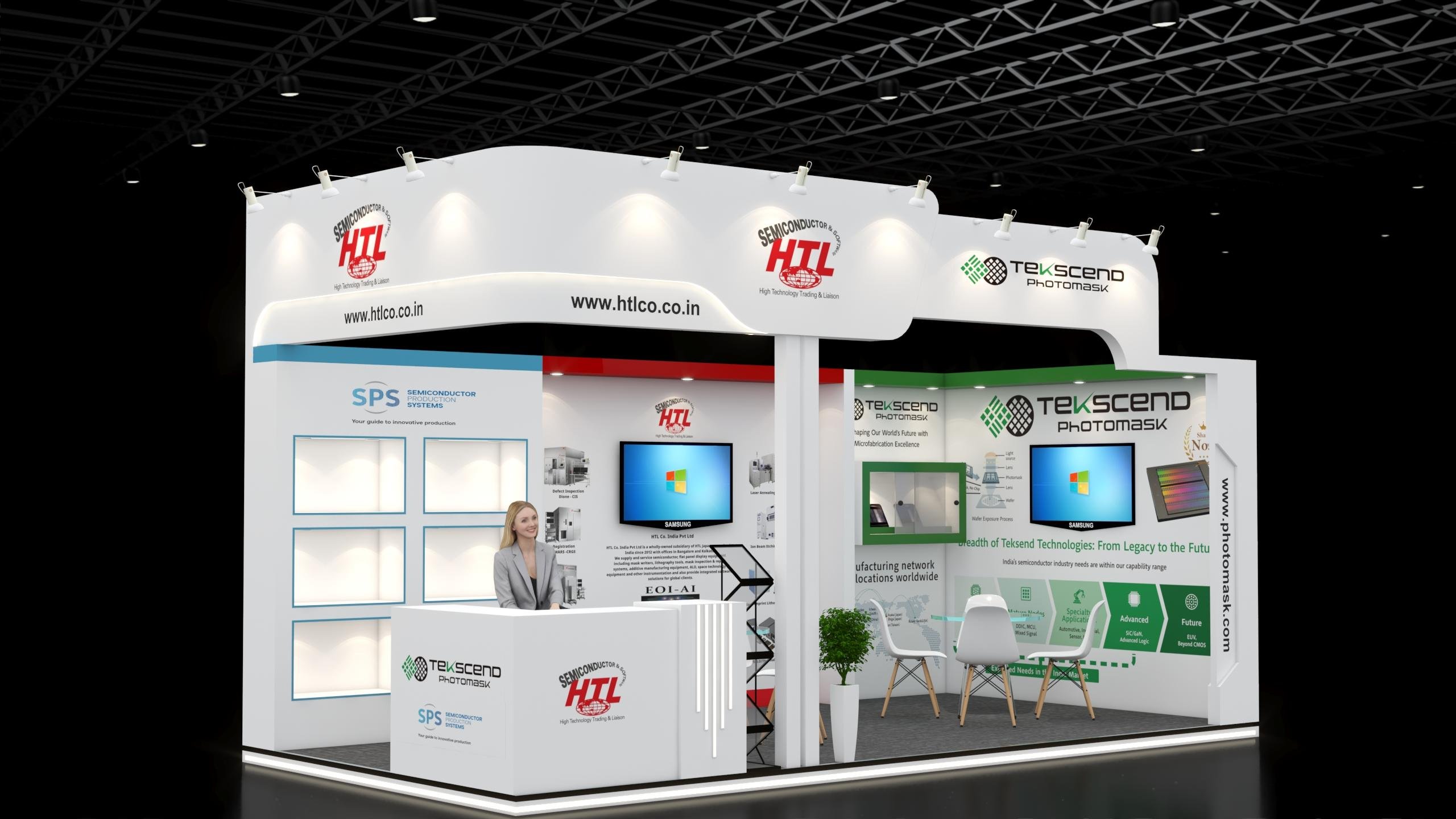
Booth design image
At the exhibition, Tekscend Photomask will showcase actual photomask products, which are essential to semiconductor manufacturing, and present a corporate video introducing the Company's business operations. In addition, wall displays will highlight the Company's global network of nine manufacturing sites, as well as its technological capabilities to support a wide range of customer requirements, from mature process nodes to advanced semiconductor technologies.
Event Overview
Dates: Thursday, September 17, 2026, through Saturday, September 19, 2026
*Event hours vary by date. Please check the official SEMICON India 2026 website for details.
Location: Yashobhoomi(India International Convention & Expo Centre), Sector 25, Dwarka, New Delhi 110077, India
Booth Number: Hall 1 Booth 1662
Exhibition Highlights: Display of actual photomasks, screening of a company introduction video, and wall displays
introducting our global lacations and technological capabillities.
Official Website: https://portal2026.semiconindia.org/home
About Tekscend Photomask Corp.
Tekscend Photomask Corp. is a leading manufacturer and supplier of photomasks, which are essential to semiconductor manufacturing. The company operates nine manufacturing sites across North America, Europe, Asia, and Japan, leveraging its global production network to provide a stable and reliable supply of photomasks.
Leveraging its advanced technology development capabilities, Tekscend Photomask Corp. holds the No. 1 global market share in the merchant photomask market and contributes to the continued development of the semiconductor industry.
In addition, the company is expanding into microfabrication fields, including nanoimprint molds, building on the technologies and expertise cultivated through its photomask business.
※1.
The information contained in this news release is current as of the date of publication. It is subject to change without notice.
Be the First Choice,
Always
Tekscend Photomask Corp.
© 2025 Tekscend Photomask
大量保有報告書(特例対象株券等)(イーストスプリング・インベストメンツ(シンガポール)リミテッド)
Bull 0
Bear 0
Routine
Tekcsend Photomask Holds Exchange Event with Kawagoe Girls' High School Biology Club
Bull 0
Bear 0
Routine
Preserving Endangered Species and Passing on the Value of Living in Harmony with Nature to Future Generations
On Monday, August 24, 2026, Tekscend Photomask welcomed members of the Biology Club from Saitama Prefectural Kawagoe Girls' High School to its Asaka site and held an exchange meeting to discuss biodiversity conservation initiatives.
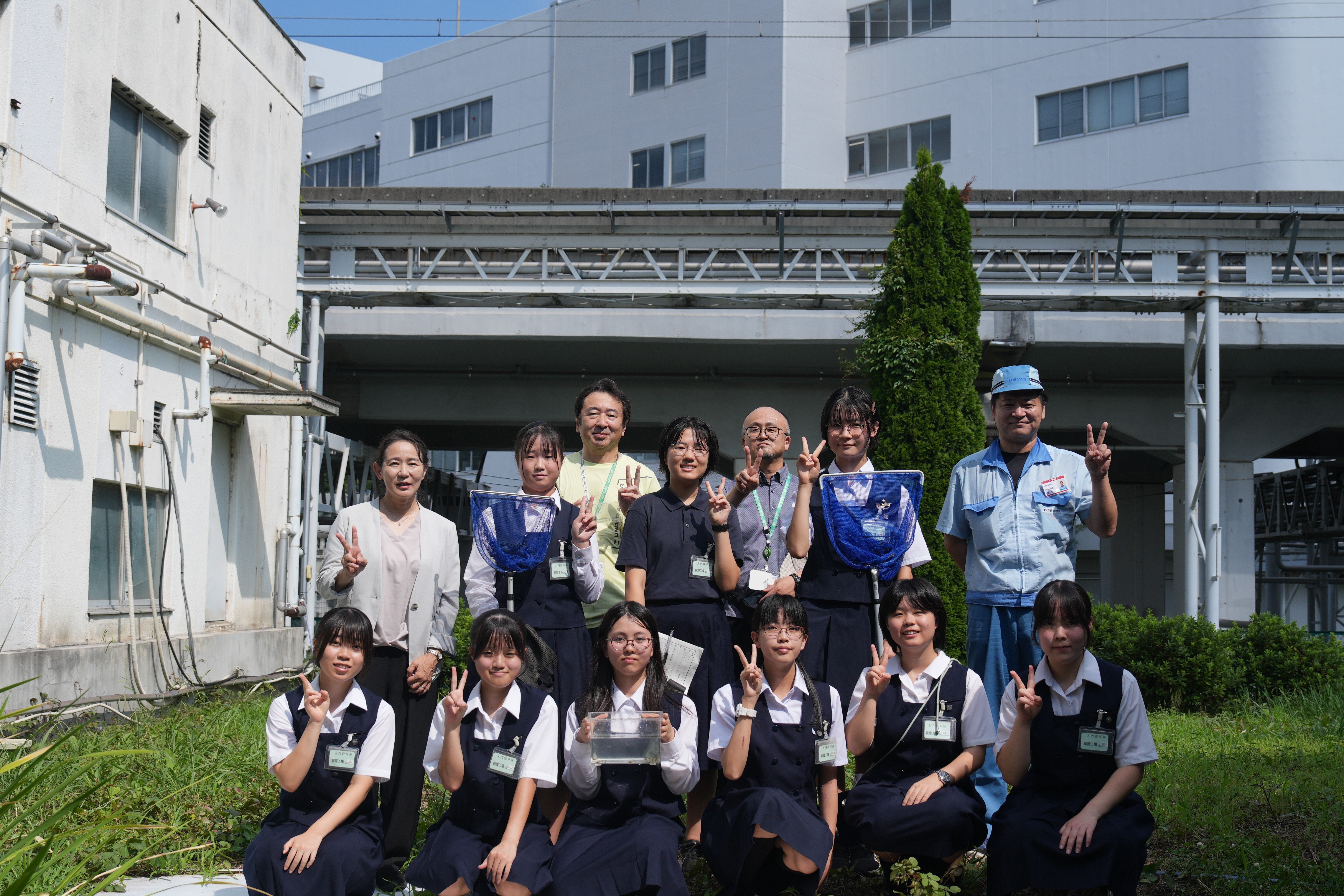


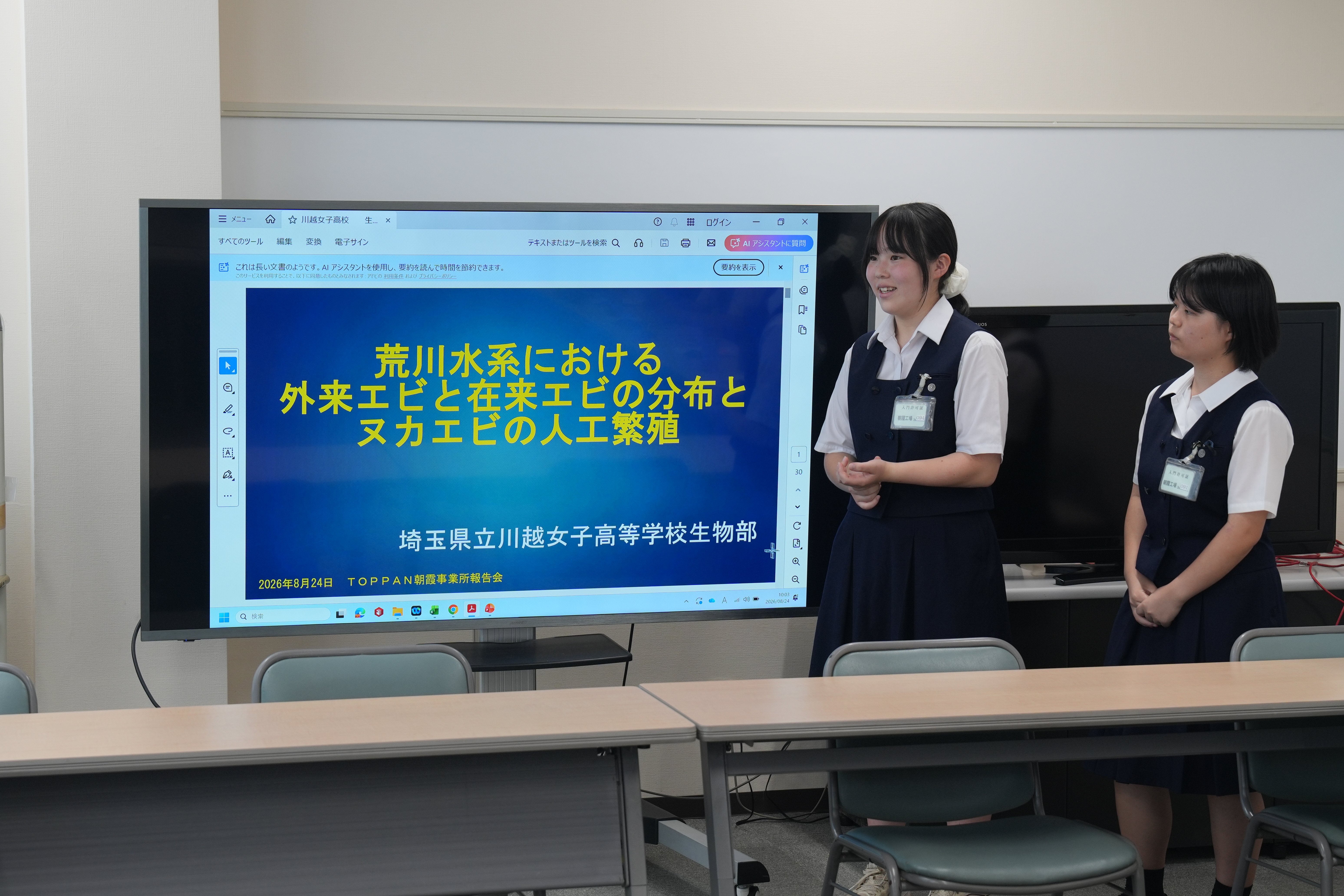
Tekscend Photomask is engaged in the maintenance and management of a biotope at its Asaka site as part of its efforts to preserve biodiversity and foster coexistence with the local community. As part of these activities, the company supports the creation of a habitat for the endangered Nuka shrimp, a species that is being studied and protected by the Biology Club at Saitama Prefectural Kawagoe Girls' High School. Through this initiative, we have continued its collaboration and exchange with the club since 2024.
During this exchange meeting, participants toured our biotope and presented the results of their research, "Distribution of Invasive and Native Shrimp in the Arakawa River System and the Artificial Breeding of the Nuka Shrimp." We also shared its biodiversity conservation initiatives.
The exchange provided a valuable opportunity to deepen understanding of biodiversity and nature positivity while exploring how businesses and educational institutions can collaborate to support environmental conservation.
Feedback from Students
"I had never really thought so deeply about nature positivity in my research before, so this was a very valuable experience."
"I wanted to find out how breeding Nuka shrimp in a biotope differs from breeding them at school."
"I was surprised to see that no invasive species were present in the biotope and that it was home to so many Nuka shrimp."
"Thank you very much for providing us with so much data and information. Going forward, we hope to build on this work and eventually expand our efforts to include releasing Nuka shrimp into the wild."
Implementation Overview
Date and Time: Monday, August 24, 2026, 9:00-10:45
Location: Tekscend Photomask Corp., Asaka Site
(7-21-33 Nobidome, Niiza City, Saitama Prefecture)
Participants: Biology Club and teachers from Saitama Prefectural Kawagoe Girls' High School, Tekscend Photomask Corp., Ltd., Environmental Technology Department, etc.
Program:
9:00-9:40
・ Tour of our company's biotope
9:45-10:45
・ Presentation of research findings by the Kawagoe Girls' High School Biology Club on the theme "Distribution of Invasive and Native Shrimp in the Arakawa River System and the Artificial Breeding of Nuka Shrimp"
・ Report on biodiversity activities by our company, including the FY2026 "Arakawa Taroemon Nature Restoration Project"
・ Discussion Session (Q&A and Exchange of Ideas)
Biodiversity Initiatives
Since 2013, Tekscend Photomask has been developing a biotope at its Asaka site by repurposing a former on-site wastewater treatment facility and has continued its biodiversity conservation activities. In collaboration with specialized organizations such as the Saitama Prefecture Ecosystem Conservation Association, we have been working to protect and conserve local flora and fauna, including endangered species listed on the Red Lists of the Ministry of the Environment and Saitama Prefecture. In recognition of our long-standing track record in ecosystem conservation and our sustainable management system, our biotope was certified as a "Nature Coexistence Site" by the Ministry of the Environment in September 2025. Through collaboration with local educational institutions, municipalities, and specialized organizations, we aim to contribute to the conservation of the natural environment and the development of the next generation of leaders, while working toward the realization of a sustainable society.
Be the First Choice,
Always
Tekscend Photomask Corp.
© 2025 Tekscend Photomask
Financial Results Briefing FY2026 Q1 Q&A
Bull 2
Bear 0
Results
Financial Results Briefing
FY2026 Q1
Q&A
Date
August 6th, 2026
Presenter
Director, Executive Officer and CFO
Seiichi Itoga
This document is a partial translation of the original Japanese document filed by Tekscend
Photomask Corp (the “Company”) and is provided for reference purposes only. In the event
of any discrepancy between this document and the original Japanese document, the original
Japanese document shall prevail.
Question 1
On a sequential quarter basis, U.S. dollar-denominated sales appear to have been somewhat weak.
Could you explain the background behind this trend? The presentation materials indicated that
there were challenges in capturing business from certain customers. Could you elaborate on the
factors involved and the regions affected?
Answer
Looking at our sales mix, the proportion of revenue from Taiwan declined during this quarter. The
primary reason was a quality-related issue involving a certain customer, which negatively impacted
sales in Taiwan compared with the previous quarter. However, the issue has already been resolved,
and we expect to recover the impact beginning in the second quarter and beyond.
Question 2
Regarding the quality issue, was this a technical problem in which the performance of the
photomask failed to meet customer requirements, or was it something else?
Answer
In this case, the product met the customer's specification requirements. However, certain
operational considerations arose during customer use. We identified the root cause and resolved
the matter through process modifications. As a result, there is currently no impact on orders or
business activities.
Question 3
One of your competitors indicated during its earnings announcement that it is facing supply
constraints that could limit its ability to meet customer demand. If market demand continues to
expand, do you believe your company is well positioned to gain additional market share?
Answer
We are making proactive investments to address customer demand, and we expect these
investments to begin contributing to revenue around 2027 to 2028. In the meantime, we will
continue to leverage our worldwide maintenance organization to ensure proper servicing of
equipment at each site, improve equipment utilization rates, and achieve stable supply and higher
productivity
Question 4
Is it fair to say that your company has an advantage in terms of supply stability compared with
competitors? Also, is there a possibility that orders could shift from competitors to your company?
Answer
We cannot say that all such business will come to us. However, our production capacity exceeds
that of our competitors, and we believe our ability to provide a stable supply has earned strong
customer confidence.
Question 5
Could you provide more details regarding the positive memory market environment? Specifically,
is the benefit coming from increasing logic demand associated with HBM, or from increased mask
demand driven by DRAM manufacturers that do not produce photomasks internally? How is the
changing memory market affecting your business?
Answer
Demand in the memory market remains solid. In particular, we are receiving inquiries related to
qualification projects from major customers, accompanied by requests for accelerated delivery
schedules. We expect these developments to contribute positively to our financial performance
from the second quarter through the third quarter and beyond.
Question 6
As a follow-up, is the demand growth related to HBM logic dies, DRAM photomasks, or both?
Answer
It is demand for DRAM photomasks.
Question 7
Given rising U.S.-China tensions and China's push toward semiconductor self-sufficiency, could
you share your current view on your China business?
Answer
The trend toward localization in China continues to strengthen, and we are seeing increasing
adoption of domestically manufactured equipment by local companies. At present, we have no
plans to use photomask manufacturing equipment from Chinese suppliers. However, we will
continue to monitor industry developments and evaluate future options accordingly.
Regarding our China business, we intend to maintain profitability by increasing the proportion of
high-value-added products and advanced photomasks in our sales mix, thereby protecting overall
consolidated earnings.
Question 8
Regarding memory-related demand, what drove the temporary increase in orders from a specific
customer? Was it a one-time demand spike limited to the first quarter?
Answer
The increase actually occurred during the previous fourth quarter and was primarily driven by
strong demand from customers in China. Demand moderated during the first quarter, but we have
begun to see certain demand trends strengthen again from the second quarter onward.
Question 9
You previously indicated that Korea would become a significant growth driver this fiscal year.
However, this does not seem to be reflected in regional revenue composition. Has progress been
slower than initially expected?
Answer
Due to circumstances on the customer side, there have been temporary delays in qualification
activities and tape-outs. However, these delays are temporary in nature, and there have been no
changes to the original investment plans. Recent developments since the second quarter indicate
that customer demand and requirements remain solid.
Question 10
Have there been any notable developments or updates regarding your investment in Korea over
the past three months since the full-year earnings announcement?
Answer
Progress remains on track, and the project is proceeding largely according to the original schedule.
Question 11
Is there any possibility that the startup schedule for the Korea facility could be accelerated, or
should we continue to assume operations will commence in or after 2028 considering qualification
requirements?
Answer
At present, we are proceeding according to the original schedule. However, there remains a
possibility that customers could request an accelerated timelin
Financial Results Briefing FY2026 Q1
Bull 3
Bear 0
Results
Financial Results Briefing
FY2026 Q1
Date
August 6th, 2026
Presenter
Director, Executive Officer and CFO
Seiichi Itoga
This document is a partial translation of the original Japanese document filed by Tekscend
Photomask Corp (the “Company”) and is provided for reference purposes only. In the event
of any discrepancy between this document and the original Japanese document, the original
Japanese document shall prevail.
Thank you very much for joining us today for the financial results briefing for the first quarter of
My name is Itoga, CFO of the company. I would now like to walk you through the presentation
materials.
Please turn to page four. This page provides an overview of the results for the current quarter
and explains the current business environment.
The semiconductor market has continued to perform strongly since the second half of last year,
particularly in the memory segment, driven by growth in AI and data center-related demand.
Meanwhile, in the photomask market, major semiconductor manufacturers with captive production
capabilities are concentrating their internal resources on the development and mass production of
leading-edge technologies.
As a result, there is a growing trend toward outsourcing photomasks for advanced nodes other
than the most cutting-edge technologies.
Under this business environment, we have continued to expand our revenue steadily.
On page four, this slide presents the financial performance of the first quarter of FY2026 and
provides a year-on-year comparison using graphs of our key KPIs: revenue, operating profit, and
EBITDA.
Revenue was JPY 34.5 billion, representing an increase of 14.8% year-on-year.
Operating profit increased 25.3% year-on-year, resulting in an operating profit margin of 21.3%.
Supported by a higher contribution from advanced-node products, leading to a 1.8 percentage
point increase in operating margin compared with the same period of the previous year.
This improvement in profitability reflects the success of our ongoing shift toward advanced-node
products.
The EBITDA margin was 35.4%, improving by 1.6 percentage points year-on-year.
Please turn to the next page.
This slide presents the consolidated profit and loss results for the first quarter of FY2026.
Revenue increased both year-on-year and quarter-on-quarter, as shown on the previous slide.
While we experienced some difficulty capturing demand from certain major customers, we
leveraged one of our key strengths, our broad customer base, to secure orders from other
customers and maintain revenue at roughly the same level as the previous quarter.
Gross profit and operating profit increased year-on-year but decreased compared with the
previous quarter.
Regarding costs, expenses increased both year-on-year and quarter-on-quarter, reflecting higher
fixed costs such as depreciation and maintenance expenses for newly introduced equipment, as
well as additional expenses related to the ERP upgrade.
Revenue growth of 14.8% year on year was sufficient to absorb the increase in costs and support
profit growth.
On the revenue side, revenue grew 14.8% year-on-year, more than offsetting the increase in
expenses and supporting profit growth. However, quarter-on-quarter revenue growth was modest
at 3.5%, which was insufficient to fully absorb the increase in fixed costs.
Profit attributable to owners of the company decreased both year-on-year and quarter-on-
quarter.
This was primarily due to withholding tax expenses arising from dividend payments received from
subsidiaries.
Next, I would like to explain EBITDA and the EBITDA margin.
Compared with the previous quarter, operating profit declined mainly due to higher depreciation
expenses. However, because EBITDA excludes the impact of depreciation expense, EBITDA
increased by 1.8% quarter on quarter in absolute terms.
On the other hand, because revenue growth was limited to 3.5%, the EBITDA margin decreased by
0.6 percentage points.
Before concluding the discussion of earnings, I would like to note that more than half of our
transactions are denominated in U.S. dollars. As a result, our reported results are affected by
foreign exchange fluctuations when translated into Japanese yen. For reference purposes, we
therefore also disclose revenue and operating profit on a U.S. dollar basis.
On a U.S. dollar basis, revenue increased 2.7% year on year, and operating profit increased 12.0%,
resulting in both revenue and profit growth.
While our results benefited from the weaker yen, profitability also improved due to the higher
proportion of advanced-node products in our sales mix.
On a quarter-on-quarter basis, however, revenue increased only 0.8%, remaining essentially flat.
As a result, the increase in fixed costs could not be fully absorbed, and operating profit declined
by 6.1%.
Under IFRS, we use the average exchange rate during the reporting period. The average exchange
rate for the first quarter was JPY 160.72 per U.S. dollar.
Please turn to the next page.
I will now explain our revenue mix. Revenue by process node was composed of 35% advanced-
node products, 35% middle-node products, and 30% mature-node products.
The proportion of advanced-node products, which represent our primary growth driver, remained
above 35%. Compared with the same period last year, the advanced-node ratio increased by
approximately 5 percentage points.
This improvement in product mix contributed directly to improved profitability. Demand for
advanced-node products remains strong and continues to be a key driver of our future growth.
By application, logic products accounted for 89% of revenue during the quarter, while memory
products accounted for 11%.
In the previous fourth quarter, the proportion of memory-related sales increased temporarily due
to demand from a specific customer. However, in the first quarter, the mix returned to levels like
those seen before that period.
At the same time, the memory market is expected to remain strong going forward, we will continue
to monitor developments among memory manufacturers even more closely.
Please turn to the next page.
Next, I will explain our regional revenue mix.
Market conditions remain solid globally across all regions and compared with the previous fourth
quarter, the proportion of revenue from the U.S., Korea, and Europe increased.
Meanwhile, China continues to account for a significant share of our revenue mix. We will continue
to monitor market conditions and future trends in China carefully. That concludes my explanation
of revenue composition.
Please turn to the next page.
Next, I will explain our balance sheet.
Total assets amounted to 229.9 billion yen, while total equity was 177.4 billion yen and our equity
ratio remained stable in the 70% range.
Please turn to the next page.
Next, I will explain our consolidated cash flow results.
Cash flow from operating activities was positive 11.5 billion yen, supported primarily by profit
before tax of 8.1 billion yen and depreciation expense of 4.7 billion yen.
Cash flow from investing activities was negative JPY 7.2 billion, mainly due to purchases of
property, plant, and equipment.
Cash flow from financing activities was negative JPY 6.4 billion, primarily reflecting the payment of
FY2025 year-end dividends totaling JPY 5.5 billion.
As a result, cash and cash equivalents at the end of June decreased by 1.4 billion yen from the
beginning of the fiscal year to 50.1 billion yen.
Please turn to the next page.
Next, I will explain the trends in capital expenditure, depreciation, and EBITDA.
We continue to position the current fiscal year as a period of upfront investment. Even so, first-
quarter EBITDA exceeded capital expenditures, demonstrating our continued ability to generate
cash.
However, we expect capital expenditure to increase from the second quarter onward. Accordingly,
while maintaining liquidity and financial discipline, we will pursue flexible and timely financing
options, including the utilization of external funding when appropriate.
Next, I would like to discuss our performance against the full-year forecast.
Progress against the FY2026 guidance announced in May was approximately 25% at the end of the
first quarter.
At this stage, performance is progressing generally in line with our plan, supported in part by the
benefit of a weaker yen. Accordingly, there is no change in our full-year earnings forecast.
Finally, I would like to introduce some recent topics.
Today's topic concerns our participation in an investor relations event for individual investors.
We will exhibit for the first time at the Nikkei and Tokyo Stock Exchange IR Fair 2026, which will
be held at the end of August.
This is one of Japan's largest IR events for individual investors.
We hope to use this opportunity to help investors gain a deeper understanding of our business,
market growth opportunities, and long-term growth strategy.
This concludes my presentation
Thank you very much for your kind attention.
Consolidated Financial Results For the Three Months Ended June 30, 2026
Bull 3
Bear 0
Results
August 6, 2026
Consolidated Financial Results
For the Three Months Ended June 30, 2026
(Under IFRS)
Company name: Tekscend Photomask Corp.
Listing: Tokyo Stock Exchange
Securities code: 429A
URL: https://www.photomask.com/en
Representative: Teruo Ninomiya, Representative Director, President and CEO
Inquiries: Seiichi Itoga, Director, Executive Officer and CFO
Telephone: +81-3-5418-3905
Scheduled date to commence dividend payments: -
Preparation of supplementary material on financial results: Yes
Holding of financial results briefing: Yes (for institutional investors and securities analysts)
(Yen amounts are rounded down to millions, unless otherwise noted.)
- Consolidated financial results for the three months ended June 30, 2026 (from April 1, 2026 to June 30,
(1) Consolidated operating results (cumulative)
(Percentages indicate year-on-year changes.)
Revenue Operating profit Profit before tax Profit for the period
Three months ended
Millions of yen % Millions of yen % Millions of yen % Millions of yen %
June 30, 2026 34,518 14.8 7,360 25.3 8,127 19.5 5,300 (3.2)
June 30, 2025 30,076 0.9 5,875 (12.6) 6,799 (18.3) 5,475 22.5
Profit attributable to
owners of the Company
Total comprehensive
income
Basic earnings
per share
Diluted earnings
per share
Three months ended
Millions of yen % Millions of yen % Yen Yen
June 30, 2026
5,300 (3.2) 8,522 68.9
53.36 52.44
June 30, 2025
5,475 22.5 5,045 (54.7)
59.33 57.60
(2) Consolidated financial position
Total assets Total equity
Equity attributable to
owners of the Company
Ratio of equity
attributable to owners of
the Company to total
assets
As of
Millions of yen Millions of yen Millions of yen %
June 30, 2026 229,957 177,493 177,493 77.2
March 31, 2026
230,725 174,507 174,507 75.6
- Cash dividends
Annual dividends per share
First quarter-end Second quarter-end Third quarter-end Fiscal year-end Total
Yen Yen Yen Yen Yen
Fiscal year ended
March 31, 2026
-
0.00
-
56.00 56.00
Fiscal year ending
March 31, 2027
-
Fiscal year ending
March 31, 2027
(Forecast)
35.00
-
35.00 70.00
Note
Revision of forecasted dividend: None
The Company has designated the end of the second quarter and the end of the fiscal year as the record dates for dividends in its Articles
of Incorporation.
- Consolidated financial results forecast for the fiscal year ending March 31, 2027 (April 1, 2026 to March 31,
(% indicates changes from the previous corresponding period.)
Revenue Operating profit Profit before tax Profit for the year
Profit attributable
to owners of the
Company
Basic earnings
per share
Millions of
yen %
Millions of
yen %
Millions of
yen %
Millions of
yen %
Millions of
yen % Yen
Full year 140,100 8.1 29,800 8.2 31,200 (6.7) 23,700 (5.0) 23,700 (5.0) 238.57
Note
Any current announcement of revisions to the latest forecasts: None
- Notes
(1) Significant changes in the scope of consolidation during the period: None
(2) Changes in accounting policies and changes in accounting estimates
(i) Changes in accounting policies required by IFRS: None
(ii) Changes in accounting policies due to other reasons: None
(iii) Changes in accounting estimates: None
(3) Number of issued shares (common shares)
(i) Total number of issued shares at the end of the period (including treasury stock)
As of June 30, 2026
99,355,867
shares
As of March 31, 2026 99,329,195 shares
(ii) Number of treasury stock at the end of the period
As of June 30, 2026
-
shares
As of March 31, 2026
-
shares
(iii) Average number of shares outstanding during the period
Three months ended June 30, 2026
99,340,676
shares
Three months ended June 30, 2025 92,291,220 shares
- Review of the Japanese-language originals of the attached consolidated quarterly financial statements by certified
public accountants or an audit firm: None
- Proper use of consolidated financial results forecast, and other special matters
Forward-looking Information including consolidated financial results forecast, contained in these disclosure materials
are based on certain assumptions relating to economic situations and market trends deemed reasonable as of the date
of publication of this document. Actual results may differ from these forecasts due to a wide range of factors.
(How to access supplementary material on financial results)
The supplementary material on financial results will be made available via the Company’s website.
- 1 -
Table of Contents of Appendix
- Overview of Financial Results for the Period
................................................................................................. - 2 -
(1) Operating Results
......................................................................................................................................... - 2 -
(2) Financial Position
......................................................................................................................................... - 2 -
(3) Cash Flows
................................................................................................................................................... - 2 -
(4) Forward-Looking Information Including Consolidated Financial Results Forecast
............................ - 3 -
- Condensed Consolidated Financial Statements and Primary Notes
............................................................ - 4 -
(1) Condensed Consolidated Statement of Financial Position
....................................................................... - 4 -
(2) Condensed Consolidated Statements of Profit or Loss and Comprehensive Income
............................ - 6 -
Condensed Consolidated Statement of Profit or Loss .................................................................................... - 6 -
Condensed Consolidated Statement of Comprehensive Income ................................................................. - 7 -
(3) Condensed Consolidated Statement of Changes in Equity
.................................................................... - 8 -
(4) Condensed Consolidated Statement of Cash Flows
................................................................................ - 10 -
(5) Notes to Condensed Consolidated Financial Statements
........................................................................ - 11 -
Going concern assumption ........................................................................................................................... - 11 -
Segment information .................................................................................................................................... - 11 -
- 2 -
- Overview of Financial Results for the Period
(1) Operating Results
During the first quarter of the fiscal year, the global economy continued to face uncertainty due to rising energy
prices stemming from heightened tensions in the Middle East and increasing geopolitical risks. Nevertheless,
supported by expanding AI-related investments and resilient consumer spending, particularly in the United States,
the global economy maintained a moderate growth trajectory.
Against this backdrop, the semiconductor market continued its strong expansion, driven by increased data center
investments associated with the growing adoption of generative AI, as well as tightening supply-demand
conditions and rising prices for memory products, including High Bandwidth Memory (HBM). In particular,
robust demand for advanced logic semiconductors and HBM products used in AI servers remained at a high level
and continued to drive market growth.
Furthermore, supported by the expansion of the semiconductor market, demand in the photomask market
remained solid, particularly for advanced-node applications. In the merchant photomask market, which directly
impacts the Group’s business performance, demand continued to be strong, especially for cutting-edge products.
Under these business conditions, the Group leveraged its advanced microfabrication technologies, including EUV
mask technologies, together with its global manufacturing network spanning eight production sites worldwide,
to meet customer needs by providing high-quality photomasks with reliable delivery lead times. As a result,
revenue for the first quarter amounted to 34,518 million yen (year-on-year increase of 14.8%), while operating
profit and profit before tax amounted to 7,360 million yen (year-on-year increase of 25.3%) and 8,127 million
yen (year-on-year increase of 19.5%), respectively. Profit attributable to owners of the Company amounted to
5,300 million yen (year-on-year decrease of 3.2%), primarily due to an increase in withholding taxes on dividends
received from overseas subsidiaries, among other factors.
Segment information is omitted as the Group operates within a single segment of the photomask business.
(2) Financial Position
Total assets as of June 30, 2026 amounted to 229,957 million yen, decreasing by 768 million yen from the end of
the previous fiscal year. The decrease was mainly attributable to decreases in cash and cash equivalents of 1,446
million yen and trade and other receivables of 600 million yen, partially offset by an increase in other financial
assets of 1,104 million yen.
Total liabilities as of June 30, 2026 amounted to 52,463 million yen, decreasing by 3,755 million yen from the
end of the previous fiscal year. The decrease was mainly due to a 1,723 million yen decrease in trade and other
payables, an 883 million yen decrease in income taxes payable, and a 399 million yen decrease in other financial
liabilities.
Total equity as of June 30, 2026 amounted to 177,493 million yen, increasing by 2,986 million yen from the end
of the previous fiscal year. The increase was primarily attributable to a 3,163 million yen increase in other
components of equity.
(3) Cash Flows
Cash and cash equivalents as of June 30, 2026 amounted to 50,105 million yen, decreasing by 1,446 million yen
from the end of the previous fiscal year.
- 3 -
Net cash provided by operating activities amounted to 11,578 million yen, compared with net cash provided of
9,027 million yen in the same period of the previous fiscal year. This was mainly because profit before tax of
8,127 million yen and depreciation and amortization of 4,725 million yen exceeded cash outflows, including
income taxes paid of 4,041 million yen.
Net cash used in investing activities amounted to 7,270 million yen, compared with net cash used of 15,469
million yen in the same period of the previous fiscal year. This was mainly attributable to payments for purchase
of property, plant and equipment of 7,455 million yen and payments for acquisition of investment securities of
314 million yen.
Net cash used in financing activities amounted to 6,468 million yen, compared with net cash used of 174 million
yen in the same period of the previous fiscal year. This was mainly due to dividend payments of 5,510 million
yen and repayments of lease liabilities of 767 million yen.
(4) Forward-Looking Information Including Consolidated Financial Results Forecast
There are no changes to the consolidated financial results forecast announced on May 13, 2026. The Company
will disclose any changes as appropriate in the future.
- 4 -
- Condensed Consolidated Financial Statements and Primary Notes
(1) Condensed Consolidated Statement of Financial Position
(Millions of yen)
As of March 31, 2026 As of June 30, 2026
Assets
Current assets
Cash and cash equivalents 51,552 50,105
Trade and other receivables 32,610 32,009
Other current financial assets 987 990
Inventories 4,807 5,083
Income taxes receivable 3,604 3,177
Other current assets 3,806 3,520
Total current assets 97,369 94,887
Non-current assets
Property, plant and equipment 109,074 108,875
Intangible assets 170 182
Investments accounted for using equity method 8,958 9,134
Other non-current financial assets 11,533 12,635
Deferred tax assets 2,199 2,965
Retirement benefit assets
-
7
Other non-current assets 1,420 1,269
Total non-current assets 133,356 135,069
Total assets 230,725 229,957
- 5 -
As of March 31, 2026 As of June 30, 2026
Liabilities and equity
Liabilities
Current liabilities
Trade and other payables 19,065 17,342
Borrowings 1,460 1,257
Other current financial liabilities 2,201 2,309
Income taxes payable 4,645 3,762
Contract liabilities 2,629 2,558
Other current liabilities 4,580 4,434
Total current liabilities 34,582 31,665
Non-current liabilities
Other non-current financial liabilities 11,937 11,429
Deferred tax liabilities 358
-
Retirement benefit liabilities 3,374 3,365
Contract liabilities 2,255 2,296
Provisions 746 778
Other non-current liabilities 2,964 2,928
Total non-current liabilities 21,636 20,797
Total liabilities 56,218 52,463
Equity
Share capital 10,440 10,449
Capital surplus 55,617 55,635
Retained earnings 83,402 83,198
Other components of equity 25,046 28,210
Equity attributable to owners of the Company 174,507 177,493
Total equity 174,507 177,493
Total liabilities and equity 230,725 229,957
- 6 -
(2) Condensed Consolidated Statements of Profit or Loss and Comprehensive Income
Condensed Consolidated Statement of Profit or Loss
(Millions of yen)
Three months ended
June 30, 2025
Three months ended
June 30, 2026
Revenue
30,076 34,518
Cost of sales
(20,264) (23,053)
Gross profit
9,811 11,464
Selling, general and administrative expenses
(3,572) (3,835)
Research and development expenses
(266) (266)
Other income
18 32
Other expenses
(114) (36)
Operating profit
5,875 7,360
Finance income
1,198 1,324
Finance costs
(400) (699)
Share of profit of investments accounted for
using equity method
125 142
Profit before tax
6,799 8,127
Income tax expenses
(1,323) (2,827)
Profit for the period
5,475 5,300
Profit attributable to:
Owners of the Company
5,475 5,300
Profit for the period
5,475 5,300
Earnings per share
Basic earnings per share (yen) 59.33 53.36
Diluted earnings per share (yen) 57.60 52.44
- 7 -
Condensed Consolidated Statement of Comprehensive Income
(Millions of yen)
Three months ended
June 30, 2025
Three months ended
June 30, 2026
Profit for the period
5,475 5,300
Other comprehensive income (net of tax)
Items that will not be reclassified subsequently to
FY2026 Q1 Financial Results Briefing
Bull 3
Bear 0
Results
Financial Results Briefing
August 6, 2026
2
FY2026 Q1 Financial Results
3
3
Financial Highlights and Analysis -Overview
Revenue
Revenue
Growth
Operating
Profit Margin
EBITDA
Margin
※
CAPEX
•Strong demand in semiconductor market for AI and data center-related products along with the
ongoing progress in miniaturization
•Merchant Photomask Market Growth:
-Outsourcing of advanced-node photomasks continues as captive manufacturers concentrating on
leading-edge technologies
-Supported by semiconductor market demand, the performanceof foundry related business is solid
mainly in advanced products compared with last year
FY2026 Q1 Revenue increased by 14.8% YoY in JPY
(As reference: FY2026 Q1 Revenue increased by 2.7% in US dollars)
Operating profit margin for FY2026 Q1 was 21.3% (increased by 1.8 pt YoY)
EBITDA margin
for FY2026 Q1 was 35.4% (increased by 1.6 pt YoY)
We are allocating our CAPEX to advanced nodes to drive growth
-Establishing a new manufacturing fab in Singapore
-Expanding advanced-node production lines in the U.S. and Korea
- EBITDA = Profit Attributable to Owners of the Company + Income tax expenses –Finance income + Finance costs + Depreciation andamortization, EBITDA Margin = EBITDA / Revenue.
4
4
30,076
34,518
Growth rate:14.8%
Growth rate:20.3%Growth rate:25.3%
FY2026 Q1 Cumulative Performance Summary
FY2026 Q1 Revenue increased by 14.8% YoY.
Improved profitability driven by a higher proportion of advanced-node products, resulting in year-on-year earnings
growth and margin expansion.
RevenueAdjusted EBITDA Operating Profit
Operating Profit Margin
EBITDA Margin
FY2026
Q1
results
FY2025
Q1
results
FY2026
Q1
results
FY2025
Q1
results
FY2026
Q1
results
FY2025
Q1
results
(Unit:MJPY
※
)
- Yen amounts are rounded down to millions, unless otherwise noted.
(Unit:MJPY
※
)(Unit:MJPY*)
10,167
12,228
35.4%
33.8%
5,875
7,360
21.3%
19.5%
5
5
Consolidated Financial Results –P/L for FY2026 Q1
Revenue: Increased YoY and QoQ, as growth from other customers and favorable FX effects more than offset slower-than-expected
sales from a major customer.
Operating Profit: Increased YoY as higher revenue offset increased fixed costs associated with newly installed equipment for advanced-
node production. However, operating profit declined QoQ as revenue growth was insufficient to fully absorb the increase in fixedcosts.
Profit Attributable to Owners of the Company: Decreased YoY and QoQ due to higher tax expenses related to dividend payments.
(MJPY)
FY2025FY2026Percentage Change
Q1
Q4
Q1
YoY
FY2026 Q1
vs
FY2025 Q1
QoQ
FY2026 Q1
vs
FY2025 Q4
Revenue30,076
33,34134,51814.8%3.5%
Gross Profit Margin32.6%
34.8%33.2%0.6pt-1.6pt
Operating Profit5,875
7,6057,36025.3%-3.2%
Operating Profit Margin19.5%
22.8%21.3%1.8pt-1.5pt
Profit for the period5,475
5,9445,300-3.2%-10.8%
Profit Attributable to
Owners of the Company
5,475
5,9445,300-3.2%-10.8%
Exchange Rate (USD/JPY)
143.75
156.51160.72
1As reference
EBITDA (MJPY)
10,167
12,00712,22820.3%1.8%
EBITDA Margin33.8%36.0%
35.4%
1.6pt-0.6pt
Revenue (KUSD)
209,224
213,037214,7712.7%0.8%
Operating Profit (KUSD)
40,87548,75645,79512.0%-6.1%
6
33%
32%
30%
29%
30%
38%
32%
34%
35%
35%
29%
36%
36%
36%
35%
30%
35%
35%
Sales Mix -By Node
Demand for advanced logic applications remained robust, with advanced-node products (≤28nm) consistently
representing over 35% of total revenue.
Sales Mix -By Node
-
Based on the Photomask product sales revenue
Advance
(≦28nm)
Middle
(28-90nm)
Mature
(90nm<)
Full-year
Q1
Apr-Jun
Q2
Jul-Sep
Q3
Oct-Dec
Q4
Jan-Mar
Q1
Apr-Jun
FY2025FY2026FY2025
7
88%
87%
90%
85%
89%
12%
13%
10%
15%
11%
88%
12%
Sales Mix -By Application
•In the previous quarter, the memory mix increased due to AI-driven demand and temporary customer orders.
•In the current quarter, stronger advanced logic sales normalized the sales mix, while memory demand remained
solid.
Sales Mix-By Application
-
Based on the Photomask product sales revenue
Logic
and other
products
Memory
Full-year
Q1
Apr-Jun
Q2
Jul-Sep
Q3
Oct-Dec
Q4
Jan-Mar
Q1
Apr-Jun
FY2025FY2026FY2025
8
27%
27%
27%
30%
30%
18%
20%
19%
19%
21%
14%
16%
16%
15%
12%
10%
8%
10%
10%
11%
13%
15%
15%
11%
12%
11%
7%
8%
8%
7%
7%
7%
6%
7%
7%
28%
19%
15%
10%
13%
8%
7%
Reflecting the expansion of advanced logic demand, the share of sales generated in the U.S., Korea and Europe
increased QoQ.
Sales Mix -By Region
Sales Mix –By Region
-
Based on US Dollars
China
US
Taiwan
Europe
Korea
Japan
others
(incl. Singapore)
Full-year
Q1
Apr-Jun
Q2
Jul-Sep
Q3
Oct-Dec
Q4
Jan-Mar
Q1
Apr-Jun
FY2025FY2026FY2025
9
9
Consolidated Financial Results -B/S for FY2026 Q1
Total assets decreased by 768 MJPY, primarily due to decreases in cash and cash equivalents and trade and other
receivables.
Total liabilities decreased by 3,755 MJPY, mainly reflecting decreases in trade and other payables and income tax
payables.
Total equity increased by 2,986 MJPY, while the equity ratio remained stable in the 70% range.
Balance Sheet(as of the End of March 2026)Balance Sheet(as of the End of June 2026)
(Unit:MJPY)
(Unit:MJPY)
Total assets229,957
Current assets
94,887
Non-current assets
135,069
Current liabilities 31,665
Non-current liabilities 20,797
Equity
177,493
(Equity ratio:77.2%)
Total assets230,725
Current assets
97,369
Non-current assets
133,356
Current liabilities 34,582
Non-current liabilities 21,636
Equity
174,507
(Equity ratio:75.6%)
10
10
Consolidated Financial Results -C/F for FY2026 Q1
Cash inflow from the operating activities was 11,578MJPY, mainly due to profit before tax of 8,127MJPY
and depreciation and amortization of 4,725 MJPY.
Cash outflow from the investing activities was -7,270 MJPY, mainly due to payments for purchase of
property, plant and equipment of 7,455 MJPY.
Cash outflow from the financing activities was -6,468 MJPY, mainly due to dividend payments related to the
year-end dividend for FY2025 of 5,510 MJPY.
FY2026 Q1CashFlow
(Unit: MJPY)
Cash &cash equivalents
at beginning of the period
Cash inflow from
the operating activities
Cash outflow from
theinvesting activities
Cash outflow from
the financing activities
Effect of exchange rate
changes on cash and
cash equivalents
Cash &cash equivalents
at end of the period
+11,578
-7,270
-6,468
+714
51,552
50,105
11
11
13,606
6,775
7,711
5,141
7,418
4,167
4,666
5,389
4,263
4,725
10,167
11,821
12,570
12,007
12,228
0
5,000
10,000
15,000
Consolidated Financial Results –CAPEX, Depreciation and
EBITDA
EBITDA remained consistently above capital expenditures, supporting solid cash generation capacity while
continuing growth investments.
FY2025 -FY2026 Q1
(Unit: MJPY)
CAPEX
Depreciation
EBITDA
Full-year
Q1
Apr-Jun
Q2
Jul-Sep
Q3
Oct-Dec
Q4
Jan-Mar
Q1
Apr-Jun
FY2025FY2026
FY2025
33,236
7,418
18,486
4,725
47,444
12,228
0
10,000
20,000
30,000
40,000
50,000
Full-year
FY2026
12
12
During Q1, performance progressed broadly in line with the full-year plan, supported by favorable exchange rates.
Progress Against FY2026 Full-Year Forecast
MJPY
FY2026
Full-year
(Initial Forecast)
FY2026
Q1
(Result)
Progress
Rate
Revenue
140,10034,51824.6%
Operating Profit
Operating Profit Margin
29,800
21.3%
7,360
21.3%
24.7%
Profit Before Tax
Profit before tax Margin
31,200
22.3%
8,127
23.5%
26.1%
Profit Attributable to Owners of
the Company
Margin of Profit Attributable to Owners of the
Company
23,700
16.9%
5,300
15.4%
22.4%
Exchange Rate (USD/JPY)
145
(plan)
160.72-
13
Topics
14
14
Topics
•First-time participation in Nikkei–TSE IR Fair 2026, one of Japan's largest retail investor events.
-The Company will introduce its company overview, business operations, and growth strategy at its exhibition booth.
Event: Nikkei–TSE IR Fair 2026
Date and Time: August 28-29, 2026 10:00-17:00
Venue: Tokyo Big Sight (South Halls 3 & 4)
*For details, please visit the organizer's website.
Retail Investor Event Participation
15
Appendix
16
16
Financial Information P/L (Non-GAAP)
(MJPY)
FY2025FY2026
Q1
Apr –Jun
Q2
Jul –Sep
Q3
Oct -Dec
Q4
Jan -Mar
Q1
Apr –Jun
Revenue30,07631,695
34,46233,341
34,518
Gross Profit9,81111,088
10,74911,619
11,464
Gross Profit Margin32.6%35.0%
31.2%34.8%
33.2%
Adjusted Operating
Profit
5,9817,208
7,104 8,111
7,368
Adjusted Operating Profit
Margin
19.9%22.7%
20.6%24.3%
21.3%
Adjusted profit for the
period/for the year
5,5497,005
6,7056,295
5,306
Adjusted profit
Attributable to Owners
of the Company
5,5497,005
6,705 6,295
5,306
EBITDA10,16711,82112,57012,00712,228
EBITDAMargin33.8%37.3%36.5%36.0%35.4%
Adjusted EBITDA10,27512,00912,64512,51312,237
Adjusted EBITDA Margin34.2%37.9%36.7%37.5%35.5%
Exchange Rate (USD/JPY)143.75148.34155.46156.51160.72
Note
This document includes certain non-IFRS financial measures of the Company, such as adjusted EBITDA, adjusted EBITDA margin, adjusted operating profit, and adjusted profit. This financial information has not been prepared in accordance with Japanese GAAPorIFRS and has not been audited.
FY2025
Full-year
129,576
43,269
33.4%
28,407
21.9%
25,556
25,556
46,567
35.9%
47,444
36.6%
151.09
17
17
Financial Information P/L (IFRS)
(MJPY)
FY2025FY2026
Q1
Apr –Jun
Q2
Jul -Sep
Q3
Oct -Dec
Q4
Jan –Mar
Q1
Apr –Jun
Revenue30,07631,695
34,46233,341
34,518
Gross Profit9,81111,088
10,74911,619
11,464
Gross Profit Margin32.6%35.0%
31.2%34.8%
33.2%
Operating Profit5,8757,020
7,028 7,605
7,360
Operating Profit Margin19.5%22.2%
20.4%22.8%
21.3%
Profit for the period/for
the year
5,4756,874
6,6525,944
5,300
Profit Attributable to
Owners of the
Company
5,4756,874
6,6525,944
5,300
Depreciation4,1674,666
5,3894,263
4,725
Depreciation Rate13.9%14.7%
15.6%12.8%
13.7%
Exchange Rate
(USD/JPY)
143.75148.34
155.46 156.51
160.72
FY2025
Full-year
129,576
43,269
33.4%
27,530
21.2%
24,947
24,947
18,486
14.3%
151.09
18
18
Financial Information B/S (IFRS)
(MJPY)As of March 31, 2026As of Jun 30, 2026
Total assets230,725229,957
Cash and cash equivalents51,55250,105
Trade and other receivables32,61032,009
Other financial assets12,52013,625
Inventories4,8075,083
Property, plant and equipment109,074108,875
Investments accounted for using equity method8,9589,134
Deferred tax assets2,1992,965
Other assets9,0038,156
Total liabilities56,21852,463
Trade and other payables19,06517,342
Borrowings1,4601,257
Other financial liabilities14,13813,738
Income tax payable4,6453,762
Retirement benefit liabilities3,3743,365
Contract liabilities4,8844,855
Other liabilities8,6488,141
Total equity174,507177,493
Total liabilities and equity230,725229,957
19
19
Financial Information C/F (IFRS)
FY2025FY2026
(MJPY)
Q1
Apr -Jun
Q1
Apr -Jun
Cash flows from operating activities9,02711,578
Profit before tax6,7998,127
Depreciation and amortization4,1674,725
Increase in working capital1,1281,110
Other operating activities-3,315-1,390
Changes in derivative assets and liabilities248-994
Cash flows from investing activities-15,469-7,270
Payments for purchase of property,
plant and equipment
-13,606-7,418
Payments for loans receivable-1,769324
Other investing activities-93-176
Cash flows from financing activities-174-6,468
Proceeds from issuance of new sharesーー
Paymentsforpurchase of treasury stockーー
Dividends paidー-5,510
Otherfinancingactivities-174-957
Free Cash Flow-6,4424,307
20
20
447
547
564
528
626
743
903
970
1,080
1,205
1,348
0
500
1,000
1,500
20202021202220232024202520262027202820292030
MPUMCUAcceleratorSpecial-purpose logic
Standard cell ASICFPGAAnalogOther nonmemory IC
DRAMNAND FlashOther Semiconductor
0
100
200
300
400
20202021202220232024202520262027202820292030
Advanced (≤2nm)Advanced (≤3≤7nm)
Semi Advanced (≤28nm)
Mid-range (28-90nm)
Mature (90nm<)
(Billion USD)
CAGR 25-30
+5.0%
CAGR 25-30
+17.9%
Source:IBS Dec 2025
Market Trend(Semiconductor)
The semiconductor market is expected to see accelerated growth, driven by strong demand from AI and data centers, with
memory acting as a key growth driver.
In terms of technology nodes, the market is projected to expand particularly in the sub-2nm leading-edge segment.
(単位:百万円
※
)
(Billion USD)
Source:IBS Jan 2026
CAGR 25-30
+12.6%
Semiconductor Market Outlook by ProductFoundry Market Outlook by Technology Node
21
21
36%
34%
30%
29%
27%
26%
30%
36%
38%
40%
38%
36%
34%
33%
33%
0%
5%
10%
15%
20%
25%
30%
35%
40%
45%
0
500
1,000
1,500
2,000
2,500
3,000
Market Trend(Photomask)
As the foundry market continues to expand, photomask demand is also increasing, driving a significant rise in outsourcing
demand. Accordingly, the merchant photomask market is expected to achieve a CAGR of 8.7%.
Notice of the First Quarter Financial Results Briefing for the Fiscal Year Ending March 2027
Bull 0
Bear 0
Routine
Notice of the First Quarter Financial Results Briefing
for the Fiscal Year Ending March 2027
Thank you for the continued support and we are pleased to announce the details of the briefing
session as follows:
ーーーーーー Overview ーーーーーー
Date and Time 【Live】Thursday, August. 6 16:00~17:00 (JST)
【On-Demand】Available
Briefing Title Financial Results Briefing for the First Quarter of the Fiscal Year
Ending March 2027
Presenters Seiichi Itoga, Director, Executive Officer and CFO
ーーーーー Registration・Details ーーーーーー
https://nikkoir.smktg.jp/public/seminar/view/41647
(Registration is required)
Matters Concerning Controlling Shareholder, Etc.
Bull 0
Bear 0
Routine
Tekscend Photomask Corp. (the “Company”) hereby announces the following information on its controlling
shareholder, Toppan Holdings, Inc., which is the Company’s other affiliated company.
- Trade name, etc. of parent company, controlling shareholder (excluding parent company), other affiliated
company or parent company of other affiliated company
(As Of March 31, 2026)
Name Attribute
Ratio of voting rights held (%)
Financial instruments exchange, etc. on
which the issued shares, etc. are listed
Voting rights
directly held
Voting rights
subject to
aggregation
Total
TOPPAN
Holdings Inc.
Other affiliated
company
46.55 0.00 46.55
・Tokyo Stock Exchange Prime Market
- Position of the Company within the corporate group and its relationship with the parent company, etc.
The Company was established through the spin-off of the photomask business division of TOPPAN Holdings
Inc., which is an other affiliated company. As a result, the Company’s Asaka Plant is located on a portion of land
owned by TOPPAN Holdings Inc., and the Company leases the land for the plant under a fixed-term land lease
agreement for business use.
In addition, at the same plant, certain infrastructure such as extra-high-voltage substations has historically been
shared with other factories belonging to TOPPAN Holdings Inc. prior to the spin-off. Accordingly, upon the
separation of the Company, an infrastructure provision agreement was executed to continue the shared use of such
infrastructure.
Out of the Company’s seven directors, one concurrently serves as an executive of TOPPAN Holdings Inc.
However, no matters requiring prior approval by the other affiliated company are stipulated with respect to the
management of the Company Group, and decisions are made independently by the Company’s Board of Directors
based on its own management judgment.
Furthermore, as the Company has a low level of dependence on transactions with the corporate group of the
other affiliated company, it is considered that a certain level of independence from the other affiliated company is
ensured in terms of business operations.
Position Name
Position in Other Affiliated
Company Group
Reason for Appointment
Director Takashi Kurobe Director, Senior Managing
Executive Officer, CFO of TOPPAN
Holdings Inc.
Takashi Kurobe has a high level of expertise in
overall corporate finance as well as broad
practical experience in management gained
through his many years in accounting and
finance at Toppan Printing Co., Ltd. (currently
TOPPAN Holdings Inc.). The Company has
determined that he will provide appropriate
and effective guidance and advice on both
management and governance.
- Matters concerning transactions with controlling shareholder, etc.
Type
Company
Name
Location
Capital
(Million
Yen)
Business
Description
Voting
Rights
Held
(%)
Relationship
with Related
Party
Transaction
Description
Transaction
Amount
(Million Yen)
Account
Title
Ending
Balance
(Million
Yen)
Other
affiliated
company
TOPPAN
Holdings
Inc.
Taito-ku,
Tokyo
104,986
Integrated
operation of
operating
companies
46.55
(direct)
Other
affiliated
company
Cost
SG&A
expenses
31
9
Accrued
expenses –
others
0
End
Notice of Resolution at the 5th Annual General Meeting of Shareholders
Bull 0
Bear 0
Routine
We would like to express our sincere appreciation for your continued support and trust.
We hereby announce that the following matters were reported and resolved at the 5th Annual
General Meeting of Shareholders, held today.
Matters reported:
- The Business Report, the Consolidated Financial Statements and the audit results of the
Consolidated Financial Statements by the Accounting Auditor and the Audit & Supervisory
Board for the 5th fiscal year (from April 1, 2025 to March 31, 2026)
- The Non-consolidated Financial Statements for the 5th fiscal year (from April 1, 2025 to
March 31, 2026)
The contents of items 1 and 2 above were reported.
Proposals resolved:
Proposal 1: Election of Seven (7) Directors
The proposal was approved and resolved as originally proposed, and Teruo
Ninomiya, Michael G. Hadsell, Seiichi Itoga, Takashi Kurobe, Tadahiro Suhara,
Chiharu Tokoro, Elvis Deng were elected and assumed their respective offices.
Proposal 2: Election of Two (2) Audit & Supervisory Board Members
The proposal was approved and resolved as originally proposed, and Kaoru Nozaki
and Fumiko Kosao were elected and assumed their respective offices.
Proposal 3: Introduction of a Performance-based Restricted Share Unit (PSU) Plan for Directors
(Excluding Outside Directors)
The proposal was approved and resolved as originally proposed, and the Company
decided to introduce a Performance-based Restricted Share Unit (PSU) Plan for
Directors (Excluding Outside Directors).
.
We hereby announce that the following decisions were made at the Board of Directors and the
Audit & Supervisory Board held after the conclusion of the 5th Annual General Meeting of
Shareholders.
Representative Director Teruo Ninomiya
Director Michael G. Hadsell
Director Seiichi Itoga
Director Takashi Kurobe
Outside Director Tadahiro Suhara
Outside Director Chiharu Tokoro
Outside Director Elvis Deng
Full-time Auditor Kaoru Nozaki
Outside Auditor Takeshi Motomura
Outside Auditor Fumiko Kosao
IR Materials Annual Securities Report for the 5th Fiscal Year
Bull 0
Bear 0
Routine
Cover Document title:
Annual Securities Report
Clause of stipulation:
Article 24, Paragraph 1 of the Financial Instruments and Exchange Act
Place of filing:
Director-General of the Kanto Local Finance Bureau
Filing date:
June 24, 2026
Fiscal Year:
The 5th Fiscal Year (From April 1, 2025 to March 31, 2026)
Company name:
Tekscend Photomask Kabushiki Kaisha
Company name in English:
Tekscend Photomask Corp.
Title and name of representative:
Teruo Ninomiya, Representative Director, President and CEO
Address of registered head office:
1-5-2 Higashi-Shimbashi, Minato-ku, Tokyo
Telephone number:
+81-3-5418-3905 (Main)
Name of contact person:
Seiichi Itoga, Director, Executive Officer and CFO
Nearest place of contact:
1-5-2 Higashi-Shimbashi, Minato-ku, Tokyo
Telephone number:
+81-3-5418-3905 (Main)
Name of contact person:
Seiichi Itoga, Director, Executive Officer and CFO
Place for public inspection:
Tokyo Stock Exchange, Inc. (2-1, Nihombashi Kabutocho, Chuo-ku, Tokyo)
Note:
This document has been translated from the Japanese original for reference purposes only. In the event of any discrepancy between this translated document and the Japanese original, the original shall prevail.
―1―
Part 1 The Company Information Section 1. Overview of the Company
- Key Financial Data (1) Consolidated financial data (Millions of yen, unless otherwise stated) IFRS Term 2nd
3rd
4th
5th
March 31, 2023
March 31, 2024
March 31, 2025
March 31, 2026
Revenue
100,782
107,086
117,974
129,576
Profit before tax
29,366
22,901
30,771
33,432
22,159
16,105
9,945
24,947
27,293
27,086
5,633
38,058
110,604
137,709
116,381
174,507
157,963
189,906
167,752
230,725
Year end
Profit attributable to owners of the Company Comprehensive income attributable to owners of the Company Equity attributable to owners of the Company Total assets Equity attributable to owners of the Company per share
(Yen)
1,106.03
1,377.07
1,260.98
1,756.86
Basic earnings per share
(Yen)
221.60
161.05
104.16
261.12
Diluted earnings per share
(Yen)
221.48
159.59
101.22
256.97
Ratio of equity attributable to owners of the Company to total assets
(%)
70.0
72.5
69.4
75.6
Ratio of profit to equity attributable to owners of the Company
(%)
22.9
13.0
7.8
17.2
(Times)
–
–
-
11.3
43,335
28,638
26,227
36,061
3,648
(13,896)
(32,885)
(35,150)
(1,347)
(1,608)
(28,536)
19,862
45,698
63,286
27,715
51,552
1,698
1,747
1,869
1,944
[79]
[97]
[108]
[158]
Price-earnings ratio Net cash provided by (used in) operating activities Net cash provided by (used in) investing activities Net cash provided by (used in) financing activities Cash and cash equivalents at end of the period Number of employees [temporary employees shown separately] Notes: 1.
(Persons)
Tekscend Photomask Corp. (“the Company”) has prepared the consolidated financial statements in accordance with International Financial Reporting Standards (“IFRS Accounting Standards”) since the 2nd term.
Price-earnings ratios for the 2nd, 3rd, and 4th terms are not presented because the Company’s shares are unlisted.
The consolidated financial statements under IFRS Accounting Standards for the 2nd, 3rd, 4th and 5th terms were audited by KPMG AZSA LLC in accordance with the provisions of Article 193-2, Paragraph 1 of the Financial Instruments and Exchange Act.
The number of employees represents the number of personnel actually working at the Company, excluding employees on secondment to other companies and including employees seconded to the Company.
Temporary employees consist of contract employees, part-time employees, and temporary workers, and are shown separately.
―2―
(2) Non-consolidated financial data of the Company (Millions of yen, unless otherwise stated) Japanese GAAP Term 1st Year end
2nd
3rd
4th
5th
March 31, 2022 March 31, 2023 March 31, 2024 March 31, 2025 March 31, 2026
Revenue
–
21,556
21,899
23,258
26,362
Ordinary profit
–
13,721
7,247
27,042
10,086
Profit for the year
–
10,891
5,238
23,091
7,338
Share capital
50
400
400
400
10,440
50,000,000
100,000,000
100,000,000
92,291,220
99,329,195
Total net assets
50
93,512
98,751
94,845
122,265
Total assets
50
102,407
111,680
168,185
180,694
Total number of issued shares
(Shares)
Net assets per share
(Yen)
1.00
935.11
987.49
1,027.63
1,230.87
Dividend per share
(Yen)
–
–
90.0
-
56.0
Basic earnings per share
(Yen)
–
108.91
52.38
241.85
76.81
Diluted earnings per share
(Yen)
–
108.86
51.91
235.03
75.59
Equity ratio
(%)
100.0
91.3
88.4
56.4
67.7
Return on equity
(%)
–
11.6
5.3
24.3
6.8
Price-earnings ratio
(Times)
–
–
–
-
38.4
Dividend payout ratio
(%)
–
–
171.8
-
72.9
Number of employees [temporary (Persons) employees shown separately]
–
386
425
452
499
[–]
[54]
[76]
[88]
[80]
Total Shareholder Return (Comparative benchmark: -)
– (–)
– (–)
– (–)
– (–)
– (–)
Highest share price
(Yen)
–
–
–
–
3,725
Lowest share price
(Yen)
–
–
–
–
2,671
Notes: 1.
As the Company was established on December 13, 2021, the 1st term covers the period from December 13, 2021 to March 31, 2022. In addition, the Company effectively succeeded to the business of Toppan Printing Co., Ltd. (currently TOPPAN Holdings Inc.) starting from the 2nd term, and accordingly, no revenue or expenses were recorded for the 1st term. Additionally, there were no employees as of the end of the 1st term.
As the Company did not pay any dividends in any fiscal years other than the 3rd and 5th terms, dividend per share and the dividend payout ratio are not presented for those terms.
Diluted earnings per share for the 1st term are not presented because the Company had no potential shares.
Price-earnings ratios for the 1st, 2nd, 3rd, and 4th terms are not presented because the Company’s shares are unlisted.
The non-consolidated financial statements for the 3rd, 4th, and 5th terms were prepared in accordance with the Regulation on Terminology, Forms, and Preparation Methods of Financial Statements (Ministry of Finance Order No. 59 of 1963) and were audited by KPMG AZSA LLC in accordance with the provisions of Article 193-2, Paragraph 1 of the Financial Instruments and Exchange Act. The non-consolidated financial statements for the 1st and 2nd terms were based on the figures calculated in accordance with the provisions of the Regulations for Corporate Accounting (Ministry
―3―
of Justice Order No. 13 of 2006) and were not subject to an audit certification in accordance with the provisions of Article 193-2, Paragraph 1 of the Financial Instruments and Exchange Act. 6.
The number of employees represents the number of personnel actually working at the Company, excluding employees on secondment to other companies and including employees seconded to the Company.
Temporary employees consist of contract employees, part-time employees, and temporary workers, and are shown separately.
The Company was listed on the Prime Market of the Tokyo Stock Exchange on October 16, 2025. Accordingly, Total Shareholder Return and the comparative benchmark for the 1st through 5th fiscal years are not presented.
The highest and lowest share prices are based on those on the Prime Market of the Tokyo Stock Exchange. As the Company was listed on the same exchange on October 16, 2025, share price information prior to this date is not presented.
―4―
- History The Company traces its origins to the photomask business and related support services of TOPPAN PRINTING CO., LTD. (currently TOPPAN Holdings Inc., the same applies hereinafter) and its wholly owned subsidiary (collectively, the “TOPPAN Group”). As the 2020s commenced, the rapid growth of the semiconductor market led to a new phase for the photomask market. To achieve continuous business expansion and growth, the company's business began to require more swift and flexible investment into Research and Development (R&D) and facilities than ever before, while carefully assessing changes in the market environment and customer trends. In light of these considerations, the TOPPAN Group decided that, in order to further develop the photomask business and related support services, it would be necessary to establish our business as an independent corporate entity that could make flexible management decisions, enabling quicker investments aligned with the needs of the semiconductor market. This approach would contribute to further growth and strengthen competitiveness, leading to greater corporate value. To that end, the Company was established on December 13, 2021 as a potential successor entity to the TOPPAN Group’s photomask business and related support services. Following an absorption-type company split on April 1, 2022, the Company commenced operations as Toppan Photomasks Co., Ltd., as the successor to the rights and obligations of that business. The Company changed its trade name to Tekscend Photomask Corp. on November 1, 2024, and was listed on the Tokyo Stock Exchange Prime Market on October 16, 2025. Before the Establishment of the Company Month and year
Event
1961
Successful prototype development of photomasks for silicon transistor manufacturing
March 1968
Completion of a clean room at the precision components building of the Asaka Plant Start of mass production of silicon transistor masks
September 1970 Completion of the Shiga Precision Plant December 1974
Completion of the Asaka Precision Electronics First Plant Installation of state-of-the-art equipment and high-performance clean rooms
February 1986
Completion of the Asaka Precision Electronics Second Plant
March 1997
Establishment of Toppan Chunghwa Electronics Co., Ltd. (currently Tekscend Photomask Chunghwa Inc.) as a joint venture with Chunghwa Picture Tubes Ltd. and Ampoc Far-East Co., Ltd.
August 1998
Completion of a new photomask building at the Shiga Plant
February 2003
Completion of the Asaka Third Plant
April 2005 May 2014 March 2015 April 2015 August 2019
Completion of procedures for the acquisition of shares in DuPont Photomasks, Inc. Commencement of operations of Toppan Photomasks, Inc. (currently Tekscend Photomask US Inc.) Acquisition of a 28.5% of equity interest in Toppan Photomasks Company Limited, Shanghai (currently Tekscend Photomask Company Limited, Shanghai Xuhui) from the Shanghai Institute of Microsystem and Information Technology, Chinese Academy of Sciences, making it a wholly owned subsidiary Acquisition of shares in Toppan Chunghwa Electronics Co., Ltd. (currently Tekscend Photomask Chunghwa Inc.) held by Chunghwa Picture Tubes Ltd., making it a subsidiary. Construction of a new plant by Toppan Photomasks Company Limited, Shanghai Expansion of manufacturing lines and enhancement of photomask production capacity Establishment of Toppan Photomasks Round Rock, Inc. (currently Tekscend Photomask Round Rock Inc.) Purchase and relocation of GlobalFoundries’ in-house photomask line production equipment, and supply of photomasks to GlobalFoundries wafer fabs in the United States.
―5―
After the Establishment of the Company Month and year
Event
April 2022
Succession of the photomask business from Toppan Printing Co., Ltd. by Toppan Photomasks Co., Ltd. (currently Tekscend Photomask Corp.) Acquisition of a 49.9% equity interest in the Company by the Integral Group from Toppan Printing Co., Ltd.
July 2023
Relocation of the head office to Shiodome City Center
November 2024 Change of the trade name to Tekscend Photomask Corp. October 2025
Listing on the Tokyo Stock Exchange Prime Market
―6―
- Description of Business The Company was established as a manufacturer and seller of semiconductor photomasks, succeeding to the photomask business from the TOPPAN Group through an absorption-type company split. The Company and its consolidated subsidiaries (collectively referred to as “the Group”) commenced operations in April 2022. The Group consists of 16 entities, including the Company, 13 consolidated subsidiaries, and 2 equity-method associates. Leveraging our global service network and eight manufacturing sites located in key regions with semiconductor demand, we mainly engage in the production of EUV masks. With industry-leading technological development capabilities, we operate as a leading company in the merchant photomask market. We are also advancing into new business domains, such as molds for nanoimprinting, by applying our microfabrication technology. The Group’s business originated in 1968 when its predecessor, the TOPPAN Group, applied the microfabrication technology—one of its printing technologies—to start the mass-production of photomasks for transistors. Over more than half a century since then, we established Toppan Chunghwa Electronics Co., Ltd. (currently Tekscend Photomask Chunghwa Inc.) in Taiwan and acquired DuPont Photomasks, Inc. Today, we operate as a merchant photomask manufacturer with manufacturing sites worldwide, holding the top market share of 37.8% in the merchant photomask market for semiconductors in 2024 according to SEMI’s report entitled 2024 Photomask Characterization Study. While the Group has a single reportable segment, namely the photomask business, its business activities are presented across two domains: the photomask business domain and the new business domain. Photomask Business Domain A photomask is a glass substrate that serves as a master plate for transferring any shape or pattern onto an object through photolithography.* It is often compared to a photographic negative. Today, photomasks are widely used for photolithography in the semiconductor manufacturing process. Using photomasks makes it possible to produce finely detailed circuit patterns by scaling down and exposing circuit patterns from the photomask onto a silicon wafer. The Group manufactures various high-precision photomasks for mass production, prototyping, and R&D purposes, commissioned by semiconductor manufacturers, research institutions, and other customers. Semiconductor photomasks play an extremely crucial role as “molds” in the semiconductor manufacturing process, requiring fine, high-precision products to be delivered within short lead times. Photomasks are manufactured by using a laser and an electron beam to draw patterns, provided by the customer, onto photomask blanks, which are glass substrates coated with a light-shielding film and subsequently coated with photoresist, a light-sensitive material used to form a patterned coating. These patterns are then chemically etched onto the mask blanks, developed and finally, the photoresist is removed, leaving a completed photomask. Once completed, various dimensional measurements and visual inspections are carried out to ensure that the photomasks meet the required precision and specifications to provide quality assurance before delivery to the customer. Use of semiconductor photomasks
Manufacturing process of semiconductor photomasks
―7―
(1) Semiconductor photomasks
-
Industry structure and the Group’s business domain The business model in the semiconductor market has changed significantly over time. In the past, the vertical integration model, where companies handled everything from design to manufacturing, was the mainstream. However, from the late 1980s onward, the horizontal division of labor models emerged as the competition to miniaturize devices intensified. Today, the market consists of both vertically Integrated Device Manufacturers (IDMs), which handle everything from semiconductor design to manufacturing and sales, and players operating under the horizontal division of labor models. The players include design houses, which focus solely on semiconductor design and are known as fabless companies not having their own manufacturing processes, and foundries, which undertake semiconductor manufacturing. While IDMs have continued to pursue a policy of captive production of photomasks, a model in which foundries outsource 100% of photomask production has also been established amid the trend toward horizontal specialization. As a result, the semiconductor photomask market has developed into two major segments: captive production and external sales. As an external photomask supplier, the Group is entrusted with the manufacture of photomasks not only to meet demand from foundries that do not have captive production capabilities, but also to support foundries with captive production when their production capacity is exceeded. The position of photomasks in the semiconductor device manufacturing process is illustrated in the figure below.
-
Demand structure Semiconductor devices are broadly categorized into logic semiconductors and memory semiconductors. Logic semiconductors, which are the “brains” of electronic devices, process information, execute logical operations, and control device functions. Examples include CPUs (central processing units) and GPUs (graphics processing units). These products range from versatile, general-purpose products to those specialized for specific applications, with development and design fundamentally tailored to each application. In recent years, the outsourcing of photomask production has accelerated due to increased capital expenditures driven by advances in miniaturization technology. Memory semiconductors are semiconductors for data storage, including DRAM for short-term working memory and NAND flash memory for long-term storage. Since memory semiconductors are primarily mass-produced in large lots as identical products and sold from inventory, manufacturers of these semiconductors must prioritize achieving economies of scale. For this reason, compared with logic semiconductors, the photomask market for memory semiconductors has a higher proportion of captive production by IDMs. Within the Group, photomasks for logic semiconductors constitute the core product. However, amid intensifying development competition in areas such as HBM (High Bandwidth Memory), as well as the expansion of memory demand and tight supply capacity, demand for externally supplied photomasks for memory semiconductors has also been increasing. The Group’s semiconductor photomask production volume is not simply proportional to the overall semiconductor market’s manufacturing volume because photomasks are used as circuit master plates. The company's production volume is influenced by the complexity of circuit patterns and the number of semiconductor device designs. Therefore, our production volume is more susceptible to trends in the logic semiconductor market than in the memory semiconductor market, which mass-produces identical products. In addition, in the semiconductor market, the degree of miniaturization is classified by the process node* derived from circuit line widths and other parameters, and is expressed as in nanometers. While the benchmark values fluctuate over time, nodes are broadly categorized as advanced nodes for those manufactured using advanced technology by limited players and as legacy nodes for those employing more widely adopted technology. In the past, the prevailing concept was process migration, where advancing miniaturization would replace existing legacy node demand with advanced node ―8―
demand. However, in the modern world, due to the growing volume demand for semiconductor devices that do not necessarily require latest technologies, such as devices for IoT* and automotive applications, both advanced nodes and legacy nodes continue to see market expansion. Demand for semiconductor photomasks arises in both the R&D and prototype production phase for semiconductor device manufacturers adopting new technology nodes and establishing new production processes, and the mass-production phase using established production processes. For this reason, separate from the volume demand for the semiconductor devices themselves, a certain level of demand will continue to arise stably as long as semiconductor device manufacturers continue their technology and product development. In addition, being selected as a partner to provide semiconductor photomasks during the customer’s R&D phase means the Group’s photomasks will be adopted as the standard in the customer’s production process. Therefore, the manufacturing specifications optimized for the Group will be applied to meet the demand for semiconductor photomasks in the subsequent mass-production phase. This creates a technical barrier for other companies attempting to enter the market as second vendors. For this reason, we actively invest in human resources and facilities mainly for our own R&D and joint development with customers and have technical, development, and production capabilities in place, allowing us to respond precisely and flexibly to customer’s technical requirements from the upstream phases. Structure of semiconductor photomasks Semiconductor devices are produced by repeating the photolithography process multiple times on the same silicon wafer to form circuit patterns in a multi-layered structure. Therefore, multiple photomasks (at least one for each layer) are required to produce one semiconductor device, equal to the number of photolithography steps, and photomasks are therefore usually used as one set. The level of precision and miniaturization required for each layer is different, becoming more precise as the layers become finer in detail. Specifically, as miniaturization advances, the processing precision required for high-precision layers (critical layers) becomes finer. At the same time, stacking circuit patterns requires lower-precision layers (coarse layers) to intermediate-precision layers (intermediate layers). For this reason, semiconductors that require increased miniaturization also result in more photomasks in a single photomask set, which typically leads to a higher unit price for the photomask set. For device manufacturers to efficiently utilize photomasks in sets, such as improving wafer process yields, the finishing characteristics of photomasks and the alignment accuracy between layers are critical. For this reason, when outsourcing the manufacture of photomasks, device manufacturers typically place orders with the same photomask vendor on a set basis.
―9―
(2) The Group’s products We produce our photomasks entirely on a made-to-order basis based on the specifications provided by our customers, meaning we do not have a proprietary product lineup. The company's photomasks can be broadly categorized based on their structure as described below. Our group accepts contracts to manufacture various types of photomasks according to our customers' specifications.
-
Binary masks A binary mask is a simple mask made up only of a mask blank substrate covered with a patterned layer of opaque material. The mask is described as “binary” because it is patterned in a way such that the mask is either transparent or non-transparent. Binary masks are used for printing patterns where the width of the pattern’s lines is greater than the exposure wavelength. We have co-developed with our blank vendor a new type of binary mask (OMOG* material) that is easier to produce, enabling better high-dimensional accuracy and higher resolution.
-
Phase-shifting masks Phase-shifting masks, or PSM, are masks that, by controlling the phase of light waves and the level of light transmission, improve the resolution and depth of focus possible during the exposure of a wafer to a particular pattern, thereby improving the transfer characteristics of the process. This is a standard technology used in photolithography at wavelengths below the exposure wavelength. Examples include the Halftone mask (attenuated PSM)* and the Levenson mask (alternating PSM)*. In collaboration with our blank supplier, the Group has successfully developed a new type of phase‑shifting blank with excellent transfer characteristics and a long service life.
―10―
- EUV masks Extreme ultraviolet (EUV) masks use light with a shorter wavelength (13.56 nm) than existing deep ultraviolet (DUV) light* (ArF*: 193 nm), enabling the exposure of finer patterns. However, unlike conventional technologies that use DUV light, EUV light is absorbed by glass and cannot be transmitted, making it impossible to focus light through refraction using glass lenses. As a result, both wafer exposure tools and photomasks used in semiconductor manufacturing processes employ reflective, rather than transmissive, optical systems. Since the early 2000s, the Group has been at the forefront of research and development in EUV masks. The Group has established a mass production system by advancing manufacturing technologies and introducing cutting edge facilities.
―11―
(3) The Group’s production capabilities The Group manufactures photomasks at a total of eight plants: five in Asia, one in the United States, and two in Europe. (As of 2026, the Singapore plant only handles the data processing operations, which precedes the photomask manufacturing process. A new plant is scheduled to commence operations during fiscal year 2026.) For outsourced photomask production, delivery times are critically important. After receiving circuit pattern data from our customers, device manufacturers, we are generally required to deliver products in a very short time: about two weeks for advanced products and two to three days for legacy products. Therefore, it is fundamentally considered optimal to establish plants close to customers and produce locally with the practice of consuming locally produced products. However, semiconductor demand fluctuates greatly depending on timing, region, and customer circumstances. It is difficult to consistently maintain a high utilization rate at a plant relying solely on a single customer or customers in the region where the plant is located. Making capital expenditure based solely on the maximum local demand is considered to increase business risk. Similarly, since it is difficult to easily make capital expenditures or expand production capacity, situations can arise during peak periods where demand exceeds local production capacity. The Group has systems in place to supply products locally across Asia, North America, and Europe. This allows us to provide products to local customers with short lead times. Furthermore, for customer demand that cannot be fully met by local plants during peak periods, we have a flexible manufacturing system in place that uses production outsourcing within the Group to supply products from plants in other regions. This approach helps us smooth out production needs and capacity across multiple plants, maintaining high plant utilization rates globally.
The Group’s production capabilities
(4) The Group’s advantages
- Advantages in technological development We develop cutting-edge mask blanks in collaboration with material vendors, and our involvement in the composition of materials allows us to gain deeper knowledge in order to optimize our processes in the production of cutting-edge photomasks. Because the properties of photomask blanks also affect the wafer production process, we have developed photomask blanks with the intention of optimizing the semiconductor manufacturing process of our customers. By proposing the adoption of these materials to our customers, we are able to quickly capture the demand for advanced photomask products. In this regard, one of our achievements in our development efforts has been OMOG*, which realizes high accuracy despite being a binary mask. It has not only been adopted internally but is also marketed through our codevelopment partner, the blank vendor, and has gained widespread acceptance across the industry. We are also currently developing photomask blanks for high-NA* EUV lithography, which is the next generation of EUV technology, aiming for our developed technology to become the industry standard in the EUV domain as well. ―12―
In combination with our technological achievements, we gain further advantage by ensuring that we register and protect our intellectual property rights for this technology. In addition to eliminating the entry of other competitors by restricting sales at the initial stage of introduction, our intellectual property rights also contribute to improving our business performance through the royalty income that we collect through the licensing of such rights by third parties. In production technology, in addition to our past technological development in know-how and data accumulation, we use AI to quickly establish highly accurate and efficient processes to improve productivity and yield rates. This know-how not only improves our production processes, but also results in improvements in the productivity of our customers’ processes. In particular, we focus on controlling HAZE,* the deterioration of photomask quality caused by repeated use of the same photomasks in the manufacturing process of our customers. When HAZE occurs, maintenance work is required to remove it from the affected photomask. Since controlling HAZE directly leads to maintaining and improving the operating rate of customer production lines, we believe that our efforts to control HAZE are contributing to our stellar reputation among our customers facing the issue. 2) Advanced production capacity management The Group owns not only the advanced production facilities required for critical layers, but also a large number of legacy facilities for manufacturing photomasks for mature and intermediate layers. This enables us to meet demand for photomasks for advanced semiconductor devices on a set basis, covering layers from critical to coarse. We can also respond to robust volume demand for legacy semiconductors, allowing us to meet demand across a broad range of technology nodes. Production equipment for legacy nodes that was widely used in the past has already become difficult to procure its same model from the market. If we procure new equipment, we have to purchase production equipment for advanced nodes that is over-specified for legacy applications. The Group focuses on extending the service life of, and maintaining, photomask production equipment for legacy nodes. The company's initiatives range from establishing in-house maintenance expertise to developing substitutes for parts that have reached EOL.* Through these initiatives, we minimize capital investments for upgrading legacy equipment and have a significant cost advantage over competitors, particularly emerging photomask manufacturers in the legacy-node segment, where barriers to entry are relatively low. 3) Timely and flexible product supply through our global production capabilities The Group operates multiple manufacturing sites that work in close coordination. Mutual backup among these sites enables short-lead-time product supply and business continuity planning (BCP). In general, key equipment used in photomask production, such as mask writers and inspection tools, requires customer approval (certification) before manufacturers receive photomask production orders from customers. Even for identical models, performance characteristics can vary individually, meaning separate certification is often required for each plant. To address this, the Group focuses on advancing data matching technologies between sites and between pieces of equipment. By applying parameter corrections and optimizing process conditions for each piece of production equipment, the Group ensures equivalent product characteristics even when using production equipment of different plants. This enables us to obtain certifications for multiple production plants within a short period of time. In addition to obtaining certifications for multiple production plants, the Group is developing and improving an AI-based production management system, aiming to optimize delivery times and equipment utilization. This system estimates the process capability of each piece of equipment and the man-hours required until shipment based on historical production data. Photomasks are custom-made products designed specifically for each customer’s semiconductor device. We therefore must determine the optimal process sequence from a wide range of possible equipment combinations, taking into account both product specifications and real-time equipment availability. Controlling delivery deadlines is particularly challenging because, when defects are detected during inspection, the correction and inspection processes may need to be repeated multiple times. Utilizing the production management system enables us to improve delivery date forecast accuracy and provide faster and more precise delivery date responses to customers, aiming to increase customer trust and shipment volumes.
―13―
- Initiatives in the cutting-edge area The Group is working on joint development projects with various partners in the cutting-edge area. We are collaborating not only with photomask material vendors and production equipment vendors, but also with various leading-edge technology development players, including those in the field of wafer processes, through Interuniversity Microelectronics Center, or imec, and other research and development institutions. Recently, we concluded a process joint development agreement with International Business Machines Corporation, or IBM, for EUV masks for 2 nm semiconductors. Internally, the Company is deepening its EUV mask production technology using a multibeam mask writer.* The Company is also focusing on developing curvilinear* technology, which optimizes circuit patterns on photomasks by considering the properties of light in semiconductor wafer fabrication processes. Through these initiatives, we are advancing our technological development and R&D efforts to support not only EUV lithography but also further technological progress in conventional optical lithography. New Businesses We apply the lithography technology expertise we have cultivated through our semiconductor photomask business into the development and manufacture of high-precision molds for nanoimprinting as well as silicon stencil masks. (1) Molds for nanoimprinting Nanoimprinting is a microfabrication technology that transfers patterns on the order of tens of nanometers by sandwiching resin between a mold and a substrate. The resin is then cured, fixing the pattern. We expect this simple process to become a means of mass-producing microstructures at a low cost and with highly reproducibility. We apply the lithography technology expertise we have cultivated through our semiconductor photomask business into the development and manufacture of high-precision molds for nanoimprinting. (2) Silicon stencil masks Silicon stencil masks are photomasks that are used for electron beam, or EB, lithography. These masks have nanometersized apertures that can be used to fabricate nanometer scale patterns. EB lithography is being researched in the semiconductor industry as a technology for fabricating advanced masks. The Group is advancing the development of stencil masks by leveraging its core microfabrication technology and is establishing a stable supply system for the products. Terms marked with an asterisk (*) Photolithography
The process of using light sources, such as ultraviolet (UV) light, deep ultraviolet (DUV) light, and extreme ultraviolet (EUV) light, to transfer a circuit pattern onto an object.
Process node
A measure indicating the generation or scale of microfabrication technology in semiconductor manufacturing. Generally expressed in nanometers (nm) as the minimum dimensions of transistor size (gate length) or circuit line width. Often abbreviated simply as “node.”
IoT
An abbreviation for “Internet of Things″, which refers to a system in which various things are connected to the internet and information is exchanged. Whereas people traditionally accessed the internet via PCs or smartphones, IoT connects everyday things themselves to the network.
OMOG or Opaque MoSi on Glass (New
A binary blank that uses molybdenum silicide, or MoSi, in the opaque layer instead of
type of binary blank)
chromium, or Cr, used in traditional binary blanks. The new type of binary blank was jointly developed by the Company with material manufacturer.
Halftone mask (attenuated PSM)
A photomask using a semi-transparent light-shielding film with a 180-degree phase shift. Light slows down when passing through a material, causing a phase shift proportional to the delay. This property allows local phase shifting at patterned areas by applying a semi-transparent light-shielding film to the photomask.
―14―
Levenson mask (alternative PSM)
A type of phase-shift mask that creates phase differences by adding a transparent film that shifts the light’s phase to the photomask or by etching the photomask glass.
DUV light
An abbreviation for “Deep Ultraviolet″, which refers to the deep ultraviolet light used in photolithography.
ArF laser
An argon fluoride (ArF) excimer laser, which is a specialized light source used in semiconductor manufacturing. Its extremely short wavelength of 193 nm makes it well-suited for forming fine patterns.
High-NA
A technology that increases the numerical aperture (NA) of lenses in EUV processes from the conventional 0.33 to 0.55.
HAZE
A phenomenon of a photomask that occurs when repeated exposure causes the exposure energy to interact with gaseous contaminants on the surface of the photomask, resulting in haze or growth-type contaminants forming on the surface of the photomask.
EOL
An abbreviation for “End of Life″, which refers here to the cessation of maintenance services and spare parts supply for older generation models by photomask manufacturing equipment manufacturers.
Multibeam mask writer
A drawing system that uses multiple electron beams simultaneously to draw circuit patterns.
Curvilinear
A technology that uses curved shapes in patterns on photomasks to manufacture wafers with more complex designs.
―15―
Business structure diagram
―16―
- Affiliated Entities Name
Main business
Percentage of voting rights owned or held
Location
Issued capital
Relationship
Tekscend Photomask US Inc. (Note 2)
Texas, U.S.A.
USD 1
Photomask business
100.0
Tekscend Photomask Round Rock Inc. (Note 5)
Texas, U.S.A.
USD 1
Photomask business
100.0 (100.0)
Tekscend Photomask North America Inc.
Texas, U.S.A.
USD 10 thousand
Photomask business
100.0
Interlocking directorates
Tekscend Photomask Germany GmbH
Saxony, Germany
EUR 25 thousand
Photomask business
100.0
Sales of products Purchase of materials and others
Tekscend Photomask GmbH (Note 4)
Saxony, Germany
EUR 25 thousand
Photomask business
100.0
–
Tekscend Photomask France S.A.S. (Note 2)
Essonne, France
EUR 2,000 thousand
Photomask business
100.0
Tekscend Photomask Korea Inc. (Notes 2 and 5)
Icheon, Korea
KRW 500 million
Photomask business
100.0
Tekscend Photomask Singapore Pte. Ltd. (Note 2)
Singapore
USD 58,250 thousand
Photomask business
100.0
Tekscend Photomask Chunghwa Inc. (Notes 2 and 5)
Taoyuan, Taiwan
NTD 2,742 million
Photomask business
100.0
Tekscend Photomask Company Limited, Shanghai Xuhui (Notes 2 and 5)
Shanghai, China
USD 93,434 thousand
Photomask business
100.0
Shanghai, China
USD 40,000 thousand
Photomask business
100.0 (100.0)
–
USD 40,000 thousand USD 40,000 thousand
Photomask business
100.0 (100.0)
–
Photomask business
100.0
–
Consolidated subsidiaries:
Tekscend Photomask Company Limited, Shanghai (Note 2) Tekscend Photomask HK Company Limited (Note 2) Tekscend Photomask Cayman Inc. (Note 2)
Hong Kong SAR Cayman Islands
―17―
Interlocking directorates Sales of products Purchase of materials and others Interlocking directorates Sales of products Purchase of materials and others
Sales of products Purchase of materials and others Interlocking directorates Sales of products Purchase of materials and others Interlocking directorates Sales of products Interlocking directorates Sales of products Purchase of materials and others Interlocking directorates Sales of products Purchase of materials and others
Name Associates accounted for using the equity method: Advanced Mask Technology Center GmbH & Co. KG (Note 6) Maskhouse Building Administration GmbH & Co. KG (Note 6) Other affiliated entities: TOPPAN Holdings Inc. (Notes 7 and 8) Notes: 1.
Percentage of voting rights owned or held
Location
Issued capital
Main business
Saxony, Germany
EUR 6,000 thousand
Photomask business
50.0 (50.0)
Sales of products Purchase of materials and others
Saxony, Germany
EUR 10,000 thousand
Photomask business
50.0 (50.0)
–
Information and communication, living and industry, and electronics
Held: 46.55
Taito-ku, Tokyo
JPY 104,986 million
Relationship
Interlocking directorates Leasing of land and certain buildings
The “Main business” column shows the business name specified in the segment information.
These subsidiaries fall under the category of specified subsidiary.
Figures in parentheses in the “Percentage of voting rights owned or held” column represent the indirect ownership ratio and are included in the percentage of voting rights owned.
Tekscend Photomask GmbH is a dormant company.
Revenue (excluding intercompany revenue within the consolidated group) of each of the following four entities exceeded 10% of consolidated revenue: Tekscend Photomask Round Rock Inc., Tekscend Photomask Korea Inc., Tekscend Photomask Chunghwa Inc., and Tekscend Photomask Company Limited, Shanghai Xuhui. Their major financial information was as follows. The major financial information of Tekscend Photomask Round Rock Inc., was prepared in accordance with U.S. generally accepted accounting principles. (Millions of yen) Company name
Revenue
Operating profit
Profit
Total assets
Net assets
Tekscend Photomask Round Rock Inc.
25,290
1,524
1,041
25,263
6,145
Tekscend Photomask Korea Inc.
23,040
4,993
4,005
18,193
11,780
39,684
15,211
12,741
51,019
41,033
19,701
1,702
1,942
26,940
21,024
Tekscend Photomask Chunghwa Inc. Tekscend Photomask Company Limited, Shanghai Xuhui 6.
With respect to the two equity-method affiliates, GlobalFoundries holds a 50% ownership interest in each of them.
There are no companies, other than TOPPAN Holdings Inc., that have filed a securities registration statement or an annual securities report.
TOPPAN Holdings Inc. had been the parent company of the Company, holding 46,237 thousand shares of the Company (representing 50.10% of the voting rights). However, following the offering and sale of the Company’s shares in connection with the listing of its shares on the Prime Market of the Tokyo Stock Exchange on October 16, 2025, its voting rights ratio decreased to 46.57%. As a result, TOPPAN Holdings Inc. no longer holds a majority of the voting rights of the Company and has ceased to be the parent company of the Company.
―18―
Section 2. Business Review
- Management Policy, Business Environment, and Challenges to Be Addressed The Group’s management policy, business environment, and challenges to be addressed are as follows. The forwardlooking statements included in the following descriptions are based on the Group’s judgment as of the end of the fiscal year under review. (1) Management policy On April 1, 2025, the Group established its Mission, Vision, and Values (MVV) to clarify its strategic direction and approach to creating value. Guided by the MVV, our basic management policy is to enhance corporate value in the mediumto long-term while adapting effectively to changes in the business environment. Our Group’s Mission is Reshaping Our World’s Future with Microfabrication Excellence. Guided by this mission, we are committed to contributing to the sustainable growth of society and industry by providing state-of-the-art technology and high-quality products and services in the photomask sector, which is essential to the advancement of the semiconductor industry. Our Vision is to Be the First Choice, Always. We strive to consistently exceed expectations by building on our foundation of world-changing technology, shared value with stakeholders, and a people and organization that enables diverse talent to thrive. In order to achieve this vision, we will continue research and development and capital investments, especially in cutting-edge areas such as EUV masks, to further enhance our technological capabilities and increase our supply capacity. The Group shares the following Values: Integrity; Customer Focus; Innovation; Global Thinking, Local Commitment; and Continuous Improvement. By upholding integrity, fulfilling our social responsibility, and being guided by the belief that our growth begins with our customers’ success, we will integrate different cultures and values to create new solutions and achieve sustainable growth with a global mindset and commitment to local communities. Based on the MVV, the Group is committed to strengthening our stable supply system by leveraging our production and service bases worldwide, ensuring business operations that prioritize quality, safety, and the environment, and enhancing our human resource development and governance systems. Furthermore, through proactive, bold initiatives and continuous improvement, we will aim to enhance corporate value over the medium to long term by not only improving the competitiveness of our existing businesses but also creating new business areas that leverage our microfabrication technologies (2) Business environment The semiconductor market, which has a significant impact on the photomask market, continued to see high levels of investment in data centers, driven by the growing popularity of generative AI and increased demand for cloud services. Demand recovered and growth accelerated, particularly for logic products used in high-performance computing and memory products supporting increasing data processing volumes. These segments strongly drove the overall semiconductor market. On the other hand, while demand trends varied across final product sectors, the business environment as a whole was on a recovery trend. Against the background of this expanding semiconductor market, demand in the photomask market remained robust across all processes, from advanced to mature nodes. In the cutting-edge area, demand for high-precision, high-value-added photomasks continued to be strong, reflecting advances in semiconductor miniaturization and high integration, and the environment for receiving orders remained stable. In addition, demand for mature process nodes remained firm, supported by a wide range of applications. In the merchant photomask market, outsourcing demand increased, supported not only by foundries that do not produce photomasks in-house but also by semiconductor manufacturers that, despite in-house production, turned to outsourcing due to a shortage of internal resources. (3) Priority business and financial challenges to be addressed
- Expansion of the photomask business a) Strengthening strategic alliances and achieving growth in growing areas of the photomask business ―19―
For the Group’s sustainable growth, it is essential to make appropriate capital expenditures in regions with anticipated market growth to expand its production capacity while strengthening its technological and R&D capabilities in new technology areas to differentiate itself. As part of our regional strategy, we will identify investment opportunities while closely monitoring industry trends, industrial policies, and export regulations in each country and region. In particular, we will focus on demand in the United States and Asian countries outside of China, where significant growth is expected, and make capital investments to expand production capacity. Meanwhile, with respect to the Chinese market, which has driven market growth to date, competition with local players is intensifying due to the ongoing U.S.–China decoupling and government-led localization policies; accordingly, the Group will pursue selective business development and capital expenditures with a focus on profitability. In every region, we consider it crucial to solidify the Group’s market position by building stable business relationships and establishing a strong operational foundation through the development of relationships with local authorities and the conclusion of long-term supply agreements with key customers. In the cutting-edge technology area, the Group has already installed multibeam mask writers, essential for the technological development and production of photomasks, at its Asaka and Dresden Plants. We use writers to produce optical masks using curvilinear and other cutting-edge technologies, in addition to developing and producing EUV masks. For EUV masks in particular, we are promoting the development of new blanks for high-NA lithography in collaboration with mask blank manufacturers, as well as joint process development with IBM, with the aim of staying ahead of our competitors in the next-generation EUV mask field. b) Implementing more strategic initiatives in the legacy area In the semiconductor market, future growth is expected not only in advanced nodes at 28 nm and smaller but also in the so-called legacy semiconductor area. The reason for this is the growing demand for relatively high-performance semiconductors for AI and data centers, as well as expanding volume demand for semiconductors in legacy semiconductor areas that do not necessarily require high performance due to the proliferation of diverse applications, such as IoT and autonomous driving. To maintain a system capable of supplying photomasks in a timely manner to meet this demand, we formulate investment plans for upgrading legacy equipment at each of our plants from the perspective of optimizing group-wide operations, and proceed with efficient and planned equipment upgrades. We are also seeking to maintain and improve equipment utilization rates and reduce costs by extending the service life of equipment and advancing our in-house maintenance techniques. At the same time, we are working to secure a competitive lineup of production equipment by collaborating with secondary vendors, distinct from the original facility vendors, to jointly develop substitute parts. c) Making our global manufacturing sites function as a “virtual one” plant The Group produces photomasks at manufacturing sites located within the same country as its customers in principle. However, we outsource production across sites to optimize supply and demand and maximize production volume across the entire group, considering the specifications required by customers, operational status, and production capacity of each site, along with other factors. To further advance this initiative, we are promoting the formation of a virtually one plant, in which our eight manufacturing sites collaborate and function as one integrated facility. Specifically, we will improve production efficiency and strengthen our supply capabilities by reforming workflows. This includes the automation of the process of inter-site production outsourcing and the development and application of an AI engine for production scheduling. 2) Development of new businesses We are applying our microfabrication technology developed through our photomask business to produce molds used in nanoimprinting. Nanoimprinting holds promise for diverse applications, but we are particularly focusing on commercializing waveguide* molds for AR glasses, which are expected to form a large market in the future. To this end, in addition to the currently widespread binary structure, we are developing competitive 3D structure master molds,* and exploring new customer opportunities. We are currently establishing production systems for 3D structure master molds in Japan and Europe. This will strengthen our presence in the 3D mold market and allow the Company to respond swiftly to ―20―
customer needs. In addition, as part of our mid-term strategy, we have established a core prototyping line at our Asaka Plant to launch contract manufacturing services utilizing nanoimprint technology in Japan. We are enhancing our capabilities to develop high-quality optical components, including those required by the photonics market for AR glasses and metamaterials. We are also establishing a framework for mass production. 3) Sustainability Initiatives The Company has identified environmental, social, and governance priorities as being essential to achieving sustainable growth and contributing to the environment and society and is promoting initiatives to address these priorities. Details of the identified materialities are provided in “Section 2. Business Review, 2. Approach to Sustainability and Related Initiatives, (1) Comprehensive Sustainability Commitment, 4) Strategy.” (4) Objective indicators for assessing the achievement of management goals We consider revenue growth rate and operating profit margin as key management indicators. In addition to managing profitability to enhance sustainable corporate value, we aim to balance proactive business investment with financial soundness and to strengthen shareholder returns commensurate with profit growth. The calculation methods for each indicator are as follows. Revenue Growth Rate = (Revenue for the current fiscal year – Revenue for the previous fiscal year) ÷ Revenue for the previous fiscal year Operating Profit Margin = Operating Profit ÷ Revenue Terms marked with an asterisk (*) Waveguide
An optical device used to direct light in a specific direction, typically used in devices such as AR and VR headsets.
Master mold
A mold used in nanoimprinting. We produce 3D structure master molds using our lithography developed through our photomask business.
―21―
- Approach to Sustainability and Related Initiatives The forward-looking statements included in the following descriptions are based on the Group’s judgment as of thefiscal year ended March 31, 2026. (1) Comprehensive sustainability commitment
- Approach to sustainability The Group is committed to becoming a trusted corporate group for all stakeholders—including customers, shareholders, business partners, local communities, and employees—by striving to balance business growth with contributions toward the realization of a sustainable environment and society, thereby enhancing corporate value. To this end, we believe that sustainable management is essential not only for continuous expansion and development, but also for enhancing long-term corporate value. To achieve this, we are actively strengthening our governance framework and undertaking initiatives to practice sustainability-conscious management, such as identifying material issues and setting indicators and targets aligned with those issues. Among these efforts, we recognize our responsibility to minimize environmental impacts across the entire semiconductor supply chain and to contribute to the realization of a sustainable society. To fulfill this responsibility, we have established a Corporate Social Responsibility (CSR) Policy and promote business activities aligned with the Responsible Business Alliance (RBA) Code of Conduct.
- Governance To promote sustainability across the Group, we have established the Sustainability Committee, chaired by the President and Representative Director and composed of executive officers responsible for business execution at Group companies and members of the management audit department. The Committee meets quarterly. The Committee shares information on issues and measures related to sustainability as a whole, including climate change, and discusses future initiatives and measures. Significant matters are reported to the Board of Directors, which oversees sustainability efforts, makes comprehensive decisions, and incorporates them into management strategy formulation, implementation, and progress monitoring.
- Risk management To assess the significance of risks related to sustainability—including climate change—the Group has established the Crisis Management Committee, chaired by the President and Representative Director. The committee meets quarterly and is also convened on an ad hoc basis in response to critical incidents affecting business operations, enabling swift and effective action. With respect to risks and opportunities related to sustainability, including climate change, the committee periodically reviews them in light of their impact on the Group’s business and on society. Matters deemed material are reported to the Board of Directors.
―22―
- Strategy To achieve sustainable growth and contribute to the environment and society, the Group has identified material issues in the areas of environment, society, and governance as follows, and is advancing initiatives to address these issues. In identifying materiality, the Group comprehensively considered the content of international ESG disclosure guidelines such as the SASB Standards, evaluation criteria used by ESG rating agencies, and social issues surrounding the Group, and extracted and organized sustainability-related management issues. The identified sustainability-related management issues were then evaluated using a materiality matrix from two perspectives: their financial impact on the Group and their impact on stakeholders. Issues assessed as having higher significance were identified as the Group’s material issues. Material issue Climate change Environmental Appropriate use of water resources Biodiversity conservation Promoting human rights and responsible labor practices Social
Contribution to local communities Human capital development Effective corporate management
Governance
Strengthening compliance framework Promoting shareholder engagement
Key initiatives • Introduction of renewable energy and implementation of energy efficiency improvement plans, including necessary capital expenditures • Development and execution of water usage reduction plans • Implementation of pollution prevention measures based on water quality standards • Formulation of implementation plans tailored to local conditions at each Group site and monitoring of their execution status • Human rights training and education for employees • Promotion of workforce diversity to enhance corporate competitiveness • Regular review of employment conditions such as wages, working hours, and leave to ensure alignment with social trends • Participation in initiatives to preserve local natural resources and landscapes, and reduce environmental impact in surrounding areas • Systematic implementation of training programs tailored to employees’ skills and experience • Maintenance of training records for foundational and emerging technologies and processes to support future skill development • Appointment of management teams with balanced knowledge, experience, and capabilities to ensure sound decision-making • Regular meetings of the Crisis Management Committee, Compliance Committee, and Sustainability Committee, and coordination with the Board of Directors to maintain and enhance risk and compliance management • Conducting business activities in compliance with laws and regulations in each country and region • Proactive efforts to create opportunities for dialogue with shareholders beyond the general meeting, and reflecting their input in corporate management
- Metrics and targets Alongside the identification of material issues in the areas of environmental, social, and governance, the Group sets specific indicators and targets for each material issue. We regularly monitor progress toward targets on an annual basis and report the results to the Sustainability Committee.
―23―
Material issue Climate change Environmental
Appropriate use of water resources Biodiversity conservation Promoting human rights and responsible labor practices
Social
Contribution to local communities Human capital development
• CO2 emissions (Scope 1 and 2): 35.1% reduction by FY2030 compared to FY2017 • Number of administrative actions due to exceeding regulatory limits: 0 (zero) • Completion of a survey on the status of implementation at each of our Group’s sites, taking into account local conditions in the respective countries and regions • Conduct global engagement surveys starting FY2025 (Improvement targets to be set based on survey results) • Number of community and/or environmental activities and participants: increase compared to previous fiscal year • Total hours and frequency of employee training for skill development: increase compared to previous fiscal year
Effective corporate
• Creation and disclosure of skill matrix: once per year
management
• Evaluation of Board effectiveness: once per year
Strengthening compliance Governance
Metrics and targets
framework Promoting shareholder engagement
• Number of serious legal violations: 0 (zero) • Number of investor meetings (e.g., financial results briefings): at least four times per year • Conduct, analyze, and disclose shareholder surveys
―24―
(2) Climate change
- Strategy The Group recognizes that climate-related risks and opportunities represent a critical management issue with the potential to significantly impact our financial performance in the future. In addressing climate change issues surrounding the Group, we identify significant climate-related risks and opportunities that are expected to have a high level of impact on both the Group and its stakeholders. To mitigate each identified risk and to capture related opportunities, we will proceed with the initiatives described below. In addition, while closely monitoring trends in international sustainability disclosure standards, we are advancing the development of our internal disclosure framework and are examining ways to enhance the sophistication of our disclosed information in the future. Classification
Description
Key measures • Emission reduction activities aligned with FY2030 CO2 reduction targets
Increased costs due to carbon taxes Transition risks Risks
• Monitoring and consideration of decarbonization policies and emerging renewable energy technologies
Rising costs from renewable energy
• Improving energy efficiency
surcharges and implementation
• Promoting energy usage monitoring and optimization
Loss of investment or business opportunities due to insufficient disclosure
Physical risks
• Obtaining third-party certifications • Ensuring transparency through regular publication of sustainability reports
Disruption of business operations and supply
• Development of Business Continuity Plans (BCPs)
chains due to increased natural disasters
• Diversification of manufacturing sites
Increased water stress and difficulty
• Improving water use efficiency
securing water resources at plant sites
• Preserving water quality and preventing pollution • Promoting R&D of energy-efficient, environmentally
Growing customer demand for
compliant products
environmentally friendly products
• Expanding markets through enhanced competitiveness and brand value
Opportunities Rising semiconductor demand driven by
• Expanding production capacity and strengthening supply
energy-saving technologies, EVs, servers, automation, and energy circulation
chains • Advancing innovation and R&D
- Metrics and targets As a key metric for assessing our response to climate-related risks, the Group has set a target to reduce CO2 emissions (Scope 1 and 2) by 35.1% by FY2030, compared to FY2017 levels. We are actively promoting a variety of initiatives aimed at reducing emissions generated through our business activities. (3) Human Capital Strategy, Metrics and Targets Aiming for sustainable growth and social contribution, the Group is committed to building an organization and developing people where both employees and the Group can grow together by advancing a human resources strategy in alignment with our business strategy. We view our human resources as the Group’s most valuable asset—our human capital. We are working to create a workplace environment where every employee can thrive in a psychologically safe setting, maximize their performance, and thereby create social value. In terms of talent acquisition, we recruit and promote individuals who can thrive globally, across organizations, countries, and regions. For talent development and skill enhancement, we have established systematic programs to support each employee’s proactive development of skills and careers. Through a unified global HR system, we are developing systems that enable talent worldwide to collaborate as one team toward common goals and excel across national and regional boundaries. Furthermore, recognizing that Diversity, Equity, and Inclusion (DEI) are key drivers of value creation, we are ―25―
implementing DEI initiatives to drive transformation.
- Human capital development and enhance employees' engagemen t The Group's human resource development policy is intended to strengthen organizational capabilities and enhance employee engagement by supporting the growth of each individual employee. This approach enables the Group to respond effectively to changes in our business, organizational structure, and external environment, while fostering employee development that contributes directly to the Group’s overall growth. a) Fostering shared values and principles across the Group To consistently meet and exceed the expectations of our customers worldwide, the Group promotes a unified culture under the principles of “One Team” and “One Operation.” We actively foster shared values and a common philosophy that enables our organization to work together seamlessly and deliver the highest level of performance across the entire Group. In fiscal year 2025, we conducted a company-wide engagement survey for the first time in our history. To enhance employee engagement and improve organizational performance, we implemented various measures at each location. Additionally, to instill our mission, vision, and values and foster a workforce capable of competing on the global stage, we formulated our Corporate Commitment and Organizational Vision. Group's Commitment "Providing opportunities to thrive globally"
- By aiming for development and achieving sustainable growth, the Group provides employees with a stage and field where they can thrive on the global stage. Talent Development and a Sense of Growth
- By bringing together a diverse workforce and fostering collaboration, we create a workplace environment where "organizational growth" and "individual growth" are interconnected, allowing employees to truly feel a sense of "growth" and "contribution." Organizational Vision "An autonomous organization that encourages "initiative" and "challenge," where employees can truly feel their growth and contributions"
- Each employee understands the Group’s policies, takes a proactive approach to their role with a customer-centric mindset, and puts that into action.
- We enhance the quality of relationships through cross-departmental dialogue and interaction, and strive for peak performance across the entire organization.
- Managers and related departments support employees’ challenges, promoting continuous improvement and transformation. b) Building self-directed careers The Group believes it is important that each employee maximizes performance in their respective roles and positions, thereby enhancing overall organizational performance, while also developing future career opportunities in line with the Group’s growth and development. To support skill development and autonomous career planning, we have established a system that enables employees to identify their roles and growth challenges through daily dialogue with supervisors. We also provide systematic training programs tailored to different levels and specialized fields, as well as opportunities such as internal job postings and self-nomination systems. c) Strengthening organizational capabilities through foundational knowledge and capabilities in management and business The Group believes that improved organizational performance is achieved when every employee clearly understands their role, possesses the necessary knowledge and skills, and collaborates across organizational boundaries. With this in ―26―
mind, we offer a diverse range of training programs. In fiscal year 2026, we will further strengthen our education and training programs, while systematically cultivating digital talent and future management leaders. In addition, through talent exchanges both within and outside the Company, we will expand perspectives and elevate insights, thereby contributing to the creation of new value. To enhance organizational strength through talent development, we introduced a new survey tool in fiscal year 2025 to measure training effectiveness. By measuring not just satisfaction, but also the depth of learning, on-the-job application, and behavioral changes at regular intervals, we can design effective programs and continuously improve them. d) Developing and promoting the utilization of AI/DX talent The Group will strategically develop artificial intelligence (AI) and digital transformation (DX) talent both domestically and internationally, while creating opportunities to strengthen collaboration across organizations, countries, and regions. Through these efforts, we aim to significantly improve operational efficiency and productivity, and streamline our workforce structure. Additionally, we will accelerate technological development and quality improvements, and promote data-driven management that leverages data and AI as key assets. e) Embedding organizational culture and enhancing engagement As part of our efforts to enhance employee engagement and foster an empowering environment, we are strengthening management, improving communication, and establishing organizational cultures and systems that encourage initiative, challenge, learning, and growth throughout the Group. Through these initiatives, we aim to improve engagement scores and maximize team performance based on a foundation of trust.
Employee Engagement Score FY2025 Actual
FY2026 Goal
FY2027 Goal
Employees Engagement
65
+4PP YoY
+4PP YoY
Employee Enablement
66
+4PP YoY
+3PP YoY
- Promoting Diversity, Equity & Inclusion (DEI) The Group recognizes that sustainable growth and development require respecting the diversity of every employee— regardless of age, gender, race, or nationality—and enabling each individual to perform at their highest potential. We are committed to creating an environment where employees with different perspectives can collaborate and learn from one another, fostering both personal and organizational growth. This approach helps build a workplace where every employee can thrive on a global stage.
―27―
a) Promoting the employment of diverse, highly skilled talent across departments. To support our medium- to long-term business growth, we combine new graduate and mid-career hiring while systematically securing the talent we need through diverse channels, including employee referrals and alumni networks. In our hiring process, we place a high priority on diversity in expertise, experience, and values, and strive to provide fair opportunities regardless of gender, age, nationality, or other factors. FY2024 Actual Percentage of mid-career hires Percentage of female employees Percentage of foreign employees
FY2025 Actual
FY2026 Plan
58.1%
58.6%
43.2%
14.1%
16.6%
17.1%
2.8%
3.9%
4.0%
b) Encouraging women's participation and employment of people with disabilities The Group is committed to promoting women's participation in the workplace. Based on the concept of affirmative action, we have formulated an action plan and are implementing various initiatives. At the Company, the percentage of women in managerial positions was 8.4% in FY2025. We aim to raise this figure to 15.0% by FY2030. We are also actively working to promote the employment of people with disabilities. In collaboration with nearby special needs schools, we conduct ongoing recruitment activities. In addition, we are improving workplace facilities—such as improvements to on-site workplace environments, including automatic doors and restrooms—to create an environment where everyone can work safely, comfortably, and with vitality. 3) Work style reform
As employees’ workstyle needs continue to diversify, particularly in balancing work with childcare and caregiving, it has become increasingly important for companies to expand employment opportunities, create environments where employees can fully demonstrate their potential, enhance productivity, and support work-life balance. The Group is implementing various measures to support life events such as childcare and caregiving, and is also working to expand work arrangements that enable flexible working styles, including work-from-home and smart work arrangements. Additionally, we promote initiatives that aim to achieve a healthy work-life balance by improving productivity in software and hardware aspects. These initiatives include enhancing operational efficiency through AI and DX and creating office environments that offer functionality and convenience. 4) Promoting employee health and safety We consider the safety and physical and mental well-being of our employees to be a key management priority. In addition to striving for a workplace without accidents, we are working to reduce excessive working hours, optimize work management, and promote flexible work arrangements. In collaboration with our health insurance association and companies that support our Employee Assistance Program (EAP), we are implementing various initiatives to promote health and provide mental health support. These initiatives foster a workplace environment where employees can work with peace of mind. Through initiatives such as those described above, we will strive to enhance our human resources strategy in light of changes in our business strategy and the external environment. By continuously investing in our human capital, we are committed to the sustained improvement of our corporate value and to maintaining the trust of society. 5) Metrics and targets As part of our human capital and diversity initiatives, we are advancing efforts from three key perspectives: gender, midcareer recruitment, and nationality. The following table outlines the Company’s main KPIs, along with their targets and actual results.
―28―
KPIs
Targets
Percentage of women in managerial positions (%) (Note 1)
FY2026 results
15.0% by FY2030
8.4%
30.0%
100.0%
Ratio of mid-career recruitment (%)
Year-on-year increase
+0.5%
Ratio of foreign national employees (%)
Year-on-year increase
+1.1%
Rate of men taking childcare leave (%) (Note 2)
Notes: 1.
The figures were calculated in accordance with the provisions of the Act on the Promotion of Women’s Active Engagement in Professional Life (Act No. 64 of 2015).
The calculation was made according to the method for the percentage of workers taking childcare leave etc. as stipulated in Article 71-6, Item i) of the Ordinance for Enforcement of the Act on Childcare Leave, Caregiver Leave, and Other Measures for the Welfare of Workers Caring for Children or Other Family Members (Ordinance of the Ministry of Labor No. 25 of 1991), pursuant to the provisions of the Act on Childcare Leave, Caregiver Leave, and Other Measures for the Welfare of Workers Caring for Children or Other Family Members (Act No. 76 of 1991).
―29―
- Business Risks The following are the principal risks that management recognizes as potentially having a significant impact on the Group’s financial condition, results of operations, and cash flows, among the matters in “Business Review,” “Financial Information,” and other sections of this report. For each risk, we describe the likelihood of materialization (“Likelihood”), time horizon for materialization (“Time horizon”), degree of impact on consolidated results (“Impact”), and mitigation measures. The forward-looking statements included in the following descriptions are based on the Group’s judgment as of the fiscal year ended March 31, 2026. (1) Risks related to management
- Risks related to demand fluctuations in the semiconductor industry Likelihood: Medium
Time horizon: Medium to long term
Impact: High
The semiconductor industry surrounding the Group’s core businesses operates in an environment characterized by significant demand fluctuations and is highly susceptible to factors such as the economic environment and geopolitical risks. Depending on global economic trends, demand for electronic devices using semiconductors could decline amid an economic recession, resulting in a contraction of demand in the overall semiconductor market. Demand for outsourced photomask manufacturing may also vary due to shifts in the business strategies of IDMs and foundries. Furthermore, political and economic instability in certain regions, trade friction, and other factors could disrupt the semiconductor supply chain, causing further fluctuations in photomask demand. The materialization of these risks could adversely affect the Group’s results of operations, financial condition, and cash flows. Mitigation measures
The Group continues to develop next-generation technologies, such as EUV masks and curvilinear technology, and to make capital investment in order to keep pace with technological innovation in the semiconductor market. Because demand for photomasks in the R&D phase is less susceptible to economic trends than in the mass-production phase, the Group is working through joint development with customers and equipment vendors, among others, to build a framework that enables it to participate as a technology partner from the R&D stage. By doing so, the Group seeks to secure a certain level of demand prior to mass production and to reduce the impact of demand fluctuations in the semiconductor market on its business performance. 2) Risk related to competition Likelihood: Medium
Time horizon: Medium to long term
Impact: High
The photomask market is broadly divided into two segments: “in-house production,” in which semiconductor manufacturers manufacture photomasks internally, and “merchant sales” in which external vendors supply photomasks. The merchant photomask market is composed of a relatively limited number of photomask vendors, including the Group. Accordingly, if major customers such as IDMs or foundries strengthen their procurement policies toward in-house production, or if price competition among merchant photomask vendors intensifies, there is a possibility that the Group’s operating results, financial position, and cash flows may be affected. In particular, within the merchant photomask market, a growing number of emerging photomask vendors have appeared in China in recent years, raising concerns about intensified price and technology competition. In addition, it cannot be ruled out that IDMs or foundries with in‑house photomask production capabilities may expand their businesses in the future as merchant photomask vendors. Changes in such competitive dynamics pose a risk of increasing uncertainty in the Group’s business environment. Mitigation measures
The Group is promoting technological development and capital investment to support a wide range of applications, from the most advanced nodes to legacy products, while also improving production efficiency and strengthening cost competitiveness. We also collaborate with customers from the research and development stage and aim to build long-term business relationships by emphasizing our independence and reliability as a dedicated photomask manufacturer. In addition, to reduce dependence on specific customers, we are working to establish business relationships with a diverse set of buyers.
―30―
- Risks related to supply chain Likelihood: Low
Time horizon: –
Impact: High
The Group procures raw materials, manufacturing equipment and components, as well as energy and other resources for its operations from external suppliers and partners. In semiconductor manufacturing, a limited number of suppliers may have large market shares for specific raw materials or manufacturing equipment. Should any disruptions arise in the supply of these items, it could have a major impact on the entire semiconductor supply chain. In contract photomask manufacturing in particular, the materials and manufacturing equipment are often specified by the customer based on their approval (license), so it may be difficult to switch to alternative materials or equipment based solely on the Group’s judgment. Furthermore, expanding the scope of approval requires evaluation by the customer and may take a certain amount of time to obtain a license. Accordingly, if an approved supplier or partner suffers damage, bankruptcy, or business closure due to a geopolitical event or a disaster, or if they encounter quality issues, it may become difficult to secure a stable supply of raw materials and other necessary items. This could adversely affect the Group’s business performance and financial condition. Soaring raw material and energy prices could also negatively impact the Group’s business performance and financial condition. Mitigation measures
Based on forecast information provided by customers, the Group shares information closely with suppliers and partners to build a stable procurement system. From a perspective of business continuity, we propose the expansion of alternatives to be approved to customers, as appropriate, for materials with strong demand and equipment. In addition, to prepare for unforeseen events, the Group maintains appropriate inventory levels at each site and has a system in place that allows inventory to be shared flexibly and in a timely manner among sites, thereby reducing supply risks. 4) Risks related to the changes in the external environment associated with international transactions Likelihood: Medium to high
Time horizon: Short to medium term
Impact: High
The Group conducts production and sales activities both in Japan and internationally, providing products and services to overseas markets. Consequently, fluctuations in exchange rates related to transactions in foreign currency may temporarily impact the Group’s business performance. In addition, fluctuations in exchange rates may impact the conversion of overseas subsidiaries’ financial statements from local currencies to Japanese yen. Additionally, changes in security and industrial policies of various countries and regions, including the U.S. government’s tightening of tariff measures and import/export regulation changes, could lead to a relative decline in the Group’s competitiveness. This could negatively impact sales and profits. Furthermore, violations of export regulations and other restrictions could result in administrative penalties, such as export bans and fines, or criminal sanctions. If changes in the external environment or fluctuations in exchange rates related to international transactions occur, they could adversely affect the Group’s business activities, results of operations, financial condition, and cash flows. Mitigation measures
The Group continuously monitors developments in trade and security policies in each country and region, analyzes their potential impact on the Group’s business, and seeks to mitigate risks by examining countermeasures in advance. With respect to foreign exchange fluctuations, the Group shares information across the organization on orders, production, shipments, sales, and other financial data, as well as interest rate trends. Based on market analyses provided by financial institutions, the Group utilizes risk-hedging instruments such as forward exchange contracts on a timely basis, as necessary. Regarding tariffs, the Group seeks to minimize tariff costs by reviewing its manufacturing footprint in accordance with demand in each country and region, and endeavors to appropriately reflect necessary costs in sales prices through discussions with customers. In addition, in response to export controls and related laws and regulations, the Group collects information at an early stage through communication with policymakers, industry associations, and relevant authorities in each country and region. The Group also strengthens efforts to enhance knowledge of export controls and ensure compliance among its officers and employees by providing regular training on export regulations and regulations related to technological development. 5) Risks related to the failure to achieve medium term business targets ―31―
Likelihood: Medium
Time horizon: Medium term
Impact: Medium
The medium-term business targets established by the Group are based on revenue growth and improved profitability of maintaining and expanding market share through timely capital investments, launching new production processes in response to customer demand forecasts, and obtaining customer production certifications. However, we may not achieve these goals if market conditions differ from our original assumptions, competition in the external sale photomask market intensifies, we are unable to secure engineers or other personnel, there are unfavorable changes in relevant laws, regulations, or tax systems, we cannot adequately adapt to technological changes, or the costs to address these issues exceed expectations. The materialization of these risks could adversely affect the Group’s business activities, results of operations, financial condition, and cash flows. Mitigation measures
By developing a diverse customer base and a global production network, the Group aims to build a business structure that is not overly dependent on any single customer demand or location. While the sales department continuously monitors customer trends, our manufacturing and administrative departments also track policies, regulations, and technological developments in each country and region. Through regular information sharing, we review our strategies and maintain a structure that enables us to adapt flexibly to changes in the business environment, thereby enabling the timely and appropriate execution of revisions to our effective initiatives. 6) Risks related to labor management Likelihood: Medium
Time horizon: Long term
Impact: Medium
The Group properly manages labor practices in compliance with the labor laws and regulations applicable in the countries and regions in which its manufacturing sites are located. However, in the event of compliance violations, such as excessive working hours, harassment, discrimination, and human rights violations, or deterioration in employees’ physical health or mental well-being, the Group could face penalties or sanctions under laws and regulations. Furthermore, such incidents could lead to a decline in social credibility and corporate reputation, as well as compensation costs. These outcomes could adversely affect the Group’s results of operations, financial condition, and cash flows. Mitigation measures
The Group is committed to properly managing working hours and thoroughly managing occupational safety and health, based on strict compliance with labor-related laws and regulations. In addition to providing labor management training and education, we implement various systems and initiatives aimed at improving employee engagement and maintaining and enhancing their health and safety, as described in “2. Approach to Sustainability and Related Initiatives, (3) Human capital development.” 7) Risks related to tax Likelihood: Medium
Time horizon: Long term
Impact: Medium
The Group adheres to the tax laws of the countries and regions in which it operates and strives to ensure proper tax accounting and compliance. However, higher-than-expected tax burdens may arise due to tax system revisions in each country or region, changes in tax administration application, or differences in interpretation with tax authorities in tax filings. The materialization of these risks could adversely affect the Group’s results of operations, financial condition, and cash flows. Mitigation measures
Recognizing the impact of taxation on management and business performance, the Group is committed to establishing a system that continuously and comprehensively identifies and assesses tax risks. Additionally, we are strengthening our tax compliance by developing in-house tax professionals, accumulating expertise, and engaging external tax experts as needed. 8) Risks related to environmental regulation Likelihood: Medium
Time horizon: Long term
Impact: Low
The Group is subject to environmental laws and regulations regarding water pollution, air and soil contamination, chemical substance management, and noise and vibration in the countries and regions in which its manufacturing sites are located. ―32―
If these regulations are violated, tightened, or additional measures to reduce environmental impact are required, the Group’s results of operations, financial condition, and cash flows could be adversely affected by increased environmental conservation costs. Mitigation measures
The Group has established internal rules, regulations, and policies on environmental protection, and engages in various environmental protection activities. These activities include regular inspections and maintenance of environmental facilities and equipment. In addition, the Sustainability Committee and the Crisis Management Committee regularly monitor progress toward achieving targets for material issues. The committees are also establishing systems that enable swift responses to minimize the impact on our business operations in the event of environmental issues. 9) Risks related to impairment losses on property, plant and equipment. Likelihood: Medium
Time horizon: Long term
Impact: Medium
The Group continuously makes capital investments with the aim of maintaining and expanding production capacity, and therefore holds a significant amount of property, plant and equipment. We make capital investment decisions based on careful analysis of objective data. However, if the business environment changes or operating conditions deteriorate beyond our expectations and these assets cannot generate sufficient cash flow, we may need to recognize an impairment loss on them. Such events could adversely impact the Group’s results of operations and financial position. Mitigation measures
The Group works to improve the accuracy of investment criteria for capital expenditures, assess the appropriate timing for investments, and verify reasonable rates of return. We utilize information from external research institutions and other sources as needed. By continuously monitoring changes in the market environment, we strive to mitigate the risk of impairment losses. 10) Risks related to intellectual property Likelihood: Medium
Time horizon: Long term
Impact: Low
To maintain and strengthen our business competitiveness, the Group is committed to protecting and securing intellectual property (IP) rights related to our technologies and products. However, if a third party infringes on the Group’s IP rights, or if the Group infringes on a third party’s IP rights, the resulting costs associated with litigation and damages claims could adversely affect the Group’s results of operations, financial condition, and cash flows. Mitigation measures
The Group coordinates efforts across its research and development, technology, business strategy, and legal departments, and seeks support from external experts when necessary to formulate and implement IP strategies. We regularly provide IP training to our officers and employees, and we work to mitigate risks. 11) Risks related to product quality Likelihood: Medium
Time horizon: Long term
Impact: Medium
Customers, including semiconductor manufacturers, require advanced quality control for the semiconductor photomasks manufactured by the Group. In order to maintain and improve quality, the Group strives to strengthen its quality control system by establishing training programs and conducting internal audits. Furthermore, in anticipation of any equipment faults or other issues affecting quality, we have clearly defined procedures for communication and response at each manufacturing site. However, in case of quality-related product defects or equipment malfunctions that cause customer losses, the Group may incur liability for damages, which could adversely affect its results of operations, financial position, and cash flows. Mitigation measures
The Group standardizes operations and organizes manufacturing recipes at each production site, while also utilizing manufacturing execution systems (MES) for production and quality control. To facilitate coordination among production sites, we use high-precision data matching technologies to build a system that ensures consistent quality across all locations. In addition, when quality issues arise, we leverage the insights of other sites to promptly implement corrective actions and ―33―
prevent recurrence. 12) Risks related to information security Likelihood: Medium
Time horizon: Long term
Impact: High
If the Group experiences unauthorized access, cyberattacks, or other unforeseen incidents resulting in information system failures or the destruction, tampering, or leakage of critical data, it could suffer reputational damage, loss of proprietary know-how, and significant costs associated with response and recovery efforts. Furthermore, it could be forced to temporarily suspend business operations. The occurrence of these events could adversely affect the Group’s results of operations, financial condition, and cash flows. Mitigation measures
Based on the Information Security Basic Policy, the Group establishes and implements information security regulations and rules. In addition, we regularly evaluate and improve security measures at our sites located in various countries and regions. To raise awareness of information security and reduce risks, we implement technical countermeasures against cyberattacks, acquire Information Security Management System (ISMS) certifications, and provide training to all officers and employees. 13) Risks related to compliance Likelihood: Low
Time horizon: Short to long term
Impact: Medium to high
The Group, in conducting its business operations both in Japan and overseas, has implemented measures to ensure thorough compliance with the laws, regulations, industry rules, and social norms of each country and region. These measures include reviewing the status of business execution through committees such as the Risk Management Committee and the Compliance Committee. However, if any event occurs that violates such laws, regulations, or norms, the Group may be subject to penalties imposed under applicable laws and regulations or restrictions on its business activities. In addition, a decline in reputation or other factors may adversely affect the Group’s results of operations, financial condition, and cash flows. Mitigation measures
The Compliance Committee is leading the Group in its commitment to developing internal regulations, conducting education and training programs, operating an internal reporting system, and strengthening our audit framework. Furthermore, we have established a system to appropriately investigate the facts and formulate measures to prevent recurrence in the event of a violation, thereby mitigating compliance risk 14) Risks related to litigation and other legal matters. Likelihood: Low
Time horizon: Short to long term
Impact: Low to medium
Although the Group is committed to complying with applicable laws, regulations, and contracts, it may still face lawsuits from business partners or other parties in the course of conducting its business activities. The Group may also be subject to disputes or claims that do not result in litigation. Such disputes may involve labor issues, warranties, or liability concerning product quality, IP infringement, and the leakage of confidential information. The Group cannot guarantee favorable outcomes in these lawsuits or disputes, and depending on their nature and outcome, they could adversely affect the Group’s business activities, social reputation, results of operations, financial condition, and cash flow. Mitigation measures
To prevent and respond appropriately to litigation and disputes, the Group’s legal department works closely with other relevant departments and, when necessary, seeks advice from external experts. 15) Risks to Key Business Assets, Including the Asaka Plant and Energy/Water Supply Storage Sites Likelihood: Low
Time horizon: Long term
Impact: High
The Group leases certain land and buildings necessary for its business operations, including those related to its Asaka Plant, from third parties such as TOPPAN Holdings Inc. In addition, the Group outsources the operation of certain utility supply facilities, including electricity, gas, and water, that are necessary for its business activities to external service providers. ―34―
In leasing business assets and outsourcing the operation of utility facilities, the Group has secured legal rights that enable stable long-term use based on contractual agreements. However, if contract terms are changed upon renewal, rents are revised, or contracts are not renewed, there is a possibility that the continuation of the Group’s business activities may be affected. Furthermore, if, due to changes in relationships with counterparties, amendments to laws and regulations, or changes in the surrounding environment, it becomes difficult to continue using business assets or utility facilities, or if additional costs arise in connection with restoration obligations or securing alternative sites, such factors may adversely affect the Group’s results of operations, financial condition, and cash flows. Mitigation measures
The Group, when entering into contracts related to business assets, ensures that contractual terms are in place to safeguard the stability of its business operations. In addition, taking renewal timing into account, the Group conducts thorough prior assessments of appropriate countermeasures and strives to maintain stable relationships with its lease counterparties through ongoing communication. Furthermore, with respect to utility supply facilities, the Group regularly monitors the operational status of its contractors. From the perspective of minimizing the impact on business continuity, the Group endeavors to establish a framework that enables it to conduct maintenance and operational management in-house as necessary, while also exploring alternative measures and promoting risk diversification. (2) Risks related to disasters and other events Natural disaster and infectious disease risks Likelihood: Medium
Time horizon: Long term
Impact: Medium
Because the Group operates globally and in various countries and regions where its manufacturing sites are located, natural disasters, such as earthquakes or typhoons, or the spread of serious infectious diseases could damage the Group’s production facilities, including clean rooms, and force us to halt production and business operations. Furthermore, if these events disrupt the entire supply chain, including external suppliers, partners, and customers, they could adversely affect the Group’s results of operations, financial position, and cash flows. Mitigation measures
From a perspective of business continuity, the Group has obtained customer approvals at its multiple manufacturing sites across countries and regions, and is working to establish a production system that avoids excessive dependence on any specific sites. The Group also maintains appropriate inventory levels for materials with strong demand and equipment at each site and has established a system that allows inventory to be flexibly and timely shared among sites. Additionally, to prepare for major disasters, we implement measures to ensure business continuity and swift recovery. These measures include maintaining various manuals, action procedures, and emergency communication systems. (3) Relationship with major shareholders Likelihood: Low
Time horizon: Medium term
Impact: Low
As of the fiscal year ended March 31, 2026, TOPPAN Holdings Inc. owns 46.55% of the Company’s voting rights and has dispatched one director to the Company. In making decisions on important matters concerning management policies and business operations, as well as on resolutions by corporate bodies such as the Board of Directors, the Company ensures sufficient deliberations and determines such matters based on its own independent judgment. However, TOPPAN Holdings Inc. may exert a certain degree of influence on the Company’s management policies and important decision-making through the exercise of its voting rights at general meetings of shareholders and the expression of its opinions at meetings of the Board of Directors. In addition, any changes in the relationship with TOPPAN Holdings Inc. or any divergence of interests between the Company and TOPPAN Holdings Inc. may adversely affect the Group’s results of operations, financial condition, and cash flows. Mitigation measures
The Company has established a governance system by appointing independent outside directors and auditors with a wide ―35―
range of expertise, insight, experience, and proven management capabilities. Through these appointments, the Company maintains and enhances the functions of overseeing and supervising corporate management and administrative operations across its global operations, including the Company itself, thereby ensuring sound corporate management and business operations that give due consideration to the interests of minority shareholders. In addition, with respect to transactions with TOPPAN Group, the Company has established procedures and frameworks under which a special committee, primarily composed of outside directors, reviews the appropriateness and economic rationality of transaction terms, and such transactions are executed only when these requirements are confirmed to be satisfied. Furthermore, the Company has established a mechanism whereby internal audits verify that such transactions are carried out in accordance with the approved terms, thereby ensuring the soundness of the Group’s management and the independence of its business operations. (4) Leased properties used as a plant by Tekscend Photomask Company Limited, Shanghai Xuhui Likelihood: Low
Time horizon: Short term
Impact: Medium
At the Group's company, Tekscend Photomask Company Limited, Shanghai Xuhui, issues have arisen under local regulatory requirements and administrative procedures regarding the leased properties used as its plant, as described below. The Company has obtained a legal opinion from its local law firm regarding this matter. According to that opinion, the Company believes that the subsidiary, as the lessee, bears direct responsibility only for item “4. Inadequate administrative procedures at the time of building expansion” among the four items listed below, and that primary responsibility for the remaining items rests with the lessor. If the local regulatory authorities impose restrictions on the subsidiary’s production activities due to this matter, the subsidiary may be required to suspend operations or relocate the plants. This could adversely affect the Group’s results of operations, financial condition, and cash flows.
- Deficiencies in requirements (including administrative procedures) for leasing the buildings on a plot of land
- Discrepancy in permitted land use
- Incomplete administrative procedures at the time of building construction
- Inadequate administrative procedures at the time of building expansion Mitigation measures
The Company and the subsidiary have repeatedly discussed on this matter with the lessor while gaining expertise from the local law firm to resolve the issues. However, mainly because multiple other illegal buildings owned by the lessor exist on the same site, we concluded that it is difficult to complete the formal procedures solely for the properties leased by the subsidiary. Leaving administrative procedures incomplete carries the risk of the local regulatory authorities ordering eviction or plant demolition. To mitigate this risk, we have engaged in discussions with the authorities. As a result, in February 2024, the Xuhui District Commission of Commerce, which oversees industrial policies for the district in which the land is located, issued a written statement to the subsidiary endorsing the subsidiary’s continued use of the leased business locations within the existing scope, maintenance of the existing production and business purposes, and legal conduct of business activities through the term of the lease agreement. Accordingly, the Group believes that the risk of eviction or demolition has been reduced and has decided to continue production at the current plants.
―36―
- Management’s Discussion and Analysis of Consolidated Financial Condition, Operating Results and Cash Flows (1) Overview of Financial Results for the Period An overview of the Group’s financial position, operating results, and cash flows (collectively, the “Business Results, etc.”) is as follows. Segment information is omitted as the Company and its subsidiaries operate within a single segment of the photomask business.
- Summary of Financial Position and operating results a) Financial Position Total assets as of March 31, 2026 increased by 62,973 million yen from the end of the previous fiscal year to 230,725 million yen. This increase was primarily due to increases of 23,837 million yen in cash and cash equivalents, 21,154 million yen in property, plant, and equipment, and 7,298 million yen in other financial assets. Total liabilities as of March 31, 2026 increased by 4,848 million yen from the end of the previous fiscal year to 56,218 million yen. This was primarily due to a 4,814 million yen increase in other financial liabilities and a 661 million yen increase in borrowings, offset by a 1,495 million yen decrease in contract liabilities. Equity as of March 31, 2026 increased by 58,125 million yen from the end of the previous fiscal year to 174,507 million yen. This increase was primarily because of increases of 25,125 million yen in retained earnings, 10,040 million yen in share capital due to the issuance of new shares at the initial public offering, 10,026 million yen in capital surplus, and 12,933 million yen in other components of equity. b) Operating Results During the fiscal year ended March 31, 2026, the global economy showed a gradual overall recovery, supported by solid consumer spending and corporate investment, particularly in the United States, despite ongoing uncertainties such as geopolitical risks and developments in monetary policy. Although the pace of economic recovery varied across regions, including Europe and China, investment in medium- to long-term growth areas, such as digitalization and green initiatives, continued, resulting in a resilient global economic environment. Under these circumstances, in the semiconductor market, investment for data centers, driven by the expanding adoption of generative AI and the growing demand for cloud services, remained at a high level. As a result, demand for logic products used in high-performance computing, as well as memory products required to handle increasing data volumes, recovered and expanded, significantly driving overall semiconductor market growth. While demand trends continued to vary by end-product category, the overall business environment remained on a recovery trajectory. In the photomask market, steady demand continued across all nodes, from advanced to mature processes, supported by the expansion of the semiconductor market. In advanced nodes, demand for highly precise and high valueadded photomasks continued to be strong, supported by ongoing semiconductor miniaturization and higher integration, resulting in a stable order environment. In addition, demand for mature process applications remained steady across a broad range of uses, contributing to a resilient market overall. In the merchant photomask market, outsourcing demand increased not only from foundries that do not manufacture photomasks in-house, but also from semiconductor manufacturers that produce photomasks inhouse due to constraints on internal resources. In this business environment, the Company and its subsidiaries (hereinafter collectively, the “Group”) leveraged its strengths in advanced microfabrication technology such as EUV masks and its global production network spanning eight ―37―
locations worldwide. As a result of providing high-quality photomasks to customers and partners around the world with stable delivery times, the Company reported revenue of 129,576 million yen (year-on-year increase of 9.8%) for the fiscal year ended March 31, 2026. Meanwhile, due to increases in material costs and depreciation and amortization expenses, as well as higher one-time expenses associated with the listing, operating profit decreased to 27,530 million yen (year-on-year decrease of 2.4%). Profit before tax was 33,432 million yen (year-on-year increase of 8.6%) and profit attributable to owners of the Company was 24,947 million yen (year-on-year increase of 150.9%). 2) Cash Flows As of March 31, 2026, cash and cash equivalents amounted to 51,552 million yen, increased by 23,837 million yen from the fiscal year ended March 31, 2025. Net cash provided by operating activities amounted to 36,061 million yen (compared with 26,227 million yen provided for the year ended March 31, 2025), which was primarily attributable to profit before tax of 33,432 million yen, depreciation and amortization of 18,486 million yen, and income taxes paid of 8,621 million yen, among other factors. Net cash used in investing activities amounted to 35,150 million yen (compared with 32,885 million yen used for the year ended March 31, 2025), which was primarily attributable to payments for purchase of property, plant and equipment of 33,207 million yen and payments for loans receivable of 2,961 million yen, among other factors. Net cash provided in financing activities amounted to 19,862 million yen (compared with 28,536 million yen used for the year ended March 31, 2025), which was primarily due to proceeds from share issuance of 19,992 million yen, a net increase in short-term borrowings of 1,064 million yen, and payments for lease liabilities of 2,413 million yen, among other factors. 3) Production, orders received, and sales a) Production results As the lead time from order receipt to delivery is short, the Group’s production results are generally comparable in amount to its revenue. Accordingly, sales results are presented in place of production results. (Millions of yen, unless otherwise stated) Segment Amount Photomask business
YoY change (%) 129,576
109.8
b) Orders received We produce photomasks on a made-to-order basis. As the lead time from order receipt to delivery is short, the disclosure of orders received is omitted. c) Revenue Revenue for the fiscal year ended March 31, 2026 is as follows. (Millions of yen, unless otherwise stated) Fiscal year ended March 31, 2026 (April 1, 2025 to March 31, 2026)
Segment Sales Photomask business
YoY change (%) 129,576
―38―
109.8
Note:
Sales results by major counterparty, and the percentage of those results to the total, are as follows. (Millions of yen, unless otherwise stated) Current fiscal year
Previous fiscal year Counterparty
(April 1, 2024 to March 31, 2025) Amount
Samsung Electronics Co., Ltd. Note:
(April 1, 2025 to March 31, 2026)
Percentage (%) -
-
Amount
Percentage (%)
15,063
11.6
Disclosure of sales to Samsung Electronics Co., Ltd. for the fiscal year ended March 31, 2025 has been omitted as such sales did not exceed 10% of total revenue from external customers.
(2) Management’s discussion and analysis of financial position, operating results, and cash flows Management’s understanding, analysis, and discussion of the Group’s Business Results, etc. are as follows. The forwardlooking statements included in the following descriptions are based on the judgment as of the end of the current fiscal year.
- Significant accounting estimates and underlying assumptions The Group’s consolidated financial statements are prepared in accordance with IFRS Accounting Standards. In preparing the consolidated financial statements, management makes estimates and judgments after considering past experience, available information, and various factors considered reasonable. However, due to the inherent uncertainty in such estimates, actual results may differ from these estimates. The significant accounting estimates and assumptions used in the preparation of the consolidated financial statements are described in “Section 5. Financial Information, 1. Consolidated Financial Statements etc., (1) Consolidated financial statements, Notes to Consolidated Financial Statements, 4. Significant Accounting Estimates and Judgments.”
- Management’s recognition, discussion and analysis of financial condition and results of operations Management’s recognition, discussion and analysis of the Group’s financial condition and results of operations for the fiscal year ended March 31, 2026 are as stated in “(1) Overview of results of operations , 1) Financial position and results of operations.” Factors that have a significant impact on the results of operations are as stated in “Section 2. Business Review, 3. Business Risks.”
- Management’s discussion and analysis of cash flows and information on capital resources and liquidity Management’s discussion and analysis of the Group’s cash flows for the fiscal year ended March 31, 2026 are as stated in “(1) Overview of Financial Results for the Period, 2) Cash flows.” For information on capital resources and liquidity, the Group’s cash and capital requirements consist of working capital and capital expenditures, which are funded through internally generated cash. In addition, the Group has entered into commitment line agreements with financial institutions to ensure timely access to necessary funds in preparation for unforeseen circumstances.
- Objective indicators for assessing the achievement of management goals As stated in “Section 2. Business Review, 1. Management Policy, Business Environment, and Challenges to Be Addressed, (4) Objective indicators for assessing the achievement of management goals” we have objective indicators for assessing the achievement of management goals. In order to manage profitability that contributes to the sustainable enhancement of corporate value, as well as to achieve a balance between proactive business investment and financial soundness and to strengthen shareholder returns in line with profit growth, we have positioned “revenue growth rate” and “operating profit margin” as key management indicators. The figures for each indicator for the fiscal year ended March 31, 2026 are as follows.
―39―
Fiscal year ended March 31, 2023
Fiscal year ended March 31, 2024
Fiscal year ended March 31, 2025
Fiscal year ended March 31, 2026
-
106.3%
110.2%
109.8%
28.5%
18.5%
23.9%
21.2%
Revenue growth rate Operating profit margin
For the fiscal year ended March 31, 2026, against the backdrop of expansion in the semiconductor market, demand in the photomask market remained firm across all nodes, from leading-edge to mature nodes, and the revenue growth rate was 109.8%. However, due to increases in material costs and depreciation expenses, as well as an increase in one-time expenses associated with the listing, the operating profit margin declined to 21.2%. Going forward, the Group will continue to implement measures aimed at improving both the revenue growth rate and operating profit margin.
(Reference Information) The Group calculates Adjusted Operating Profit, Adjusted EBITDA and Adjusted Profit Attributable to owners of the Company for the Year to appropriately monitor trends in our operating performance. These are not measures prescribed by IFRS Accounting Standards but are supplemental financial measures that the Group believes are useful for investors in assessing the Group’s operating performance, excluding the effects of listing-related expenses that are not expected to recur after the listing and non-recurring profit and loss items that the Group does not consider to be indicative of the results of its ongoing operations. (1) Adjusted Operating Profit (Millions of yen) IFRS 2nd
3rd
4th
5th
For the fiscal year For the fiscal year For the fiscal year For the fiscal year ended
ended
ended
ended
March 31, 2023
March 31, 2024
March 31, 2025
March 31, 2026
28,680
19,827
28,199
27,530
+Impairment loss
67
2,580
-
482
+Listing preparation and standalone fee
80
71
234
348
+Stock-based compensation expense
5
18
36
45
-
9
1
-
Total adjustment amount
152
2,677
270
876
Adjusted Operating Profit
28,832
22,504
28,469
28,407
Operating profit (Adjustment amount)
+ Costs incurred in considering the capital restructuring
―40―
(2) Adjusted EBITDA (Millions of yen) IFRS 2nd
3rd
4th
5th
For the fiscal year For the fiscal year For the fiscal year For the fiscal year ended
ended
ended
ended
March 31, 2023
March 31, 2024
March 31, 2025
March 31, 2026
22,159
16,105
9,945
24,947
+Income tax expenses
7,206
6,796
20,825
8,484
-Finance income
(601)
(2,851)
(3,411)
(7,151)
+Finance costs
304
316
1,348
1,800
Profit for the year
+Depreciation and amortization
8,480
15,876
15,240
18,486
37,548
36,242
43,947
46,567
+Impairment loss
67
2,580
-
482
+Listing preparation and standalone fee
80
71
234
348
+Stock-based compensation expense
5
18
36
45
-
9
1
-
EBITDA (Adjustment amount)
+ Costs incurred in considering the capital restructuring Total adjustment amount Adjusted EBITDA
152
2,677
270
876
37,700
38,919
44,217
47,444
―41―
(3) Adjusted Profit attributable to owners of the Company for the Year (Millions of yen) IFRS 2nd
3rd
4th
5th
For the fiscal year For the fiscal year For the fiscal year For the fiscal year ended
ended
ended
ended
March 31, 2023
March 31, 2024
March 31, 2025
March 31, 2026
22,159
16,105
9,945
24,947
+Impairment loss
67
2,580
-
482
+Listing preparation and standalone fee
80
71
234
348
+Stock-based compensation expense
5
18
36
45
-
9
1
-
-
-
6,247
-
-
-
8,221
-
+Tax adjustment amount for adjustment items
(47)
(820)
(83)
(268)
Total adjustment amount
106
1,858
14,656
608
22,265
17,963
24,601
25,556
Profit attributable to owners of the Company for the Year (Adjustment amount)
+ Costs incurred in considering the capital restructuring +Tax expenses related to restructuring +Reversal of deferred tax assets at European subsidiaries
Adjusted Profit attributable to owners of the Company for the Year Notes:
Adjusted Operating Profit = operating profit + impairment loss + listing preparation and standalone fee + stockbased compensation expense + costs incurred in considering the capital restructuring Adjusted EBITDA = profit for the year – finance income + finance costs + income tax expenses + depreciation and amortization + impairment loss + listing preparation and standalone fee + stock-based compensation expense + costs incurred in considering the capital restructuring Adjusted Profit attributable to owners of the Company for the Year= profit attributable to owners of the Company for the year + impairment loss + listing preparation and standalone fee +stock-based compensation expense + costs incurred in considering the capital restructuring + tax expenses related to restructuring + reversal of deferred tax assets at European subsidiaries +tax adjustment amount of adjusted items
―42―
- Material Contracts (1) Joint Venture Agreement Parties: Toppan Photomasks, Inc. (currently Tekscend Photomask US Inc., hereinafter “TPCUS”) and GlobalFoundries Management Services Limited Liability Company & Co. KG Date of Execution: January 15, 2010 The Group has entered into a Joint Venture Agreement with GlobalFoundries Management Services Limited Liability Company & Co. KG, whose parent company is GlobalFoundries Inc., for the purpose of operating Advanced Mask Technology Center GmbH & Co. KG (hereinafter “AMTC”) as a joint venture. Under this agreement, the production capacity of AMTC is shared such that GlobalFoundries Inc. utilizes 70% and TPCUS utilizes 30%. Through this arrangement, the Group has secured a supply capability to photomasks, including advanced products, in Europe. This agreement remains in effect as long as the Limited Partnership Agreement entered into among TPCUS, GlobalFoundries Management Services Limited Liability Company & Co. KG, and AMTC continues to be valid and in force. The said Limited Partnership Agreement is stipulated to remain effective indefinitely unless any of the parties gives notice of termination of the partnership. (2) Joint Research and Development Agreement Parties: The Company and International Business Machines Corporation (“IBM”) Date of Execution: January 25, 2024 The Company has entered into a Joint Research and Development Agreement with IBM for the purpose of conducting joint research and development over a five-year period from February 2024, relating to photomasks for 2-nanometer (nm) logic semiconductor process nodes using EUV lithography, including High-NA EUV, for next-generation semiconductors.
―43―
- Research and Development Activities Under its policy of maintaining its leading market share in the merchant photomask market and contributing to market development, the Group conducts R&D activities focused on several key areas. These include increasing our technological development capabilities in growing technology areas, developing next-generation EUV masks and in other new business areas, and generating profits through improved productivity and rationalization by, for example, extending the service life of legacy equipment and developing substitute parts. We conduct these R&D activities primarily at our Asaka Plant and Advanced Mask Technology Center GmbH & Co. KG, the Group’s equity-method associate. As necessary, we also actively promote and conduct joint development projects with our customers, our vendors, and various research consortia. Furthermore, we have a system in place to transfer the results of our R&D activities and our established technologies to each of our plants. Our main R&D activities and their results are as follows. Since the Group operates a single segment of the photomask business, information by segment is omitted. (1) Development of absorbent film for next-generation EUV masks EUV lithography uses light with a shorter wavelength than conventional optical lithography, enabling the formation of finer circuit patterns. Because EUV lithography exposes wafers using reflective optical systems, EUV masks must have reflective properties (see the figure below). To achieve this, EUV masks are coated with a multi-layer reflective film that reflects EUV light onto the substrate and an absorbent film that absorbs EUV light is placed above that film. By drawing and etching the desired pattern on the absorbent film, a pattern is formed on the mask, and EUV light irradiated onto the EUV mask is reflected onto the wafer to form the wafer pattern. The quality of the absorbent film is therefore important for the quality of the pattern exposure on the wafer. There are two main categories of absorbent film candidates. One uses low-refractive-index materials, which leverage phase effects to achieve high contrast on the wafer, enabling wafer patterning at lower exposure doses than conventional approaches. The other uses materials with a high extinction coefficient, allowing the absorbent film to be made thinner than conventional approaches and thereby reducing three-dimensional effects (such as shadowing effects) that can pose problems during wafer exposure. During the current fiscal year, we developed a mask process using a new material in collaboration with mask blank manufacturers. In partnership with the research and development organizations imec and IBM, we then conducted wafer exposure tests and confirmed favorable characteristics on the wafers. Illustrative figure: EUV lithography
(2) Advances in EUV mask post-processing and equipment investigation ―44―
EUV mask post-processing refers to the process that takes place after pattern formation in EUV mask manufacturing, such as inspection, correction, judgment of defects, and pellicle attachment/detachment. Our group is working to select equipment based on customer needs, technology, and cost; identify the equipment necessary for the mass production of EUV masks; and develop defect assurance technologies. During the current fiscal year, we worked with equipment manufacturers to develop the inspection functions required for next-generation photomasks. We presented some of our findings at an international conference. (3) Developing fundamental technology for optical and EUV masks We are developing technology with the goal of improving positional accuracy for the manufacturing of our photomasks, which will enable the desired pattern to be transferred more accurately onto the substrate of photomasks. We are also developing technology to improve the dimensional characteristics of photomasks (ensuring that the patterns are sized and shaped correctly). To this end, we are currently investigating the causes of deterioration in positional accuracy over time. In particular, we are developing countermeasures to the effects of film stress, buildup of electric charge during the drawing process and heat on positional accuracy. Regarding dimensional characteristics, we are developing improved materials and new techniques. (4) Nanoimprint lithography (NIL) NIL is a technology to which we can apply our strengths in microfabrication technology cultivated through our photomask business. NIL is expected to be applicable to a wide range of applications, such as augmented reality (AR) headsets, smartphone and automotive sensors, and medical imaging systems. When creating fine and specialized three-dimensional patterns, such as meta-lenses, conventional photolithography is often difficult or inefficient. In contrast, NIL is a costeffective mass-production process that can efficiently replicate complex nanometer-scale structures across larger areas. We have established manufacturing processes for 3D structure master molds required for the NIL process, such as slanted and blazed structures. In addition, we are conducting R&D activities aimed at establishing mass-production prototype lines not only for the molds but also for the NIL process itself using the molds. For the fiscal year ended March 31, 2026 (April 1, 2025 to March 31, 2026) Research and development expenses of the entire Group for the fiscal year ended March 31, 2026 were 1,238 million yen.
―45―
Section 3. Information about Facilities
- Overview of Capital Expenditures The Group continues to make capital expenditures aimed at expanding production capacity, improving productivity and efficiency, enhancing the quality of manufactured products, and strengthening and expanding its research and development functions. For the fiscal year ended March 31, 2026, capital expenditures made by the Group, including investments in property, plant and equipment and intangible assets, totaled 33,236 million yen. The purposes of the major capital investments were to upgrade production facilities and legacy equipment, such as multibeam mask writers and other EUV masks, and to extend their useful lives.
- Major Facilities (1) The Company As of March 31, 2026 Carrying amount (millions of yen) Description Buildings Machinery Segment Right-of- Construction in of facilities and and Land [m2] Other use assets progress structures equipment Head office Office Photomask (Minato-ku, equipment 11 7 0 184 - - business Tokyo) etc. Asaka Plant Production Photomask (Niiza, facilities 1,164 14,103 643 259 168 - business Saitama) etc. Shiga Plant Production Photomask 262 (Higashifacilities 581 2,404 92 260 8 business [9,998] Omi, Shiga) etc. Business office (location)
Notes: 1.
Total
Number of employees [persons]
203
96 [9]
16,338
290 [25]
3,610
113 [46]
All figures are prepared in accordance with IFRS Accounting Standards.
Figures in “Other” under “Carrying amount” represent the total of tools, furniture and fixtures, vehicles, and software.
The number of employees represents the number of personnel actually working at the Company, excluding employees on secondment to other companies and including employees seconded to the Company.
The annual average number of temporary employees is disclosed separately in square brackets.
Temporary employees consist of contract employees, part-time employees, and temporary workers.
Major facilities, such as equipment, land and buildings leased from parties other than consolidated companies, are included in right-of-use assets.
―46―
(2) Foreign subsidiaries As of March 31, 2026 Carrying amount (millions of yen) Number Description of Segment Buildings Machinery Construction of facilities employees Land Right-ofand and in Other Total [persons] [m2] use assets structures equipment progress Tekscend Head office Office 354 Photomask 65 Photomask etc. (Texas, equipment 870 66 [71,905 8,962 95 - 10,350 business [4] US Inc. U.S.A.) etc. ] Tekscend Office Head office Photomask Photomask equipment, 316 etc. (Texas, 767 8,992 55 3,414 - - 13,230 Round business production [11] U.S.A.) Rock Inc. facilities etc. Tekscend Office Head office Photomasks Photomask equipment, 71 (Saxony, 26 191 0 218 - - - Germany business production [6] Germany) GmbH facilities etc. Head office Tekscend etc. Photomask Photomask – - - - - - - - - (Saxony, business GmbH Germany) Tekscend Head office Office Photomask etc. Photomask equipment, 84 30 791 821 56 - - 1,700 France (Essonne, business production [4] S.A.S. France) facilities etc. Office Tekscend Head office 658 Photomask equipment, 202 Photomask etc. (Icheon, 612 6,548 [38,473 17 3,209 - 11,046 business production [4] Korea Inc. Korea) ] facilities etc. Tekscend Head office Office Photomask Photomask 16 etc. equipment 37 1 1,299 6,578 - - 7,917 Singapore business [2] (Singapore) etc. Pte. Ltd. Tekscend Head office Office 5,440 Photomask etc. Photomask equipment, 392 1,800 18,933 [15,088 268 87 26,530 - Chunghwa (Taoyuan, business production [43] ] Inc. Taiwan) facilities etc. Tekscend Photomask Head office Office Company etc. Photomask equipment, 299 1,144 9,925 1,454 671 - - 13,196 Limited, (Shanghai, business production [4] Shanghai China) facilities etc. Xuhui Tekscend Photomask Head office Photomask HK (Hong Kong – - - - - - - - - business Company SAR) Limited Tekscend Head office Photomask Photomask (Cayman – - - - - - - - - Cayman business Islands) Inc. Tekscend Head office Photomask etc. Photomask Production Company 4,892 - - - - - 4,892 - (Shanghai, business facilities Limited, China) Shanghai Tekscend Photomask Head office Photomask North etc. (Texas, – - - - - - - - - business America U.S.A.) Inc. Company name
Notes: 1.
Business office (location)
All figures are prepared in accordance with IFRS Accounting Standards.
Figures in “Other” under “Carrying amount” represent the total of tools, furniture and fixtures, vehicles, and software.
The number of employees represents the number of personnel actually working at the Company, excluding employees on secondment to other companies and including employees seconded to the Company.
The annual average number of temporary employees is disclosed separately in square brackets.
―47―
Temporary employees consist of contract employees, part-time employees, and temporary workers.
Major facilities, such as machinery, land and buildings leased from parties other than consolidated companies, are included in right-of-use assets.
- Planned Addition, Retirement, and Other Changes of Facilities (As of March 31, 2026) (1) Addition of important facilities etc. In Singapore, the semiconductor industry is becoming increasingly concentrated, and production capacity is expanding with the backing of proactive government support measures. Demand for photomasks is expected to increase under such circumstances. Given our proximity to major customers and the strategic importance of establishing a supply base for the future Indian market, we are building a new plant in Singapore to capitalize on growth in the Southeast Asian and Indian markets. Additionally, due to the growing demand for photomasks in the advanced semiconductor sector, driven by the expansion of AI and data centers, we plan to build a third factory in South Korea, with an aim of strengthening our supply structure and ensuring a stable product supply in this country. For these newly constructed facilities, the Group plans to make growth investments primarily in manufacturing equipment, as well as investments aimed at renewing existing equipment and in related systems. An overview of these investments is provided by equipment category. . The total amount of planned capital expenditures for the one-year period following the end of the current for the fiscal year ended March 31, 2026 is ¥63.0 billion, with a breakdown by equipment category as follows. As the Group operates in a single business segment (photomask business), disclosure by segment is omitted. (Millions of yen) Equipment category
Plan Amount as of March 31, 2026
Growth Investment
48,500
Description Construction of new plants in Singapore and South Korea, and expansion of manufacturing equipment in the United States and other regions
Maintenance/Renewal
6,000
Replacement of aging equipment
Others
8,500
Enhancement of related systems, etc.
Total
63,000
Investments
(2) Retirement of important facilities etc. Not applicable.
―48―
Section 4. Information on the Company
- Information on the Company’s Shares (1) Total number of shares
- Total number of shares Class
Total number of shares authorized to be issued (shares)
Common Shares
369,000,000
Total
369,000,000
- Issued shares
Class
Name of Listed Financial As of the end of the fiscal year As of the date of submission Instruments Exchange or Number of shares issued Number of shares issued Registered/Authorized (shares) (shares) Financial Instruments Business (March 31, 2026) (June 24, 2026) Association
Description
Common Shares
99,329,195
99,348,623
Tokyo Stock Exchange Prime Market
The number of shares per trading unit is 100.
Total
99,329,195
99,348,623
–
–
Note
The number of shares issued as of the filing date does not include shares issued upon the exercise of stock acquisition rights from June 1, 2026 to the filing date of this Securities Report.
―49―
(2) Information on stock acquisition rights
- Stock option plans 1st stock acquisition rights Resolution date Categories and number of grantees Number of stock acquisition rights [units]* Class, description, and number of shares subject to the stock acquisition rights* Paid-in amount upon exercise of stock acquisition rights (yen)*
September 30, 2022 The Company’s executives: 2 The Company’s employees: 395 (Note 9) 537,785 (Notes 1, 8) [520,629] 537,785 shares of common shares (Notes 1, 8) [520,629] 670 (Note 3)
Exercise period of stock acquisition rights*
October 1, 2024 to September 30, 2032 (Note 4)
Issue price of shares upon exercise of stock acquisition
Issue price: 670
rights and amount to be credited to capital (yen)*
Amount to be credited to capital: 335
Conditions for exercising stock acquisition rights
(Note 5)
Matters concerning transfer of stock acquisition rights Matters concerning delivery of stock acquisition rights in connection with reorganization *
The transfer of the stock acquisition rights shall require approval by resolution of the Company’s board of directors. (Note 7)
The figure denotes the status as of the end of the most recent fiscal year (March 31, 2026). With respect to matters changed during the period from the end of the most recent fiscal year (March 31, 2026) to the end of the month preceding the filing date(May 31, 2026), the details as of the end of the month preceding the filing date are presented in square brackets [ ]. All other matters remain unchanged from those as of the end of the most recent fiscal year.
Notes: 1.
Class and number of shares subject to the stock acquisition rights and calculation method thereof The class of shares subject to each stock acquisition right shall be the Company’s common shares, and the number of shares subject to each stock acquisition right (the “Number of Shares Granted”) shall be one (1) share; provided, however, that if the Company effects a share split (including a share split by way of a gratis allotment of the Company’s common shares; the same shall apply hereinafter to references to a share split) or a share consolidation after the allotment date of the stock acquisition rights, the Number of Shares Granted shall be adjusted in accordance with the following formula (any fraction of less than one (1) share resulting from such adjustment shall be rounded down). Adjusted Number of Shares Granted = Number of Shares Granted before adjustment x Ratio of share split or share consolidation In the case of a share split, the adjusted Number of Shares Granted shall apply from the day immediately following the record date (or, if no record date is specified, the effective date) of such share split. In the case of a share consolidation, the adjusted Number of Shares Granted shall apply from the effective day thereof; provided, however, that in case of a share split conducted on the condition that a proposal to increase the amount of capital stock or capital reserve by reducing the amount of surplus is approved at a general meeting of shareholders of the Company, where a date prior to the date of the conclusion of such general meeting of shareholders is designated as the record date for the share split, the adjusted Number of Shares Granted shall apply from the day immediately following the date of the conclusion of such general meeting of shareholders. In addition to the foregoing, if, after the allotment date of the stock acquisition rights, the Company effects a merger, company split, or reduction of the amount of capital stock, or in any other case similar thereto where an adjustment of the Number of Shares Granted is required, the Company may appropriately adjust the Number of Shares Granted within a reasonable range.
―50―
Further, the adjustment under this item shall be made only with respect to the Number of Shares Granted subject to the stock acquisition rights that have not been exercised at the time of such adjustment. 2.
Amount to be paid in for subscription stock acquisition rights, calculation method thereof, or statement that no payment is required No payment of money shall be required in exchange for the stock acquisition rights.
Value of property to be contributed upon exercise of stock acquisition rights or calculation method thereof The property to be contributed upon exercise of the stock acquisition rights shall be money, and the value thereof shall be the amount obtained by multiplying the payment amount per share of common shares to be delivered upon exercise of the stock acquisition rights (the “Exercise Price”) by the Number of Shares Granted. The initial Exercise Price shall be ¥670. Further, if the Company effects a share split or share consolidation of its common shares after the allotment date of the stock acquisition rights, the Exercise Price shall be adjusted in accordance with the following formula, and any fraction of less than one (1) yen resulting from such adjustment shall be rounded up. Adjusted Exercise Price =
Exercise Price before adjustment
1
×
Ratio of share split or share consolidation
In the case of a share split, the adjusted Exercise Price shall apply from the day immediately following the record date (or, if no record date is specified, the effective date) of such share split. In the case of a share consolidation, the adjusted Exercise Price shall apply from the effective date thereof; provided, however, that if a record date is designated for any such act and such act is subject to an approval resolution at a general meeting of shareholders of the Company to be held on or after such record date with respect to certain matters (including an increase in the amount of capital stock or capital reserve by reducing the amount of surplus), the adjusted Exercise Price shall apply from the day immediately following the date of the conclusion of the general meeting of shareholders at which such approval resolution was adopted. Further, if, after the allotment date of the stock acquisition rights, the Company issues new shares or disposes of Treasury Stock of its common shares at a price below market value (excluding the issuance of new shares or disposal of Treasury Stock upon exercise of stock acquisition rights, the delivery of the Company’s common shares in exchange for the acquisition of shares with acquisition provisions or shares with put options issued by the Company, and the transfer of Treasury Stock through a share exchange), the Exercise Price shall be adjusted in accordance with the following formula, and any fraction of less than one (1) yen resulting from such adjustment shall be rounded up. Adjusted Exercise Price
=
Exercise Price before adjustment
Number of ×
issued shares
Number of newly issued shares x Payment amount +
per share Market price per share before new issuance
Number of issued shares + Number of newly issued shares For the purpose of the above formula, the “Number of issued shares” shall mean the total number of issued shares of the Company’s common shares minus the number of Treasury Stock of the Company’s common shares. In the case of a disposal of Treasury Stock of the Company’s common shares, the “Number of newly issued shares” shall be read as the “Number of Treasury Stock disposed of,” and the “Payment amount” shall be read as the “Disposal price.” In addition to the foregoing, if, after the allotment date of the stock acquisition rights, the Company effects a merger or company split, or in any other case similar thereto where an adjustment of the Exercise Price is required, the Company may appropriately adjust the Exercise Price within a reasonable range. 4.
Period during which stock acquisition rights may be exercised From the day on which two (2) years have elapsed after the date of the resolution for issuance, to September 30, 2032.
―51―
Conditions for exercising stock acquisition rights
(1)
The holders of stock acquisition rights may exercise such rights in accordance with the provisions of item (3) or (4) below if the Company’s consolidated statement of profit or loss for the fiscal year ended March 31, 2024 shows EBITDA of ¥22.0 billion or more. For this purpose, EBITDA represents operating profit plus depreciation, amortization of goodwill, amortization of customer-related intangible assets, amortization of intangible assets, amortization of long-term prepaid expenses, and share-based payment expenses, excluding EBITDA attributable to the on-chip color filter manufacturing and sale business. If the number of exercisable stock acquisition rights calculated based on the applicable percentage results in a fraction of less than one right, such fraction shall be rounded down, and only the resulting whole number of stock acquisition rights may be exercised. If there is any significant change in the concepts of operating profit or depreciation that should be referenced due to the adoption of IFRS Accounting Standards or other reasons, the Company shall, within a reasonable range, determine alternative reference indicators by resolution of the board of directors (or the general meeting of shareholders if the Company does not have a board of directors).
(2)
Notwithstanding the satisfaction of the condition set forth in item (1) above, if any of the following events 1) through 4) occurs on or before the date of exercise of the stock acquisition rights, the holders may not exercise any of the remaining stock acquisition rights: 1)
If the issuance of the Company’s common shares takes place with consideration, less than the Exercise Price;
If the sale or purchase or any other transaction of the Company’s common shares takes place with consideration less than the Exercise Price;
If, during the period from the allotment date of the stock acquisition rights to the listing of the Company’s common shares on a financial instruments exchange, the stock valuation calculated by a third-party valuation institution or any other organization using the discounted cash flow method, comparable company method, or other similar method, falls below the Exercise Price; or
If the Company’s common shares are listed on any financial instruments exchange and the average closing price of the Company’s common shares on each business day for the past year falls below the Exercise Price even once.
(3)
Except as otherwise determined under the allocation agreement for the stock acquisition rights and by resolution of the board of directors (or the general meeting of shareholders if the Company does not have a board of directors), and provided that the condition set forth in item (1) above has been satisfied, the holders may exercise the stock acquisition rights during the periods set forth in 1) through 5) below, at the maximum of the applicable proportion specified therein, inclusive of stock acquisition rights already exercised. If the number of exercisable stock acquisition rights calculated based on the applicable percentage results in a fraction of less than one right, such fraction shall be rounded down, and only the resulting whole number of stock acquisition rights may be exercised. 1)
The period until the day immediately preceding the date on which the Company’s common shares are listed on a financial instruments exchange in Japan (including an over-the-counter securities market) or on a financial instruments exchange established under the laws and regulations of a foreign jurisdiction (hereinafter, the “Listing Date”): zero
One year from the Listing Date: Number equivalent to one-quarter of the total number of stock acquisition rights to be allotted to the holders
One year from the date on which one year has passed from the Listing Date: Number equivalent to one-half of the total number of the stock acquisition rights to be allotted to the holders
One year from the date on which two years have passed from the Listing Date: Number equivalent to three-quarters of the total number of the stock acquisition rights to be allotted to the holders
On or after the date on which three years have passed from the Listing Date: Total number of the stock acquisition rights to be allotted to the holders
(4)
Notwithstanding the provisions of item (3) above, if an agreement is entered into under which the partnerships transfer to a third party (including Toppan Printing Co., Ltd.(currently TOPPAN Holdings Inc.) all issued shares of the Company held by them at any point in time (hereinafter, the “Exit”), the holders may exercise all exercisable stock acquisition rights only during the period from the date of execution of such agreement until the business day immediately preceding the execution date of the Exit, and provided that the condition set forth in item (1) above has been satisfied.
―52―
(5)
The holders shall be officers or employees of the Company or its subsidiaries or associates (as defined under the Regulation on Terminology, Forms, and Preparation Methods of Financial Statements) at the time the stock acquisition rights are allotted and exercised. However, this requirement shall not apply in cases of retirement upon expiration of term, mandatory retirement, or other circumstances where the board of directors (or the general meeting of shareholders if the Company does not have a board of directors) determines that there is a justifiable reason.
(6)
Notwithstanding the provisions of item (5) above, if the holders are, at the time of exercise, employees on loan from Toppan Printing Co., Ltd.(currently TOPPAN Holdings Inc.) or its subsidiaries or associates (as defined under the Regulation on Terminology, Forms, and Preparation Methods of Financial Statements, excluding the Company’s subsidiaries), the holders may not exercise the stock acquisition rights.
(7)
If any of the following events occur, the holders may not exercise the stock acquisition rights from the time such event occurs: 1)
The holders become subject to, or file a petition for, bankruptcy proceedings, civil rehabilitation proceedings, or any other insolvency proceedings;
The holders become subject to dismissal with notice or disciplinary dismissal under the employment rules of the Company or its subsidiaries or associates, engages in conduct equivalent thereto as determined by resolution of the board of directors (or the general meeting of shareholders if the Company does not have a board of directors), or otherwise is deemed inappropriate to be permitted to exercise the stock acquisition rights as determined by such resolution;
Without the Company’s prior written consent, the holders engage in the same business as, or directly or indirectly compete with, the business conducted by the Company or its subsidiaries or associates, including assuming any position such as employee, advisor, officer, counselor, representative, consultant, or any equivalent position at an entity conducting such business or activity ; or
In the event the holders retire upon expiration of term or mandatory retirement, if the Company or its subsidiaries or associates notify the holders in writing that the exercise of the stock acquisition rights is not permitted, and the holders do not submit a written objection within two weeks from the date of such notice (such period may be shortened by resolution of the board of directors [or the general meeting of shareholders if the Company does not have a board of directors]) .
(8)
The exercise of the stock acquisition rights by heirs of the holders is not permitted; provided, however, that this restriction shall not apply if inheritance occurs on or after the Listing Date.
(9)
The stock acquisition rights may not be exercised if such exercise would cause the total number of issued shares of the Company to exceed the number of authorized shares at the time of exercise.
(10) Exercise of less than one stock acquisition right is not permitted. 6.
Grounds and conditions for acquisition of stock acquisition rights by the Company
(1)
If a merger agreement under which the Company becomes a disappearing company, a company split agreement or company split plan under which the Company becomes a splitting company, or a share exchange agreement or share transfer plan under which the Company becomes a wholly owned subsidiary is approved at a general meeting of shareholders of the Company (or, if the Company is a company with a board of directors and such approval is not required at a general meeting of shareholders, by a resolution of the board of directors), the Company may acquire all of the stock acquisition rights without consideration as of a date separately determined by the board of directors of the Company (or, if the Company is not a company with a board of directors, the general meeting of shareholders).
(2)
If the stock acquisition rights become no longer exercisable pursuant to the provisions of 5 above before being exercised by the holder of the stock acquisition rights, the Company may acquire the stock acquisition rights without consideration.
(3)
In addition to the provisions of the preceding items, if the board of directors of the Company (or, if the Company is not a company with a board of directors, the general meeting of shareholders) separately determines the date of acquisition, the Company may acquire the stock acquisition rights without consideration as of such date.
Treatment of stock acquisition rights upon reorganization In the event that the Company conducts a merger (limited to cases where the Company is extinguished as a result of the merger), absorption-type company split, incorporation-type company split, share exchange, or share transfer (collectively,
―53―
the “Reorganization”), the Company shall deliver to the holders of the stock acquisition rights, on the effective date of the Reorganization, stock acquisition rights of the stock company listed in Article 236, Paragraph 1, Item 8, a) through e) of the Companies Act (the “Reorganizing Company”), in each case in accordance with the following conditions; provided, however, that this shall apply only where the relevant absorption-type merger agreement, incorporation-type merger agreement, absorption-type company split agreement, incorporation-type company split plan, share exchange agreement, or share transfer plan stipulates that stock acquisition rights of the Reorganizing Company will be delivered in accordance with the following conditions. (1)
Number of stock acquisition rights of the Reorganizing Company to be delivered A number equal to the number of stock acquisition rights held by each holder of the stock acquisition rights shall be delivered.
(2)
Class of shares of the Reorganizing Company to be subject to the stock acquisition rights Common shares of the Reorganizing Company
(3)
Number of shares of the Reorganizing Company subject to the stock acquisition rights To be determined in consideration of the conditions of the Reorganization in accordance with Item 1 above, with the necessary changes having been made.
(4)
Value of property to be contributed upon exercise of stock acquisition rights The value of the property to be contributed upon exercise of each stock acquisition right to be delivered shall be the amount obtained by multiplying the post-reorganization Exercise Price, which is obtained by adjusting the Exercise Price specified in Item 1 above in consideration of the conditions of the Reorganization, by the number of shares of the Reorganizing Company subject to such stock acquisition right as determined in accordance with (3) above.
(5)
Period during which stock acquisition rights may be exercised From the later of the first day of the exercise period specified in Item 4 above and the effective date of the Reorganization to the last day of the exercise period specified in Item 4 above.
(6)
Matters concerning increase in stated capital and capital reserves upon exercise of stock acquisition rights 1)
If common shares are issued upon exercise of the stock acquisition rights, the amount of capital stock to be increased shall be one-half (1/2) of the maximum amount of increase in capital stock calculated in accordance with Article 17, Paragraph 1 of the Regulations for Company Accounting. Any fraction of less than one (1) yen resulting from such calculation shall be rounded up.
If common shares are issued upon exercise of the stock acquisition rights, the amount of capital reserves to be increased shall be the amount obtained by subtracting the amount of capital stock to be increased as specified in 1) above from the maximum amount of increase in capital stock specified in 1) above.
(7)
Restriction on acquisition of stock acquisition rights by transfer Acquisition of stock acquisition rights by transfer shall require approval by a resolution of the board of directors of the Reorganizing Company (or, if the Reorganizing Company is not a company with a board of directors, a resolution of the general meeting of shareholders).
(8)
Other conditions for exercise of stock acquisition rights To be determined in accordance with Item 5 above, with the necessary changes having been made.
(9)
Grounds and conditions for acquiring stock acquisition rights To be determined in accordance with Item 6 above, with the necessary changes having been made.
(10) Any other conditions shall be determined by the Reorganizing Company. 8.
“Number of stock acquisition rights(units)” and “Class, description, and number of shares subject to the stock acquisition rights” reflect the total after deducting those reduced due to exercise and retirement.
Due to the forfeiture of rights resulting from the retirement of grantees, as of the date of this submission, the “Categories and number of grantees” are as follows: 2 Company's executives and 360 Company's employees (including 1 retiree).
―54―
2nd stock acquisition rights Resolution date Categories and number of grantees Number of stock acquisition rights (units)* Class, description, and number of shares subject to the stock acquisition rights* Paid-in amount upon exercise of stock acquisition rights (yen)*
September 30, 2022 The Company’s subsidiary executives: 1 The Company’s subsidiary employees: 23 (Note 9) 75,000 (Notes 1, 8) 75,000 shares of common shares (Notes 1, 8) 670 (Note 3)
Exercise period of stock acquisition rights*
October 1, 2024 to September 30, 2032(Note 4)
Issue price of shares upon exercise of stock acquisition
Issue price: 670
rights and amount to be credited to capital (yen)*
Amount to be credited to capital: 335
Conditions for exercising stock acquisition rights
(Note 5)
Matters concerning transfer of stock acquisition rights Matters concerning delivery of stock acquisition rights in connection with reorganization *
The transfer of the stock acquisition rights shall require approval by resolution of the Company’s board of directors. (Note 7)
The figure denotes the status as of the end of the most recent fiscal year (March 31, 2026). There have been no changes from the information as of the end of the most recent fiscal year.
Notes: 1.
Class and number of shares subject to the stock acquisition rights and calculation method thereof The class of shares subject to each stock acquisition right shall be the Company’s common shares, and the number of shares subject to each stock acquisition right (the “Number of Shares Granted”) shall be one (1) share; provided, however, that if the Company effects a share split (including a share split by way of a gratis allotment of the Company’s common shares; the same shall apply hereinafter to references to a share split) or a share consolidation after the allotment date of the stock acquisition rights, the Number of Shares Granted shall be adjusted in accordance with the following formula (any fraction of less than one (1) share resulting from such adjustment shall be rounded down). Adjusted Number of Shares Granted = Number of Shares Granted before adjustment x Ratio of share split or share consolidation In the case of a share split, the adjusted Number of Shares Granted shall apply from the day immediately following the record date (or, if no record date is specified, the effective date) of such share split. In the case of a share consolidation, the adjusted Number of Shares Granted shall apply from the effective day thereof; provided, however, that in case of a share split conducted on the condition that a proposal to increase the amount of capital stock or capital reserve by reducing the amount of surplus is approved at a general meeting of shareholders of the Company, where a date prior to the date of the conclusion of such general meeting of shareholders is designated as the record date for the share split, the adjusted Number of Shares Granted shall apply from the day immediately following the date of the conclusion of such general meeting of shareholders. In addition to the foregoing, if, after the allotment date of the stock acquisition rights, the Company effects a merger, company split, or reduction of the amount of capital stock, or in any other case similar thereto where an adjustment of the Number of Shares Granted is required, the Company may appropriately adjust the Number of Shares Granted within a reasonable range. Further, the adjustment under this item shall be made only with respect to the Number of Shares Granted subject to the stock acquisition rights that have not been exercised at the time of such adjustment.
Amount to be paid in for subscription stock acquisition rights, calculation method thereof, or statement that no payment is required
―55―
No payment of money shall be required in exchange for the stock acquisition rights. 3.
Value of property to be contributed upon exercise of stock acquisition rights or calculation method thereof The property to be contributed upon exercise of the stock acquisition rights shall be money, and the value thereof shall be the amount obtained by multiplying the payment amount per share of common shares to be delivered upon exercise of the stock acquisition rights (the “Exercise Price”) by the Number of Shares Granted. The initial Exercise Price shall be ¥670. Further, if the Company effects a share split or share consolidation of its common shares after the allotment date of the stock acquisition rights, the Exercise Price shall be adjusted in accordance with the following formula, and any fraction of less than one (1) yen resulting from such adjustment shall be rounded up. Adjusted Exercise Price =
Exercise Price before adjustment
1
×
Ratio of share split or share consolidation
In the case of a share split, the adjusted Exercise Price shall apply from the day immediately following the record date (or, if no record date is specified, the effective date) of such share split. In the case of a share consolidation, the adjusted Exercise Price shall apply from the effective date thereof; provided, however, that if a record date is designated for any such act and such act is subject to an approval resolution at a general meeting of shareholders of the Company to be held on or after such record date with respect to certain matters (including an increase in the amount of capital stock or capital reserve by reducing the amount of surplus), the adjusted Exercise Price shall apply from the day immediately following the date of the conclusion of the general meeting of shareholders at which such approval resolution was adopted. Further, if, after the allotment date of the stock acquisition rights, the Company issues new shares or disposes of Treasury Stock of its common shares at a price below market value (excluding the issuance of new shares or disposal of Treasury Stock upon exercise of stock acquisition rights, the delivery of the Company’s common shares in exchange for the acquisition of shares with acquisition provisions or shares with put options issued by the Company, and the transfer of Treasury Stock through a share exchange), the Exercise Price shall be adjusted in accordance with the following formula, and any fraction of less than one (1) yen resulting from such adjustment shall be rounded up. Adjusted Exercise Price
=
Exercise Price before adjustment
Number of ×
issued shares
Number of newly issued shares x Payment amount +
per share Market price per share before new issuance
Number of issued shares + Number of newly issued shares For the purpose of the above formula, the “Number of issued shares” shall mean the total number of issued shares of the Company’s common shares minus the number of Treasury Stock of the Company’s common shares. In the case of a disposal of Treasury Stock of the Company’s common shares, the “Number of newly issued shares” shall be read as the “Number of Treasury Stock disposed of,” and the “Payment amount” shall be read as the “Disposal price.” In addition to the foregoing, if, after the allotment date of the stock acquisition rights, the Company effects a merger or company split, or in any other case similar thereto where an adjustment of the Exercise Price is required, the Company may appropriately adjust the Exercise Price within a reasonable range. 4.
Period during which stock acquisition rights may be exercised From the day on which two (2) years have elapsed after the date of the resolution for issuance, to September 30, 2032.
―56―
Conditions for exercising stock acquisition rights
(1)
The holders of stock acquisition rights may exercise such rights in accordance with the provisions of item (3) or (4) below if the Company’s consolidated statement of profit or loss for the fiscal year ended March 31, 2023 shows EBITDA of ¥22.0 billion or more. For this purpose, EBITDA represents operating profit plus depreciation, amortization of goodwill, amortization of customer-related intangible assets, amortization of intangible assets, amortization of long-term prepaid expenses, and share-based payment expenses, excluding EBITDA attributable to the on-chip color filter manufacturing and sale business. If the number of exercisable stock acquisition rights calculated based on the applicable percentage results in a fraction of less than one right, such fraction shall be rounded down, and only the resulting whole number of stock acquisition rights may be exercised. If there is any significant change in the concepts of operating profit or depreciation that should be referenced due to the adoption of IFRS Accounting Standards or other reasons, the Company shall, within a reasonable range, determine alternative reference indicators by resolution of the board of directors (or the general meeting of shareholders if the Company does not have a board of directors).
(2)
Notwithstanding the satisfaction of the condition set forth in item (1) above, if any of the following events 1) through 4) occurs on or before the date of exercise of the stock acquisition rights, the holders may not exercise any of the remaining stock acquisition rights: 1)
If the issuance of the Company’s common shares takes place with consideration, less than the Exercise Price;
If the sale or purchase or any other transaction of the Company’s common shares takes place with consideration less than the Exercise Price;
If, during the period from the allotment date of the stock acquisition rights to the listing of the Company’s common shares on a financial instruments exchange, the stock valuation calculated by a third-party valuation institution or any other organization using the discounted cash flow method, comparable company method, or other similar method, falls below the Exercise Price; or
If the Company’s common shares are listed on any financial instruments exchange and the average closing price of the Company’s common shares on each business day for the past year falls below the Exercise Price even once.
(3)
Except as otherwise determined under the allocation agreement for the stock acquisition rights and by resolution of the board of directors (or the general meeting of shareholders if the Company does not have a board of directors), and provided that the condition set forth in item (1) above has been satisfied, the holders may exercise the stock acquisition rights during the periods set forth in 1) through 5) below, at the maximum of the applicable proportion specified therein, inclusive of stock acquisition rights already exercised. If the number of exercisable stock acquisition rights calculated based on the applicable percentage results in a fraction of less than one right, such fraction shall be rounded down, and only the resulting whole number of stock acquisition rights may be exercised. 1)
The period until the day immediately preceding the date on which the Company’s common shares are listed on a financial instruments exchange in Japan (including an over-the-counter securities market) or on a financial instruments exchange established under the laws and regulations of a foreign jurisdiction (hereinafter, the “Listing Date”): zero
One year from the Listing Date: Number equivalent to one-quarter of the total number of stock acquisition rights to be allotted to the holders
One year from the date on which one year has passed from the Listing Date: Number equivalent to one-half of the total number of the stock acquisition rights to be allotted to the holders
One year from the date on which two years have passed from the Listing Date: Number equivalent to three-quarters of the total number of the stock acquisition rights to be allotted to the holders
On or after the date on which three years have passed from the Listing Date: Total number of the stock acquisition rights to be allotted to the holders
(4)
Notwithstanding the provisions of item (3) above, if an agreement is entered into under which the partnerships transfer to a third party (including Toppan Printing Co., Ltd. (currently TOPPAN Holdings Inc.) all issued shares of the Company held by them at any point in time (hereinafter, the “Exit”), the holders may exercise all exercisable stock acquisition rights only during the period from the date of execution of such agreement until the business day immediately preceding the execution date of the Exit, and provided that the condition set forth in item (1) above has been satisfied.
―57―
(5)
The holders shall be officers or employees of the Company or its subsidiaries or associates (as defined under the Regulation on Terminology, Forms, and Preparation Methods of Financial Statements) at the time the stock acquisition rights are allotted and exercised. However, this requirement shall not apply in cases of retirement upon expiration of term, mandatory retirement, or other circumstances where the board of directors (or the general meeting of shareholders if the Company does not have a board of directors) determines that there is a justifiable reason.
(6)
Notwithstanding the provisions of item (5) above, if the holders are, at the time of exercise, employees on loan from Toppan Printing Co., Ltd. (currently TOPPAN Holdings Inc.) or its subsidiaries or associates (as defined under the Regulation on Terminology, Forms, and Preparation Methods of Financial Statements, excluding the Company’s subsidiaries), the holders may not exercise the stock acquisition rights.
(7)
If any of the following events occurs, the holders may not exercise the stock acquisition rights from the time such event occurs: 1)
The holders become subject to, or file a petition for, bankruptcy proceedings, civil rehabilitation proceedings, or any other insolvency proceedings;
The holders become subject to dismissal with notice or disciplinary dismissal under the employment rules of the Company or its subsidiaries or associates, engages in conduct equivalent thereto as determined by resolution of the board of directors (or the general meeting of shareholders if the Company does not have a board of directors), or otherwise is deemed inappropriate to be permitted to exercise the stock acquisition rights as determined by such resolution;
Without the Company’s prior written consent, the holders engage in the same business as, or directly or indirectly compete with, the business conducted by the Company or its subsidiaries or associates, including assuming any position such as employee, advisor, officer, counselor, representative, consultant, or any equivalent position at an entity conducting such business or activity ; or
In the event the holders retire upon expiration of term or mandatory retirement, if the Company or its subsidiaries or associates notify the holders in writing that the exercise of the stock acquisition rights is not permitted, and the holders do not submit a written objection within two weeks from the date of such notice (such period may be shortened by resolution of the board of directors [or the general meeting of shareholders if the Company does not have a board of directors]) .
(8)
The exercise of the stock acquisition rights by heirs of the holders is not permitted; provided, however, that this restriction shall not apply if inheritance occurs on or after the Listing Date.
(9)
The stock acquisition rights may not be exercised if such exercise would cause the total number of issued shares of the Company to exceed the number of authorized shares at the time of exercise.
(10) Exercise of less than one stock acquisition right is not permitted. 6.
Grounds and conditions for acquisition of stock acquisition rights by the Company
(1)
If a merger agreement under which the Company becomes a disappearing company, a company split agreement or company split plan under which the Company becomes a splitting company, or a share exchange agreement or share transfer plan under which the Company becomes a wholly owned subsidiary is approved at a general meeting of shareholders of the Company (or, if the Company is a company with a board of directors and such approval is not required at a general meeting of shareholders, by a resolution of the board of directors), the Company may acquire all of the stock acquisition rights without consideration as of a date separately determined by the board of directors of the Company (or, if the Company is not a company with a board of directors, the general meeting of shareholders).
(2)
If the stock acquisition rights become no longer exercisable pursuant to the provisions of 5 above before being exercised by the holder of the stock acquisition rights, the Company may acquire the stock acquisition rights without consideration.
(3)
In addition to the provisions of the preceding items, if the board of directors of the Company (or, if the Company is not a company with a board of directors, the general meeting of shareholders) separately determines the date of acquisition, the Company may acquire the stock acquisition rights without consideration as of such date.
Treatment of stock acquisition rights upon reorganization In the event that the Company conducts a merger (limited to cases where the Company is extinguished as a result of the merger), absorption-type company split, incorporation-type company split, share exchange, or share transfer (collectively,
―58―
the “Reorganization”), the Company shall deliver to the holders of the stock acquisition rights, on the effective date of the Reorganization, stock acquisition rights of the stock company listed in Article 236, Paragraph 1, Item 8, a) through e) of the Companies Act (the “Reorganizing Company”), in each case in accordance with the following conditions; provided, however, that this shall apply only where the relevant absorption-type merger agreement, incorporation-type merger agreement, absorption-type company split agreement, incorporation-type company split plan, share exchange agreement, or share transfer plan stipulates that stock acquisition rights of the Reorganizing Company will be delivered in accordance with the following conditions. (1)
Number of stock acquisition rights of the Reorganizing Company to be delivered A number equal to the number of stock acquisition rights held by each holder of the stock acquisition rights shall be delivered.
(2)
Class of shares of the Reorganizing Company to be subject to the stock acquisition rights Common shares of the Reorganizing Company
(3)
Number of shares of the Reorganizing Company subject to the stock acquisition rights To be determined in consideration of the conditions of the Reorganization in accordance with Item 1 above, with the necessary changes having been made.
(4)
Value of property to be contributed upon exercise of stock acquisition rights The value of the property to be contributed upon exercise of each stock acquisition right to be delivered shall be the amount obtained by multiplying the post-reorganization Exercise Price, which is obtained by adjusting the Exercise Price specified in Item 1 above in consideration of the conditions of the Reorganization, by the number of shares of the Reorganizing Company subject to such stock acquisition right as determined in accordance with (3) above.
(5)
Period during which stock acquisition rights may be exercised From the later of the first day of the exercise period specified in Item 4 above and the effective date of the Reorganization to the last day of the exercise period specified in Item 4 above.
(6)
Matters concerning increase in stated capital and capital reserves upon exercise of stock acquisition rights 1)
If common shares are issued upon exercise of the stock acquisition rights, the amount of capital stock to be increased shall be one-half (1/2) of the maximum amount of increase in capital stock calculated in accordance with Article 17, Paragraph 1 of the Regulations for Company Accounting. Any fraction of less than one (1) yen resulting from such calculation shall be rounded up.
If common shares are issued upon exercise of the stock acquisition rights, the amount of capital reserves to be increased shall be the amount obtained by subtracting the amount of capital stock to be increased as specified in 1) above from the maximum amount of increase in capital stock specified in 1) above.
(7)
Restriction on acquisition of stock acquisition rights by transfer Acquisition of stock acquisition rights by transfer shall require approval by a resolution of the board of directors of the Reorganizing Company (or, if the Reorganizing Company is not a company with a board of directors, a resolution of the general meeting of shareholders).
(8)
Other conditions for exercise of stock acquisition rights To be determined in accordance with Item 5 above, with the necessary changes having been made.
(9)
Grounds and conditions for acquiring stock acquisition rights To be determined in accordance with Item 6 above, with the necessary changes having been made.
(10) Any other conditions shall be determined by the Reorganizing Company. 8.
“Number of stock acquisition rights(units)” and “Class, description, and number of shares subject to the stock acquisition rights” reflect the total after deducting those reduced due to exercise and retirement.
Due to the forfeiture of rights resulting from the retirement of grantees, as of the date of this submission, the “Categories and number of grantees” are as follows: 1 Company's subsidiary executive and 20 Company's subsidiary employees (including 1 retiree).
―59―
3rd stock acquisition rights Resolution date
September 30, 2022 The Company’s executives: 2
Categories and number of grantees
The Company’s employees: 9 The Company’s subsidiary executives: 9 The Company’s subsidiary employees: 67 (Note 9)
Number of stock acquisition rights (units)* Class, description, and number of shares subject to the stock acquisition rights* Paid-in amount upon exercise of stock acquisition rights (yen)*
601,990 (Notes 1, 8) [600,218] 601,990 shares of common shares (Notes 1, 8) [600,218] 670 (Note 3)
Exercise period of stock acquisition rights*
October 1, 2024 to September 30, 2032(Note 4)
Issue price of shares upon exercise of stock acquisition
Issue price: 670
rights and amount to be credited to capital (yen)*
Amount to be credited to capital: 335
Conditions for exercising stock acquisition rights
(Note 5)
Matters concerning transfer of stock acquisition rights Matters concerning delivery of stock acquisition rights in connection with reorganization *
The transfer of the stock acquisition rights shall require approval by resolution of the Company’s board of directors. (Note 7)
The figure denotes the status as of the end of the most recent fiscal year (March 31, 2026). With respect to matters changed during the period from the end of the most recent fiscal year (March 31, 2026) to the end of the month preceding the filing date(May 31, 2026), the details as of the end of the month preceding the filing date are presented in square brackets [ ]. All other matters remain unchanged from those as of the end of the most recent fiscal year.
Notes: 1.
Class and number of shares subject to the stock acquisition rights and calculation method thereof The class of shares subject to each stock acquisition right shall be the Company’s common shares, and the number of shares subject to each stock acquisition right (the “Number of Shares Granted”) shall be one (1) share; provided, however, that if the Company effects a share split (including a share split by way of a gratis allotment of the Company’s common shares; the same shall apply hereinafter to references to a share split) or a share consolidation after the allotment date of the stock acquisition rights, the Number of Shares Granted shall be adjusted in accordance with the following formula (any fraction of less than one (1) share resulting from such adjustment shall be rounded down). Adjusted Number of Shares Granted = Number of Shares Granted before adjustment x Ratio of share split or share consolidation In the case of a share split, the adjusted Number of Shares Granted shall apply from the day immediately following the record date (or, if no record date is specified, the effective date) of such share split. In the case of a share consolidation, the adjusted Number of Shares Granted shall apply from the effective day thereof; provided, however, that in case of a share split conducted on the condition that a proposal to increase the amount of capital stock or capital reserve by reducing the amount of surplus is approved at a general meeting of shareholders of the Company, where a date prior to the date of the conclusion of such general meeting of shareholders is designated as the record date for the share split, the adjusted Number of Shares Granted shall apply from the day immediately following the date of the conclusion of such general meeting of shareholders. In addition to the foregoing, if, after the allotment date of the stock acquisition rights, the Company effects a merger, company split, or reduction of the amount of capital stock, or in any other case similar thereto where an adjustment of the Number of Shares Granted is required, the Company may appropriately adjust the Number of Shares Granted within a reasonable range.
―60―
Further, the adjustment under this item shall be made only with respect to the Number of Shares Granted subject to the stock acquisition rights that have not been exercised at the time of such adjustment. 2.
Amount to be paid in for subscription stock acquisition rights, calculation method thereof, or statement that no payment is required The issue price per stock acquisition right shall be ¥2.11. The amount was determined to be the same as the calculated result, as it was not considered to constitute a particularly favorable amount, based on the Company’s own examination taking into account the results calculated by a third-party valuation institution using the Monte Carlo simulation, a commonly used option pricing model, with consideration given to the Company’s share price information and other factors. The due date for payment of money in exchange for the stock acquisition rights shall be November 15, 2022.
Value of property to be contributed upon exercise of stock acquisition rights or calculation method thereof The property to be contributed upon exercise of the stock acquisition rights shall be money, and the value thereof shall be the amount obtained by multiplying the payment amount per share of common shares to be delivered upon exercise of the stock acquisition rights (the “Exercise Price”) by the Number of Shares Granted. The initial Exercise Price shall be ¥670. Further, if the Company effects a share split or share consolidation of its common shares after the allotment date of the stock acquisition rights, the Exercise Price shall be adjusted in accordance with the following formula, and any fraction of less than one (1) yen resulting from such adjustment shall be rounded up. Adjusted Exercise Price =
Exercise Price before adjustment
1
×
Ratio of share split or share consolidation
In the case of a share split, the adjusted Exercise Price shall apply from the day immediately following the record date (or, if no record date is specified, the effective date) of such share split. In the case of a share consolidation, the adjusted Exercise Price shall apply from the effective date thereof; provided, however, that if a record date is designated for any such act and such act is subject to an approval resolution at a general meeting of shareholders of the Company to be held on or after such record date with respect to certain matters (including an increase in the amount of capital stock or capital reserve by reducing the amount of surplus), the adjusted Exercise Price shall apply from the day immediately following the date of the conclusion of the general meeting of shareholders at which such approval resolution was adopted. Further, if, after the allotment date of the stock acquisition rights, the Company issues new shares or disposes of Treasury Stock of its common shares at a price below market value (excluding the issuance of new shares or disposal of Treasury Stock upon exercise of stock acquisition rights, the delivery of the Company’s common shares in exchange for the acquisition of shares with acquisition provisions or shares with put options issued by the Company, and the transfer of Treasury Stock through a share exchange), the Exercise Price shall be adjusted in accordance with the following formula, and any fraction of less than one (1) yen resulting from such adjustment shall be rounded up. Adjusted Exercise Price
=
Exercise Price before adjustment
Number of ×
issued shares
Number of newly issued shares x Payment amount +
per share Market price per share before new issuance
Number of issued shares + Number of newly issued shares For the purpose of the above formula, the “Number of issued shares” shall mean the total number of issued shares of the Company’s common shares minus the number of Treasury Stock of the Company’s common shares. In the case of a disposal of Treasury Stock of the Company’s common shares, the “Number of newly issued shares” shall be read as the “Number of Treasury Stock disposed of,” and the “Payment amount” shall be read as the “Disposal price.” In addition to the foregoing, if, after the allotment date of the stock acquisition rights, the Company effects a merger or company split, or in any other case similar thereto where an adjustment of the Exercise Price is required, the Company may appropriately adjust the Exercise Price within a reasonable range. 4.
Period during which stock acquisition rights may be exercised From the day on which two (2) years have elapsed after the date of the resolution for issuance, to September 30, 2032.
―61―
Conditions for exercising stock acquisition rights
(1)
The holders of stock acquisition rights may exercise such rights in accordance with the provisions of item (3) or (4) below if the Company’s consolidated statement of profit or loss for the fiscal year ended March 31, 2023 shows EBITDA of ¥22.0 billion or more. For this purpose, EBITDA represents operating profit plus depreciation, amortization of goodwill, amortization of customer-related intangible assets, amortization of intangible assets, amortization of long-term prepaid expenses, and share-based payment expenses, excluding EBITDA attributable to the on-chip color filter manufacturing and sale business. If the number of exercisable stock acquisition rights calculated based on the applicable percentage results in a fraction of less than one right, such fraction shall be rounded down, and only the resulting whole number of stock acquisition rights may be exercised. If there is any significant change in the concepts of operating profit or depreciation that should be referenced due to the adoption of IFRS Accounting Standards or other reasons, the Company shall, within a reasonable range, determine alternative reference indicators by resolution of the board of directors (or the general meeting of shareholders if the Company does not have a board of directors).
(2)
Notwithstanding the satisfaction of the condition set forth in item (1) above, if any of the following events 1) through 4) occurs on or before the date of exercise of the stock acquisition rights, the holders may not exercise any of the remaining stock acquisition rights: 1)
If the issuance of the Company’s common shares takes place with consideration, less than the Exercise Price;
If the sale or purchase or any other transaction of the Company’s common shares takes place with consideration less than the Exercise Price;
If, during the period from the allotment date of the stock acquisition rights to the listing of the Company’s common shares on a financial instruments exchange, the stock valuation calculated by a third-party valuation institution or any other organization using the discounted cash flow method, comparable company method, or other similar method, falls below the Exercise Price; or
If the Company’s common shares are listed on any financial instruments exchange and the average closing price of the Company’s common shares on each business day for the past year falls below the Exercise Price even once.
(3)
Except as otherwise determined under the allocation agreement for the stock acquisition rights and by resolution of the board of directors (or the general meeting of shareholders if the Company does not have a board of directors), and provided that the condition set forth in item (1) above has been satisfied, the holders may exercise the stock acquisition rights during the periods set forth in 1) through 5) below, at the maximum of the applicable proportion specified therein, inclusive of stock acquisition rights already exercised. If the number of exercisable stock acquisition rights calculated based on the applicable percentage results in a fraction of less than one right, such fraction shall be rounded down, and only the resulting whole number of stock acquisition rights may be exercised. 1)
The period until the day immediately preceding the date on which the Company’s common shares are listed on a financial instruments exchange in Japan (including an over-the-counter securities market) or on a financial instruments exchange established under the laws and regulations of a foreign jurisdiction (hereinafter, the “Listing Date”):
One year from the Listing Date: Number equivalent to one-quarter of the total number of stock acquisition rights to be allotted to the holders
One year from the date on which one year has passed from the Listing Date: Number equivalent to one-half of the total number of the stock acquisition rights to be allotted to the holders
One year from the date on which two years have passed from the Listing Date: Number equivalent to three-quarters of the total number of the stock acquisition rights to be allotted to the holders
On or after the date on which three years have passed from the Listing Date: Total number of the stock acquisition rights to be allotted to the holders
(4)
Notwithstanding the provisions of item (3) above, if an agreement is entered into under which the partnerships transfer to a third party (including Toppan Printing Co., Ltd. (currently TOPPAN Holdings Inc.) all issued shares of the Company held by them at any point in time (hereinafter, the “Exit”) , the holders may exercise all exercisable stock acquisition rights only during the period from the date of execution of such agreement until the business day immediately preceding the execution date of the Exit, and provided that the condition set forth in item (1) above has been satisfied.
―62―
(5)
The holders shall be officers or employees of the Company or its subsidiaries or associates (as defined under the Regulation on Terminology, Forms, and Preparation Methods of Financial Statements) at the time the stock acquisition rights are allotted and exercised. However, this requirement shall not apply in cases of retirement upon expiration of term, mandatory retirement, or other circumstances where the board of directors (or the general meeting of shareholders if the Company does not have a board of directors) determines that there is a justifiable reason.
(6)
Notwithstanding the provisions of item (5) above, if the holders are, at the time of exercise, employees on loan from Toppan Printing Co., Ltd. (currently TOPPAN Holdings Inc.) or its subsidiaries or associates (as defined under the Regulation on Terminology, Forms, and Preparation Methods of Financial Statements, excluding the Company’s subsidiaries), the holders may not exercise the stock acquisition rights.
(7)
If any of the following events occurs, the holders may not exercise the stock acquisition rights from the time such event occurs: 1)
The holders become subject to, or file a petition for, bankruptcy proceedings, civil rehabilitation proceedings, or any other insolvency proceedings;
The holders become subject to dismissal with notice or disciplinary dismissal under the employment rules of the Company or its subsidiaries or associates, engages in conduct equivalent thereto as determined by resolution of the board of directors (or the general meeting of shareholders if the Company does not have a board of directors), or otherwise is deemed inappropriate to be permitted to exercise the stock acquisition rights as determined by such resolution;
Without the Company’s prior written consent, the holders engage in the same business as, or directly or indirectly compete with, the business conducted by the Company or its subsidiaries or associates, including assuming any position such as employee, advisor, officer, counselor, representative, consultant, or any equivalent position at an entity conducting such business or activity ; or
In the event the holders retire upon expiration of term or mandatory retirement, if the Company or its subsidiaries or associates notify the holders in writing that the exercise of the stock acquisition rights is not permitted, and the holders do not submit a written objection within two weeks from the date of such notice (such period may be shortened by resolution of the board of directors [or the general meeting of shareholders if the Company does not have a board of directors]) .
(8)
The exercise of the stock acquisition rights by heirs of the holders is not permitted; provided, however, that this restriction shall not apply if inheritance occurs on or after the Listing Date.
(9)
The stock acquisition rights may not be exercised if such exercise would cause the total number of issued shares of the Company to exceed the number of authorized shares at the time of exercise.
(10) Exercise of less than one stock acquisition right is not permitted. 6.
Grounds and conditions for acquisition of stock acquisition rights by the Company
(1)
If a merger agreement under which the Company becomes a disappearing company, a company split agreement or company split plan under which the Company becomes a splitting company, or a share exchange agreement or share transfer plan under which the Company becomes a wholly owned subsidiary is approved at a general meeting of shareholders of the Company (or, if the Company is a company with a board of directors and such approval is not required at a general meeting of shareholders, by a resolution of the board of directors), the Company may acquire all of the stock acquisition rights without consideration as of a date separately determined by the board of directors of the Company (or, if the Company is not a company with a board of directors, the general meeting of shareholders).
(2)
If the stock acquisition rights become no longer exercisable pursuant to the provisions of 5 above before being exercised by the holder of the stock acquisition rights, the Company may acquire the stock acquisition rights without consideration.
(3)
In addition to the provisions of the preceding items, if the board of directors of the Company (or, if the Company is not a company with a board of directors, the general meeting of shareholders) separately determines the date of acquisition, the Company may acquire the stock acquisition rights without consideration as of such date.
Treatment of stock acquisition rights upon reorganization In the event that the Company conducts a merger (limited to cases where the Company is extinguished as a result of the merger), absorption-type company split, incorporation-type company split, share exchange, or share transfer (collectively,
―63―
the “Reorganization”), the Company shall deliver to the holders of the stock acquisition rights, on the effective date of the Reorganization, stock acquisition rights of the stock company listed in Article 236, Paragraph 1, Item 8, a) through e) of the Companies Act (the “Reorganizing Company”), in each case in accordance with the following conditions; provided, however, that this shall apply only where the relevant absorption-type merger agreement, incorporation-type merger agreement, absorption-type company split agreement, incorporation-type company split plan, share exchange agreement, or share transfer plan stipulates that stock acquisition rights of the Reorganizing Company will be delivered in accordance with the following conditions. (1)
Number of stock acquisition rights of the Reorganizing Company to be delivered A number equal to the number of stock acquisition rights held by each holder of the stock acquisition rights shall be delivered.
(2)
Class of shares of the Reorganizing Company to be subject to the stock acquisition rights Common shares of the Reorganizing Company
(3)
Number of shares of the Reorganizing Company subject to the stock acquisition rights To be determined in consideration of the conditions of the Reorganization in accordance with Item 1 above, with the necessary changes having been made.
(4)
Value of property to be contributed upon exercise of stock acquisition rights The value of the property to be contributed upon exercise of each stock acquisition right to be delivered shall be the amount obtained by multiplying the post-reorganization Exercise Price, which is obtained by adjusting the Exercise Price specified in Item 1 above in consideration of the conditions of the Reorganization, by the number of shares of the Reorganizing Company subject to such stock acquisition right as determined in accordance with (3) above.
(5)
Period during which stock acquisition rights may be exercised From the later of the first day of the exercise period specified in Item 4 above and the effective date of the Reorganization to the last day of the exercise period specified in Item 4 above.
(6)
Matters concerning increase in stated capital and capital reserves upon exercise of stock acquisition rights 1)
If common shares are issued upon exercise of the stock acquisition rights, the amount of capital stock to be increased shall be one-half (1/2) of the maximum amount of increase in capital stock calculated in accordance with Article 17, Paragraph 1 of the Regulations for Company Accounting. Any fraction of less than one (1) yen resulting from such calculation shall be rounded up.
If common shares are issued upon exercise of the stock acquisition rights, the amount of capital reserves to be increased shall be the amount obtained by subtracting the amount of capital stock to be increased as specified in 1) above from the maximum amount of increase in capital stock specified in 1) above.
(7)
Restriction on acquisition of stock acquisition rights by transfer Acquisition of stock acquisition rights by transfer shall require approval by a resolution of the board of directors of the Reorganizing Company (or, if the Reorganizing Company is not a company with a board of directors, a resolution of the general meeting of shareholders).
(8)
Other conditions for exercise of stock acquisition rights To be determined in accordance with Item 5 above, with the necessary changes having been made.
(9)
Grounds and conditions for acquiring stock acquisition rights To be determined in accordance with Item 6 above, with the necessary changes having been made.
(10) Any other conditions shall be determined by the Reorganizing Company. 8.
“Number of stock acquisition rights(units)” and “Class, description, and number of shares subject to the stock acquisition rights” reflect the total after deducting those reduced due to exercise and retirement.
Due to the forfeiture of rights resulting from the retirement of grantees and changes in assignment, as of the date of this submission, the “Categories and number of grantees” are as follows: 2 Company's executives, 9 Company's employees, 9 Company's subsidiary executives and 62 Company's subsidiary employees (including 4 retirees).
―64―
4th stock acquisition rights Resolution date
November 25, 2022
Categories and number of grantees
The Company’s subsidiary employees:1
Number of stock acquisition rights (units)*
3,000 (Note 1)
Class, description, and number of shares subject to the stock acquisition rights* Paid-in amount upon exercise of stock acquisition rights (yen)*
3,000 shares of common shares (Note 1) 670 (Note 3)
Exercise period of stock acquisition rights*
November 26, 2024 to September 30, 2032(Note 4)
Issue price of shares upon exercise of stock acquisition
Issue price: 670
rights and amount to be credited to capital (yen)*
Amount to be credited to capital: 335
Conditions for exercising stock acquisition rights
(Note 5)
Matters concerning transfer of stock acquisition rights Matters concerning delivery of stock acquisition rights in connection with reorganization *
The transfer of the stock acquisition rights shall require approval by resolution of the Company’s board of directors. (Note 7)
The figure denotes the status as of the end of the most recent fiscal year (March 31, 2026). There have been no changes from the information as of the end of the most recent fiscal year.
Notes: 1.
Class and number of shares subject to the stock acquisition rights and calculation method thereof The class of shares subject to each stock acquisition right shall be the Company’s common shares, and the number of shares subject to each stock acquisition right (the “Number of Shares Granted”) shall be one (1) share; provided, however, that if the Company effects a share split (including a share split by way of a gratis allotment of the Company’s common shares; the same shall apply hereinafter to references to a share split) or a share consolidation after the allotment date of the stock acquisition rights, the Number of Shares Granted shall be adjusted in accordance with the following formula (any fraction of less than one (1) share resulting from such adjustment shall be rounded down). Adjusted Number of Shares Granted = Number of Shares Granted before adjustment x Ratio of share split or share consolidation In the case of a share split, the adjusted Number of Shares Granted shall apply from the day immediately following the record date (or, if no record date is specified, the effective date) of such share split. In the case of a share consolidation, the adjusted Number of Shares Granted shall apply from the effective day thereof; provided, however, that in case of a share split conducted on the condition that a proposal to increase the amount of capital stock or capital reserve by reducing the amount of surplus is approved at a general meeting of shareholders of the Company, where a date prior to the date of the conclusion of such general meeting of shareholders is designated as the record date for the share split, the adjusted Number of Shares Granted shall apply from the day immediately following the date of the conclusion of such general meeting of shareholders. In addition to the foregoing, if, after the allotment date of the stock acquisition rights, the Company effects a merger, company split, or reduction of the amount of capital stock, or in any other case similar thereto where an adjustment of the Number of Shares Granted is required, the Company may appropriately adjust the Number of Shares Granted within a reasonable range. Further, the adjustment under this item shall be made only with respect to the Number of Shares Granted subject to the stock acquisition rights that have not been exercised at the time of such adjustment.
Amount to be paid in for subscription stock acquisition rights, calculation method thereof, or statement that no payment is required
―65―
No payment of money shall be required in exchange for the stock acquisition rights. 3.
Value of property to be contributed upon exercise of stock acquisition rights or calculation method thereof The property to be contributed upon exercise of the stock acquisition rights shall be money, and the value thereof shall be the amount obtained by multiplying the payment amount per share of common shares to be delivered upon exercise of the stock acquisition rights (the “Exercise Price”) by the Number of Shares Granted. The initial Exercise Price shall be ¥670. Further, if the Company effects a share split or share consolidation of its common shares after the allotment date of the stock acquisition rights, the Exercise Price shall be adjusted in accordance with the following formula, and any fraction of less than one (1) yen resulting from such adjustment shall be rounded up. Adjusted Exercise Price =
Exercise Price before adjustment
1
×
Ratio of share split or share consolidation
In the case of a share split, the adjusted Exercise Price shall apply from the day immediately following the record date (or, if no record date is specified, the effective date) of such share split. In the case of a share consolidation, the adjusted Exercise Price shall apply from the effective date thereof; provided, however, that if a record date is designated for any such act and such act is subject to an approval resolution at a general meeting of shareholders of the Company to be held on or after such record date with respect to certain matters (including an increase in the amount of capital stock or capital reserve by reducing the amount of surplus), the adjusted Exercise Price shall apply from the day immediately following the date of the conclusion of the general meeting of shareholders at which such approval resolution was adopted. Further, if, after the allotment date of the stock acquisition rights, the Company issues new shares or disposes of Treasury Stock of its common shares at a price below market value (excluding the issuance of new shares or disposal of Treasury Stock upon exercise of stock acquisition rights, the delivery of the Company’s common shares in exchange for the acquisition of shares with acquisition provisions or shares with put options issued by the Company, and the transfer of Treasury Stock through a share exchange), the Exercise Price shall be adjusted in accordance with the following formula, and any fraction of less than one (1) yen resulting from such adjustment shall be rounded up. Adjusted Exercise Price
=
Exercise Price before adjustment
Number of ×
issued shares
Number of newly issued shares x Payment amount +
per share Market price per share before new issuance
Number of issued shares + Number of newly issued shares For the purpose of the above formula, the “Number of issued shares” shall mean the total number of issued shares of the Company’s common shares minus the number of Treasury Stock of the Company’s common shares. In the case of a disposal of Treasury Stock of the Company’s common shares, the “Number of newly issued shares” shall be read as the “Number of Treasury Stock disposed of,” and the “Payment amount” shall be read as the “Disposal price.” In addition to the foregoing, if, after the allotment date of the stock acquisition rights, the Company effects a merger or company split, or in any other case similar thereto where an adjustment of the Exercise Price is required, the Company may appropriately adjust the Exercise Price within a reasonable range. 4.
Period during which stock acquisition rights may be exercised From the day on which two (2) years have elapsed after the date of the resolution for issuance, to September 30, 2032.
―66―
Conditions for exercising stock acquisition rights
(1)
The holders of stock acquisition rights may exercise such rights in accordance with the provisions of item (3) or (4) below if the Company’s consolidated statement of profit or loss for the fiscal year ended March 31, 2023 shows EBITDA of ¥22.0 billion or more. For this purpose, EBITDA represents operating profit plus depreciation, amortization of goodwill, amortization of customer-related intangible assets, amortization of intangible assets, amortization of long-term prepaid expenses, and share-based payment expenses, excluding EBITDA attributable to the on-chip color filter manufacturing and sale business. If the number of exercisable stock acquisition rights calculated based on the applicable percentage results in a fraction of less than one right, such fraction shall be rounded down, and only the resulting whole number of stock acquisition rights may be exercised. If there is any significant change in the concepts of operating profit or depreciation that should be referenced due to the adoption of IFRS Accounting Standards or other reasons, the Company shall, within a reasonable range, determine alternative reference indicators by resolution of the board of directors (or the general meeting of shareholders if the Company does not have a board of directors).
(2)
Notwithstanding the satisfaction of the condition set forth in item (1) above, if any of the following events 1) through 4) occurs on or before the date of exercise of the stock acquisition rights, the holders may not exercise any of the remaining stock acquisition rights: 1)
If the issuance of the Company’s common shares takes place with consideration, less than the Exercise Price;
If the sale or purchase or any other transaction of the Company’s common shares takes place with consideration less than the Exercise Price;
If, during the period from the allotment date of the stock acquisition rights to the listing of the Company’s common shares on a financial instruments exchange, the stock valuation calculated by a third-party valuation institution or any other organization using the discounted cash flow method, comparable company method, or other similar method, falls below the Exercise Price; or
If the Company’s common shares are listed on any financial instruments exchange and the average closing price of the Company’s common shares on each business day for the past year falls below the Exercise Price even once.
(3)
Except as otherwise determined under the allocation agreement for the stock acquisition rights and by resolution of the board of directors (or the general meeting of shareholders if the Company does not have a board of directors), and provided that the condition set forth in item (1) above has been satisfied, the holders may exercise the stock acquisition rights during the periods set forth in 1) through 5) below, at the maximum of the applicable proportion specified therein, inclusive of stock acquisition rights already exercised. If the number of exercisable stock acquisition rights calculated based on the applicable percentage results in a fraction of less than one right, such fraction shall be rounded down, and only the resulting whole number of stock acquisition rights may be exercised. 1)
The period until the day immediately preceding the date on which the Company’s common shares are listed on a financial instruments exchange in Japan (including an over-the-counter securities market) or on a financial instruments exchange established under the laws and regulations of a foreign jurisdiction (hereinafter, the “Listing Date”):
One year from the Listing Date: Number equivalent to one-quarter of the total number of stock acquisition rights to be allotted to the holders
One year from the date on which one year has passed from the Listing Date: Number equivalent to one-half of the total number of the stock acquisition rights to be allotted to the holders
One year from the date on which two years have passed from the Listing Date: Number equivalent to three-quarters of the total number of the stock acquisition rights to be allotted to the holders
On or after the date on which three years have passed from the Listing Date: Total number of the stock acquisition rights to be allotted to the holders
(4)
Notwithstanding the provisions of item (3) above, if an agreement is entered into under which the partnerships transfer to a third party (including Toppan Printing Co., Ltd. (currently TOPPAN Holdings Inc.) all issued shares of the Company held by them at any point in time (hereinafter, the “Exit”), the holders may exercise all exercisable stock acquisition rights only during the period from the date of execution of such agreement until the business day immediately preceding the execution date of the Exit, and provided that the condition set forth in item (1) above has been satisfied.
―67―
(5)
The holders shall be officers or employees of the Company or its subsidiaries or associates (as defined under the Regulation on Terminology, Forms, and Preparation Methods of Financial Statements) at the time the stock acquisition rights are allotted and exercised. However, this requirement shall not apply in cases of retirement upon expiration of term, mandatory retirement, or other circumstances where the board of directors (or the general meeting of shareholders if the Company does not have a board of directors) determines that there is a justifiable reason.
(6)
Notwithstanding the provisions of item (5) above, if the holders are, at the time of exercise, employees on loan from Toppan Printing Co., Ltd. (currently TOPPAN Holdings Inc.) or its subsidiaries or associates (as defined under the Regulation on Terminology, Forms, and Preparation Methods of Financial Statements, excluding the Company’s subsidiaries), the holders may not exercise the stock acquisition rights.
(7)
If any of the following events occurs, the holders may not exercise the stock acquisition rights from the time such event occurs: 1)
The holders become subject to, or file a petition for, bankruptcy proceedings, civil rehabilitation proceedings, or any other insolvency proceedings;
The holders become subject to dismissal with notice or disciplinary dismissal under the employment rules of the Company or its subsidiaries or associates, engages in conduct equivalent thereto as determined by resolution of the board of directors (or the general meeting of shareholders if the Company does not have a board of directors), or otherwise is deemed inappropriate to be permitted to exercise the stock acquisition rights as determined by such resolution;
Without the Company’s prior written consent, the holders engage in the same business as, or directly or indirectly compete with, the business conducted by the Company or its subsidiaries or associates, including assuming any position such as employee, advisor, officer, counselor, representative, consultant, or any equivalent position at an entity conducting such business or activity ; or
In the event the holders retire upon expiration of term or mandatory retirement, if the Company or its subsidiaries or associates notify the holders in writing that the exercise of the stock acquisition rights is not permitted, and the holders do not submit a written objection within two weeks from the date of such notice (such period may be shortened by resolution of the board of directors [or the general meeting of shareholders if the Company does not have a board of directors]) .
(8)
The exercise of the stock acquisition rights by heirs of the holders is not permitted; provided, however, that this restriction shall not apply if inheritance occurs on or after the Listing Date.
(9)
The stock acquisition rights may not be exercised if such exercise would cause the total number of issued shares of the Company to exceed the number of authorized shares at the time of exercise.
(10) Exercise of less than one stock acquisition right is not permitted. 6.
Grounds and conditions for acquisition of stock acquisition rights by the Company
(1)
If a merger agreement under which the Company becomes a disappearing company, a company split agreement or company split plan under which the Company becomes a splitting company, or a share exchange agreement or share transfer plan under which the Company becomes a wholly owned subsidiary is approved at a general meeting of shareholders of the Company (or, if the Company is a company with a board of directors and such approval is not required at a general meeting of shareholders, by a resolution of the board of directors), the Company may acquire all of the stock acquisition rights without consideration as of a date separately determined by the board of directors of the Company (or, if the Company is not a company with a board of directors, the general meeting of shareholders).
(2)
If the stock acquisition rights become no longer exercisable pursuant to the provisions of 5 above before being exercised by the holder of the stock acquisition rights, the Company may acquire the stock acquisition rights without consideration.
(3)
In addition to the provisions of the preceding items, if the board of directors of the Company (or, if the Company is not a company with a board of directors, the general meeting of shareholders) separately determines the date of acquisition, the Company may acquire the stock acquisition rights without consideration as of such date.
Treatment of stock acquisition rights upon reorganization In the event that the Company conducts a merger (limited to cases where the Company is extinguished as a result of the merger), absorption-type company split, incorporation-type company split, share exchange, or share transfer (collectively,
―68―
the “Reorganization”), the Company shall deliver to the holders of the stock acquisition rights, on the effective date of the Reorganization, stock acquisition rights of the stock company listed in Article 236, Paragraph 1, Item 8, a) through e) of the Companies Act (the “Reorganizing Company”), in each case in accordance with the following conditions; provided, however, that this shall apply only where the relevant absorption-type merger agreement, incorporation-type merger agreement, absorption-type company split agreement, incorporation-type company split plan, share exchange agreement, or share transfer plan stipulates that stock acquisition rights of the Reorganizing Company will be delivered in accordance with the following conditions. (1)
Number of stock acquisition rights of the Reorganizing Company to be delivered A number equal to the number of stock acquisition rights held by each holder of the stock acquisition rights shall be delivered.
(2)
Class of shares of the Reorganizing Company to be subject to the stock acquisition rights Common shares of the Reorganizing Company
(3)
Number of shares of the Reorganizing Company subject to the stock acquisition rights To be determined in consideration of the conditions of the Reorganization in accordance with Item 1 above, with the necessary changes having been made.
(4)
Value of property to be contributed upon exercise of stock acquisition rights The value of the property to be contributed upon exercise of each stock acquisition right to be delivered shall be the amount obtained by multiplying the post-reorganization Exercise Price, which is obtained by adjusting the Exercise Price specified in Item 1 above in consideration of the conditions of the Reorganization, by the number of shares of the Reorganizing Company subject to such stock acquisition right as determined in accordance with (3) above.
(5)
Period during which stock acquisition rights may be exercised From the later of the first day of the exercise period specified in Item 4 above and the effective date of the Reorganization to the last day of the exercise period specified in Item 4 above.
(6)
Matters concerning increase in stated capital and capital reserves upon exercise of stock acquisition rights 1)
If common shares are issued upon exercise of the stock acquisition rights, the amount of capital stock to be increased shall be one-half (1/2) of the maximum amount of increase in capital stock calculated in accordance with Article 17, Paragraph 1 of the Regulations for Company Accounting. Any fraction of less than one (1) yen resulting from such calculation shall be rounded up.
If common shares are issued upon exercise of the stock acquisition rights, the amount of capital reserves to be increased shall be the amount obtained by subtracting the amount of capital stock to be increased as specified in 1) above from the maximum amount of increase in capital stock specified in 1) above.
(7)
Restriction on acquisition of stock acquisition rights by transfer Acquisition of stock acquisition rights by transfer shall require approval by a resolution of the board of directors of the Reorganizing Company (or, if the Reorganizing Company is not a company with a board of directors, a resolution of the general meeting of shareholders).
(8)
Other conditions for exercise of stock acquisition rights To be determined in accordance with Item 5 above, with the necessary changes having been made.
(9)
Grounds and conditions for acquiring stock acquisition rights To be determined in accordance with Item 6 above, with the necessary changes having been made.
(10) Any other conditions shall be determined by the Reorganizing Company.
―69―
5th stock acquisition rights Resolution date
November 8, 2023 The Company’s executives: 1
Categories and number of grantees
The Company’s subsidiary executives: 5 The Company’s subsidiary employees: 77 (Note 9)
Number of stock acquisition rights (units)* Class, description, and number of shares subject to the stock acquisition rights* Paid-in amount upon exercise of stock acquisition rights (yen)*
480,572 (Notes 1, 8) 480,572 shares of common shares (Notes 1, 8) 900 (Note 3)
Exercise period of stock acquisition rights*
November 9, 2025 to November 8, 2033(Note 4)
Issue price of shares upon exercise of stock acquisition
Issue price: 900
rights and amount to be credited to capital (yen)*
Amount to be credited to capital: 450
Conditions for exercising stock acquisition rights
(Note 5)
Matters concerning transfer of stock acquisition rights Matters concerning delivery of stock acquisition rights in connection with reorganization *
The transfer of the stock acquisition rights shall require approval by resolution of the Company’s board of directors. (Note 7)
The figure denotes the status as of the end of the most recent fiscal year (March 31, 2026). There have been no changes from the information as of the end of the most recent fiscal year.
Notes: 1.
Class and number of shares subject to the stock acquisition rights and calculation method thereof The class of shares subject to each stock acquisition right shall be the Company’s common shares, and the number of shares subject to each stock acquisition right (the “Number of Shares Granted”) shall be one (1) share; provided, however, that if the Company effects a share split (including a share split by way of a gratis allotment of the Company’s common shares; the same shall apply hereinafter to references to a share split) or a share consolidation after the allotment date of the stock acquisition rights, the Number of Shares Granted shall be adjusted in accordance with the following formula (any fraction of less than one (1) share resulting from such adjustment shall be rounded down). Adjusted Number of Shares Granted = Number of Shares Granted before adjustment x Ratio of share split or share consolidation In the case of a share split, the adjusted Number of Shares Granted shall apply from the day immediately following the record date (or, if no record date is specified, the effective date) of such share split. In the case of a share consolidation, the adjusted Number of Shares Granted shall apply from the effective day thereof; provided, however, that in case of a share split conducted on the condition that a proposal to increase the amount of capital stock or capital reserve by reducing the amount of surplus is approved at a general meeting of shareholders of the Company, where a date prior to the date of the conclusion of such general meeting of shareholders is designated as the record date for the share split, the adjusted Number of Shares Granted shall apply from the day immediately following the date of the conclusion of such general meeting of shareholders. In addition to the foregoing, if, after the allotment date of the stock acquisition rights, the Company effects a merger, company split, share exchange, share delivery or reduction of the amount of capital stock, or in any other case similar thereto where an adjustment of the Number of Shares Granted is required, the Company may appropriately adjust the Number of Shares Granted within a reasonable range. Further, the adjustment under this item shall be made only with respect to the Number of Shares Granted subject to the stock acquisition rights that have not been exercised at the time of such adjustment.
Amount to be paid in for subscription stock acquisition rights, calculation method thereof, or statement that no payment
―70―
is required No payment of money shall be required in exchange for the stock acquisition rights. 3.
Value of property to be contributed upon exercise of stock acquisition rights or calculation method thereof The property to be contributed upon exercise of the stock acquisition rights shall be money, and the value thereof shall be the amount obtained by multiplying the payment amount per share of common shares to be delivered upon exercise of the stock acquisition rights (the “Exercise Price”) by the Number of Shares Exercised. The initial Exercise Price shall be ¥900. Further, if the Company effects a share split or share consolidation of its common shares after the allotment date of the stock acquisition rights, the Exercise Price shall be adjusted in accordance with the following formula, and any fraction of less than one (1) yen resulting from such adjustment shall be rounded up. Adjusted Exercise Price =
Exercise Price before adjustment
1
×
Ratio of share split or share consolidation
In the case of a share split, the adjusted Exercise Price shall apply from the day immediately following the record date (or, if no record date is specified, the effective date) of such share split. In the case of a share consolidation, the adjusted Exercise Price shall apply from the effective date thereof; provided, however, that if a record date is designated for any such act and such act is subject to an approval resolution at a general meeting of shareholders of the Company to be held on or after such record date with respect to certain matters (including an increase in the amount of capital stock or capital reserve by reducing the amount of surplus), the adjusted Exercise Price shall apply from the day immediately following the date of the conclusion of the general meeting of shareholders at which such approval resolution was adopted. Further, if, after the allotment date of the stock acquisition rights, the Company issues new shares or disposes of Treasury Stock of its common shares at a price below market value (excluding the issuance of new shares or disposal of Treasury Stock upon exercise of stock acquisition rights, the delivery of the Company’s common shares in exchange for the acquisition of shares with acquisition provisions or shares with put options issued by the Company, and the transfer of Treasury Stock through a share exchange), the Exercise Price shall be adjusted in accordance with the following formula, and any fraction of less than one (1) yen resulting from such adjustment shall be rounded up. Adjusted Exercise Price
=
Exercise Price before adjustment
Number of ×
issued shares
Number of newly issued shares x Payment amount +
per share Market price per share before new issuance
Number of issued shares + Number of newly issued shares For the purpose of the above formula, the “Number of issued shares” shall mean the total number of issued shares of the Company’s common shares minus the number of Treasury Stock of the Company’s common shares. In the case of a disposal of Treasury Stock of the Company’s common shares, the “Number of newly issued shares” shall be read as the “Number of Treasury Stock disposed of,” and the “Payment amount” shall be read as the “Disposal price.” In addition to the foregoing, if, after the allotment date of the stock acquisition rights, the Company effects a merger or company split, share exchange, share delivery or in any other case similar thereto where an adjustment of the Exercise Price is required, the Company may appropriately adjust the Exercise Price within a reasonable range. 4.
Period during which stock acquisition rights may be exercised From the day on which two (2) years have elapsed after the date of the resolution for issuance, to November 8, 2033.
―71―
Conditions for exercising stock acquisition rights
(1)
The holders of stock acquisition rights may exercise such rights in accordance with the provisions of item (3) or (4) below if the Company’s consolidated statement of profit or loss for the fiscal year ended March 31, 2024 shows EBITDA of ¥28.0 billion or more. For this purpose, EBITDA represents operating profit plus depreciation, amortization of goodwill, amortization of customer-related intangible assets, amortization of intangible assets, amortization of long-term prepaid expenses, and share-based payment expenses, excluding EBITDA attributable to the on-chip color filter manufacturing and sale business. If the number of exercisable stock acquisition rights calculated based on the applicable percentage results in a fraction of less than one right, such fraction shall be rounded down, and only the resulting whole number of stock acquisition rights may be exercised. If there is any significant change in the concepts of operating profit or depreciation that should be referenced due to the adoption of IFRS Accounting Standards or other reasons, the Company shall, within a reasonable range, determine alternative reference indicators by resolution of the board of directors (or the general meeting of shareholders if the Company does not have a board of directors).
(2)
Notwithstanding the satisfaction of the condition set forth in item (1) above, if any of the following events 1) through 4) occurs on or before the date of exercise of the stock acquisition rights, the holders may not exercise any of the remaining stock acquisition rights: 1)
If the issuance of the Company’s common shares takes place with consideration, less than the Exercise Price;
If the sale or purchase or any other transaction of the Company’s common shares takes place with consideration less than the Exercise Price;
If, during the period from the allotment date of the stock acquisition rights to the listing of the Company’s common shares on a financial instruments exchange, the stock valuation calculated by a third-party valuation institution or any other organization using the discounted cash flow method, comparable company method, or other similar method, falls below the Exercise Price; or
If the Company’s common shares are listed on any financial instruments exchange and the average closing price of the Company’s common shares on each business day for the past year falls below the Exercise Price even once.
(3)
Except as otherwise determined under the allocation agreement for the stock acquisition rights and by resolution of the board of directors (or the general meeting of shareholders if the Company does not have a board of directors), and provided that the condition set forth in item (1) above has been satisfied, the holders may exercise the stock acquisition rights during the periods set forth in 1) through 5) below, at the maximum of the applicable proportion specified therein, inclusive of stock acquisition rights already exercised. If the number of exercisable stock acquisition rights calculated based on the applicable percentage results in a fraction of less than one right, such fraction shall be rounded down, and only the resulting whole number of stock acquisition rights may be exercised. 1)
The period until the day immediately preceding the date on which the Company’s common shares are listed on a financial instruments exchange in Japan (including an over-the-counter securities market) or on a financial instruments exchange established under the laws and regulations of a foreign jurisdiction (hereinafter, the “Listing Date”):
One year from the Listing Date: Number equivalent to one-quarter of the total number of stock acquisition rights to be allotted to the holders
One year from the date on which one year has passed from the Listing Date: Number equivalent to one-half of the total number of the stock acquisition rights to be allotted to the holders
One year from the date on which two years have passed from the Listing Date: Number equivalent to three-quarters of the total number of the stock acquisition rights to be allotted to the holders
On or after the date on which three years have passed from the Listing Date: Total number of the stock acquisition rights to be allotted to the holders
(4)
Notwithstanding the provisions of item (3) above, if an agreement is entered into under which Ice Integral 1 Investment Limited Partnership, Ice Integral 2 Investment Limited Partnership, Innovation Alpha Ice L.P., Initiative Delta Ice L.P., and Insight Beta Ice L.P. and Infinity Gamma Ice L.P. transfer to a third party (including TOPPAN Holdings Inc.) all issued shares of the Company held by them at any point in time (hereinafter, the “Exit”), the holders may exercise all exercisable stock acquisition rights only during the period from the date of execution of such agreement until the business
―72―
day immediately preceding the execution date of the Exit, and provided that the condition set forth in item (1) above has been satisfied. (5)
The holders shall be officers or employees of the Company or its subsidiaries or associates (as defined under the Regulation on Terminology, Forms, and Preparation Methods of Financial Statements) at the time the stock acquisition rights are allotted and exercised. However, this requirement shall not apply in cases of retirement upon expiration of term, mandatory retirement, or other circumstances where the board of directors (or the general meeting of shareholders if the Company does not have a board of directors) determines that there is a justifiable reason.
(6)
Notwithstanding the provisions of item (5) above, if the holders are, at the time of exercise, employees on loan from TOPPAN Holdings Inc. or its subsidiaries or associates (as defined under the Regulation on Terminology, Forms, and Preparation Methods of Financial Statements, excluding the Company’s subsidiaries), the holders may not exercise the stock acquisition rights.
(7)
If any of the following events occurs, the holders may not exercise the stock acquisition rights from the time such event occurs: 1)
The holders become subject to, or file a petition for, bankruptcy proceedings, civil rehabilitation proceedings, or any other insolvency proceedings;
The holders become subject to dismissal with notice or disciplinary dismissal under the employment rules of the Company or its subsidiaries or associates, engages in conduct equivalent thereto as determined by resolution of the board of directors (or the general meeting of shareholders if the Company does not have a board of directors), or otherwise is deemed inappropriate to be permitted to exercise the stock acquisition rights as determined by such resolution;
Without the Company’s prior written consent, the holders engage in the same business as, or directly or indirectly compete with, the business conducted by the Company or its subsidiaries or associates, including assuming any position such as employee, advisor, officer, counselor, representative, consultant, or any equivalent position at an entity conducting such business or activity ; or
In the event the holders retire upon expiration of term or mandatory retirement, if the Company or its subsidiaries or associates notify the holders in writing that the exercise of the stock acquisition rights is not permitted, and the holders do not submit a written objection within two weeks from the date of such notice (such period may be shortened by resolution of the board of directors [or the general meeting of shareholders if the Company does not have a board of directors]) .
(8)
The exercise of the stock acquisition rights by heirs of the holders is not permitted; provided, however, that this restriction shall not apply if inheritance occurs on or after the Listing Date.
(9)
The stock acquisition rights may not be exercised if such exercise would cause the total number of issued shares of the Company to exceed the number of authorized shares at the time of exercise.
(10) Exercise of less than one stock acquisition right is not permitted. 6.
Grounds and conditions for acquisition of stock acquisition rights by the Company
(1)
If a merger agreement under which the Company becomes a disappearing company, a company split agreement or company split plan under which the Company becomes a splitting company, or a share exchange agreement or share transfer plan under which the Company becomes a wholly owned subsidiary is approved at a general meeting of shareholders of the Company (or, if the Company is a company with a board of directors and such approval is not required at a general meeting of shareholders, by a resolution of the board of directors), the Company may acquire all of the stock acquisition rights without consideration as of a date separately determined by the board of directors of the Company (or, if the Company is not a company with a board of directors, the general meeting of shareholders).
(2)
If the stock acquisition rights become no longer exercisable pursuant to the provisions of 5 above before being exercised by the holder of the stock acquisition rights, the Company may acquire the stock acquisition rights without consideration.
(3)
In addition to the provisions of the preceding items, if the board of directors of the Company (or, if the Company is not a company with a board of directors, the general meeting of shareholders) separately determines the date of acquisition, the Company may acquire the stock acquisition rights without consideration as of such date.
Treatment of stock acquisition rights upon reorganization
―73―
In the event that the Company conducts a merger (limited to cases where the Company is extinguished as a result of the merger), absorption-type company split, incorporation-type company split, share exchange, or share transfer (collectively, the “Reorganization”), the Company shall deliver to the holders of the stock acquisition rights, on the effective date of the Reorganization, stock acquisition rights of the stock company listed in Article 236, Paragraph 1, Item 8, a) through e) of the Companies Act (the “Reorganizing Company”), in each case in accordance with the following conditions; provided, however, that this shall apply only where the relevant absorption-type merger agreement, incorporation-type merger agreement, absorption-type company split agreement, incorporation-type company split plan, share exchange agreement, or share transfer plan stipulates that stock acquisition rights of the Reorganizing Company will be delivered in accordance with the following conditions. (1)
Number of stock acquisition rights of the Reorganizing Company to be delivered A number equal to the number of stock acquisition rights held by each holder of the stock acquisition rights shall be delivered.
(2)
Class of shares of the Reorganizing Company to be subject to the stock acquisition rights Common shares of the Reorganizing Company
(3)
Number of shares of the Reorganizing Company subject to the stock acquisition rights To be determined in consideration of the conditions of the Reorganization in accordance with Item 1 above, with the necessary changes having been made.
(4)
Value of property to be contributed upon exercise of stock acquisition rights The value of the property to be contributed upon exercise of each stock acquisition right to be delivered shall be the amount obtained by multiplying the post-reorganization Exercise Price, which is obtained by adjusting the Exercise Price specified in Item 1 above in consideration of the conditions of the Reorganization, by the number of shares of the Reorganizing Company subject to such stock acquisition right as determined in accordance with (3) above.
(5)
Period during which stock acquisition rights may be exercised From the later of the first day of the exercise period specified in Item 4 above and the effective date of the Reorganization to the last day of the exercise period specified in Item 4 above.
(6)
Matters concerning increase in stated capital and capital reserves upon exercise of stock acquisition rights 1)
If common shares are issued upon exercise of the stock acquisition rights, the amount of capital stock to be increased shall be one-half (1/2) of the maximum amount of increase in capital stock calculated in accordance with Article 17, Paragraph 1 of the Regulations for Company Accounting. Any fraction of less than one (1) yen resulting from such calculation shall be rounded up.
If common shares are issued upon exercise of the stock acquisition rights, the amount of capital reserves to be increased shall be the amount obtained by subtracting the amount of capital stock to be increased as specified in 1) above from the maximum amount of increase in capital stock specified in 1) above.
(7)
Restriction on acquisition of stock acquisition rights by transfer Acquisition of stock acquisition rights by transfer shall require approval by a resolution of the board of directors of the Reorganizing Company (or, if the Reorganizing Company is not a company with a board of directors, a resolution of the general meeting of shareholders).
(8)
Other conditions for exercise of stock acquisition rights To be determined in accordance with Item 5 above, with the necessary changes having been made.
(9)
Grounds and conditions for acquiring stock acquisition rights To be determined in accordance with Item 6 above, with the necessary changes having been made.
(10) Any other conditions shall be determined by the Reorganizing Company. 8.
“Number of stock acquisition rights(units)” and “Class, description, and number of shares subject to the stock acquisition rights” reflect the total after deducting those reduced due to exercise and retirement.
Due to the forfeiture of rights resulting from the retirement of grantees, as of the date of this submission, the “Categories and number of grantees” are as follows: 1 Company's executive, 5 Company's subsidiary executives and 72 Company's subsidiary employees (including 6 retirees).
―74―
6th stock acquisition rights Resolution date
November 8, 2023 The Company’s executives: 1
Categories and number of grantees
The Company’s subsidiary executives: 4 The Company’s subsidiary employees: 9 (Note 8)
Number of stock acquisition rights (units)* Class, description, and number of shares subject to the stock acquisition rights* Paid-in amount upon exercise of stock acquisition rights (yen)*
108,428 (Note 1) 108,428 shares of common shares (Note 1) 900 (Note 3)
Exercise period of stock acquisition rights*
November 9, 2025 to November 8, 2033 (Note 4)
Issue price of shares upon exercise of stock acquisition
Issue price: 900
rights and amount to be credited to capital (yen)*
Amount to be credited to capital: 450
Conditions for exercising stock acquisition rights
(Note 5)
Matters concerning transfer of stock acquisition rights Matters concerning delivery of stock acquisition rights in connection with reorganization *
The transfer of the stock acquisition rights shall require approval by resolution of the Company’s board of directors. (Note 7)
The figure denotes the status as of the end of the most recent fiscal year (March 31, 2026). There have been no changes from the information as of the end of the most recent fiscal year.
Notes: 1.
Class and number of shares subject to the stock acquisition rights and calculation method thereof The class of shares subject to each stock acquisition right shall be the Company’s common shares, and the number of shares subject to each stock acquisition right (the “Number of Shares Granted”) shall be one (1) share; provided, however, that if the Company effects a share split (including a share split by way of a gratis allotment of the Company’s common shares; the same shall apply hereinafter to references to a share split) or a share consolidation after the allotment date of the stock acquisition rights, the Number of Shares Granted shall be adjusted in accordance with the following formula (any fraction of less than one (1) share resulting from such adjustment shall be rounded down). Adjusted Number of Shares Granted = Number of Shares Granted before adjustment x Ratio of share split or share consolidation In the case of a share split, the adjusted Number of Shares Granted shall apply from the day immediately following the record date (or, if no record date is specified, the effective date) of such share split. In the case of a share consolidation, the adjusted Number of Shares Granted shall apply from the effective day thereof; provided, however, that in case of a share split conducted on the condition that a proposal to increase the amount of capital stock or capital reserve by reducing the amount of surplus is approved at a general meeting of shareholders of the Company, where a date prior to the date of the conclusion of such general meeting of shareholders is designated as the record date for the share split, the adjusted Number of Shares Granted shall apply from the day immediately following the date of the conclusion of such general meeting of shareholders. In addition to the foregoing, if, after the allotment date of the stock acquisition rights, the Company effects a merger, company split, share exchange, share delivery or reduction of the amount of capital stock, or in any other case similar thereto where an adjustment of the Number of Shares Granted is required, the Company may appropriately adjust the Number of Shares Granted within a reasonable range. Further, the adjustment under this item shall be made only with respect to the Number of Shares Granted subject to the stock acquisition rights that have not been exercised at the time of such adjustment.
Amount to be paid in for subscription stock acquisition rights, calculation method thereof, or statement that no payment
―75―
is required The issue price per stock acquisition right shall be ¥9.45. The amount was determined to be the same as the calculated result, as it was not considered to constitute a particularly favorable amount, based on the Company’s own examination taking into account the results calculated by a third-party valuation institution using the Monte Carlo simulation, a commonly used option pricing model, with consideration given to the Company’s share price information and other factors. The due date for payment of money in exchange for the stock acquisition rights shall be December 15, 2023. 3.
Value of property to be contributed upon exercise of stock acquisition rights or calculation method thereof The property to be contributed upon exercise of the stock acquisition rights shall be money, and the value thereof shall be the amount obtained by multiplying the payment amount per share of common shares to be delivered upon exercise of the stock acquisition rights (the “Exercise Price”) by the Number of Shares Exercised. The initial Exercise Price shall be ¥900. Further, if the Company effects a share split or share consolidation of its common shares after the allotment date of the stock acquisition rights, the Exercise Price shall be adjusted in accordance with the following formula, and any fraction of less than one (1) yen resulting from such adjustment shall be rounded up. Adjusted Exercise Price =
Exercise Price before adjustment
1
×
Ratio of share split or share consolidation
In the case of a share split, the adjusted Exercise Price shall apply from the day immediately following the record date (or, if no record date is specified, the effective date) of such share split. In the case of a share consolidation, the adjusted Exercise Price shall apply from the effective date thereof; provided, however, that if a record date is designated for any such act and such act is subject to an approval resolution at a general meeting of shareholders of the Company to be held on or after such record date with respect to certain matters (including an increase in the amount of capital stock or capital reserve by reducing the amount of surplus), the adjusted Exercise Price shall apply from the day immediately following the date of the conclusion of the general meeting of shareholders at which such approval resolution was adopted. Further, if, after the allotment date of the stock acquisition rights, the Company issues new shares or disposes of Treasury Stock of its common shares at a price below market value (excluding the issuance of new shares or disposal of Treasury Stock upon exercise of stock acquisition rights, the delivery of the Company’s common shares in exchange for the acquisition of shares with acquisition provisions or shares with put options issued by the Company, and the transfer of Treasury Stock through a share exchange), the Exercise Price shall be adjusted in accordance with the following formula, and any fraction of less than one (1) yen resulting from such adjustment shall be rounded up. Adjusted Exercise Price
=
Exercise Price before adjustment
Number of ×
issued shares
Number of newly issued shares x Payment amount +
per share Market price per share before new issuance
Number of issued shares + Number of newly issued shares For the purpose of the above formula, the “Number of issued shares” shall mean the total number of issued shares of the Company’s common shares minus the number of Treasury Stock of the Company’s common shares. In the case of a disposal of Treasury Stock of the Company’s common shares, the “Number of newly issued shares” shall be read as the “Number of Treasury Stock disposed of,” and the “Payment amount” shall be read as the “Disposal price.” In addition to the foregoing, if, after the allotment date of the stock acquisition rights, the Company effects a merger or company split, share exchange, share delivery or in any other case similar thereto where an adjustment of the Exercise Price is required, the Company may appropriately adjust the Exercise Price within a reasonable range. 4.
Period during which stock acquisition rights may be exercised From the day on which two (2) years have elapsed after the date of the resolution for issuance, to November 8, 2033.
―76―
Conditions for exercising stock acquisition rights
(1)
The holders of stock acquisition rights may exercise such rights in accordance with the provisions of item (3) or (4) below if the Company’s consolidated statement of profit or loss for the fiscal year ended March 31, 2024 shows EBITDA of ¥28.0 billion or more. For this purpose, EBITDA represents operating profit plus depreciation, amortization of goodwill, amortization of customer-related intangible assets, amortization of intangible assets, amortization of long-term prepaid expenses, and share-based payment expenses, excluding EBITDA attributable to the on-chip color filter manufacturing and sale business. If the number of exercisable stock acquisition rights calculated based on the applicable percentage results in a fraction of less than one right, such fraction shall be rounded down, and only the resulting whole number of stock acquisition rights may be exercised. If there is any significant change in the concepts of operating profit or depreciation that should be referenced due to the adoption of IFRS Accounting Standards or other reasons, the Company shall, within a reasonable range, determine alternative reference indicators by resolution of the board of directors (or the general meeting of shareholders if the Company does not have a board of directors).
(2)
Notwithstanding the satisfaction of the condition set forth in item (1) above, if any of the following events 1) through 4) occurs on or before the date of exercise of the stock acquisition rights, the holders may not exercise any of the remaining stock acquisition rights: 1)
If the issuance of the Company’s common shares takes place with consideration, less than the Exercise Price;
If the sale or purchase or any other transaction of the Company’s common shares takes place with consideration less than the Exercise Price;
If, during the period from the allotment date of the stock acquisition rights to the listing of the Company’s common shares on a financial instruments exchange, the stock valuation calculated by a third-party valuation institution or any other organization using the discounted cash flow method, comparable company method, or other similar method, falls below the Exercise Price; or
If the Company’s common shares are listed on any financial instruments exchange and the average closing price of the Company’s common shares on each business day for the past year falls below the Exercise Price even once.
(3)
Except as otherwise determined under the allocation agreement for the stock acquisition rights and by resolution of the board of directors (or the general meeting of shareholders if the Company does not have a board of directors), and provided that the condition set forth in item (1) above has been satisfied, the holders may exercise the stock acquisition rights during the periods set forth in 1) through 5) below, at the maximum of the applicable proportion specified therein, inclusive of stock acquisition rights already exercised. If the number of exercisable stock acquisition rights calculated based on the applicable percentage results in a fraction of less than one right, such fraction shall be rounded down, and only the resulting whole number of stock acquisition rights may be exercised. 1)
The period until the day immediately preceding the date on which the Company’s common shares are listed on a financial instruments exchange in Japan (including an over-the-counter securities market) or on a financial instruments exchange established under the laws and regulations of a foreign jurisdiction (hereinafter, the “Listing Date”):
One year from the Listing Date: Number equivalent to one-quarter of the total number of stock acquisition rights to be allotted to the holders
One year from the date on which one year has passed from the Listing Date: Number equivalent to one-half of the total number of the stock acquisition rights to be allotted to the holders
One year from the date on which two years have passed from the Listing Date: Number equivalent to three-quarters of the total number of the stock acquisition rights to be allotted to the holders
On or after the date on which three years have passed from the Listing Date: Total number of the stock acquisition rights to be allotted to the holders
(4)
Notwithstanding the provisions of item (3) above, if an agreement is entered into under which Ice Integral 1 Investment Limited Partnership, Ice Integral 2 Investment Limited Partnership, Innovation Alpha Ice L.P., Initiative Delta Ice L.P., and Insight Beta Ice L.P. and Infinity Gamma Ice L.P. transfer to a third party (including TOPPAN Holdings Inc.) all issued shares of the Company held by them at any point in time (hereinafter, the “Exit”), the holders may exercise all exercisable stock acquisition rights only during the period from the date of execution of such agreement until the business
―77―
day immediately preceding the execution date of the Exit, and provided that the condition set forth in item (1) above has been satisfied. (5)
The holders shall be officers or employees of the Company or its subsidiaries or associates (as defined under the Regulation on Terminology, Forms, and Preparation Methods of Financial Statements) at the time the stock acquisition rights are allotted and exercised. However, this requirement shall not apply in cases of retirement upon expiration of term, mandatory retirement, or other circumstances where the board of directors (or the general meeting of shareholders if the Company does not have a board of directors) determines that there is a justifiable reason.
(6)
Notwithstanding the provisions of item (5) above, if the holders are, at the time of exercise, employees on loan from TOPPAN Holdings Inc. or its subsidiaries or associates (as defined under the Regulation on Terminology, Forms, and Preparation Methods of Financial Statements, excluding the Company’s subsidiaries), the holders may not exercise the stock acquisition rights.
(7)
If any of the following events occurs, the holders may not exercise the stock acquisition rights from the time such event occurs: 1)
The holders become subject to, or file a petition for, bankruptcy proceedings, civil rehabilitation proceedings, or any other insolvency proceedings;
The holders become subject to dismissal with notice or disciplinary dismissal under the employment rules of the Company or its subsidiaries or associates, engages in conduct equivalent thereto as determined by resolution of the board of directors (or the general meeting of shareholders if the Company does not have a board of directors), or otherwise is deemed inappropriate to be permitted to exercise the stock acquisition rights as determined by such resolution;
Without the Company’s prior written consent, the holders engage in the same business as, or directly or indirectly compete with, the business conducted by the Company or its subsidiaries or associates, including assuming any position such as employee, advisor, officer, counselor, representative, consultant, or any equivalent position at an entity conducting such business or activity ; or
In the event the holders retire upon expiration of term or mandatory retirement, if the Company or its subsidiaries or associates notify the holders in writing that the exercise of the stock acquisition rights is not permitted, and the holders do not submit a written objection within two weeks from the date of such notice (such period may be shortened by resolution of the board of directors [or the general meeting of shareholders if the Company does not have a board of directors]) .
(8)
The exercise of the stock acquisition rights by heirs of the holders is not permitted; provided, however, that this restriction shall not apply if inheritance occurs on or after the Listing Date.
(9)
The stock acquisition rights may not be exercised if such exercise would cause the total number of issued shares of the Company to exceed the number of authorized shares at the time of exercise.
(10) Exercise of less than one stock acquisition right is not permitted. 6.
Grounds and conditions for acquisition of stock acquisition rights by the Company
(1)
If a merger agreement under which the Company becomes a disappearing company, a company split agreement or company split plan under which the Company becomes a splitting company, or a share exchange agreement or share transfer plan under which the Company becomes a wholly owned subsidiary is approved at a general meeting of shareholders of the Company (or, if the Company is a company with a board of directors and such approval is not required at a general meeting of shareholders, by a resolution of the board of directors), the Company may acquire all of the stock acquisition rights without consideration as of a date separately determined by the board of directors of the Company (or, if the Company is not a company with a board of directors, the general meeting of shareholders).
(2)
If the stock acquisition rights become no longer exercisable pursuant to the provisions of 5 above before being exercised by the holder of the stock acquisition rights, the Company may acquire the stock acquisition rights without consideration.
(3)
In addition to the provisions of the preceding items, if the board of directors of the Company (or, if the Company is not a company with a board of directors, the general meeting of shareholders) separately determines the date of acquisition, the Company may acquire the stock acquisition rights without consideration as of such date.
Treatment of stock acquisition rights upon reorganization
―78―
In the event that the Company conducts a merger (limited to cases where the Company is extinguished as a result of the merger), absorption-type company split, incorporation-type company split, share exchange, or share transfer (collectively, the “Reorganization”), the Company shall deliver to the holders of the stock acquisition rights, on the effective date of the Reorganization, stock acquisition rights of the stock company listed in Article 236, Paragraph 1, Item 8, a) through e) of the Companies Act (the “Reorganizing Company”), in each case in accordance with the following conditions; provided, however, that this shall apply only where the relevant absorption-type merger agreement, incorporation-type merger agreement, absorption-type company split agreement, incorporation-type company split plan, share exchange agreement, or share transfer plan stipulates that stock acquisition rights of the Reorganizing Company will be delivered in accordance with the following conditions. (1)
Number of stock acquisition rights of the Reorganizing Company to be delivered A number equal to the number of stock acquisition rights held by each holder of the stock acquisition rights shall be delivered.
(2)
Class of shares of the Reorganizing Company to be subject to the stock acquisition rights Common shares of the Reorganizing Company
(3)
Number of shares of the Reorganizing Company subject to the stock acquisition rights To be determined in consideration of the conditions of the Reorganization in accordance with Item 1 above, with the necessary changes having been made.
(4)
Value of property to be contributed upon exercise of stock acquisition rights The value of the property to be contributed upon exercise of each stock acquisition right to be delivered shall be the amount obtained by multiplying the post-reorganization Exercise Price, which is obtained by adjusting the Exercise Price specified in Item 1 above in consideration of the conditions of the Reorganization, by the number of shares of the Reorganizing Company subject to such stock acquisition right as determined in accordance with (3) above.
(5)
Period during which stock acquisition rights may be exercised From the later of the first day of the exercise period specified in Item 4 above and the effective date of the Reorganization to the last day of the exercise period specified in Item 4 above.
(6)
Matters concerning increase in stated capital and capital reserves upon exercise of stock acquisition rights 1)
If common shares are issued upon exercise of the stock acquisition rights, the amount of capital stock to be increased shall be one-half (1/2) of the maximum amount of increase in capital stock calculated in accordance with Article 17, Paragraph 1 of the Regulations for Company Accounting. Any fraction of less than one (1) yen resulting from such calculation shall be rounded up.
If common shares are issued upon exercise of the stock acquisition rights, the amount of capital reserves to be increased shall be the amount obtained by subtracting the amount of capital stock to be increased as specified in 1) above from the maximum amount of increase in capital stock specified in 1) above.
(7)
Restriction on acquisition of stock acquisition rights by transfer Acquisition of stock acquisition rights by transfer shall require approval by a resolution of the board of directors of the Reorganizing Company (or, if the Reorganizing Company is not a company with a board of directors, a resolution of the general meeting of shareholders).
(8)
Other conditions for exercise of stock acquisition rights To be determined in accordance with Item 5 above, with the necessary changes having been made.
(9)
Grounds and conditions for acquiring stock acquisition rights To be determined in accordance with Item 6 above, with the necessary changes having been made.
(10) Any other conditions shall be determined by the Reorganizing Company. 8.
Due to the retirement of directors who was a grantee, as of the date of this submission, the “Categories and number of grantees” are as follows: 1 Company's executive, 3 Company's subsidiary executives and 10 Company's subsidiary employees (including 1 retiree).
―79―
7th stock acquisition rights Resolution date Categories and number of grantees Number of stock acquisition rights (units)* Class, description, and number of shares subject to the stock acquisition rights* Paid-in amount upon exercise of stock acquisition rights (yen)*
November 8, 2023 The Company’s subsidiary executives: 1 The Company’s employees: 75 (Note 9) 88,250 (Notes 1, 8) [86,750] 88,250 shares of common shares (Notes 1, 8) [86,750] 900 (Note 3)
Exercise period of stock acquisition rights*
November 9, 2025 to November 8, 2033 (Note 4)
Issue price of shares upon exercise of stock acquisition
Issue price: 900
rights and amount to be credited to capital (yen)*
Amount to be credited to capital: 450
Conditions for exercising stock acquisition rights
(Note 5)
Matters concerning transfer of stock acquisition rights Matters concerning delivery of stock acquisition rights in connection with reorganization *
The transfer of the stock acquisition rights shall require approval by resolution of the Company’s board of directors. (Note 7)
The figure denotes the status as of the end of the most recent fiscal year (March 31, 2026). With respect to matters changed during the period from the end of the most recent fiscal year (March 31, 2026) to the end of the month preceding the filing date (May 31, 2026), the details as of the end of the month preceding the filing date are presented in square brackets [ ]. All other matters remain unchanged from those as of the end of the most recent fiscal year.
Notes: 1.
Class and number of shares subject to the stock acquisition rights and calculation method thereof The class of shares subject to each stock acquisition right shall be the Company’s common shares, and the number of shares subject to each stock acquisition right (the “Number of Shares Granted”) shall be one (1) share; provided, however, that if the Company effects a share split (including a share split by way of a gratis allotment of the Company’s common shares; the same shall apply hereinafter to references to a share split) or a share consolidation after the allotment date of the stock acquisition rights, the Number of Shares Granted shall be adjusted in accordance with the following formula (any fraction of less than one (1) share resulting from such adjustment shall be rounded down). Adjusted Number of Shares Granted = Number of Shares Granted before adjustment x Ratio of share split or share consolidation In the case of a share split, the adjusted Number of Shares Granted shall apply from the day immediately following the record date (or, if no record date is specified, the effective date) of such share split. In the case of a share consolidation, the adjusted Number of Shares Granted shall apply from the effective day thereof; provided, however, that in case of a share split conducted on the condition that a proposal to increase the amount of capital stock or capital reserve by reducing the amount of surplus is approved at a general meeting of shareholders of the Company, where a date prior to the date of the conclusion of such general meeting of shareholders is designated as the record date for the share split, the adjusted Number of Shares Granted shall apply from the day immediately following the date of the conclusion of such general meeting of shareholders. In addition to the foregoing, if, after the allotment date of the stock acquisition rights, the Company effects a merger, company split, share exchange, share delivery or reduction of the amount of capital stock, or in any other case similar thereto where an adjustment of the Number of Shares Granted is required, the Company may appropriately adjust the Number of Shares Granted within a reasonable range. Further, the adjustment under this item shall be made only with respect to the Number of Shares Granted subject to the stock acquisition rights that have not been exercised at the time of such adjustment.
―80―
Amount to be paid in for subscription stock acquisition rights, calculation method thereof, or statement that no payment is required No payment of money shall be required in exchange for the stock acquisition rights.
Value of property to be contributed upon exercise of stock acquisition rights or calculation method thereof The property to be contributed upon exercise of the stock acquisition rights shall be money, and the value thereof shall be the amount obtained by multiplying the payment amount per share of common shares to be delivered upon exercise of the stock acquisition rights (the “Exercise Price”) by the Number of Shares Granted. The initial Exercise Price shall be ¥900. Further, if the Company effects a share split or share consolidation of its common shares after the allotment date of the stock acquisition rights, the Exercise Price shall be adjusted in accordance with the following formula, and any fraction of less than one (1) yen resulting from such adjustment shall be rounded up. Adjusted Exercise Price =
Exercise Price before adjustment
1
×
Ratio of share split or share consolidation
In the case of a share split, the adjusted Exercise Price shall apply from the day immediately following the record date (or, if no record date is specified, the effective date) of such share split. In the case of a share consolidation, the adjusted Exercise Price shall apply from the effective date thereof; provided, however, that if a record date is designated for any such act and such act is subject to an approval resolution at a general meeting of shareholders of the Company to be held on or after such record date with respect to certain matters (including an increase in the amount of capital stock or capital reserve by reducing the amount of surplus), the adjusted Exercise Price shall apply from the day immediately following the date of the conclusion of the general meeting of shareholders at which such approval resolution was adopted. Further, if, after the allotment date of the stock acquisition rights, the Company issues new shares or disposes of Treasury Stock of its common shares at a price below market value (excluding the issuance of new shares or disposal of Treasury Stock upon exercise of stock acquisition rights, the delivery of the Company’s common shares in exchange for the acquisition of shares with acquisition provisions or shares with put options issued by the Company, and the transfer of Treasury Stock through a share exchange), the Exercise Price shall be adjusted in accordance with the following formula, and any fraction of less than one (1) yen resulting from such adjustment shall be rounded up. Adjusted Exercise Price
=
Exercise Price before adjustment
Number of ×
issued shares
Number of newly issued shares x Payment amount +
per share Market price per share before new issuance
Number of issued shares + Number of newly issued shares For the purpose of the above formula, the “Number of issued shares” shall mean the total number of issued shares of the Company’s common shares minus the number of Treasury Stock of the Company’s common shares. In the case of a disposal of Treasury Stock of the Company’s common shares, the “Number of newly issued shares” shall be read as the “Number of Treasury Stock disposed of,” and the “Payment amount” shall be read as the “Disposal price.” In addition to the foregoing, if, after the allotment date of the stock acquisition rights, the Company effects a merger or company split, share exchange, share delivery or in any other case similar thereto where an adjustment of the Exercise Price is required, the Company may appropriately adjust the Exercise Price within a reasonable range. 4.
Period during which stock acquisition rights may be exercised From the day on which two (2) years have elapsed after the date of the resolution for issuance, to November 8, 2033.
―81―
Conditions for exercising stock acquisition rights
(1)
The holders of stock acquisition rights may exercise such rights in accordance with the provisions of item (3) or (4) below if the Company’s consolidated statement of profit or loss for the fiscal year ended March 31, 2024 shows EBITDA of ¥28.0 billion or more. For this purpose, EBITDA represents operating profit plus depreciation, amortization of goodwill, amortization of customer-related intangible assets, amortization of intangible assets, amortization of long-term prepaid expenses, and share-based payment expenses, excluding EBITDA attributable to the on-chip color filter manufacturing and sale business. If the number of exercisable stock acquisition rights calculated based on the applicable percentage results in a fraction of less than one right, such fraction shall be rounded down, and only the resulting whole number of stock acquisition rights may be exercised. If there is any significant change in the concepts of operating profit or depreciation that should be referenced due to the adoption of IFRS Accounting Standards or other reasons, the Company shall, within a reasonable range, determine alternative reference indicators by resolution of the board of directors (or the general meeting of shareholders if the Company does not have a board of directors).
(2)
Notwithstanding the satisfaction of the condition set forth in item (1) above, if any of the following events 1) through 4) occurs on or before the date of exercise of the stock acquisition rights, the holders may not exercise any of the remaining stock acquisition rights: 1)
If the issuance of the Company’s common shares takes place with consideration, less than the Exercise Price;
If the sale or purchase or any other transaction of the Company’s common shares takes place with consideration less than the Exercise Price;
If, during the period from the allotment date of the stock acquisition rights to the listing of the Company’s common shares on a financial instruments exchange, the stock valuation calculated by a third-party valuation institution or any other organization using the discounted cash flow method, comparable company method, or other similar method, falls below the Exercise Price; or
If the Company’s common shares are listed on any financial instruments exchange and the average closing price of the Company’s common shares on each business day for the past year falls below the Exercise Price even once.
(3)
Except as otherwise determined under the allocation agreement for the stock acquisition rights and by resolution of the board of directors (or the general meeting of shareholders if the Company does not have a board of directors), and provided that the condition set forth in item (1) above has been satisfied, the holders may exercise the stock acquisition rights during the periods set forth in 1) through 5) below, at the maximum of the applicable proportion specified therein, inclusive of stock acquisition rights already exercised. If the number of exercisable stock acquisition rights calculated based on the applicable percentage results in a fraction of less than one right, such fraction shall be rounded down, and only the resulting whole number of stock acquisition rights may be exercised. 1)
The period until the day immediately preceding the date on which the Company’s common shares are listed on a financial instruments exchange in Japan (including an over-the-counter securities market) or on a financial instruments exchange established under the laws and regulations of a foreign jurisdiction (hereinafter, the “Listing Date”):
One year from the Listing Date: Number equivalent to one-quarter of the total number of stock acquisition rights to be allotted to the holders
One year from the date on which one year has passed from the Listing Date: Number equivalent to one-half of the total number of the stock acquisition rights to be allotted to the holders
One year from the date on which two years have passed from the Listing Date: Number equivalent to three-quarters of the total number of the stock acquisition rights to be allotted to the holders
On or after the date on which three years have passed from the Listing Date: Total number of the stock acquisition rights to be allotted to the holders
(4)
Notwithstanding the provisions of item (3) above, if an agreement is entered into under which Ice Integral 1 Investment Limited Partnership, Ice Integral 2 Investment Limited Partnership, Innovation Alpha Ice L.P., Initiative Delta Ice L.P., and Insight Beta Ice L.P. and Infinity Gamma Ice L.P. transfer to a third party (including TOPPAN Holdings Inc.) all issued shares of the Company held by them at any point in time (hereinafter, the “Exit”), the holders may exercise all exercisable stock acquisition rights only during the period from the date of execution of such agreement until the business
―82―
day immediately preceding the execution date of the Exit, and provided that the condition set forth in item (1) above has been satisfied. (5)
The holders shall be officers or employees of the Company or its subsidiaries or associates (as defined under the Regulation on Terminology, Forms, and Preparation Methods of Financial Statements) at the time the stock acquisition rights are allotted and exercised. However, this requirement shall not apply in cases of retirement upon expiration of term, mandatory retirement, or other circumstances where the board of directors (or the general meeting of shareholders if the Company does not have a board of directors) determines that there is a justifiable reason.
(6)
Notwithstanding the provisions of item (5) above, if the holders are, at the time of exercise, employees on loan from TOPPAN Holdings Inc. or its subsidiaries or associates (as defined under the Regulation on Terminology, Forms, and Preparation Methods of Financial Statements, excluding the Company’s subsidiaries), the holders may not exercise the stock acquisition rights.
(7)
If any of the following events occurs, the holders may not exercise the stock acquisition rights from the time such event occurs: 1)
The holders become subject to, or file a petition for, bankruptcy proceedings, civil rehabilitation proceedings, or any other insolvency proceedings;
The holders become subject to dismissal with notice or disciplinary dismissal under the employment rules of the Company or its subsidiaries or associates, engages in conduct equivalent thereto as determined by resolution of the board of directors (or the general meeting of shareholders if the Company does not have a board of directors), or otherwise is deemed inappropriate to be permitted to exercise the stock acquisition rights as determined by such resolution;
Without the Company’s prior written consent, the holders engage in the same business as, or directly or indirectly compete with, the business conducted by the Company or its subsidiaries or associates, including assuming any position such as employee, advisor, officer, counselor, representative, consultant, or any equivalent position at an entity conducting such business or activity ; or
In the event the holders retire upon expiration of term or mandatory retirement, if the Company or its subsidiaries or associates notify the holders in writing that the exercise of the stock acquisition rights is not permitted, and the holders do not submit a written objection within two weeks from the date of such notice (such period may be shortened by resolution of the board of directors [or the general meeting of shareholders if the Company does not have a board of directors]) .
(8)
The exercise of the stock acquisition rights by heirs of the holders is not permitted; provided, however, that this restriction shall not apply if inheritance occurs on or after the Listing Date.
(9)
The stock acquisition rights may not be exercised if such exercise would cause the total number of issued shares of the Company to exceed the number of authorized shares at the time of exercise.
(10) Exercise of less than one stock acquisition right is not permitted. 6.
Grounds and conditions for acquisition of stock acquisition rights by the Company
(1)
If a merger agreement under which the Company becomes a disappearing company, a company split agreement or company split plan under which the Company becomes a splitting company, or a share exchange agreement or share transfer plan under which the Company becomes a wholly owned subsidiary is approved at a general meeting of shareholders of the Company (or, if the Company is a company with a board of directors and such approval is not required at a general meeting of shareholders, by a resolution of the board of directors), the Company may acquire all of the stock acquisition rights without consideration as of a date separately determined by the board of directors of the Company (or, if the Company is not a company with a board of directors, the general meeting of shareholders).
(2)
If the stock acquisition rights become no longer exercisable pursuant to the provisions of 5 above before being exercised by the holder of the stock acquisition rights, the Company may acquire the stock acquisition rights without consideration.
(3)
In addition to the provisions of the preceding items, if the board of directors of the Company (or, if the Company is not a company with a board of directors, the general meeting of shareholders) separately determines the date of acquisition, the Company may acquire the stock acquisition rights without consideration as of such date.
Treatment of stock acquisition rights upon reorganization
―83―
In the event that the Company conducts a merger (limited to cases where the Company is extinguished as a result of the merger), absorption-type company split, incorporation-type company split, share exchange, or share transfer (collectively, the “Reorganization”), the Company shall deliver to the holders of the stock acquisition rights, on the effective date of the Reorganization, stock acquisition rights of the stock company listed in Article 236, Paragraph 1, Item 8, a) through e) of the Companies Act (the “Reorganizing Company”), in each case in accordance with the following conditions; provided, however, that this shall apply only where the relevant absorption-type merger agreement, incorporation-type merger agreement, absorption-type company split agreement, incorporation-type company split plan, share exchange agreement, or share transfer plan stipulates that stock acquisition rights of the Reorganizing Company will be delivered in accordance with the following conditions. (1)
Number of stock acquisition rights of the Reorganizing Company to be delivered A number equal to the number of stock acquisition rights held by each holder of the stock acquisition rights shall be delivered.
(2)
Class of shares of the Reorganizing Company to be subject to the stock acquisition rights Common shares of the Reorganizing Company
(3)
Number of shares of the Reorganizing Company subject to the stock acquisition rights To be determined in consideration of the conditions of the Reorganization in accordance with Item 1 above, with the necessary changes having been made.
(4)
Value of property to be contributed upon exercise of stock acquisition rights The value of the property to be contributed upon exercise of each stock acquisition right to be delivered shall be the amount obtained by multiplying the post-reorganization Exercise Price, which is obtained by adjusting the Exercise Price specified in Item 1 above in consideration of the conditions of the Reorganization, by the number of shares of the Reorganizing Company subject to such stock acquisition right as determined in accordance with (3) above.
(5)
Period during which stock acquisition rights may be exercised From the later of the first day of the exercise period specified in Item 4 above and the effective date of the Reorganization to the last day of the exercise period specified in Item 4 above.
(6)
Matters concerning increase in stated capital and capital reserves upon exercise of stock acquisition rights 1)
If common shares are issued upon exercise of the stock acquisition rights, the amount of capital stock to be increased shall be one-half (1/2) of the maximum amount of increase in capital stock calculated in accordance with Article 17, Paragraph 1 of the Regulations for Company Accounting. Any fraction of less than one (1) yen resulting from such calculation shall be rounded up.
If common shares are issued upon exercise of the stock acquisition rights, the amount of capital reserves to be increased shall be the amount obtained by subtracting the amount of capital stock to be increased as specified in 1) above from the maximum amount of increase in capital stock specified in 1) above.
(7)
Restriction on acquisition of stock acquisition rights by transfer Acquisition of stock acquisition rights by transfer shall require approval by a resolution of the board of directors of the Reorganizing Company (or, if the Reorganizing Company is not a company with a board of directors, a resolution of the general meeting of shareholders).
(8)
Other conditions for exercise of stock acquisition rights To be determined in accordance with Item 5 above, with the necessary changes having been made.
(9)
Grounds and conditions for acquiring stock acquisition rights To be determined in accordance with Item 6 above, with the necessary changes having been made.
(10) Any other conditions shall be determined by the Reorganizing Company. 8.
“Number of stock acquisition rights(units)” and “Class, description, and number of shares subject to the stock acquisition rights” reflect the total after deducting those reduced due to exercise and retirement.
Due to the forfeiture of rights resulting from the retirement of grantees, as of the date of this submission, the “Categories and number of grantees” are as follows: 1 Company's subsidiary executive and 67 Company's employees (including 2 retirees).
―84―
8th stock acquisition rights Resolution date
November 8, 2023
Categories and number of grantees
The Company’s subsidiary executives:1
Number of stock acquisition rights (units)*
9,000 (Note 1)
Class, description, and number of shares subject to the stock acquisition rights* Paid-in amount upon exercise of stock acquisition rights (yen)*
9,000 shares of common shares (Note 1) 900 (Note 3)
Exercise period of stock acquisition rights*
November 9, 2025 to November 8, 2033 (Note 4)
Issue price of shares upon exercise of stock acquisition
Issue price: 900
rights and amount to be credited to capital (yen)*
Amount to be credited to capital: 450
Conditions for exercising stock acquisition rights
(Note 5)
Matters concerning transfer of stock acquisition rights Matters concerning delivery of stock acquisition rights in connection with reorganization *
The transfer of the stock acquisition rights shall require approval by resolution of the Company’s board of directors. (Note 7)
The figure denotes the status as of the end of the most recent fiscal year (March 31, 2026). There have been no changes from the information as of the end of the most recent fiscal year.
Notes: 1.
Class and number of shares subject to the stock acquisition rights and calculation method thereof The class of shares subject to each stock acquisition right shall be the Company’s common shares, and the number of shares subject to each stock acquisition right (the “Number of Shares Granted”) shall be one (1) share; provided, however, that if the Company effects a share split (including a share split by way of a gratis allotment of the Company’s common shares; the same shall apply hereinafter to references to a share split) or a share consolidation after the allotment date of the stock acquisition rights, the Number of Shares Granted shall be adjusted in accordance with the following formula (any fraction of less than one (1) share resulting from such adjustment shall be rounded down). Adjusted Number of Shares Granted = Number of Shares Granted before adjustment x Ratio of share split or share consolidation In the case of a share split, the adjusted Number of Shares Granted shall apply from the day immediately following the record date (or, if no record date is specified, the effective date) of such share split. In the case of a share consolidation, the adjusted Number of Shares Granted shall apply from the effective day thereof; provided, however, that in case of a share split conducted on the condition that a proposal to increase the amount of capital stock or capital reserve by reducing the amount of surplus is approved at a general meeting of shareholders of the Company, where a date prior to the date of the conclusion of such general meeting of shareholders is designated as the record date for the share split, the adjusted Number of Shares Granted shall apply from the day immediately following the date of the conclusion of such general meeting of shareholders. In addition to the foregoing, if, after the allotment date of the stock acquisition rights, the Company effects a merger, company split, share exchange, share delivery or reduction of the amount of capital stock, or in any other case similar thereto where an adjustment of the Number of Shares Granted is required, the Company may appropriately adjust the Number of Shares Granted within a reasonable range. Further, the adjustment under this item shall be made only with respect to the Number of Shares Granted subject to the stock acquisition rights that have not been exercised at the time of such adjustment.
Amount to be paid in for subscription stock acquisition rights, calculation method thereof, or statement that no payment is required
―85―
No payment of money shall be required in exchange for the stock acquisition rights. 3.
Value of property to be contributed upon exercise of stock acquisition rights or calculation method thereof The property to be contributed upon exercise of the stock acquisition rights shall be money, and the value thereof shall be the amount obtained by multiplying the payment amount per share of common shares to be delivered upon exercise of the stock acquisition rights (the “Exercise Price”) by the Number of Shares Granted. The initial Exercise Price shall be ¥900. Further, if the Company effects a share split or share consolidation of its common shares after the allotment date of the stock acquisition rights, the Exercise Price shall be adjusted in accordance with the following formula, and any fraction of less than one (1) yen resulting from such adjustment shall be rounded up. Adjusted Exercise Price =
Exercise Price before adjustment
1
×
Ratio of share split or share consolidation
In the case of a share split, the adjusted Exercise Price shall apply from the day immediately following the record date (or, if no record date is specified, the effective date) of such share split. In the case of a share consolidation, the adjusted Exercise Price shall apply from the effective date thereof; provided, however, that if a record date is designated for any such act and such act is subject to an approval resolution at a general meeting of shareholders of the Company to be held on or after such record date with respect to certain matters (including an increase in the amount of capital stock or capital reserve by reducing the amount of surplus), the adjusted Exercise Price shall apply from the day immediately following the date of the conclusion of the general meeting of shareholders at which such approval resolution was adopted. Further, if, after the allotment date of the stock acquisition rights, the Company issues new shares or disposes of Treasury Stock of its common shares at a price below market value (excluding the issuance of new shares or disposal of Treasury Stock upon exercise of stock acquisition rights, the delivery of the Company’s common shares in exchange for the acquisition of shares with acquisition provisions or shares with put options issued by the Company, and the transfer of Treasury Stock through a share exchange), the Exercise Price shall be adjusted in accordance with the following formula, and any fraction of less than one (1) yen resulting from such adjustment shall be rounded up. Adjusted Exercise Price
=
Exercise Price before adjustment
Number of ×
issued shares
Number of newly issued shares x Payment amount +
per share Market price per share before new issuance
Number of issued shares + Number of newly issued shares For the purpose of the above formula, the “Number of issued shares” shall mean the total number of issued shares of the Company’s common shares minus the number of Treasury Stock of the Company’s common shares. In the case of a disposal of Treasury Stock of the Company’s common shares, the “Number of newly issued shares” shall be read as the “Number of Treasury Stock disposed of,” and the “Payment amount” shall be read as the “Disposal price.” In addition to the foregoing, if, after the allotment date of the stock acquisition rights, the Company effects a merger or company split, share exchange, share delivery or in any other case similar thereto where an adjustment of the Exercise Price is required, the Company may appropriately adjust the Exercise Price within a reasonable range. 4.
Period during which stock acquisition rights may be exercised From the day on which two (2) years have elapsed after the date of the resolution for issuance, to November 8, 2033.
―86―
Conditions for exercising stock acquisition rights
(1)
The holders of stock acquisition rights may exercise such rights in accordance with the provisions of item (3) or (4) below if the Company’s consolidated statement of profit or loss for the fiscal year ended March 31, 2024 shows EBITDA of ¥28.0 billion or more. For this purpose, EBITDA represents operating profit plus depreciation, amortization of goodwill, amortization of customer-related intangible assets, amortization of intangible assets, amortization of long-term prepaid expenses, and share-based payment expenses, excluding EBITDA attributable to the on-chip color filter manufacturing and sale business. If the number of exercisable stock acquisition rights calculated based on the applicable percentage results in a fraction of less than one right, such fraction shall be rounded down, and only the resulting whole number of stock acquisition rights may be exercised. If there is any significant change in the concepts of operating profit or depreciation that should be referenced due to the adoption of IFRS Accounting Standards or other reasons, the Company shall, within a reasonable range, determine alternative reference indicators by resolution of the board of directors (or the general meeting of shareholders if the Company does not have a board of directors).
(2)
Notwithstanding the satisfaction of the condition set forth in item (1) above, if any of the following events 1) through 4) occurs on or before the date of exercise of the stock acquisition rights, the holders may not exercise any of the remaining stock acquisition rights: 1)
If the issuance of the Company’s common shares takes place with consideration, less than the Exercise Price;
If the sale or purchase or any other transaction of the Company’s common shares takes place with consideration less than the Exercise Price;
If, during the period from the allotment date of the stock acquisition rights to the listing of the Company’s common shares on a financial instruments exchange, the stock valuation calculated by a third-party valuation institution or any other organization using the discounted cash flow method, comparable company method, or other similar method, falls below the Exercise Price; or
If the Company’s common shares are listed on any financial instruments exchange and the average closing price of the Company’s common shares on each business day for the past year falls below the Exercise Price even once.
(3)
Except as otherwise determined under the allocation agreement for the stock acquisition rights and by resolution of the board of directors (or the general meeting of shareholders if the Company does not have a board of directors), and provided that the condition set forth in item (1) above has been satisfied, the holders may exercise the stock acquisition rights during the periods set forth in 1) through 5) below, at the maximum of the applicable proportion specified therein, inclusive of stock acquisition rights already exercised. If the number of exercisable stock acquisition rights calculated based on the applicable percentage results in a fraction of less than one right, such fraction shall be rounded down, and only the resulting whole number of stock acquisition rights may be exercised. 1)
The period until the day immediately preceding the date on which the Company’s common shares are listed on a financial instruments exchange in Japan (including an over-the-counter securities market) or on a financial instruments exchange established under the laws and regulations of a foreign jurisdiction (hereinafter, the “Listing Date”):
One year from the Listing Date: Number equivalent to one-quarter of the total number of stock acquisition rights to be allotted to the holders
One year from the date on which one year has passed from the Listing Date: Number equivalent to one-half of the total number of the stock acquisition rights to be allotted to the holders
One year from the date on which two years have passed from the Listing Date: Number equivalent to three-quarters of the total number of the stock acquisition rights to be allotted to the holders
On or after the date on which three years have passed from the Listing Date: Total number of the stock acquisition rights to be allotted to the holders
(4)
Notwithstanding the provisions of item (3) above, if an agreement is entered into under which Ice Integral 1 Investment Limited Partnership, Ice Integral 2 Investment Limited Partnership, Innovation Alpha Ice L.P., Initiative Delta Ice L.P., and Insight Beta Ice L.P. and Infinity Gamma Ice L.P. transfer to a third party (including TOPPAN Holdings Inc.) all issued shares of the Company held by them at any point in time (hereinafter, the “Exit”), the holders may exercise all exercisable stock acquisition rights only during the period from the date of execution of such agreement until the business
―87―
day immediately preceding the execution date of the Exit, and provided that the condition set forth in item (1) above has been satisfied. (5)
The holders shall be officers or employees of the Company or its subsidiaries or associates (as defined under the Regulation on Terminology, Forms, and Preparation Methods of Financial Statements) at the time the stock acquisition rights are allotted and exercised. However, this requirement shall not apply in cases of retirement upon expiration of term, mandatory retirement, or other circumstances where the board of directors (or the general meeting of shareholders if the Company does not have a board of directors) determines that there is a justifiable reason.
(6)
Notwithstanding the provisions of item (5) above, if the holders are, at the time of exercise, employees on loan from TOPPAN Holdings Inc. or its subsidiaries or associates (as defined under the Regulation on Terminology, Forms, and Preparation Methods of Financial Statements, excluding the Company’s subsidiaries), the holders may not exercise the stock acquisition rights.
(7)
If any of the following events occurs, the holders may not exercise the stock acquisition rights from the time such event occurs: 1)
The holders become subject to, or file a petition for, bankruptcy proceedings, civil rehabilitation proceedings, or any other insolvency proceedings;
The holders become subject to dismissal with notice or disciplinary dismissal under the employment rules of the Company or its subsidiaries or associates, engages in conduct equivalent thereto as determined by resolution of the board of directors (or the general meeting of shareholders if the Company does not have a board of directors), or otherwise is deemed inappropriate to be permitted to exercise the stock acquisition rights as determined by such resolution;
Without the Company’s prior written consent, the holders engage in the same business as, or directly or indirectly compete with, the business conducted by the Company or its subsidiaries or associates, including assuming any position such as employee, advisor, officer, counselor, representative, consultant, or any equivalent position at an entity conducting such business or activity ; or
In the event the holders retire upon expiration of term or mandatory retirement, if the Company or its subsidiaries or associates notify the holders in writing that the exercise of the stock acquisition rights is not permitted, and the holders do not submit a written objection within two weeks from the date of such notice (such period may be shortened by resolution of the board of directors [or the general meeting of shareholders if the Company does not have a board of directors]) .
(8)
The exercise of the stock acquisition rights by heirs of the holders is not permitted; provided, however, that this restriction shall not apply if inheritance occurs on or after the Listing Date.
(9)
The stock acquisition rights may not be exercised if such exercise would cause the total number of issued shares of the Company to exceed the number of authorized shares at the time of exercise.
(10) Exercise of less than one stock acquisition right is not permitted. 6.
Grounds and conditions for acquisition of stock acquisition rights by the Company
(1)
If a merger agreement under which the Company becomes a disappearing company, a company split agreement or company split plan under which the Company becomes a splitting company, or a share exchange agreement or share transfer plan under which the Company becomes a wholly owned subsidiary is approved at a general meeting of shareholders of the Company (or, if the Company is a company with a board of directors and such approval is not required at a general meeting of shareholders, by a resolution of the board of directors), the Company may acquire all of the stock acquisition rights without consideration as of a date separately determined by the board of directors of the Company (or, if the Company is not a company with a board of directors, the general meeting of shareholders).
(2)
If the stock acquisition rights become no longer exercisable pursuant to the provisions of 5 above before being exercised by the holder of the stock acquisition rights, the Company may acquire the stock acquisition rights without consideration.
(3)
In addition to the provisions of the preceding items, if the board of directors of the Company (or, if the Company is not a company with a board of directors, the general meeting of shareholders) separately determines the date of acquisition, the Company may acquire the stock acquisition rights without consideration as of such date.
Treatment of stock acquisition rights upon reorganization
―88―
In the event that the Company conducts a merger (limited to cases where the Company is extinguished as a result of the merger), absorption-type company split, incorporation-type company split, share exchange, or share transfer (collectively, the “Reorganization”), the Company shall deliver to the holders of the stock acquisition rights, on the effective date of the Reorganization, stock acquisition rights of the stock company listed in Article 236, Paragraph 1, Item 8, a) through e) of the Companies Act (the “Reorganizing Company”), in each case in accordance with the following conditions; provided, however, that this shall apply only where the relevant absorption-type merger agreement, incorporation-type merger agreement, absorption-type company split agreement, incorporation-type company split plan, share exchange agreement, or share transfer plan stipulates that stock acquisition rights of the Reorganizing Company will be delivered in accordance with the following conditions. (1)
Number of stock acquisition rights of the Reorganizing Company to be delivered A number equal to the number of stock acquisition rights held by each holder of the stock acquisition rights shall be delivered.
(2)
Class of shares of the Reorganizing Company to be subject to the stock acquisition rights Common shares of the Reorganizing Company
(3)
Number of shares of the Reorganizing Company subject to the stock acquisition rights To be determined in consideration of the conditions of the Reorganization in accordance with Item 1 above, with the necessary changes having been made.
(4)
Value of property to be contributed upon exercise of stock acquisition rights The value of the property to be contributed upon exercise of each stock acquisition right to be delivered shall be the amount obtained by multiplying the post-reorganization Exercise Price, which is obtained by adjusting the Exercise Price specified in Item 1 above in consideration of the conditions of the Reorganization, by the number of shares of the Reorganizing Company subject to such stock acquisition right as determined in accordance with (3) above.
(5)
Period during which stock acquisition rights may be exercised From the later of the first day of the exercise period specified in Item 4 above and the effective date of the Reorganization to the last day of the exercise period specified in Item 4 above.
(6)
Matters concerning increase in stated capital and capital reserves upon exercise of stock acquisition rights 1)
If common shares are issued upon exercise of the stock acquisition rights, the amount of capital stock to be increased shall be one-half (1/2) of the maximum amount of increase in capital stock calculated in accordance with Article 17, Paragraph 1 of the Regulations for Company Accounting. Any fraction of less than one (1) yen resulting from such calculation shall be rounded up.
If common shares are issued upon exercise of the stock acquisition rights, the amount of capital reserves to be increased shall be the amount obtained by subtracting the amount of capital stock to be increased as specified in 1) above from the maximum amount of increase in capital stock specified in 1) above.
(7)
Restriction on acquisition of stock acquisition rights by transfer Acquisition of stock acquisition rights by transfer shall require approval by a resolution of the board of directors of the Reorganizing Company (or, if the Reorganizing Company is not a company with a board of directors, a resolution of the general meeting of shareholders).
(8)
Other conditions for exercise of stock acquisition rights To be determined in accordance with Item 5 above, with the necessary changes having been made.
(9)
Grounds and conditions for acquiring stock acquisition rights To be determined in accordance with Item 6 above, with the necessary changes having been made.
(10) Any other conditions shall be determined by the Reorganizing Company.
―89―
9th stock acquisition rights Resolution date
December 22, 2023
Categories and number of grantees
The Company’s subsidiary employees: 1
Number of stock acquisition rights (units)*
3,000 (Note 1)
Class, description, and number of shares subject to the stock acquisition rights* Paid-in amount upon exercise of stock acquisition rights (yen)*
3,000 shares of common shares (Note 1) 900 (Note 3)
Exercise period of stock acquisition rights*
December 23, 2025 to December 22, 2033 (Note 4)
Issue price of shares upon exercise of stock acquisition
Issue price: 900
rights and amount to be credited to capital (yen)*
Amount to be credited to capital: 450
Conditions for exercising stock acquisition rights
(Note 5)
Matters concerning transfer of stock acquisition rights Matters concerning delivery of stock acquisition rights in connection with reorganization *
The transfer of the stock acquisition rights shall require approval by resolution of the Company’s board of directors. (Note 7)
The figure denotes the status as of the end of the most recent fiscal year (March 31, 2026). There have been no changes from the information as of the end of the most recent fiscal year.
Notes: 1.
Class and number of shares subject to the stock acquisition rights and calculation method thereof The class of shares subject to each stock acquisition right shall be the Company’s common shares, and the number of shares subject to each stock acquisition right (the “Number of Shares Granted”) shall be one (1) share; provided, however, that if the Company effects a share split (including a share split by way of a gratis allotment of the Company’s common shares; the same shall apply hereinafter to references to a share split) or a share consolidation after the allotment date of the stock acquisition rights, the Number of Shares Granted shall be adjusted in accordance with the following formula (any fraction of less than one (1) share resulting from such adjustment shall be rounded down). Adjusted Number of Shares Granted = Number of Shares Granted before adjustment x Ratio of share split or share consolidation In the case of a share split, the adjusted Number of Shares Granted shall apply from the day immediately following the record date (or, if no record date is specified, the effective date) of such share split. In the case of a share consolidation, the adjusted Number of Shares Granted shall apply from the effective day thereof; provided, however, that in case of a share split conducted on the condition that a proposal to increase the amount of capital stock or capital reserve by reducing the amount of surplus is approved at a general meeting of shareholders of the Company, where a date prior to the date of the conclusion of such general meeting of shareholders is designated as the record date for the share split, the adjusted Number of Shares Granted shall apply from the day immediately following the date of the conclusion of such general meeting of shareholders. In addition to the foregoing, if, after the allotment date of the stock acquisition rights, the Company effects a merger, company split, share exchange, share delivery or reduction of the amount of capital stock, or in any other case similar thereto where an adjustment of the Number of Shares Granted is required, the Company may appropriately adjust the Number of Shares Granted within a reasonable range. Further, the adjustment under this item shall be made only with respect to the Number of Shares Granted subject to the stock acquisition rights that have not been exercised at the time of such adjustment.
Amount to be paid in for subscription stock acquisition rights, calculation method thereof, or statement that no payment is required
―90―
No payment of money shall be required in exchange for the stock acquisition rights. 3.
Value of property to be contributed upon exercise of stock acquisition rights or calculation method thereof The property to be contributed upon exercise of the stock acquisition rights shall be money, and the value thereof shall be the amount obtained by multiplying the payment amount per share of common shares to be delivered upon exercise of the stock acquisition rights (the “Exercise Price”) by the Number of Shares Exercised. The initial Exercise Price shall be ¥900. Further, if the Company effects a share split or share consolidation of its common shares after the allotment date of the stock acquisition rights, the Exercise Price shall be adjusted in accordance with the following formula, and any fraction of less than one (1) yen resulting from such adjustment shall be rounded up. Adjusted Exercise Price =
Exercise Price before adjustment
1
×
Ratio of share split or share consolidation
In the case of a share split, the adjusted Exercise Price shall apply from the day immediately following the record date (or, if no record date is specified, the effective date) of such share split. In the case of a share consolidation, the adjusted Exercise Price shall apply from the effective date thereof; provided, however, that if a record date is designated for any such act and such act is subject to an approval resolution at a general meeting of shareholders of the Company to be held on or after such record date with respect to certain matters (including an increase in the amount of capital stock or capital reserve by reducing the amount of surplus), the adjusted Exercise Price shall apply from the day immediately following the date of the conclusion of the general meeting of shareholders at which such approval resolution was adopted. Further, if, after the allotment date of the stock acquisition rights, the Company issues new shares or disposes of Treasury Stock of its common shares at a price below market value (excluding the issuance of new shares or disposal of Treasury Stock upon exercise of stock acquisition rights, the delivery of the Company’s common shares in exchange for the acquisition of shares with acquisition provisions or shares with put options issued by the Company, and the transfer of Treasury Stock through a share exchange), the Exercise Price shall be adjusted in accordance with the following formula, and any fraction of less than one (1) yen resulting from such adjustment shall be rounded up. Adjusted Exercise Price
=
Exercise Price before adjustment
Number of ×
issued shares
Number of newly issued shares x Payment amount +
per share Market price per share before new issuance
Number of issued shares + Number of newly issued shares For the purpose of the above formula, the “Number of issued shares” shall mean the total number of issued shares of the Company’s common shares minus the number of Treasury Stock of the Company’s common shares. In the case of a disposal of Treasury Stock of the Company’s common shares, the “Number of newly issued shares” shall be read as the “Number of Treasury Stock disposed of,” and the “Payment amount” shall be read as the “Disposal price.” In addition to the foregoing, if, after the allotment date of the stock acquisition rights, the Company effects a merger or company split, share exchange, share delivery or in any other case similar thereto where an adjustment of the Exercise Price is required, the Company may appropriately adjust the Exercise Price within a reasonable range. 4.
Period during which stock acquisition rights may be exercised From the day on which two (2) years have elapsed after the date of the resolution for issuance, to December 22, 2033.
―91―
Conditions for exercising stock acquisition rights
(1)
The holders of stock acquisition rights may exercise such rights in accordance with the provisions of item (3) or (4) below if the Company’s consolidated statement of profit or loss for the fiscal year ended March 31, 2024 shows EBITDA of ¥28.0 billion or more. For this purpose, EBITDA represents operating profit plus depreciation, amortization of goodwill, amortization of customer-related intangible assets, amortization of intangible assets, amortization of long-term prepaid expenses, and share-based payment expenses, excluding EBITDA attributable to the on-chip color filter manufacturing and sale business. If the number of exercisable stock acquisition rights calculated based on the applicable percentage results in a fraction of less than one right, such fraction shall be rounded down, and only the resulting whole number of stock acquisition rights may be exercised. If there is any significant change in the concepts of operating profit or depreciation that should be referenced due to the adoption of IFRS Accounting Standards or other reasons, the Company shall, within a reasonable range, determine alternative reference indicators by resolution of the board of directors (or the general meeting of shareholders if the Company does not have a board of directors).
(2)
Notwithstanding the satisfaction of the condition set forth in item (1) above, if any of the following events 1) through 4) occurs on or before the date of exercise of the stock acquisition rights, the holders may not exercise any of the remaining stock acquisition rights: 1)
If the issuance of the Company’s common shares takes place with consideration, less than the Exercise Price;
If the sale or purchase or any other transaction of the Company’s common shares takes place with consideration less than the Exercise Price;
If, during the period from the allotment date of the stock acquisition rights to the listing of the Company’s common shares on a financial instruments exchange, the stock valuation calculated by a third-party valuation institution or any other organization using the discounted cash flow method, comparable company method, or other similar method, falls below the Exercise Price; or
If the Company’s common shares are listed on any financial instruments exchange and the average closing price of the Company’s common shares on each business day for the past year falls below the Exercise Price even once.
(3)
Except as otherwise determined under the allocation agreement for the stock acquisition rights and by resolution of the board of directors (or the general meeting of shareholders if the Company does not have a board of directors), and provided that the condition set forth in item (1) above has been satisfied, the holders may exercise the stock acquisition rights during the periods set forth in 1) through 5) below, at the maximum of the applicable proportion specified therein, inclusive of stock acquisition rights already exercised. If the number of exercisable stock acquisition rights calculated based on the applicable percentage results in a fraction of less than one right, such fraction shall be rounded down, and only the resulting whole number of stock acquisition rights may be exercised. 1)
The period until the day immediately preceding the date on which the Company’s common shares are listed on a financial instruments exchange in Japan (including an over-the-counter securities market) or on a financial instruments exchange established under the laws and regulations of a foreign jurisdiction (hereinafter, the “Listing Date”):
One year from the Listing Date: Number equivalent to one-quarter of the total number of stock acquisition rights to be allotted to the holders
One year from the date on which one year has passed from the Listing Date: Number equivalent to one-half of the total number of the stock acquisition rights to be allotted to the holders
One year from the date on which two years have passed from the Listing Date: Number equivalent to three-quarters of the total number of the stock acquisition rights to be allotted to the holders
On or after the date on which three years have passed from the Listing Date: Total number of the stock acquisition rights to be allotted to the holders
(4)
Notwithstanding the provisions of item (3) above, if an agreement is entered into under which Ice Integral 1 Investment Limited Partnership, Ice Integral 2 Investment Limited Partnership, Innovation Alpha Ice L.P., Initiative Delta Ice L.P., and Insight Beta Ice L.P. and Infinity Gamma Ice L.P. transfer to a third party (including TOPPAN Holdings Inc.) all issued shares of the Company held by them at any point in time (hereinafter, the “Exit”), the holders may exercise all exercisable stock acquisition rights only during the period from the date of execution of such agreement until the business
―92―
day immediately preceding the execution date of the Exit, and provided that the condition set forth in item (1) above has been satisfied. (5)
The holders shall be officers or employees of the Company or its subsidiaries or associates (as defined under the Regulation on Terminology, Forms, and Preparation Methods of Financial Statements) at the time the stock acquisition rights are allotted and exercised. However, this requirement shall not apply in cases of retirement upon expiration of term, mandatory retirement, or other circumstances where the board of directors (or the general meeting of shareholders if the Company does not have a board of directors) determines that there is a justifiable reason.
(6)
Notwithstanding the provisions of item (5) above, if the holders are, at the time of exercise, employees on loan from TOPPAN Holdings Inc. or its subsidiaries or associates (as defined under the Regulation on Terminology, Forms, and Preparation Methods of Financial Statements, excluding the Company’s subsidiaries), the holders may not exercise the stock acquisition rights.
(7)
If any of the following events occurs, the holders may not exercise the stock acquisition rights from the time such event occurs: 1)
The holders become subject to, or file a petition for, bankruptcy proceedings, civil rehabilitation proceedings, or any other insolvency proceedings;
The holders become subject to dismissal with notice or disciplinary dismissal under the employment rules of the Company or its subsidiaries or associates, engages in conduct equivalent thereto as determined by resolution of the board of directors (or the general meeting of shareholders if the Company does not have a board of directors), or otherwise is deemed inappropriate to be permitted to exercise the stock acquisition rights as determined by such resolution;
Without the Company’s prior written consent, the holders engage in the same business as, or directly or indirectly compete with, the business conducted by the Company or its subsidiaries or associates, including assuming any position such as employee, advisor, officer, counselor, representative, consultant, or any equivalent position at an entity conducting such business or activity ; or
In the event the holders retire upon expiration of term or mandatory retirement, if the Company or its subsidiaries or associates notify the holders in writing that the exercise of the stock acquisition rights is not permitted, and the holders do not submit a written objection within two weeks from the date of such notice (such period may be shortened by resolution of the board of directors [or the general meeting of shareholders if the Company does not have a board of directors]) .
(8)
The exercise of the stock acquisition rights by heirs of the holders is not permitted; provided, however, that this restriction shall not apply if inheritance occurs on or after the Listing Date.
(9)
The stock acquisition rights may not be exercised if such exercise would cause the total number of issued shares of the Company to exceed the number of authorized shares at the time of exercise.
(10) Exercise of less than one stock acquisition right is not permitted. 6.
Acquisition of stock acquisition rights
(1)
If a merger agreement under which the Company becomes a disappearing company, a company split agreement or company split plan under which the Company becomes a splitting company, or a share exchange agreement or share transfer plan under which the Company becomes a wholly owned subsidiary is approved at a general meeting of shareholders of the Company (or, if the Company is a company with a board of directors and such approval is not required at a general meeting of shareholders, by a resolution of the board of directors), the Company may acquire all of the stock acquisition rights without consideration as of a date separately determined by the board of directors of the Company (or, if the Company is not a company with a board of directors, the general meeting of shareholders).
(2)
If the stock acquisition rights become no longer exercisable pursuant to the provisions of 5 above before being exercised by the holder of the stock acquisition rights, the Company may acquire the stock acquisition rights without consideration.
(3)
In addition to the provisions of the preceding items, if the board of directors of the Company (or, if the Company is not a company with a board of directors, the general meeting of shareholders) separately determines the date of acquisition, the Company may acquire the stock acquisition rights without consideration as of such date.
Treatment of stock acquisition rights upon reorganization
―93―
In the event that the Company conducts a merger (limited to cases where the Company is extinguished as a result of the merger), absorption-type company split, incorporation-type company split, share exchange, or share transfer (collectively, the “Reorganization”), the Company shall deliver to the holders of the stock acquisition rights, on the effective date of the Reorganization, stock acquisition rights of the stock company listed in Article 236, Paragraph 1, Item 8, a) through e) of the Companies Act (the “Reorganizing Company”), in each case in accordance with the following conditions; provided, however, that this shall apply only where the relevant absorption-type merger agreement, incorporation-type merger agreement, absorption-type company split agreement, incorporation-type company split plan, share exchange agreement, or share transfer plan stipulates that stock acquisition rights of the Reorganizing Company will be delivered in accordance with the following conditions. (1)
Number of stock acquisition rights of the Reorganizing Company to be delivered A number equal to the number of stock acquisition rights held by each holder of the stock acquisition rights shall be delivered.
(2)
Class of shares of the Reorganizing Company to be subject to the stock acquisition rights Common shares of the Reorganizing Company
(3)
Number of shares of the Reorganizing Company subject to the stock acquisition rights To be determined in consideration of the conditions of the Reorganization in accordance with Item 1 above, with the necessary changes having been made.
(4)
Value of property to be contributed upon exercise of stock acquisition rights The value of the property to be contributed upon exercise of each stock acquisition right to be delivered shall be the amount obtained by multiplying the post-reorganization Exercise Price, which is obtained by adjusting the Exercise Price specified in Item 1 above in consideration of the conditions of the Reorganization, by the number of shares of the Reorganizing Company subject to such stock acquisition right as determined in accordance with (3) above.
(5)
Period during which stock acquisition rights may be exercised From the later of the first day of the exercise period specified in Item 4 above and the effective date of the Reorganization to the last day of the exercise period specified in Item 4 above.
(6)
Matters concerning increase in stated capital and capital reserves upon exercise of stock acquisition rights 1)
If common shares are issued upon exercise of the stock acquisition rights, the amount of capital stock to be increased shall be one-half (1/2) of the maximum amount of increase in capital stock calculated in accordance with Article 17, Paragraph 1 of the Regulations for Company Accounting. Any fraction of less than one (1) yen resulting from such calculation shall be rounded up.
If common shares are issued upon exercise of the stock acquisition rights, the amount of capital reserves to be increased shall be the amount obtained by subtracting the amount of capital stock to be increased as specified in 1) above from the maximum amount of increase in capital stock specified in 1) above.
(7)
Restriction on acquisition of stock acquisition rights by transfer Acquisition of stock acquisition rights by transfer shall require approval by a resolution of the board of directors of the Reorganizing Company (or, if the Reorganizing Company is not a company with a board of directors, a resolution of the general meeting of shareholders).
(8)
Other conditions for exercise of stock acquisition rights To be determined in accordance with Item 5 above, with the necessary changes having been made.
(9)
Grounds and conditions for acquiring stock acquisition rights To be determined in accordance with Item 6 above, with the necessary changes having been made.
(10) Any other conditions shall be determined by the Reorganizing Company.
―94―
10th stock acquisition rights Resolution date Categories and number of grantees Number of stock acquisition rights (units)* Class, description, and number of shares subject to the stock acquisition rights Paid-in amount upon exercise of stock acquisition rights (yen)*
September 18, 2024 The Company’s subsidiary executives: 1 The Company’s employees: 410 (Note 9) 273,087 (Notes 1, 8) [272,087] 273,087 shares of common shares (Notes 1, 8) [272,087] 2,335 (Note 3)
Exercise period of stock acquisition rights
September 19, 2026 to September 18, 2039(Note 4)
Issue price of shares upon exercise of stock acquisition
Issue price: 2,335
rights and amount to be credited to capital (yen)*
Amount to be credited to capital: 1,168
Conditions for exercising stock acquisition rights
(Note 5)
Matters concerning transfer of stock acquisition rights Matters concerning delivery of stock acquisition rights in connection with reorganization *
The transfer of the stock acquisition rights shall require approval by resolution of the Company’s board of directors. (Note 7)
The figure denotes the status as of the end of the most recent fiscal year (March 31, 2026). With respect to matters changed during the period from the end of the most recent fiscal year (March 31, 2026) to the end of the month preceding the filing date (May 31, 2026), the details as of the end of the month preceding the filing date are presented in square brackets [ ]. All other matters remain unchanged from those as of the end of the most recent fiscal year.
Notes: 1.
Class and number of shares subject to the stock acquisition rights and calculation method thereof The class of shares subject to each stock acquisition right shall be the Company’s common shares, and the number of shares subject to each stock acquisition right (the “Number of Shares Granted”) shall be one (1) share; provided, however, that if the Company effects a share split (including a share split by way of a gratis allotment of the Company’s common shares; the same shall apply hereinafter to references to a share split) or a share consolidation after the allotment date of the stock acquisition rights, the Number of Shares Granted shall be adjusted in accordance with the following formula (any fraction of less than one (1) share resulting from such adjustment shall be rounded down). Adjusted Number of Shares Granted = Number of Shares Granted before adjustment x Ratio of share split or share consolidation In the case of a share split, the adjusted Number of Shares Granted shall apply from the day immediately following the record date (or, if no record date is specified, the effective date) of such share split. In the case of a share consolidation, the adjusted Number of Shares Granted shall apply from the effective day thereof; provided, however, that in case of a share split conducted on the condition that a proposal to increase the amount of capital stock or capital reserve by reducing the amount of surplus is approved at a general meeting of shareholders of the Company, where a date prior to the date of the conclusion of such general meeting of shareholders is designated as the record date for the share split, the adjusted Number of Shares Granted shall apply from the day immediately following the date of the conclusion of such general meeting of shareholders. In addition to the foregoing, if, after the allotment date of the stock acquisition rights, the Company effects a merger, company split, share exchange, share delivery or reduction of the amount of capital stock, or in any other case similar thereto where an adjustment of the Number of Shares Granted is required, the Company may appropriately adjust the Number of Shares Granted within a reasonable range. Further, the adjustment under this item shall be made only with respect to the Number of Shares Granted subject to the stock acquisition rights that have not been exercised at the time of such adjustment.
―95―
Amount to be paid in for subscription stock acquisition rights, calculation method thereof, or statement that no payment is required No payment of money shall be required in exchange for the stock acquisition rights.
Value of property to be contributed upon exercise of stock acquisition rights or calculation method thereof The property to be contributed upon exercise of the stock acquisition rights shall be money, and the value thereof shall be the amount obtained by multiplying the payment amount per share of common shares to be delivered upon exercise of the stock acquisition rights (the “Exercise Price”) by the Number of Shares Exercised. The initial Exercise Price shall be ¥2,335. Further, if the Company effects a share split or share consolidation of its common shares after the allotment date of the stock acquisition rights, the Exercise Price shall be adjusted in accordance with the following formula, and any fraction of less than one (1) yen resulting from such adjustment shall be rounded up. Adjusted Exercise Price =
Exercise Price before adjustment
1
×
Ratio of share split or share consolidation
In the case of a share split, the adjusted Exercise Price shall apply from the day immediately following the record date (or, if no record date is specified, the effective date) of such share split. In the case of a share consolidation, the adjusted Exercise Price shall apply from the effective date thereof; provided, however, that if a record date is designated for any such act and such act is subject to an approval resolution at a general meeting of shareholders of the Company to be held on or after such record date with respect to certain matters (including an increase in the amount of capital stock or capital reserve by reducing the amount of surplus), the adjusted Exercise Price shall apply from the day immediately following the date of the conclusion of the general meeting of shareholders at which such approval resolution was adopted. Further, if, after the allotment date of the stock acquisition rights, the Company issues new shares or disposes of Treasury Stock of its common shares at a price below market value (excluding the issuance of new shares or disposal of Treasury Stock upon exercise of stock acquisition rights, the delivery of the Company’s common shares in exchange for the acquisition of shares with acquisition provisions or shares with put options issued by the Company, and the transfer of Treasury Stock through a share exchange), the Exercise Price shall be adjusted in accordance with the following formula, and any fraction of less than one (1) yen resulting from such adjustment shall be rounded up. Adjusted Exercise Price
=
Exercise Price before adjustment
Number of ×
issued shares
Number of newly issued shares x Payment amount +
per share Market price per share before new issuance
Number of issued shares + Number of newly issued shares For the purpose of the above formula, the “Number of issued shares” shall mean the total number of issued shares of the Company’s common shares minus the number of Treasury Stock of the Company’s common shares. In the case of a disposal of Treasury Stock of the Company’s common shares, the “Number of newly issued shares” shall be read as the “Number of Treasury Stock disposed of,” and the “Payment amount” shall be read as the “Disposal price.” In addition to the foregoing, if, after the allotment date of the stock acquisition rights, the Company effects a merger or company split, share exchange, share delivery or in any other case similar thereto where an adjustment of the Exercise Price is required, the Company may appropriately adjust the Exercise Price within a reasonable range. 4.
Period during which stock acquisition rights may be exercised From the day on which two (2) years have elapsed after the date of the resolution for issuance, to September 18, 2039.
―96―
Conditions for exercising stock acquisition rights
(1)
The holders of stock acquisition rights may exercise such rights in accordance with the provisions of item (3) or (4) below if the Company’s consolidated statement of profit or loss for the fiscal year ended March 31, 2025 shows EBITDA of ¥36.0 billion or more. For this purpose, EBITDA represents operating profit plus depreciation, amortization of goodwill, amortization of customer-related intangible assets, amortization of intangible assets, amortization of long-term prepaid expenses, and share-based payment expenses, excluding EBITDA attributable to the on-chip color filter manufacturing and sale business. If the number of exercisable stock acquisition rights calculated based on the applicable percentage results in a fraction of less than one right, such fraction shall be rounded down, and only the resulting whole number of stock acquisition rights may be exercised. If there is any significant change in the concepts of operating profit or depreciation that should be referenced due to the adoption of IFRS Accounting Standards or other reasons, the Company shall, within a reasonable range, determine alternative reference indicators by resolution of the board of directors (or the general meeting of shareholders if the Company does not have a board of directors).
(2)
Notwithstanding the satisfaction of the condition set forth in item (1) above, if any of the following events 1) through 4) occurs on or before the date of exercise of the stock acquisition rights, the holders may not exercise any of the remaining stock acquisition rights: 1)
If the issuance of the Company’s common shares takes place with consideration, less than the Exercise Price;
If the sale or purchase or any other transaction of the Company’s common shares takes place with consideration less than the Exercise Price;
If, during the period from the allotment date of the stock acquisition rights to the listing of the Company’s common shares on a financial instruments exchange, the stock valuation calculated by a third-party valuation institution or any other organization using the discounted cash flow method, comparable company method, or other similar method, falls below the Exercise Price; or
If the Company’s common shares are listed on any financial instruments exchange and the average closing price of the Company’s common shares on each business day for the past year falls below the Exercise Price even once.
(3)
Except as otherwise determined under the allocation agreement for the stock acquisition rights and by resolution of the board of directors (or the general meeting of shareholders if the Company does not have a board of directors), and provided that the condition set forth in item (1) above has been satisfied, the holders may exercise the stock acquisition rights during the periods set forth in 1) through 5) below, at the maximum of the applicable proportion specified therein, inclusive of stock acquisition rights already exercised. If the number of exercisable stock acquisition rights calculated based on the applicable percentage results in a fraction of less than one right, such fraction shall be rounded down, and only the resulting whole number of stock acquisition rights may be exercised. 1)
The period until the day immediately preceding the date on which the Company’s common shares are listed on a financial instruments exchange in Japan (including an over-the-counter securities market) or on a financial instruments exchange established under the laws and regulations of a foreign jurisdiction (hereinafter, the “Listing Date”):
One year from the Listing Date: Number equivalent to one-quarter of the total number of stock acquisition rights to be allotted to the holders
One year from the date on which one year has passed from the Listing Date: Number equivalent to one-half of the total number of the stock acquisition rights to be allotted to the holders
One year from the date on which two years have passed from the Listing Date: Number equivalent to three-quarters of the total number of the stock acquisition rights to be allotted to the holders
On or after the date on which three years have passed from the Listing Date: Total number of the stock acquisition rights to be allotted to the holders
(4)
Notwithstanding the provisions of item (3) above, if an agreement is entered into under which Ice Integral 1 Investment Limited Partnership, Ice Integral 2 Investment Limited Partnership, Innovation Alpha Ice L.P., Initiative Delta Ice L.P., and Insight Beta Ice L.P. and Infinity Gamma Ice L.P. transfer to a third party (including TOPPAN Holdings Inc.) all issued shares of the Company held by them at any point in time (hereinafter, the “Exit”), the holders may exercise all exercisable stock acquisition rights only during the period from the date of execution of such agreement until the business
―97―
day immediately preceding the execution date of the Exit, and provided that the condition set forth in item (1) above has been satisfied. (5)
The holders shall be officers or employees of the Company or its subsidiaries or associates (as defined under the Regulation on Terminology, Forms, and Preparation Methods of Financial Statements) at the time the stock acquisition rights are allotted and exercised. However, this requirement shall not apply in cases of retirement upon expiration of term, mandatory retirement, or other circumstances where the board of directors (or the general meeting of shareholders if the Company does not have a board of directors) determines that there is a justifiable reason.
(6)
Notwithstanding the provisions of item (5) above, if the holders are, at the time of exercise, employees on loan from TOPPAN Holdings Inc. or its subsidiaries or associates (as defined under the Regulation on Terminology, Forms, and Preparation Methods of Financial Statements, excluding the Company’s subsidiaries), the holders may not exercise the stock acquisition rights.
(7)
If any of the following events occurs, the holders may not exercise the stock acquisition rights from the time such event occurs: 1)
The holders become subject to, or file a petition for, bankruptcy proceedings, civil rehabilitation proceedings, or any other insolvency proceedings;
The holders become subject to dismissal with notice or disciplinary dismissal under the employment rules of the Company or its subsidiaries or associates, engages in conduct equivalent thereto as determined by resolution of the board of directors (or the general meeting of shareholders if the Company does not have a board of directors), or otherwise is deemed inappropriate to be permitted to exercise the stock acquisition rights as determined by such resolution;
Without the Company’s prior written consent, the holders engage in the same business as, or directly or indirectly compete with, the business conducted by the Company or its subsidiaries or associates, including assuming any position such as employee, advisor, officer, counselor, representative, consultant, or any equivalent position at an entity conducting such business or activity ; or
In the event the holders retire upon expiration of term or mandatory retirement, if the Company or its subsidiaries or associates notify the holders in writing that the exercise of the stock acquisition rights is not permitted, and the holders do not submit a written objection within two weeks from the date of such notice (such period may be shortened by resolution of the board of directors [or the general meeting of shareholders if the Company does not have a board of directors]) .
(8)
The exercise of the stock acquisition rights by heirs of the holders is not permitted; provided, however, that this restriction shall not apply if inheritance occurs on or after the Listing Date.
(9)
The stock acquisition rights may not be exercised if such exercise would cause the total number of issued shares of the Company to exceed the number of authorized shares at the time of exercise.
(10) Exercise of less than one stock acquisition right is not permitted. 6.
Acquisition of stock acquisition rights
(1)
If a merger agreement under which the Company becomes a disappearing company, a company split agreement or company split plan under which the Company becomes a splitting company, or a share exchange agreement or share transfer plan under which the Company becomes a wholly owned subsidiary is approved at a general meeting of shareholders of the Company (or, if the Company is a company with a board of directors and such approval is not required at a general meeting of shareholders, by a resolution of the board of directors), the Company may acquire all of the stock acquisition rights without consideration as of a date separately determined by the board of directors of the Company (or, if the Company is not a company with a board of directors, the general meeting of shareholders).
(2)
If the stock acquisition rights become no longer exercisable pursuant to the provisions of 5 above before being exercised by the holder of the stock acquisition rights, the Company may acquire the stock acquisition rights without consideration.
(3)
In addition to the provisions of the preceding items, if the board of directors of the Company (or, if the Company is not a company with a board of directors, the general meeting of shareholders) separately determines the date of acquisition, the Company may acquire the stock acquisition rights without consideration as of such date.
Treatment of stock acquisition rights upon reorganization
―98―
In the event that the Company conducts a merger (limited to cases where the Company is extinguished as a result of the merger), absorption-type company split, incorporation-type company split, share exchange, or share transfer (collectively, the “Reorganization”), the Company shall deliver to the holders of the stock acquisition rights, on the effective date of the Reorganization, stock acquisition rights of the stock company listed in Article 236, Paragraph 1, Item 8, a) through e) of the Companies Act (the “Reorganizing Company”), in each case in accordance with the following conditions; provided, however, that this shall apply only where the relevant absorption-type merger agreement, incorporation-type merger agreement, absorption-type company split agreement, incorporation-type company split plan, share exchange agreement, or share transfer plan stipulates that stock acquisition rights of the Reorganizing Company will be delivered in accordance with the following conditions. (1)
Number of stock acquisition rights of the Reorganizing Company to be delivered A number equal to the number of stock acquisition rights held by each holder of the stock acquisition rights shall be delivered.
(2)
Class of shares of the Reorganizing Company to be subject to the stock acquisition rights Common shares of the Reorganizing Company
(3)
Number of shares of the Reorganizing Company subject to the stock acquisition rights To be determined in consideration of the conditions of the Reorganization in accordance with Item 1 above, with the necessary changes having been made.
(4)
Value of property to be contributed upon exercise of stock acquisition rights The value of the property to be contributed upon exercise of each stock acquisition right to be delivered shall be the amount obtained by multiplying the post-reorganization Exercise Price, which is obtained by adjusting the Exercise Price specified in Item 1 above in consideration of the conditions of the Reorganization, by the number of shares of the Reorganizing Company subject to such stock acquisition right as determined in accordance with (3) above.
(5)
Period during which stock acquisition rights may be exercised From the later of the first day of the exercise period specified in Item 4 above and the effective date of the Reorganization to the last day of the exercise period specified in Item 4 above.
(6)
Matters concerning increase in stated capital and capital reserves upon exercise of stock acquisition rights 1)
If common shares are issued upon exercise of the stock acquisition rights, the amount of capital stock to be increased shall be one-half (1/2) of the maximum amount of increase in capital stock calculated in accordance with Article 17, Paragraph 1 of the Regulations for Company Accounting. Any fraction of less than one (1) yen resulting from such calculation shall be rounded up.
If common shares are issued upon exercise of the stock acquisition rights, the amount of capital reserves to be increased shall be the amount obtained by subtracting the amount of capital stock to be increased as specified in 1) above from the maximum amount of increase in capital stock specified in 1) above.
(7)
Restriction on acquisition of stock acquisition rights by transfer Acquisition of stock acquisition rights by transfer shall require approval by a resolution of the board of directors of the Reorganizing Company (or, if the Reorganizing Company is not a company with a board of directors, a resolution of the general meeting of shareholders).
(8)
Other conditions for exercise of stock acquisition rights To be determined in accordance with Item 5 above, with the necessary changes having been made.
(9)
Grounds and conditions for acquiring stock acquisition rights To be determined in accordance with Item 6 above, with the necessary changes having been made.
(10) Any other conditions shall be determined by the Reorganizing Company. 8.
“Number of stock acquisition rights(units)” and “Class, description, and number of shares subject to the stock acquisition rights” reflect the total after deducting those reduced due to exercise and retirement.
Due to the forfeiture of rights resulting from the retirement of grantees, as of the date of this submission, the “Categories and number of grantees” are as follows: 1 Company's subsidiary executive and 395 Company's employees (including 4 retirees).
―99―
11th stock acquisition rights Resolution date
September 18, 2024
Categories and number of grantees
The Company’s subsidiary employees: 1
Number of stock acquisition rights (units)*
3,000 (Note 1)
Class, description, and number of shares subject to the stock acquisition rights* Paid-in amount upon exercise of stock acquisition rights (yen)*
3,000 shares of common shares (Note 1) 2,335 (Note 3)
Exercise period of stock acquisition rights*
September 19, 2026 to September 18, 2039 (Note 4)
Issue price of shares upon exercise of stock acquisition
Issue price: 2,335
rights and amount to be credited to capital (yen)*
Amount to be credited to capital: 1,168
Conditions for exercising stock acquisition rights
(Note 5)
Matters concerning transfer of stock acquisition rights Matters concerning delivery of stock acquisition rights in connection with reorganization *
The transfer of the stock acquisition rights shall require approval by resolution of the Company’s board of directors. (Note 7)
The figure denotes the status as of the end of the most recent fiscal year (March 31, 2026). There have been no changes from the information as of the end of the most recent fiscal year.
Notes: 1.
Class and number of shares subject to the stock acquisition rights and calculation method thereof The class of shares subject to each stock acquisition right shall be the Company’s common shares, and the number of shares subject to each stock acquisition right (the “Number of Shares Granted”) shall be one (1) share; provided, however, that if the Company effects a share split (including a share split by way of a gratis allotment of the Company’s common shares; the same shall apply hereinafter to references to a share split) or a share consolidation after the allotment date of the stock acquisition rights, the Number of Shares Granted shall be adjusted in accordance with the following formula (any fraction of less than one (1) share resulting from such adjustment shall be rounded down). Adjusted Number of Shares Granted = Number of Shares Granted before adjustment x Ratio of share split or share consolidation In the case of a share split, the adjusted Number of Shares Granted shall apply from the day immediately following the record date (or, if no record date is specified, the effective date) of such share split. In the case of a share consolidation, the adjusted Number of Shares Granted shall apply from the effective day thereof; provided, however, that in case of a share split conducted on the condition that a proposal to increase the amount of capital stock or capital reserve by reducing the amount of surplus is approved at a general meeting of shareholders of the Company, where a date prior to the date of the conclusion of such general meeting of shareholders is designated as the record date for the share split, the adjusted Number of Shares Granted shall apply from the day immediately following the date of the conclusion of such general meeting of shareholders. In addition to the foregoing, if, after the allotment date of the stock acquisition rights, the Company effects a merger, company split, share exchange, share delivery or reduction of the amount of capital stock, or in any other case similar thereto where an adjustment of the Number of Shares Granted is required, the Company may appropriately adjust the Number of Shares Granted within a reasonable range. Further, the adjustment under this item shall be made only with respect to the Number of Shares Granted subject to the stock acquisition rights that have not been exercised at the time of such adjustment.
Amount to be paid in for subscription stock acquisition rights, calculation method thereof, or statement that no payment is required
―100―
No payment of money shall be required in exchange for the stock acquisition rights. 3.
Value of property to be contributed upon exercise of stock acquisition rights or calculation method thereof The property to be contributed upon exercise of the stock acquisition rights shall be money, and the value thereof shall be the amount obtained by multiplying the payment amount per share of common shares to be delivered upon exercise of the stock acquisition rights (the “Exercise Price”) by the Number of Shares Exercised. The initial Exercise Price shall be ¥2,335. Further, if the Company effects a share split or share consolidation of its common shares after the allotment date of the stock acquisition rights, the Exercise Price shall be adjusted in accordance with the following formula, and any fraction of less than one (1) yen resulting from such adjustment shall be rounded up. Adjusted Exercise Price =
Exercise Price before adjustment
1
×
Ratio of share split or share consolidation
In the case of a share split, the adjusted Exercise Price shall apply from the day immediately following the record date (or, if no record date is specified, the effective date) of such share split. In the case of a share consolidation, the adjusted Exercise Price shall apply from the effective date thereof; provided, however, that if a record date is designated for any such act and such act is subject to an approval resolution at a general meeting of shareholders of the Company to be held on or after such record date with respect to certain matters (including an increase in the amount of capital stock or capital reserve by reducing the amount of surplus), the adjusted Exercise Price shall apply from the day immediately following the date of the conclusion of the general meeting of shareholders at which such approval resolution was adopted. Further, if, after the allotment date of the stock acquisition rights, the Company issues new shares or disposes of Treasury Stock of its common shares at a price below market value (excluding the issuance of new shares or disposal of Treasury Stock upon exercise of stock acquisition rights, the delivery of the Company’s common shares in exchange for the acquisition of shares with acquisition provisions or shares with put options issued by the Company, and the transfer of Treasury Stock through a share exchange), the Exercise Price shall be adjusted in accordance with the following formula, and any fraction of less than one (1) yen resulting from such adjustment shall be rounded up. Adjusted Exercise Price
=
Exercise Price before adjustment
Number of ×
issued shares
Number of newly issued shares x Payment amount +
per share Market price per share before new issuance
Number of issued shares + Number of newly issued shares For the purpose of the above formula, the “Number of issued shares” shall mean the total number of issued shares of the Company’s common shares minus the number of Treasury Stock of the Company’s common shares. In the case of a disposal of Treasury Stock of the Company’s common shares, the “Number of newly issued shares” shall be read as the “Number of Treasury Stock disposed of,” and the “Payment amount” shall be read as the “Disposal price.” In addition to the foregoing, if, after the allotment date of the stock acquisition rights, the Company effects a merger or company split, share exchange, share delivery or in any other case similar thereto where an adjustment of the Exercise Price is required, the Company may appropriately adjust the Exercise Price within a reasonable range. 4.
Period during which stock acquisition rights may be exercised From the day on which two (2) years have elapsed after the date of the resolution for issuance, to September 18, 2039.
―101―
Conditions for exercising stock acquisition rights
(1)
The holders of stock acquisition rights may exercise such rights in accordance with the provisions of item (3) or (4) below if the Company’s consolidated statement of profit or loss for the fiscal year ended March 31, 2025 shows EBITDA of ¥36.0 billion or more. For this purpose, EBITDA represents operating profit plus depreciation, amortization of goodwill, amortization of customer-related intangible assets, amortization of intangible assets, amortization of long-term prepaid expenses, and share-based payment expenses, excluding EBITDA attributable to the on-chip color filter manufacturing and sale business. If the number of exercisable stock acquisition rights calculated based on the applicable percentage results in a fraction of less than one right, such fraction shall be rounded down, and only the resulting whole number of stock acquisition rights may be exercised. If there is any significant change in the concepts of operating profit or depreciation that should be referenced due to the adoption of IFRS Accounting Standards or other reasons, the Company shall, within a reasonable range, determine alternative reference indicators by resolution of the board of directors (or the general meeting of shareholders if the Company does not have a board of directors).
(2)
Notwithstanding the satisfaction of the condition set forth in item (1) above, if any of the following events 1) through 4) occurs on or before the date of exercise of the stock acquisition rights, the holders may not exercise any of the remaining stock acquisition rights: 1)
If the issuance of the Company’s common shares takes place with consideration, less than the Exercise Price;
If the sale or purchase or any other transaction of the Company’s common shares takes place with consideration less than the Exercise Price;
If, during the period from the allotment date of the stock acquisition rights to the listing of the Company’s common shares on a financial instruments exchange, the stock valuation calculated by a third-party valuation institution or any other organization using the discounted cash flow method, comparable company method, or other similar method, falls below the Exercise Price; or
If the Company’s common shares are listed on any financial instruments exchange and the average closing price of the Company’s common shares on each business day for the past year falls below the Exercise Price even once.
(3)
Except as otherwise determined under the allocation agreement for the stock acquisition rights and by resolution of the board of directors (or the general meeting of shareholders if the Company does not have a board of directors), and provided that the condition set forth in item (1) above has been satisfied, the holders may exercise the stock acquisition rights during the periods set forth in 1) through 5) below, at the maximum of the applicable proportion specified therein, inclusive of stock acquisition rights already exercised. If the number of exercisable stock acquisition rights calculated based on the applicable percentage results in a fraction of less than one right, such fraction shall be rounded down, and only the resulting whole number of stock acquisition rights may be exercised. 1)
The period until the day immediately preceding the date on which the Company’s common shares are listed on a financial instruments exchange in Japan (including an over-the-counter securities market) or on a financial instruments exchange established under the laws and regulations of a foreign jurisdiction (hereinafter, the “Listing Date”):
One year from the Listing Date: Number equivalent to one-quarter of the total number of stock acquisition rights to be allotted to the holders
One year from the date on which one year has passed from the Listing Date: Number equivalent to one-half of the total number of the stock acquisition rights to be allotted to the holders
One year from the date on which two years have passed from the Listing Date: Number equivalent to three-quarters of the total number of the stock acquisition rights to be allotted to the holders
On or after the date on which three years have passed from the Listing Date: Total number of the stock acquisition rights to be allotted to the holders
(4)
Notwithstanding the provisions of item (3) above, if an agreement is entered into under which Ice Integral 1 Investment Limited Partnership, Ice Integral 2 Investment Limited Partnership, Innovation Alpha Ice L.P., Initiative Delta Ice L.P., and Insight Beta Ice L.P. and Infinity Gamma Ice L.P. transfer to a third party (including TOPPAN Holdings Inc.) all issued shares of the Company held by them at any point in time (hereinafter, the “Exit”), the holders may exercise all exercisable stock acquisition rights only during the period from the date of execution of such agreement until the business
―102―
day immediately preceding the execution date of the Exit, and provided that the condition set forth in item (1) above has been satisfied. (5)
The holders shall be officers or employees of the Company or its subsidiaries or associates (as defined under the Regulation on Terminology, Forms, and Preparation Methods of Financial Statements) at the time the stock acquisition rights are allotted and exercised. However, this requirement shall not apply in cases of retirement upon expiration of term, mandatory retirement, or other circumstances where the board of directors (or the general meeting of shareholders if the Company does not have a board of directors) determines that there is a justifiable reason.
(6)
Notwithstanding the provisions of item (5) above, if the holders are, at the time of exercise, employees on loan from TOPPAN Holdings Inc. or its subsidiaries or associates (as defined under the Regulation on Terminology, Forms, and Preparation Methods of Financial Statements, excluding the Company’s subsidiaries), the holders may not exercise the stock acquisition rights.
(7)
If any of the following events occurs, the holders may not exercise the stock acquisition rights from the time such event occurs: 1)
The holders become subject to, or file a petition for, bankruptcy proceedings, civil rehabilitation proceedings, or any other insolvency proceedings;
The holders become subject to dismissal with notice or disciplinary dismissal under the employment rules of the Company or its subsidiaries or associates, engages in conduct equivalent thereto as determined by resolution of the board of directors (or the general meeting of shareholders if the Company does not have a board of directors), or otherwise is deemed inappropriate to be permitted to exercise the stock acquisition rights as determined by such resolution;
Without the Company’s prior written consent, the holders engage in the same business as, or directly or indirectly compete with, the business conducted by the Company or its subsidiaries or associates, including assuming any position such as employee, advisor, officer, counselor, representative, consultant, or any equivalent position at an entity conducting such business or activity ; or
In the event the holders retire upon expiration of term or mandatory retirement, if the Company or its subsidiaries or associates notify the holders in writing that the exercise of the stock acquisition rights is not permitted, and the holders do not submit a written objection within two weeks from the date of such notice (such period may be shortened by resolution of the board of directors [or the general meeting of shareholders if the Company does not have a board of directors]) .
(8)
The exercise of the stock acquisition rights by heirs of the holders is not permitted; provided, however, that this restriction shall not apply if inheritance occurs on or after the Listing Date.
(9)
The stock acquisition rights may not be exercised if such exercise would cause the total number of issued shares of the Company to exceed the number of authorized shares at the time of exercise.
(10) Exercise of less than one stock acquisition right is not permitted. 6.
Acquisition of stock acquisition rights
(1)
If a merger agreement under which the Company becomes a disappearing company, a company split agreement or company split plan under which the Company becomes a splitting company, or a share exchange agreement or share transfer plan under which the Company becomes a wholly owned subsidiary is approved at a general meeting of shareholders of the Company (or, if the Company is a company with a board of directors and such approval is not required at a general meeting of shareholders, by a resolution of the board of directors), the Company may acquire all of the stock acquisition rights without consideration as of a date separately determined by the board of directors of the Company (or, if the Company is not a company with a board of directors, the general meeting of shareholders).
(2)
If the stock acquisition rights become no longer exercisable pursuant to the provisions of 5 above before being exercised by the holder of the stock acquisition rights, the Company may acquire the stock acquisition rights without consideration.
(3)
In addition to the provisions of the preceding items, if the board of directors of the Company (or, if the Company is not a company with a board of directors, the general meeting of shareholders) separately determines the date of acquisition, the Company may acquire the stock acquisition rights without consideration as of such date.
Treatment of stock acquisition rights upon reorganization
―103―
In the event that the Company conducts a merger (limited to cases where the Company is extinguished as a result of the merger), absorption-type company split, incorporation-type company split, share exchange, or share transfer (collectively, the “Reorganization”), the Company shall deliver to the holders of the stock acquisition rights, on the effective date of the Reorganization, stock acquisition rights of the stock company listed in Article 236, Paragraph 1, Item 8, a) through e) of the Companies Act (the “Reorganizing Company”), in each case in accordance with the following conditions; provided, however, that this shall apply only where the relevant absorption-type merger agreement, incorporation-type merger agreement, absorption-type company split agreement, incorporation-type company split plan, share exchange agreement, or share transfer plan stipulates that stock acquisition rights of the Reorganizing Company will be delivered in accordance with the following conditions. (1)
Number of stock acquisition rights of the Reorganizing Company to be delivered A number equal to the number of stock acquisition rights held by each holder of the stock acquisition rights shall be delivered.
(2)
Class of shares of the Reorganizing Company to be subject to the stock acquisition rights Common shares of the Reorganizing Company
(3)
Number of shares of the Reorganizing Company subject to the stock acquisition rights To be determined in consideration of the conditions of the Reorganization in accordance with Item 1 above, with the necessary changes having been made.
(4)
Value of property to be contributed upon exercise of stock acquisition rights The value of the property to be contributed upon exercise of each stock acquisition right to be delivered shall be the amount obtained by multiplying the post-reorganization Exercise Price, which is obtained by adjusting the Exercise Price specified in Item 1 above in consideration of the conditions of the Reorganization, by the number of shares of the Reorganizing Company subject to such stock acquisition right as determined in accordance with (3) above.
(5)
Period during which stock acquisition rights may be exercised From the later of the first day of the exercise period specified in Item 4 above and the effective date of the Reorganization to the last day of the exercise period specified in Item 4 above.
(6)
Matters concerning increase in stated capital and capital reserves upon exercise of stock acquisition rights 1)
If common shares are issued upon exercise of the stock acquisition rights, the amount of capital stock to be increased shall be one-half (1/2) of the maximum amount of increase in capital stock calculated in accordance with Article 17, Paragraph 1 of the Regulations for Company Accounting. Any fraction of less than one (1) yen resulting from such calculation shall be rounded up.
If common shares are issued upon exercise of the stock acquisition rights, the amount of capital reserves to be increased shall be the amount obtained by subtracting the amount of capital stock to be increased as specified in 1) above from the maximum amount of increase in capital stock specified in 1) above.
(7)
Restriction on acquisition of stock acquisition rights by transfer Acquisition of stock acquisition rights by transfer shall require approval by a resolution of the board of directors of the Reorganizing Company (or, if the Reorganizing Company is not a company with a board of directors, a resolution of the general meeting of shareholders).
(8)
Other conditions for exercise of stock acquisition rights To be determined in accordance with Item 5 above, with the necessary changes having been made.
(9)
Grounds and conditions for acquiring stock acquisition rights To be determined in accordance with Item 6 above, with the necessary changes having been made.
(10) Any other conditions shall be determined by the Reorganizing Company.
―104―
12th stock acquisition rights Resolution date
September 18, 2024
Categories and number of grantees
The Company’s subsidiary employees: 5
Number of stock acquisition rights (units)*
28,000 (Note 1)
Class, description, and number of shares subject to the stock acquisition rights* Paid-in amount upon exercise of stock acquisition rights (yen)*
28,000 shares of common shares (Note 1) 2,335 (Note 3)
Exercise period of stock acquisition rights*
September 19, 2026 to September 18, 2034 (Note 4)
Issue price of shares upon exercise of stock acquisition
Issue price: 2,335
rights and amount to be credited to capital (yen)*
Amount to be credited to capital: 1,168
Conditions for exercising stock acquisition rights
(Note 5)
Matters concerning transfer of stock acquisition rights Matters concerning delivery of stock acquisition rights in connection with reorganization *
The transfer of the stock acquisition rights shall require approval by resolution of the Company’s board of directors. (Note 7)
The figure denotes the status as of the end of the most recent fiscal year (March 31, 2026). There have been no changes from the information as of the end of the most recent fiscal year.
Notes: 1.
Class and number of shares subject to the stock acquisition rights and calculation method thereof The class of shares subject to each stock acquisition right shall be the Company’s common shares, and the number of shares subject to each stock acquisition right (the “Number of Shares Granted”) shall be one (1) share; provided, however, that if the Company effects a share split (including a share split by way of a gratis allotment of the Company’s common shares; the same shall apply hereinafter to references to a share split) or a share consolidation after the allotment date of the stock acquisition rights, the Number of Shares Granted shall be adjusted in accordance with the following formula (any fraction of less than one (1) share resulting from such adjustment shall be rounded down). Adjusted Number of Shares Granted = Number of Shares Granted before adjustment × Ratio of share split or share consolidation In the case of a share split, the adjusted Number of Shares Granted shall apply from the day immediately following the record date (or, if no record date is specified, the effective date) of such share split. In the case of a share consolidation, the adjusted Number of Shares Granted shall apply from the effective day thereof; provided, however, that in case of a share split conducted on the condition that a proposal to increase the amount of capital stock or capital reserve by reducing the amount of surplus is approved at a general meeting of shareholders of the Company, where a date prior to the date of the conclusion of such general meeting of shareholders is designated as the record date for the share split, the adjusted Number of Shares Granted shall apply from the day immediately following the date of the conclusion of such general meeting of shareholders. In addition to the foregoing, if, after the allotment date of the stock acquisition rights, the Company effects a merger, company split, share exchange, share delivery or reduction of the amount of capital stock, or in any other case similar thereto where an adjustment of the Number of Shares Granted is required, the Company may appropriately adjust the Number of Shares Granted within a reasonable range. Further, the adjustment under this item shall be made only with respect to the Number of Shares Granted subject to the stock acquisition rights that have not been exercised at the time of such adjustment.
Amount to be paid in for subscription stock acquisition rights, calculation method thereof, or statement that no payment is required No payment of money shall be required in exchange for the stock acquisition rights.
―105―
Value of property to be contributed upon exercise of stock acquisition rights or calculation method thereof The property to be contributed upon exercise of the stock acquisition rights shall be money, and the value thereof shall be the amount obtained by multiplying the payment amount per share of common shares to be delivered upon exercise of the stock acquisition rights (the “Exercise Price”) by the Number of Shares Exercised. The initial Exercise Price shall be ¥2,335. Further, if the Company effects a share split or share consolidation of its common shares after the allotment date of the stock acquisition rights, the Exercise Price shall be adjusted in accordance with the following formula, and any fraction of less than one (1) yen resulting from such adjustment shall be rounded up. Adjusted Exercise Price =
Exercise Price before adjustment
1
×
Ratio of share split or share consolidation
In the case of a share split, the adjusted Exercise Price shall apply from the day immediately following the record date (or, if no record date is specified, the effective date) of such share split. In the case of a share consolidation, the adjusted Exercise Price shall apply from the effective date thereof; provided, however, that if a record date is designated for any such act and such act is subject to an approval resolution at a general meeting of shareholders of the Company to be held on or after such record date with respect to certain matters (including an increase in the amount of capital stock or capital reserve by reducing the amount of surplus), the adjusted Exercise Price shall apply from the day immediately following the date of the conclusion of the general meeting of shareholders at which such approval resolution was adopted. Further, if, after the allotment date of the stock acquisition rights, the Company issues new shares or disposes of Treasury Stock of its common shares at a price below market value (excluding the issuance of new shares or disposal of Treasury Stock upon exercise of stock acquisition rights, the delivery of the Company’s common shares in exchange for the acquisition of shares with acquisition provisions or shares with put options issued by the Company, and the transfer of Treasury Stock through a share exchange), the Exercise Price shall be adjusted in accordance with the following formula, and any fraction of less than one (1) yen resulting from such adjustment shall be rounded up. Adjusted Exercise Price
=
Exercise Price before adjustment
Number of ×
issued shares
Number of newly issued shares x Payment amount +
per share Market price per share before new issuance
Number of issued shares + Number of newly issued shares For the purpose of the above formula, the “Number of issued shares” shall mean the total number of issued shares of the Company’s common shares minus the number of Treasury Stock of the Company’s common shares. In the case of a disposal of Treasury Stock of the Company’s common shares, the “Number of newly issued shares” shall be read as the “Number of Treasury Stock disposed of,” and the “Payment amount” shall be read as the “Disposal price.” In addition to the foregoing, if, after the allotment date of the stock acquisition rights, the Company effects a merger or company split, share exchange, share delivery or in any other case similar thereto where an adjustment of the Exercise Price is required, the Company may appropriately adjust the Exercise Price within a reasonable range. 4.
Period during which stock acquisition rights may be exercised From the day on which two (2) years have elapsed after the date of the resolution for issuance, to September 18, 2034.
―106―
Conditions for exercising stock acquisition rights
(1)
The holders of stock acquisition rights may exercise such rights in accordance with the provisions of item (3) or (4) below if the Company’s consolidated statement of profit or loss for the fiscal year ended March 31, 2025 shows EBITDA of ¥36.0 billion or more. For this purpose, EBITDA represents operating profit plus depreciation, amortization of goodwill, amortization of customer-related intangible assets, amortization of intangible assets, amortization of long-term prepaid expenses, and share-based payment expenses, excluding EBITDA attributable to the on-chip color filter manufacturing and sale business. If the number of exercisable stock acquisition rights calculated based on the applicable percentage results in a fraction of less than one right, such fraction shall be rounded down, and only the resulting whole number of stock acquisition rights may be exercised. If there is any significant change in the concepts of operating profit or depreciation that should be referenced due to the adoption of IFRS Accounting Standards or other reasons, the Company shall, within a reasonable range, determine alternative reference indicators by resolution of the board of directors (or the general meeting of shareholders if the Company does not have a board of directors).
(2)
Notwithstanding the satisfaction of the condition set forth in item (1) above, if any of the following events 1) through 4) occurs on or before the date of exercise of the stock acquisition rights, the holders may not exercise any of the remaining stock acquisition rights: 1)
If the issuance of the Company’s common shares takes place with consideration, less than the Exercise Price;
If the sale or purchase or any other transaction of the Company’s common shares takes place with consideration less than the Exercise Price;
If, during the period from the allotment date of the stock acquisition rights to the listing of the Company’s common shares on a financial instruments exchange, the stock valuation calculated by a third-party valuation institution or any other organization using the discounted cash flow method, comparable company method, or other similar method, falls below the Exercise Price; or
If the Company’s common shares are listed on any financial instruments exchange and the average closing price of the Company’s common shares on each business day for the past year falls below the Exercise Price even once.
(3)
Except as otherwise determined under the allocation agreement for the stock acquisition rights and by resolution of the board of directors (or the general meeting of shareholders if the Company does not have a board of directors), and provided that the condition set forth in item (1) above has been satisfied, the holders may exercise the stock acquisition rights during the periods set forth in 1) through 5) below, at the maximum of the applicable proportion specified therein, inclusive of stock acquisition rights already exercised. If the number of exercisable stock acquisition rights calculated based on the applicable percentage results in a fraction of less than one right, such fraction shall be rounded down, and only the resulting whole number of stock acquisition rights may be exercised. 1)
The period until the day immediately preceding the date on which the Company’s common shares are listed on a financial instruments exchange in Japan (including an over-the-counter securities market) or on a financial instruments exchange established under the laws and regulations of a foreign jurisdiction (hereinafter, the “Listing Date”):
One year from the Listing Date: Number equivalent to one-quarter of the total number of stock acquisition rights to be allotted to the holders
One year from the date on which one year has passed from the Listing Date: Number equivalent to one-half of the total number of the stock acquisition rights to be allotted to the holders
One year from the date on which two years have passed from the Listing Date: Number equivalent to three-quarters of the total number of the stock acquisition rights to be allotted to the holders
On or after the date on which three years have passed from the Listing Date: Total number of the stock acquisition rights to be allotted to the holders
(4)
Notwithstanding the provisions of item (3) above, if an agreement is entered into under which Ice Integral 1 Investment Limited Partnership, Ice Integral 2 Investment Limited Partnership, Innovation Alpha Ice L.P., Initiative Delta Ice L.P., and Insight Beta Ice L.P. and Infinity Gamma Ice L.P. transfer to a third party (including TOPPAN Holdings Inc.) all issued shares of the Company held by them at any point in time (hereinafter, the “Exit”), the holders may exercise all exercisable stock acquisition rights only during the period from the date of execution of such agreement until the business
―107―
day immediately preceding the execution date of the Exit, and provided that the condition set forth in item (1) above has been satisfied. (5)
The holders shall be officers or employees of the Company or its subsidiaries or associates (as defined under the Regulation on Terminology, Forms, and Preparation Methods of Financial Statements) at the time the stock acquisition rights are allotted and exercised. However, this requirement shall not apply in cases of retirement upon expiration of term, mandatory retirement, or other circumstances where the board of directors (or the general meeting of shareholders if the Company does not have a board of directors) determines that there is a justifiable reason.
(6)
Notwithstanding the provisions of item (5) above, if the holders are, at the time of exercise, employees on loan from TOPPAN Holdings Inc. or its subsidiaries or associates (as defined under the Regulation on Terminology, Forms, and Preparation Methods of Financial Statements, excluding the Company’s subsidiaries), the holders may not exercise the stock acquisition rights.
(7)
If any of the following events occurs, the holders may not exercise the stock acquisition rights from the time such event occurs: 1)
The holders become subject to, or file a petition for, bankruptcy proceedings, civil rehabilitation proceedings, or any other insolvency proceedings;
The holders become subject to dismissal with notice or disciplinary dismissal under the employment rules of the Company or its subsidiaries or associates, engages in conduct equivalent thereto as determined by resolution of the board of directors (or the general meeting of shareholders if the Company does not have a board of directors), or otherwise is deemed inappropriate to be permitted to exercise the stock acquisition rights as determined by such resolution;
Without the Company’s prior written consent, the holders engage in the same business as, or directly or indirectly compete with, the business conducted by the Company or its subsidiaries or associates, including assuming any position such as employee, advisor, officer, counselor, representative, consultant, or any equivalent position at an entity conducting such business or activity ; or
In the event the holders retire upon expiration of term or mandatory retirement, if the Company or its subsidiaries or associates notify the holders in writing that the exercise of the stock acquisition rights is not permitted, and the holders do not submit a written objection within two weeks from the date of such notice (such period may be shortened by resolution of the board of directors [or the general meeting of shareholders if the Company does not have a board of directors]) .
(8)
The exercise of the stock acquisition rights by heirs of the holders is not permitted; provided, however, that this restriction shall not apply if inheritance occurs on or after the Listing Date.
(9)
The stock acquisition rights may not be exercised if such exercise would cause the total number of issued shares of the Company to exceed the number of authorized shares at the time of exercise.
(10) Exercise of less than one stock acquisition right is not permitted. 6.
Acquisition of stock acquisition rights
(1)
If a merger agreement under which the Company becomes a disappearing company, a company split agreement or company split plan under which the Company becomes a splitting company, or a share exchange agreement or share transfer plan under which the Company becomes a wholly owned subsidiary is approved at a general meeting of shareholders of the Company (or, if the Company is a company with a board of directors and such approval is not required at a general meeting of shareholders, by a resolution of the board of directors), the Company may acquire all of the stock acquisition rights without consideration as of a date separately determined by the board of directors of the Company (or, if the Company is not a company with a board of directors, the general meeting of shareholders).
(2)
If the stock acquisition rights become no longer exercisable pursuant to the provisions of 5 above before being exercised by the holder of the stock acquisition rights, the Company may acquire the stock acquisition rights without consideration.
(3)
In addition to the provisions of the preceding items, if the board of directors of the Company (or, if the Company is not a company with a board of directors, the general meeting of shareholders) separately determines the date of acquisition, the Company may acquire the stock acquisition rights without consideration as of such date.
Treatment of stock acquisition rights upon reorganization
―108―
In the event that the Company conducts a merger (limited to cases where the Company is extinguished as a result of the merger), absorption-type company split, incorporation-type company split, share exchange, or share transfer (collectively, the “Reorganization”), the Company shall deliver to the holders of the stock acquisition rights, on the effective date of the Reorganization, stock acquisition rights of the stock company listed in Article 236, Paragraph 1, Item 8, a) through e) of the Companies Act (the “Reorganizing Company”), in each case in accordance with the following conditions; provided, however, that this shall apply only where the relevant absorption-type merger agreement, incorporation-type merger agreement, absorption-type company split agreement, incorporation-type company split plan, share exchange agreement, or share transfer plan stipulates that stock acquisition rights of the Reorganizing Company will be delivered in accordance with the following conditions. (1)
Number of stock acquisition rights of the Reorganizing Company to be delivered A number equal to the number of stock acquisition rights held by each holder of the stock acquisition rights shall be delivered.
(2)
Class of shares of the Reorganizing Company to be subject to the stock acquisition rights Common shares of the Reorganizing Company
(3)
Number of shares of the Reorganizing Company subject to the stock acquisition rights To be determined in consideration of the conditions of the Reorganization in accordance with Item 1 above, with the necessary changes having been made.
(4)
Value of property to be contributed upon exercise of stock acquisition rights The value of the property to be contributed upon exercise of each stock acquisition right to be delivered shall be the amount obtained by multiplying the post-reorganization Exercise Price, which is obtained by adjusting the Exercise Price specified in Item 1 above in consideration of the conditions of the Reorganization, by the number of shares of the Reorganizing Company subject to such stock acquisition right as determined in accordance with (3) above.
(5)
Period during which stock acquisition rights may be exercised From the later of the first day of the exercise period specified in Item 4 above and the effective date of the Reorganization to the last day of the exercise period specified in Item 4 above.
(6)
Matters concerning increase in stated capital and capital reserves upon exercise of stock acquisition rights 1)
If common shares are issued upon exercise of the stock acquisition rights, the amount of capital stock to be increased shall be one-half (1/2) of the maximum amount of increase in capital stock calculated in accordance with Article 17, Paragraph 1 of the Regulations for Company Accounting. Any fraction of less than one (1) yen resulting from such calculation shall be rounded up.
If common shares are issued upon exercise of the stock acquisition rights, the amount of capital reserves to be increased shall be the amount obtained by subtracting the amount of capital stock to be increased as specified in 1) above from the maximum amount of increase in capital stock specified in 1) above.
(7)
Restriction on acquisition of stock acquisition rights by transfer Acquisition of stock acquisition rights by transfer shall require approval by a resolution of the board of directors of the Reorganizing Company (or, if the Reorganizing Company is not a company with a board of directors, a resolution of the general meeting of shareholders).
(8)
Other conditions for exercise of stock acquisition rights To be determined in accordance with Item 5 above, with the necessary changes having been made.
(9)
Grounds and conditions for acquiring stock acquisition rights To be determined in accordance with Item 6 above, with the necessary changes having been made.
(10) Any other conditions shall be determined by the Reorganizing Company.
―109―
13th stock acquisition rights Resolution date Categories and number of grantees Number of stock acquisition rights (units)* Class, description, and number of shares subject to the stock acquisition rights* Paid-in amount upon exercise of stock acquisition rights (yen)*
September 18, 2024 The Company’s subsidiary executives: 4 The Company’s subsidiary employees: 12 67,913 (Note 1) 67,913 shares of common shares (Note 1) 2,335 (Note 3)
Exercise period of stock acquisition rights*
September 19, 2026 to September 18, 2039 (Note 4)
Issue price of shares upon exercise of stock acquisition
Issue price: 2,335
rights and amount to be credited to capital (yen)*
Amount to be credited to capital: 1,168
Conditions for exercising stock acquisition rights
(Note 5)
Matters concerning transfer of stock acquisition rights Matters concerning delivery of stock acquisition rights in connection with reorganization *
The transfer of the stock acquisition rights shall require approval by resolution of the Company’s board of directors. (Note 7)
The figure denotes the status as of the end of the most recent fiscal year (March 31, 2026). There have been no changes from the information as of the end of the most recent fiscal year.
Notes: 1.
Class and number of shares subject to the stock acquisition rights and calculation method thereof The class of shares subject to each stock acquisition right shall be the Company’s common shares, and the number of shares subject to each stock acquisition right (the “Number of Shares Granted”) shall be one (1) share; provided, however, that if the Company effects a share split (including a share split by way of a gratis allotment of the Company’s common shares; the same shall apply hereinafter to references to a share split) or a share consolidation after the allotment date of the stock acquisition rights, the Number of Shares Granted shall be adjusted in accordance with the following formula (any fraction of less than one (1) share resulting from such adjustment shall be rounded down). Adjusted Number of Shares Granted = Number of Shares Granted before adjustment x Ratio of share split or share consolidation In the case of a share split, the adjusted Number of Shares Granted shall apply from the day immediately following the record date (or, if no record date is specified, the effective date) of such share split. In the case of a share consolidation, the adjusted Number of Shares Granted shall apply from the effective day thereof; provided, however, that in case of a share split conducted on the condition that a proposal to increase the amount of capital stock or capital reserve by reducing the amount of surplus is approved at a general meeting of shareholders of the Company, where a date prior to the date of the conclusion of such general meeting of shareholders is designated as the record date for the share split, the adjusted Number of Shares Granted shall apply from the day immediately following the date of the conclusion of such general meeting of shareholders. In addition to the foregoing, if, after the allotment date of the stock acquisition rights, the Company effects a merger, company split, share exchange, share delivery or reduction of the amount of capital stock, or in any other case similar thereto where an adjustment of the Number of Shares Granted is required, the Company may appropriately adjust the Number of Shares Granted within a reasonable range. Further, the adjustment under this item shall be made only with respect to the Number of Shares Granted subject to the stock acquisition rights that have not been exercised at the time of such adjustment.
Amount to be paid in for subscription stock acquisition rights, calculation method thereof, or statement that no payment is required
―110―
The issue price per stock acquisition right shall be ¥26.03. The amount was determined to be the same as the calculated result, as it was not considered to constitute a particularly favorable amount, based on the Company’s own examination taking into account the results calculated by a third-party valuation institution using the Monte Carlo simulation, a commonly used option pricing model, with consideration given to the Company’s share price information and other factors. The due date for payment of money in exchange for the stock acquisition rights shall be November 15, 2024. 3.
Value of property to be contributed upon exercise of stock acquisition rights or calculation method thereof The property to be contributed upon exercise of the stock acquisition rights shall be money, and the value thereof shall be the amount obtained by multiplying the payment amount per share of common shares to be delivered upon exercise of the stock acquisition rights (the “Exercise Price”) by the Number of Shares Exercised. The initial Exercise Price shall be ¥2,335. Further, if the Company effects a share split or share consolidation of its common shares after the allotment date of the stock acquisition rights, the Exercise Price shall be adjusted in accordance with the following formula, and any fraction of less than one (1) yen resulting from such adjustment shall be rounded up. Adjusted Exercise Price =
Exercise Price before adjustment
1
×
Ratio of share split or share consolidation
In the case of a share split, the adjusted Exercise Price shall apply from the day immediately following the record date (or, if no record date is specified, the effective date) of such share split. In the case of a share consolidation, the adjusted Exercise Price shall apply from the effective date thereof; provided, however, that if a record date is designated for any such act and such act is subject to an approval resolution at a general meeting of shareholders of the Company to be held on or after such record date with respect to certain matters (including an increase in the amount of capital stock or capital reserve by reducing the amount of surplus), the adjusted Exercise Price shall apply from the day immediately following the date of the conclusion of the general meeting of shareholders at which such approval resolution was adopted. Further, if, after the allotment date of the stock acquisition rights, the Company issues new shares or disposes of Treasury Stock of its common shares at a price below market value (excluding the issuance of new shares or disposal of Treasury Stock upon exercise of stock acquisition rights, the delivery of the Company’s common shares in exchange for the acquisition of shares with acquisition provisions or shares with put options issued by the Company, and the transfer of Treasury Stock through a share exchange), the Exercise Price shall be adjusted in accordance with the following formula, and any fraction of less than one (1) yen resulting from such adjustment shall be rounded up. Adjusted Exercise Price
=
Exercise Price before adjustment
Number of ×
issued shares
Number of newly issued shares x Payment amount +
per share Market price per share before new issuance
Number of issued shares + Number of newly issued shares For the purpose of the above formula, the “Number of issued shares” shall mean the total number of issued shares of the Company’s common shares minus the number of Treasury Stock of the Company’s common shares. In the case of a disposal of Treasury Stock of the Company’s common shares, the “Number of newly issued shares” shall be read as the “Number of Treasury Stock disposed of,” and the “Payment amount” shall be read as the “Disposal price.” In addition to the foregoing, if, after the allotment date of the stock acquisition rights, the Company effects a merger or company split, share exchange, share delivery or in any other case similar thereto where an adjustment of the Exercise Price is required, the Company may appropriately adjust the Exercise Price within a reasonable range. 4.
Period during which stock acquisition rights may be exercised From the day on which two (2) years have elapsed after the date of the resolution for issuance, to September 18, 2039.
―111―
Conditions for exercising stock acquisition rights
(1)
The holders of stock acquisition rights may exercise such rights in accordance with the provisions of item (3) or (4) below if the Company’s consolidated statement of profit or loss for the fiscal year ended March 31, 2025 shows EBITDA of ¥36.0 billion or more. For this purpose, EBITDA represents operating profit plus depreciation, amortization of goodwill, amortization of customer-related intangible assets, amortization of intangible assets, amortization of long-term prepaid expenses, and share-based payment expenses, excluding EBITDA attributable to the on-chip color filter manufacturing and sale business. If the number of exercisable stock acquisition rights calculated based on the applicable percentage results in a fraction of less than one right, such fraction shall be rounded down, and only the resulting whole number of stock acquisition rights may be exercised. If there is any significant change in the concepts of operating profit or depreciation that should be referenced due to the adoption of IFRS Accounting Standards or other reasons, the Company shall, within a reasonable range, determine alternative reference indicators by resolution of the board of directors (or the general meeting of shareholders if the Company does not have a board of directors).
(2)
Notwithstanding the satisfaction of the condition set forth in item (1) above, if any of the following events 1) through 4) occurs on or before the date of exercise of the stock acquisition rights, the holders may not exercise any of the remaining stock acquisition rights: 1)
If the issuance of the Company’s common shares takes place with consideration, less than the Exercise Price;
If the sale or purchase or any other transaction of the Company’s common shares takes place with consideration less than the Exercise Price;
If, during the period from the allotment date of the stock acquisition rights to the listing of the Company’s common shares on a financial instruments exchange, the stock valuation calculated by a third-party valuation institution or any other organization using the discounted cash flow method, comparable company method, or other similar method, falls below the Exercise Price; or
If the Company’s common shares are listed on any financial instruments exchange and the average closing price of the Company’s common shares on each business day for the past year falls below the Exercise Price even once.
(3)
Except as otherwise determined under the allocation agreement for the stock acquisition rights and by resolution of the board of directors (or the general meeting of shareholders if the Company does not have a board of directors), and provided that the condition set forth in item (1) above has been satisfied, the holders may exercise the stock acquisition rights during the periods set forth in 1) through 5) below, at the maximum of the applicable proportion specified therein, inclusive of stock acquisition rights already exercised. If the number of exercisable stock acquisition rights calculated based on the applicable percentage results in a fraction of less than one right, such fraction shall be rounded down, and only the resulting whole number of stock acquisition rights may be exercised. 1)
The period until the day immediately preceding the date on which the Company’s common shares are listed on a financial instruments exchange in Japan (including an over-the-counter securities market) or on a financial instruments exchange established under the laws and regulations of a foreign jurisdiction (hereinafter, the “Listing Date”):
One year from the Listing Date: Number equivalent to one-quarter of the total number of stock acquisition rights to be allotted to the holders
One year from the date on which one year has passed from the Listing Date: Number equivalent to one-half of the total number of the stock acquisition rights to be allotted to the holders
One year from the date on which two years have passed from the Listing Date: Number equivalent to three-quarters of the total number of the stock acquisition rights to be allotted to the holders
On or after the date on which three years have passed from the Listing Date: Total number of the stock acquisition rights to be allotted to the holders
(4)
Notwithstanding the provisions of item (3) above, if an agreement is entered into under which Ice Integral 1 Investment Limited Partnership, Ice Integral 2 Investment Limited Partnership, Innovation Alpha Ice L.P., Initiative Delta Ice L.P., and Insight Beta Ice L.P. and Infinity Gamma Ice L.P. transfer to a third party (including TOPPAN Holdings Inc.) all issued shares of the Company held by them at any point in time (hereinafter, the “Exit”), the holders may exercise all exercisable stock acquisition rights only during the period from the date of execution of such agreement until the business
―112―
day immediately preceding the execution date of the Exit, and provided that the condition set forth in item (1) above has been satisfied. (5)
The holders shall be officers or employees of the Company or its subsidiaries or associates (as defined under the Regulation on Terminology, Forms, and Preparation Methods of Financial Statements) at the time the stock acquisition rights are allotted and exercised. However, this requirement shall not apply in cases of retirement upon expiration of term, mandatory retirement, or other circumstances where the board of directors (or the general meeting of shareholders if the Company does not have a board of directors) determines that there is a justifiable reason.
(6)
Notwithstanding the provisions of item (5) above, if the holders are, at the time of exercise, employees on loan from TOPPAN Holdings Inc. or its subsidiaries or associates (as defined under the Regulation on Terminology, Forms, and Preparation Methods of Financial Statements, excluding the Company’s subsidiaries), the holders may not exercise the stock acquisition rights.
(7)
If any of the following events occurs, the holders may not exercise the stock acquisition rights from the time such event occurs: 1)
The holders become subject to, or file a petition for, bankruptcy proceedings, civil rehabilitation proceedings, or any other insolvency proceedings;
The holders become subject to dismissal with notice or disciplinary dismissal under the employment rules of the Company or its subsidiaries or associates, engages in conduct equivalent thereto as determined by resolution of the board of directors (or the general meeting of shareholders if the Company does not have a board of directors), or otherwise is deemed inappropriate to be permitted to exercise the stock acquisition rights as determined by such resolution;
Without the Company’s prior written consent, the holders engage in the same business as, or directly or indirectly compete with, the business conducted by the Company or its subsidiaries or associates, including assuming any position such as employee, advisor, officer, counselor, representative, consultant, or any equivalent position at an entity conducting such business or activity ; or
In the event the holders retire upon expiration of term or mandatory retirement, if the Company or its subsidiaries or associates notify the holders in writing that the exercise of the stock acquisition rights is not permitted, and the holders do not submit a written objection within two weeks from the date of such notice (such period may be shortened by resolution of the board of directors [or the general meeting of shareholders if the Company does not have a board of directors]) .
(8)
The exercise of the stock acquisition rights by heirs of the holders is not permitted; provided, however, that this restriction shall not apply if inheritance occurs on or after the Listing Date.
(9)
The stock acquisition rights may not be exercised if such exercise would cause the total number of issued shares of the Company to exceed the number of authorized shares at the time of exercise.
(10) Exercise of less than one stock acquisition right is not permitted. 6.
Acquisition of stock acquisition rights
(1)
If a merger agreement under which the Company becomes a disappearing company, a company split agreement or company split plan under which the Company becomes a splitting company, or a share exchange agreement or share transfer plan under which the Company becomes a wholly owned subsidiary is approved at a general meeting of shareholders of the Company (or, if the Company is a company with a board of directors and such approval is not required at a general meeting of shareholders, by a resolution of the board of directors), the Company may acquire all of the stock acquisition rights without consideration as of a date separately determined by the board of directors of the Company (or, if the Company is not a company with a board of directors, the general meeting of shareholders).
(2)
If the stock acquisition rights become no longer exercisable pursuant to the provisions of 5 above before being exercised by the holder of the stock acquisition rights, the Company may acquire the stock acquisition rights without consideration.
(3)
In addition to the provisions of the preceding items, if the board of directors of the Company (or, if the Company is not a company with a board of directors, the general meeting of shareholders) separately determines the date of acquisition, the Company may acquire the stock acquisition rights without consideration as of such date.
Treatment of stock acquisition rights upon reorganization
―113―
In the event that the Company conducts a merger (limited to cases where the Company is extinguished as a result of the merger), absorption-type company split, incorporation-type company split, share exchange, or share transfer (collectively, the “Reorganization”), the Company shall deliver to the holders of the stock acquisition rights, on the effective date of the Reorganization, stock acquisition rights of the stock company listed in Article 236, Paragraph 1, Item 8, a) through e) of the Companies Act (the “Reorganizing Company”), in each case in accordance with the following conditions; provided, however, that this shall apply only where the relevant absorption-type merger agreement, incorporation-type merger agreement, absorption-type company split agreement, incorporation-type company split plan, share exchange agreement, or share transfer plan stipulates that stock acquisition rights of the Reorganizing Company will be delivered in accordance with the following conditions. (1)
Number of stock acquisition rights of the Reorganizing Company to be delivered A number equal to the number of stock acquisition rights held by each holder of the stock acquisition rights shall be delivered.
(2)
Class of shares of the Reorganizing Company to be subject to the stock acquisition rights Common shares of the Reorganizing Company
(3)
Number of shares of the Reorganizing Company subject to the stock acquisition rights To be determined in consideration of the conditions of the Reorganization in accordance with Item 1 above, with the necessary changes having been made.
(4)
Value of property to be contributed upon exercise of stock acquisition rights The value of the property to be contributed upon exercise of each stock acquisition right to be delivered shall be the amount obtained by multiplying the post-reorganization Exercise Price, which is obtained by adjusting the Exercise Price specified in Item 1 above in consideration of the conditions of the Reorganization, by the number of shares of the Reorganizing Company subject to such stock acquisition right as determined in accordance with (3) above.
(5)
Period during which stock acquisition rights may be exercised From the later of the first day of the exercise period specified in Item 4 above and the effective date of the Reorganization to the last day of the exercise period specified in Item 4 above.
(6)
Matters concerning increase in stated capital and capital reserves upon exercise of stock acquisition rights 1)
If common shares are issued upon exercise of the stock acquisition rights, the amount of capital stock to be increased shall be one-half (1/2) of the maximum amount of increase in capital stock calculated in accordance with Article 17, Paragraph 1 of the Regulations for Company Accounting. Any fraction of less than one (1) yen resulting from such calculation shall be rounded up.
If common shares are issued upon exercise of the stock acquisition rights, the amount of capital reserves to be increased shall be the amount obtained by subtracting the amount of capital stock to be increased as specified in 1) above from the maximum amount of increase in capital stock specified in 1) above.
(7)
Restriction on acquisition of stock acquisition rights by transfer Acquisition of stock acquisition rights by transfer shall require approval by a resolution of the board of directors of the Reorganizing Company (or, if the Reorganizing Company is not a company with a board of directors, a resolution of the general meeting of shareholders).
(8)
Other conditions for exercise of stock acquisition rights To be determined in accordance with Item 5 above, with the necessary changes having been made.
(9)
Grounds and conditions for acquiring stock acquisition rights To be determined in accordance with Item 6 above, with the necessary changes having been made.
(10) Any other conditions shall be determined by the Reorganizing Company.
- Shareholder rights plans Not applicable.
―114―
- Other stock acquisition rights, etc. Not applicable. (3) Status of Exercise of Bonds with Stock Acquisition Rights Subject to Exercise Price Adjustment Clause Not applicable.
―115―
(4) Changes in total number of issued shares, share capital and legal capital surplus (Millions of yen, unless otherwise stated) Change in total Balance of total Change in share Balance of share Change in legal Balance of legal number of issued number of issued capital capital capital surplus capital surplus shares (shares) shares (shares)
Date December 13, 2021 (Note 1)
Common Shares 50,000,000
Common Shares 50,000,000
50
50
–
–
April 1, 2022 (Note 2)
Common Shares 50,000,000
Common Shares 100,000,000
350
400
–
–
September 18, 2024 (Note 3)
Common Shares (7,708,780)
Common Shares 92,291,220
–
400
–
–
October 15, 2025 (Note 4)
Common Shares 7,000,000
Common Shares 99,291,220
10,027
10,427
10,027
10,027
From October 16, 2025 to March 31, 2026 (Note 5)
Common Shares 37,975
Common Shares 99,329,195
13
10,440
13
10,040
Notes: 1. 2.
The increases in the total number of issued shares and share capital were due to the establishment of the Company. Third-party allotment for consideration: 50,000,000 shares Issue price: ¥7 Amount credited to capital: ¥7 Major allottee: Toppan Printing Co., Ltd. (currently TOPPAN Holdings Co., Ltd.)
Cancellation of treasury stock: 7,708,780 shares (-7.7%) The Company’s Board of Directors resolved to repurchase the Company’s own shares at its meeting held on June 27, 2024 to increase the value of stock options issued in the past for the stakeholder return purposes, and the repurchased shares were cancelled based on the resolution at the Board of Directors meeting held on September 18, 2024.
This increase is due to a public offering (conducted via bookbuilding) in connection with the Company’s listing on the Tokyo Stock Exchange Prime Market. Issue price: ¥3,000 Underwriting Price: ¥2,865 Amount credited to capital: ¥1,432.50
This increase resulted from the exercise of stock options.
Between April 1, 2026, and May 31, 2026, the total number of shares issued increased by 19,428 shares, and both the capital stock and capital reserve increased by 6,565,880 yen, respectively, due to the exercise of stock options.
(5) Shareholding by shareholder category As of March 31, 2026 Shares (one trading unit = 100 shares) Category
Number of shareholders (persons) Number of shares held (units) Percentage of shareholdings (%)
Foreign investors other than individuals Other legal Individuals entities and others NonIndividuals individuals
Share less than one trading unit (shares)
National and Financial local institutions governments
Financial service providers
-
15
55
926
145
111
30,700
31,952
-
-
91,265
32,978
501,568
186,021
612
180,660
993,104
18,795
-
9.2
3.3
50.5
18.7
0.1
18.2
100.0
-
―116―
Total
(6) Major Shareholders As of March 31, 2026 Number of Name
Address
shares held (shares)
TOPPAN Holdings Inc.
1-5-1, Taito, Taito-ku, Tokyo, Japan
The Master Trust Bank of Japan, Ltd. (Trust Account)
Akasaka Intercity AIR, 1-8-1 Akasaka, Minato-ku, Tokyo, Japan C/O QATAR INVESTMENT AUTHORITY, Ooredo QATAR HOLDING LLC (Standing Proxy: Tower (BUILDING 14), Aldafna Street (Street 801), Settlement & Clearing Services ALDAFNA (Shinagawa Intercity Tower A, 2-15-1 Department, Mizuho Bank, Ltd.) Konan, Minato-ku, Tokyo, Japan) CEPLUX‐THE INDEPENDENT UCITS 31, Z.A. BOURMICHT, L-8070, BERTRANGE, PLATFORM 2 (Standing Proxy: Citibank, LUXEMBOURG (6-27-30 Shinjuku, Shinjuku-ku, N.A., Tokyo Branch) Tokyo) THE CHASE MANHATTAN BANK, WOOLGATE HOUSE, COLEMAN STREET N.A. LONDONSECS LENDING LONDON EC2P 2HD, ENGLAND (Shinagawa OMNIBUS ACCOUNT (Standing Proxy: Intercity Tower A, 2-15-1 Konan, Minato-ku, Tokyo, Settlement & Clearing Services Japan) Department, Mizuho Bank, Ltd.) Custody Bank of Japan, Ltd. (Trust 1-8-12 Harumi, Chuo-ku, Tokyo, Japan Account) NORTHERN TRUST CO. (AVFC) RE UKUC UCITS CLIENTS NON 50 BANK STREET CANARY WHARF LONDON LENDING 10PCT TREATY ACCOUNT E14 5NT, UK (11-1, Nihonbashi 3-chome, Chuo-ku, (Standing Proxy: The Hongkong & Tokyo) Shanghai Banking Corporation Limited, Tokyo Branch) STATE STREET BANK AND TRUST ONE CONGRESS STREET, SUITE 1, BOSTON, COMPANY 505025 (Standing Proxy: MASSACHUSETTS (Shinagawa Intercity Tower A, Settlement & Clearing Services 2-15-1 Konan, Minato-ku, Tokyo, Japan) Department, Mizuho Bank, Ltd.) Masahiro Miki
Minato-ku, Tokyo, Japan
Integral Corporation
1-9-2, Marunouchi, Chiyoda-ku, Tokyo, Japan
Total
-
―117―
Shareholding ratio (%)
46,237,901
46.55
6,873,000
6.91
4,600,641
4.63
2,232,600
2.24
1,436,700
1.44
1,385,200
1.39
1,322,200
1.33
1,131,704
1.13
1,116,300
1.12
849,633
0.85
67,185,879
67.59
(7) Information on voting rights
- Issued shares As of March 31, 2026 Number of shares (share)
Number of voting rights (units)
Description
Shares without voting rights
-
-
-
Shares with restricted voting rights (treasury stock, etc.)
-
-
-
Shares with restricted voting rights (other)
-
-
-
Shares with full voting rights (treasury stock, etc.)
-
-
-
Category
Standard common shares of the Company without any restriction Number of shares constituting one unit is 100 shares
Shares with full voting rights (other)
Common shares 99,310,400
Share less than one unit
Common shares 18,795
-
-
Total number of issued shares
99,329,195
-
-
Voting rights held by all shareholders
-
993,104
993,104
- Treasury stock Not applicable.
―118―
-
- Repurchase and Disposal of Treasury Stock Class of shares etc. Not applicable. (1) Purchase based on resolution of general meeting of shareholders Not applicable. (2) Purchase based on resolution of Board of Directors Not applicable. (3) Purchase not based on resolution of general meeting of shareholders or Board of Directors Not applicable. (4) Status of disposal and holdings of treasury stock Not applicable.
- Dividend Policy The Company considers increasing its corporate value over the medium-to-long term and returning profits to its shareholders to be important management goals. Its general policy is to return profits to shareholders by taking into account its internal reserves for building a strong management base, promoting continued business growth and strengthening its competitiveness, together with its business performance, financial condition and dividend payout ratio. As a basic policy, the Company aims for a consolidated dividend payout ratio of around 30%. The Company's Articles of Incorporation provide that it may declare dividends of surplus as prescribed in each item of Article 459, Paragraph 1 of the Companies Act by resolution of the Board of Directors, unless otherwise specified by law or regulation. The Company’s basic policy is to pay dividends of surplus twice a year, consisting of interim dividends and year-end dividends. The record date for year-end dividends is March 31 and the record date for interim dividends is September 30 of each year. In addition, the Company’s Articles of Incorporation provide that dividends of surplus may be paid by setting other record dates. (Actual Dividend for the Fiscal Year Ended March 31, 2026) Regarding retained earnings for the fiscal year ended March 31, 2026, the Company has resolved at the meeting of the Board of Directors held on May 21, 2026 to pay a year-end dividend of ¥56 per share, taking into comprehensive consideration the steady business performance supported by strong orders for advanced products, as well as planned capital expenditures in Singapore and South Korea. Date of Resolution
Total Amount of Dividends (Millions of Yen)
May 21, 2026 (Board of Directors)
Dividends per Share (Yen) 5,562
56.00
- Corporate Governance (1) Overview of corporate governance
- Basic views on corporate governance The Company views corporate governance as one of the most important management issues. We are working to continuously increase our corporate value and ensure the soundness, efficiency, and transparency of management, while contributing broadly to society. In this way, we aim to become a corporate group trusted by stakeholders, such as shareholders, investors, customers, business partners, and employees as well as local communities and consumers.
- Overview of corporate governance system and reasons for adoption of such system The Company has established a General Meeting of Shareholders, Board of Directors, and Audit & Supervisory Board, as ―119―
well as a Corporate Audit Office to monitor day-to-day operations. The Company has adopted this system based on the judgment that the soundness, efficiency, and transparency of management can be ensured through the mutual cooperation of these bodies. Our corporate governance system is as illustrated below.
a) Board of Directors As of March 31, 2026, the Company’s Board of Directors consists of eight directors, and there have been no changes to its composition as of the date of this submission. The Company has proposed “the election of seven directors” as an agenda item(resolution) for the Annual General Meeting of Shareholders scheduled to be held on June 25, 2026. If this proposal is approved, the Board of Directors is expected to consist of seven directors (including three outside directors). In principle, the Board of Directors meets regularly once a month in accordance with the Rules of the Board of Directors. In addition, extraordinary meetings of the Board of Directors are held as necessary to ensure that formulation and execution of overall policies and strategies are carried out quickly and flexibly. Specifically, the Board receives reports on the status of business execution from directors in a timely manner and supervises the directors’ business execution, in addition to making decisions on important matters in accordance with laws and regulations, the Articles of Incorporation, the Rules of the Board of Directors, and the Regulations for Official Authority, among other duties. During the fiscal year ended March 31, 2026, a total of 20 board of directors meetings were held. The attendance of individual directors at the Board of Directors meetings is as shown in the table below: During the fiscal year under review, the Group deliberated on matters including the listing of the Company’s shares, medium- to long-term business plans, capital investments including the construction of a new plant, transactions with related parties, CO₂ emissions reduction targets, evaluations of the effectiveness of the Board of Directors, internal regulations, employee engagement surveys, and the introduction of a Stock-Based Compensation Plan for directors.
―120―
Title
Name
Number of attendance/Number of meetings held
Representative Director, President and CEO
Teruo Ninomiya ◎
20/20
Director, Executive Officer and COO
Michael G. Hadsell
20/20
Director, Executive Officer and CFO
Seiichi Itoga
20/20
Director
Tetsuro Ueki
7/7
Director
Satoshi Oya
7/7
Director
Takashi Kurobe
13/13
Outside Director
Tsuyoshi Yamazaki
20/20
Outside Director
Yuji Yashiro
7/7
Independent Outside Director
Tadahiro Suhara
20/20
Independent Outside Director
Chiharu Tokoro
20/20
Independent Outside Director
Elvis Deng
20/20
Notes: 1. 2.
◎ denotes the chairperson. Director Takashi Kurobe assumed office as a Director at the Extraordinary General Meeting of Shareholders held on September 4, 2025. Accordingly, the attendance status shown reflects the meetings of the Board of Directors held after his appointment.
Director Tetsuro Ueki and Satoshi Oya retired from their positions as Directors at the conclusion of the Extraordinary General Meeting of Shareholders held on September 4, 2025. Accordingly, the attendance status shown reflects the meetings of the Board of Directors held during their respective terms of office up to their retirement.
Outside Director Yuji Yashiro retired from his position as Director at the conclusion of the Extraordinary General Meeting of Shareholders held on September 4, 2025. Accordingly, the attendance status shown reflects the meetings of the Board of Directors held during his term of office up to his retirement.
b) Audit & Supervisory Board The Company is a company with an Audit & Supervisory Board consisting of three members with considerable knowledge of finance and accounting matters. The details are as provided in “(3) Audits, 1) Audits by audit & supervisory board members.” c) Corporate Audit Office The Company has established a Corporate Audit Office in order to enhance the soundness of management and the appropriateness and effectiveness of internal controls. The Corporate Audit Office conducts audits based on an annual audit plan at each business office and plant, including each company that makes up the Group, from a standpoint independent of the business execution departments and mainly based on the perspective of accounting and operational audits. The details are as provided in “(3) Audits, 2) Internal audits.” d) Management Meeting The Company has established a Management Meeting, chaired by the Representative Director, President, and composed of directors and persons appointed by the directors, which is convened in principle every other week. The Management Meeting deliberates and considers matters to be resolved by the Board of Directors in advance, and makes certain decisions, except for matters to be discussed at the Board of Directors meetings, in order to improve management efficiency and speed ―121―
up the process. The Management Meeting also conducts periodic post-evaluations of decisions made by the Board of Directors and the Management Meeting. e) Special Committee (committee on the appropriateness of transactions with major shareholders etc.) The Company has established a Special Committee as a voluntary advisory body to the Board of Directors as a system to ensure the appropriateness of transactions with major shareholders in order to prevent the common interests of the Company and its shareholders from being undermined through transactions or acts that constitute a conflict of interest between the Company’s major shareholders etc. and minority shareholders. The Special Committee mainly deliberates the necessity of transactions with the Company’s major shareholders and the appropriateness of the transaction amounts, as well as whether or not such transactions involve risks associated with the independence of the Company’s businesses. The Special Committee is chaired by Independent Outside Director Tadahiro Suhara, with two independent outside directors and the Company’s Representative Director, President as its members, the majority of which are independent outside directors. The Committee meets as needed. f) Nomination and Compensation Committee The Company has established a Nomination and Compensation Committee as a voluntary advisory body to the Board of Directors to ensure the fairness, transparency, and objectivity of procedures and content related to director nominations and compensation. The Nomination and Compensation Committee is chaired by Independent Outside Director Tadahiro Suhara, with one independent outside director and the Company’s Representative Director, President as its members, the majority of which are independent outside directors. The Nomination and Compensation Committee deliberates the following matters and reports to the Board of Directors in response to inquiries from the Board of Directors. Nomination i)
Matters related to the election and dismissal of directors to be proposed at the General Meeting of Shareholders ii) Matters related to the selection and dismissal of representative directors and directors with special titles ⅲ) Matters related to the election and dismissal of executive officers and their appointments ⅳ) Matters related to proposed candidates for directors and executive officers, succession plans, etc. ⅴ) Matters related to the election and dismissal, or selection and dismissal, of directors and executive officers of important subsidiaries ⅵ) Other matters related to the nomination of officers for which the Board of Directors consults the Nomination and Compensation Committee Compensation i) Matters related to compensation for directors to be proposed at the General Meeting of Shareholders ii) Matters related to the details of compensation etc. for individual directors and executive officers ⅲ) Matters related to the basic policy and compensation system for directors and executive officers ⅳ) Matters related to compensation for directors and executive officers of important subsidiaries ⅴ) Other matters related to compensation for directors and executive officers for which the Board of Directors consults the Nomination and Compensation Committee
―122―
The attendance of Nomination and Compensation Committee members Title
Number of attendance/Number of meetings held
Name
Outside Director
Tadahiro Suhara ◎
8/8
Outside Director
Chiharu Tokoro
8/8
Representative Director, President and CEO
Teruo Ninomiya
8/8
Director, Executive Officer and CFO
Seiichi Itoga
1/1
Full-time Audit & Supervisory Board Member
Masaaki Usui
1/1
Notes: 1. 2.
◎ denotes the chairperson. Director Seiichi Itoga and Full-time Audit & Supervisory Board Member Usui retired on April 1, 2025.
Specifically, the Nomination and Compensation Committee deliberated on the appointment of Board of Directors and Audit & Supervisory Board Members by reviewing candidates' biographies and the rationale for their selection. The committee also discussed the formulation of a succession planning program, reviewed the executive compensation structure including the introduction of a stock-based compensation plan and deliberated on executive compensation levels for the fiscal year in question based on performance evaluations and other factors. The members of each meeting body are as follows. Nomination Special and Committee Compensation Committee
Board of Directors
Audit & Supervisory Board
Management Meeting
Teruo Ninomiya
◎
–
◎
〇
〇
Michael G. Hadsell
〇
–
〇
–
–
Seiichi Itoga
〇
–
〇
–
–
Director
Takashi Kurobe
〇
–
–
–
–
Outside Director
Tsuyoshi Yamazaki
〇
–
–
–
–
Outside Director
Tadahiro Suhara
〇
–
–
◎
◎
Outside Director
Chiharu Tokoro
〇
–
–
〇
〇
Outside Director
Elvis Deng
〇
–
–
〇
–
Masaaki Usui
〇
◎
〇
–
–
Kazuko Saito
〇
〇
–
–
–
Takeshi Motomura
〇
〇
–
–
–
Title Representative Director President and CEO Director, Executive Officer and COO Director, Executive Officer and CFO
Full-time Outside Audit & Supervisory Board Member Outside Audit & Supervisory Board Member Outside Audit & Supervisory Board Member Notes: 1. 2.
Name
◎ denotes the chairperson and 〇 denotes the members. Only executives are displayed.
- Other matters concerning corporate governance a) Status of development of internal control systems The Company builds and develops a system to ensure the appropriateness of the Company’s operations and the reliability of its financial reporting in accordance with the Companies Act and the Regulations for Enforcement of the Companies Act. The Company has also established the Basic Policy on Internal Control Systems to ensure the appropriate and continuous operation of such systems. The Company’s Basic Policy on Internal Control Systems and the business execution ―123―
and audit systems are as outlined below. i)
System to ensure that the execution of duties by directors and employees complies with laws and regulations and the Articles of Incorporation
-.
The Company has established Crisis Management committee and Compliance Committee to clarify our accountability structure regarding corporate ethics, and to promote corporate ethics, ensure compliance, and conduct education and training.
The Company manages and supervises the proper execution of business operations through our organizational structure, based on documents such as the “Corporate Code of Conduct” that outlines the standards and norms for the conduct of directors and employees.
To detect and correct legal and ethical issues at an early stage, the Company establishes an internal reporting channel staffed by our Human Resources Director and attorneys from a law firm separately designated by the Company. This channel accepts reports and consultations from all officers and employees.
In accordance with the Internal Audit Regulations, the Company conducts systematic audits, including those of affiliated entities, to ensure the appropriateness and effectiveness of business processes, compliance with laws and regulations, and the reliability and appropriateness of financial reporting, and provides guidance and enlightenment to each department and each entity. In addition, the Company appropriately reports important matters to the Board of Directors and the Audit & Supervisory Board.
ii)
System for storage and management of information related to execution of duties by directors
The Company prepares information (documents and minutes) pertaining to decision-making at meetings of the Board of Directors and other important meetings and information pertaining to important decisions (approval documents) in accordance with various regulations, including the Rules of the Board of Directors and the Rules for Approval, and stores and manages such information in accordance with the Document Management Rules.
ⅲ) Basic policy and system for eliminating antisocial forces
Our basic policy is to have no relationship with antisocial forces, groups, or individuals, and not to accept any unreasonable or illegal demands. The Company makes efforts to collect information from relevant administrative agencies etc. on a routine basis and maintains close contact with relevant administrative agencies and legal experts in the event of an incident, thereby establishing a system that enables the entire organization to promptly respond to such incidents, while making sure that the aforementioned policy is communicated to all directors and employees.
ⅳ) Regulations and other systems for managing risk of loss
The Company establishes regulations concerning risk management, and based on these regulations, the Crisis Management Committee, chaired by the Representative Director, President and composed of directors etc. in charge of respective departments, oversees risk management in each department and determines basic policies, promotion systems, and other important matters concerning risk management.
The head of each department organizes the description of his or her responsible duties and takes appropriate countermeasures after identifying, analyzing, and assessing existing risks. He or she supervises the management status of such risks and makes a periodic review.
In preparations for potential risks that could have a material impact on the Company’s management, the Company formulates a crisis management system diagram and takes necessary action to minimize losses from materialized risks.
ⅴ)
System to ensure efficient execution of duties by directors
In principle, the Company’s Board of Directors meets once a month to make decisions on important management matters based on relevant laws and regulations, principles of management judgment, etc. in accordance with the Rules of the Board of Directors. The Company also establishes an Executive Officer Meeting under the Board of Directors. The Meeting consists of the Representative Director, President, the Company’s executive directors, and executive officers and meets periodically to hold deliberations to enhance discussions at Board of Directors meetings.
ⅵ) System to ensure the appropriateness of operations of the corporate group consisting of the Company and its subsidiaries ―124―
The Company implements appropriate management control of its affiliated companies in accordance with the Regulations for Affiliated Entity Management.
The Company provides appropriate management control and guidance in the areas of compliance, information retention and management, and risk management.
ⅶ) Matters concerning employees who are requested by audit & supervisory board members to assist them in their duties and matters related to ensuring the effectiveness of instructions given by audit & supervisory board members to such employees
The Company discusses with the audit & supervisory board member the number of employees, system, independence, and other matters, and takes necessary measures in the event that an audit & supervisory board member requests the placement of an employee to assist him or her.
The authority to issue instructions and orders to the employee shall belong to the audit & supervisory board member. For the purpose of ensuring proper performance of duties, prior consultation with the member shall also be conducted regarding the personnel matters of said employee.
ⅷ) System for directors and employees to report to audit & supervisory board members and other reporting systems related to reporting to audit & supervisory board members
Directors, employees, and directors and corporate auditors of the Company’s subsidiaries are required to report the following matters to audit & supervisory board members. Reports on emergencies and important matters shall be made without delay. a)
Matters that may cause significant damage to the Company
b)
Matters related to violations of laws and regulations, violations of the Articles of Incorporation, or financial matters that are expected to have a material impact on the Company
c)
Details of announcements of business results and forecasts of business results, and contents of material disclosure documents
d)
Significant accounting policies, accounting standards, and changes thereof
e)
Status of internal audits
f)
Review of important internal approval documents, contract documents, and minutes of meetings by audit & supervisory board members
g)
Operation of the internal reporting system and details of reports
The Company prohibits any disadvantageous treatment of any director or employee who makes a report to audit & supervisory board members on the basis of such report.
ⅸ) System to ensure the effective implementation of audits by audit & supervisory board members
Audit & supervisory board members audit the execution of duties by directors in accordance with the “Regulations Governing the Audit & Supervisory Board” and the “Audit Standards for Audit & Supervisory Board Members.”
Audit & supervisory board members exchange opinions with representative directors, accounting auditor, and internal auditors on a regular basis and as necessary.
Audit & supervisory board members are allowed to attend meetings of the Board of Directors and other important meetings.
Audit & supervisory board members are allowed to receive advice on audit work from outside experts if it is deemed necessary.
ⅹ)
Matters concerning the policy for the treatment of expenses or liabilities incurred in the execution of duties by audit & supervisory board members, including procedures for prepayment or reimbursement of expenses incurred in the execution of their duties
The Company promptly reimburses the audit & supervisory board member for such expenses, except in cases where such expenses are deemed not necessary for the performance of his/her duties when an audit & supervisory board member makes a request for expenses incurred in the performance of his/her duties.
b) Status of development of risk management systems i) Crisis Management Committee ―125―
The Company has established a Crisis Management Committee as an organization chaired by the Representative Director, President and composed of chief operating officers and corporate audit departments of group companies. The Meeting meets quarterly with the attendance of a full-time audit & supervisory board member. The Crisis Management Meeting gathers and shares risk information of the Company and other group companies to monitor the entire risks and analyzes and assesses the details of such risks to look into the countermeasures. The Meeting reports the analysis and assessment results to the Board of Directors. ii) Compliance Committee The Company has established a Compliance Committee as an organization chaired by the Representative Director, President and composed of chief operating officers and corporate audit departments of group companies. The Committee meets quarterly with the attendance of a full-time audit & supervisory board member. The Committee's deliberations encompass matters related to the development, operation, and promotion of the compliance system. It also works actively to ensure legal compliance and to foster corporate ethics. Activities of the Committee are reported to the Board of Directors as appropriate. ⅲ) Sustainability Committee The Company has established a Sustainability Committee as an organization chaired by the Representative Director, President and composed of chief operating officers and corporate audit departments of group companies. The Committee meets quarterly. The specific activities of the Sustainability Committee are as provided in “Section 2. Business Review 2. Approach to Sustainability and Related Initiatives.” c) Outline of liability limitation agreement Pursuant to Article 427, Paragraph 1 of the Companies Act, the Company has concluded agreements with outside directors and audit & supervisory board members to limit their liability for damages under Article 423, Paragraph 1 of the same act. The limit of liability for damages under the agreement is the minimum liability amount provided for in Article 425, Paragraph 1 of the Companies Act. d) Outline of directors and officers' liability insurance agreement The Company has concluded a directors and officers' liability insurance agreement with an insurance company. i)
Scope of insured persons Directors and audit & supervisory board members of the Company
ii)
Outline of the content of the insurance agreement This insurance agreement covers compensation for damage and litigation costs to be borne by the insured persons in the event of claims made against them for their action or inaction. Measures are taken so that the properness of the execution of business operations by the insured persons is not impaired by specifying the deductible and exclusion clauses (e.g., criminal acts) in the insurance agreement. The insurance premiums are fully borne by the Company.
e) Number of directors Our Articles of Incorporation provide that the Company shall have no more than 13 directors. f) Requirements for resolution on election of directors Our Articles of Incorporation provide that a resolution for the election of directors shall require a majority of the voting rights of shareholders present at a meeting where the shareholders holding at least one-third of the voting rights of all shareholders entitled to exercise their voting rights are present, and that such election shall not be conducted by cumulative voting. g) Requirements for special resolutions Our Articles of Incorporation provide that the special resolutions, prescribed in Article 309, Paragraph 2 of the Companies ―126―
Act, shall require the approval of at least two-thirds of the voting rights of shareholders present at a general meeting of shareholders where the shareholders holding at least one-third of the voting rights of all shareholders entitled to exercise their voting rights are present. h) Matters to be resolved by the general meeting of shareholders that the Board of Directors can resolve and reasons for the foregoing i) Outline of exemption from liability Our Articles of Incorporation provide that we may, by resolution of the Board of Directors, in accordance with Article 426, Paragraph 1 of the Companies Act, exempt any officer (including former officers) from their liability for damages due to negligence of their duties to the extent provided in laws and regulations. The purpose is to create an environment where they can fully demonstrate their abilities and fulfill their expected roles in performing their duties. ii) Share repurchase Our Articles of Incorporation provide that we may, by resolution of the Board of Directors, in accordance with Article 165, Paragraph 2 of the Companies Act, repurchase our own shares through market transactions or other means in order to enable the Company to implement a capital policy quickly and flexibly in response to changes in the business environment. ⅲ) Dividends of surplus and other matters Our Articles of Incorporation provide that we may determine dividends of surplus and other matters prescribed in each item of Article 459, Paragraph 1 of the Companies Act by resolution of the Board of Directors, unless otherwise specified by law or regulation, in order to return profits to shareholders quickly and flexibly.
―127―
(2) Directors and audit & supervisory board members
- List of directors and audit & supervisory board members a) As of June 24, 2026 (the filing date of the Annual Securities Report), the status of the Company’s directors and corporate officers is as follows. Men: 9; Women: 2 (women account for 18.2%) Title
Name
Date of birth
Career summary April 1987 April 2005
Representative Director, President and CEO
April 2008 Teruo Ninomiya
May 1, 1964 April 2018 April 2022 April 2024 June 1984 June 1989 June 1999
Director, Executive Officer and COO
Michael G. Hadsell
March 22, 1961
December 2001 May 2005 December 2013 April 2022 April 2024 April 1985 April 1995 April 2013
Director, Executive Officer and CFO
Seiichi Itoga
November 18, 1966 April 2017 April 2022 April 2024
Joined Toppan Printing Co., Ltd. (currently TOPPAN Holdings Inc.) General Manager of Corporate Strategy Department, Corporate Planning Division General Manager of Business Strategy Department and General Manager of Purchasing Department, Semiconductor Solution Division Executive Officer, Head of Semiconductor Unit, Electronics Division Representative Director and President of the Company Representative Director, President and CEO (present) Joined E.I. du Pont de Nemours and Company Account Manager, DuPont Photomask, Inc. Managing Director and General Manager (stationed in Singapore) Asia Pacific Sales Vice President then Managing Director and President (stationed in Taiwan) Executive Vice President and W/W Sales and Marketing, Toppan Photomasks, Inc President and CEO
Number of Term of shares held office (shares)
(Note 3)
32
(Note 3)
0
(Note 3)
32
COO of the Company Director, Executive Officer and COO (present) Joined Toppan Printing Co., Ltd. (currently TOPPAN Holdings Co., Ltd.) Assigned to Shanghai Toppan Printing Co., Ltd. Seconded to Ortus Technology Co., Ltd. and assumed the position of Director, General Manager of Administrative Division General Manager of Accounting Department, Electronics Division CFO of the Company Director, Executive Officer and CFO (present)
―128―
Title
Name
Date of birth
Career summary April 1986 October 2000 June 2018
April 2021 April 2023
October 2023 Director
Takashi Kurobe
January 31, 1964 April 2024
June 2024
January 2025
April 2025
September 2025
Joined Toppan Printing Co., Ltd. (currently TOPPAN Holdings Co., Ltd.) CFO, Toppan Interamerica Inc. Director, Executive Officer, General Manager of Finance & Accounting Division, Toppan Printing Co., Ltd. Director, General Manager of Finance & Accounting Division, Toppan Printing Co., Ltd. Director, Managing Executive Officer, General Manager of Finance & Accounting Division, and Overseeing Global GRC Division, Toppan Printing Co., Ltd. Director, Managing Executive Officer, CFO, General Manager of Finance & Accounting Division, and Overseeing Global GRC Division, TOPPAN Holdings Inc. Director, Managing Executive Officer, CFO, CRO, General Manager of Finance & Accounting Division, and Overseeing GRC Division Director, Senior Managing Executive Officer, CFO, CRO, General Manager of Finance & Accounting Division, and Overseeing GRC Division Director, Senior Managing Executive Officer, CFO, CRO, and Overseeing Finance & Accounting Division and GRC Division Director, Senior Managing Executive Officer, CFO, and Overseeing Finance & Accounting Division (present) Director of the Company (present)
―129―
Term of office
Number of shares held (shares)
(Note 3)
0
Title
Name
Date of birth
Career summary April 2001
Outside Director
Tsuyoshi Yamazaki
August 17, 1978
July 2004 July 2009 November 2010 September 2011 December 2013 January 2017 January 2017 November 2017 April 2019 October 2019 January 2020 January 2021 April 2022 April 2025 September 2025 December 2025 April 1983
April 2004 April 2004 April 2009 Tadahiro Suhara
February 13, 1961
April 2010
October 2014 May 2019 June 2019 April 2023 November 2023
Number of shares held (shares)
(Note 3)
0
(Note 3)
64
Joined Deloitte Tohmatsu Consulting LLC (currently ABeam Consulting Ltd.) Joined Industrial Revitalization Corporation of Japan Joined Integral Corporation Audit & Supervisory Board Member, Yoji Yamamoto Inc. Executive Officer, FiBest, Limited (currently MACOM Japan Limited) Director Outside Director, Aderans Company Limited (present) Outside Director, Aderans Medical Research Co., Ltd. Outside Director, EADERM Co., Ltd. Senior Advisor of Corporate Strategy Division, Toyo Engineering Corporation (present) Outside Director, SANDEN RETAIL SYSTEMS CORPORATION (present) Partner, Integral Corporation (present) Outside Director, Primo Global Holdings Co., Ltd. (present) Outside Director, the Company (present) Outside Director, Asahi Kasei Medical Co., Ltd. (present) Director, Golf Digest Online Inc. (present) Director, TGT Holdings Inc.
October 1999
Outside Director
Term of office
Joined Dainippon Screen Mfg. Co., Ltd. (currently SCREEN Holdings Co., Ltd.) Vice President, DNS Electronics, LLC (currently SCREEN SPE USA, LLC) President Vice President of Semiconductor Equipment Company, Dainippon Screen Mfg. Co., Ltd. Representative Director, President & CEO, Sokudo Co., Ltd. Senior Corporate Officer and President of Semiconductor Equipment Company, Dainippon Screen Mfg. Co., Ltd. Representative Director and President, SCREEN Semiconductor Solutions Co., Ltd. Advisor, JSR Corporation Managing Officer, Supervising Digital Solutions Business Representative Director, TSSC Co., Ltd. (present) Outside Director, the Company (present)
―130―
Title
Name
Date of birth
Career summary April 2009 April 2015
November 2016 November 2018 April 2021 Outside Director
Chiharu Tokoro September 6, 1975
April 2021 September 2022 September 2022 November 2023 September 2024 February 1988 December 1994 July 1996
Outside Director
Elvis Deng
September 25, 1962
August 1999 July 2003 August 2010 August 2014 April 2020 April 2020 December 2021 May 2024
Associate Professor, Faculty of Science and Engineering, Waseda University Professor, the Department of Resources and Environmental Engineering, Creative Science and Engineering, Waseda University (present) Project Professor, the Institute of Industrial Science, The University of Tokyo (present) Director, Office for Promotion of Equality and Diversity, Waseda University Professor, the Graduate School of Engineering, the University of Tokyo (present) Outside Director, JX Advanced Metals Corporation (present) Associate Director, Waseda Institute for Advanced Study Associate Director, Waseda Center for a Carbon Neutral Society, Waseda University Outside Director, the Company (present) Dean, the School of Creative Science and Engineering (Departments), Faculty of Science and Engineering, Waseda University (present) Joined Electronic Research and Services Organization, Industrial Technology Research Institute Operation Planning Manager, Vanguard International Semiconductor Corporation Secretary, CFO, and Liaison Director of Product Development, Vanguard International SemiconductorAmerica (seconded) Co-Founder and Vice President, Ardentec Corporation VP, COO, and President, CSMC Technologies Corporation CRM, CEO and Executive Director President, Etron Technology, Inc. (present) Chairman and President, eEver Technology, Inc. (present) Chairman, eYs3D Microelectronics (present) Managing Director, Invention and Collaboration Laboratory Pte. Ltd. (present) Outside Director, the Company (present)
―131―
Term of office
Number of shares held (shares)
(Note 3)
32
(Note 3)
0
Title
Name
Full-time Outside Audit & Supervisory Masaaki Usui Board Member
Date of birth
April 9, 1992
Career summary February 2015 May 2022 December 2023 March 1963 July 1981
July 1985 July 1988 July 1989 July 1990 July 1991 July 1993 July 1994 July 1996 Kazuko Saito
July 3, 1944 July 1998 July 2000 July 2001 July 2002 October 2016 April 2017 July 2018 January 2022 January 2023 August 2023 December 2023
Number of shares held (shares)
(Note 4)
0
(Note 4)
0
Joined Deloitte Touche Tohmatsu LLC
July 1983
Outside Audit & Supervisory Board Member
Term of office
Joined TACT Consulting Tax Corporation Outside Audit & Supervisory Board Member, the Company (present) Joined Chiba Tax Office Examiner, Corporation Tax and Withholding Tax Group, Koto Nishi Tax Office Senior Examiner, Corporation Tax and Withholding Tax Group, Funabashi Tax Office Senior Examiner, Corporation Tax and Withholding Tax Group, Asakusa Tax Office Deputy Chief Examiner, Corporation Tax and Withholding Tax Group, Ichikawa Tax Office Deputy Chief Examiner, Second Corporation Tax and Withholding Tax Group, Katsushika Tax Office Deputy Chief Examiner, Sixth Corporation Tax and Withholding Tax Group, Katsushika Tax Office Special Officer (Public Relations), Chiba Higashi Tax Office Chief Examiner, Fourth Corporation Taxation Group, Shibuya Tax Office Chief Examiner, First Corporation Taxation Group, Funabashi Tax Office Chief Examiner, First Corporation Taxation Group, Koto Higashi Tax Office Special Examiner (Corporation Examination (Corporate Tax etc.)), Kamata Tax Office Special Examiner, First Large Enterprise Examination Department, Tokyo Regional Taxation Bureau Deputy Director, Tokyo Training Center, National Tax College District Director, Koishikawa Tax Office Representative Partner, Keiyo Godo Tax Accountant Office (present) Audit & Supervisory Board Member, Sinrokukosan Co., Ltd. (present) Outside Director, TOELL Co., Ltd. Audit & Supervisory Board Member, Okatsune Shoji Co., Ltd. (present) Audit & Supervisory Board Member, Ohshima Showten Co., Ltd. (present) Audit & Supervisory Board Member, Daishin Co., Ltd. (present) Outside Audit & Supervisory Board Member, the Company (present)
―132―
Title
Name
Date of birth
Career summary April 1997 October 2003 June 2007 September 2007 April 2015
Outside Audit & Supervisory Board Member
Takeshi Motomura
August 22, 1970
April 2017 November 2017 June 2018 April 2019
June 2023 June 2023 December 2023
Number of shares held (shares)
(Note 4)
96
Registered as an attorney at law and joined Iwata Godo (present position) Joined Washington Office, Steptoe & Johnson LLP Auditor-secretary, Otsuma Women’s University, Otsuma Gakuin Educational Institution Lecturer, Keio University Law School Professor for Civil Advocacy of the Legal Training and Research Institute, Supreme Court of Japan Outside Director & Supervisory Board Member, Data Applications Co., Ltd. (present) Outside Director, HITOWA Holdings Co., Ltd. Outside Corporate Auditor, ARTERIA Networks Corporation Outside Audit & Supervisory Board Member, Oi Electric Co., Ltd. Visiting Professor, Institute of Business Law and Comparative Law & Politics (IBC), Graduate Schools for Law and Politics, The University of Tokyo External Director, Otsuma Women’s University, Otsuma Gakuin Educational Institution (present) Director (Audit and Supervisory Committee), Oi Electric Co., Ltd. (present) Outside Audit & Supervisory Board Member, the Company (present)
June 2016
Term of office
Total
Notes: 1.
256
Directors Tsuyoshi Yamazaki, Tadahiro Suhara, Chiharu Tokoro, and Elvis Deng are outside directors as defined in Article 2, item 15 of the Companies Act.
Audit & Supervisory Board Members Masaaki Usui, Kazuko Saito, and Takeshi Motomura are outside audit & supervisory board members as defined in Article 2, item 16 of the Companies Act.
The term of office of directors expires at the close of the annual general meeting of shareholders to be held with respect to the last fiscal year ending within one year after such directors’ election.
The term of office of audit & supervisory board members expires at the close of the annual general meeting of shareholders to be held with respect to the last fiscal year ending within four years after such directors’ election.
The Company has adopted an executive officer system. As of June 24, 2026 (the filing date of the Annual Securities Report), the names and responsibilities of executive officers are as follows. Title
Name
Representative Director, President and CEO
Teruo Ninomiya
Director, Executive Officer and COO
Michael G. Hadsell
Director, Executive Officer and CFO
Seiichi Itoga
Executive Officer and CTO
Chan-Uk Jeon
Executive Officer and CHRO
Nobuyuki Iijima
Executive Officer and Asia Region President
Tadashi Ishimatsu
Executive Officer and Chief Business Officer (CBO) Executive Officer, Deputy CFO and President of Tekscend Photomask Chunghwa Inc.
―133―
Arthur Kuo Andrew Liu
b) As matters to be resolved at the Annual General Meeting of Shareholders scheduled to be held on June 25, 2026, the Company proposes the “Election of Seven (7) Directors” and the “Election of Two (2) Audit & Supervisory Board Members.” If these proposals are approved and adopted, the composition of the Company’s officers is expected to be as follows. The titles and other details of the officers include those to be determined by resolutions of the Board of Directors to be held immediately after the said Annual General Meeting of Shareholders. Men: 8; Women: 2 (women account for 20.0%) Title
Name
Date of birth
Career summary April 1987 April 2005
Representative Director, President and CEO
Teruo Ninomiya
May 1, 1964
April 2008 April 2018 April 2022 April 2024 June 1984 June 1989 June 1999
Director, Executive Officer and COO
Michael G. Hadsell
March 22, 1961
December 2001 May 2005 December 2013 April 2022 April 2024 April 1985
Director, Executive Officer and CFO
April 1995 April 2013
Seiichi Itoga
November 18, 1966 April 2017 April 2022 April 2024
Joined Toppan Printing Co., Ltd. (currently TOPPAN Holdings Inc.) General Manager of Corporate Strategy Department, Corporate Planning Division General Manager of Business Strategy Department and General Manager of Purchasing Department, Semiconductor Solution Division Executive Officer, Head of Semiconductor Unit, Electronics Division Representative Director and President of the Company Representative Director, President and CEO (present) Joined E.I. du Pont de Nemours and Company Account Manager, DuPont Photomask, Inc. Managing Director and General Manager (stationed in Singapore) Asia Pacific Sales Vice President then Managing Director and President (stationed in Taiwan) Executive Vice President and W/W Sales and Marketing, Toppan Photomasks, Inc President and CEO
Term of office
Number of shares held (shares)
(Note 3)
32
(Note 3)
0
(Note 3)
32
COO of the Company Director, Executive Officer and COO (present) Joined Toppan Printing Co., Ltd. (currently TOPPAN Holdings Co., Ltd.) Assigned to Shanghai Toppan Printing Co., Ltd. Seconded to Ortus Technology Co., Ltd. and assumed the position of Director, General Manager of Administrative Division General Manager of Accounting Department, Electronics Division CFO of the Company Director, Executive Officer and CFO (present)
―134―
Title
Name
Date of birth
Career summary April 1986 October 2000 June 2018
April 2021 April 2023
October 2023
Director
Takashi Kurobe
January 31, 1964
April 2024
June 2024
January 2025
April 2025
September 2025 April 1983 October 1999 April 2004 April 2004 April 2009 April 2010
Outside Director
Tadahiro Suhara
February 13, 1961
October 2014 May 2019 June 2019 April 2023 November 2023 April 2026
Term of office
Joined Toppan Printing Co., Ltd. (currently TOPPAN Holdings Co., Ltd.) CFO, Toppan Interamerica Inc. Director, Executive Officer, General Manager of Finance & Accounting Division, Toppan Printing Co., Ltd. Director, General Manager of Finance & Accounting Division, Toppan Printing Co., Ltd. Director, Managing Executive Officer, General Manager of Finance & Accounting Division, and Overseeing Global GRC Division, Toppan Printing Co., Ltd. Director, Managing Executive Officer, CFO, General Manager of Finance & Accounting Division, and Overseeing Global GRC Division, TOPPAN Holdings Inc. (Note 3) Director, Managing Executive Officer, CFO, CRO, General Manager of Finance & Accounting Division, and Overseeing GRC Division Director, Senior Managing Executive Officer, CFO, CRO, General Manager of Finance & Accounting Division, and Overseeing GRC Division Director, Senior Managing Executive Officer, CFO, CRO, and Overseeing Finance & Accounting Division and GRC Division Director, Senior Managing Executive Officer, CFO, and Overseeing Finance & Accounting Division (present) Director of the Company (present) Joined Dainippon Screen Mfg. Co., Ltd. (currently SCREEN Holdings Co., Ltd.) Vice President, DNS Electronics, LLC (currently SCREEN SPE USA, LLC) President Vice President of Semiconductor Equipment Company, Dainippon Screen Mfg. Co., Ltd. Representative Director, President & CEO, Sokudo Co., Ltd. Senior Corporate Officer and President of Semiconductor Equipment Company, Dainippon Screen Mfg. Co., Ltd. (Note 3) Representative Director and President, SCREEN Semiconductor Solutions Co., Ltd. Advisor, JSR Corporation Managing Officer, Supervising Digital Solutions Business Representative Director, TSSC Co., Ltd. (present) Outside Director, the Company (present) Managing Executive Officer and Business Sector President of ICT Solutions Business Sector, Mitsui Chemicals, Inc. (present)
―135―
Number of shares held (shares)
0
64
Title
Name
Date of birth
Career summary April 2009
Associate Professor, Faculty of Science and Engineering, Waseda University Professor, the Department of Resources and Environmental Engineering, Creative Science and Engineering, Waseda University (present) Project Professor, the Institute of Industrial Science, The University of Tokyo (present) Director, Office for Promotion of Equality and Diversity, Waseda University Professor, the Graduate School of Engineering, the University of Tokyo (present) Outside Director, JX Advanced Metals Corporation (present) Associate Director, Waseda Institute for Advanced Study Associate Director, Waseda Center for a Carbon Neutral Society, Waseda University Outside Director, the Company (present)
April 2015
November 2016 November 2018 April 2021
Outside Director
Chiharu Tokoro
September 6, 1975
April 2021 September 2022 September 2022 November 2023 September 2024 February 1988 December 1994 July 1996
August 1999
Outside Director
Elvis Deng
September 25, 1962
July 2003 August 2010 August 2014 April 2020 April 2020 December 2021 May 2024 May 1991 April 2006 April 2011
Full-time Audit & Supervisory Board Member
Kaoru Nozaki
November 11, 1961
April 2015 April 2020 April 2022 October 2022 June 2026
Term of office
Number of shares held (shares)
(Note 3)
32
Dean, the School of Creative Science and Engineering (Departments), Faculty of Science and Engineering, Waseda University (present) Joined Electronic Research and Services Organization, Industrial Technology Research Institute Operation Planning Manager, Vanguard International Semiconductor Corporation Secretary, CFO, and Liaison Director of Product Development, Vanguard International Semiconductor-America (seconded) Co-Founder and Vice President, Ardentec Corporation (Note 3) VP, COO, and President, CSMC Technologies Corporation CRM, CEO and Executive Director President, Etron Technology, Inc. (present) Chairman and President, eEver Technology, Inc. (present) Chairman, eYs3D Microelectronics (present) Managing Director, Invention and Collaboration Laboratory Pte. Ltd. (present) Outside Director, the Company (present) Joined Toppan Printing Co., Ltd. (currently TOPPAN Holdings Inc.) Senior Manager of PM Customer Center, Electronics Division TOPPAN Electronics Taiwan Inc. (seconded); assigned to Taiwan TOPPAN Chunghwa Electronics Inc. (seconded); assigned to Taiwan Senior Manager of Electronics Division, Toppan Printing Co., Ltd. Business Strategy of the Company Head of Management Audit Office Audit & Supervisory Board Member, the Company (present)
―136―
(Note 4)
0
0
Title
Name
Date of birth
Career summary April 1973 July 2003 August 2008
July 2010
July 2011 July 2012
July 2013
Outside Audit & Supervisory Board Member
Fumiko Kosao
April 17, 1954
July 2014 August 2015
June 2016 March 2017 June 2017 July 2020 June 2023 June 2026 April 1997 October 2003 June 2007 September 2007 April 2015
Outside Audit & Supervisory Board Member
Takeshi Motomura
August 22, 1970
April 2017 November 2017 June 2018 April 2019
June 2023 June 2023 December 2023
Number of shares held (shares)
Joined the National Tax Agency Deputy District Director, Kanda Tax Office Senior Internal Inspector of Tokyo Regional Taxation Bureau, Commissioner’s Secretariat, National Tax Agency Chief Examiner of Second Large Enterprise Examination Group, Tokyo Regional Taxation Bureau District Director, Gyoda Tax Office Director of Investigation Coordination Division, Fourth Large Enterprise Examination Group, Tokyo Regional Taxation Bureau Deputy Assistant Regional Commissioner, Second Large Enterprise Examination Group, Tokyo Regional Taxation Bureau District Director, Nihonbashi Tax Office, (Note 4) Registered as a certified public tax accountant Representative, Fumiko Kosao Tax Accountant Office (present) Outside Audit & Supervisory Board Member of TOBISHIMA CORPORATION External Director, CTI Engineering Co., Ltd. (present) Outside Director, METAWATER Co., Ltd. (present) Outside Director (Audit and Supervisory Committee Member), Toell Co., Ltd. Outside Director, THE NIPPON ROAD CO., LTD. (present) Outside Audit & Supervisory Board Member, the Company (present) Registered as an attorney at law and joined, Iwata Godo (present position) Joined Washington Office, Steptoe & Johnson LLP Auditor-secretary, Otsuma Women’s University, Otsuma Gakuin Educational Institution Lecturer, Keio University Law School Professor for Civil Advocacy of the Legal Training and Research Institute, Supreme Court of Japan Outside Director & Supervisory Board Member, Data Applications Co., Ltd. (present) Outside Director, HITOWA Holdings Co., Ltd. Outside Corporate Auditor, ARTERIA Networks Corporation Outside Audit & Supervisory Board Member, Oi Electric Co., Ltd. Visiting Professor, Institute of Business Law and Comparative Law & Politics (IBC), Graduate Schools for Law and Politics, The University of Tokyo External Director, Otsuma Women’s University, Otsuma Gakuin Educational Institution (present) Director (Audit and Supervisory Committee), Oi Electric Co., Ltd. (present) Outside Audit & Supervisory Board Member, the Company (present)
June 2016
Term of office
(Note 4)
Total Notes: 1.
0
96
256
Directors Tadahiro Suhara, Chiharu Tokoro, and Elvis Deng are outside directors as defined in Article 2, item 15 of the Companies Act.
Audit & Supervisory Board Members Fumiko Kosao, Takeshi Motomura are outside audit & supervisory board members as defined in Article 2, item 16 of the Companies Act.
The term of office of directors expires at the close of the annual general meeting of shareholders to be held with respect to the last fiscal year ending within one year after such directors’ election.
―137―
The term of office of audit & supervisory board members expires at the close of the annual general meeting of shareholders to be held with respect to the last fiscal year ending within four years after such directors’ election.
The Company has adopted an executive officer system. At the annual general meeting of shareholders scheduled to be held on June 25, 2026, the Company plans to submit the proposals “Election of Seven Directors” and “Election of Two Audit & Supervisory Board Members”. Assuming that these proposals are approved as originally proposed, the names and responsibilities of executive officers as of June 25, 2026 are as follows.
Title
Name
Representative Director, President and CEO
Teruo Ninomiya
Director, Executive Officer and COO
Michael G. Hadsell
Director, Executive Officer and CFO
Seiichi Itoga
Executive Officer and CTO
Chan-Uk Jeon
Executive Officer and CHRO
Nobuyuki Iijima
Executive officer and Asia Region President
Tadashi Ishimatsu
Executive Officer and Chief Business Officer (CBO) Executive Officer, Deputy CFO and President of Tekscend Photomask Chunghwa Inc.
Arthur Kuo Andrew Liu
- Outside officers As of June 24, 2026, the filing date of this Annual Securities Report, the Company has appointed four Outside Directors and three Outside Audit & Supervisory Board Members. Outside Director Tsuyoshi Yamazaki has many years of experience in the management of multiple companies and a high level of insight, including serving concurrently on the boards of directors of other investee companies. We have elected him as we believe that he can provide various useful advice and recommendations in establishing a management foundation for the Company’s business development and growth, as well as in building a governance structure. The Company has no personal, capital, material business relationships, or any other conflicts of interest with him. Outside Director Tadahiro Suhara has knowledge of the semiconductor industry and technology cultivated at a business company, as well as abundant experience in corporate management. We have elected him as we believe that he can provide advice and recommendations on the Company’s overall management in the future and he will contribute to the realization of the Company’s sustainable growth and improvement of corporate value. The Company has no personal, capital, material business relationships, or any other conflicts of interest with him. We have elected Outside Director Chiharu Tokoro as we believe that she can provide useful advice and recommendations regarding the environment and sustainability, which are important management issues for the Company, and contribute to the realization of the Company’s sustainable growth and improvement of corporate value by utilizing her expertise in the development of advanced separation technologies required for resource development and metal resource recycling, such as resource recycling engineering. The Company has no personal, capital, material business relationships, or any other conflicts of interest with her. Outside Director Elvis Deng has many years of knowledge of the semiconductor industry and extensive experience in corporate management. We have elected him as we believe that he can provide advice and recommendations on future growth strategies and he will contribute to the realization of the Company’s sustainable growth and improvement of corporate value. The Company has no personal, capital, material business relationships, or any other conflicts of interest with him. Full-time Audit & Supervisory Board Member Masaaki Usui is a certified public accountant and a licensed tax accountant, ―138―
and possesses a high level of expertise as an accounting and tax professional. He also has extensive hands-on experience at a consulting firm, including engaging in support for corporate management and developing financial strategies. We have elected him as we believe that he will perform continuous and effective audits of the Company’s management and business execution by utilizing his deep knowledge in a wide range of fields, such as business analysis, risk management, and internal controls. The Company has no personal, capital, material business relationships, or any other conflicts of interest with him. Outside Audit & Supervisory Board Member Kazuko Saito has knowledge of tax affairs, finance, and accounting as a licensed tax accountant and extensive experience in corporate management. We have elected her as we believe that she will perform accurate and effective audits of the Company’s management and expect her to perform appropriate audits of the Company’s business execution system. The Company has no personal, capital, material business relationships, or any other conflicts of interest with her. Outside Audit & Supervisory Board Member Takeshi Motomura has extensive experience in legal affairs as an attorney, and has served as an outside director and outside audit & supervisory board member for various companies, providing advice and recommendations on management and corporate governance. We have elected him as we believe that he has practical understanding of organizational management, in addition to legal knowledge, and he will perform fair and accurate audits of the Company’s business execution from an independent standpoint. The Company has no personal, capital, material business relationships, or any other conflicts of interest with him. In order to clarify the criteria for determining the independence of Outside Directors and Outside Audit & Supervisory Board Members, the Company established the “Criteria for Determining Independence of Outside Officers” by resolution of the Board of Directors on June 28, 2024. In determining the independence of Outside Officers, the Company makes judgments based on both the criteria set by the Tokyo Stock Exchange and the requirements set forth in these internal criteria. These criteria are disclosed on the Company’s website (please refer to the report under “Basic Views on Corporate Governance” for details). https://contents.xj-storage.jp/xcontents/AS83405/53ec1ce3/3e65/4c37/a08c/91a7498fa9d4/140120251017575373.pdf As of the filing date, Outside Directors Tadahiro Suhara, Chiharu Tokoro, and Elvis Deng have been designated as independent officers in accordance with the regulations of the Tokyo Stock Exchange. Furthermore, as matters to be resolved at the Annual General Meeting of Shareholders scheduled to be held on June 25, 2026, the Company proposes the “Election of Seven (7) Directors” and the “Election of Two (2) Audit & Supervisory Board Members.” If these proposals are approved and adopted, the Company’s outside officers are expected to consist of the following five members (three Outside Directors and two Outside Audit & Supervisory Board Members): Outside Director Tadahiro Suhara Outside Director Chiharu Tokoro Outside Director Elvis Deng Outside Audit & Supervisory Board Member Fumiko Kosao Outside Audit & Supervisory Board Member Takeshi Motomura The Company also plans to designate Tadahiro Suhara, Chiharu Tokoro, and Elvis Deng as Outside Directors, and Fumiko Kozasa and Takeshi Motomura as Outside Audit & Supervisory Board Members, as independent officers in accordance with the regulations of the Tokyo Stock Exchange. 3) Mutual corporation among supervision or audits by outside directors and outside audit & supervisory board members, internal audits, audits by audit & supervisory board members, and audits by accounting auditor, and their relationships with internal control departments. Outside directors receive reports on the status of audits by the accounting auditor and on internal controls through such means as attending meetings of the Board of Directors and expressing their opinions as necessary. In such ways, outside directors share information on the status of internal control and other matters and strengthen their cooperation with ―139―
departments in charge of internal controls. Outside audit & supervisory board members receive explanations on, among other matters, the status of daily audits, the content of important meetings, and the summary of inspected documents from a full-time audit & supervisory board member at the Audit & Supervisory Board meetings, and share the details of audit plans, audit results, and other matters. In such ways, outside audit & supervisory board members seek to facilitate close cooperation. Outside audit & supervisory board members also ensure sufficient communication by receiving reports from departments in charge of audits by accounting auditor and internal controls, as well as by exchanging opinions as needed.
―140―
(3) Audits
- Audits by audit & supervisory board members a) Organizations and staff composition As of June 24, 2026 (the date of submission of the annual securities report), the Company’s Audit & Supervisory Board is composed of three (3) members, including one full-time outside audit & supervisory board member, two part-time outside audit & supervisory board members. Full-time Outside Audit & Supervisory Board Member Masaaki Usui is a certified public accountant and a licensed tax accountant, and possesses knowledge of tax affairs, finance, and accounting and extensive experience in corporate management. Outside Audit & Supervisory Board Member Kazuko Saito has knowledge of tax affairs, finance, and accounting as a licensed tax accountant and extensive experience in corporate management. Outside Audit & Supervisory Board Member Takeshi Motomura has extensive experience in legal affairs as an attorney, as well as experience serving as an outside director at several companies. We have established an Audit & Supervisory Board Office and assigned full-time staff with the appropriate skills and experience to assist audit & supervisory board members in performing their duties. Matters concerning the personnel and performance evaluations of the office’s staff require the consent of the audit & supervisory board members, thereby enhancing their independence and ensuring the effectiveness of the Audit & Supervisory Board. b) Activities of audit & supervisory board members and the Audit & Supervisory Board Audit & supervisory board members attend the board of directors meetings and other important internal meetings of the Company and group companies to understand the status of their management, and audit the execution of duties by directors and express their opinions as appropriate. In addition, audit & supervisory board members hold a hearing to gather opinions from directors, employees, and other persons on the execution of their duties based on audit plans formulated by the Audit & Supervisory Board and the predetermined scope of audit work. Audit & supervisory board members also perform onsite audits of the Company and group companies, and if necessary, review financial documents, approval documents, various contracts, minutes of meetings, and other important documents related to business execution as appropriate to confirm whether the companies’ management systems work appropriately, thereby forming their audit opinions. The fulltime audit & supervisory board member works to build an effective and efficient audit system through mutual cooperation with the Corporate Audit Office and the accounting auditor by holding trilateral meetings and sharing audit plans. In addition to regular meetings held once a month, the Audit & Supervisory Board held extraordinary meetings as necessary to audit and examine the audit policy, audit plans, the operation status of corporate governance, and the development and operation status of internal control systems, among other matters. The Audit & Supervisory Board also works to build an effective and efficient audit system by closely working with the Corporate Audit Office and the auditing firm, such as exchanging information and holding discussions, to enhance the effectiveness of their audits. The Company held 13 meetings of the Audit & Supervisory Board during the fiscal year ended March 31, 2026, and the attendance of individual audit & supervisory board members at the meetings is as follows. Number of meetings held
Number of attendance
Masaaki Usui
13
13
Takashi Kurobe
6
4
Yoshihiro Hemmi
6
6
Kazuko Saito
13
13
Takeshi Motomura
13
13
Name
Note:
Takashi Kurobe and Yoshihiro Hemmi retired from their positions on September 4, 2025.
―141―
- Internal audits The Company has established a Corporate Audit Office under the direct control of the Representative Director, President, in order to enhance the soundness of management and the appropriateness and effectiveness of internal controls. The Corporate Audit Office conducts audits based on an annual audit plan at each business office and plant, including each company that makes up the Group, from a standpoint independent of the business execution departments and mainly based on the perspective of accounting and operational audits. As of March 31, 2026, Six (6) employees, including a manager and subordinates, are engaged in internal audits. They examine and evaluate whether the consistency with management strategy and goals and risk control are sufficiently ensured in corporate audits. They also examine and evaluate the status of compliance with laws and regulations and various internal rules as well as mechanisms for fraud prevention in operational audits. If any improvement items are detected as a result of the audits, the Corporate Audit Office provides guidance and advice to request specific improvements from the relevant departments and group companies, monitors and confirms the status of improvement on an ongoing basis, and reports all audit results directly to the Representative Director, President, and the Audit & Supervisory Board. As for mutual cooperation among internal audits, audits by audit & supervisory board members, and audits by accounting auditor, the Corporate Audit Office creates opportunities for meetings with the full-time audit & supervisory board member, cooperation with the Audit & Supervisory Board, and trilateral meetings with the accounting auditor to share information on a regular basis. As for cooperation with internal control departments, the Cooperate Audit Office reports and exchanges opinions with these internal control departments as necessary to share information and strives to coorperate them by reporting and exchanging opinions on audit results and the status of internal controls.
- Audits by accounting auditor The Company has concluded an audit agreement with KPMG AZSA LLC. The Company has no special interests with the auditing firm and its engagement partners. The names of certified public accountants who executed the accounting audit and the composition of assistants in the accounting audit are as follows. At the Annual General Meeting of Shareholders held on June 20, 2025, the Company submitted proposals to amend the Articles of Incorporation to appoint an accounting auditor as a company organ and to appoint KPMG AZSA LLC as accounting auditor, both of which have been approved at the meeting. a) Designation of the auditing firm KPMG AZSA LLC b) Continuous audit period Four (4) years c) Certified public accountants who executed the accounting audit Makoto Yamashita, Designated Engagement Partner Danya Sekiguchi, Designated Engagement Partner d) Composition of assistants in the accounting audit The assistants in the Company’s accounting audit are composed of 21 certified public accountants and 50 other persons. e) Policy and reasons for the appointment of the auditing firm The Company has appointed KPMG AZSA LLC as accounting auditor by giving comprehensive consideration to its audit system, independence, the maintenance and improvement of audit quality, the execution status of efficient audit work, and other matters. The Audit & Supervisory Board believes that KPMG AZSA LLC is appropriate as the Company’s auditing firm as the Board examined the independence and expertise of the firm and confirmed that the firm is familiar with the Company’s ―142―
business operations, business environment, and accounting policies, and has performed appropriate and stringent audit work. In case of an impediment in the accounting auditor’s execution of their duties or other such events that necessitate to dismiss or refuse to reelect the accounting auditor, the Audit & Supervisory Board will decide the content of a proposal on the dismissal or refusal of reelection of the accounting auditor and submit the proposal to a general meeting of shareholders. If any of the reasons prescribed in each item of Article 340, Paragraph 1 of the Companies Act is found to apply to the accounting auditor, the Audit & Supervisory Board will dismiss the accounting auditor with unanimous consent of audit & supervisory board members. In such a case, an audit & supervisory board member selected by the Audit & Supervisory Board will report the dismissal and the reasons therefor at the first general meeting of shareholders to be convened after the dismissal. f) Evaluation of the auditing firm by audit & supervisory board members and the Audit & Supervisory Board The Company’s audit & supervisory board members and the Audit & Supervisory Board receive reports on, among other things, audit plans, the implementation status of audits, and a system and audit quality management standards to ensure the appropriate execution of their duties from the auditing firm to deliberate evaluation items, such as audit quality, independence and professional ethics, expertise as professional experts, and communication with audit & supervisory board members, to give a comprehensive evaluation. As a result of the evaluation, we have confirmed that there are no particular issues to point out for all of the evaluation items and that the auditing firm has a sufficient system and capability to perform the Group’s audit work. 4) Details of audit fees etc. a) Details of audit fees paid to auditing certified public accountants etc. (Millions of yen) Previous fiscal year
Current fiscal year
Category Audit fees
Non-audit fees
Audit fees
Non-audit fees
The Company
136
-
156
37
Consolidated subsidiaries
-
-
-
-
Total
136
-
156
37
Non-audit services provided to the Company primarily consist of preparing comfort letters. b) Fees paid to organizations that belong to the same network as the auditing certified public accountants etc. (excluding a)) (Millions of yen) Previous fiscal year
Current fiscal year
Category Audit fees
Non-audit fees
Audit fees
Non-audit fees
The Company
-
-
-
-
Consolidated subsidiaries
392
9
249
17
Total
392
9
249
17
Non-audit services provided to consolidated subsidiaries primarily consist of advice on tax declaration and transfer pricing documentation. c) Other significant matters related to audit fees Not applicable. ―143―
d) Policy for determining audit fees The amount of audit fees is determined after taking into account, among other factors, the number of audit days based on the audit plan and the Company’s business scale and industry characteristics with consent of the Audit & Supervisory Board. e) Reasons for consent to fees paid to the auditing firm The Audit & Supervisory Board confirmed and examined the accounting auditor’s audit plans, implementation status of audits, and basis for calculating estimated fees, among other things, in accordance with the Practical Guidelines for Coordination with Accounting Auditors published by the Japan Audit & Supervisory Board Members Association. As a result of such confirmation and examination, the Audit & Supervisory Board consented to the fees and other consideration payable to the accounting auditor pursuant to Article 399, Paragraph 1 of the Companies Act.
―144―
(4) Compensation etc. for directors and audit & supervisory board members
- Policy for determining the amount of compensation etc. for directors and audit & supervisory board members and calculation method thereof The Company’s Board of Directors has resolved the policy for determining the details of compensation etc. for individual directors. In adopting the resolution of the Board of Directors, the Board of Directors consulted with the Nomination and Compensation Committee on the matters to be resolved in advance and received reports from the Committee. The policy for determining the details of compensation etc. for individual directors is as follows. The amount of compensation for audit & supervisory board members is determined in consultation with the Audit & Supervisory Board. Basic Policy on Determining Details of Compensation, etc. for Individual Directors a) Basic policy The Company has established an executive compensation system designed to ensure that each officer appropriately fulfills his or her respective role and responsibilities, with the aim of achieving future business expansion and sustained enhancement of corporate value. b) Outline of the determination policy
- Compensation for each director consists of “fixed compensation” and “performance-linked compensation.” In determining the compensation of each director, the Company designs a compensation structure with appropriate competitiveness, taking into account compensation levels in the semiconductor and related industries in each country and region. However, performance-linked compensation is limited to executive directors.
- “Fixed compensation” consists of monetary compensation paid in accordance with the functions and roles to be undertaken. Fixed compensation is paid at a fixed time each month.
- “Performance-linked compensation” consists of two components: short-term incentives (STI) and long-term incentives (LTI). STI is calculated based on the results of the previous fiscal year ended March 31, 2026, taking into account i) revenue growth rate, ii) operating profit margin, iii) EBITDA margin, iv) the degree of achievement of ROIC targets under the relevant period plan, and individual performance results. LTI is calculated over a three consecutive fiscal-year evaluation period based on the degree of achievement of operating profit targets and the level of individual contribution during such period. Both STI and LTI are paid in cash once a year. Performance-linked compensation for the base fiscal year is calculated based on the degree of achievement of the plan for the fiscal year ended March 31, 2026, and the payment amounts have been determined in light of STI and LTI achievement levels of 116.4% and 108.0% of plan, respectively. The reason for selecting the above performance indicators for STI and LTI is that the Company considers them to be appropriate indicators for measuring the Company’s business performance and the contribution of directors. c) Reasons for the Board of Directors to determine that the details of compensation etc. for individual directors for the current fiscal year are consistent with the above policy The details of compensation etc. for individual directors for the current fiscal year were deliberated by the Nomination and Compensation Committee, and the Committee confirmed that the compensation was calculated in accordance with the aforementioned basic policy. Therefore, the Company determined that the details are consistent with said policy. d) Matters concerning resolutions at general meetings of shareholders about compensation etc. for directors and audit & supervisory board members The date of the resolution at the General Meeting of Shareholders regarding compensation for directors of the Company is June 20, 2025, at which it was resolved that the total amount of compensation for directors shall not exceed ¥620 million per year (the number of directors at the time of the resolution was 10). The date of the resolution at the General Meeting of Shareholders regarding compensation for audit & supervisory board members is also June 20, 2025, at which it was resolved that the total amount of compensation for audit & supervisory board members shall not exceed ¥80 million per year (the number of audit & supervisory board members at the time of the resolution was 5). ―145―
e) Activities of the Nomination and Compensation Committee in the Process of Determining the Amount of Compensation for the Company’s Officers for the Current Fiscal Year Date
Matters Deliberated
April 16, 2025
Deliberation on the basic policy for officer compensation Deliberation on performance indicators for performance-linked compensation for FY2025
May 14, 2025
Deliberation on directors’ compensation and performance-linked compensation based on FY2024 results
June 5, 2025
Deliberation on proposed revisions to compensation for directors and executive officers Deliberation on proposed payment of performance-linked compensation based on FY2024 results
December 18, 2025
Discussion on the introduction of a stock-based compensation system
March 23, 2026 April 20, 2026 May 15, 2026
June 5, 2026
Deliberation on the proposed introduction of a performance-linked restricted stock compensation plan Deliberation on proposed revisions to compensation for directors and executive officers and proposed payment of performance-linked compensation based on FY2025 results Deliberation on the proposed introduction of a performance-linked restricted stock compensation plan Deliberation on proposed revisions to compensation for executive directors and executive officers and proposed payment of performance-linked compensation based on FY2025 results Deliberation on the proposed introduction of a performance-linked restricted stock compensation plan Deliberation on proposed revisions to compensation for executive directors and executive officers and proposed payment of performance-linked compensation based on FY2025 results Deliberation on the proposed introduction of a performance-linked restricted stock compensation plan Deliberation on the proposed revision of the Basic Policy on Executive Compensation Deliberation on the proposed revision of compensation amounts for Executive Directors and Corporate Officers, as well as the proposed payment of performance-linked compensation based on FY2025 results
f) Matters concerning delegation of decisions on the details of compensation etc. for individual directors The Board of Directors has delegated decisions on the amount of basic compensation for each director and the evaluation and allocation of bonuses for each director, excluding directors in charge of administrative departments and outside directors, based on, among other factors, the business results of their responsible departments for the current fiscal year to Teruo Ninomiya, Representative Director, President and CEO. The reason for the delegation is that we have determined that the Representative Director, President is suitable for evaluating the responsible department of each director, while taking into account, among other factors, the business results of the Company as a whole. In making decisions on the delegated matters, the Representative Director, President shall consult with the Nomination and Compensation Committee on proposed amount of basic compensation and payment amount of bonuses for each director, and the Nomination and Compensation Committee shall discuss and confirm the appropriateness of the proposals and report to the Representative Director, President. After that, the Representative Director, President shall obtain approval of the Board of Directors. 2) Total amount of compensation etc. by position and type of compensation, and number of recipients The breakdown of compensation by position for the fiscal year ended March 31, 2026 is as follows. (Millions of yen, unless otherwise stated) Position Directors (excluding outside directors) Audit & supervisory board members (excluding outside audit & supervisory board members) Outside officers
Total amount of compensation etc.
Total amount of compensation etc. by type Fixed compensation
Performance-linked Retirement benefits compensation
Number of recipients (persons)
388
120
267
-
6
0
0
-
-
1
51
51
-
-
9
―146―
- Total amount of consolidated compensation etc. by director/officer (Millions of yen) Total amount of compensation etc. by type Name
Total amount of compensation etc.
Position
Company
Teruo Ninomiya
118
Director
Michael G. Hadsell
217
Director
Fixed compensation
Performancelinked compensation
The Company
26
92
0
The Company
79
138
0
Retirement benefits
Note: The above is limited to individuals whose total consolidated compensation, etc. amounts to ¥100 million or more. 4) Policy for determining the details of individual directors’ compensation, etc. from FY2026 onward The Company has resolved to introduce a performance-linked restricted stock compensation plan (hereinafter, the “Stock Compensation Plan”) in place of monetary long-term incentive compensation (LTI), with the aim of providing incentives for enhancing medium- to long-term corporate value and promoting management that emphasizes value sharing with shareholders. Accordingly, a proposal relating to the Stock Compensation Plan will be submitted to the Annual General Meeting of Shareholders scheduled to be held on June 25, 2026 (hereinafter, the “Shareholders Meeting”). The total amount of compensation, etc. to be paid to Directors, including both monetary compensation and the Stock Compensation Plan to be newly introduced, shall remain unchanged at no more than ¥620 million per year. In addition, the number of shares of the Company’s Common Shares to be granted under the Stock Compensation Plan shall be limited to 100,000 shares per year. Subject to the approval of the proposal relating to the Stock Compensation Plan at the Shareholders Meeting, the following outlines the policy for determining the details of individual Directors’ compensation, etc. for FY2026 and thereafter. a) Basic Policy The Company has established its executive compensation system with the objective of achieving future business expansion and sustainable enhancement of corporate value, while ensuring that each executive appropriately fulfills the responsibilities associated with his or her position. b) Details of Compensation, etc. (1)Compensation Levels Compensation levels shall be designed to ensure appropriate competitiveness, with reference to compensation levels in the semiconductor and related industries in each country and region. (2)Compensation Structure Compensation for each Director shall consist of “fixed compensation” and “performance-linked compensation.” However, performance-linked compensation shall be limited to Executive Directors.
- Fixed Compensation “Fixed compensation” consists of monetary compensation paid in accordance with the functions and roles to be undertaken. Fixed compensation is paid at a fixed time each month.
- Performance-linked Compensation “Performance-linked compensation” consists of two components: short-term incentives (STI) and long-term incentives (LTI). STI consists of monetary compensation paid based on the results of the previous fiscal year ended March 31, 2026, taking into account i) revenue growth rate, ii) operating profit margin, iii) EBITDA margin, iv) the degree of achievement of ROIC targets under the relevant period plan, and individual performance results. The reason for selecting these indicators as STI ―147―
performance indicators is that the Company considers them to be appropriate indicators for measuring the Company’s business performance and the contribution of directors. Such compensation is paid at a certain time after the Ordinary General Meeting of Shareholders relating to the relevant fiscal year. LTI is a performance-linked stock compensation system (Performance Share Unit: PSU) under which, in principle, three consecutive fiscal years are designated as the performance evaluation period, and compensation is granted according to the degree of achievement of performance targets. The amount of such compensation fluctuates according to a payment ratio calculated based on the degree of achievement of predetermined performance indicators, using as the base amount for each fiscal year an amount obtained by multiplying fixed compensation by a certain ratio established for each level of responsibility. Specific indicators, their upper and lower limits, calculation methods, and the range of fluctuation in payment ratios are deliberated by the voluntary Nomination and Compensation Committee, a majority of whose members are independent outside directors, and determined by the Board of Directors. Such compensation is granted in units at a certain time after the Ordinary General Meeting of Shareholders relating to the relevant fiscal year, and shares of the Company’s Common Shares are delivered after the expiration of the predetermined performance evaluation period. The outline of the stock compensation system is as follows. Final number of shares delivered (rounded up to one share if less than one share) Granted units (i) × Payment ratio (ii) i) Granted units Calculated according to the following formula: Individual base amount (a) × Applicable exchange rate (b) ÷ Applicable share price (c) a) Individual base amount The base amount for each fiscal year is an amount obtained by multiplying fixed compensation by a certain ratio established for each level of responsibility. b) Applicable exchange rate At the beginning of the applicable period, the average exchange rate for the period from January to March of the previous fiscal year is used. c) Applicable share price At the beginning of the applicable period, the average closing price of the Company’s common shares in ordinary trading on the Tokyo Stock Exchange during the period from January to March of the previous fiscal year is used. ii) Payment ratio Calculated according to the degree of achievement of performance indicators during each performance evaluation period. To ensure objectivity and transparency, the payment ratio is calculated within a range predetermined by the Board of Directors after deliberation by the voluntary Nomination and Compensation Committee, a majority of whose members are independent outside directors. For the FY2026 performance evaluation period (FY2026 to FY2028), the relevant performance indicators are calculated using i) relative TSR (Total Shareholder Return), ii) ROE (Return on Equity), iii) consolidated operating profit margin, iv) revenue growth rate, and v) strategic execution indicators, as these are considered to have a high linkage with enhancement of the Company’s corporate value. The reason for selecting these indicators as LTI performance indicators is that the Company considers them appropriate indicators for measuring the Company’s sustainable corporate value, business performance, and the contribution of directors.
―148―
iii) Transfer restrictions With respect to the Company’s common shares delivered under this system, transfer restrictions are imposed during the term of office of the director and until one year after retirement. During such period, the eligible director may not freely transfer, create security interests over, or otherwise dispose of such shares. iv) Clawback provision With respect to the Company’s common shares delivered under this system, in the event certain circumstances occur, such as serious accounting misconduct or material losses, a clawback provision shall apply under which all or part of the stock compensation already paid may be required to be returned without compensation, depending on the responsibility of the eligible director. v) Other matters In addition to the foregoing, matters necessary for the introduction and operation of this system shall be entrusted to the Board of Directors within the scope of this resolution. (5) Shareholdings
- Standards for and views on classification of investment shares The Company classifies shares held for the purpose of generating capital gains through changes in share prices or income through dividends related to the shares as investment shares held for pure investment and other shares as investment shares held for purposes other than pure investment.
- Investment shares held for purposes other than pure investment a) Shareholding policy, method of verification of holding rationale, and details of verification by the Board of Directors of the appropriateness of shareholdings in individual stocks The Company holds investment shares held for purposes other than pure investment only if the Company determines that the maintenance and strengthening of stable business relationship with the business partner will contribute to the improvement of its corporate value over the medium- to long-term. For such shareholdings, the economic rationality and future outlook of each stock are verified by the Board of Directors. b) Number of stocks and balance sheet amount Number of stocks (shares)
Total balance sheet amount (millions of yen)
Unlisted shares
2
1
Shares other than unlisted shares
-
-
Stocks whose shares held by the Company increased during the current fiscal year: Not applicable. Stocks whose shares held by the Company decreased during the current fiscal year: Not applicable. c) Information on the numbers and balance sheet amounts of specified investment shares and deemed holding shares by stock Specified investment shares: Not applicable. Deemed holding shares: Not applicable. ―149―
- Investment shares held for pure investment Not applicable.
- Investment shares reclassified from held for pure investment to held for purposes other than pure investment during the current fiscal year Not applicable.
- Investment shares reclassified from held for purposes other than pure investment to held for pure investment during the current fiscal year Not applicable.
- Overview of business and other alliances with issuers of strategically held shares Not applicable.
―150―
- Employees (1) Basic policy of the Human Resource Strategy The basic policy for human capital strategy of the Company Group is as described in Section 2,“Business Review” 2“Approach to Sustainability and Related Initiatives” and (3) “Human Capital Strategy, Metrics and Targets.” (2) Status of Employees a) Information on the Group As of March 31, 2026 Segment
Number of employees (persons) 1,944 [158] 1,944 [158]
Photomask business Total Notes: 1.
The number of employees represents the number of personnel actually working at the Company, excluding employees on secondment to other companies and including employees seconded to the Company.
The annual average number of temporary employees is disclosed separately in square brackets.
Temporary employees consist of contract employees, part-time employees, and temporary workers.
Since the Group’s reportable segment is a single segment of the photomask business, the number of employees by segment is not disclosed.
b) Information on the Company Number of employees (persons)
Average age (Years)
499 [80] Notes: 1.
Average years of service (Years)
Average annual salary (Thousands of yen)
3.3
8,070
43.5
As of March 31, 2026 Average annual salary change rate from the previous fiscal year (%) 1.5
The number of employees represents the number of personnel actually working at the Company, excluding employees on secondment to other companies and including employees seconded to the Company.
The annual average number of temporary employees is disclosed separately in square brackets.
The average annual salary includes bonuses and extra wages paid for unscheduled work.
Since the Company operates a single segment of the photomask business, information by segment is not disclosed.
(3) Trade union The Company’s trade union is named Tekscend Photomask Trade Union, and the number of its members as of March 31, 2026 was 413. The trade union belongs to a superior body, Japanese Electrical, Electronic & Information Union (JEIU). Labor-management relationships are favorable, and there are no special matters to be noted. (4) Percentage of women in managerial positions, rate of men taking childcare leave, and differences in wages between men and women
- The Company Fiscal year ended March 31, 2026 Percentage of Differences in wages between men and women (%) (Note 1) women in Rate of men taking Of which, Part-time and managerial childcare leave (%) Regular All workers managerial fixed-term positions (%) (Note 2) employees positions workers (Note 1) 8.4 Notes: 1.
100.0
80.1
80.3
96.6
Supplementary explanation
57.9
The figures were calculated in accordance with the provisions of the Act on the Promotion of Women’s Active Engagement in Professional Life (Act No. 64 of 2015).
The calculation was made according to the method for the percentage of workers taking childcare leave etc. as stipulated in Article 71-6, Item i) of the Ordinance for Enforcement of the Act on Childcare Leave, Caregiver Leave,
―151―
–
and Other Measures for the Welfare of Workers Caring for Children or Other Family Members (Ordinance of the Ministry of Labor No. 25 of 1991), pursuant to the provisions of the Act on Childcare Leave, Caregiver Leave, and Other Measures for the Welfare of Workers Caring for Children or Other Family Members (Act No. 76 of 1991).
- Consolidated subsidiaries This information is omitted because the consolidated subsidiaries are incorporated outside Japan and are not subject to the disclosure requirements under the Act on the Promotion of Women’s Active Engagement in Professional Life (Act No. 64 of 2015) or the Act on Childcare Leave, Caregiver Leave, and Other Measures for the Welfare of Workers Caring for Children or Other Family Members (Act No. 76 of 1991).
―152―
Section 5. Financial Information
- Basis of Preparation of Consolidated Financial Statements and Non-Consolidated Financial Statements (1) The Company prepared its consolidated financial statements in accordance with International Financial Reporting Standards (“IFRS Accounting Standards”) pursuant to Article 312 of the Ministry of Finance Order No. 28, 1976 Regulation on Terminology, Forms and Preparation Methods of Consolidated Financial Statements. (2) The Company prepared its non-consolidated financial statements in accordance with the Ministry of Finance Order No. 59, 1963 Regulation on Terminology, Forms, and Preparation Methods of Financial Statements (“Regulation on Financial Statements”). The Company falls under the category of a company submitting special financial statements, and prepared its nonconsolidated financial statements in accordance with Article 127 of the Regulation on Financial Statements.
- Audit Certification In accordance with the provisions of Article 193-2, Paragraph 1 of the Financial Instruments and Exchange Act, the Company has received an audit of its consolidated financial statements for the fiscal year ended March 31, 2026 (from April 1, 2025 to March 31, 2026) and non-consolidated financial statements for the fiscal year ended March 31, 2026 (from April 1, 2025 to March 31, 2026) conducted by KPMG AZSA LLC.
- Specific measures to Ensure Fair Presentation of Consolidated Financial Statements etc., and Development of an Internal System to Prepare Consolidated Financial Statements etc. Fairly in Accordance with IFRS Accounting Standards The Company makes remarkable efforts to ensure the fair presentation of the consolidated financial statements etc., and has developed an internal system to prepare the consolidated financial statements etc. fairly in accordance with IFRS Accounting Standards. The details are as follows. (1) In order to develop an internal system for gaining a proper understanding of the content of accounting standards and relevant guidance and accurately adapting to changes therein, the Company assigns employees possessing sufficient knowledge of IFRS Accounting Standards. The Company has also joined the Financial Accounting Standards Foundation and attends seminars and workshops organized by the foundation, an auditing firm, and other organizations. (2) In applying IFRS Accounting Standards, the Company obtains press releases and standards issued by the International Accounting Standards Board as needed to keep track of the latest standards. In addition, in order to prepare fair consolidated financial statements in accordance with IFRS Accounting Standards, the Company has prepared the Group’s accounting policies and guidelines in compliance with IFRS Accounting Standards and performs accounting procedures in accordance with these policies and guidelines.
―153―
- Consolidated Financial Statements (1) Consolidated Financial Statements
- Consolidated Statement of Financial Position (Millions of yen) Note
As of March 31, 2025
As of March 31, 2026
Assets Current assets Cash and cash equivalents
7
27,715
51,552
Trade and other receivables
8
27,668
32,610
818
987
3,825
4,807
451
3,604
3,603
3,806
64,082
97,369
Other current financial assets Inventories
9, 34, 35 10
Income taxes receivable Other current assets
11
Total current assets Non-current assets Property, plant and equipment
12
87,919
109,074
Intangible assets
13
219
170
Investments accounted for using equity method
14
7,209
8,958
4,403
11,533
Other non-current financial assets
9, 34, 35
Deferred tax assets
19
2,661
2,199
Other non-current assets
11
1,256
1,420
103,669
133,356
167,752
230,725
Total non-current assets Total assets
―154―
(Millions of yen) Note
As of March 31, 2025
As of March 31, 2026
Liabilities and equity Liabilities Current liabilities Trade and other payables Borrowings Other current financial liabilities
15
19,105
19,065
21, 33
399
1,460
2,125
2,201
4,779
4,645
16, 17, 33, 34
Income taxes payable Contract liabilities
26
2,381
2,629
Other current liabilities
23
4,522
4,580
33,314
34,582
399
-
7,198
11,937
Total current liabilities Non-current liabilities Borrowings Other non-current financial liabilities
21, 33 16, 17, 33, 34
Deferred tax liabilities
19
509
358
Retirement benefit liabilities
20
3,514
3,374
Contract liabilities
26
3,998
2,255
Provisions
22
491
746
Other non-current liabilities
23
1,943
2,964
18,055
21,636
51,370
56,218
Total non-current liabilities Total liabilities Equity Share capital
24
400
10,440
Capital surplus
24
45,591
55,617
Retained earnings
24
58,276
83,402
Other components of equity
24
12,113
25,046
Equity attributable to owners of the Company
116,381
174,507
Total equity
116,381
174,507
Total liabilities and equity
167,752
230,725
―155―
- Consolidated Statement of Profit or Loss and Consolidated Statement of Comprehensive Income Consolidated Statement of Profit or Loss (Millions of yen)
Note
Revenue
Fiscal year ended
Fiscal year ended
March 31, 2025
March 31, 2026
5, 26
117,974
129,576
(76,846)
(86,306)
41,128
43,269
(12,903)
(14,501)
(797)
(1,238)
10, 12, Cost of sales
13, 18, 20, 27
Gross profit Selling, general and administrative
12, 13,
expenses
20, 28
Research and development expenses
12, 13, 20
Other income
29
2,462
255
Other expenses
29
(1,690)
(254)
28,199
27,530
Operating profit Finance income
30
3,411
7,151
Finance costs
30
(1,348)
(1,800)
14
508
550
30,771
33,432
(20,825)
(8,484)
9,945
24,947
9,945
24,947
9,945
24,947
Share of profit of investments accounted for using equity method Profit before tax Income tax expenses
19
Profit for the year
Profit attributable to: Owners of the Company Profit for the year
Earnings per share Basic earnings per share (yen)
32
104.16
261.12
Diluted earnings per share (yen)
32
101.22
256.97
―156―
Consolidated Statement of Comprehensive Income (Millions of yen)
Note
Fiscal year ended
Fiscal year ended
March 31, 2025
March 31, 2026
Profit for the year
9,945
24,947
31
(280)
(3)
20, 31
(222)
180
(503)
177
(3,800)
12,314
(8)
619
(3,808)
12,933
Total other comprehensive income
(4,311)
13,110
Total comprehensive income
5,633
38,058
Owners of the Company
5,633
38,058
Total comprehensive income
5,633
38,058
Other comprehensive income (net of tax) Items that will not be reclassified subsequently to profit or loss: Financial assets measured at fair value through other comprehensive income Remeasurements of defined benefit plans Total Items that may be reclassified subsequently to profit or loss: Foreign currency translation adjustments
31
Share of other comprehensive income of investments accounted for using
14, 31
equity method Total
Total comprehensive income attributable to:
Notes:
Items in the statement above are presented net of tax.
Income taxes related to each component of other comprehensive income are presented in Note “(31) Other Comprehensive Income.”
―157―
- Consolidated Statement of Changes in Equity For the fiscal year ended March 31, 2025 (April 1, 2024 to March 31, 2025) (Millions of yen) Equity attributable to owners of the Company Other Note
Share
Capital
Retained
Total equity
Treasury components
capital
surplus
earnings
Total
stock of equity
As of April 1, 2024
400
63,553
57,736
-
16,020
137,709
137,709
Profit for the year
-
-
9,945
-
-
9,945
9,945
-
-
-
-
(4,311)
(4,311)
(4,311)
-
-
9,945
-
(4,311)
5,633
5,633
-
-
(9,000)
-
-
(9,000)
(9,000)
-
-
-
-
-
-
-
24
-
-
-
(18,000)
-
(18,000)
(18,000)
24
-
(18,000)
-
18,000
-
-
-
25
-
38
-
-
-
38
38
24
-
-
(404)
-
404
-
-
-
(17,961)
(9,404)
-
404
(26,961)
(26,961)
400
45,591
58,276
-
12,113
116,381
116,381
Other comprehensive income Total comprehensive income
Dividends
24
Issuance of new shares Purchase of treasury stock Cancellation of treasury stock Share-based payment transaction Transfer from other components of equity to retained earnings Total transactions with owners and others As of March 31, 2025
―158―
For the fiscal year ended March 31, 2026 (April 1, 2025 to March 31, 2026) (Millions of yen) Equity attributable to owners of the Company Other Note
Share
Capital
Retained
Total equity
Treasury components
capital
surplus
earnings
Total
stock of equity
As of April 1, 2025
400
45,591
58,276
-
12,113
116,381
116,381
Profit for the year
-
-
24,947
-
-
24,947
24,947
-
-
-
-
13,110
13,110
13,110
-
-
24,947
-
13,110
38,058
38,058
24
-
-
-
-
-
-
-
24
10,040
9,980
-
-
-
20,021
20,021
24
-
-
-
-
-
-
-
24
-
-
-
-
-
-
-
25
-
45
-
-
-
45
45
24
-
-
177
-
(177)
-
-
10,040
10,026
177
-
(177)
20,067
20,067
10,440
55,617
83,402
-
25,046
174,507
174,507
Other comprehensive income Total comprehensive income
Dividends Issuance of new shares Purchase of treasury stock Cancellation of treasury stock Share-based payment transaction Transfer from other components of equity to retained earnings Total transactions with owners and others As of March 31, 2026
―159―
- Consolidated Statement of Cash Flows (Millions of yen)
Note
Cash flows from operating activities Profit before tax Depreciation and amortization Interest and dividend income Share of profit of investments accounted for using equity method Gain on sale of property, plant and equipment Interest expenses Increase in trade and other receivables Increase in inventories Increase (decrease) in trade and other payables Increase and decrease in derivative assets and liabilities Decrease in contract liabilities Others Subtotal Interest received Interest paid Income taxes paid Net cash provided by operating activities Cash flows from investing activities Payments for purchase of property, plant and equipment Proceeds from sale of property, plant and equipment Payments for purchase of intangible assets Payments into time deposits Proceeds from withdrawal of time deposits Payments for loans receivable Collection of loans receivable Others Net cash used in investing activities Cash flows from financing activities Net increase in short-term borrowings Proceeds from long-term borrowings Repayments of long-term borrowings Repayments of lease liabilities Proceeds from issuance of new shares Payments for purchase of treasury stock Dividends paid Proceeds from settlement of derivatives Others Net cash provided by (used in) financing activities Effect of exchange rate changes on cash and cash equivalents Net increase (decrease) in cash and cash equivalents Cash and cash equivalents at beginning of the year Cash and cash equivalents at end of the year
33 33 33
7
―160―
Fiscal year ended
Fiscal year ended
March 31, 2025
March 31, 2026
30,771 15,240 (1,615)
33,432 18,486 (491)
(508)
(550)
(741) 670 (2,586) (646) (1,076) 586 (2,604) (237) 37,251 1,615 (668) (11,971) 26,227
- 732 (2,292) (709) 961 (5,037) (2,041) 2,428 44,918 491 (725) (8,621) 36,061
(30,691) 1,395 (65) - - (4,855) 1,353 (21) (32,885)
(33,207) - (28) (9,132) 9,132 (2,961) 1,141 (93) (35,150)
- 971 (194) (2,224) - (18,000) (9,000) - (89) (28,536)
1,064 - (404) (2,413) 19,992 - - 1,623 - 19,862
(376)
3,063
(35,571) 63,286 27,715
23,837 27,715 51,552
Notes to Consolidated Financial Statements (1) Reporting Entity Tekscend Photomask Corp. (hereinafter, the “Company”) is a company located in Japan. The addresses of the registered head office and main business offices are disclosed on its website. The consolidated financial statements of the Company have a fiscal year end as of March 31, 2026 and comprise the accounts of the Company and its subsidiaries (hereinafter collectively, the “Group”). TOPPAN HOLDINGS INC., which was the parent company at the end of the previous fiscal year, became an “other affiliated entity” at the end of the current fiscal year because its percentage of voting rights decreased following the public offerings and secondary offerings of the Company’s shares accompanying its listing. The Company was established as a newly incorporated subsidiary of Toppan Printing Co., Ltd. (currently TOPPAN Holdings Inc., the same applies hereinafter) on December 13, 2021. Subsequently, Toppan Printing Co., Ltd. carved out the semiconductor photomask business operated by Toppan Printing Co., Ltd. and its wholly owned subsidiary TOPPAN ELECTRONICS PRODUCTS Co., Ltd. (currently TOPPAN Electronics Products Inc., the same applies hereinafter) to transfer the business and subsidiaries to the Company on April 1, 2022. The Group mainly manufactures photomask products for semiconductors and sells photomasks to semiconductor manufacturers in and outside Japan as a leading company in the external photomask industry with global manufacturing sites. (2) Basis for Preparation of Consolidated Financial Statements
- Compliance with IFRS The Group’s consolidated financial statements satisfy the requirements for a “Specified Company under Designated International Financial Reporting Standards” as stipulated under Article 1-2 of the Ministry of Finance Order No. 28, 1976, “Regulation on Terminology, Forms and Preparation Methods of Consolidated Financial Statements” and therefore have been prepared in accordance with International Financial Reporting Standards (hereinafter, “IFRS”) as prescribed in Article 312 of the above Regulation. The consolidated financial statements were approved by Teruo Ninomiya, Representative Director, President and CEO on June 18, 2026.
- Basis of measurement As stated in Note “(3) Significant Accounting Policies,” the Group’s consolidated financial statements are prepared on a historical cost basis, except for such items as certain financial instruments measured at fair value and assets and liabilities associated with post-retirement benefit plans.
- Functional currency and presentation currency The consolidated financial statements are prepared in Japanese yen as the presentation currency, which is the functional currency of the Company, and amounts less than one million yen are rounded down to the nearest million yen.
- Early adoption of new standards Not applicable.
- Standards and interpretations issued but not yet adopted The major standards and interpretations newly issued or revised by the approval date of the consolidated financial statements are as follows. None of them were early adopted by the Group as of March 31, 2026. IFRS
Title
Mandatory
To be adopted by
―161―
Description of new standards and
application date Presentation and IFRS 18
Disclosure in
January 1, 2027
Financial Statements
the Group from
interpretations or revisions
Fiscal year ending
Revisions to the presentation and disclosure in
March 31, 2028
financial statements
The Group will adopt these standards in the fiscal year stated above. The potential impact of the standards to be adopted in the fiscal year ending March 31, 2027 and beyond on the Group’s consolidated financial statements is currently under assessment and cannot be estimated at present. (3) Significant Accounting Policies
- Basis of consolidation a) Subsidiaries Subsidiaries are entities controlled by the Group. The Group is deemed to control an entity when it is exposed to, or has rights to, variable returns from its involvement with the entity and has the ability to affect those returns through its power
1 Matters Concerning the Framework for Internal Control over Financial Reporting Teruo Ninomiya, Representative Director, President and CEO, and Seiichi Itoga, Director, Executive Officer and CFO, have a responsibility to design and implement the internal controls over financial reports and prepare the internal control report, and are subject to the basic framework for internal controls set forth in the “Opinion on the Revision of Standards for the Evaluation and Auditing of Internal Controls over Financial Reports and Implementation Standards for the Evaluation and Auditing of Internal Controls over Financial Reports,” and have established and operate internal controls over financial reports in accordance with the basic framework for internal controls set forth therein. It should be noted that internal controls are designed to achieve their objectives within reasonable limits through the organic interconnection and integrated functioning of their various fundamental components. For this reason, internal controls over financial reports may not be able to completely prevent or detect misstatements in financial reports.
2 Matters concerning the scope of valuation, the valuation date, and the valuation procedures We conducted an assessment of internal controls over financial reports as of March 31, 2026, the end of the current fiscal year, in accordance with audit criteria for internal controls over financial reports which are generally accepted as fair and appropriate. In this assessment, we first evaluated the company-wide internal controls that have a significant impact on the overall financial reporting on a consolidated basis, and then selected the business processes to be evaluated based on those results. In evaluating these business processes, we analyzed the selected processes to identify control points that have a significant impact on the reliability of financial reports, and assessed the effectiveness of internal controls by evaluating the design and operation of those control points.
The scope of the evaluation of internal controls over financial reports was determined for the Company, its consolidated subsidiaries, and its equity-method affiliates based on the materiality of the impact on the reliability of financial reports. The materiality of the impact on the reliability of financial reports was determined by considering both the quantitative and qualitative impacts as well as their likelihood of occurrence, and the scope of the evaluation of internal controls over business processes was reasonably determined based on the results of the evaluation of company-wide internal controls. With regard to company-wide internal controls, we included all business locations in the assessment, with the exception of a small number of locations. For business processes related to financial reports and accounting that we deemed appropriate to evaluate from a company-wide perspective, we included all business locations—with the exception of a small number—in the assessment, in accordance with the company-wide internal control framework. Regarding the scope of evaluation for internal controls related to business processes other than those mentioned above, given that our Group operates primarily in the manufacturing sector, we determined that revenue linked to production volume is an appropriate indicator for assessing the significance of business locations. Accordingly, we used revenue as the criterion for selecting significant business locations. Based on monetary materiality, we selected business locations by aggregating those with the highest initial projected revenue for the current fiscal year. Additionally, based on qualitative materiality, we added business locations that form the core of the Group’s business structure. As a result, we selected business locations that collectively account for approximately two-thirds of the initial projected consolidated revenue for the current fiscal year as “significant business locations.” We have confirmed that there is no need to revise the significant business locations following a review of the figures and business structure for the current fiscal year. At these significant business locations, we assessed business processes related to revenue, accounts receivable, and inventory—accounting items that are closely tied to the company’s business objectives and have a significant impact on the presentation and disclosure in the consolidated financial statements, as well as materiality in terms of
their effect on consolidated income before income taxes—as we determined that the risk of material misstatements occurring in these areas is relatively high. Furthermore, regardless of the selected business locations, we took into account the reliability of financial reporting and individually added business processes related to significant account items—such as derivative transactions, provisions, impairment of fixed assets, changes in useful lives, and lease accounting—that carry a high risk of material misstatement and involve estimates or management’s forecasts to the scope of evaluation,.
3 Matters Concerning the Evaluation Results Based on the results of the above assessment, we have determined that the Company’s internal controls over financial reports were effective as of the end of the current fiscal year.
4 Additional Notes No applicable items
5 Special Notes No applicable items
FY2025 1H Financial Results Briefing
Bull 0
Bear 0
Results
FY2025 1H
(2025/4-2025/9)
Financial Results Briefing
November 12
th
, 2025
INDEX
2
Part 1:Company Overview
Representative Director, President & CEO
Teruo Ninomiya
Part 2:FY2025 1H Financial Results
Director, Executive Officer & CFO
Seiichi Itoga
Part 1:Company Overview
4
TekscendPhotomask -at a Glance
As a global leading vendor of merchant photomask (“PM”), Tekscend Photomask provides key
products for the growing semiconductor value chain and supports evolving technologies & society
60+
Years History
Long-standing relationship
with customers
16.4%
Revenue CAGR
(FY21 -FY24)*
1
High growth rate with
continuous increase in demand
37.1%
Average Adjusted EBITDA Margin*
2
(FY22 -FY24)
High margin with
efficient/resilient business model
37.8%
No.1 Merchant PM Market Share
in terms of revenue*
3
Increased its market share
by 7.5 percentage points since 2020*
4
87%
Logic Ratio
(Non-memory)*
5
Growth profile with high
logic presence
8
Manufacturing Sites*
6
1,869 employees*
7
in 7 countries
across majorcontinents
Notes:
*1:Company Information. Financial figures are on a managerial accounting basis for FY21, the period before the carve-out from TOPPAN Holdings, and on an IFRS basis for FY22, and
thereafter. Therefore, the amounts of revenue for FY22, and thereafter are not directly comparable with revenue for FY21
*2:EBITDA Margin= (Profit for the year + Income tax expenses –Finance income + Finance costs + Depreciation and amortization) / Revenue. See page 66 for reconciliation table
*3:Represents the share of TPC among the aggregate market share of merchant PM suppliers within the PM supplier (both market and captive) market for the twelve-month period
ended December 31, 2024, based on SEMI “2024 PHOTOMASK CHARACTERIZATION STUDY.
*4:In terms of revenuebasedonSEMI “2024 PHOTOMASK CHARACTERIZATION STUDY. 9 consecutive years refer to CY2016-CY2024
*5:Logic ratio in terms of revenue. Data for FY25H1
*6:Data as of 9/20/2025
*7:Data as of 3/31/2025
5
Well-Diversified Footprint & Management Team
Icheon
Shanghai
Taoyuan
Asaka
Shiga
Round Rock
Global Manufacturing-8 sites cover key regions
*1
Dresden
Corbeil
Teruo Ninomiya
CEO
(Japan)
Michael G. Hadsell
COO
(US & EU)
Chan-UkJeon
CTO
(US & EU)
Seiichi Itoga
CFO
(Japan)
NobuyukiIijima
CHRO
(Japan)
ArthurKuo
CBO
(Asia)
AndrewLiu
Deputy CFO
(Asia)
TadashiIshimatsu
President, APAC
(Asia)
Management
Notes:
*1:Data as of 9/30/2025
*2:Expansion plan in Singapore manufacturing site.
Singapore
*2
Company Overview
Successful prototype production of PM
Acquired all shares of DUPONT Photomask
Established as a pure-play IC PM vendor through
a JV with Integral
Rebranded as TekscendPhotomask
1961
2005
2022
2024
2025
October 16
th
:
Listed on the Tokyo Stock Exchange Prime
Market
6
Photomask & Market Growth Drivers
PM Revenue
of mask set
ASP of mask set
of
chip designs
of
production lines
-
Fabs & Production Lines Expansion
-
Growth/Diversification of Chip Design
-
Miniaturization: Acceleration of Photomask Layer Increase
& ASP (Average Seling Price) Rise of Mask Set
Replace with
new PM and
repeat process
multiple times
Light
Lens
PM
Lens
Wafer
Front-endLithography
Semiconductor chip
completed
Repeat and stackPM CompletedCircuit Design
PM in the Semiconductor Manufacturing Process
Structural Analysis of Growth Drivers in the Photomask Market
7
Overview of the PM Market
CY161718192021222324252627282930
Merchant PM Market on Revenue Basis
*2
Composition of the PM
Market
(CY2024)
Tekscend: 37.8%
No.1Share
Captive (in-house)
market:63.0%
Market share in the
Merchant PM market
(CY2024)
Merchant Market:
37.0%
Others:
62.2%
⚫The PM market is divided into Captive(in-house production) & Merchantand Tekscendholds the #1 market share in
the merchant PM market.
⚫Emerging outsourcing trend from mature to advanced nodes amid captive players’ focus on leading-edge development &
mass production.
(USD bn)
Estimates
◼Captive
◼Merchant
MerchantPM
CAGRCY16-24
7.4%
MerchantPM
CAGR CY24-30E
8.7%
Merchant
1.2bn
2.1bn
3.4bn
Overview of the PM Market
*1
Notes:
*1:SEMI “2024 PHOTOMASK CHARACTERIZATION STUDY”
*2:Market data based on research by a third-party vendor commissioned by the Company for a fee
8
FY25H1
87%
% of TPC’s Revenue
for Logic
*4
20.0%
25.0%
30.0%
35.0%
40.0%
45.0%
50.0%
0
50
100
150
200
250
300
CY10CY12CY14CY16CY18CY20CY22CY24CY26CY28CY30
Foundry Market
TPC's Share in Merchant PM Market
(USD bn)
Estimates
CY24
*2
37.8%
Mid-Term Target
*3
approx. 40%
1st Certification
Multi-site Certification
Order Take in Main Fab
How We Differentiate Ourselves
1
2
3
Automatic Data Transfer
4
Production in Multi-site
5
Shipping from Multi-site
6
High-precision Data
Matching Technology
Original AI Production
Management System
Calculation of process capability based
on accumulated data
Adjustment of production line balance
Process of Multi-site Supply
JapanAsiaEUUS
✓✓✓✓
Market Share Expansion Driven by Foundry’s Growth
*1
Multi-site Supply as One Global Factory
Market Share Expansion through Foundry Growth
Data transfer
CD-Measurement
Process CD trendRecipe
Compatibility test
Benchmarking
Notes:
*1:This graph is made by combining three sets of data from different sources. Foundry Market by Revenue (CY10-CY24): Gartner Semiconductor Foundry Worldwide, (CY25E-30E): IBS ”Design Forecast”. TPC’s Merchant Market Share: SEMI ”2024 PHOTOMASK CHARACTERIZATION STUDY“. Percentage of Logic / Foundry is based
on Company information (Revenue basis)
*2:SEMI ”2024 PHOTOMASK CHARACTERIZATION STUDY”. 37.8%isthe Company's market share as of CY2024 in terms of revenue
*3:Based on Company information
*4:Logic ratio in terms of revenue. Data for FY25H1
9
Miniaturization: More Masks & Higher Value
Note:
*1:FUJI KEIZAI “2025 Current status and future outlook for semiconductor material markets”
Node130-110nm90-40nm28-7nmKey Trend
Chip Interconnect
Mask set
of PM Sheets
*1
35-4040-5550-80
(Structure of chip / mask set)
Miniaturization
(Rising complexity)
Increase of PM
sheets / layers
Multi-patterning
Higher value (ASP)
⚫Advanced application requires more layers and a more complex structure in a single mask set.
⚫The trend of ASP rise of a mask set is continued along with the progress of miniaturization & technology innovation.
10
Notable Resilience of the PM Market
300
292
336
335
469
412
556
574
527
761
CY10111213141516171819202122232425E26E
61
57
79
77
158
106
154
130
92
215
CY10111213141516171819202122232425E26E
Market Size in terms of economic value of PM produced($bn)
*1
Oligopolistic industry structure and strong bargaining power
Less price conscious and more quality focused customers given critical nature
Structural upward trend of ASP with continuous transition to next generation
- Strong Pricing Environment
Memory
*2
Semiconductor
*2
-6.2%
-2.6%
-32.6%
-40.0%
-0.2%
-2.7%
-12.0%
-5.2%
PM
*1
0%
+1.5%
+8.8%
+1.5%
Key FactorsforPM Market Stability
- Business Model with High Stability
Limited inventory risk with built-to-order model
Stable demand from logic
Robust R&D / pilot production demand with technology innovation
R&D
Pilot
production
Linked to R&D spending from
chip vendors
Linked to # of utilization and
Capex from chip vendors
Utilization
Capex
R&D /
Pilot
Production
Mass
production
3.1 3.1
3.2
3.3
4.0
4.1
5.0
5.5
5.4
6.2
CY10111213141516171819202122232425E26E
Market Size in terms of revenue($bn)
*1
Note:
*1:Market data from SEMI ”2024 PHOTOMASK CHARACTERIZATION STUDY”
*2:Market data from WSTS “World Semiconductor Trade Statistics”
⚫The PM market is less cyclical than the memory and semiconductor market
⚫Healthy industry structure supported by (i) logic-focus product mix and (ii) business model with higher stability
11
Competitive Advantage as Market Leader
4
3
2
Solid Customer Relationships
1
Joint Development with Leading Partners
Development Strategies Capturing Market Trends
Technology for Optimizing Customers’ Production Efficiency
5
Wide Node Coverage from Mature to Advanced
6
Global Production for Timely & Flexible Delivery
12
Mid-Term Targets
FY22FY23FY24
Mid-Term Targets
Revenue Growth
YoY
-6.3%10.2%
Approx. 10%
(CAGR)
Gross Profit
Margin
39.4%29.5%34.9%
Operating Profit Margin
28.5%18.5%23.9%
Approx. 20%
EBITDAMargin
*1
37.3%33.8%37.3%
Approx. 40%
Note:
*1:EBITDA Margin= (Profit for the year + Income tax expenses –Finance income + Finance costs + Depreciation and amortization) / Revenue.
13
Part 2: FY2025 1H Financial Results
14
14
Financial Highlights and Analysis -Overview
Strong demand in semiconductor market for AI and cloud-related products along with the
ongoing progress in miniaturization.
【PM Merchant Market Growth】
•Outsourcing in advanced nodes continues as captive players concentrating on leading-edge
•Supported by semiconductor market demand, the performance is solid both in advanced and core
products comparing to last year YoY
FY2025 1H sales revenue increased by 3.8% YoY
(As Reference: FY2025 1H sales revenue increased by 8.3% in US dollars)
Operating profit margin for FY2025 1H was 20.9% (4.1 pt declined YoY)
The main factors contributing to the increasing of depreciation expenses associated with upfront
investments and of one-time IPO expenses
EBITDA margin for FY2025 1H was 35.6% (1.8 pt declined YoY)
(As reference: Adjusted EBITDA was 36.1%)
Focusing on investments of advanced nodes as our growth drivers
Establishing a new manufacturing site in Singapore
Sales
Revenue
Revenue
Growth
EBITDA
Margin
Operating
Profit Margin
CAPEX
15
15
FY24
1H
FY25
Percentage Change
FY25 Q1FY25 Q2
1H
MJPYMJPYMJPYMJPY
QoQ
FY25Q1vsFY25Q2
YoY
FY24H1vsFY25H1
Revenue
59,51630,07631,69561,771
+
5.4%
+
3.8%
Gross Profit
21,2269,81111,08820,900
+
13.0%
▲
1.5%
Gross Profit Margin
35.7%32.6%35.0%33.8%
+
2.4pt
▲
1.9pt
Operating Profit
14,8785,8757,02012,896
+
19.5%
▲
13.3%
Operating Profit Margin
25.0%19.5%22.2%20.9%
+
2.7pt
▲
4.1pt
Quarterly/Interim Profit
8,7285,4756,87412,350
+
25.6%
+
41.5%
Quarterly/Interim Profit Attributable to
Owners of the Company
8,7285,4756,87412,350
+
25.6%
+
41.5%
EBITDAMargin
37.4%33.8%37.3%35.6%
+
3.5pt
▲
1.8pt
Adjusted EBITDAMargin※
37.6%
34.2%37.9%36.1%
+
3.7pt
▲
1.5pt
R&D Expenditure Rate
0.8%0.9%0.9%0.9%
+
0.0pt
+
0.1pt
Depreciation Rate
12.0%13.9%14.7%14.3%
+
0.8pt
+
2.3pt
Exchange Rate (USD/JPY)
152.45yen143.75 yen148.34 yen146.07 yen
Financial Highlights and Analysis -Overview
※Adjusted EBITDA = Profit for the year/period + Income tax expenses + Depreciation and amortization + Impairment loss + Standalone listing preparation costs + Stock-based compensation expense + Costs incurred in considering capital restructuring
EBITDA Margin= (Profit for the year + Income tax expenses –Finance income + Finance costs + Depreciation and amortization) / Revenue.
⚫The sales revenue growth remains solid despite of the FX impact.
⚫Operating margin declined by increased material costs & IPO related expenses.
Revenue
390,397209,224213,665422,886
+
2.1%
+
8.3%
Gross Profit
139,23368,25074,747143,082
+
9.5%
+
2.8%
【As reference (KUSD)】
16
Sales Mix: By Node & Application
⚫Aiming for high growth & stable revenue expansion in advanced nodes including EUV, with a key focus on logic applications.
⚫Expansion of the advanced nodes sales ratio where we have competitive advantages.
Sales Mix -By Node Sales Mix-By Application
34%
32%
38%
35%
28%
33%
FY24
Full year
FY25
1H
Advance
(≦28nm)
Middle
(28-90nm)
Mature
(90nm<)
84%
87%
16%
13%
FY24
Full year
FY25
1H
Logic
Memory
17
Sales Mix–By Region
※
Sales Analysis (FY2025 1H vs FY2024)
Growth Strategy
Sales Mix: By Region
30%
27%
19%
19%
17%
15%
11%
9%
10%
14%
7%
9%
6%
7%
FY24
Full year
FY25
H1
China
USA
Taiwan
EU
Korea
Japan
Other
⚫Japan
Increased orders of cutting-edge nodes
⚫Korea
Orders for capturing increased demand for advanced nodes
⚫China
Intensifying competition with local photomask vendors
⚫Japan
Readinessofmass production linesforEUVmasks.
⚫Singapore
Establishing a new manufacturing site in Singapore to capture growing local demands
⚫United States
The growing of local demands due to the geopoliticaltensions& tariff risks.
Enhancing the production line to meet the increasing local needs.
⚫China
Productmix adjustment on advanced nodes focus, with higher entry-barrier &
profitability.
※Based on US Dollars
⚫South Korea: +4 pt, Japan: +2 pt, China: △3 pt.
18
18
Consolidated Financial Results -B/S for FY2025 1H
Current assets
64,082
Non-current assets
103,669
Current liabilities
33,314
Non-current liabilities 18,055
Equity 116,381
Total assets167,752
Current assets
68,666
Non-current assets
118,702
Current liabilities
36,813
Non-current liabilities 19,452
Equity 131,102
Total assets187,368
Equity ratio 69.4%)
(Equity ratio 70.0%)
⚫Total assets for FY2025 1H increased by 19,616 million yen compared to the end of the previous fiscal year, due to
(Correction) Partial Amendment to the “(Correction) FY2025 1H Financial Results Briefing” and "Financial Results Briefing FY2025 Full-Year”
Bull 0
Bear 0
Routine
(Correction) Partial Amendment to the “(Correction) FY2025 1H Financial Results Briefing” and
"Financial Results Briefing FY2025 Full-Year”
We hereby announce the correction of certain information disclosed in the “(Correction) FY2025 1H Financial Results
Briefing” published on November 28, 2025 and "Financial Results Briefing FY2025 Full-Year” published on May 13,
- We sincerely apologize for the need to make this additional revision. The details are as follows:
Details of the Correction
Certain market share figures presented on pages 4, 7, and 8 of the “(Correction) FY2025 1H Financial Results Briefing”
and page 29 of the "Financial Results Briefing FY2025 Full-Year” have been corrected due to errors in the underlying the
calculations.
(Before Correction)
38.9%
(After Correction)
37.8%
FY2025 Full-Year Financial Results Briefing
Bull 4
Bear 0
Results
FY2025 Full-Year
(2025/4-2026/3)
Financial Results Briefing
May 13, 2026
INDEX
2
Part 1:FY2025 Financial Results
Director, Executive Officer & CFO
Seiichi Itoga
Part 2:FY2026 Forecast
Representative Director, President & CEO
Teruo Ninomiya
3
Part 1: FY2025 Financial Results
4
4
Financial Highlights and Analysis -Overview
Revenue
Revenue
Growth
Operating
Profit Margin
EBITDA
Margin
※
CAPEX
•Strong demand in semiconductor market for AI and data center-related products along with the
ongoing progress in miniaturization.
•Merchant Photomask Market Growth:
-Outsourcing in advanced nodes continues as captive players concentrating on leading-edge
-Supported by semiconductor market demand, the performanceof foundry related business is solid
both in advanced and mature products compared with last year
FY2025 Full-year revenue increased by 9.8% YoY in JPY
(As reference: FY2025 Full-year revenue increased by 10.9% in US dollars)
Operating profit margin for FY2025 Full-year was 21.2% (decreased by 2.7 pt YoY)
The main factors contributing to change from previous year include a higher material cost ratio,
increasing of depreciation expenses associated with upfront investments and of one-time listing
preparing fee
EBITDA margin
for FY2025 Full-year was 35.9% (decreased by 1.3 pt YoY)
(As reference: Adjusted EBITDA Margin
**
was 36.6%)
We are allocating our CAPEX to advanced nodes to drive growth.
Establishing a new manufacturing fab in Singapore
Proceeding with expansion investment to the Korea plant
- EBITDA = Profit for the year + Income tax expenses –Finance income + Finance costs + Depreciation and amortization, EBITDA Margin = EBITDA / Revenue.
** Adjusted EBITDA = Profit for the year/period + Income tax expenses + Depreciation and amortization + Impairment loss + Listing preparation and standalone fee + Stock-based compensation expense + Restructuring costs including expenses in connection with the reorganization.
5
Existing Demand -Growing Demand from Merchant-Supplied Vendors
New Demand -Accelerated Outsourcing from Captive Vendors
Semiconductor market expansion
Fabs & production lines expansion
Growth / diversification of chip design
More PM sheets / layers and increased ASP due to miniaturization
Conventional EUV
expected to be outsourced by acceleration of EUV adoption /
migration to High-NA
(For Illustrative Purpose)
Merchant
CurrentFuturePast
Captive
Outsourcing
Low NA
EUV
Advanced
(Optical)
High NA
EUV -
Low NA
EUV
Advanced
(Optical)
Process node
migration
EUV
Advanced
(Optical)
Middle
Mature
•Since the 2H 2025, outsourcing has been on an increasing trend, driven by capacity constraints in in-house production at
memory manufacturers amid the AI boom.
EUV Outsourcing Opportunities
Increasing outsource demand for advanced nodes expected due to greater focus
on / Capex requirement for cutting-edge nodes
Capacity limitation leads to accelerate the outsourcing of mature nodes
Acceleration of Outsourcing in Advanced and Mature Nodes
Structural Demand Growth from Current Customers
- EUV=Extreme Ultraviolet
Financial Highlights and Analysis -Overview
Low-NA EUV:EUV process currently used for manufacturing semiconductors in
the 5–2 nm nodes
High-NA EUV:Next-generation EUV process under development for sub-1 nm
semiconductor nodes
6
6
28,199
27,530
44,217
47,444
Growth rate:9.8%
Growth rate:7.3%Growth rate:-2.4%
FY2025 Full-year Cumulative Performance Summary
FY2025 Full-year Revenue increased by 9.8% YoY.
On the other hand, Operating Profit Margin and EBITDA Margin for FY2025 Full-year decreased YoYdue to a
higher material cost ratio, increasing of depreciation expenses and of one-time listing preparing fee.
RevenueAdjusted EBITDA Operating Profit
Operating Profit Margin
Adjusted EBITDA Margin
FY2025
Full-year
results
FY2024
Full-year
results
117,974
129,576
21.2%
23.9%
FY2025
Full-year
results
FY2024
Full-year
results
FY2025
Full-year
results
FY2024
Full-year
Results
36.6%
37.5%
(Unit:MJPY
※
)
- Yen amounts are rounded down to millions, unless otherwise noted.
(Unit:MJPY
※
)(Unit:MJPY*)
7
7
MJPY
FY2025Percentage Change
Q1Q2Q3Q4
FY2025
Cumulative
QoQ
FY2025Q4
vs
FY2025 Q3
YoY
FY2025 Q4
vs
FY2024 Q4
YoY
FY2025 Q1-Q4
vs
FY2024 Q1-Q4
Revenue30,07631,695
34,46233,341129,576-3.3%16.4%9.8%
Gross Profit Margin32.6%35.0%
31.2%34.8%33.4%3.7pt1.8Pt-1.5pt
Operating Profit5,8757,020
7,028 7,60527,5308.2%21.6%-2.4%
Operating Profit Margin19.5%22.2%
20.4%22.8%21.2%2.4pt1.0pt-2.7pt
Profit for the period5,4756,874
6,6525,94424,947-10.7%ー150.9%
Profit Attributable to
Owners of the Company
5,4756,874
6,6525,94424,947-10.7%ー150.9%
EBITDA Margin33.8%37.3%36.5%36.0%
35.9%
-0.5pt-0.8pt-1.3pt
Adjusted EBITDA Margin
34.2%37.9%36.7%37.5%
36.6%0.8pt0.4pt-0.9pt
Exchange Rate (USD/JPY)143.75148.34
155.46156.51151.09
1
As reference (KUSD)
Revenue
209,224213,665
221,680213,037857,610-3.9%12.4%10.9%
Operating Profit
40,87547,41545,16748,756182,2157.9%17.7%-1.4%
Consolidated Financial Results –P/L for FY2025 Full-year
Revenue:Increasedfrom previous year, supported by solid photomask demand, with sales expanding across global operations.
OperatingProfit:Decreasedfrom previous yeardue to increased material costs, depreciation expenses, and one-time listing-related fee.
Profit for the period:Increasedfrom previous yeardue to higher financial income (significant increase in gain on valuation of currency
swaps).
8
35%
33%
34%
33%
33%
32%
30%
29%
39%
37%
41%
34%
38%
32%
34%
35%
26%
30%
25%
33%
29%
36%
36%
36%
Sales Mix -By Node & Application
By Node:Driven by expanding demand mainly for advanced logic, the proportion of sales from advance nodes
tends to increase.
Sales Mix -By Node
-
Based on the Photomask product sales revenue
Advance
(≦28nm)
Middle
(28-90nm)
Mature
(90nm<)
FY2024FY2025
34%
30%
38%
35%
28%
35%
FY2024FY2025
Full-yearFull-year
Q1
Apr-Jun
Q2
Jul-Sep
Q3
Oct-Dec
Q4
Jan-Mar
Q1
Apr-Jun
Q2
Jul-Sep
Q3
Oct-Dec
Q4
Jan-Mar
9
81%
83%
86%
88%
88%
87%
90%
85%
19%
17%
14%
12%
12%
13%
10%
15%
84%
88%
16%
12%
Sales Mix -By Node & Application
The memory sector is highly sensitive to final demand trends, and its share of our quarterly revenue fluctuates.
Although the memory segment's share decreased in Q3 FY2025, it increased in Q4 due to rising demand.
Sales Mix-By Application
-
Based on the Photomask product sales revenue
Logic
Memory
FY2024FY2025
Q1
Apr-Jun
Q2
Jul-Sep
Q3
Oct-Dec
Q4
Jan-Mar
Q1
Apr-Jun
Q2
Jul-Sep
Q3
Oct-Dec
Q4
Jan-Mar
FY2024FY2025
Full-yearFull-year
10
Sales to China increased, supported by a robust memory demand. Overall, we maintain a well-diversified sales
mix without concentration in any particular region.
30%
28%
19%
19%
17%
15%
11%
10%
10%
13%
7%
8%
6%
7%
33%
33%
30%
26%
27%
27%
27%
30%
18%
21%
18%
19%
18%
20%19%
19%
17%
15%
16%
19%
14%
16%
16%
15%
10%
10%
13%
10%
10%
8%
10%
10%
10%
9%
10%
11%
13%
15%
15%
11%
6%
7%
7%
9%
11%
7%
8%
8%
6%
5%
6%
6%
7%
7%
6%
7%
Sales Mix -By Region
Sales Mix –By Region
-
Based on US Dollars
China
US
Taiwan
Europe
Korea
Japan
others
(incl. Singapore)
FY2024FY2025FY2024FY2025
Full-yearFull-year
Q1
Apr-Jun
Q2
Jul-Sep
Q3
Oct-Dec
Q4
Jan-Mar
Q1
Apr-Jun
Q2
Jul-Sep
Q3
Oct-Dec
Q4
Jan-Mar
11
11
(自己資本比率69.4%)
Consolidated Financial Results -B/S for FY2025
Total assets for FY2025 increased by 62,973 MJPY from the end of the previous fiscal year, due to increases of
cash and cash equivalents, property, plant and equipment and other financial assets.
Total liabilities increased by 4,848 MJPY from the end of the previous fiscal year, due to increases in borrowings
and other financial liabilities whereas a decrease in contract liabilities.
Total equity increased by 58,125 MJPY from the end of the previous fiscal year, including a 19,992 MJPY capital
increase related to the company’s listing. The equity ratio remained stable in the 70% range.
Current assets
64,082
Non-current assets
103,669
Current liabilities 33,314
Non-current liabilities 18,055
Equity
116,381
Total assets167,752
(Equity ratio:69.4%)
Balance Sheet(as of the End of March 2025)Balance Sheet(as of the End of March 2026)
(Unit:MJPY)
(Unit:MJPY)
Total assets230,725
Current assets
97,369
Non-current assets
133,356
Current liabilities 34,582
Non-current liabilities 21,636
Equity
174,507
(Equity ratio:75.6%)
12
12
+36,061
-35,150
+19,862
+3,063
Consolidated Financial Results -C/F for FY2025 Full-year
Cash inflow from the operating activities was 36,061MJPY, mainly due to profit before tax of 33,432MJPY
and depreciation and amortization of 18,486 MJPY.
Cash outflow from the investing activities was -35,150 MJPY, mainly due to payments for purchase of
property, plant and equipment of 33,207 MJPY.
Cash inflow from the financing activities was 19,862 MJPY, mainly due to proceeds from the issuance of new
shares of 19,992 MJPY and repayments of lease liabilities of 2,413 MJPY.
FY2025 Full-yearCashFlow
(Unit: MJPY)
27,715
34,095
Cash &cash equivalents
at beginning of the period
Cash inflow from
the operating activities
Cash outflow from
theinvesting activities
Cash inflow from
the financing activities
Effect of exchange rate
changes on cash and
cash equivalents
Cash &cash equivalents
at end of the period
51,552
13
13
Consolidated Financial Results –CAPEX, Depreciation and
Adj. EBITDA
CAPEX:Increased in FY2025, driven by investments in the new Singapore plant and expansion of the US plant
Depreciation:Increased due to upfront investments in FY2024–2025
Adj. EBITDA : Even during the phase of upfront investment, EBITDA consistently exceeded CAPEX, ensuring a
stable return on investment
FY2024 -FY2025 Full-year
(Unit: MJPY)
CAPEX
Depreciation
Adj. EBITDA
FY2024FY2025
30,757
33,236
15,240
18,486
44,217
47,444
0
10,000
20,000
30,000
40,000
50,000
FY2024
total
FY2025
total
Q1
Apr-Jun
Q2
Jul-Sep
Q3
Oct-Dec
Q4
Jan-Mar
Q1
Apr-Jun
Q2
Jul-Sep
Q3
Oct-Dec
Q4
Jan-Mar
15,588
3,842
7,061
4,264
13,606
6,775
7,711
5,141
3,725
3,405
3,936
4,172
4,167
4,666
5,389
4,263
10,626
11,744
11,198
10,648
10,275
12,009
12,645
12,513
0
10,000
20,000
14
14
Revenue/Operating Profit : Exceeded both initial and most recent forecasts due to market growth in each
region and an increase in the advanced ratio.
Profit Before Tax / Profit Attributable to Owners of the Company:Exceeded both initial and most recent
forecasts due to an increase in financial income.
Consolidated Financial Result
MJPY
FY2025
Full-year
(Initial Forecast)
FY2025
Full-year
(Latest Forecast)
FY2025
Full-year
(Result)
Progress
Rate
(Initial Forecast)
Progress
Rate
(Latest Forecast)
Revenue
125,291129,200 129,576103.4%100.3%
Operating Profit
Operating Profit Margin
25,500
20.4%
26,600
20.6%
27,530
21.2%
108.0%103.5%
Profit Before Tax
Profit before tax Margin
25,915
20.7%
30,900
23.9%
33,432
25.8%
129.0%108.2%
Profit Attributable to
Owners of the Company
Margin of Profit Attributable to Owners of
the Company
18,878
15.1%
23,300
18.0%
24,947
19.3%
132.2%107.1%
Exchange Rate (USD/JPY)
140
(plan)
150.68
(plan)
151.09--
15
Topics
16
16
Topics
•Strengthening supply capacity in Korea through the MOU with Icheon City
and construction of a third plant
-Signed the MOU on investment cooperation with Icheon City, Korea, in March 2026
-With administrative support from Icheon City, we will strengthen our supply capacity
for advanced photomasks in Korea through the construction of the third plant,
enhancing our medium-to long-term growth foundation
【Schedule】
-Mar 17, 2026 : MOU signed
-2027 : Completion of the third plant (planned)
-2028–2029 : Start of mass production of advanced photomasks (planned)
MOU / Investment in Korea
•Recipient of DEALWATCH AWARDS 2025 –Equity Issuer of the Year
-Received the 'Equity Issuer of the Year' award in the equity category at the
DEALWATCH AWARDS 2025, hosted by LSEG
.
Award / Market Recognition
*LSEG:London Stock Exchange Group
17
Part 2: FY2026 Forecast
18
18
447
547
564
528
626
743
903
970
1,080
1,205
1,348
0
500
1,000
1,500
20202021202220232024202520262027202820292030
MPUMCUAcceleratorSpecial-purpose logic
Standard cell ASICFPGAAnalogOther nonmemory IC
DRAMNAND FlashOther Semiconductor
0
100
200
300
400
20202021202220232024202520262027202820292030
Advanced (≤2nm)Advanced (≤3≤7nm)
Semi Advanced (≤28nm)
Mid-range (28-90nm)
Mature (90nm<)
(Billion US Dollar)
CAGR 25-30
+5.0%
CAGR 25-30
+17.9%
Source:IBS Dec 2025
Market Trend(Semiconductor)
The semiconductor market is expected to see accelerated growth, driven by strong demand from AI and data centers, with
memory acting as a key growth driver.
In terms of technology nodes, the market is projected to expand particularly in the sub-2nm leading-edge segment.
(単位:百万円
※
)
(Billion US Dollar)
Source:IBS Jan 2026
CAGR 25-30
Financial Results Briefing FY2025 Full-Year Q&A
Bull 0
Bear 0
Routine
Financial Results Briefing
FY2025 Full-Year
Q&A
Date
May 13th, 2026
Presenter
Representative Director, President and CEO
Teruo Ninomiya
Director, Executive Officer and CFO
Seiichi Itoga
This document is a partial translation of the original Japanese document filed by Tekscend
Photomask Corp (the “Company”) and is provided for reference purposes only. In the event
of any discrepancy between this document and the original Japanese document, the original
Japanese document shall prevail.
Question 1
Regarding the outsourcing demand shown on page 5, it appears that there is demand capture for
EUV-related applications. Could you provide details on new outsourcing demand? In particular, is
this EUV demand for memory or logic?
Answer
Regarding EUV outsourcing, at present the merchant mask market itself has not yet been fully
formed. Going forward, we believe EUV will first grow, toward 2027, mainly centered on logic
applications.
We expect that demand for logic will also emerge outside Japan, but we believe it will take some
more time. Therefore, at this point, we assume logic demand mainly centered in Japan.
On the other hand, EUV adoption will also progress in memory in the future. As such, we believe
that both logic and memory demand will gradually increase outside Japan as well. In addition,
Taiwanese foundries are making capital investments, so we expect future demand from those
developments.
Question 2
Please tell us the EUV ratio in your FY ending March 2026 revenue, and how it will change through
2027–2028.
Answer
In the fiscal year ending March 2026, the EUV ratio is around 5%, and we expect it to increase to
around 8–9% by 2027–2028.
Question 3
Regarding your equity ratio, which is currently about 75% and appears cash-rich, what level do you
consider appropriate for operating the business?
Answer
The current equity ratio is at a very high level. While we were able to generate positive free cash
flow in the fiscal year ending March 2026, we have already decided to undertake a certain level of
capital expenditures going forward.
Even under such circumstances, we aim to proceed with investment recovery as planned, and
ultimately maintain stable management while keeping the equity ratio at a level not falling below
around 60%, or at minimum above 55%.
Question 4
You mentioned that the merchant photomask market is expected to grow. Which regions do you
expect to drive this growth?
Also, for the revenue increase in FY ending March 2027, which regions are contributing? Previously,
Korea was mentioned—please comment on its continuity and geographic expansion.
Answer
The regions targeted for ongoing capacity expansion investments are Korea, Singapore, and the
United States. Although the strength varies by region, we believe demand will continue to grow
steadily in all of these areas.
In particular, in Korea, a shift from in-house production to outsourcing is progressing, which we
believe will drive growth in the merchant market.
In the United States as well, capital investment in front-end semiconductor processes is active,
and our direction is to capture that demand.
Question 5
In FY ending March 2027, revenue is expected to grow while the operating margin remains flat. Are
there conservative assumptions behind this, such as rising costs?
Answer
We are preparing our plan based on an assumption of a stronger yen compared to current levels.
Since more than 90% of our revenue comes from overseas, a stronger yen relative to our assumed
exchange rate constitutes a risk. Therefore, we set exchange rate assumptions conservatively.
Question 6
If photomask supply-demand conditions tighten, would it be possible to raise prices?
Answer
Material costs have been increasing year by year recently, so we are continuously negotiating with
customers for price pass-through.
Since negotiations take place within a competitive environment, it is not always possible to fully
pass through all costs. However, while explaining the situation of photomasks, we continue such
negotiations, and we promote them by enhancing added value through quality improvements,
shorter delivery times via capital investment, and new technologies.
Question 7
How do you view the sustainability of increasing outsourcing demand in memory?
Answer
In the memory market, there is demand for general-purpose products such as DDR4, DDR5, and
LPDDR5, as well as demand for HBM for AI and data centers. Demand is tight in these areas.
Currently, memory manufacturers are expanding capacity for HBM. Meanwhile, due to resource
shortages, products such as DDR4, DDR5, and LPDDR5 are in short supply, and this is expected
to continue until around 2027.
Historically, the semiconductor market has been cyclical based on supply-demand balance in
memory. However, due to the long-term tightening of supply-demand driven by the AI and data
center boom, current conditions are not exhibiting a simple cyclical pattern.
For flash as well, demand for AI and data centers is increasing, and given that companies are not
announcing aggressive expansion plans, we believe supply-demand will remain tight. Furthermore,
new flash products with additional functions are planned, which may further tighten supply-demand.
Question 8
Under such conditions, how do you expect the outsourcing ratio for DRAM and NAND to evolve?
Answer
The policy regarding outsourcing ratios depends on customer intentions, so we cannot state it
explicitly.
However, if competition in cutting-edge areas such as HBM continues, internal resources will be
concentrated on leading-edge development. Therefore, we believe that masks for nodes one
generation or more behind the cutting edge will continue to be outsourced.
Question 9
What impact do you expect if the CPU market becomes more active?
Answer
Major semiconductor manufacturers engaged in CPU production have a policy of procuring masks
in-house. However, depending on the situation of their foundry businesses, resource shortages
may arise.
In addition, demand for advanced-node projects in the United States is expected to increase,
which we believe will have a positive impact.
Question 10
Are your recent capital investments in each region aimed at current demand, or are they forward-
looking investments for future demand? Please also explain changes in market conditions.
Answer
The capital investments currently underway in Singapore, the United States, and Korea are
intended to meet demand in 2027–2028. Demand in 2026 can be handled with existing facilities.
From the perspective of future demand, since our business is order-based, we confirm customer
demand and secure facilities so that we can provide capacity at the right timing when demand
arises.
For R&D, we look 3–5 years ahead, and we will make upfront investments particularly to support
High-NA EUV development.
Question 11
Regarding EUV, how do you see the impact on merchant photomask vendors of “continuation of
Low-NA” versus “transition to High-NA”?
Answer
This is a personal view at this stage, but looking at TSMC, the current direction is to advance from
2nm to around 1.4nm using Low-NA EUV, and we believe the market will continue to progress
centered on Low-NA for the next 2–3 years.
As for High-NA, there were previously discussions about using two large masks, but currently the
method of “stitching” is considered more viable.
Full-scale adoption of High-NA is expected when moving into sub-1nm nodes, around 2029–2030.
This is not limited to in-house but applies to the photomask market as a whole, including merchant
vendors.
From a mask demand perspective, new technologies such as curvilinear enable reducing the
number of EUV masks while shifting to optical masks, creating value for customers.
Therefore, demand is not determined solely by whether High-NA is adopted, but rather by a
combination of factors:
Increase in mask count due to scaling
Advancement in design technology
Optimal allocation between EUV and optical
Question 12
Do margins increase as nodes become more advanced?
Answer
In terms of profitability, as nodes become more advanced, added value increases, and margins tend
to improve.
However, there may be short-term fluctuations due to yield issues. For example, EUV blanks are
extremely expensive compared to conventional photomasks, so profitability can be significantly
affected if yields are not sufficient.
On the other hand, due to high technological value and higher mask prices accompanying scaling,
margins are generally higher. Going forward, we aim to improve profitability by enhancing
productivity.
Question 13
Please elaborate on the drivers behind increasing EUV demand after 2027.
Answer
While we refrain from providing details on specific customers, several semiconductor
manufacturers are expected to transition to mass production from the second half of 2027, and
we expect demand from those developments.
Photomasks are essential in launching semiconductor processes, and during the development
stage, demand for photomasks arises for improving yields and other purposes. Therefore, being
involved from the development stage is expected to lead to supply during mass production.
Question 14
What impact do you expect from geopolitical risks such as the situation in Iran? While your
materials are not oil-based, could you comment on overall impact including power costs and
procurement?
Answer
There is some impact on profit and loss from electricity price increases. However, materials such
as helium are mainly sourced from the United States, so direct impact is limited.
On the other hand, the impact on demand from semiconductor manufacturers, our customers,
remains uncertain, and we are closely monitoring this.
Question 15
Among the factors such as equipment and human resources, what is the most significant driver
behind the increase in outsourcing demand for advanced masks?
Answer
The biggest factor is the increase in the number of design patterns. In terms of the shift to
outsourcing, we consider the following two factors:
Resource shortages due to increasing mask count with scaling
As nodes advance from 28nm → 14nm → 7nm, mask count per set increases from approximately
50 → 70 → 90, leading to resource constraints
Concentration of resources on cutting-edge development
Manufacturers with in-house capabilities focus resources on cutting-edge nodes, and outsource
nodes one generation behind
We believe that the combination of these two factors is driving the current increase in demand.
This concludes the Q&A session.
Thank you very much.
Financial Results Briefing FY2025 Full-Year
Bull 4
Bear 0
Results
Financial Results Briefing
FY2025 Full-Year
Date
May 13th, 2026
Presenter
Representative Director, President and CEO
Teruo Ninomiya
Director, Executive Officer and CFO
Seiichi Itoga
This document is a partial translation of the original Japanese document filed by Tekscend
Photomask Corp (the “Company”) and is provided for reference purposes only. In the event
of any discrepancy between this document and the original Japanese document, the original
Japanese document shall prevail.
[Section 1]
Thank you very much for joining us today for the financial results briefing for the FY2025. My
name is Itoga, CFO of the company. I would now like to walk you through the presentation
materials.
Please turn to page four. This page provides an overview of the current fiscal year's results and
explains the current business environment. The semiconductor market continues to perform
strongly, driven particularly by growth in AI and data centers. The overall supply-demand balance,
especially for memory, has improved significantly since last year.
Meanwhile, regarding photomasks, the market is divided into “captive” in-house production by
semiconductor manufacturers, and “merchant” external procurement by foundries and others.
The current trend is that captive players are concentrating their internal resources on developing
cutting-edge nodes, leading to a increasing tendency to outsource the advanced nodes, which are
one step before cutting-edge.
Page five illustrates the growth mechanisms within the merchant photomask market.
There are two main drivers of growth in the merchant photomask market.
One is the increase in outsourcing from semiconductor manufacturers that traditionally produced
masks in-house. Since the second half of fiscal year 2025, outsourcing has been increasing as
memory manufacturers face internal resource constraints due to the AI boom. This trend is driven
by intensifying competition in developing cutting-edge memory for AI and data center applications.
In addition, demand from foundries remains strong, supported by overall semiconductor market
growth which is the second driver.
Under this business environment, our company has continued to expand revenues steadily.
I will now explain the cumulative results for FY2025.
Page six provides an overview of the financial highlights.
This slide presents a year-on-year comparison of our key KPIs: revenue, operating profit, and
adjusted EBITDA using cumulative annual graphs.
Revenue was 129.6 billion yen, representing a 9.8% increase year-on-year.
Operating profit decreased by 2.4% year-on-year, with an operating margin of 21.2%.
The 2.7-point decline in margin year-on-year was due to higher material costs for cutting-edge
products, increased depreciation from upfront investments, and one-time IPO-related costs.
The EBITDA margin was 35.9%, while adjusted EBITDA margin was 36.6%.
Next slide shows the consolidated profit and loss for the fiscal year 2025. Revenue increased by
9.8% year-on-year to 129.6 billion yen, supported by strong photomask demand.
Sales grew particularly in Korea, where we handle many advanced node products, contributing to
overall steady performance.
Gross profit margin declined by 1.5 points. It was due to higher material costs for cutting-edge
prototypes, increased depreciation from advanced node investments, and rising personnel
expenses.
SG&A expenses also increased due to one-time IPO-related costs and higher personnel expenses
driven by headcount expansion and wage hikes, associated with strengthening corporate functions
as a listed company.
As a result, cumulative operating profit decreased year on year to JPY 27.5 billion, and the
operating profit margin decreased by 2.7 points to 21.2%.
Profits attributable to owners of the company increased by 150.9%, driven by higher financial
income. This was mainly due to a significant increase in valuation gains on currency swaps and the
absence of last year's one-time expenses related to capital restructuring, including transfer taxes
and reversal of deferred tax assets.
Since more than half of our transactions are denominated in U.S. dollars, our results are affected
by exchange rate fluctuations. For this reason, we also disclose revenue and operating profit on a
U.S. dollar basis for reference. On a U.S. dollar basis, revenue increased by 10.9%, and operating
profit decreased by 1.4%, resulting in both figures being 1 point higher than the yen-based results.
Under IFRS, we used the average exchange rate during the period, which was 151.09 yen against
the U.S. dollar for the fiscal year 2025.
From here, I will explain the breakdown of revenue.
By process node, in the most recent fourth quarter, advanced nodes accounted for 36%, middle
nodes for 35%, and mature nodes for 29%. Sales of advanced node increased, resulting in a 3-point
rise in the advanced node ratio compared to the same period last year.
Our strategy is to expand the share of advanced node products where we hold competitive
advantages, and this has progressed steadily throughout the year.
By application, logic accounted for 85% in the most recent fourth quarter.
Until the third quarter, the ratio of logic products had been gradually increasing, but in the fourth
quarter, mass production orders for memory increased, raising the memory share by 5%.
We have been expanding orders for advanced logic photomasks, but recently, even memory
manufacturers that had previously procured photomasks solely through in-house production have
been focusing on cutting-edge memory development due to the expansion of AI demand, and we
are seeing increased outsourcing of photomasks.
We expect orders to improve as well, and we will continue to monitor trends among memory
manufacturers.
Next, I will discuss the regional revenue composition.
In China, intensified price competition with local photomask vendors led to a year-on-year decline
in our Chinese sales ratio for the fiscal year 2025. However, as a result of measures such as
improving the product mix within China, the downward trend has recently begun to bottom out.
Meanwhile, in other regions, the market environment remains firm globally, and we maintain a
revenue composition that is not dependent on a specific region.
Next, I will explain the Balance Sheet, Total assets amounted to 230.7 billion yen, and total equity
was 174.5 billion yen, the equity ratio remained in the 70% range, which is stable.
I will now explain the consolidated cash flow results.
As you can see, the cash flow was positive 36.1billion yen, with a pre-tax value of 33.4 billion yen
and depreciation expense of 18.5 billion yen. Cash flow from investing activities was negative 35.2
billion yen, mainly due to the capital expenditure. Cash flow from financing activities totaled
positive 19.9 billion yen, driven primarily by proceeds from share issuance of 20.0 billion yen.
As a result, cash and cash equivalents at the end of March increased by 24.0 billion yen to 51.6
billion yen.
Next, I will explain the trends in capital expenditure and depreciation.
As we are currently in a phase of upfront investment, the scale of capital expenditure has become
at a higher level. This fiscal year, capital expenditure increased primarily due to the construction
of the new Singapore plant and the expansion of production capacity at our U.S. plant.
Depreciation has increased due to the capital investment made during the period from FY2024
through FY2025.
Regarding return on investment, even during this upfront investment phase, EBITDA has
consistently exceeded capital expenditures, ensuring a stable Return.
Next, I will explain our actual performance compared to forecast. Compared to the most recently
revised forecast announced in March, revenue, operating profit, profit before tax, and profit
attributable to owners of the company exceeded our full-year forecast.
The significant increase in profit before tax and profit attributable to owners of the company
compared to this initial forecast was due to the gain on valuation of currency swaps. Exchange
rates and interest rates moved significantly from initial assumptions, causing the valuation gain on
currency swaps to exceed expectations, resulting in this outcome.
Finally, I would like to introduce our recent topics.
We have two topics to share today. First, the signing of an MOU with Icheon City, Korea, and
second, receiving the Equity Issuer of the Year award at the DEALWATCH AWARDS 2025.
Regarding the MOU with Icheon City in Korea, with the administrative support from Icheon City
under this MOU, we will construct a third plant on the available space within the existing Icheon
plant, thereby strengthening our supply capacity for advanced photomasks in Korea and
strengthening our medium- to long-term growth foundation.
Next, regarding the DEALWATCH AWARDS recognition, we received the Equity Issuer of the Year
award in the equity category at the DEALWATCH AWARDS 2025 hosted by LSEG, the London
Stock Exchange Group. This award reflects recognition from a third party of our growth strategy
and our track record in equity markets. We will continue to devote our full efforts to meeting the
expectations of our investors through the sustained enhancement of corporate value. We look
forward to your continued support.
That concludes my presentation. Thank you very much.
I will now hand over to Ninomiya.
[Section 2]
I will now present our financial forecast for FY2026.
The semiconductor market is expected to continue growing, driven primarily by demand from AI
and data center related business. In the foundry segment in particular, the growth is expected to
accelerate in the sub-2nm leading-edge area.
Next, I will explain the photomask market. The overall photomask market is also expected to
expand in both the captive and merchant segments in line with the growth of the semiconductor
market. The merchant photomask market, which directly impacts our business, is expected to
grow at a CAGR of 8.7%. Even memory manufacturers that had previously sourced photomasks
exclusively for in-house production are now seeing a shortage of internal resources due to the
intensified competition to develop cutting-edge memory amid the AI boom, and we are receiving
inquiries from such companies seeking to use our merchant supply. As growth in the advanced
node segment is expected to be the strongest by technology node, we aim to capture demand in
that space and further increase the proportion of advanced products in our sales mix.
Strengthening our capabilities for EUV within the advanced area is a critically important priority
for us.
Based on this market environment, we aim to achieve a revenue growth rate of about 10 percent,
exceeding market growth.
For FY2026, we forecast revenue of 140.1 billion yen, operating profit of 29.8 billion yen, an
operating profit margin of 21.3 percent, and EBITDA margin of 34.2 percent. On a U.S. Dollar basis,
revenue is projected to grow 12.6 percent.
By capturing efficiency in the rapidly expanding advanced node segment, we increase the
proportion of advanced products in our revenue. And through optimal cost management and
operational efficiency, we will work to improve profitability toward our mid-term business target of
an operating profit margin of 20 percent or above and EBITDA margin of 40 percent or above.
Regarding dividends, we plan to pay 70 yen per share for this fiscal year, representing an increase
of 14 yen compared to the previous year.
On the next page, we present a comparison of revenue, operating profit, and EBITDA against the
prior year.
While operating profit and EBITDA are increasing in absolute terms year-on-year, the benefits of
our investments are still in the early stage of realization and margin improvement will be limited.
Next, let me talk about the cash allocation.
Based on operating cash flow and financing, we will execute a balanced approach between
shareholder returns and capital expenditures. For shareholder returns, our basic policy is a payout
ratio of approximately 30 percent. However, we do assess the optimal level based on our Balance
sheet condition at each point in time.
Our major capital expenditures include the construction of a new plant in Singapore, capacity-
expanding investments in the U.S. and Korea, and EUV-related investments, all of which are
currently under way and are planned to contribute to our production from 2027 onwards.
Finally, let me talk about the outlook for the scale of our capital expenditure going forward. As we
are currently in the upfront investment phase, capital expenditure as a percentage of revenue
exceeds 20 percent. However, once this phase concludes, it is expected to come down to an
average level of 10 to 15 percent.
Accordingly, depreciation is also expected to increase by approximately 1 percentage point from
current levels, reflecting the upfront investment phase.
Through all these elements, we will work to enhance our corporate value while advancing our
strategy of strengthening our position in growing markets and optimizing the balance between
investment and return.
Thank you very much for your kind attention.
1 Note: This document has been translated from the Japanese original for reference purposes only. In the event of any discrepancy between this translated document and the Japanese original, the original shall prevail. The Company assumes no responsibility for this translation or for direct, indirect or any other forms of damages arising from the translation.
Securities code: 429A June 10, 2026 (Commencement date of electronic provision measures: June 3, 2026)
To Shareholders with Voting Rights:
Teruo Ninomiya Representative Director, President and CEO Tekscend Photomask Corp. 1-5-2 Higashi-Shimbashi, Minato-ku, Tokyo
Notice of the 5th Annual General Meeting of Shareholders
We are pleased to announce that the 5th Annual General Meeting of Shareholders of Tekscend Photomask Corp. (the “Company”) will be held as indicated below.
When convening this General Meeting of Shareholders, the Company takes electronic provision measures and posts matters subject to such measures as “Notice of the 5th Annual General Meeting of Shareholders” on the following website.
The Company’s website https://www.photomask.com/en/ir/shareholders-materials/
In addition to the above, said information is also posted on the following website. Tokyo Stock Exchange website (Listed Company Search) https://www2.jpx.co.jp/tseHpFront/JJK020010Action.do?Show=Show
Please access the above website, enter the Company's name or its securities code (429A) and click “Search.” Then, click “Basic information” and select “Documents for public inspection/PR information.”
If you are not attending the meeting, you may exercise your voting rights online or in writing. Please review the reference documents for the general meeting of shareholders included in the matters subject to electronic provision measures and exercise your voting rights by 6:00 p.m. on Wednesday, June 24, 2026 (Japan Standard Time).
2 1.
Date and Time: Thursday, June 25, 2026 at 10:00 a.m. (Reception opens at 9:00 a.m.) 2.
Place: Station Conference Tokyo Sapia Tower 5F, 1-7-12 Marunouchi, Chiyoda-ku, Tokyo 3.
Meeting Agenda:
Matters to be reported: 1. The Business Report, the Consolidated Financial Statements and the audit results of the Consolidated Financial Statements by the Accounting Auditor and the Audit & Supervisory Board for the 5th fiscal year (from April 1, 2025 to March 31, 2026) 2. The Non-consolidated Financial Statements for the 5th fiscal year (from April 1, 2025 to March 31, 2026)
Proposals to be resolved:
Proposal 1: Election of Seven (7) Directors
Proposal 2: Election of Two (2) Audit & Supervisory Board Members
Proposal 3: Introduction of a Performance-based Restricted Share Unit (PSU) Plan for Directors (Excluding Outside Directors) ◼ When attending the meeting, please submit the enclosed voting rights exercise form at the reception desk. ◼ If you indicate neither your approval nor disapproval of the proposals on the voting rights exercise form, it will be deemed that you indicated your approval of the proposals. ◼ If revisions to the items subject to electronic provision measures arise, the details of the revisions will be posted on each of the websites mentioned above. ◼ The documents sent to shareholders who have made a request for delivery of paper-based documents do not contain the following matters based on the laws and regulations and the provisions of Article 15 of the Company’s Articles of Incorporation. Accordingly, these documents are part of the documents audited by the Audit & Supervisory Board Members and the accounting auditor in the course of preparing the audit report.
- Consolidated Financial Statements: Consolidated Statement of Changes in Equity, Notes to Consolidated Financial Statements
- Non-consolidated Financial Statements: Non-consolidated Statement of Changes in Equity, Notes to Non-consolidated Financial Statements
3 Guidance for the Exercise of Voting Rights
There are three ways to exercise your voting rights.
Attendance at the General Meeting of Shareholders
Please bring the enclosed voting rights exercise form and submit it at the reception desk. Date and Time of General Meeting of Shareholders 10:00 a.m. on Thursday, June 25, 2026
Advance Exercise of Voting Rights Exercising Voting Rights by Postal Mail
Please indicate your vote for or against the proposals on the enclosed voting rights exercise form and return it so
that it arrives by the voting deadline.
Voting Deadline Arrival by 6:00 p.m. on Wednesday, June 24, 2026
Exercising Voting Rights Online
Please exercise your voting rights after reviewing the "Guide to Exercising Voting Rights Online" on the next page. Voting Deadline By 6:00 p.m. on Wednesday, June 24, 2026
If you exercise your voting rights both online and in writing, the Company will regard the vote exercised online as valid. If you exercise your voting rights more than once online or in duplicate using both a computer and a smartphone, the Company will regard the last vote as valid. The website for exercising voting rights may not be available depending on the Internet usage environment of a computer and a smartphone.
4 Guide to Exercising Voting Rights Online
Scanning QR code Entering login ID and temporary password You can log in to the website for exercising voting rights without entering the login ID and temporary password provided on the voting rights exercise form.
The website for exercising voting rights: https://evote.tr.mufg.jp/
-
Please scan the QR code indicated on the voting rights exercise form.
-
Please access the website for exercising voting rights. *"QR Code" is a registered trademark of DENSO WAVE INCORPORATED.
-
Please enter the “login ID and temporary password” provided on the voting rights exercise form and click.
-
Please follow the instructions on the screen to enter “for” or “against.”
-
Please follow the instructions on the screen to enter “for” or “against.”
If you have any questions about how to use your computer or smartphone to exercise your voting rights online, please
Notice Concerning Introduction of Performance-based Restricted Share Unit (PSU) Plan for Directors
Bull 1
Bear 0
Routine
Tekscend Photomask Corp. (the “Company”) hereby announces that it has resolved, at a meeting of the Board of
Directors held on May 21, 2026, to introduce the Performance-based Restricted Share Unit Plan (hereinafter
referred to as the “Plan”) for the Company’s directors (excluding outside directors; hereinafter referred to as the
“Eligible Director(s)”) and to submit a proposal concerning the Plan to the 5th Ordinary General Meeting of
Shareholders (hereinafter referred to as the “General Meeting of Shareholders”) scheduled to be held on June 25,
2026, as described below.
- Purpose of Introducing the Plan, etc.
- Purpose of Introducing the Plan
Under the Company’s current executive compensation plan, the compensation for the Eligible Directors consists
of fixed compensation and performance-based compensation. Furthermore, the performance-based compensation
comprises two components: short-term incentives (hereinafter referred to as “STI”) and long-term incentives
(hereinafter referred to as “LTI”). STI is calculated based on the performance for a previous consolidated fiscal
year (single fiscal year) and individual performance results, while LTI is calculated based on the achievement of
operating profit targets and individual performance contributions over a three-year evaluation period. However,
under the current system, both STI and LTI are cash incentive plans.
With the aim of providing the Eligible Directors with incentives to enhance corporate value over the medium to
long term and to conduct management that prioritizes value sharing with shareholders, the Company will change
the LTI component of performance-based compensation from the current cash-based form to the performance-
based restricted share compensation.
- Conditions for Introducing the Plan
As the Plan involves delivering the Company’s common shares to Eligible Directors as a performance-based
restricted share unit (PSU), the introduction of the Plan is subject to the approval of shareholders at the General
Meeting of Shareholders.
- Overview of the Plan
The Plan is a performance-based restricted share unit (PSU) plan under which the Company’s Board of Directors
predetermines the base number of shares, the performance evaluation period, and the performance evaluation metrics
for the Eligible Directors, and delivers the Company’s common shares calculated based on the degree of achievement
of such performance evaluation metrics. The scheme of the Plan is as follows:
① The Company sets a base amount in advance based on the scope of each Eligible Director’s responsibilities, and
the Board of Directors determines the number of units to be delivered to each Eligible Director based on that
amount, which are then delivered.
Note: This document has been translated from the Japanese original for reference purposes only. In the event of any discrepancy
between this translated document and the Japanese original, the original shall prevail.
- 2 -
② Under the Plan, the Company’s common shares will be delivered based on the fulfillment of certain
performance conditions—which reflect the achievement of the Company’s medium-term to long-term
performance targets—and other conditions. The first performance evaluation period following the introduction
of the Plan will cover the three fiscal years from the fiscal year ending March 31, 2027, through the fiscal year
ending March 31, 2029. The performance evaluation metrics will consist of a combination of total shareholder
return (TSR), return on equity (ROE), consolidated operating margin, revenue growth rate, and multiple
strategic execution indicators, all of which are considered to be highly correlated with the enhancement of the
Company’s corporate value. The Company plans to establish appropriate metrics based on the Company’s
management strategy and business environment.
③ In principle, after the end of the performance evaluation period, in order to deliver the Company’s common
shares, the Company shall, following deliberation by a voluntary Nominations and Compensation Committee
(hereinafter referred to as the “Voluntary Nominations and Compensation Committee”) chaired by an outside
director and composed of a majority of outside directors, and based on a decision by the Board of Directors,
issue the Company’s common shares to the Eligible Directors as compensation, without requiring any cash
payment or the delivery of property contributed in kind, by issuing or disposing of the Company’s common
shares.
④ The specific selection of performance evaluation indicators, the performance evaluation period, the grant rate,
and other details of the Plan shall be determined by the Board of Directors following deliberation by the
Voluntary Nominations and Compensation Committee.
⑤ Regarding the extent of dilution associated with the issuance or disposition of shares under the Plan, the
Company judges that it will be within a reasonable range in light of the Plan’s purpose, given that the Plan aims
to enhance corporate value over the medium to long term and maximize shareholder value, that the number of
shares is determined reasonably based on the degree of performance achievement, and that it is operated under
an appropriate governance structure decided by the Board of Directors following deliberation by the Voluntary
Nominations and Compensation Committee.
- Eligible Directors
If the proposal for the election of directors submitted to the General Meeting of Shareholders is approved, the
number of directors will be seven, of whom three will be Eligible Directors.
- Details of Remunerations under the Plan
① The number of the Company’s common shares to be delivered to each Eligible Director shall be calculated by
multiplying the number of units delivered by a grant rate corresponding to the degree of achievement of the
performance evaluation indicators. (However, if the calculation results in a fraction of less than one share, such
fraction shall be rounded down.)
② In principle, the vesting of units is conditional upon the Eligible Director being a director, executive officer,
employee, or similar position at the Company or its subsidiaries at the time of vesting; however, even if an
Eligible Director loses such status prior to the vesting of units, the number and timing of the delivery of the
Company’s common shares may be adjusted in accordance with the method determined by the Company’s
Board of Directors, provided that the loss of status is due to reasons predetermined by the Board.
③ The amount of remunerations for the Company’s directors was resolved at the Company’s 4th Ordinary General
Meeting of Shareholders (held on June 20, 2025) to be within 620 million JPY annually, and this remains in
effect to the present. The total amount of remunerations paid to directors, including monetary remunerations and
the performance-based restricted share compensation introduced herein, shall be within 620 million JPY
annually, and there shall be no change to this upper limit. Note that while the common shares issued or disposed
of by the Company do not require payment of cash, the amount of remunerations to be paid to each Eligible
Director will be calculated based on the average closing price of the Company’s common shares on the Tokyo
Stock Exchange from January to March of the final fiscal year of the performance evaluation period.
④ The total number of the Company’s common shares to be delivered to Eligible Directors under the Plan shall be
limited to 100,000 shares per year. Furthermore, if a share split, reverse share split, or similar event occurs
between the date of the resolution on the proposal regarding the Plan and the delivery of the Company’s
common shares, the total number shall be adjusted within a reasonable range.
- Others
(1) Restrictions on Transfer
With respect to the Company’s common shares delivered under the Plan, a restriction on the transfer of shares
shall be imposed during the term of office as a director and for one year following retirement; during such period,
Eligible Directors shall not be permitted to freely transfer, create security interests in, or otherwise dispose of
such shares.
- 3 -
(2) Grounds for Forfeiture of Units
If an Eligible Director commits certain misconduct specified by the Company’s Board of Directors or falls under
other grounds specified by the Board, such director shall forfeit all or part of the unvested units. Furthermore,
regarding the Company’s common shares delivered under the Plan, the Company shall establish a clawback
provision under which, if certain events occur—such as serious accounting fraud or massive losses— each
Eligible Director shall be required to return, without compensation, all or part of the share-based compensation
already delivered, to the extent of such director’s liability.
(3) Treatment in the Event of Organizational Restructuring
Prior to the delivery of the Company’s common shares, if a proposal regarding a merger in which the Company is
the dissolving company, a share exchange agreement in which the Company becomes a wholly-owned subsidiary,
a share transfer plan, or other organizational restructuring is approved at a general meeting of shareholders of the
Company (or, if approval by the general meeting of shareholders is not required for such organizational
restructuring, by the Board of Directors), the Company may adjust the number and timing of the delivery of the
Company’s common shares, etc., based on a resolution of the Board of Directors.
(For your reference)
The Company plans to introduce a similar system for its executive officers and employees, as well as for the
directors and employees of its subsidiaries, to be effective from the conclusion of the General Meeting of
Shareholders.
Prompts
Click prompts to add them under the company line, click again to take one out, then copy the result into your AI chat. Shared by Asian Century Stocks and Uncovered Thai Stocks. Thank you.
Tekscend Photomask Corp. (ticker 429A), listed in Japan.
Copied
ETFs Holding Tekscend Photomask Corp.
Exchange-traded funds whose newest published daily portfolio holds one of the company's listings, largest weight first.