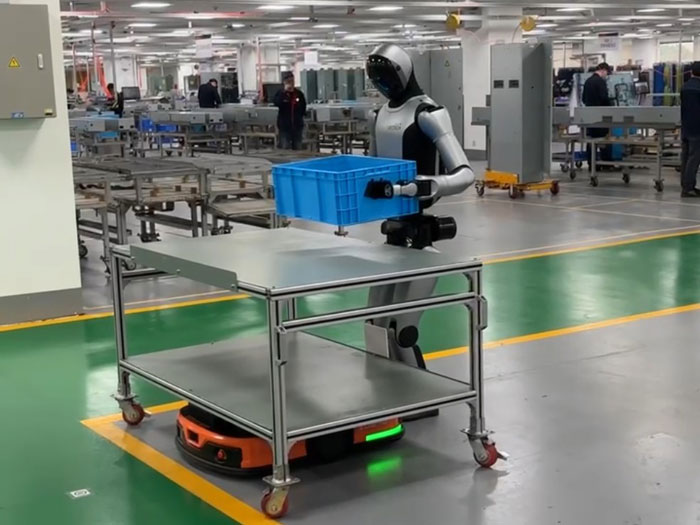
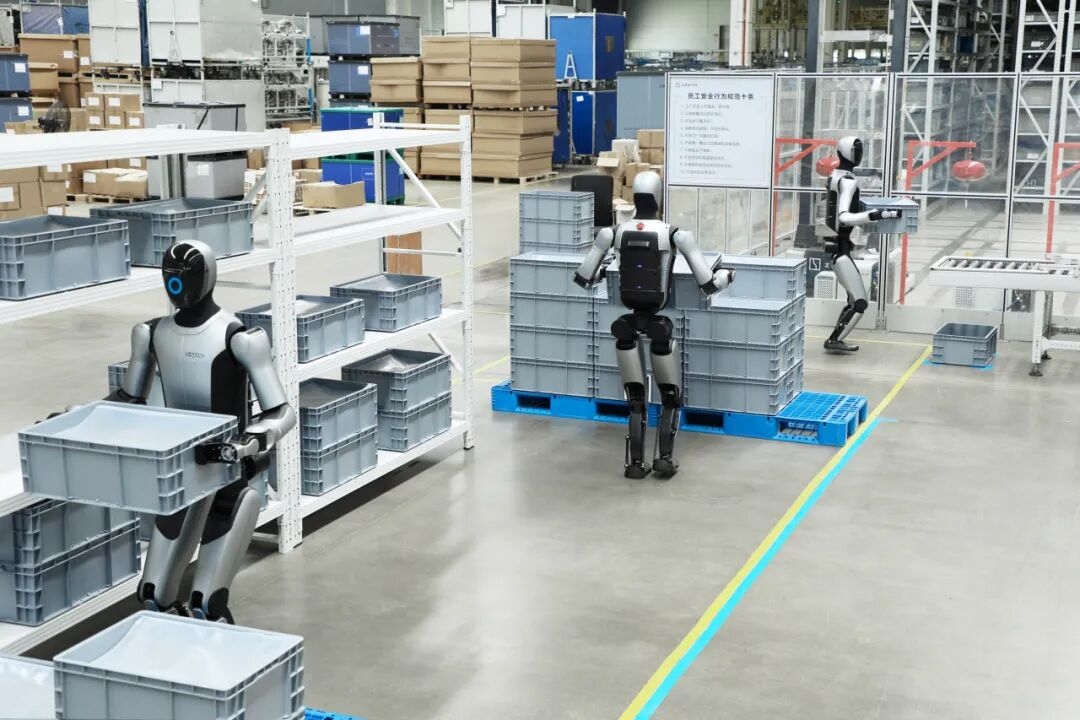
The board (the “Board”) of directors (the “Directors”) of UBTECH ROBOTICS CORP LTD (the “Company”) is pleased to announce the unaudited consolidated interim results of the Company and its subsidiaries (collectively, the “Group”, “we”, “our”, “us”…
The board (the “Board”) of directors (the “Directors”) of UBTECH ROBOTICS CORP LTD
(the “Company”) is pleased to announce the unaudited consolidated interim results of the
Company and its subsidiaries (collectively, the “Group”, “we”, “our”, “us” or “UBTECH”)
for the six months ended June 30, 2026 (the “Reporting Period”), together with the
comparative figures for the corresponding period in 2025.
FINANCIAL SUMMARY
For the six months ended June 30, 2026, our:
• Revenue was RMB1,269.1 million, representing a significant year-on-year increase of
104.2% (same period last of year: RMB621.5 million);
• Revenue from full-size embodied intelligent humanoid robot products and services grew
rapidly by 1,445.0% to RMB590.3 million (same period of last year: RMB38.2 million);
• Overall gross profit increased significantly by 160.9% year-on-year to RMB566.9 million
(same period of last year: RMB217.3 million);
• Overall gross profit margin was 44.7%, representing a year-on-year increase of 9.7 (same
period of last year: 35.0%); and
• Loss for the period decreased by 23.0% year-on-year to RMB338.8 million (same period
of last year: RMB440.0 million).
–1–
FINANCIAL SUMMARY
For the six months ended June 30,
2026
2025
RMB’000
RMB’000
(Unaudited)
(Unaudited)
1,269,130
566,878
(279,093)
(338,827)
621,460
217,312
(439,067)
(439,989)
–
72,205
Adjusted net loss for the period
(non-GAAP measure)
(338,827)
(367,784)
Add:
Interest expenses(Note 1)
Income tax expense
Depreciation and amortisation
Credit impairment loss
Asset impairment loss
1,191
59,040
62,207
91,070
3,771
2,130
4,857
44,370
1,303
470
Less:
Interest income
52,596
7,187
(174,144)
(321,841)
Revenue
Gross profit
Operating loss
Loss for the period
Add:
Share-based payments
Adjusted EBITDA (non-GAAP measure)
–2–
Revenue by Type of Products and Services
For the six months ended June 30,
2026
2025
Amount
% of Total
Amount
% of Total Year-on-Year
RMB’000
Revenue
RMB’000
Revenue
Change
Full-size embodied intelligent humanoid robot products
and services
Non-embodied intelligent humanoid robot products
and services
Other smart robot products and services
Other smart hardware devices
Garden machinery, automotive and hydraulic components
Others(Note 2)
590,299
46.5%
38,206
6.1%
1,445.0%
32,725
245,754
259,377
139,176
1,799
2.6%
19.4%
20.4%
11.0%
0.1%
26,846
302,814
251,967
–
1,627
4.4%
48.7%
40.5%
0.0%
0.3%
21.9%
(18.8%)
2.9%
–
10.6%
Total
1,269,130
100.0%
621,460
100.0%
104.2%
Due to changes in the business segments, adjustments have been made to the revenue
disclosure categories. The breakdown of revenue in accordance with the categorisation
adopted for the six months ended June 30, 2025 is set out in the table below:
For the six months ended June 30,
2026
2025
Amount
% of Total
Amount
% of Total Year-on-Year
RMB’000
Revenue
RMB’000
Revenue
Change
Education smart robot
products and services
Full-size embodied intelligent humanoid
robot products and services
Non-embodied intelligent humanoid robot
products and services
Other smart robot products and services
Subtotal
–3–
21,247
1.7%
1,121
0.2%
1,795.4%
4,046
96,726
0.3%
7.6%
11,610
227,088
1.9%
36.5%
(65.2%)
(57.4%)
122,019
9.6%
239,819
38.6%
(49.1%)
For the six months ended June 30,
2026
2025
Amount
% of Total
Amount
% of Total Year-on-Year
RMB’000
Revenue
RMB’000
Revenue
Change
Logistics smart robot
products and services
Full-size embodied intelligent humanoid
robot products and services
Other smart robot products and services
–
137,056
0.0%
10.8%
2,045
54,118
0.3%
8.7%
(100.0%)
153.3%
Subtotal
137,056
10.8%
56,163
9.0%
144.0%
569,052
44.8%
35,040
5.6%
1,524.0%
–
11,972
0.0%
1.0%
7,152
21,608
1.2%
3.5%
(100.0%)
(44.6%)
Subtotal
581,024
45.8%
63,800
10.3%
810.7%
Consumer-level robots and Non-embodied intelligent humanoid robot
other hardware devices
products and services
Other smart hardware devices
28,679
259,377
2.3%
20.4%
8,084
251,967
1.3%
40.5%
254.8%
2.9%
Subtotal
288,056
22.7%
260,051
41.8%
10.8%
139,176
11.0%
–
0.0%
–
Others(Note2)
1,799
0.1%
1,627
0.3%
10.6%
Total
1,269,130
100.0%
621,460
100.0%
104.2%
Other sector-tailored smart Full-size embodied intelligent humanoid
robot products and services
robot products and
Non-embodied intelligent humanoid robot
services
products and services
Other smart robot products and services
Garden machinery,
automotive and
hydraulic components
Garden machinery, automotive and
hydraulic components
Notes:
(1)
Interest expenses included interest expenses arising from borrowings (net of capitalised amounts) and
interest expenses on lease liabilities.
(2)
“Others” primarily included sales of raw materials and spare parts.
–4–
BUSINESS REVIEW AND OUTLOOK
Part 1 Review of Core Technology Progress
In the first half of 2026, the global artificial intelligence sector officially entered the inaugural
year of mass production and implementation for embodied intelligence. With the evolution
of embodied intelligence technologies, the accumulation of scenario-specific data, and the
extensive collaboration of the industry chain, AI technologies are accelerating their extension
from the digital realm to the physical world. By integrating with physical entities such as
humanoid robots, embodied intelligence further enhances them with long-term time series
autonomous perception, continuous learning, and the ability to interact in real-time within
complex dynamic environments.
UBTECH is positioned as an embodied intelligent ecosystem platform and physical AI
terminal company. Leveraging its full-stack technologies accumulated over the years in
the humanoid robot sector, the Company centres on its humanoid robot hardware and
software platform, and continues to build four key technology clusters, namely “Embodied
Brain, Humanoid Cerebellum, High-Performance Body, and Swarm Intelligence”. It also
continuously drives the open sharing of its core technologies, hardware and software
platforms, and application capabilities, connecting developers, industry chain participants and
industry partners, and progressively establishing a humanoid robot ecosystem platform for the
era of embodied intelligence.
In the “Embodied Brain” domain, the Company focuses on building embodied intelligence
foundation models, VLA models and world models. The VLA model integrates vision
perception, language understanding and action generation capabilities, while the world model
enhances the robot’s ability to predict and reason about future states by learning changes
in the physical world’s states, object interactions and action outcomes. Together, these
advancements enable humanoid robots to develop embodied intelligence capabilities that form
a continuum of “understanding the world – predicting the world – deciding and acting.”
At the “Humanoid Cerebellum and High-Performance Body” level, the Company continues
to develop key technologies such as whole-body motion control, reinforcement learning,
dexterous manipulation, pure vision end-to-end navigation, high-performance servo drives,
and humanoid binocular vision perception, transforming the intelligent decisions of the
embodied brain into stable and precise actions in the physical world, and continuously closing
the loop of embodied intelligence encompassing “perception – understanding – prediction –
decision-making – control – execution – feedback”.
At the “Swarm Intelligence” level, the Company integrates BrainNet 2.0 and Co-Agent
technologies to drive the evolution of embodied intelligence from single-robot autonomy to
multi-robot collaboration, enabling task decomposition, intelligent scheduling, information
sharing and collaborative operations across multiple humanoid robots, and building an AI dualloop evolution system for embodied intelligent humanoid robots tailored for industrial scenarios.
–5–
Leveraging the aforementioned full-stack technology architecture of hardware and software,
the Company continues to pioneer an application paradigm for smart manufacturing and
other real-world physical scenarios across multi-task scenarios, long-sequence field and
multi-robot collaboration and has successfully completed larger-scale, long-sequence field
implementations of multi-robot swarm intelligence collaborative training, driving the
continuous evolution of humanoid robots from single-point task verification to autonomous
operation, swarm collaboration, and large-scale application. The Company will further
extend its capabilities from “products and technologies” to “platforms and ecosystems”.
The Company has always been committed to using humanoid robot as the intelligent carrier,
embodied intelligence algorithms and models as the intelligent core, and the software and
hardware platform as the ecological foundation. By continuously opening up core capabilities
and providing standardized interfaces, the Company lowers the threshold for application
development and deployment of humanoid robots, and works together with developers,
industry chain partners, and industry collaborators to expand application scenarios, forming a
mutually reinforcing development model of “technology – product – platform – ecosystem”.
The Company strives to build a global embodied intelligence humanoid robot ecosystem
platform with sustained innovation and scalability.
UBTECH continues to ramp up its R&D investment in embodied intelligent humanoid robots,
officially entering a new phase of application across three major application scenarios, namely
industrial, commercial and household scenarios.
On the industrial front, UBTECH consistently focuses on industrial application scenarios,
driving the “working” cluster mode of the embodied intelligent humanoid robots toward
deeper large-scale deployment. Through multi-robot collaboration executing complex
production line tasks, the robots carry out a series of workstation operations, including
workbin handling, loading and unloading, and parcel sorting, SPS sorting, components
assembly, process material handling, quality inspection. The Walker S series, bipedal series
and Cruzr wheeled series serves as an industrial embodied intelligence carrier, designed
specifically to address real-world industrial application needs, with the scale of mass
production, the acceleration of application deployment of Cruzr Y1 and delivery for the
Walker S2 continuing to expand. On the commercial front, targeting urban comprehensive
service scenarios, UBTECH has launched the Walker C1, a commercial service embodied
intelligent humanoid robot, becoming the Chain Expo’s first official “silicon-based
spokesperson”. It is specifically designed to meet the needs of commercial scenarios such
as exhibition hall guided tours, commercial reception, cultural and entertainment interaction,
and education and scientific research. On the commercial and household front, we focus on
scenarios of emotional companionship and personalized interaction, launching the Ultrabionic humanoid robot U1 series, while continuously improving its humanoid interaction and
long-term companionship capabilities.
–6–
A.
Robotic Technologies
At the complete robot level, we launched the Cruzr Y1 wheeled industrial embodied
intelligent humanoid robot, which is built upon a foundation of domestic computing
chips, proprietary hardware architecture and the ROSA software system, integrates
technologies such as VLA, 3D visual perception, omni-directional mobility and
integrated harmonic joints, and is equipped with a proprietary collaborative agent. In
unstructured and mixed-material environments, it is capable of independently executing
the entire chain of autonomous operations from perception to decision-making to
grasping to placement. We developed the fourth-generation industrial embodied
intelligent humanoid robot. This model offers significant improvements over the previous
product generation in terms of on-device computing power, perception, and operational
precision, and adopts innovative configuration to increase the range of motion of the leg
joints, while aerospace-grade lightweight materials are used to reduce the overall weight
of the machine by more than 15%, with the battery replacement time shortened to two
minutes. We released a new generation of embodied intelligent humanoid robot, Walker
C1, designed for commercial service scenarios. Building on the technical expertise
gained from the large-scale mass production of the Walker S series, it innovatively
introduces 3D-printed lattice structures as “muscle structures”, featuring 53 degrees of
freedom (DoF), and equipped with full-body trajectory tracking and dynamic balance
algorithms as well as waist joint design to enhance high-dynamic motion capabilities. It
also possesses 3D whole-body planning and real-time obstacle avoidance capabilities,
enabling it to identify centimetre-level small obstacles and achieve real-time obstacle
avoidance across all body joints. We also launched the ultra-bionic humanoid robot U1
series, which features dual male and female morphological designs with a total of 88
degrees of freedom across the entire body, and enhances anthropomorphism in wholebody movements and facial expressions through a modular head design, a “dual-pivot +
four-bar” bionic cervical spine, a facial system with 19 active degrees of freedom, and
multi-material process optimisation. On this basis, the Company has built a full-stack
technology architecture encompassing bionic ontology, facial expression drive, edgecloud collaborative intelligence, emotionally resonant foundation models, long-term
memory and digital twins, reinforcing its capabilities in anthropomorphic interaction and
long-term companionship.
At the domain control level of embodied humanoid robots, UBTECH has explored
and developed a domain control solution that combines the brain and cerebellum of
humanoid robots, further improving the integration of their electronic systems. At
the same time, we are advancing the deployment of a second-source domain control
platform, implementing system base image adaptation, sensor driver debugging, and
master station full-process verification, promoting cost-reduction adaptation solutions.
–7–
In the first half of 2026, we have further improved the safety risk prevention system
for embodied humanoid robot during the design stage, while continuously optimising
manufacturing processes and full-dimensional testing and verification of components,
modules, and complete robots. We overcame the quality and delivery challenges in the
mass production of full-sized embodied humanoid robots, providing strong support to the
achievement of annual production target of 10,000 units and the fulfilment of customer
orders across multiple industries.
B.
Artificial Intelligence (AI) Technologies
For embodied intelligent humanoid robot swarm collaboration scenarios, we continue
to optimise BrainNet 2.0, equipped with our self-developed Co-Agent specifically
designed for industrial embodied intelligent humanoid robots, building an industrialgrade embodied intelligent AI dual-loop to drive the evolution of embodied intelligent
humanoid robot applications in industrial scenarios towards refined collaboration.
In the first half of 2026, we completed the release of UBTECH’s self-developed
foundational large model, Thinker 1.0, and achieved the top ranking in nine embodied
intelligence leaderboards. We continue to iterate our embodied intelligence foundational
large model Thinker, launching the embodied intelligence world model Thinker-WM.
We have built a unified multimodal spatial architecture based on Diffusion Transformer,
achieving collaborative optimisation between video representation and robot action
space, and ranked first in the Libero embodied benchmark in the first half of the year. In
terms of the world model, we addressed data-reading bottlenecks and repeated encoding
issues, which improved the training efficiency of the entire data processing pipeline
by 17 times. At the same time, we supplemented supervisory signals across different
modalities, reducing video action drift. These optimisations have made world model
training more efficient, with generation results becoming more stable in terms of action
logic and spatial geometry. Based on the above improvements, we expect to officially
release the upgraded version, Thinker-WM 2.0, in the second half of 2026.
We have iterated and optimized the visual language action model (Thinker-VLA) with
closed-loop feedback, built a VLA full-link technical framework, and optimized the
on-device inference and motion control capabilities, so as to enhance the performance
in complex operations such as autonomous millimeter-level precision loading and
unloading, generalized grasping, and dual-arm collaborative box handling. At the same
time, we have built an emotional interaction large model with multi-persona and multiscene active empathetic dialogue capabilities, in order to construct a complete interaction
system from passive response to active care.
–8–
We are building humanoid robot data collection and testing centers in multiple locations,
and establishing a one-stop embodied intelligence data collection platform, with an aim
to uniformly manage equipment, collection tasks and data resources, and connect the
entire process of data collection, annotation, training and deployment. Meanwhile, the
platform integrates real-machine data and world model-generated samples into the data
flywheel, continuously feeding back into model.
In terms of embodied intelligence developer ecosystem construction, we have released
the exclusive “Thinker Cosmos” developer community, continuously opening the full set
of model weights, training toolchains and application cases to accelerate the large-scale
implementation of embodied intelligence technology. In addition, we have also opensourced the code and model weights of the Thinker embodied large model on GitHub
and Hugging Face, which has accumulated more than a thousand downloads.
In terms of on-device inference optimization, through hardware-software codevelopment, we have achieved deep adaptation between our self-developed algorithms
and the chip hardware, forming a deployment solution with four layers of full-link
optimization: low-level system memory reclamation, on-device inference engine
reconstruction, GPU computing power intelligent allocation, and low-loss model
precision compression. We have reconstructed the VLA inference link based on C++ and
Tensor RT, enhancing the efficiency of model optimization and inference. At the same
time, we have asynchronously decoupled the visual understanding and action generation
modules to enable efficient action generation.
C.
Integrated Robotic and AI Technologies
1.
Integration of Positioning, Navigation, and AI
We have continuously advanced the iteration of spatial intelligence technology,
thereby forming a navigation technology system centered on spatial perception, 4D
ground truth system, mapping and localization, scene understanding, and intelligent
planning.
In terms of spatial perception and scene understanding, through the 4D ground
truth data closed-loop system, we have realized the deployment of the multi-view
pure-vision multi-task spatial perception model for humanoid robots, enabling
humanoid robots to have 360° full-coverage semantic obstacle perception and AEB
safety monitoring. In the field of mapping and localization, we have continuously
optimized the construction of the technical system for pure-vision mapping &
localization and vision-LiDAR fused localization. Continuous improvements have
been achieved in map construction, map compression, map updating, dynamic
–9–
environment adaptation and localization robustness for indoor and outdoor
scenarios, weak-texture scenarios, and large open scenarios, further enhancing
deployment efficiency and interactive ease of use.
In terms of navigation decision-making and motion obstacle avoidance, our robots
support the fusion processing of multi-source data including point cloud, map,
LiDAR, OCC and OD, achieving the separation and filtering of dynamic and static
obstacles as well as 3D full-body joint collision detection. We have continuously
optimized the capabilities of robots’ global planning, trajectory optimization,
velocity planning and dynamic obstacle avoidance, supporting task planning for
narrow passages, stairs and other complex scenarios. This helps to realize obstacleavoidance following navigation under no-localization/mapless modes, and enhance
the autonomous mobility of the robot in complex environments.
To further improve the anthropomorphism, safety, efficiency and intelligence
of humanoid robot navigation, we have been exploring cutting-edge technical
directions such as data-driven navigation, spatio-temporal memory, visual
reconstruction and reinforcement learning, promoting the evolution of the
navigation system from rule-driven to intelligent decision-making.
2.
Integration of Motion Control and AI Technologies
In the first half of 2026, we have focused on full-body motion intelligence. First,
we developed a general-purpose full-body tracking and control model to enable
robots to understand full-body movements and achieve stable control. Second,
we developed a full-body trajectory tracking model to further enable the rapid
generation and replication of complex motion skills, thereby improving the
efficiency of expanding robots’ motion capabilities. We combined Xsens, Pico
and Camera multi-source online teleoperation systems to enable the collection
of complex motion data, and built a full-body motion dataset to support the
continuous optimization of motion policies. At the same time, we established a
robot motion control model training framework based on GPU clusters to support
large-scale motion data processing and accelerate the iteration efficiency of fullbody control models. Currently, our full-body trajectory tracking model can support
the development of various dynamic skills, including waltz, boxing, gymnastics
and guided-tour movements, enabling the rapid expansion of application scenarios
such as teaching assistant robots.
– 10 –
Building on our full-body trajectory tracking and control capabilities, we are
expanding into motion generation technologies of humanoid robot driven
by perception, voice commands and multimodal fusion, comprehensively
understanding task objectives and the robot’s own state, thereby generating more
natural and stable full-body motion policies.
3.
Application and Deployment of VLA in Industrial Scenarios
Our VLA (Vision-Language-Action) technology integrates visual perception,
task instructions, and robotic action generation, enabling robots to autonomously
generate and adjust operational actions in response to environmental changes. In
the first half of 2026, we focused on advancing the industrial application of VLA
technology in industrial handling and loading/unloading scenarios.
In the area of industrial handling, we have established a complete application
closed loop encompassing real-world operational data, model training, edge-side
deployment, and robot control. Leveraging UBtech’s self-developed ROSA robotic
system, we have optimised the model inference and control pipeline, enabling
robots to autonomously handle anomalies such as significant container tilting,
thereby enhancing stability across multiple robot models and diverse scenarios.
In loading/unloading scenarios, we have introduced wrist-mounted visual
perception and optimised the data collection – model training – real-robot
deployment pipeline across task sequences including material pick-up, loading,
unloading, and placement. This enhances the robots’ adaptability to dynamic
incoming materials and fine-manipulation tasks. Currently, our success rate in
laboratory settings has reached 75%, preliminarily validating the generalisation
capability of VLA technology in transitioning from controlled environments to
dynamic industrial scenarios.
Integration of Embodied Simulation and AI Technologies
In the development of our embodied simulation platform, we have continued to
enhance end-to-end capabilities across scene reconstruction, asset generation,
data synthesis, simulation evaluation, and platform architecture. We have
already achieved real-scene reconstruction in simulation environments and scene
understanding based on large language models (LLMs), supporting the construction
of virtual objects at lower cost and higher efficiency through methods such as
text-to-3D and image-to-3D, further enhancing the generalization efficiency of
simulation scenarios. In terms of data generation, we have developed multiple
data generation capabilities, including teleoperation, data augmentation, and
automated generation, providing more data for robotic model training. In terms of
model testing, we have integrated embodied AI models and motion control models,
– 11 –
and have conducted tests in typical scenarios such as box handling and loading/
unloading. We have also established a systematic Sim2Real (simulation-to-reality)
Gap analysis framework to improve the accuracy of simulation results.
As at June 30, 2026, we held 3,112 granted patents, representing a 4.2% increase compared to
the end of 2025, which 530 patents were granted overseas.
Part II Business Review
I.
Full-size embodied intelligent humanoid robot products and services
For the first half of 2026, full-size embodied intelligent humanoid robot products and
services for all scenarios achieved revenue of RMB590.3 million, representing a yearon-year increase of 1,445.0%; achieved sales volume of 921 units, representing a yearon-year increase of 1,946.7%.
For full-size embodied intelligent humanoid robot products, the Company continues
to improve its product matrix of embodied intelligent humanoid robots. The Company
has launched the Cruzr Y1 wheeled humanoid robot for industrial scenarios such as
manufacturing and warehousing, the Walker C1 bipedal humanoid robot for commercial
services, education and research scenarios, and the ultra-bionic humanoid robot U1
series for commercial and consumer companionship scenarios. This diversified product
matrix is driving the evolution of embodied intelligent humanoid robots towards multiscenario applications:
1.
Product matrix continues to improve, forming a layout of humanoid robot products
and services covering different application directions
Designed for manufacturing and warehousing scenarios, Cruzr Y1 focuses on
addressing key challenges in flexible operations involving various types of
bins, cartons, material loading and unloading, and sorting. It directly addresses
critical pain points in the manufacturing industry associated with conventional
automated equipment, including limited generalisability, lengthy changeover and
commissioning cycles, and the inability to perform more than a single process.
The Walker C1 is positioned for commercial and educational scenarios, catering
to application needs such as guiding and reception, interactive display, education
and research. It is equipped with capabilities including anthropomorphic gait,
dancing, multimodal interaction, tour guiding and full-body motion. The U1 series
is positioned as a hyper-bionic humanoid robot product, exploring the direction of
consumer-grade companionship and human-robot emotional interaction through
full-size bionic design, modular structure and a high-degree-of-freedom motion
system.
– 12 –
Humanoid robot product capabilities continue to improve, evolving towards highdynamics, high-interaction, high-intelligence and high-human-likeness
Overall, the Company’s humanoid robot products are gradually developing into an
integrated technology system combining motion control, multimodal interaction
and intelligent decision-making capabilities. In particular, Cruzr Y1 enhances
autonomous perception, intelligent decision-making, multi-robot collaboration
and continuous operation capabilities, driving the expansion of humanoid robots
into multi-scenario applications. Walker C1 focuses on enhancing high-dynamic
balance, whole-body motion control and multimodal interaction capabilities, and
can demonstrate extreme dynamic balance while maintaining single-foot or dualfoot point contact. The U1 series focuses on enhancing its hyper-bionic appearance,
facial expressions, emotional interaction and long-term memory capabilities.
In respect of full-size embodied intelligent humanoid robot services, our core business
continues to advance around high-value scenarios such as material handling, loading/
unloading, sorting, depalletizing and palletizing. We are progressively establishing a
closed-loop solution framework for large-scale deployment, covering demand assessment,
solution design, teleoperation validation, data acquisition and model training:
1.
Key industrial scenarios have been continuously expanded, driving robots from
technical verification to practical applications. We have carried out solution
validation for typical industrial scenarios such as material handling, sheet metal
parts loading and unloading, express sorting, seeding wall sorting, depalletizing
and palletizing.
A multi-technical-route synergistic solution capability has been formed, matching
different technical paths according to scenario requirements. We have also
explored the combined application of teleoperation, VLA, end-to-end and other
technical solutions based on the characteristics of different industrial tasks.
Remote teleoperation capabilities have continued to break through, enabling
cross-geographical robot operation and data acquisition capabilities. We have
completed cross-region remote teleoperation tests based on wireless links, and
established routine remote teleoperation test points at the embodied intelligence
data acquisition centre.
– 13 –
II.
Data infrastructure has been progressively enhanced to support the continuous
iteration of robotic AI capabilities. We have completed the upgrade of our
embodied intelligence data acquisition centre, expanding our data collection
capabilities towards scenario-based data services and data trading. We have
established a data system covering real-robot data, manually annotated data and
human motion data, while enhancing our capabilities in automated pre-screening,
VLA annotation and data backup, thereby supporting robot model training, skill
optimisation and large-scale deployment.
Non-Embodied Intelligent Humanoid Robot Products and Services
In the first half of 2026, UBTECH continued to explore its presence in the non-embodied
intelligent humanoid robot field. On the R&D front, the AI Wukong robot collaborated
with hundreds of domestic and international business partners to actively explore and
implement vertical products and products for export across various industries. Together
with partners, we launched multiple language versions, including Cantonese, English,
Spanish, and German, as well as customized products for early childhood education,
live streaming, and higher education. On the market front, seizing the promotional
opportunity of the 2026 FIFA World Cup, we actively carried out diversified brand
marketing and cross-border content initiatives. We collaborated with renowned sports
commentator Zhan Jun to produce a viral Douyin video for the AI Wukong robot, and
established an extensive partnership with Migu Live to achieve a closed-loop conversion
through event in-stream ads and e-commerce live streaming. As a result, our marketing
content related to the Wukong robot achieved over 10 million views and over 50,000
interactions across the internet.
In the first half of 2026, we completed an iterative upgrade of the desktop humanoid
robot Yanshee Pro, significantly enhancing its edge-side computing power and
environmental perception capabilities. This upgrade supports the implementation of
cutting-edge technologies such as LLM, VLM, and VLA in education, promoting
the application of multimodal embodied intelligence technology in both primary and
vocational education. This represents an upgrade in teaching models from “traditional
STEAM AI” to “advanced embodied intelligence education”.
– 14 –
III. Other Intelligent Robot Products and Services
1.
Education intelligent robot products and intelligent robot services
In the first half of 2026, in the K12 education sector, the Company has officially
commenced the R&D of a new-generation Yanshee humanoid robot, equipped
with a higher-performance computing chip that significantly enhances edge
computing capabilities, AI algorithm deployment, and secondary development
capabilities, thereby providing a more stable and open hardware foundation for
AI and robotics education, competitions, and practical training. With the goal of
“bringing embodied AI into real-world classrooms”, we continue to advance the
R&D and scenario validation of humanoid teaching assistant robots. Equipped with
the UIRO intelligent teaching assistant system, the robots are designed to enhance
course comprehension, lesson planning, classroom collaboration, and intelligent
scheduling. We have initially established a human-machine collaborative teaching
closed loop featuring “teacher-led, UIRO-coordinated, and robot-executed”
operations, laying a product foundation for AI classrooms, embodied intelligence
laboratories, and educational innovation demonstration scenarios. Meanwhile, the
Company continues to optimize the UDECA series of open intelligent hardware
teaching platforms, enrich its library of bionic teaching cases, and integrate
interdisciplinary curricula to develop an end-to-end “creation and manufacturing”
solution for innovation and technology education. This effectively addresses key
industry challenges, including fragmented disciplines and insufficient practical
engineering training. The UDECA series and UGOT products have been adapted
for competition programs and support the implementation of ROBOG competitions,
further strengthening the Company’s technological advantages and industry
position in AI innovation and technology education.
In the industry-education integration context, targeting universities, vocational
colleges, and developers, we have launched a new suite of embodied intelligence
product solutions covering scientific research, practical training, and secondary
development, which have received positive recognition from both domestic
and overseas customers. In collaboration with the China Vocational and
Technical Education Society under the Ministry of Education, we launched the
“Production Process Industrial Humanoid Data Collection Center” initiative, with
28 institutions participating in the initial construction. Shenzhen Polytechnic
University, in collaboration with UBTECH, established the first embodied
intelligence industry institute at a vocational undergraduate university in China.
We launched the Thinker Cosmos embodied intelligence developer community,
providing the Thinker Studio/Lab developer toolchain and hosting third-party
open-source algorithm sets, receiving support from universities including CUHK,
Beihang University, and Wuhan University. Concurrently, we launched the Global
– 15 –
Humanoid Robot Challenge, attracting 173 teams from 13 countries and regions to
participate in challenges related to industrial scenario algorithms and applications.
In overseas regions such as Germany and South Korea, we are collaborating with
local developer partners to carry out secondary development and application
implementation in research and industrial scenarios.
In terms of platform ecology, we continue to optimize the UDECA series of open
intelligent hardware teaching platforms, enrich the bionic teaching case library,
and integrate a multi-disciplinary framework to construct a full-process “creation
and manufacturing” solution for science and innovation education. This addresses
industry pain points such as subject fragmentation and a lack of engineering
practice. We have also completed the adaptation of competition schemes for the
UDECA series and UGOT products, supporting the implementation of the ROBOG
competition, thereby reinforcing the Company’s technological advantages and
industry position in the field of AI science and technology innovation education.
In terms of overseas expansion, we accelerated our internationalization efforts by
establishing strategic partnerships with overseas partners and local governments,
while exploring localized production and localized education and training service
models. For products such as uKit AI, UGOT and Yanshee, we established
a standardized raw material export system, streamlined the entire process,
and implemented a localization adaptation mechanism for less widely spoken
languages, thereby reducing the risks associated with overseas operations.
2.
Logistics intelligent robot products and intelligent robot services
In the first half of 2026, the next-generation unmanned logistics vehicle, Chitu,
officially rolled off the production line at the Foxconn’s Zhengzhou plant and
commenced global pre-sales. We continued to optimise industrial logistics
scenario applications based on wheeled humanoid robots, and completed project
deliveries to multiple Fortune Global 500 clients, including OPmobility, Jabil,
Foxconn and Honda. At the same time, we officially initiated the construction of
our sales channel network in the China market, significantly expanding the sales
and operational channels for our Wali series industrial mobile robots and Chitu
unmanned logistics vehicles.
Other sector-tailored intelligent robot products and intelligent robot services
In the first half of 2026, in terms of market expansion, we accelerated
multi-scenario penetration and the development of our global channel network,
and engaged in in-depth, end-to-end collaboration with industry partners across
key operation and maintenance scenarios in various industries, including business
– 16 –
travel and power grids, to explore large-scale deployment of humanoid robots.
In parallel, we continued to drive the commercial deployment of our commercial
robot series in both domestic and overseas markets. Product sales and channel
development have covered multiple key markets across Chinese mainland and
overseas, including Europe, North America, Japan, South Korea, the Middle East,
Southeast Asia, Central Asia and Latin America, enabling us to continuously
expand the market potential for commercial service and other sector-tailored
intelligent robot products and services.
IV.
Other Intelligent Hardware Devices
In the first half of 2026, in terms of smart pet hardware, UBTECH continued to deepen
its presence in smart pet devices, with global sales of its intelligent pet equipment
continuing to maintain a leading market position. The smart cat litter boxes C30 and
C40 became best-selling new products, while the smart refrigerated dual-temperature pet
feeder F20 also received strong market recognition. We also launched the CP100 and
MV10 series of smart cleaning products focusing on niche categories such as carpets,
upholstered fabrics and mattresses, further enriching our home product line with costeffective solutions.
In terms of smart yard robotics, the smart lawnmower M20 is being launched to the
market, with its product strength gaining recognition from a wide range of channel
customers. We have commenced the R&D project for the PC30 series of new smart
pool cleaning robots, focusing on the synergistic enhancement of cost optimisation,
performance experience and overall product strength. This series is planned to
commence mass production and hit the market officially by the end of 2026.
V.
Garden Machinery, Automotive and Hydraulic Components
In the first half of 2026, the Company remained market-focused and proactively
responded to changes in both domestic and international sales environments. It monitored
overseas niche markets that lead industry trends to drive business development. At
the same time, the Company stepped up efforts to expand its domestic sales market,
continuously exploring new customers and application areas. In addition, leveraging
resources from its existing shareholders, industry networks, and manufacturing
capabilities in mechanical and electronic control systems, the Company advanced its
exploration of new business opportunities and pursued upgrades to its business structure.
The Company continued to strengthen refined cost management across all aspects of
procurement, production, and operations, with an emphasis on inventory control and
strict implementation of price comparison mechanisms, so as to continuously enhance
its cost advantages. In response to fluctuations in raw material markets, the Company
maintained close communication and negotiation with customers, promptly initiating
product price adjustments to reasonably pass on cost pressures.
– 17 –
Part III Future Outlook
UBTECH has been adopting embodied intelligent humanoid robots and AI as the Company’s
core strategy, focusing strategically on the research and development of embodied intelligence
technology and its commercial application, and working hard on the breakthrough towards
the commercialization of embodied intelligent humanoid robot technology and AI technology,
continuously enhancing the autonomous perception, decision-making, manipulation and
collaborative capabilities of humanoid robots, committed to expanding the reach of embodied
intelligent humanoid robots from industrial and commercial applications to every household.
Specifically, we will focus on the following areas:
1.
Embodied Intelligent Humanoid Robots
Building on our existing product matrix, we will further promote the cross-model reuse
and platformisation of key technologies, while enhancing the standardisation of core
components, software and hardware interfaces, and overall system architectures. We
will continue to invest in the R&D of new models of the Walker S series of industrial
embodied intelligent humanoid robots, and promote product upgrades and new model
development for the commercial Walker C series and the Ultra-bionic humanoid robot
U1 series, which covers commercial, educational and home scenarios. In terms of
overall machine technology, our focus is on advancing integrated joints, bionic fivefingered dexterous hands and other key technologies, further advancing core capabilities
including full-sized bipedal configurations, lightweight design, high-load stability, highprecision perception and manipulation, on-device intelligence, autonomous battery
swapping, and industrial-grade safety, thereby enhancing overall system integration,
system stability, single-unit autonomy, swarm collaboration, and continuous operation
capabilities. We aim to drive the large-scale application of embodied intelligence across
industrial, commercial, educational, and home scenarios. Concurrently, we will continue
to build a robotics developer community and an open ecosystem platform, bringing
together industry partners to jointly expand the application ecosystem for embodied
intelligence humanoid robots.
Industrial Vertical Domain Embodied Intelligence Dataset
Based on our multiple humanoid robot data collection and testing centers, we will
further refine our unified data standards, quality control and automated processing
capabilities, and enhance data processing efficiency and quality through methods such as
large-model-assisted annotation and cross-validation across multiple models. Building
upon remote operation of physical robots, we will further expand our multi-source data
system to include first-person data, data without a physical body, data generated from
world models, and data from simulation platforms. We will continue to improve the
construction of our embodied simulation platform to enhance the efficiency of model
training and adaptation to new scenarios.
– 18 –
Multi-modal Perception and Large Model Technology
We will continue to iterate the Thinker embodied intelligence foundation large model,
promote the upgrades of the Thinker-WM world model and the Thinker-VLA visionlanguage-action model, and further enhance the models’ ability to understand the
environment, tasks, and the robot’s own state. We will further enhance ThinkerWM’s video generation and action prediction capabilities, and strengthen ThinkerVLA’s abilities in long-term task understanding, cross-scenario generalization, finegrained operations, and real-time inference on the device side. In terms of human-robot
interaction, we will continue to improve the emotional resonance large model, enhancing
its long-term memory, natural interaction, and personalized companionship capabilities.
Embodied Intelligence Decision-Making Technologies
We will continue to focus on complex industrial tasks and multi-robot collaboration
scenarios and continue to iterate and enhance the BrainNet and Co-Agent to strengthen
their capabilities in task understanding, task decomposition, skill invocation, execution
feedback and autonomous error correction, enhance task scheduling, state sharing and
resource coordination among multiple robots, and improve the level of autonomous
operation of individual robots and dynamic coordination among multiple robots. We will
also further improve the “proactive perception – proactive decision-making – proactive
action” workflow to support cluster-based deployment in industrial scenarios.
End-to-End Motion Control Technology
We will continue to advance end-to-end learning-based motion control and dexterous
manipulation technologies, so as to improve the highly generalized manipulation
performance of robots in complex industrial tasks and commercial scenarios. In
terms of full-body motion control, we will continuously expand the full-body motion
dataset, iterate the universal full-body trajectory tracking model, optimize the VLA-RL
reinforcement learning model and force control algorithm, to further enhance the success
rate and stability of operations in industrial scenarios.
End-to-End Full-Body Humanoid Navigation Technology
We will further advance the research and development of end-to-end humanoid
navigation technology on the basis of the development of our navigation and spatial
intelligence capabilities, with a focus on the development of technologies including
spatio-temporal memory, visual reconstruction, data-driven planning and control,
reinforcement learning-based local navigation, and vision-language navigation, so
as to promote the gradual evolution of navigation towards an integrated approach
encompassing perception, understanding, planning and control. By accumulating real-
– 19 –
environment data and optimising navigation strategies, we will improve the robots’
adaptability to dynamic pedestrians, narrow passages, and complex obstacles, driving
our navigation capabilities to upgrade from “being able to reach a target point” to
“completing tasks more naturally, more safely and more efficiently”. This will provide
stronger technical support for the task execution of humanoid robots in industrial,
commercial and multi-scenario services.
MANAGEMENT DISCUSSION AND ANALYSIS
Revenue
Our revenue attributable to full-size embodied smart humanoid robot products and services
increased by 1,445.0% from RMB38.2 million for the six months ended June 30, 2025 to
RMB590.3 million for the six months ended June 30, 2026, primarily due to the accelerated
adoption of applications across large-scale scenarios, successfully translating accumulated
technological expertise into the delivery of bulk orders.
Our revenue attributable to non-embodied smart humanoid robot products and services
increased by 21.9% from RMB26.8 million for the six months ended June 30, 2025 to
RMB32.7 million for the six months ended June 30, 2026, primarily due to the Company’s
continuous launch of new products, resulting in increased revenue from new product sales.
Our revenue attributable to other smart robot products and services decreased by 18.8% from
RMB302.8 million for the six months ended June 30, 2025 to RMB245.8 million for the six
months ended June 30, 2026, primarily due to the decrease in revenue from education smart
robot products and services.
Our revenue attributable to other smart hardware devices increased by 2.9% from RMB252.0
million for the six months ended June 30, 2025 to RMB259.4 million for the six months ended
June 30, 2026, primarily due to the Company’s continuous launch of new products, resulting
in increased revenue from new product sales.
Our revenue attributable to garden machinery, automotive and hydraulic components products
increased from RMB nil for the six months ended June 30, 2025 to RMB139.2 million for
the six months ended June 30, 2026, primarily due to the acquisition of equity interests in
Zhejiang Fenglong Electric Co., Ltd.* (浙江鋒龍電氣股份有限公司), which was completed
in March 2026 and its financial results have been included in the consolidated financial
statements of the Group since April 2026.
For identification purposes only
– 20 –
Cost of Sales
Our cost of sales for the six months ended June 30, 2026 was RMB702.3 million, representing
an increase of 73.8% as compared with RMB404.1 million for the six months ended June 30,
2025, primarily due to the increase in revenue leading to a corresponding increase in costs.
Gross Profit and Gross Profit Margin
As a result of foregoing, our overall gross profit for the six months ended June 30, 2026 was
RMB566.9 million, representing an increase of 160.9% as compared with RMB217.3 million
for the six months ended June 30, 2025. For the six months ended June 30, 2026, our overall
gross margin was 44.7%, representing an increase of 9.7 percentage points from 35.0% for
the six months ended June 30, 2025. This was primarily attributable to changes in our revenue
structure, with an increased proportion of revenue generated from our full-size embodied
smart humanoid robot products and services, which have a higher gross profit margin.
Selling Expenses
Our selling expenses for the six months ended June 30, 2026 were RMB238.0 million,
representing an increase of 6.5% as compared with RMB223.5 million for the six months
ended June 30, 2025, primarily due to an increase of RMB29.3 million in advertising and
promotion expenses as a result of the Company’s intensified efforts in brand promotion and
the marketing of new products.
Selling expenses as a percentage of revenue decreased from 36.0% for the six months ended
June 30, 2025 to 18.8% for the six months ended June 30, 2026, as our revenue significantly
increased.
Administrative Expenses
Our administrative expenses for the six months ended June 30, 2026 were RMB149.3
million, representing a decrease of 19.3% as compared with RMB185.1 million for the six
months ended June 30, 2025, primarily due to a decrease of RMB51.6 million in share-based
payments.
Administrative expenses as a percentage of revenue decreased from 29.8% for the six months
ended June 30, 2025 to 11.8% for the six months ended June 30, 2026, as our revenue
significantly increased while share-based payments decreased.
– 21 –
Research and Development Expenses
Our research and development expenses for the six months ended June 30, 2026 were
RMB303.1 million, representing an increase of 38.9% as compared with RMB218.3 million
for the six months ended June 30, 2025, primarily due to the Company’s continued increase
in investment in the research and development of full-size embodied smart humanoid robot
products.
Research and development expenses as a percentage of revenue decreased from 35.1% for
the six months ended June 30, 2025 to 23.9% for the six months ended June 30, 2026, as our
revenue significantly increased.
Credit Impairment Losses
We had credit impairment losses of RMB91.1 million for the six months ended June 30, 2026 as
compared to a credit impairment losses of RMB1.3 million for the six months ended June 30,
2025, primarily due to changes from the external rating method to the migration rate method
of the Company since the end of 2025 to determine the expected credit loss rate, thereby
resulting in a year-on-year increase in the provision for credit impairment losses.
Other Income
Other income consists primarily of government grants, value-added tax and other tax refunds.
For the six months ended June 30, 2026, our other income was RMB8.3 million (for the six
months ended June 30, 2025: RMB4.6 million).
Operating Loss
As a result of the foregoing, we had an operating loss of RMB279.1 million for the six months
ended June 30, 2026, representing a decrease of 36.4% from the operating loss of RMB439.1
million for the six months ended June 30, 2025.
Finance Expenses
Our finance expenses primarily comprised (i) interest expenses on our lease liabilities; (ii)
interest expenses on borrowings; (iii) exchange gains and losses; and (iv) interest income.
We had finance expenses of RMB23.3 million for the six months ended June 30, 2026, as
compared to our finance income of RMB10.2 million for the six months ended June 30, 2025,
mainly due to an increase in foreign exchange losses for the reporting period.
– 22 –
Income tax expense
Our income tax expense increased from RMB4.9 million for the six months ended June 30,
2025 to RMB59.0 million for the six months ended June 30, 2026, primarily due to an increase
in pre-tax profits of our taxable subsidiaries.
Loss for the Period
For the six months ended June 30, 2026, we reported a loss for the period of RMB338.8
million, representing a decrease of 23% from the loss of RMB440.0 million for the six months
ended June 30, 2025.
Non-GAAP Measures
To supplement our consolidated financial statements, which are presented in accordance with
PRC GAAP, we also use “adjusted net loss for the period (non-GAAP measure)” and “adjusted
EBITDA (non-GAAP measure)” as additional financial measures. We present these financial
measures because they are used by our management to evaluate our financial performance. We
also believe these non-GAAP measures provide additional information to investors and others
in understanding and evaluating our results of operations in the same manner as they help
our management. However, these non-GAAP measures do not have a standardized meaning
prescribed by PRC GAAP and therefore, they may not be comparable to similar measures
presented by other companies.
We define “adjusted net loss for the period (non-GAAP measure)” as loss for the period
adjusted by adding back share-based payments (being non-cash in nature). We define “adjusted
EBITDA (non-GAAP measure)” as “adjusted net loss for the period (non-GAAP measure)”
adjusted by adding back (i) interest expenses; (ii) income tax expense; (iii) depreciation
and amortisation, which are non-cash in nature; (iv) credit impairment losses; and (v) asset
impairment loss, and deducting interest income from it.
– 23 –
For the six months ended June 30,
2026
2025
RMB’000
RMB’000
(Unaudited)
(Unaudited)
Reconciliation of loss for the period to “adjusted
EBITDA (non-GAAP measure)” and “adjusted net
loss for the period (non-GAAP measure)”
Loss for the period
(338,827)
(439,989)
–
72,205
(338,827)
(367,784)
Add:
Interest expenses(Note)
Income tax expense
Depreciation and amortization
Credit impairment loss
Asset impairment loss
1,191
59,040
62,207
91,070
3,771
2,130
4,857
44,370
1,303
470
Less:
Interest income
52,596
7,187
(174,144)
(321,841)
Add:
Share-based payments
Adjusted net loss for the period (non-GAAP measure)
Adjusted EBITDA (non-GAAP measure)
Note: Interest expenses included interest expenses on borrowings, net of amount capitalised and lease liabilities.
– 24 –
Liquidity and Capital Resources
Cash at Bank and on Hand
As at June 30, 2026, our cash and cash equivalents were RMB2,325.6 million, compared
to RMB4,887.9 million as at December 31, 2025, mainly attributable to the payment of
RMB1,665.3 million due to the completion of the material acquisition. Most of our cash and
cash equivalents were denominated in RMB.
Gearing Ratio
We monitor capital with reference to our gearing ratio, which is calculated as total interest
bearing borrowings and lease liabilities divided by total equity. As of June 30, 2026, our
gearing ratio was 13.3% (as at December 31, 2025: 16.0%) and our liquidity position remains
strong to meet our working capital requirements.
Material Acquisitions and Disposals
As disclosed in the Company’s circular dated 16 February 2026 (the “Circular”) and the
Company’s announcements dated December 24, 2025, March 10, 2026, March 12, 2026
and April 24, 2026, in March 2026, we acquired 65,529,906 A-shares of Zhejiang Fenglong
Electric Co., Ltd. (浙江鋒龍電氣股份有限公司) (“Fenglong Shares”) (representing
approximately 29.99% of the total issued share capital of Fenglong Shares), and became
the controlling shareholder of Fenglong Shares (taking into account the giving up of voting
rights in relation to the pre-acceptance shares by the vendors as detailed in the Circular). In
April 2026, we acquired an additional 28,450,000 A-shares of Fenglong Shares (representing
approximately 13.02% of the total issued share capital of Fenglong Shares), and the Company
held an aggregate of 93,979,906 A-shares of Fenglong Shares (representing approximately
43.01% of its total issued share capital). The financial results of Fenglong Shares have been
consolidated into the Group’s consolidated financial statements with effect from April 2026.
Save as disclosed above, the Group had no material acquisitions and disposals during the
Reporting Period.
Foreign Exchange Exposure
During the six months ended June 30, 2026, we mainly operated in China with most of the
transactions settled in RMB. The functional currency of our Company and the subsidiaries
is RMB. As of June 30, 2026, our balance of the cash and cash equivalents was mainly
denominated in RMB. We continue to adopt a conservative approach in our foreign exchange
exposure management. During the Reporting Period, we did not have a foreign currency
– 25 –
hedging policy in respect of foreign currency transactions, assets and liabilities. We review
our foreign exchange risks periodically and use derivative financial instruments to hedge
against such risks when necessary. As of June 30, 2026, our business is not exposed to any
significant foreign exchange risk.
Pledge of Assets
As of December 31, 2025 and June 30, 2026, 100% of the equity interest in Shenzhen
UBTECH Technology Industrial Co., Ltd.* (深圳市優必選科技實業有限公司), a subsidiary
of our Group, and the real estate ownership held by it, along with some of the patent rights
owned by the Group, have been charged/pledged to secure bank loans of our Group mainly for
our construction of property, plant and equipment.
Borrowings
Our borrowings decreased from RMB1,123.0 million as of December 31, 2025 to RMB997.3
million as of June 30, 2026 mainly in respect of daily operations and the payments of the
construction cost of our headquarter building located in Shenzhen.
Contingent Liabilities
As of June 30, 2026, we did not have any material contingent liabilities.
USE OF PROCEEDS FROM THE GLOBAL OFFERING
The net proceeds from the Global Offering and the partial exercise of the over-allotment
option amounted to HK$931.21 million (the “Proceeds from the Initial Public Offering of
H Shares”). As of June 30, 2026, the Group had fully utilized the Proceeds from the Initial
Public Offering of H Shares.
For identification purposes only
– 26 –
USE OF PROCEEDS FROM PLACINGS OF NEW H SHARES UNDER THE
GENERAL MANDATE
The Company has conducted several rounds of placing under the General Mandate, namely
(i) the placing of 10,155,099 new H Shares at the placing price of HK$90.00 per H Share
under the placing agreement entered into between the Company and the Placing Agents
dated February 20, 2025, which was completed on February 27, 2025 (the “February
2025 Placing”), the closing price of the Shares on February 20, 2025 (being the date of the
placing agreement in respect of the February 2025 Placing) was HK$94.70; (ii) the placing
of 30,155,450 new H Shares at the placing price of HK$82.00 per H Share under the placing
agreement entered into between the Company and the Placing Agents dated July 22, 2025
(the “July 2025 Placing”), which was completed on July 28, 2025, and the closing price of
the Shares was HK$85.10 on July 22, 2025 (being the date of the agreement of the July 2025
Placing); and (iii) the placing of 31,468,000 new H Shares at the placing price of HK$98.80
per H Share under the placing agreement entered into between the Company and the Placing
Agents dated November 25, 2025, which was completed on December 2, 2025 (the “November
2025 Placing”) the closing price of the Shares was HK$110.60 on November 25, 2025 (being
the date of the agreement of the November 2025 Placing), collectively with the February
2025 Placing and the July 2025 Placing, the “Placings”. For further details, please refer to the
announcements of the Company dated February 20, 2025, February 24, 2025, February 27,
2025, July 22, 2025, July 28, 2025, November 25, 2025 and December 2, 2025.
Reasons for and benefits of the Placings
The Directors consider that the Placings represent opportunities to replenish capital for
continuous optimization and iteration and future large-scale commercialization in the global
market of the products of the Group (mainly embodied smart humanoid robots) while
broadening its Shareholders and capital base.
The Directors are of the view that the Placings would strengthen the financial position of the
Group and provide more efficient funding support to the Group.
The Directors consider that the November 2025 Placing aims to integrate the upstream and
downstream supply chains, consolidate and strengthen the Group’s leading position in the
humanoid robot industry chain, thereby strengthening the Group’s strategic layout in industrial
manufacturing application scenarios, seizing the historic opportunity of the implementation
of humanoid robots in industrial manufacturing application scenarios, and enhancing the
Company’s core competitiveness, technological strength, sales revenue and profitability.
The Directors consider that the terms of each of the placement agreements under the
respective Placings (including the respective placing prices) are fair and reasonable and are in
the interests of the Company and the Shareholders as a whole.
– 27 –
The net proceeds from the February 2025 Placing, the July 2025 Placing and the November
2025 Placing amounted to HK$876.32 million, HK$2,410.26 million, and HK$3,055.71
million, respectively. The planned use of the proceeds from the Placings is consistent with the
plans previously disclosed by the Company. The utilization of the proceeds from the February
2025 Placing, the July 2025 Placing and the November 2025 Placing up to June 30, 2026 were
as below:
Use of proceeds
Unutilized
Utilized
Unutilized
net proceeds net proceeds net proceeds
as of
during the
as of
Net
June 30, Expected timeline of
Reporting
proceeds to December 31,
2026 use of unused amount
Period
2025
be applied
(HK$’ million) (HK$’ million) (HK$’ million) (HK$’ million)
February 2025 Placing
Business operation and development
– Working capital and general corporate purposes
(a) Salaries, social insurance, housing fund,
and other human resource expenses(Note 2)
(b) Payment to suppliers and service
providers(Note 3)
(c) Other operating expenses
– Project construction and renovation
– Offshore and onshore investments(Note 1)
Repayment of amounts due under the credit facilities
586.38
466.61
27.70
23.16
27.70
23.16
– N/A
– N/A
103.26
5.30
5.30
– N/A
335.78
27.57
92.62
27.15
289.94
16.18
1.68
4.54
–
14.50
16.18
1.68
4.54
–
14.50
–
–
–
–
–
876.32
42.20
42.20
– N/A
– 28 –
N/A
N/A
N/A
N/A
N/A
Use of proceeds
Net
proceeds to
be applied
(HK$’ million)
Unutilized
Utilized
Unutilized
net proceeds net proceeds net proceeds
as of
during the
as of
June 30,
Reporting
December 31,
2026
Period
2025
(HK$’ million) (HK$’ million) (HK$’ million)
Expected
timeline of
use of unused
amount
July 2025 Placing
Business operation and development
– Working capital and general corporate purposes
(a) Salaries, social insurance, housing fund,
and other human resource expenses(Note 2)
(b) Payment to suppliers and service
providers(Note 3)
(c) Other operating expenses
– Project construction and renovation
– Offshore and onshore investments(Note 1)
Repayment of amounts due under the credit facilities
1,933.91
1,765.82
573.66
1,092.29
971.36
368.44
1,045.73
924.80
323.85
46.56 By September 30, 2026
46.56 By September 30, 2026
44.59 By September 30, 2026
1,085.58
554.60
552.63
1.97 By September 30, 2026
106.58
146.35
21.74
476.35
48.32
120.93
–
27.21
48.32
120.93
–
27.21
Total
2,410.26
1,119.50
1,072.94
46.56 By September 30, 2026
Investment in or acquisition of potential upstream or
downstream targets in the Group’s business value
chain, or integration with related industries or
establish joint operating entities
Business operation and development
– Working capital and general corporate purposes
(a) Salaries, social insurance, housing fund,
and other human resource expenses(Note 2)
(b) Payment to suppliers and service
providers(Note 3)
(c) Other operating expenses
– Project construction and renovation
– Offshore and onshore investments(Note 1)
Repayment of amounts due under the credit facilities
2,291.78
2,179.75
1,756.50
423.25 By the end of 2027
458.36
319.47
64.00
348.47
319.47
64.00
218.63
200.45
0
129.84 By the end of 2027
119.02 By the end of 2027
64.00 By the end of 2027
250.47
250.47
195.45
55.02 By the end of 2027
5.00
29.00
109.89
305.57
5.00
29.00
–
305.57
5.00
18.18
–
294.08
–
10.82
–
11.49
Total
3,055.71
2,833.79
2,269.21
564.58 By the end of 2027
–
–
–
–
N/A
N/A
N/A
N/A
November 2025 Placing
– 29 –
N/A
By the end of 2027
N/A
By the end of 2027
Notes:
(1)
The offshore and onshore investments mainly comprise the fees to be incurred for identification of
potential target companies and relevant investment amount.
(2)
“Salaries, social insurance, housing fund, and other human resource expenses” mainly include the relevant
expenses for R&D personnel, selling and marketing personnel, management personnel and production
personnel. The exact allocation will be determined based on the actual situation.
(3)
“Payment to suppliers and service providers” mainly include the relevant payment for procurement
of materials for core business, procurement of services for core business, traveling and administrative
services, storage and logistics services, marketing and business development services, and human
resources related services. The exact allocation will be determined based on the actual situation.
EVENTS AFTER THE REPORTING PERIOD
References are made to the announcements of the Company dated March 30, 2025, April 22,
2025, July 3, 10 and 16, 2026 in relation to the implementation of the conversion of 5,453,931
Domestic Shares into H Shares and the listing and circulation of such converted H Shares
(the “Converted H Shares”) on the Main Board of the Stock Exchange (the “H Share Full
Circulation”). The Company has applied to the Stock Exchange for the approval of the listing
of and the permission to deal in the Converted H Shares and such approval was granted by
the Stock Exchange on July 9, 2026. The H Share Full Circulation was completed on July 16,
2026 and the listing of the Converted H Shares on the Stock Exchange commenced at 9:00 a.m.
on July 17, 2026.
As disclosed in the circular of the Company dated August 10, 2026 (the “Circular”),
the announcement of the Company dated August 10, 2026 and August 26, 2026 (the
“Announcements”), at the third extraordinary general meeting of 2026 held on August 26,
2026, the Company approved certain adjustments to the proposed use of the net proceeds from
the November 2025 Placing. For details of such adjustments, please refer to the Circular and
Announcements.
Save as disclosed above, there were no events causing significant impact on our Group
subsequent to the Reporting Period and up to the date of this announcement.
OTHER INFORMATION
Interim Dividend
The Company will not pay any interim dividend for the six months ended June 30, 2026. (For
the six months ended June 30, 2025: Nil)
– 30 –
Purchase, Sale or Redemption of the Company’s Listed Securities
During the six months ended June 30, 2026, there was no purchase, sale and redemption by
our Company or any of its subsidiaries of any listed securities of our Company (including
any sale of treasury shares (as defined under the Listing Rules)). As of June 30, 2026, the
Company did not hold any treasury shares (as defined under the Listing Rules).
Compliance with the Corporate Governance Code
We have adopted the principles and code provisions of the Corporate Governance Code (the
“CG Code”) contained in Appendix C1 to The Rules Governing the Listing of Securities
on The Stock Exchange of Hong Kong Limited (the “Listing Rules”) as the basis of the
Company’s corporate governance practice.
During the Reporting Period, except that Mr. Zhou Jian, an executive Director, has been
performing the roles as the chairman of our Board and the chief executive officer of our
Company, which deviates from Code Provision C.2.1 of the CG Code, our Company has
complied with all applicable code provisions set out in the CG Code, and adopted most of
the recommended best practices set out therein. Our Directors (including our independent
non-executive Directors) consider that it would be most suitable for Mr. Zhou to hold both
the positions of chief executive officer and the chairman of our Board, and that the existing
arrangements are beneficial to the management of our Group and are in the interests of our
Company and our shareholders as a whole. The balance of power and authority is ensured by
the operation of the senior management and our Board, both of which comprise experienced
and high-calibre individuals. Our Board will continue to review the current structure from
time to time and consider the appropriate move to take when appropriate. We are committed to
the view that our Board should include a balanced composition of executive and independent
non-executive Directors so that there is a strong independent element on our Board, which can
effectively exercise independent judgment.
Compliance with the Model Code for Securities Transactions by Directors and
Employees
We have adopted the Model Code for Securities Transactions by Directors of Listed Issuers (the
“Model Code”) set out in Appendix C3 to the Listing Rules as the code of conduct regarding
securities transactions by our Directors. Having made specific enquiries with all Directors by
the Company, all Directors confirmed that they have been in compliance with the required
standards set out in the Model Code during the Reporting Period.
– 31 –
Review by Audit Committee
The members of the audit committee of our Board (the “Audit Committee”) consist of Dr.
Dong Xiuqin (Chairperson of the Committee), Dr. He Jia and Dr. Yao Xin. The unaudited
consolidated financial information and interim results for the six months ended June 30, 2026,
which were prepared under the China Accounting Standards for Business Enterprises, have
been reviewed and confirmed by the Audit Committee.
PUBLICATION OF THE INTERIM RESULTS ANNOUNCEMENT AND INTERIM
REPORT
This interim results announcement is published on the websites of the Stock Exchange
(www.hkexnews.hk) and the Company (www.ubtrobot.com). Our interim report for the six
months ended June 30, 2026 will be made available for review on the same websites and will
be despatched to the Shareholders (if requested) in due course.
– 32 –
CONSOLIDATED INCOME STATEMENT
(All amounts in RMB’000 unless otherwise stated)
For the
six months
ended June 30,
2026
(Unaudited)
For the
six months
ended June 30,
2025
(Unaudited)
1,269,130
(702,252)
(12,696)
(238,034)
(149,346)
(303,083)
(23,282)
(1,191)
52,596
621,460
(404,148)
(3,499)
(223,534)
(185,102)
(218,281)
10,229
(2,130)
7,187
8,288
(32,609)
4,585
(39,102)
(34,492)
(37,374)
55
(91,070)
(3,771)
(423)
–
(1,303)
(470)
98
II. Operating loss
Add: Non-operating income
Less: Non-operating expenses
(279,093)
895
(1,589)
(439,067)
4,945
(1,010)
III. Total loss
Less: Income tax expenses
(279,787)
(59,040)
(435,132)
(4,857)
Item
Note
I.
5
5, 6
Revenue
Less: Cost of sales
Taxes and surcharges
Selling expenses
Administrative expenses
Research and development expenses
Finance expenses
Including: Interest expenses
Interest income
6
6
6
Add: Other income
Investment loss
Including: S
� hare of investment loss
of an associate and a
joint venture
Gains or losses from fair value
changes
Credit impairment losses
Asset impairment losses
(Loss)/gains on disposals of assets
7
– 33 –
Item
Note
IV. Net loss
Classified by continuity of operations
Net loss from continuing operations
Classified by ownership of the equity
Net loss attributable to shareholders of
the Company
Profit or loss attributable to minority
interests
V. Other comprehensive loss, net of tax
Other comprehensive income that will not
be subsequently reclassified to profit or
loss
Change in fair value of investments in
other equity instruments
Other comprehensive income that will be
reclassified to profit or loss
Translation difference on foreign
currency financial statements
VI. Total comprehensive loss
Total comprehensive loss attributable to
shareholders of the Company
Total comprehensive loss attributable to
minority interests
VII. Losses per share
Basic and diluted losses per share (RMB)
– 34 –
8
For the
six months
ended June 30,
2026
(Unaudited)
For the
six months
ended June 30,
2025
(Unaudited)
(338,827)
(439,989)
(338,827)
(439,989)
(311,478)
(413,648)
(27,349)
(26,341)
4,990
(10,576)
(1,168)
(2)
6,158
(10,574)
(333,837)
(450,565)
(306,488)
(424,224)
(27,349)
(26,341)
0.62
0.94
CONSOLIDATED BALANCE SHEET
(All amounts in RMB’000 unless otherwise stated)
June 30,
2026
(Unaudited)
December 31,
2025
(Audited)
2,381,213
270,055
10,464
1,679,607
21,443
174,627
32,356
985,473
133,090
4,918,605
50,014
39,764
1,302,224
–
125,226
128,346
576,526
136,253
Total current assets
5,688,328
7,276,958
Non-current assets
Long-term receivables
Long-term equity investments
Investment in other equity instruments
Right-of-use assets
Fixed assets
Construction in progress
Intangible assets
Goodwill
Long-term prepaid expenses
Deferred tax assets
Other non-current financial assets
Other non-current assets
247,183
119,264
78,533
40,907
843,298
1,843,157
717,904
1,123,510
23,950
9,120
3,042
104,560
196,963
149,211
66,987
41,247
241,743
1,742,139
425,319
–
24,251
–
3,042
72,948
Total non-current assets
5,154,428
2,963,850
Total assets
10,842,756
10,240,808
Assets
Note
Current assets
Cash at bank and on hand
Financial assets held for trading
Notes receivables
Accounts receivable
Financing receivables
Prepayments
Other receivables
Inventories
Other current assets
9
10
15
– 35 –
June 30,
2026
(Unaudited)
December 31,
2025
(Audited)
383,256
10,823
883,795
133,345
92,452
128,875
490,633
622,858
11,998
701,444
91,119
139,449
145,837
537,544
149,766
52,957
84,532
57,245
2,325,902
2,392,026
486,655
23,877
63,437
84,418
439,400
25,523
58,255
–
658,387
523,178
2,984,289
2,915,204
503,401
14,345,287
(57,716)
(1,210)
(7,823,691)
503,401
14,284,489
(57,716)
(6,200)
(7,505,988)
Total equity attributable to the shareholders
of the Company
Minority interests
6,966,071
892,396
7,217,986
107,618
Total shareholders’ equity
7,858,467
7,325,604
Total liabilities and shareholders’ equity
10,842,756
10,240,808
Liabilities and Shareholders’ equity
Note
Current liabilities
Short-term borrowings
Notes payable
Accounts payables
Contract liabilities
Employee benefits payable
Taxes payable
Other payables
Non-current liabilities to be settled within
one year
Other current liabilities
11
12
Total current liabilities
Non-current liabilities
Long-term borrowings
Lease liabilities
Deferred income
Deferred tax liabilities
13
Total non-current liabilities
Total liabilities
Shareholders’ equity
Share capital
Capital surplus
Treasury shares
Other comprehensive loss
Accumulated losses
14
– 36 –
GENERAL INFORMATION
UBTECH ROBOTICS CORP LTD (hereinafter referred to as the “Company”) was a joint stock company
established in the People’s Republic of China (the “PRC”) on March 31, 2012. The registered address and
headquarters of the Company is in Shenzhen City, Guangdong Province, the PRC. The Company’s shares
were listed on the main board of The Stock Exchange of Hong Kong Limited on December 29, 2023. As at
June 30, 2026, the total share capital of the Company was RMB503,401,373, each with par value of RMB1
(As of December 31, 2025, the total share capital was RMB503,401,373, each with par value of RMB1).
The major shareholder of the Company is Mr. Zhou Jian, and as at June 30, 2026, he held 23.5% of the
equity interest. The Company has had no ultimate controlling shareholder.
In the first half of 2026, the Company completed the equity acquisition of Zhejiang Fenglong Electric
Co., Ltd. (“Fenglong Electric”), including the acquisition of 29.99% of its equity interests by way of
share transfer by agreement in March 2026 and the acquisition of 13.02% of its equity interests by tender
offering in April 2026, and upon completion of the acquisition, the Company held an aggregate of 43.01%
of the equity interests of Fenglong Electric and became its controlling shareholder.
The Company and its subsidiaries (collectively, the “Group”) are primarily engaged in the research and
development, design, production and sales of robotic products and provision of ancillary service and
solutions. Upon completion of the acquisition of Fenglong Electric, the Group’s business scope has been
extended to encompass the research, development, production and sale of garden machinery components,
automotive components and hydraulic components.
These financial statements were authorised for issue by the Board of the Company on August 28, 2026.
PREPARATION BASIS OF FINANCIAL STATEMENTS
The financial statements are prepared in accordance with Accounting Standards for Business Enterprises
– Basic Standard, and the specific accounting standards and relevant regulations issued by the Ministry
of Finance on February 15, 2006 and in subsequent periods (hereafter collectively referred to as the
“Accounting Standards for Business Enterprises”).
The financial statements are prepared on a going concern basis.
Certain matters relating to financial statements have been disclosed in accordance with disclosure
requirements of the Hong Kong Companies Ordinance.
SEGMENT INFORMATION
The Group determines operating segments on the basis of the internal organisational structure,
management requirements and internal report system, and determines reporting segments on the basis of
operation segments, and discloses information of the segments.
An operating segment is a component of our Group that meets all the following conditions: (1) it engages
in business activities from which it may earn revenues and incur expenses; (2) its financial performance
is regularly reviewed by Management to make decisions about resource to be allocated to the segment
and assess its performance; (3) our Group is able to obtain its accounting information regarding financial
position, financial performance and cash flows. Two or more operating segments may be aggregated
into a single operating segment if the segments have similar economic characteristics and satisfy certain
conditions. As the management of the Group believes that the Group has only one operating segment, the
Group does not disclose any segment information.
– 37 –
In the first half of 2026, the Group completed the share acquisition of Fenglong Electric. As the business
integration is ongoing, the chief operating decision maker is assessing the impact of the newly acquired
business on the structure of operating segments of the Group. The structure of new reporting segments will
be disclosed in the annual report for the year ending December 31, 2026. The existing segment structure is
temporarily retained in this interim results announcement.
In June 2026, more than 90% of the Group’s non-current assets, excluding financial instruments and
deferred income tax assets, were situated in Chinese mainland.
4.
SIGNIFICANT CHANGES IN ACCOUNTING POLICIES
In 2025, the Ministry of Finance issued several Q&As on the Implementation of Accounting Standards
for Business Enterprises (hereinafter referred to as the “Implementation Q&As”). The accounting
policies consistently adopted by the Group are consistent with the principles set out in the aforesaid
Implementation Q&As, which have no material impact on the financial statements of the Group and the
Company.
In addition, in December 2025, the Ministry of Finance issued Interpretation No. 19 of Accounting
Standards for Business Enterprises, which became effective on January 1, 2026. The Group and the
Company expect that the adoption of such Interpretation will have no material impact on their financial
statements.
REVENUE AND COST OF SALES
For the six months ended
June 30, 2026
Revenue
Cost of sales
(Unaudited)
(Unaudited)
Sales of goods
Provision of services
For the six months ended
June 30, 2025
Revenue
Cost of sales
(Unaudited)
(Unaudited)
1,261,403
7,727
696,156
6,096
595,588
25,872
393,575
10,573
1,269,130
702,252
621,460
404,148
– 38 –
The Group’s revenue and cost of sales breakdown based on the geographical regions and the timing of
delivery of goods and provision of services are as follows:
Revenue
Including: Recognised at a point in time
Recognised over time
Revenue
Including: Recognised at a point in time
Recognised over time
For the
six months
ended June 30,
2026
Chinese
mainland
(Unaudited)
For the
six months
ended June 30,
2026
Hong Kong
and overseas
(Unaudited)
For the
six months
ended June 30,
2026
984,602
7,613
276,801
114
1,261,403
7,727
992,215
276,915
1,269,130
For the
six months
ended June 30,
2025
Chinese
mainland
(Unaudited)
For the
six months
ended June 30,
2025
Hong Kong
and overseas
(Unaudited)
For the
six months
ended June 30,
2025
386,698
25,872
208,890
–
595,588
25,872
412,570
208,890
621,460
Total
(Unaudited)
Total
(Unaudited)
For the six months ended June 30, 2026, the revenue contributed by one customer of the Group which
individually contributed more than 10% of the total revenue of the Group, amounted to RMB308,543,000
in total, representing 24% of the Group’s revenue.
For the six months ended June 30, 2025, no single customer contributed more than 10% of the total
revenue of the Group.
– 39 –
EXPENSES BY NATURE
The cost of sales, selling expenses, general and administrative expenses, research and development
expenses presented in the income statement classified by nature are set out below:
Employee benefit expenses
Raw materials and consumables used
Share-based payments
Changes in finished goods, work in progress,
delivered goods and contract fulfillment costs
Advertising and promotion expenses
Depreciation and amortisation
Transportation expenses
Subcontracting expenses
Outsourcing labour costs
Travelling expenses
Sales commission
Office expenses
Warehousing and storage expenses
Entertainment expenses
Software tools and consumables
Professional service fees
Scrap of inventories
Provision of repair and maintenance expenses
Auditors’ remuneration
– Audit services
– Non-audit services
Outsourcing processing fees
Others
For the
six months
ended June 30,
2026
(Unaudited)
For the
six months
ended June 30,
2025
(Unaudited)
484,945
359,462
–
348,548
355,513
72,205
201,784
84,245
62,207
32,881
5,531
12,942
24,128
19,900
14,897
12,358
8,990
9,420
11,842
2,429
8,139
385
385
–
8,397
27,833
(40,350)
54,989
44,370
36,318
16,758
14,615
20,512
24,304
13,039
14,817
8,018
3,221
6,519
10,524
5,030
64
64
–
–
22,051
1,392,715
1,031,065
For the
six months
ended June 30,
2026
(Unaudited)
For the
six months
ended June 30,
2025
(Unaudited)
59,040
4,857
INCOME TAX EXPENSES
Current income tax calculated based on tax law and
related regulations
The Group’s statutory tax rate in the PRC is 25%, while some PRC subsidiaries of the Group are subject
to preferential tax rates of 5% and 15%. The subsidiaries of the Company established in Hong Kong are
subject to a 16.5% income tax rate.
– 40 –
LOSSES PER SHARE
Basic losses per share is calculated by dividing the consolidated net loss attributable to ordinary
shareholders of the Company by the weighted average number of outstanding ordinary shares of the
Company:
For the
six months
ended June 30,
2026
(Unaudited)
For the
six months
ended June 30,
2025
(Unaudited)
311,478
413,648
502,585
438,524
0.62
0.94
Consolidated net loss attributable to ordinary shareholders of
the Company (RMB)
Weighted average number of outstanding ordinary shares of
the Company (share)
Basic losses per share (RMB)
As there were no dilutive potential ordinary shares for the six months ended June 30, 2026 and 2025,
diluted losses per share equal to basic losses per share.
9.
ACCOUNTS RECEIVABLES
Accounts receivables
Less: provision for bad debts
June 30,
2026
(Unaudited)
December 31,
2025
(Audited)
2,225,064
(545,457)
1,841,662
(539,438)
1,679,607
1,302,224
June 30,
2026
(Unaudited)
December 31,
2025
(Audited)
957,048
500,116
225,449
294,958
247,493
890,612
167,170
272,544
169,068
342,268
2,225,064
1,841,662
The ageing analysis of accounts receivable by invoice date is as follows:
Within 6 months
6 months to 1 year
1 to 2 years
2 to 3 years
Over 3 years
– 41 –
OTHER RECEIVABLES
June 30,
2026
(Unaudited)
December 31,
2025
(Audited)
Deposits and guarantees receivables (a)
Receivables for equity transfer
Advances to employees
Others
19,803
10,216
5,092
6,724
116,953
10,543
1,920
7,427
Less: provision for bad debts
41,835
(9,479)
136,843
(8,497)
32,356
128,346
(a)
As at June 30, 2026, the Group’s deposits and guarantees receivable mainly include deposits paid
for guarantees of product quality, construction in progress and rental deposits.
(b)
There is no situation in the Group where funds were classified as other receivables due to
centralized fund management.
SHORT-TERM BORROWINGS
Secured, pledged and guaranteed borrowings (a)
Guaranteed borrowings (b)
Credit borrowings
June 30,
2026
(Unaudited)
December 31,
2025
(Audited)
–
371,255
12,001
15,022
507,836
100,000
383,256
622,858
(a)
As at June 30, 2026, there were no secured, pledged and guaranteed bank borrowings. As at
December 31, 2025, the secured, pledged and guaranteed bank borrowings of the Group of
RMB15,022,000 were secured by certain land use rights of the Group as collateral, and pledged by
100% equity interest of a subsidiary Shenzhen UBTECH Technology Industrial Co., Ltd. and 16
patent rights independently developed by the Group as pledges, and guaranteed by the Company.
(b)
As at June 30, 2026, the guaranteed bank borrowings of RMB371,255,000 (December 31, 2025:
RMB507,836,000) were obtained by the Group which were guaranteed by the parent and other
subsidiaries.
As at June 30, 2026, the Group had no overdue short-term borrowings bearing interest ranging from
2.35% to 4.96% (December 31, 2025: 2.60% to 4.96%).
– 42 –
ACCOUNTS PAYABLES
June 30,
2026
(Unaudited)
December 31,
2025
(Audited)
862,353
19,707
1,735
648,212
51,186
2,046
883,795
701,444
June 30,
2026
(Unaudited)
December 31,
2025
(Audited)
721,021
33,521
77,835
51,418
373,226
154,778
121,580
51,860
883,795
701,444
Payables for purchase of raw materials
Payables for outsourcing labour costs
Others
The ageing analysis of accounts payables based on invoice dates is as follows:
Within 6 months
6 months to 1 year
1 to 2 years
Over 2 years
As at June 30, 2026, accounts payable over one year amounted to RMB129,253,000 (December 31, 2025:
RMB173,440,000), which were mainly the payables for procurement related to certain logistics projects,
part of which will be settled upon inspection and acceptance due to their long construction period.
13.
LONG-TERM BORROWINGS
Secured, pledged and guaranteed borrowings
Guaranteed borrowings
Less: long-term borrowings due within one year
June 30,
2026
(Unaudited)
December 31,
2025
(Audited)
534,613
79,458
(127,416)
500,096
–
(60,696)
486,655
439,400
As at June 30, 2026, long-term borrowings of RMB534,613,000 (December 31, 2025: RMB500,096,000)
were mainly secured by certain real estate ownership of the Group as collateral, 100% equity interest of
Shenzhen UBTECH Technology Industrial Co., Ltd. (深圳市優必選科技實業有限公司) and 16 patent
rights of the Group as pledges, and guaranteed by our Company, carrying floating interest rate, payable
every three months, and the principal should be fully repaid before June 18, 2031.
– 43 –
SHARE CAPITAL
December 31,
2025
(Audited)
Share capital
503,401
December 31,
2024
(Audited)
Share capital
15.
Issuance of
new shares
in the current
period
–
Issuance of
new shares
in the current
period
431,623
10,155
June 30,
2026
(Unaudited)
503,401
June 30,
2025
(Unaudited)
441,778
BUSINESS COMBINATIONS INVOLVING ENTERPRISES NOT UNDER COMMON CONTROL
On December 24, 2025, the Group entered into the Share Transfer Agreement in relation to Zhejiang
Fenglong Electric with the shareholder of Fenglong Electric, pursuant to which the Group agreed to
acquire 43.01% of the equity interests in Fenglong Electric by way of share transfer by agreement
and tender offer. In the first half of 2026, the Group completed the aforesaid acquisition and became
the controlling shareholder of Fenglong Electric, and the acquisition was accounted for as a business
combination not under common control.
(a)
The cost of combination and the recognition of goodwill are as follows:
Fenglong Electric
(Unaudited)
Cost of combination – Cash
Less: Fair value of the share of identifiable net assets acquired
1,665,324
(541,814)
Goodwill
1,123,510
– 44 –
(b)
The assets and liabilities of Fenglong Electric at the acquisition date are set out as follows:
Fair value on
acquisition date
(Unaudited)
Book value on
acquisition date
(Unaudited)
Current assets
Non-current assets
Less: Current liabilities
Non-current liabilities
652,839
834,665
(138,991)
(88,774)
652,142
499,911
(138,991)
(4,911)
Net assets
1,259,739
1,008,151
Less: Minority interests
(717,925)
Net assets acquired
541,814
As at the date of this announcement, the assessment relating to the acquired business is still in
progress, and the fair value of the identifiable net assets is presented based on provisional amounts.
16.
DIVIDENDS
On June 30, 2026, the Board of Directors of the Company did not recommend the distribution of dividends
for interim period.
By order of the Board
UBTECH ROBOTICS CORP LTD
Jian ZHOU
Chairman, Executive Director and Chief Executive Officer
Shenzhen, the PRC, August 28, 2026
As at the date of this announcement, the Board comprises (i) Mr. Zhou Jian, Mr. Liu Ming,
Mr. Deng Feng and Dr. Xiong Youjun as executive directors; (ii) Mr. Xia Zuoquan,
Mr. Zhou Zhifeng and Mr. Lu Kuan as non-executive directors; and (iii) Dr. He Jia,
Dr. Yao Xin, Dr. Dong Xiuqin and Dr. Xiong Hui as independent non-executive directors.
– 45 –