ST. James's Place PLC is a UK-based wealth management firm that provides financial advice, long-term investment products, and investment management services. The company operates through a partnership model, offering one-to-one financial planning to individuals and families. Its services cover wealth building, retirement planning, asset protection, and tax considerations. The firm serves over one million clients across the United Kingdom, utilizing a network of partner practices to deliver personalized advice. ST. James's Place also offers global fund management capabilities as part of its investment solutions. The company was founded in 1991 and operates as a listed entity on the FTSE 100 index.

Summarised from the company's own disclosures, fiscal year ended Dec 2025

Industry Asset Management Homepage sjp.co.uk
Sector Financial Services IR page sjp.co.uk/shareholders/shareholder-information
Tags
wealth management, financial advice, investment management, retirement planning, asset protection, fund management, partnership model, personal finance
Press page —

Metrics

Valuation  
Market cap £ 5.684B
Market cap (USD) $ 7.564B
P/E 10.17
PEG 1.08
P/BV 3.64
P/S —
P/OCF 5.33
P/FCF —
Dividend yield —
Turnover / mcap —
Returns  
ROE 38.6%
ROI 35.9%
ROIC 35.9%
Profit margin —
Growth  
Revenue growing —
Profits growing Yes
Revenue up 3y —
Revenue up 5y —
Earnings growth 3y (net profit CAGR) 9.5%
Quality  
Profitable Yes
Margin expanding —
Buying back stock Yes
Diluting (TTM) No
Debt/Equity —
Podcast bulls (TTM) Sign up
Podcast bears (TTM) Sign up
Podcast sentiment (TTM) Sign up
Podcast sentiment % (TTM) Sign up
News sentiment (TTM) 0
Quality score 58.3%
Insiders  
Buys, 1w Sign up
Buys, 1m Sign up
Buys, 1y Sign up
Sells, 1w Sign up
Sells, 1m Sign up
Sells, 1y Sign up

Sign up to see this company's insider trades

Figure FY 2025 FY 2024 FY 2023 FY 2022 FY 2021 FY 2020 FY 2019 FY 2018 FY 2017 FY 2016 FY 2015 FY 2014 FY 2013 FY 2012 FY 2011
Assets 224.878B 194.875B 172.293B 151.705B 155.73B 129.881B 117.292B 94.827B 90.006B — 62.045B 55.094B 47.389B 35.328B 28.452B
Net profit 531.4M 398.4M -9.9M 405.4M 287.6M 262M 146.6M 173.5M 1.817B 11.355B — — — 4.091B -546.9M

Figure FY 2025 FY 2024 FY 2023 FY 2022 FY 2021 FY 2020 FY 2019 FY 2018 FY 2017 FY 2016 FY 2015 FY 2014 FY 2013 FY 2012 FY 2011
Share price 5.69 10.98 6.25 11.96 12.8 12.02 — 11.19 11.19 — — — — — —
Price performance 12m -0.48 0.76 -0.48 -0.07 0.06 — — 0 — — — — — — —

Filed figures

Figure Dec 2019 Dec 2020 Dec 2021 Dec 2022 Dec 2023 Dec 2024 Dec 2025
Balance sheet detail
Cash and deposits (GBP) 7.01B 6.66B 7.83B 6.43B 6.2B 5.66B 6.18B
Intangible assets (GBP) — — — — 36M 15.5M 8.1M
Cash flow detail
Operating cash flow (GBP) 365M -124M 1.43B -1.05B 18.6M -656M 1.07B
Purchases of property, plant and equipment (GBP) -17.3M -8M -3.4M -4M -11.2M -3.6M -1.1M
Purchases of intangible assets (GBP) -8.9M -18.8M -19.2M -16.1M -10.9M -5.1M 0.00
Change in receivables (cash effect) (GBP) -169M -443M — — — — —
Change in payables (cash effect) (GBP) 369M 240M — — — — —
Dividends paid (cash effect) (GBP) -256M -107M -330M -304M -290M -76.6M -96.3M
Share buybacks (cash effect) (GBP) — — — -300,000 -500,000 -33.1M -189M
Interest paid (cash effect) (GBP) -12.6M -11.6M -10.2M -12.4M -17.3M -36.4M -28.9M
Income taxes paid (cash effect) (GBP) -103M -248M -319M -121M -179M -326M -525M
Share-based compensation (GBP) 29.2M 10.6M — — — — —
Operating cash flow before change in receivables (GBP) 535M 319M — — — — —
Free cash flow (OCF - PPE - intangibles) (GBP) 339M -151M 1.41B -1.07B -3.5M -664M 1.07B
Income detail
Total comprehensive income (GBP) — — — — -9.9M 398M 531M
Reported Oct 21, 2021 Oct 21, 2021 Apr 20, 2022 Mar 7, 2023 Mar 6, 2025 Mar 6, 2025 Mar 11, 2026

Sign up to see institutional holdings

Sign Up

Podcast Mentions

Sign up to see podcast mentions and sentiment

Sign Up

News

2026 Autumn Budget: What hasn’t changed? Bull 0 Bear 0 Other

Breadcrumbs

Share

Facebook

Linkedin

Twitter

  • News

30 Oct 2026

4 minute read

Jo Thornhill | Senior Content Lead - Financial Planning

Households, families and business owners are absorbing the tax changes announced in the Autumn Budget , and what they will mean for their future finances. But it can also be reassuring and helpful to reflect on what hasn’t changed.

Claire Trott, Head of Advice at St. James’s Place, says: ‘We already knew there could be no change to income tax or national insurance due to the government’s manifesto pledges. But it will no doubt be helpful for financial planning that there were few other major tax changes for individuals. ‘Consistency can be reassuring for investors and pension savers. Many who are keen for calmer waters will have been relieved at the lack of big announcements or tax changes.’

Misting morning on a lake

At a glance

  • The £20,000 limit for cash ISA savings will remain the same for all savers.
  • Savers and investors will be relieved at the lack of changes to CGT or the pension tax-free lump sum.
  • Financial advice can help people navigate Budget changes and avoid acting on rumours and speculation.
     

Cash ISA limit

Chancellor John Healey has announced that the proposed cut to the cash ISA limit for savers under the age of 65 will be scrapped.

Rachel Reeves, the previous Labour chancellor, had committed to reduce the total amount that could be saved in cash ISAs each tax year from £20,000 to £12,000, for those aged 65 or under. This change was due to come into force from April 2027. But Healey has reversed this plan.

It means all savers can continue to save up to £20,000 in cash ISAs each tax year. This is good news for first-time buyers, many of whom use cash ISAs as a way of saving up a deposit for a property purchase.

It removes uncertainty and the potential complexity around the treatment of cash held inside stocks and shares and investment ISAs. There was due to be a tax charge of 22% on the interest earned on cash held in investment ISAs. This was to prevent savers attempting to circumvent the cash limit rules by holding cash in other types of ISA. Scrapping the reduction to the cash ISA limit for everyone means this tax charge is no longer necessary.

Capital gains tax

Despite fears around potential increases to capital gains tax (CGT) in the run up to the Budget, the chancellor made no changes to this tax for individuals.

There were changes for business owners. The lifetime limit on gains eligible for business assets disposal relief (BADR) was halved from £1 million to £500,000. The new limit will apply from April 2027. The relief allows qualifying business owners to pay CGT at 18% when selling or disposing of their business.

But for individuals, there was no change to the annual exempt amount (AEA) or the rates of tax under CGT.

CGT is owed by individuals if their overall capital gains on the sale of a qualifying asset (after deducting any losses and applying any reliefs) are above the annual exempt amount (there is more on the AEA below).

Basic rate taxpayers pay CGT at 18%. This is if all income and gains for the tax year remain below the basic rate tax threshold for income tax.

Higher and additional rate taxpayers pay CGT on gains at 24%.

It had been rumoured that the chancellor was considering pushing up CGT rates to bring them in line with rates of income tax, which are 20% for basic rate taxpayers, 40% for higher rate taxpayers and 45% for additional rate taxpayers. But this has not happened.

CGT annual exempt amount

The annual exempt amount (AEA) on CGT remains the same following the Budget.

This annual allowance for capital gains on disposal of assets stands at £3,000 per person for the 2026/27 tax year.

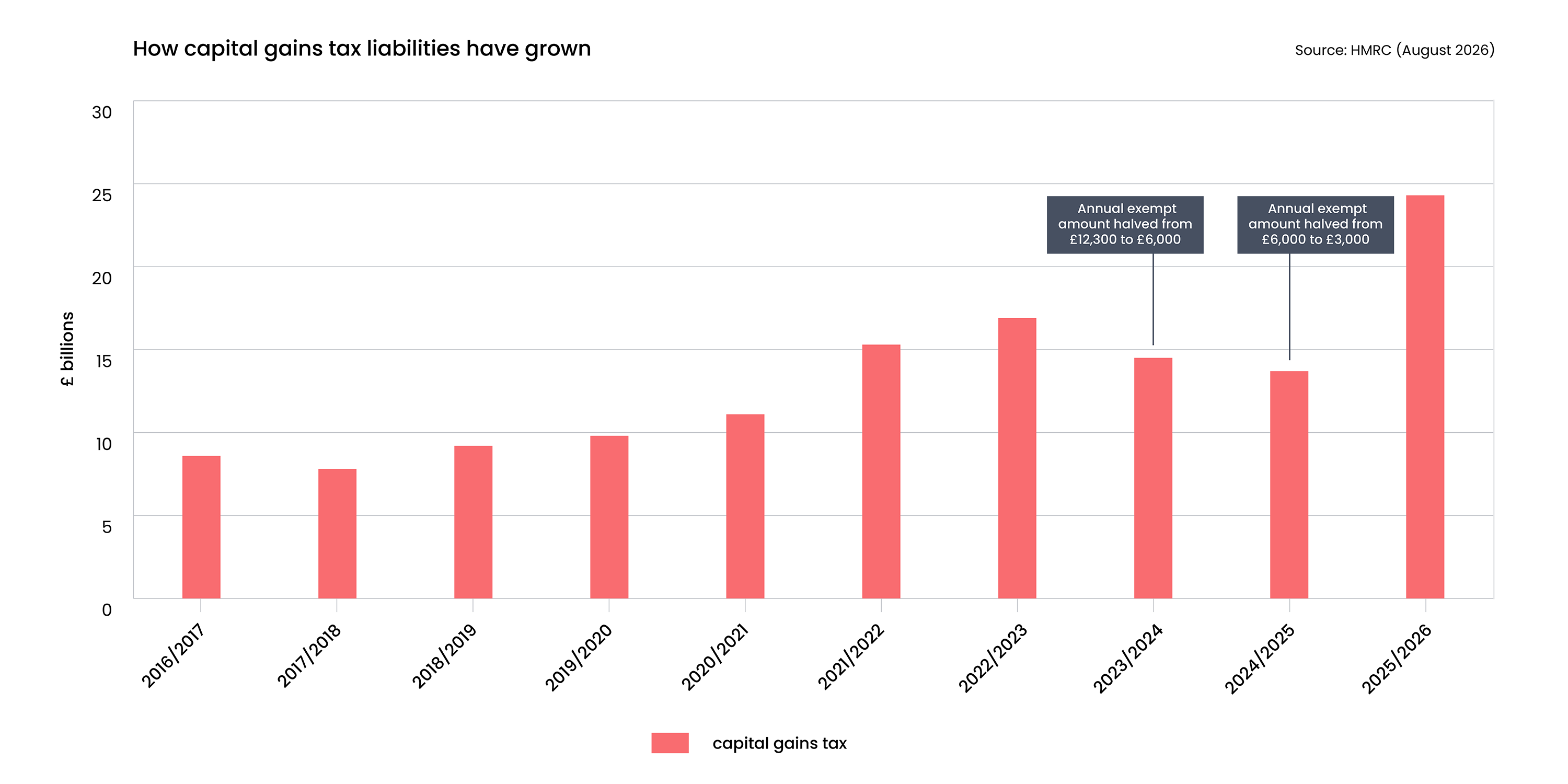
The AEA was cut from £12,300 in the 2022/23 tax year to £6,000 for 2023/24 tax year. It was then halved again to £3,000 from April 2024, where it has remained since.

The data appears to show that the cut to the AEA may have caused some taxpayers to delay the sale of assets. This is because CGT receipts fell between 2023 and 2025. But the CGT take is expected to rise significantly for the current year, as the chart below illustrates.

The Office for Budget Responsibility (OBR) has also forecast that liabilities from CGT (which includes CGT paid by individuals and businesses) will rise to around £26 billion for the 2026/27 tax year, up to £29.2 billion in 2027/28 and up to £32.4 billion in 2028/29.1  

The OBR’s long-term forecast predicts CGT receipts will rise to £41 billion in the 2031/32 tax year, which it says will be ‘driven by a forecast of rising equity prices’.2
St. James's Place

Pensions tax relief

Higher and additional rate taxpayers were relieved to see the chancellor made no changes to pensions tax relief.

Pension savers receive tax relief on pension contributions at their highest rate of income tax, subject to annual maximum limits.

There had been some speculation that this is one area the government could look to make savings. Reducing pensions tax relief down to 20% for all retirement savers, for example, regardless of their marginal income tax rate, could bring in billions for government coffers. Although it could be viewed as a 
disincentive to save.

Tax relief on pensions remains the same.

Pensions tax-free lump sum

As expected, there was no change to the pensions tax-free lump sum. Rumours circulated last year that the government was looking to scrap savers’ access to tax-free pensions cash. It caused a rush of people to access their pension funds early.

There will be widespread relief that the rules around the tax-free lump sum remain untouched by government.

It also highlights the benefit of waiting and not rushing into action around financial planning on the basis of rumours.

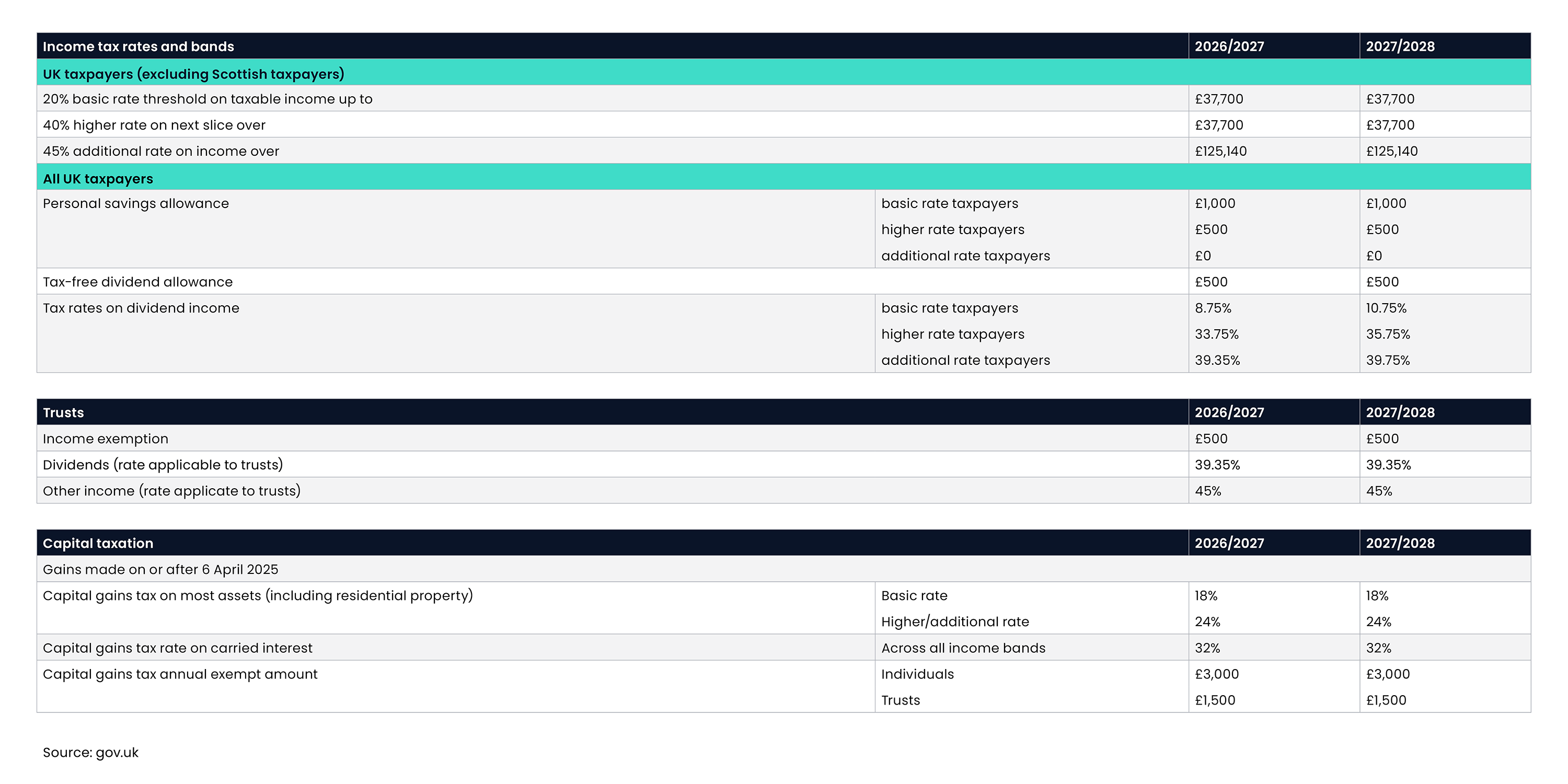
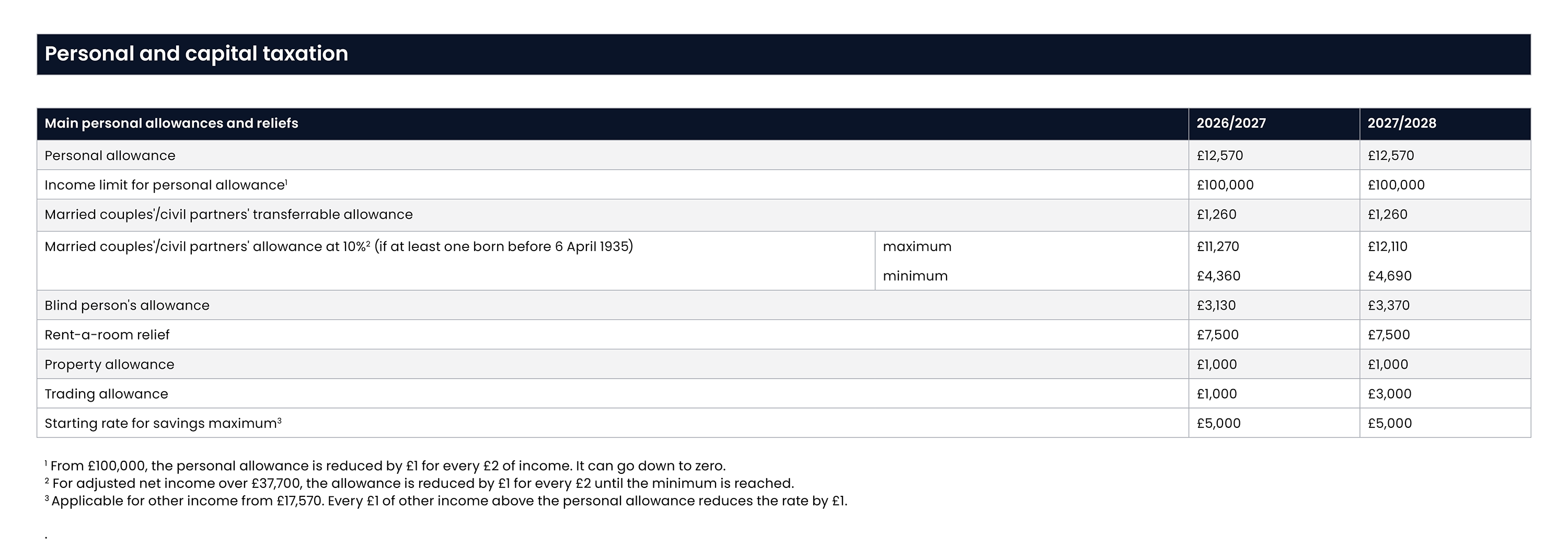
No change: summary of tax rates and allowances

The tables below show a selection of tax rates and personal allowances which have not changed following the Autumn Budget, including income tax, dividend income tax, and CGT.
St. James's PlaceSt. James's Place

Sources

 1,2 Office for Budget Responsibility. Economic and fiscal outlook – October 2026.

About the author

Jo Thornhill

Read full profile

About the author

Jo joined SJP as the Senior Content Lead – Financial Planning in February 2026. Jo is a former national newspaper journalist and experienced content writer and editor. Jo has covered a broad range of financial topics during her career, including investments, pensions, protection, and estate planning. She is passionate about helping people navigate the world of financial services to make the best decisions about their money. 

Most popular articles

Three construction employees standing together outside a construction site

Business , Exit, Sale or Succession

Employee ownership: Pros and cons of selling your company to your staff

16 Jun 2026

Houses

News

What are offset mortgages?

22 May 2026

Back view of multi-generation family moving down the hill.

Investing , News

How to avoid inheritance tax traps

22 Jan 2026

Most recent articles

News

2026 Autumn Budget: A temporary tax rise for banks

30 Oct 2026

News

2026 Autumn Budget: What hasn’t changed?

30 Oct 2026

Business

2026 Autumn Budget: What business owners need to know

29 Oct 2026

SJP Approved 29/10/2026

Close popup

Left Right

Cookie Preferences

St. James’s Place

I’m looking for advice

Become an SJP adviser

Information for shareholders

Follow us

Keep up to date on social media

Media & Marketing

More St. James's Place

Get in touch

Find an adviser

Copyright St. James's Place © 2026

Footer

BACK to TOP

Breadcrumbs

Share

Facebook

Linkedin

Twitter

  • News

30 Oct 2026

4 minute read

Johnny Minter | Senior Investment Writer

In a Budget with few big surprises, an increase to the corporation tax levied on the banking sector had been widely predicted. However, the extent of the potential increase and the subsequent impact on markets was being closely followed by many. 

Oil refinery

In the end, the increase was much lower than many feared and it will be temporary. For the 15 months from 1 January 2027 to 31 March 2028, the banking surcharge will rise from 3% to 6%.

Commenting on the change, Carlota Estragues Lopez, Equity Strategist at SJP, said: “The UK government has increased the bank surcharge by 3%, taking it to 6%, but stopped short of the more significant increase some lenders had feared. The decision reflects recognition of the banking sector’s importance to the UK economy and the risk that a heavier tax burden could weigh on growth and investment. While the UK tax regime remains relatively uncompetitive internationally, markets welcomed the more measured approach, with major UK bank shares rising 3–4% following the announcement.”

According to chancellor Healey, the temporary increase was required to fund help for families struggling in the current energy crisis. Money raised through the increased surcharge will help pay for the £2.6 billion scheme to help struggling households with rising energy costs. It will see households in England in council tax bands between A to D receive a £100 payment direct to their bank accounts.

Other tax rises included an increase in the rate of tax on savings and property income by two percentage points across all bands from April 2027. This is on top of the increases announced in the 2025 Budget. It means that from April the rate of tax payable will rise by four percentage points overall.

About the author

Johnny Minter

About the author

Johnny is a communication consultant. He has previously worked as a financial journalist and editor for a number of specialist finance titles.

Most popular articles

Three construction employees standing together outside a construction site

Business , Exit, Sale or Succession

Employee ownership: Pros and cons of selling your company to your staff

16 Jun 2026

Houses

News

What are offset mortgages?

22 May 2026

Back view of multi-generation family moving down the hill.

Investing , News

How to avoid inheritance tax traps

22 Jan 2026

Most recent articles

News

2026 Autumn Budget: A temporary tax rise for banks

30 Oct 2026

News

2026 Autumn Budget: What hasn’t changed?

30 Oct 2026

Business

2026 Autumn Budget: What business owners need to know

29 Oct 2026

SJP Approved 30/10/2026

Close popup

Left Right

Cookie Preferences

St. James’s Place

I’m looking for advice

Become an SJP adviser

Information for shareholders

Follow us

Keep up to date on social media

Media & Marketing

More St. James's Place

Get in touch

Find an adviser

Copyright St. James's Place © 2026

Footer

BACK to TOP

Breadcrumbs

Share

Facebook

Linkedin

Twitter

  • Business

29 Oct 2026

4 minute read

Sam Shaw | Consulting Editor

The UK’s small businesses were a key focus in Chancellor John Healey's first Budget , with the announcement of a package of business rates relief, entrepreneur incentives and tax reforms.

While Healey had little legroom for large giveaways, he made it clear he was focused on supporting smaller firms where possible. With the ongoing conflict in the Middle East seeing higher running costs and more expensive business loans, his efforts will likely be well-received by the business community. 

Hetal Mehta, SJP’s Chief Economist, said: “We welcome this era of less fiscal speculation and hope it continues so that businesses have more certainty and confidence to invest.”

Bar tender pulling drinks

At a glance

  • Small business rates relief (SBRR) is expanding, with a higher threshold for 100% relief and additional support for pubs, clubs and many live music venues from April 2027.
  • Entrepreneurs and founders to receive new initiatives, including a higher trading allowance of £3,000, new young entrepreneurs allowance, support for female founders and a 10% CGT rate on qualifying gains.
  • Business owners will face stricter but simpler tax rules, with changes to VAT obligations, capital allowances and business asset disposal relief (BADR).
     

Continued support for the high street

Healey confirmed plans to increase the threshold for 100% small business rates relief (SBRR) for retail, hospitality and leisure from £12,000 to £18,000.  

This means from April 2027, roughly 70,000 businesses in these sectors – such as shops, restaurants and gyms – will not pay any business rates at all. These tax breaks will not apply to adult gaming centres and vape shops.

The tapered relief band will also increase, from £15,000 to £21,000 for qualifying businesses from April 2027.

All other qualifying businesses in retail, hospitality and leisure will see their business rates frozen in real terms for the next two years – meaning not rising at the same rate of inflation, as had been previously announced.

In addition, pubs, social clubs and all but the largest live music venues in England will receive an extra 20% business rates relief from April 2027. Combined with the 15% relief announced earlier this year, this brings total support to 35%.

Keen to offer a fully funded spending plan, Healey said he would pay for this high street support package by raising taxes on gambling.

Games duty on higher-stakes machines will be increased from 20% to 25%. This tax increase will not apply to pubs and seaside arcades.

Elsewhere, Healey announced £10 million in alcohol duty relief, which should benefit around 2,000 small British brewers and cider producers.

In a bid to help level the playing field between online and bricks-and-mortar retailers, Healey is tightening the VAT rules.

From October 2027, online marketplaces will be responsible for collecting VAT on behalf of their UK-based sellers. This rule will apply where more than £90,000 of sales are transacted on their platform. Personal online sellers will not be affected.

Incentivising British innovators

Meanwhile on enterprise, Healey said too often Britain’s entrepreneurs take the fruits of their labour overseas.

To incentivise founders of high-growth businesses to remain in the UK, Healey announced a series of measures:

  • Tripling the trading allowance – the amount you can earn from a new venture without paying tax – from £1,000 to £3,000.
  • Introducing a new young entrepreneurs allowance – which will support living costs for young founders while they get their ideas off the ground.
  • Introducing a new £200 million scaleup programme to support female founders.
  • Reforming skilled worker visas and non-compete clauses in contracts, allowing founders of one successful company to more easily move on and set up another.
  • Introducing a new founders’ relief from April 2027 – a lower 10% CGT rate on up to £10 million of lifetime gains.

Modernised tax rules for business owners

Business owners and entrepreneurs can look forward to a tougher, yet simpler tax regime.

Healey announced additional HMRC funding to improve compliance and help it collect overdue tax debts.

Businesses submitting self-assessment tax returns will be able to pay in smaller, more regular payments from 2029.

Healey also announced moves to align the taxation of company profits and close perceived loopholes.

Other measures affecting business owners include:

  • Reducing the lifetime limit for business asset disposal relief – formerly known as entrepreneurs’ relief – from £1 million to £500,000. This will potentially increase the tax bill when selling shares in, or an entire, qualifying business.
  • More generous first-year relief on certain new investments, increasing the main first-year allowance from 40% to 50%.
  • Reducing the main writing-down allowance rate from 14% to 12%, meaning businesses will get slightly less tax relief on the remaining value of qualifying assets over time.
  • Full expenses will be maintained around corporation tax on eligible assets.

The Budget has brought a plethora of small changes for business owners of all shapes and sizes – from the high street to tech entrepreneurs. If any of these rule changes are likely to affect you, or if your circumstances may change, please get in touch with your financial adviser.  

About the author

Sam Shaw

Read full profile

About the author

Sam is a content consultant specialising in UK financial services. A former investment journalist and editor, she brings more than 20 years' editorial, copywriting and broadcast experience to her role as Consulting Editor at SJP.

Most popular articles

Three construction employees standing together outside a construction site

Business , Exit, Sale or Succession

Employee ownership: Pros and cons of selling your company to your staff

16 Jun 2026

Houses

News

What are offset mortgages?

22 May 2026

Back view of multi-generation family moving down the hill.

Investing , News

How to avoid inheritance tax traps

22 Jan 2026

Most recent articles

News

2026 Autumn Budget: A temporary tax rise for banks

30 Oct 2026

News

2026 Autumn Budget: What hasn’t changed?

30 Oct 2026

Business

2026 Autumn Budget: What business owners need to know

29 Oct 2026

SJP Approved 29/10/2026

Close popup

Left Right

Cookie Preferences

St. James’s Place

I’m looking for advice

Become an SJP adviser

Information for shareholders

Follow us

Keep up to date on social media

Media & Marketing

More St. James's Place

Get in touch

Find an adviser

Copyright St. James's Place © 2026

Footer

BACK to TOP

Prompts

ST. James's Place PLC (ticker STJ), listed in United Kingdom.

ETFs Holding ST. James's Place PLC

ETF Weight in ETF Shares Market value As of
AVIV 0.20% 266,529 $ 4.099M Nov 16, 2026
DFSI 0.17% 128,625 $ 1.975M Nov 12, 2026
AVDV 0.12% 1,453,312 $ 22.353M Nov 16, 2026
DIHP 0.11% 485,616 $ 7.457M Nov 12, 2026
DXIV 0.11% 16,579 $ 254.579K Nov 12, 2026
DFIS 0.10% 380,428 $ 5.842M Nov 12, 2026
AVSD 0.10% 24,833 $ 381.956K Nov 16, 2026
DFIC 0.08% 768,148 $ 11.795M Nov 12, 2026
AVDE 0.06% 792,223 $ 12.185M Nov 16, 2026
DFAX 0.05% 399,326 $ 6.132M Nov 12, 2026
NTSI 0.04% 12,116 $ 194.821K Jun 30, 2026
DFAI 0.04% 463,306 $ 7.114M Nov 12, 2026