No description written yet.

Industry Business Equipment & Supplies Homepage ricoh.com
Sector Industrials IR page ricoh.com/IR
Tags
—
Press page —

Metrics

Valuation  
Market cap —
Market cap (USD) —
P/E —
PEG —
P/BV —
P/S —
P/OCF —
P/FCF —
Dividend yield —
Turnover / mcap —
Returns  
ROE —
ROI —
ROIC —
Profit margin —
Growth  
Revenue growing —
Profits growing —
Revenue up 3y —
Revenue up 5y —
Earnings growth 3y (net profit CAGR) —
Quality  
Profitable —
Margin expanding —
Buying back stock —
Diluting (TTM) —
Debt/Equity —
Podcast bulls (TTM) Sign up
Podcast bears (TTM) Sign up
Podcast sentiment (TTM) Sign up
Podcast sentiment % (TTM) Sign up
News sentiment (TTM) —
Quality score —
Insiders  
Buys, 1w Sign up
Buys, 1m Sign up
Buys, 1y Sign up
Sells, 1w Sign up
Sells, 1m Sign up
Sells, 1y Sign up

Sign up to see this company's insider trades

Sign up to see institutional holdings

Sign Up

Podcast Mentions

Sign up to see podcast mentions and sentiment

Sign Up

  • Home

  • News Releases

  • Ricoh expands global availability of the RICOH360 THETA A1 to accelerate digital transformation in field operations

News Release Ricoh expands global availability of the RICOH360 THETA A1 to accelerate digital transformation in field operations

TOKYO, October 28, 2026 – Ricoh Company, Ltd. today announced the expansion of global availability for the RICOH360 THETA A1, a highly durable 360° camera designed specifically for field operations. Building on the product's initial launch in 2025, Ricoh is expanding availability to the United States, Canada and Australia while broadening purchasing options and distribution channels in its existing markets of Japan and Europe. The expansion makes the camera more accessible to professionals in construction, infrastructure, facility management and related industries across key global markets.

Customers will have greater flexibility in how they purchase and deploy the camera, with standalone purchasing options and a wider range of sales channels, including authorized distributors and major e-commerce platforms. The RICOH360 THETA A1 can also be used independently or as part of the broader RICOH360 ecosystem to meet customers' evolving operational needs.

Industries such as construction, infrastructure and facility management are facing growing challenges, including labor shortages, aging assets and increasingly demanding working environments. At the same time, organizations are seeking more efficient ways to document, share and review field information across distributed teams.

As adoption of 360° imaging continues to grow, customers have been asking for more flexible purchasing and deployment options, including integration with existing business applications and systems, as well as procurement through preferred sales channels. To address these needs, Ricoh is expanding access to the RICOH360 THETA A1 through broader geographic availability and standalone purchasing options, helping accelerate digital transformation across field-intensive industries.

The RICOH360 THETA A1 is built for professionals working in challenging field environments where reliable visual documentation is critical to operations.

Key capabilities include:

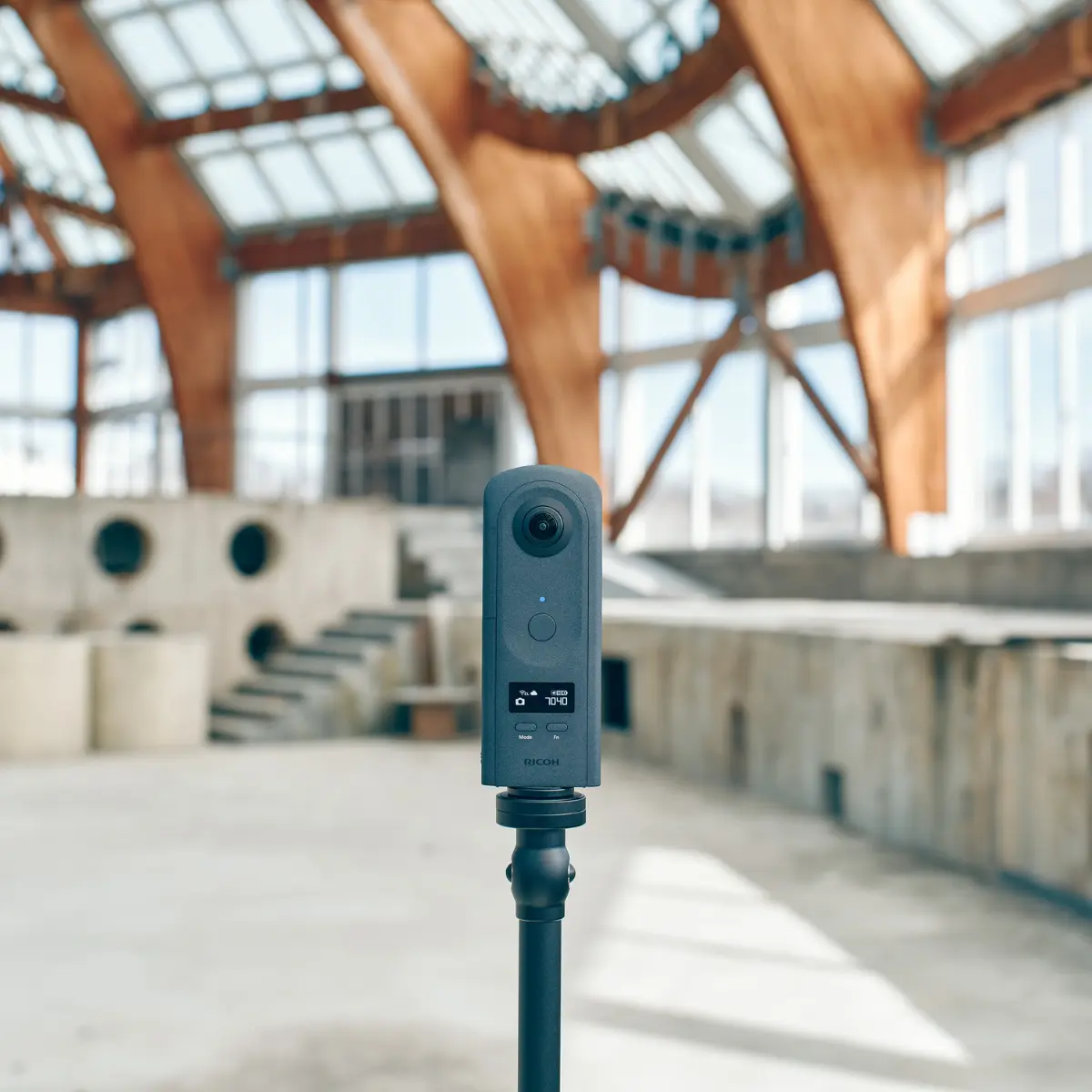
  • Highly durable design for field use The RICOH360 THETA A1 is the first model in the RICOH THETA series to offer IP64-equivalent dustproof and splashproof performance. Designed for use in environments exposed to dust, splashing water, heat and cold, the camera operates in temperatures ranging from −10°C to 40°C (14°F to 104°F), enabling reliable image capture under harsh conditions. It also supports stable, extended recording while receiving power in temperatures from 30°C to 40°C (86°F to 104°F), allowing users to keep working in high heat.

  • Fast and responsive operation The camera starts in about 3 seconds* and captures an image approximately 0.3 seconds after the shutter button is pressed, helping users document site conditions quickly and efficiently in the field. A streamlined interface and automatic noise reduction ensure consistent 360° images with minimal adjustments, even in dim indoor environments.

When starting up from power-off

  • Streamlined field workflows The RICOH360 THETA A1 stitches images and corrects tilt in-camera, recording still images in JPEG format and video in MP4 format. This allows captured content to be saved, shared and incorporated directly into existing workflows without the need for conversion using dedicated software. Built-in GPS and an electronic compass also record location and direction data with captured images. The camera can be used with existing construction management, inspection and proprietary business applications, allowing organizations to integrate 360° imaging into current operations with minimal process changes.

Expanding availability of the RICOH360 THETA A1 supports broader adoption of digital workflows across construction, infrastructure and facility management. By enabling dependable visual documentation and information sharing even in challenging environments, Ricoh aims to help customers responsible for critical infrastructure improve operational efficiency and transform their field operations.

RICOH360 THETA A1

Open new window RICOH360 THETA A1 product website Open new window RICOH360 THETA A1 promotional video

| About Ricoh |

Ricoh is a global integrator in workplace transformation, operating in approximately 200 countries and regions and headquartered in Tokyo. Supporting customers' value creation, Ricoh offers workplace services and solutions that empower organizations to work smarter through advanced technologies—including AI— together with long-standing expertise rooted in printing. Ricoh also operates commercial and industrial printing businesses and delivers new solutions leveraging inkjet technology. In the financial year ended March 2026, Ricoh Group had worldwide sales of 2,608 billion yen (approx. 16.4 billion USD).

For 90 years since our founding, Ricoh has upheld its mission and vision of empowering individuals to find Fulfillment through Work—and that commitment continues today. By understanding and transforming how people work, we unleash their potential and creativity to realize a sustainable future.

  • Home

  • News Releases

  • Ricoh to establish manufacturing capabilities to advance mass production of inkjet-printed perovskite solar cells

News Release Ricoh to establish manufacturing capabilities to advance mass production of inkjet-printed perovskite solar cells Project selected for Japan's GX Supply Chain Development Support Program

TOKYO, October 27, 2026 – Ricoh Company, Ltd. today announced that it will establish manufacturing capabilities for inkjet-printed perovskite solar cells as the company moves toward mass production. The company will build a production site at Ricoh Industry Co., Ltd.'s Tohoku Site in Miyagi Prefecture, Japan, and aims to achieve annual production capacity of several hundred megawatts (MW) by 2030, with future expansion to gigawatt (GW)-scale production.

Ricoh's perovskite solar cell manufacturing initiative has been selected for support under Japan's GX (Green Transformation) Supply Chain Development Support Program administered by Japan's Ministry of Economy, Trade and Industry (METI).

Ricoh leverages its inkjet technology, which enables precise deposition of the right amount of material exactly where it is needed, to form all functional layers of perovskite solar cells. This enables efficient material utilization and streamlines manufacturing processes, with the aim of improving productivity and reducing manufacturing costs.

As part of its medium- to long-term growth strategy, Ricoh is advancing the commercialization of “Functional Printing,” which applies inkjet technologies developed through its commercial and industrial printing businesses to manufacturing processes such as the coating and deposition of functional materials. Inkjet-printed perovskite solar cells are one of the projects being pursued under this initiative. Following this selection, Ricoh will build on its research, development, and demonstration activities to advance toward mass production and commercialization, with the aim of expanding the real-world deployment of perovskite solar cells and creating new business opportunities.

1. Background

As the transition toward a decarbonized society accelerates and renewable energy adoption continues to expand, expectations are growing for perovskite solar cells due to their thin, lightweight, and flexible characteristics. These features enable installation on rooftops and walls of buildings with limited load-bearing capacity, where conventional silicon solar cells are difficult to deploy, expanding opportunities for power generation.

To achieve widespread adoption, however, in addition to improving power generation performance and durability, establishing technologies that enable stable-quality mass production and reducing production costs remain key challenges.

2. Establishment of manufacturing capabilities

Ricoh will establish a production site for the mass production of inkjet-printed perovskite solar cells at Ricoh Industry's Tohoku Site in Miyagi Prefecture, Japan. The site will utilize a manufacturing process leveraging Ricoh's proprietary inkjet technology. With future expansion to GW-scale production in mind, Ricoh aims to establish annual production capacity of several hundred MW by 2030.

Production site overview

Location

Ricoh Industry Co., Ltd.'s Tohoku Site in Shibata, Miyagi Prefecture, Japan

Product

Inkjet-printed perovskite solar cells

Manufacturing process

Inkjet-based manufacturing process leveraging Ricoh's proprietary technology

Target start of mass production

By 2030

3. Advantages of Ricoh’s perovskite solar cell technology

(1) Pattern-printing of all functional layers using Inkjet technology

Ricoh leverages its long-established inkjet printhead technology, ink supply technology, and printing system technology in the manufacturing of perovskite solar cells.

Inkjet technology enables precise control of microscopic droplets, allowing the right amount of material to be deposited exactly where needed. By leveraging this technology to pattern-print all functional layers of perovskite solar cells, Ricoh aims to improve material utilization and streamline manufacturing processes, enabling high productivity and low-cost production.

(2) Organic photoconductor technology developed for multifunction printers

Ricoh has pursued research and development of organic solar cells based on organic photoconductor technologies developed through the innovation of its multifunction printers.

Technologies cultivated through these efforts are now being applied to perovskite solar cells.

Ricoh is leveraging its long-established inkjet and organic photoconductor technologies to enhance the performance of perovskite solar cells and establish mass-production technologies.

4. Progress to date and future outlook

In September 2025, Ricoh's technology development and demonstration project for inkjet-printed perovskite solar cells was selected for support under Japan's Green Innovation Fund administered by the New Energy and Industrial Technology Development Organization (NEDO).

Following its selection for Japan's GX Supply Chain Development Support Program, Ricoh will build on the results of its research, development, and demonstration activities to advance toward mass production and commercialization, with the aim of expanding the real-world deployment of perovskite solar cells. Ricoh will also contribute to strengthening Japan's industrial competitiveness in the GX field.

In addition, the company will advance the commercialization of Functional Printing utilizing inkjet technology and cultivate new growth areas.

Related Information

Inkjet-Printed Perovskite Solar Cells technology page

Related News

Ricoh perovskite solar cells installed on Japan Aerospace Exploration Agency cargo transfer spacecraft1 HTV-X1 Consortium of Ricoh, Daiwa House, and NTT Anode Energy selected for NEDO Green Innovation Fund

| About Ricoh |

Ricoh is a global integrator in workplace transformation, operating in approximately 200 countries and regions and headquartered in Tokyo. Supporting customers' value creation, Ricoh offers workplace services and solutions that empower organizations to work smarter through advanced technologies—including AI— together with long-standing expertise rooted in printing. Ricoh also operates commercial and industrial printing businesses and delivers new solutions leveraging inkjet technology. In the financial year ended March 2026, Ricoh Group had worldwide sales of 2,608 billion yen (approx. 16.4 billion USD).

For 90 years since our founding, Ricoh has upheld its mission and vision of empowering individuals to find Fulfillment through Work—and that commitment continues today. By understanding and transforming how people work, we unleash their potential and creativity to realize a sustainable future.

  • Home

  • News Releases

  • Ricoh and ETRIA launch “Circular New,” a manufacturing concept, turning resource circulation into competitive advantage

News Release Ricoh and ETRIA launch “Circular New,” a manufacturing concept, turning resource circulation into competitive advantage

  • Reduces newly sourced material use from about 76% to as low as 21% with product carbon footprint expected to drop by up to 25%

  • Delivers latest-generation models with consistent quality, functionality and warranty, while utilizing components recovered from the market

  • Strengthens supply chain resilience and manufacturing competitiveness through localized production in Japan and Europe

TOKYO, October 6, 2026 – Ricoh Company, Ltd. and ETRIA CO., LTD. today announced “Circular New,” a manufacturing concept that transforms products already used in the market into assets for future production, turning resource circulation into new product value and manufacturing competitiveness. As the first application, the concept will be introduced to Ricoh’s A3 monochrome multifunction printers (MFPs), with localized production and launch scheduled in Japan and Europe in the first half of 2027.
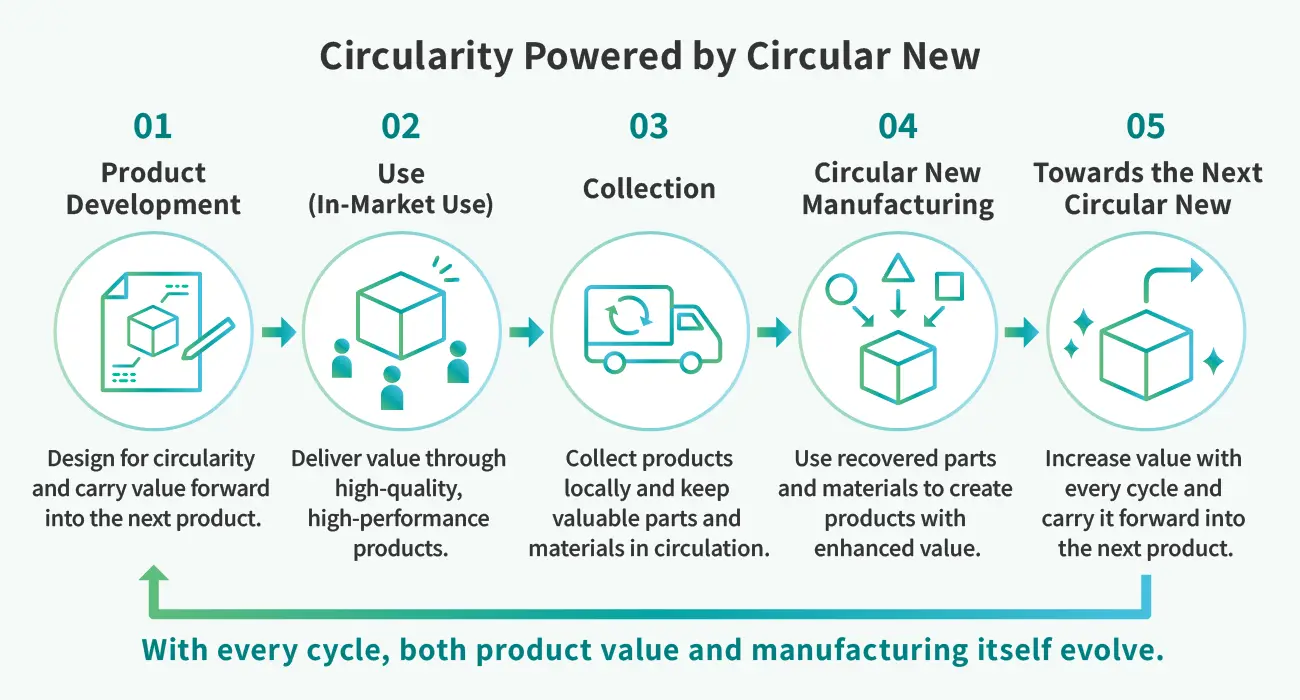
Compared with conventional centralized production at major manufacturing sites in Asia, localized circular production close to consumption markets is designed to reduce the proportion of newly sourced materials used from approximately 76% to as low as approximately 21%.1 Customers will receive the same latest-generation models, with consistent quality, functionality and warranty, regardless of the production method.

Circular New integrates product planning, design, manufacturing, use, collection and reuse into a single continuous loop, utilizing products already in the market as assets to manufacture new products with added value. In addition to conventional centralized production, Ricoh and ETRIA will establish localized circular production in Japan and France to create a regional loop of resource and component reuse, further expanding circularity. Localized production can reduce the product carbon footprint by up to 25%2 compared with centralized manufacturing of the same RICOH IM 6010 model at designated Asian production sites. This reduction is achieved by lowering the use of newly sourced materials and shortening transportation distances, while establishing a resilient supply framework to ensure reliable product delivery amid geopolitical risks, logistics disruptions and resource price volatility. Centrally manufactured and locally produced products will be offered within the same product lineup, delivering consistent product value regardless of manufacturing method or location.

Ricoh and ETRIA have long worked together to reduce newly sourced material use by incorporating recycled materials, such as recycled plastics and steel. Looking toward future circularity, ETRIA integrates design principles from the planning and development stages, including sharing frames and components across generations and models, extending component lifespans and designing structures for simple disassembly and replacement. Building on this design foundation, Circular New combines digital insights into product and component conditions with advanced sorting and quality assurance technologies. This allows Ricoh and ETRIA to go beyond using recycled materials and instead recover and reuse resources and components from existing products directly in the latest-generation models.

With Circular New, Ricoh and ETRIA aim to establish Evolving Circularity—moving beyond reducing environmental impact to continuously channel recovered resources and components into next-generation product value while advancing manufacturing itself.

In its Mid-Term Management Strategy ’26, announced in March 2026, Ricoh set a target of achieving a 30% engine market share for ETRIA by fiscal 2030. Circular New is one of the initiatives supporting this growth strategy, strengthening ETRIA’s manufacturing competitiveness through circular product design and localized production.

Katsunori Nakata, executive corporate officer and president of RICOH Digital Products Unit, Ricoh Company, Ltd., and CEO of ETRIA, said, “Circular New directly challenges the assumption that manufactured products must follow a linear lifecycle. Guided by our principle of aligning ESG with business growth, the Ricoh Group aims to reduce newly sourced material use to 60% by 2030 and 12% by 2050. Through this localized circular production model, we are committed to demonstrating that resource circulation can drive both customer value and manufacturing competitiveness.”

Leading this innovation in Europe, Michael Vavakis, chief transformation, ESG and people officer at Ricoh Europe, said, “The future belongs to organizations that create more value with fewer wasteful resources. Circular New is a powerful example of how innovation can transform sustainability from an environmental ambition into a source of long-term value. By reducing the use of newly sourced materials from approximately 76% to as low as 21%, while strengthening supply resilience and preserving product quality, we believe circularity can deliver both business growth and reduced environmental impact.

At the heart of this transformation are our people, whose expertise, creativity and commitment are enabling us to reimagine manufacturing for a circular economy. This initiative reflects our commitment to building a manufacturing model fit for the future that supports sustainable growth and strengthens regional resilience.”

  • *1

By weight, among newly manufactured A3 laser multifunction printers (MFPs). The newly sourced material usage rate varies depending on the utilization of recovered components.

  • *2

Calculated based on life-cycle greenhouse gas emissions (CO2 equivalent). The product carbon footprint reduction rate varies depending on the utilization of recovered components and transportation distances.

ENDS

Additional Information

Background

In recent years, growing climate concerns, resource constraints, geopolitical uncertainties and supply chain disruptions have driven the manufacturing sector to adopt production models that reduce environmental impact while ensuring a stable product supply. Guided by its policy of aligning ESG with business growth, the Ricoh Group has set targets to reduce the ratio of newly sourced materials used in its products to 60% by 2030 and 12% by 2050.

Through Circular New, the Ricoh Group aims to accelerate this linear-to-circular transformation (“LC transformation”), moving away from the conventional model of mass production and mass consumption toward a circular economy. By combining circular product design with localized production close to consumption markets, Ricoh aims to reduce environmental impact while ensuring stable product supply and enhancing manufacturing competitiveness, building an engineering and production foundation that continues to be the choice of brand owners and OEM partners.

Overview of the initiative

1. Product design based on circularity

Under Circular New, products are designed not to reach the end of their lifecycle after shipment, but to serve as assets for future products. By sharing frames and components across generations and models, extending component lifespans and simplifying disassembly, Ricoh can utilize resources and components recovered from the market to manufacture new products. Unlike conventional remanufactured machines3 or refurbished machines,4 which are restored to near-original condition for resale, Circular New incorporates recovered parts and materials into newly manufactured products within Ricoh's current lineup.

As the first model adopting this concept, Ricoh's A3 monochrome MFP series, RICOH IM 6010/4510/3510/2510, will be produced and supplied in Japan and Europe beginning in the first half of 2027 through circular production, alongside existing centrally produced machines. Ricoh will deliver them as the latest-generation products with globally consistent quality, functionality and warranty. Localized circular production will cut newly sourced material use for these models from about 76% to as low as 21%.

  • *3

Ricoh uses the following definitions: A machine manufactured through an industrial process based on machine that has been used at least once on the market, has undergone at least one change that influences the safety, performance, purpose or type of the product, and is then resupplied to the market after remanufacturing.

  • *4

Ricoh uses the following definitions: A machine that has been placed on the market and used at least once and has been maintained or repaired to restore its original functional or aesthetic condition or restored to a predetermined form or functionality.

2. “Localized Circular Production” that circulates resources locally

Under Circular New, alongside centralized production in Thailand and China, Ricoh will establish localized circular production to recover and cycle resources into new products close to consumption markets. Through regional circulation, the RICOH IM 6010 produced under localized circular production is designed to reduce its product carbon footprint (CFP) by up to 25% compared with the same model manufactured under centralized production at Asian production sites.

As an initial step, newly manufactured products will be produced through localized circular production at ETRIA Manufacturing Japan's Gotemba Site in Japan and ETRIA MANUFACTURING FRANCE S.A. in France. By establishing a regional cycle of “collection → resource and component utilization → production → use → recollection,” the initiative reduces environmental impact from transportation while strengthening resilience against supply chain fragmentation and logistics disruptions.

Future outlook

Ricoh will promote circular ecosystems involving customers, while ETRIA advances circular product design and expands localized circular production infrastructure. Starting in Japan and Europe, both companies will expand the application of Circular New while exploring collaboration with brand owners and OEM partners. Through these efforts, Ricoh and ETRIA aim to establish Circular New as a scalable manufacturing approach that drives resource circulation and business growth.

Related Links

[Ricoh] Resource Circulation [Ricoh] Evolving Circularity: Shaping the Circular Economy with Ricoh

| About ETRIA |

ETRIA is a manufacturing company built on the combined technologies and experiences of Ricoh, Toshiba Tec, and OKI. Focused on the development and production of imaging equipment, such as multifunction devices and printers, the company offers devices that seamlessly connect analog and digital information, elevating the value of information delivered. ETRIA will support customers in overcoming their challenges and continue to serve as their trusted partner dedicated to the advancement of society.

For more details, please visit Open new windowhttps://etria.global/en/.

| About Ricoh |

Ricoh is a global integrator in workplace transformation, operating in approximately 200 countries and regions and headquartered in Tokyo. Supporting customers' value creation, Ricoh offers workplace services and solutions that empower organizations to work smarter through advanced technologies—including AI— together with long-standing expertise rooted in printing. Ricoh also operates commercial and industrial printing businesses and delivers new solutions leveraging inkjet technology. In the financial year ended March 2026, Ricoh Group had worldwide sales of 2,608 billion yen (approx. 16.4 billion USD).

For 90 years since our founding, Ricoh has upheld its mission and vision of empowering individuals to find Fulfillment through Work—and that commitment continues today. By understanding and transforming how people work, we unleash their potential and creativity to realize a sustainable future.
Prompts

Ricoh Company, Ltd. (ticker RICO), listed in United Kingdom.

ETFs Holding Ricoh Company, Ltd.

ETF Weight in ETF Shares Market value As of
GMOI 0.20% 133,200 $ 1.415M Aug 31, 2026
SEIE 0.14% 188,555 $ 1.631M Jun 30, 2026
DFIV 0.13% 2,807,352 $ 29.601M Nov 12, 2026
AVSD 0.13% 46,000 $ 488.585K Nov 16, 2026
AVIV 0.12% 226,400 $ 2.405M Nov 16, 2026
AVDE 0.08% 1,499,100 $ 15.923M Nov 16, 2026
DXIV 0.06% 14,300 $ 150.78K Nov 12, 2026
DFIC 0.06% 844,900 $ 8.909M Nov 12, 2026
DFAX 0.04% 435,100 $ 4.588M Nov 12, 2026
DFSI 0.04% 39,300 $ 414.383K Nov 12, 2026
DFAI 0.03% 602,500 $ 6.353M Nov 12, 2026