Director/PDMR Shareholding
Bull 0
Bear 0
Routine
Fiscal year ends March
Quarters are offset from the calendar — Q1 is Apr–Jun
|
British Land Company PLC is a UK-based real estate investment and development company. The business creates, owns, and manages a portfolio of commercial property focused on three main segments: office-led campuses in Central London, retail properties across the UK, and London urban logistics. The company operates as a developer and asset manager with a value-add strategy, investing in segments with strong rental growth prospects. Its portfolio includes office spaces, retail parks, and logistics facilities, serving customers who require commercial environments. The company emphasizes creating places that deliver positive outcomes for stakeholders, with a focus on environmental sustainability and community impact. British Land manages assets through a diversified approach, leveraging its strengths in specific market segments to drive long-term value. Summarised from the company's own disclosures, fiscal year ended Mar 2026 |
Industry REIT - Diversified | Homepage britishland.com |
| Sector Real Estate | IR page britishland.com/investors | |
|
Tags
commercial real estate, office campuses, retail parks, urban logistics, property development, asset management, value-add strategy, sustainable real estate
|
Press page britishland.com/investors/press-releases |
Metrics
| Valuation | |
|---|---|
| Market cap | £ 4.38B |
| Market cap (USD) | $ 5.777B |
| P/E | 9.65 |
| PEG | — |
| P/BV | 0.71 |
| P/S | 8.37 |
| P/OCF | 14.17 |
| P/FCF | — |
| Dividend yield | 5.2% |
| Turnover / mcap | — |
| Returns | |
|---|---|
| ROE | 7.8% |
| ROI | 5.4% |
| ROIC | 5.4% |
| Profit margin | 86.8% |
| Growth | |
|---|---|
| Revenue growing | No |
| Profits growing | Yes |
| Revenue up 3y | No |
| Revenue up 5y | No |
| Earnings growth 3y (net profit CAGR) | — |
| Quality | |
|---|---|
| Profitable | Yes |
| Margin expanding | Yes |
| Buying back stock | No |
| Diluting (TTM) | No |
| Debt/Equity | 41.7% |
| Podcast bulls (TTM) | Sign up |
| Podcast bears (TTM) | Sign up |
| Podcast sentiment (TTM) | Sign up |
| Podcast sentiment % (TTM) | Sign up |
| News sentiment (TTM) | 11 |
| Quality score | 27.8% |
| Insiders | |
|---|---|
| Buys, 1w | Sign up |
| Buys, 1m | Sign up |
| Buys, 1y | Sign up |
| Sells, 1w | Sign up |
| Sells, 1m | Sign up |
| Sells, 1y | Sign up |
Sign up to see this company's insider trades
| Figure | FY 2026 | FY 2025 | FY 2024 | FY 2023 | FY 2022 | FY 2021 | FY 2020 | FY 2019 | FY 2018 | FY 2017 | FY 2016 | FY 2015 | FY 2014 | FY 2013 | FY 2012 | FY 2011 | FY 2010 | FY 2009 |
|---|---|---|---|---|---|---|---|---|---|---|---|---|---|---|---|---|---|---|
| Revenue | 523M | 454M | 575M | 418M | 410M | 468M | 613M | 904M | 639M | 589M | 590M | — | 384M | 329M | — | — | — | — |
| Net profit | 454M | 338M | 1M | -1.039B | 960M | -1.083B | — | — | — | — | — | — | — | — | — | — | — | — |
Filed figures
Lines the statements and their notes report beside the headline figures, read from the filings' XBRL as filed (no restatement applied), with figures computed from one filing's own lines. Cash-flow lines carry their cash direction: an outflow is negative. Each period links to its filing; a figure's period, report date and tag are in its tooltip.
| Figure | Mar 2020 | Mar 2021 | Mar 2022 | Mar 2023 | Mar 2024 | Mar 2025 | Mar 2026 |
|---|---|---|---|---|---|---|---|
| Balance sheet detail | |||||||
| Trade receivables (GBP) | — | 56M | 39M | 34M | 34M | 36M | 34M |
| ↳ YoY growth | -30.4% | -12.8% | 0% | +5.9% | -5.6% | ||
| ↳ 5y CAGR | -9.5% | ||||||
| Borrowings, current (GBP) | — | 161M | 189M | 402M | 10M | 311M | 521M |
| Borrowings, non-current (GBP) | — | 2.25B | 2.43B | 1.87B | 2.2B | 2.42B | 2.48B |
| Cash and deposits (GBP) | 193M | 154M | 74M | 125M | 88M | 57M | 176M |
| Net debt (borrowings + leases - cash) (GBP) | — | 2.26B | 2.54B | 2.14B | 2.12B | 2.67B | 2.82B |
| Cash flow detail | |||||||
| Operating cash flow (GBP) | — | 149M | 245M | 240M | 409M | 270M | 309M |
| Dividends paid (cash effect) (GBP) | — | -76M | -155M | -213M | -213M | -220M | -229M |
| Interest paid (cash effect) (GBP) | — | -70M | -62M | -71M | -51M | -57M | -76M |
| Income taxes paid (cash effect) (GBP) | — | -33M | -6M | 0.00 | -6M | -7M | -1M |
| Income detail | |||||||
| Total comprehensive income (GBP) | — | -1.09B | 949M | -1.03B | -1M | 338M | 449M |
| Comprehensive income to owners (GBP) | — | -1.04B | 947M | -1.03B | -3M | 338M | — |
| Reported | Jun 10, 2022 | Jun 10, 2022 | Jun 10, 2022 | Jun 12, 2023 | Jun 10, 2025 | Jun 10, 2025 | Jun 10, 2026 |
Operating KPIs — quarters
Business figures the company publishes beside its accounts (users, subscribers, same-store sales, production, occupancy ...), read from its results releases and reports, with the growth on the same period a year earlier beneath each: computed from the figures, and as the company states it where it does. Each figure links to its source; counts at a period end show under that period.
Operating KPIs — years
Business figures the company publishes beside its accounts (users, subscribers, same-store sales, production, occupancy ...), read from its results releases and reports, with the growth on the same period a year earlier beneath each: computed from the figures, and as the company states it where it does. Each figure links to its source; counts at a period end show under that period.
Sign up to see institutional holdings
Sign UpPodcast Mentions
Sign up to see podcast mentions and sentiment
Sign UpResults, director/PDMR dealings and voting-rights totals announced to the FCA's National Storage Mechanism, newest first. The link opens the announcement on the NSM. Press releases from the company's own website, newest first.
Half-year Financial Report
Bull 1
Bear 0
Results
Why Place Matters More Than Ever In An Age of Innovation
Bull 1
Bear 0
Other
Why Place Matters More Than Ever In An Age of Innovation

Written by
Amy Hockley, Head of Innovation Leasing
October 22, 2026
Tags
-
Offices
-
Science and Tech
-
Blog
Share article
There’s a striking contradiction at the heart of the UK’s innovation economy.
Technology has made it easier than ever to work, collaborate and build businesses from almost anywhere. AI is accelerating that shift again. Yet some of the world’s most dynamic ‘frontier’ businesses and organisations seem increasingly determined to be close to one another.
We’re seeing that firsthand at our Regent’s Place campus – a bustling innovation cluster of respected research institutes, global companies and fast-growing start-ups.
In recent months, Anthropic has significantly expanded its presence at One Triton Square, alongside UK-founded AI and robotics company Humanoid became the latest arrival, taking 42,000 sq ft of lab space, and Neurocrine Biosciences.
What’s interesting isn’t simply the demand for high-quality office and lab space, but the desire to be part of something bigger: an innovation ecosystem where businesses, capital, research, talent and ideas can come together. It raises an important question for those of us who create and manage places: how can the physical environment help turn proximity into meaningful connection, and ultimately growth?
Innovation is happening at the intersections
Look at the businesses coming together at Regent’s Place and traditional sector boundaries quickly start to blur. AI is transforming drug discovery and scientific research. Biology is increasingly being shaped by bleeding-edge data and computation. In robotics, advances are bringing sophisticated software and engineering together with physical experimentation. These intersections are already visible at Regent’s Place. Relation Therapeutics, one of the campus’s life sciences businesses, recently expanded its strategic collaboration with GSK, using machine learning and human cellular datasets to accelerate the discovery of potential treatments for complex diseases.

Increasingly, those intersections are being shaped according to geography. Regent’s Place is located at the heart of the Smart Mile, an innovation corridor that runs along London’s Euston Road spine from Paddington through to King’s Cross. It has Europe’s densest concentration of artificial intelligence, academic research, and venture capital: the Smart Mile is the commercial gateway where cutting-edge technology and scientific breakthroughs are transformed into billion-pound market realities. London’s connectivity to Oxford and Cambridge extends that ecosystem further, placing the capital at the heart of the Golden Triangle of science and technology innovation.
That concentration matters. But proximity alone doesn’t create an innovation ecosystem. What matters is what happens between the organisations within it.
Reasons to connect in the Smart Mile
An innovation ecosystem is the network of businesses, research bodies, investors, policymakers and supporting organisations whose connections enable knowledge, ideas and expertise to flow – helping innovation emerge, develop and scale. It’s much more than just neighbouring buildings. That means creating opportunities for people to interact, as well as providing the right physical infrastructure.
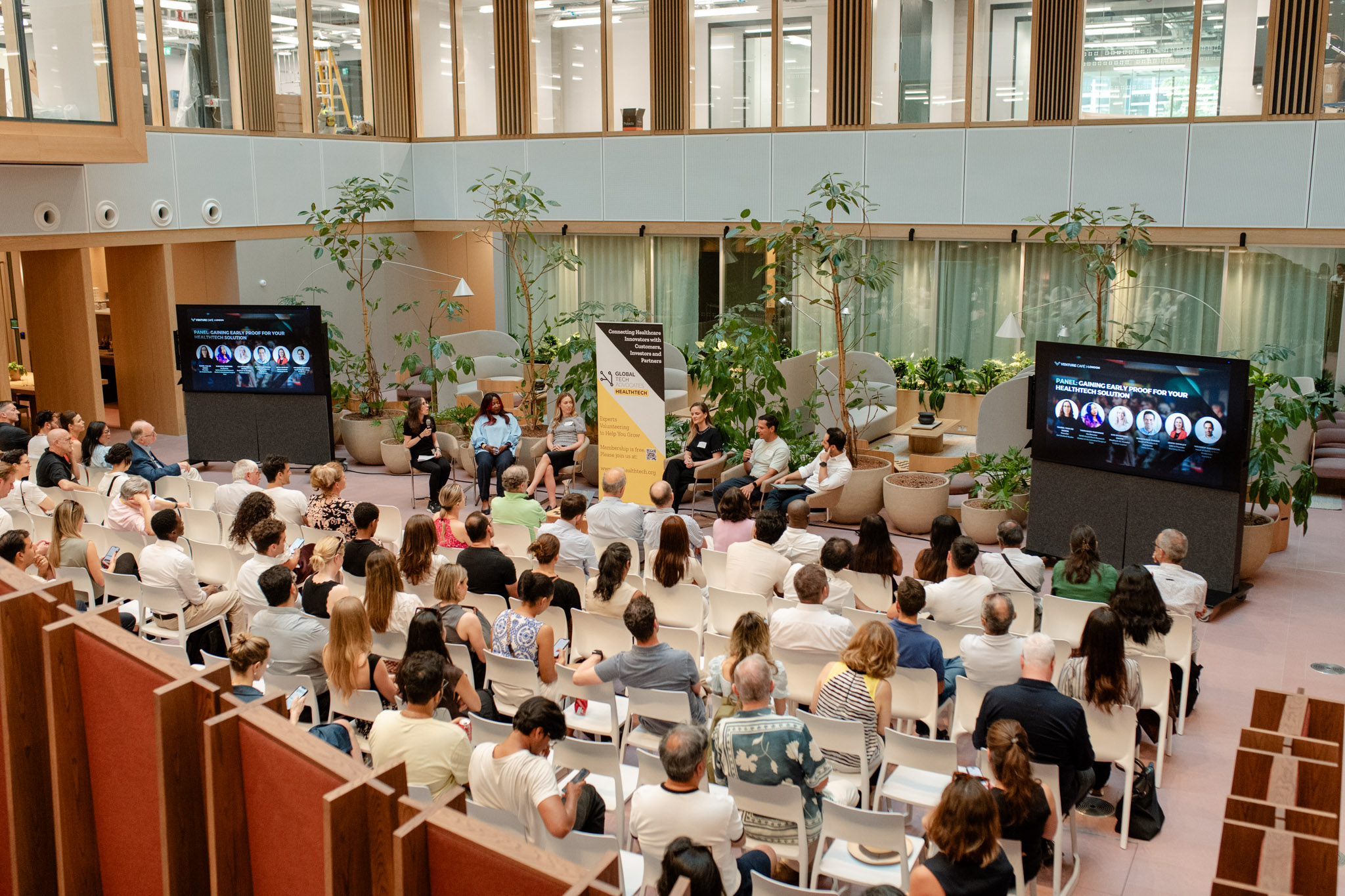
Our partnership with the Francis Crick Institute is one example. The Crick at Regent's Place will provide lab space for life sciences, health and AI-enabled biotechnology businesses, with opportunities to connect into the expertise and scientific community of one of the world's leading biomedical research institutes. Venture Café London provides another kind of connection. Now established at Regent's Place for more than a year, it brings together hundreds of founders, researchers, investors, policymakers and technologists every Thursday to share ideas, demonstrate technologies and find potential collaborators.
Formal partnerships and organised events are only part of the picture. The shared spaces and everyday activity across the campus also create opportunities for informal encounters between people who might not otherwise meet.
These interactions matter because innovation rarely follows a predictable route. A conversation between a scientist and an entrepreneur can become a business. A researcher might see an application for an idea that someone from another discipline has missed. An introduction can lead to investment, new hires or a partnership.
A successful ecosystem also needs to give businesses room to grow.
Our campus model is designed to offer space for every stage of the journey, from a single desk or bench through to a global headquarters. At Regent's Place, that means combining labs and flexible office set-ups with shared spaces for collaboration. Relation Therapeutics, for example, has expanded twice in our flexible lab spaces over the last three years, doubling its footprint to 13,000 sq ft as the company has grown its AI-led drug discovery partnerships. Anthropic's journey at the campus tells a similar story at a larger scale, following five previous deals with us as the company has rapidly grown its UK presence. For businesses like these, being able to scale in a single location, with a single landlord that understands their evolving needs, is a core part of the appeal.
Creating spaces that can foster meaningful relationships and interactions is an increasingly important part of what good placemaking means to us.
Anthropic has significantly expanded to 42,000
sq ft of lab space at One Triton Square.
Relation Therapeutics doubles footprint to 13,000
sq ft over three years as the company has grown its AI-led drug discovery partnerships.
Building Foundations for Global Reputation
There is currently a big national conversation about how the UK converts its strengths in science, research and technology into successful businesses that start, scale and stay here.
The UK doesn't have a start-up problem. Ideas flow readily from our world-class universities and research institutions. The challenge is what happens next: helping those businesses scale, keeping them in the UK and enabling them to reach their full potential. Much of the focus rightly falls on investment, access to growth capital and the role of government in creating the right conditions. But place matters too.
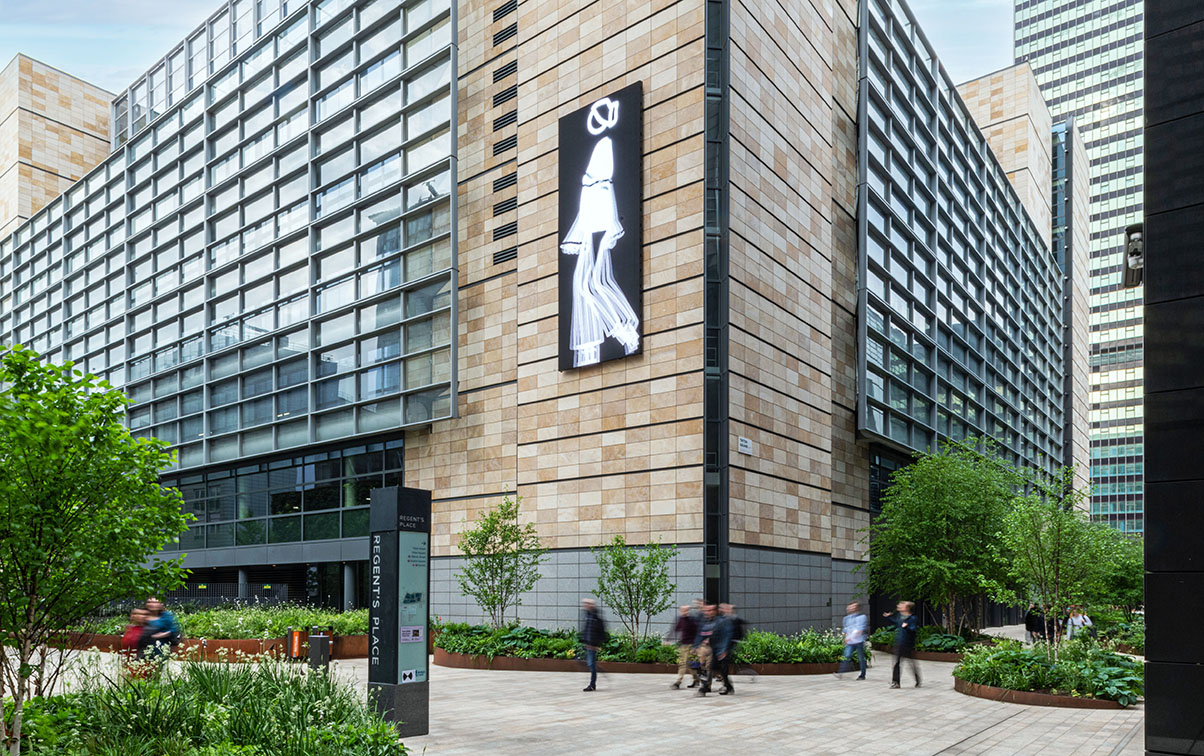
Some of the most exciting advances today are emerging at the intersection of disciplines, and this is one of London's greatest advantages. The city doesn't just have a deep tech ecosystem; it has deep sector expertise across industries where the UK is already globally significant, from finance and professional services to life sciences and engineering. That combination means London is uniquely positioned to foster growth in both frontier and traditional industries, and crucially, to bring them together. It's why ecosystems matter: not just clusters of similar businesses, but environments where different kinds of expertise collide – from tech and finance to government and world class research. This concentration in one location just doesn’t exist anywhere else globally.
That requires us to think beyond the physical boundaries of any one campus, cluster or quarter. The world's most successful innovation clusters aren't defined by a single institution or neighbourhood. Their strength comes from bringing multiple anchors together across a connected geography.
We shouldn’t just be asking how the Smart Mile, or any other individual district, competes globally, but how they contribute to a London ‘frontier’ proposition with the scale and identity to stand alongside the world’s leading innovation centres.
And there is an opportunity to think beyond London too. Innovation clusters across the UK – from Oxford and Cambridge to Manchester, Edinburgh, Glasgow, Bristol, Birmingham, Leeds, Cardiff and Belfast – each bring different combinations of research, talent, businesses and expertise. With Euston’s links north, Paddington’s links to Oxford and King’s Cross’ links to Cambridge, and St Pancras' direct connection to Europe, London can act as a gateway between regional and international innovation and the wider world.
Frontier Placemaking with Impact
Our role is clear: to create the physical spaces, partnerships and opportunities for interaction between frontier businesses that can help a wider innovation ecosystem flourish.
The UK already has many of the ingredients required for world-class innovation. The opportunity now is to recognise their collective strength – locally, across London and nationally.
When great places connect, they create a powerful competitive advantage with benefits reaching far beyond their boundaries.
Related content
 Royal London Asset Management and British Land sign Humanoid at One Triton Square, Regent’s Place
Offices
12.05.2026
 British Land and Royal London Asset Management announce letting to Gilead Sciences at One Triton Square, Regent’s Place
Science and Tech
11.03.2026
 Offer for Life Science REIT
Corporate
28.01.2026
Previous button Next button
03 / 03
SUBSCRIBE TO OUR NEWSLETTER

SITE SERVICES
SOCIAL
© British Land 2026
The British Land Company PLC. Registered in England. Company No: 621920. Registered Office: Regent's Place, 20 Triton St, London NW1 3BF
Copy link
✓
Thanks for sharing!
Find any service



 How do you make every fit out more sustainable?
 Why does social value matter in fit out?
 How we’re making fit outs more sustainable


Prompts
Click prompts to add them under the company line, click again to take one out, then copy the result into your AI chat. Shared by Asian Century Stocks and Uncovered Thai Stocks. Thank you.
British Land Company PLC (ticker BLND), listed in United Kingdom.
Copied
ETFs Holding British Land Company PLC
Exchange-traded funds whose newest published daily portfolio holds one of the company's listings, largest weight first.