Air Canada Reports Third Quarter 2026 Results
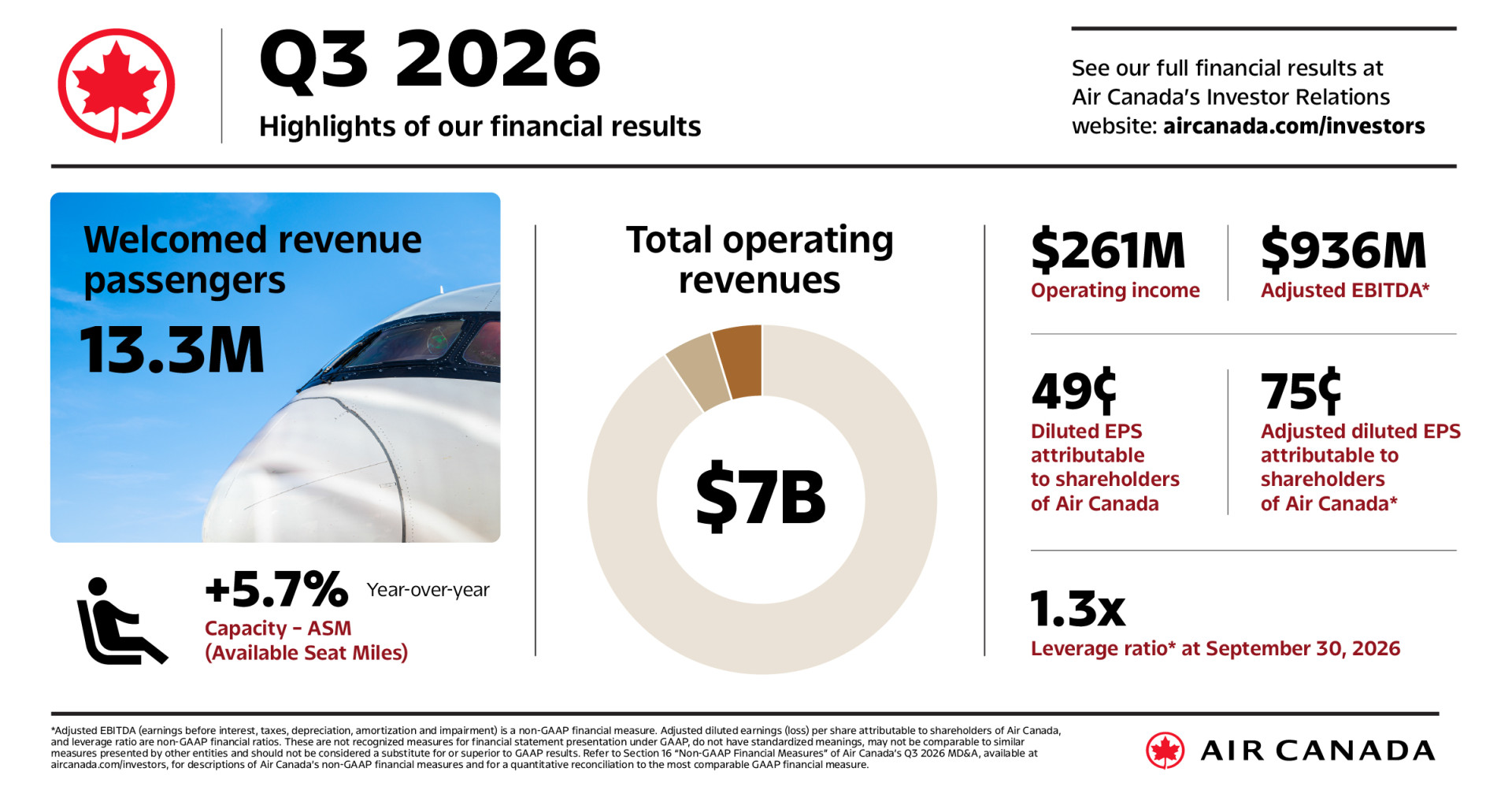
- Delivered record third-quarter operating revenues of $6.984 billion
- Achieved 14% year-over-year growth in total unit revenues in the third quarter of 2026
- Reported adjusted EBITDA of $936 million and operating income of $261 million
- Allocated Aeroplan transaction proceeds to repay $1.7 billion of debt and complete an $800 million substantial issuer bid
- Reduced shares outstanding by approximately 10% with the completion of the substantial issuer bid, ending the third quarter with 252.7 million shares outstanding
- Ended the third quarter with long-term debt and lease liabilities of $10.853 billion, net debt***** of $4.219 billion and total liquidity of $8.018 billion
MONTRÉAL, Oct. 29, 2026 (GLOBE NEWSWIRE) -- Air Canada today reported its third quarter 2026 financial results and provided updated full-year 2026 financial guidance.
“Air Canada delivered record third-quarter operating revenues of $7 billion, reflecting broad-based strength across our network and revenue streams. Strong demand supported a 2.6-percentage-point year-over-year gain in passenger load factor to 89% and an 11% increase in yield. Combined with 33% growth in cargo revenues, this solid performance contributed to a 21% year-over-year increase in total revenues. Decisive pricing, capacity and cost actions helped mitigate the impact of a $906 million year-over-year increase in fuel expense, with fuel prices 10 cents per litre above our third-quarter expectations. We delivered adjusted EBITDA* of $936 million and operating income of $261 million,” said John Di Bert, Executive Vice President and Chief Financial Officer.
“While we expect the challenging environment to persist, our strong financial position provides us with the flexibility to respond to near-term developments. We remain focused on executing on what we can control. Our diversified business model, broad global network and leading premium offering provide a solid foundation for navigating this environment and advancing our New Frontiers strategy. Air Canada’s recent recognition as Best Airline in North America at the 2026 Skytrax World Airline Awards — the 10th time since 2010 — reinforces the strength of our offering and our commitment to customers,” concluded Mr. Di Bert.
*Adjusted CASM, adjusted EBITDA (earnings before interest, taxes, depreciation, amortization and impairment), adjusted EBITDA margin, leverage ratio, net debt, adjusted pre-tax income (loss), adjusted net income (loss), adjusted earnings (loss) per share – diluted, and free cash flow are referred to in this news release. Such measures are non-GAAP financial measures, non-GAAP ratios, capital management measures or supplementary financial measures, are not recognized measures for financial statement presentation under GAAP, do not have standardized meanings, may not be comparable to similar measures presented by other entities and should not be considered a substitute for or superior to GAAP results. The leverage ratio was 1.6 at September 30, 2025. Adjusted EBITDA and operating income for the trailing 12-month period ended September 30, 2026 were $3.145 billion and $487 million, respectively ($2.953 billion and $340 million, respectively for the trailing 12-month period ended September 30, 2025). Refer to the "Non-GAAP Financial Measures" section of this news release for descriptions of these measures and for a reconciliation of Air Canada non-GAAP measures used in this news release to the most comparable GAAP financial measure.
Third Quarter 2026 Financial Results
-
Operating revenues of $6.984 billion
-
Operating expenses of $6.723 billion
-
Operating income of $261 million with an operating margin of 3.7% and an adjusted EBITDA of $936 million with an adjusted EBITDA margin* of 13.4%
-
Income before income taxes of $248 million and adjusted pre-tax income* of $328 million
-
Net income attributable to shareholders of Air Canada of $139 million and diluted earnings per share of $0.49
-
Adjusted net income attributable to shareholders of Air Canada* of $214 million and adjusted earnings per diluted share* of $0.75
-
Adjusted CASM* of 14.45 cents
-
Net cash flows from operating activities of $266 million and free cash flow* of negative $440 million
-
Long-term debt and lease liabilities of $10.853 billion and a leverage ratio* of 1.3
Outlook
For the full year 2026, Air Canada is updating its guidance and major assumptions from what was previously provided on August 11, 2026. The updated full-year 2026 guidance is as follows:
| Metric | Updated Full-Year 2026 Guidance | Prior Full-Year 2026 Guidance (Provided on August 11, 2026) |
| Adjusted EBITDA* | $2.4 billion to $2.7 billion | $2.9 billion to $3.2 billion |
| ASM capacity | Approx. 2.75% increase from 2025 | 2.25% to 3.25% increase from 2025 |
| Adjusted CASM* | 5.5-6% increase from 2025 | 5-6% increase from 2025 |
| Free cash flow* | Break-even ± $150 million | $200 million to $500 million |
*Refer to the “Non-GAAP Financial Measures” section of this news release for descriptions of these measures, and for a reconciliation of Air Canada’s non-GAAP measures used in this news release to the most comparable GAAP financial measure.
The updated full-year 2026 adjusted EBITDA and free cash flow guidance reflects Air Canada’s current expectation of higher fuel prices for the remainder of the year compared with the assumptions underlying its August 11, 2026 guidance. The updated outlook also reflects limited remaining variability in fourth-quarter capacity and adjusted CASM, which has enabled Air Canada to narrow its expectations for these operating metrics. Fuel prices remain the key variable in the outlook.
Major Assumptions
Air Canada made assumptions in providing its updated guidance, including modest Canadian GDP growth for 2026 and current demand trends continuing through the remainder of 2026. Air Canada assumes that the Canadian dollar will trade, on average, at C$1.39 per U.S. dollar for the full year 2026 (previously C$1.41 per U.S. dollar). Air Canada also assumes that the price of jet fuel will average at approximately C$1.72 per litre for the fourth quarter of 2026 (previously C$1.29 per litre). Our assumptions are based on the forward curve as of October 8, 2026, adjusted to reflect Air Canada's specific supply chain environment, including Air Canada's fuel infrastructure at Canadian hubs, where fuel is typically contracted on a one- to two-month forward basis, as well as pricing exposure at international station locations. Air Canada currently expects approximately half of its fuel requirements for the fourth quarter of 2026 to be exposed to fuel price volatility. These jet fuel estimates reflect Air Canada’s capacity plans and remain subject to ongoing volatility in global energy markets.
Air Canada expects it can offset, for the fourth quarter of 2026, approximately 70 per cent (previously 100 per cent) of the estimated incremental jet fuel expense above its assumptions immediately prior to February 12, 2026.
Air Canada has entered into agreements for up to $2 billion in sale-and-leaseback transactions, with total proceeds of $501 million from transactions completed in the first nine months of 2026. Definitive agreements have been signed for the remaining transactions, which are scheduled to close in 2026 and 2027, subject to completion of standard conditions precedent, including delivery of the aircraft concerned. As part of the assumptions for 2026 guidance, Air Canada has assumed execution on its sale-and-leaseback transactions for $1 billion in 2026.
Air Canada’s guidance constitutes forward-looking information within the meaning of applicable securities laws and is subject to important risks and uncertainties, including in relation to statements or actions by governments and uncertainty relating to the imposition of (or threats to impose) tariffs on Canadian exports or imports and their resulting impacts on the Canadian, North American and global economies and travel demand. In addition, aircraft fuel prices have been, and continue to be, subject to high volatility as a result of the ongoing conflicts in the Middle East. Moreover, there has been significant disruption to international shipping trade routes through the Strait of Hormuz, further exacerbating the impact on fuel supply and prices, including for aircraft fuel. A prolonged or escalating conflict could further disrupt global energy markets and cause aircraft fuel prices to remain elevated or rise even higher. We cannot predict future supply constraints, price volatility or cost of aircraft fuel, or how long current or future conflicts will last or their ultimate impact on global energy markets and across the aviation industry. Please see the discussion below under Caution Regarding Forward-looking Information.
Normal Course Issuer Bid
Air Canada is also announcing today that the Toronto Stock Exchange (“TSX”) has accepted notice of its intention to make a normal course issuer bid (“NCIB”) allowing it to purchase for cancellation up to 25,197,886 of its Class A variable voting shares and Class B voting shares (collectively the “Shares”) in accordance with the rules of the TSX.
Air Canada believes that the market price of its Shares from time to time may not fully reflect the underlying value of its business and future business prospects. In such circumstances, the purchase of Shares under the NCIB may be an attractive and appropriate use of its available cash, consistent with Air Canada’s priority of investing in the airline, maintaining balance sheet strength and generating shareholder value through a balanced capital allocation strategy.
Air Canada is authorized by the TSX to purchase up to 25,197,886 Shares under the NCIB, being about 10% of the public float of its Shares. As at October 26, 2026, the number of outstanding Shares totaled 252,745,331 of which 251,978,868 Shares represented the public float. Purchases under the NCIB are authorized during the period from November 9, 2026 to November 8, 2027. Decisions regarding the amount and timing of purchases of Shares will be based on market conditions, share price and other factors existing at the time of each purchase. Air Canada may elect to modify, suspend or discontinue the NCIB at any time and is not required to repurchase any Shares during the term of the NCIB.
Purchases will be made through open market transactions on the TSX or alternative Canadian trading systems, if eligible, or such other means as the securities regulatory authorities may allow, including block purchases, pre-arranged crosses or exempt offers, as well as private agreements under an issuer bid exemption order issued by a securities regulatory authority. Air Canada will pay the market price at the time of acquisition for any Share purchased, plus brokerage fees, or such other price as may be allowed. Any purchases made under an issuer bid exemption order would be at a discount to the prevailing market price of the Shares or otherwise in accordance with the terms of the order.
The average daily trading volume (“ADTV”) of the Shares on the TSX was 2,799,724 Shares for the six-month period ended September 30, 2026. Under TSX rules, Air Canada may accordingly purchase up to 699,931 Shares on the TSX on any trading day, being 25% of the ADTV. Air Canada may also, not more than once per week, purchase a block of Shares not directly or indirectly owned by insiders, which may exceed such daily limit, in accordance with TSX rules. All Shares purchased pursuant to the NCIB will be cancelled.
Under its prior NCIB that commenced on November 7, 2025 and will expire on November 6, 2026, Air Canada was authorized to purchase for cancellation up to 29,557,428 Shares, representing about 10% of Air Canada's public float as of October 24, 2025. Air Canada purchased 16,295,815 Shares authorized under the prior NCIB, at a weighted average price of $18.41 per share. All such Shares were purchased through the facilities of the TSX or alternative Canadian trading systems.
Air Canada will enter into an automatic share purchase plan (the “Plan”) with its designated broker under which it may, but is not required to, instruct the broker to make purchases at times when it would ordinarily not be active in the market due to regulatory restrictions, self-imposed blackout periods or otherwise. Purchases by the designated broker made under the Plan, if any, will be based on parameters established by Air Canada in accordance with the rules of the TSX, applicable securities laws and the terms of the Plan. Shares may in Air Canada’s discretion be purchased under the NCIB outside of the self-imposed blackout or other restricted periods in compliance with the rules of the TSX and applicable securities laws.
2028 targets and 2030 aspirations
Air Canada announced the following long-term 2028 financial targets and 2030 aspirations in December 2024:
| Metric | 2028 Targets | 2030 Aspirations |
| Operating revenues | Approximately $30 billion | Exceed $30 billion |
| Adjusted EBITDA margin* | Greater than or equal to 17% | Between 18% and 20% |
| Net cash flows from operating activities as a percentage of adjusted EBITDA* | Approximately 90% | Approximately 90% |
| Additions to property, equipment and intangible assets as a percentage of operating revenues* | Lower than or equal to 12% | Lower than 12% |
| Free cash flow margin* | Approximately 5% | Approximately 5% |
| Return on invested capital* | Not provided | Greater than or equal to 12% |
| Fully diluted share count | Lower than 300 million shares | Lower than 300 million shares |
*Adjusted EBITDA (earnings before interest, taxes, depreciation, amortization and impairment), adjusted EBITDA margin, net cash flows from operating activities as a percentage of adjusted EBITDA, additions to property, equipment and intangible assets as a percentage of operating revenues, free cash flow margin and return on invested capital are referred to in this news release. Such measures are non-GAAP financial measures, non-GAAP ratios or supplementary financial measures, are not recognized measures for financial statement presentation under GAAP, do not have standardized meanings, may not be comparable to similar measures presented by other entities and should not be considered a substitute for or superior to GAAP results. Refer to the "Non-GAAP Financial Measures" section of this news release for descriptions of these measures and for a reconciliation of Air Canada non-GAAP measures used in this news release to the most comparable GAAP financial measure.
The 2028 long-term targets and 2030 aspirations provided in this news release do not constitute guidance or outlook but rather are provided for the purpose of assisting the reader in measuring progress toward Air Canada’s objectives. Readers are cautioned that evolving conditions, particularly those relating to jet fuel prices, may result in changes to these targets and aspirations, and are referred to the assumptions, risks and uncertainties described in the 2024 Investor Day presentations, which are available in the events section at aircanada.com/investors and elsewhere in this news release, including assumptions relating to demand trends, jet fuel supply, prices and forward curves, the ability to significantly recapture elevated fuel prices, increasing revenues, growing fleet and network capacity and successfully executing on other key investments and initiatives.
Non-GAAP Financial Measures
Below is a description of certain non-GAAP financial measures and ratios used by Air Canada to provide readers with additional information on its financial and operating performance. Such measures are not recognized measures for financial statement presentation under GAAP, do not have standardized meanings, may not be comparable to similar measures presented by other entities and should not be considered a substitute for or superior to GAAP results. The non-GAAP financial measures or ratios described in this section typically have exclusions or adjustments that include one or more of the following characteristics: being highly variable, difficult to project, unusual in nature, significant to the results of a particular period or not indicative of past or future operating results. These items are excluded because Air Canada believes these may distort the analysis of certain business trends and render comparative analysis across periods less meaningful and their exclusion generally allows for a more meaningful analysis of Air Canada’s operating expense performance and may allow for a more meaningful comparison to other airlines.
In 2026, Air Canada concluded new four-year collective agreements with the International Association of Machinists and Aerospace Workers (IAMAW) and Unifor. Air Canada recorded pension past service cost charges of $131 million related to the IAMAW agreement in the third quarter and $132 million related to the Unifor agreement in the second quarter. Separately, Air Canada recorded a $6 million charge associated with the share trust in the third quarter and, in the second quarter, a $208 million charge related to pensioner lump-sum payments and voluntary separation packages funded from proceeds of the union pension funding trust, as well as a $20 million benefit-related past service cost and a $28 million provision in respect of a legal matter. These items were excluded in the calculation of adjusted CASM, adjusted EBITDA, adjusted pre-tax income and adjusted net income. Additionally, a related $41 million interest expense associated with a legal matter was excluded from adjusted pre-tax income and adjusted net income.
In 2025, Air Canada recorded a pension past service cost and other labour-related charges of $194 million, including from the pension plan amendments made in conjunction with the collective agreement reached with the Canadian Union of Public Employees (CUPE) and an operating expense related to the streamlining of Air Canada’s management structure. In 2024, following ratification of the collective agreement with the Air Line Pilots Association (ALPA), Air Canada recorded a pension past service cost of $490 million in the fourth quarter of 2024. Air Canada has excluded these charges in computing its adjusted EBITDA, adjusted CASM, adjusted pre-tax income and adjusted net income. A corporate charge of $26 million for the settlement of tax matters related to the 2019 acquisition of Aeroplan was recorded in 2025. As this item is non-recurring and cash-neutral to Air Canada, since a related tax refund was also recorded, Air Canada added back this expense in the calculation of adjusted pre-tax income and adjusted net income – attributable to shareholders of Air Canada.
A charge of $34 million was recorded in the third quarter of 2024 in other operating expenses related to estimated costs associated with contractual lease obligations. In the third quarter of 2026, Air Canada recorded a $17 million reduction related to the estimated costs recorded in 2024 as previously described. Air Canada excluded this expense and the subsequent reduction in computing adjusted CASM, adjusted EBITDA, adjusted pre-tax income and adjusted net income.
Air Canada excludes the effect of impairment of assets, if any, when calculating adjusted CASM, adjusted EBITDA, adjusted EBITDA margin, adjusted pre-tax income (loss) and adjusted net income (loss) as it may distort the analysis of certain business trends and render comparative analysis across periods or to other airlines less meaningful. Air Canada did not record charges for impairment of assets in 2026, 2025 or 2024.
Adjusted CASM
Air Canada uses adjusted CASM to assess the operating and cost performance of its ongoing airline business without the effects of aircraft fuel expense, the cost of ground packages at Air Canada Vacations, freighter costs and other items. These items may distort the analysis of certain business trends and render comparative analysis across periods less meaningful and their exclusion generally allows for a more meaningful analysis of Air Canada’s operating expense performance and may allow for a more meaningful comparison to that of other airlines.
In calculating adjusted CASM, aircraft fuel expense is excluded from operating expense results as it fluctuates widely depending on many factors, including international market conditions, geopolitical events, jet fuel refining costs and Canada/U.S. currency exchange rates. Air Canada also incurs expenses related to ground packages at Air Canada Vacations, which some airlines, without comparable tour operator businesses, may not incur. In addition, these costs do not generate ASMs and therefore excluding these costs from operating expense results provides for a more meaningful comparison across periods when such costs may vary.
Air Canada also incurs expenses related to the operation of freighter aircraft, which some airlines, without comparable cargo businesses, may not incur. Air Canada had six Boeing 767 dedicated freighter aircraft in service as at September 30, 2026, and as at September 30, 2025. These costs do not generate ASMs and therefore excluding these costs from operating expense results provides for a more meaningful comparison of the passenger airline business across periods.
The following table provides the adjusted CASM reconciliation to GAAP operating expense for the periods indicated.
| (Canadian dollars in millions, except where indicated) | Third Quarter | First Nine Months | ||||||||||||||||
| 2026 | 2025 | Change | 2026 | 2025 | Change | |||||||||||||
| Operating expense – GAAP | $ | 6,723 | $ | 5,490 | $ | 1,233 | $ | 18,872 | $ | 16,008 | $ | 2,864 | ||||||
| Adjusted for: | ||||||||||||||||||
| Aircraft fuel | (2,118 | ) | (1,212 | ) | (906 | ) | (5,025 | ) | (3,546 | ) | (1,479 | ) | ||||||
| Ground package costs | (114 | ) | (103 | ) | (11 | ) | (710 | ) | (633 | ) | (77 | ) | ||||||
| Freighter costs (excluding fuel) | (50 | ) | (44 | ) | (6 | ) | (141 | ) | (128 | ) | (13 | ) | ||||||
| Pension plan amendments and other labour-related charges | (131 | ) | (173 | ) | 42 | (263 | ) | (173 | ) | (90 | ) | |||||||
| Pension plan share trust | (6 | ) | - | (6 | ) | (214 | ) | - | (214 | ) | ||||||||
| Benefit-related past service cost | - | - | - | (20 | ) | - | (20 | ) | ||||||||||
| Provision for legal reserve | - | - | - | (28 | ) | - | (28 | ) | ||||||||||
| Provision for contractual lease obligations | 17 | - | 17 | 17 | - | 17 | ||||||||||||
| Operating expense, adjusted for the above-noted items | $ | 4,321 | $ | 3,958 | $ | 363 | $ | 12,488 | $ | 11,528 | $ | 960 | ||||||
| ASMs (millions) | 29,893 | 28,282 | 5.7 | % | 81,664 | 79,382 | 2.9 | % | ||||||||||
| Adjusted CASM (cents) | ¢ | 14.45 | ¢ | 13.99 | ¢ | 0.46 | ¢ | 15.29 | ¢ | 14.52 | ¢ | 0.77 |
Adjusted EBITDA and Adjusted EBITDA Margin
Adjusted EBITDA (earnings before interest, taxes, depreciation, amortization and impairment) and adjusted EBITDA margin (adjusted EBITDA as a percentage of operating revenues) are commonly used in the airline industry and are used by Air Canada as a means to view operating results and the related margin before interest, taxes, depreciation, amortization and impairment and other items. These items can vary significantly among airlines due to differences in the way airlines finance their aircraft and other assets.
Adjusted EBITDA and adjusted EBITDA margin are reconciled to GAAP operating income as follows:
| (Canadian dollars in millions, except where indicated) | Third Quarter | First Nine Months | ||||||||||||||||
| 2026 | 2025 | Change | 2026 | 2025 | Change | |||||||||||||
| Operating income – GAAP | $ | 261 | $ | 284 | $ | (23 | ) | $ | 163 | $ | 594 | $ | (431 | ) | ||||
| Add back: | ||||||||||||||||||
| Depreciation, amortization and impairment | 555 | 504 | 51 | 1,607 | 1,490 | 117 | ||||||||||||
| Pension plan amendments and other labour-related charges | 131 | 173 | (42 | ) | 263 | 173 | 90 | |||||||||||
| Pension plan share trust | 6 | - | 6 | 214 | - | 214 | ||||||||||||
| Benefit-related past service cost | - | - | - | 20 | - | 20 | ||||||||||||
| Provision for legal reserve | - | - | - | 28 | - | 28 | ||||||||||||
| Provision for contractual lease obligations | (17 | ) | - | (17 | ) | (17 | ) | - | (17 | ) | ||||||||
| Adjusted EBITDA | $ | 936 | $ | 961 | $ | (25 | ) | $ | 2,278 | $ | 2,257 | $ | 21 | |||||
| Operating revenues | $ | 6,984 | $ | 5,774 | $ | 1,210 | $ | 19,035 | $ | 16,602 | $ | 2,433 | ||||||
| Operating margin (%) | 3.7 | 4.9 | (1.2) pp | 0.9 | 3.6 | (2.7) pp | ||||||||||||
| Adjusted EBITDA margin (%) | 13.4 | 16.6 | (3.2) pp | 12.0 | 13.6 | (1.6) pp |
| 12 months ended | |||||||||
| (Canadian dollars in millions) | Sep. 30, 2026 | Dec. 31, 2025 | Sep. 30, 2025 | ||||||
| Operating income – GAAP | $ | 487 | $ | 918 | $ | 340 | |||
| Add back: | |||||||||
| Depreciation, amortization and impairment | 2,129 | 2,012 | 1,950 | ||||||
| Pension plan amendments and other labour-related charges | 284 | 194 | 663 | ||||||
| Pension plan share trust | 214 | - | - | ||||||
| Benefit-related past service cost | 20 | - | - | ||||||
| Provision for legal reserve | 28 | - | - | ||||||
| Provision for contractual lease obligations | (17 | ) | - | - | |||||
| Adjusted EBITDA | $ | 3,145 | $ | 3,124 | $ | 2,953 |
Adjusted Pre-tax Income (Loss)
Adjusted pre-tax income (loss) is used by Air Canada to assess the overall pre-tax financial performance of its business without the effects of foreign exchange gains or losses, net interest relating to employee benefits, gains or losses on financial instruments recorded at fair value, gains or losses on sale and leaseback of assets, gains or losses on disposal of assets, gains or losses on debt settlements and modifications and other items discussed above. These items may distort the analysis of certain business trends and render comparative analysis across periods or to other airlines less meaningful.
Adjusted pre-tax income is reconciled to GAAP income before income taxes as follows**:**
| (Canadian dollars in millions) | Third Quarter | First Nine Months | ||||||||||||||||
| 2026 | 2025 | Change | 2026 | 2025 | Change | |||||||||||||
| Income before income taxes – GAAP | $ | 248 | $ | 511 | $ | (263 | ) | $ | 55 | $ | 447 | $ | (392 | ) | ||||
| Adjusted for: | ||||||||||||||||||
| Foreign exchange (gain) loss | (43 | ) | (343 | ) | 300 | (142 | ) | (142 | ) | - | ||||||||
| Net interest relating to employee benefits | (10 | ) | (4 | ) | (6 | ) | (29 | ) | (14 | ) | (15 | ) | ||||||
| Financial instruments recorded at fair value | 13 | (16 | ) | 29 | 16 | (76 | ) | 92 | ||||||||||
| Loss on debt settlements and modifications | - | - | - | 56 | - | 56 | ||||||||||||
| Gain on sale and leaseback of assets | - | - | - | (82 | ) | - | (82 | ) | ||||||||||
| Other corporate expenses | - | 8 | (8 | ) | - | 26 | (26 | ) | ||||||||||
| Pension plan amendments and other labour-related charges | 131 | 173 | (42 | ) | 263 | 173 | 90 | |||||||||||
| Pension plan share trust | 6 | - | 6 | 214 | - | 214 | ||||||||||||
| Benefit-related past service cost | - | - | - | 20 | - | 20 | ||||||||||||
| Provision for legal reserve, including interest expense | - | - | - | 69 | - | 69 | ||||||||||||
| Provision for contractual lease obligations | (17 | ) | - | (17 | ) | (17 | ) | - | (17 | ) | ||||||||
| Adjusted pre-tax income | $ | 328 | $ | 329 | $ | (1 | ) | $ | 423 | $ | 414 | $ | 9 |
Adjusted Net Income (Loss) and Adjusted Earnings (Loss) Per Share – Diluted – Attributable to Shareholders of Air Canada
Air Canada uses adjusted net income (loss) – attributable to shareholders of Air Canada and adjusted earnings (loss) per share attributable to shareholders of Air Canada – diluted as a means to assess the overall financial performance of its business without the after-tax effects of foreign exchange gains or losses, net interest relating to employee benefits, gains or losses on financial instruments recorded at fair value, gains or losses on sale and leaseback of assets, gains or losses on debt settlements and modifications, gains or losses on disposal of assets and other items discussed above. These items may distort the analysis of certain business trends and render comparative analysis to other airlines less meaningful.
Adjusted net income and adjusted earnings per share – diluted attributable to shareholders of Air Canada are reconciled to GAAP net income attributable to shareholders of Air Canada as follows:
| (Canadian dollars in millions, except per share figures) | Third Quarter | First Nine Months | ||||||||||||||||
| 2026 | 2025 | Change | 2026 | 2025 | Change | |||||||||||||
| Net income attributable to shareholders of Air Canada – GAAP | $ | 139 | $ | 264 | $ | (125 | ) | $ | 9 | $ | 348 | $ | (339 | ) | ||||
| Adjusted for amounts, net of amount attributable to non-controlling interest: | ||||||||||||||||||
| Foreign exchange (gain) loss | (43 | ) | (343 | ) | 300 | (142 | ) | (142 | ) | - | ||||||||
| Net interest relating to employee benefits | (10 | ) | (4 | ) | (6 | ) | (29 | ) | (14 | ) | (15 | ) | ||||||
| Financial instruments recorded at fair value | 13 | (16 | ) | 29 | 16 | (76 | ) | 92 | ||||||||||
| Loss on debt settlements and modifications | - | - | - | 56 | - | 56 | ||||||||||||
| Gain on sale and leaseback of assets | - | - | - | (82 | ) | - | (82 | ) | ||||||||||
| Other corporate expenses | - | 8 | (8 | ) | - | 26 | (26 | ) | ||||||||||
| Pension plan amendments and other labour-related charges | 131 | 173 | (42 | ) | 263 | 173 | 90 | |||||||||||
| Pension plan share trust | 6 | - | 6 | 214 | - | 214 | ||||||||||||
| Benefit-related past service cost | - | - | - | 20 | - | 20 | ||||||||||||
| Provision for legal reserve, including interest expense | - | - | - | 69 | - | 69 | ||||||||||||
| Provision for contractual lease obligations | (17 | ) | - | (17 | ) | (17 | ) | - | (17 | ) | ||||||||
| Income tax, including for the above reconciling items | (5 | ) | 141 | (146 | ) | (65 | ) | (35 | ) | (30 | ) | |||||||
| Adjusted net income attributable to shareholders of Air Canada | $ | 214 | $ | 223 | $ | (9 | ) | $ | 312 | $ | 280 | $ | 32 | |||||
| Weighted average number of outstanding shares used in computing diluted income per share (in millions) | 283 | 297 | (14 | ) | 287 | 328 | (41 | ) | ||||||||||
| Adjusted earnings per share attributable to shareholders of Air Canada – diluted | $ | 0.75 | $ | 0.75 | $ | - | $ | 1.08 | $ | 0.85 | $ | 0.23 |
The table below reflects the share amounts used in the computation of basic and diluted earnings per share on an adjusted earnings per share basis:
| (in millions) | Third Quarter | First Nine Months | ||||||
| 2026 | 2025 | 2026 | 2025 | |||||
| Weighted average number of shares outstanding – basic | 280 | 296 | 285 | 316 | ||||
| Effect of dilution | 3 | 1 | 2 | 12 | ||||
| Weighted average number of shares outstanding – diluted | 283 | 297 | 287 | 328 |
Free Cash Flow
Air Canada uses free cash flow as an indicator of the financial strength and performance of its business, indicating the amount of cash Air Canada can generate from operations and after capital expenditures. Free cash flow is calculated as net cash flows from operating activities minus additions to property, equipment and intangible assets, and it is net of proceeds from sale and leaseback transactions.
The table below reconciles free cash flow to net cash flows from operating activities for the periods indicated.
| Third Quarter | First Nine Months | |||||||||||||||||
| (Canadian dollars in millions) | 2026 | 2025 | $ Change | 2026 | 2025 | $ Change | ||||||||||||
| Net cash flows from operating activities | $ | 266 | $ | 813 | $ | (547 | ) | $ | 2,715 | $ | 3,234 | $ | (519 | ) | ||||
| Additions to property, equipment and intangible assets | (706 | ) | (602 | ) | (104 | ) | (1,878 | ) | (2,009 | ) | 131 | |||||||
| Proceeds from sale and leaseback of assets | - | - | - | 501 | - | 501 | ||||||||||||
| Free cash flow | $ | (440 | ) | $ | 211 | $ | (651 | ) | $ | 1,338 | $ | 1,225 | $ | 113 |
Net Debt
Net debt is a capital management measure and a key component of the capital managed by Air Canada and provides management with a measure of its net indebtedness.
Net Debt to Trailing 12-Month Adjusted EBITDA (Leverage Ratio)
Net debt to trailing 12-month adjusted EBITDA ratio (also referred to as “leverage ratio”) is commonly used in the airline industry and is used by Air Canada as a means to measure financial leverage. Leverage ratio is calculated by dividing net debt by trailing 12-month adjusted EBITDA.
The table below reconciles leverage ratio to Air Canada’s net debt balances as at the dates indicated.
| (Canadian dollars in millions) | September 30, 2026 | December 31, 2025 | September 30, 2025 | ||||||
| Total long-term debt and lease liabilities | $ | 9,473 | $ | 8,609 | $ | 8,699 | |||
| Current portion of long-term debt and lease liabilities | 1,380 | 2,967 | 3,070 | ||||||
| Total long-term debt and lease liabilities (including current portion) | 10,853 | 11,576 | 11,769 | ||||||
| Less cash, cash equivalents and short- and long-term investments | (6,634 | ) | (6,165 | ) | (6,939 | ) | |||
| Net debt | $ | 4,219 | $ | 5,411 | $ | 4,830 | |||
| Adjusted EBITDA (trailing 12 months) | $ | 3,145 | $ | 3,124 | $ | 2,953 | |||
| Net debt to adjusted EBITDA ratio | 1.3 | 1.7 | 1.6 |
The table below presents comparative figures for the 12-month periods ended December 31, 2024 and 2025, in reference to Air Canada's full-year 2026 guidance, 2028 financial targets and 2030 aspirations.
| (Canadian dollars in millions, except where indicated) | 20251 | 20241 |
| ASM Capacity | 105.174 billion | 104.381 billion |
| Adjusted CASM (cents) | 14.72¢ | 13.80¢ |
| Operating expenses | $21.454 billion | $20.992 billion |
| Adjusted EBITDA | $3.124 billion | $3.586 billion |
| Operating income | $918 million | $1.263 billion |
| Free cash flow | $747 million | $1.294 billion |
| Net cash flows from operating activities | $3.657 billion | $3.930 billion |
| Operating revenues | $22.372 billion | $22.255 billion |
| Adjusted EBITDA margin | 14% | 16% |
| Operating margin | 4% | 6% |
| Net cash flows from operating activities as a percentage of adjusted EBITDA | 117% | 110% |
| Additions to property, equipment and intangible assets as a percentage of operating revenues | 13% | 12% |
| Free cash flow margin | 3% | 6% |
| Return on invested capital | 9% | 14% |
| Income before income taxes | $789 million | $515 million |
| Fully diluted share count | ~307 million shares | ~367 million shares |
1Percentage amounts in the table above may not calculate exactly due to rounding.
Net cash flows from operating activities as a percentage of adjusted EBITDA
Air Canada uses net cash flows from operating activities as a percentage of adjusted EBITDA to measure cash conversion from adjusted EBITDA. This measure is defined as the ratio of net cash flows from operating activities to adjusted EBITDA.
Additions to property, equipment and intangible assets as a percentage of operating revenues
Air Canada uses additions to property, equipment and intangible assets as a percentage of operating revenues to measure the proportion of operating revenues that are reinvested as capital expenditures. This measure is defined as the ratio of additions to property, equipment and intangible assets to operating revenues.
Free cash flow margin
Air Canada uses free cash flow margin to measure the amount its free cash flow represents as a percentage of operating revenues. This measure is defined as the ratio of free cash flow to operating revenues.
The table below presents the quantitative reconciliation for adjusted EBITDA, adjusted EBITDA margin, net cash flows from operating activities as a percentage of adjusted EBITDA, additions to property, equipment and intangible assets as a percentage of operating revenues, free cash flow and free cash flow margin, in each case for the financial years ended December 31, 2025 and 2024.
| (in millions, except where indicated) | 2025 | 2024 | ||||
| Total operating revenues – GAAP | $ | 22,372 | $ | 22,255 | ||
| Operating income – GAAP | $ | 918 | $ | 1,263 | ||
| Add back: | ||||||
| Depreciation, amortization and impairment | 2,012 | 1,799 | ||||
| Provision for contractual lease obligations | - | 34 | ||||
| Pension plan amendments and other labour-related charges | 194 | 490 | ||||
| Adjusted EBITDA | $ | 3,124 | $ | 3,586 | ||
| Net cash flows from operating activities | $ | 3,657 | $ | 3,930 | ||
| Additions to property, equipment and intangible assets | (2,910 | ) | (2,636 | ) | ||
| Free cash flow | $ | 747 | $ | 1,294 | ||
| Operating margin | 4% | 6% | ||||
| Adjusted EBITDA margin | 14% | 16% | ||||
| Net cash flows from operating activities as a percentage of adjusted EBITDA | 117% | 110% | ||||
| Additions to property, equipment and intangible assets as a percentage of operating revenues | 13% | 12% | ||||
| Free cash flow margin | 3% | 6% |
Return on invested capital
Air Canada uses return on invested capital (ROIC) to assess the efficiency with which it allocates its capital to generate returns. ROIC is calculated as the ratio of adjusted pre-tax income (loss), excluding interest expense – attributable to shareholders of Air Canada, to invested capital. Invested capital includes average year-over-year long-term debt and lease obligations, average year-over-year shareholders' equity and the embedded derivative on Air Canada's convertible notes. In 2020, Air Canada issued convertible unsecured notes. Air Canada had the option to deliver cash or a combination of cash and shares on the conversion date in lieu of shares, giving rise to an embedded derivative that was included as part of the definition of capital. Air Canada calculates invested capital on a book value-based method when calculating ROIC.
Return on invested capital is reconciled to GAAP income (loss) before income taxes as follows:
| 12 months ended | ||||||||||||
| (in millions, except where indicated) | September 30, 2026 | December 31, 2025 | September 30, 2025 | December 31, 2024 | ||||||||
| Income before income taxes – GAAP | $ | 397 | $ | 789 | $ | (274 | ) | $ | 515 | |||
| Adjusted for: | ||||||||||||
| Income before income taxes attributable to non-controlling interests | (10 | ) | - | - | - | |||||||
| Income before income taxes attributable to shareholders of Air Canada | 387 | 789 | (274 | ) | 515 | |||||||
| Adjusted for: | ||||||||||||
| Provision for contractual lease obligations | (17 | ) | - | - | 34 | |||||||
| Pension plan amendments and other labour-related charges | 284 | 194 | 663 | 490 | ||||||||
| Foreign exchange (gain) loss | (245 | ) | (245 | ) | 230 | 400 | ||||||
| Net interest relating to employee benefits | (39 | ) | (24 | ) | (20 | ) | (22 | ) | ||||
| (Gain) loss on financial instruments recorded at fair value | 10 | (82 | ) | (38 | ) | (28 | ) | |||||
| (Gain) loss on debt settlements and modifications | 56 | - | (38 | ) | 8 | |||||||
| Gain on sale and leaseback of assets | (82 | ) | - | - | - | |||||||
| Other corporate expenses | - | 26 | 26 | - | ||||||||
| Pension plan share trust | 214 | - | - | - | ||||||||
| Benefit-related past service cost | 20 | - | - | - | ||||||||
| Provision for legal reserve, including interest | 69 | - | - | - | ||||||||
| Adjusted pre-tax income attributable to shareholders of Air Canada | $ | 657 | $ | 658 | $ | 549 | $ | 1,397 | ||||
| Add back: | ||||||||||||
| Interest expense | 621 | 663 | 692 | 763 | ||||||||
| Interest expense attributable to non-controlling interests | 11 | - | - | - | ||||||||
| Adjusted pre-tax income before interest expense attributable to shareholders of Air Canada | $ | 1,289 | $ | 1,321 | $ | 1,241 | $ | 2,160 | ||||
| Invested capital: | ||||||||||||
| Average long-term debt and lease liabilities (including current portion) | 11,311 | 12,123 | 12,069 | 13,266 | ||||||||
| Embedded derivative on convertible notes | - | - | - | 45 | ||||||||
| Average shareholders’ equity | 2,139 | 2,490 | 2,637 | 1,592 | ||||||||
| Invested capital | $ | 13,450 | $ | 14,613 | $ | 14,705 | $ | 14,903 | ||||
| Return on invested capital (%) | 10% | 9% | 8% | 14% |
Third Quarter 2026 Conference Call
Air Canada will host its quarterly analysts’ call on Thursday, October 29, 2026, at 5:30 p.m. ET. John Di Bert, Executive Vice President and Chief Financial Officer, and Mark Galardo, Executive Vice President and Chief Commercial Officer and President, Cargo, will present the results and be available for analysts’ questions. Immediately following the analysts' Q&A session, Mr. Di Bert and Pierre Houle, Vice President and Treasurer, will be available to answer questions from term loan B lenders and holders of Air Canada bonds.
Media and the public may access this call on a listen-only basis. Webcast details are as follows: https://edge.media-server.com/mmc/p/w3vt6zud
CAUTION REGARDING FORWARD-LOOKING INFORMATION
This news release includes forward-looking statements within the meaning of applicable securities laws. Forward-looking statements relate to analyses and other information that are based on forecasts of future results and estimates of amounts not yet determinable. These statements may involve, but are not limited to, comments relating to strategies, expectations, ratings, planned operations or future actions or to Air Canada's full-year 2026 guidance, 2028 financial targets and 2030 aspirations. Forward-looking statements are identified using terms and phrases such as "preliminary"; "anticipate"; "believe"; "could"; "estimate"; "expect"; "intend"; "may"; "plan"; "predict"; "project"; "will"; "would"; and similar terms and phrases, including references to assumptions.
Forward-looking statements, by their nature, are based on assumptions including those described herein and are subject to important risks and uncertainties. Forward-looking statements cannot be relied upon due to, among other things, changing external events and general uncertainties of the business of Air Canada. Actual results may differ materially from results indicated in forward-looking statements due to a number of factors, including those discussed below.
Factors that may cause results to differ materially from results indicated in forward-looking statements include economic conditions, including high or volatile fuel prices or significant disruptions in the supply of aircraft fuel, including as a result of the military conflict in the Middle East, statements or actions by governments and uncertainty relating to the imposition of (or threats to impose) tariffs on Canadian exports or imports and their resulting impacts on the Canadian, North American and global economies and travel demand, geopolitical and security conditions including in relation to the military conflicts in the Middle East and between Russia and Ukraine, Air Canada’s ability to successfully achieve or sustain positive net profitability, industry and market conditions and the demand environment, competition, Air Canada’s dependence on technology, cybersecurity risks, interruptions of service, climate change and environmental factors (including weather systems and other natural phenomena and factors arising from anthropogenic sources), Air Canada’s dependence on key suppliers (including government agencies and other stakeholders supporting airport and airline operations), employee and labour relations and costs, Air Canada’s ability to successfully implement appropriate strategic and other important initiatives (including Air Canada’s ability to manage operating costs), energy prices, Air Canada’s ability to pay its indebtedness and maintain or increase liquidity, Air Canada’s dependence on regional and other carriers, Air Canada’s ability to attract and retain required personnel, epidemic diseases, changes in laws, regulatory developments or proceedings, terrorist acts, war, Air Canada’s ability to successfully operate its loyalty program, casualty losses, Air Canada’s dependence on Star Alliance® and joint ventures, Air Canada’s ability to preserve and grow its brand, pending and future litigation and actions by third parties, currency exchange fluctuations, limitations due to restrictive covenants, insurance issues and costs and pension plan obligations as well as the factors identified in Air Canada’s public disclosure file available at www.sedarplus.ca and, in particular, those identified in section 14 “Risk Factors” of Air Canada’s Third Quarter 2026 MD&A and section 18 “Risk Factors” of Air Canada’s 2025 MD&A.
Air Canada has and continues to establish targets, make commitments and assess the impact regarding climate change, and related initiatives, plans and proposals that Air Canada and other stakeholders (including government, regulatory and other bodies) are pursuing in relation to climate change and carbon emissions. The achievement of our commitments and targets depends on many factors, including the combined actions of governments, industry, suppliers and other stakeholders and actors, as well as the development and implementation of new technologies. In particular, our 2030 carbon emission-related targets and our related 2050 aspiration are ambitious and heavily dependent on new technologies, renewable energies and the availability of a sufficient supply of sustainable aviation fuels (SAF), which continues to present serious challenges. In addition, Air Canada has incurred, and expects to continue to incur, costs to achieve its aspirational goal of net-zero carbon emissions and to comply with environmental sustainability legislation and regulation and other standards and accords. The precise nature of future binding or non-binding legislation, regulation, standards and accords, on which local and international stakeholders are increasingly focusing, cannot be predicted with any degree of certainty, nor can their financial, operational or other impact. There can be no assurance of the extent to which any of our climate goals will be achieved or that any future investments that we make in furtherance of achieving our climate goals will produce the expected results or meet increasing stakeholder environmental, social and governance expectations. Moreover, future events could lead Air Canada to prioritize other nearer-term interests over progressing toward our current climate goals based on business strategy, economic, regulatory and social factors, and potential pressure from investors, activist groups or other stakeholders. If we are unable to meet or properly report on our progress toward achieving our climate change goals and commitments, we could face adverse publicity and reactions from investors, customers, advocacy groups or other stakeholders, which could result in reputational harm or other adverse effects to Air Canada.
The forward-looking statements contained or incorporated by reference in this news release represent Air Canada's expectations as of the date of this news release (or as of the date they are otherwise stated to be made) and are subject to change after such date. However, Air Canada disclaims any intention or obligation to update or revise any forward-looking statements whether because of new information, future events or otherwise, except as required under applicable securities regulations.
About Air Canada
Air Canada is Canada's largest airline, the country’s flag carrier and a founding member of Star Alliance, the world's most comprehensive air transportation network. Headquartered in Montréal, Air Canada provides scheduled service directly to more than 180 airports in Canada, the United States and internationally on six continents. It holds a Four-Star ranking from Skytrax. Air Canada’s Aeroplan program is Canada’s premier travel loyalty program, with more than 10 million members worldwide. Members can earn or redeem points on the world’s largest airline partner network of more than 50 airlines, plus through an extensive range of merchandise, hotel and car rental partners. Through Air Canada Vacations, it offers a selection of vacation and Flight & Hotel packages, tours, cruises, car rentals, and experiences. Its freight division, Air Canada Cargo, provides air freight lift and connectivity to hundreds of destinations across six continents using Air Canada’s passenger and freighter aircraft. Air Canada shares are publicly traded on the TSX (AC).