Umicore is a circular materials technology company that develops, produces, and recycles advanced materials and recycling solutions. The company operates through four business groups, focusing on clean mobility, clean air, and advanced materials for energy, electronics, and space exploration. Its main products include lithium-ion battery materials, diesel emission control catalysts, and precious metals. Umicore employs a closed-loop business model to recycle critical metals and reduce resource scarcity. The company serves customers in the automotive, electronics, and energy sectors across Europe and Asia. Umicore was formed in 2001 through the merger of Union Minière and the Precious Metals Group from Degussa, tracing its roots back to 1805.

Summarised from the company's own disclosures, fiscal year ended Oct 2026

Industry Specialty Chemicals Homepage umicore.com
Sector Basic Materials IR page umicore.com/en/investor-relations
Tags
circular economy, battery materials, recycling, precious metals, emission control, advanced materials, metallurgy, Umicore, Union Minière, Precious Metals Group, Degussa, Vieille-Montagne
Press page umicore.com/en/media/newsroom

Metrics

Valuation  
Market cap € 3.979B
Market cap (USD) $ 4.364B
P/E -2.69
PEG —
P/BV 2.00
P/S 0.27
P/OCF 4.58
P/FCF 13.89
Dividend yield —
Turnover / mcap —
Returns  
ROE -52.9%
ROI -76.4%
ROIC -48.8%
Profit margin -10.0%
Growth  
Revenue growing No
Profits growing No
Revenue up 3y No
Revenue up 5y —
Earnings growth 3y (net profit CAGR) —
Quality  
Profitable No
Margin expanding No
Buying back stock No
Diluting (TTM) No
Debt/Equity —
Podcast bulls (TTM) Sign up
Podcast bears (TTM) Sign up
Podcast sentiment (TTM) Sign up
Podcast sentiment % (TTM) Sign up
News sentiment (TTM) 0
Quality score —
Insiders  
Buys, 1w Sign up
Buys, 1m Sign up
Buys, 1y Sign up
Sells, 1w Sign up
Sells, 1m Sign up
Sells, 1y Sign up

Sign up to see this company's insider trades

Figure FY 2024 FY 2023 FY 2022 FY 2021
Revenue 14.854B 18.266B 25.436B 24.054B
Net profit -1.48B 385.1M 569.878M 618.959M
Free cash flow 286.5M 157.9M 142.877M 842.154M

Sign up to see institutional holdings

Sign Up

Podcast Mentions

Sign up to see podcast mentions and sentiment

Sign Up

News

October 28, 2026

Share

Share

Copy link

X

Mail

LinkedIn

Facebook

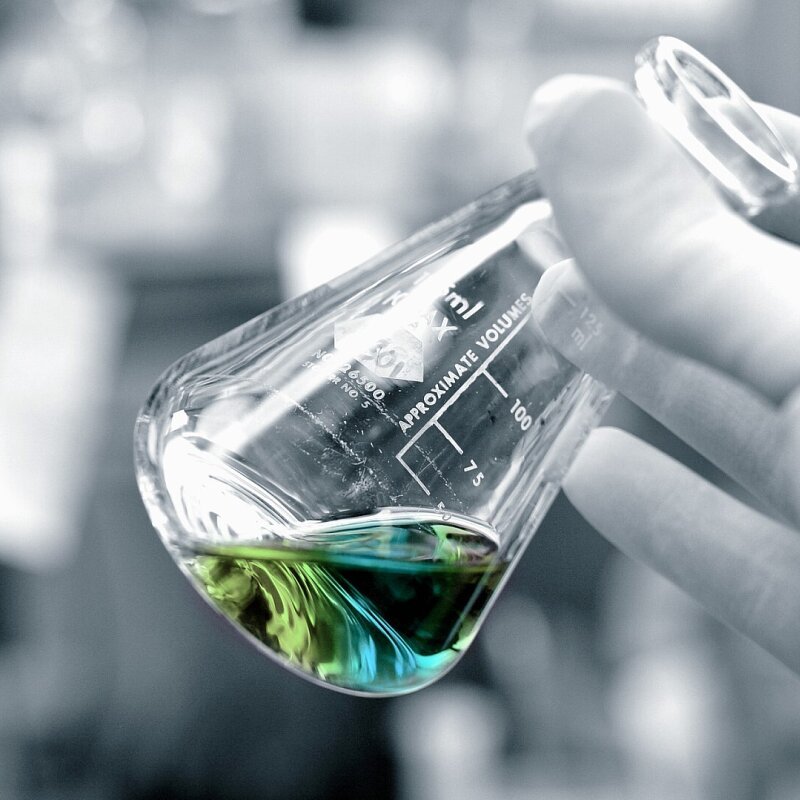
What does Nobel Prize-winning science have to do with Umicore? The connection lies in turning fundamental chemistry into practical applications. The 2026 Nobel Prize in Chemistry recognized research that advances our understanding of how molecules can be created with greater precision.

That journey from fundamental chemistry to practical application is also relevant to Umicore. Within Precious Metals Chemistry , we support customers and research partners working on complex chemical transformations where catalyst performance and selectivity are important considerations.

At the heart of this year’s Nobel Prize: chirality

Some molecules can exist in two forms that are mirror images of each other, much like our left and right hands. This property is known as chirality. Although these forms share the same chemical composition, they can behave differently in biological and chemical systems.

This difference can have important consequences. In pharmaceuticals, for example, one form of a molecule may provide the desired therapeutic effect, while its mirror image may be less active or even cause unwanted side effects. Understanding and controlling chirality has therefore become an important aspect of modern chemistry.

What role do catalysts play?

A catalyst helps a chemical reaction take place without being consumed in the process. It can also help steer the reaction towards the product chemists want to make.

Asymmetric catalysis enables chemists to selectively produce desired molecular structures and has expanded the possibilities for designing increasingly complex molecules.

The research recognized by this year’s Nobel Prize advanced scientific understanding of asymmetric synthesis and contributed to the development of catalytic approaches that are now widely used in pharmaceutical, fine chemical and specialty chemical applications.

This is also where the connection with Umicore Precious Metals Chemistry becomes tangible. Pharmaceuticals are one of the sectors served by the business, which provides specialized catalysts and reagents used in the synthesis of active pharmaceutical ingredients (APIs).

From scientific discovery to industrial application

Turning scientific advances into practical applications requires deep expertise across chemistry and materials technology. At Umicore, we bring together capabilities in catalysis, materials science and process technologies to translate that knowledge into solutions for complex industrial applications. That ability to connect science with technology and industrial know-how is how innovation can ultimately deliver value for industry and society.

Geert Olbrechts, Chief Technology Officer of Umicore

Scientific breakthroughs in asymmetric catalysis continue to support innovation in areas ranging from healthcare and agriculture to advanced materials and specialty ingredients.

The 2026 Nobel Prize in Chemistry is a reminder of the lasting value of fundamental scientific research and of the impact it can have when scientific discovery finds its way into practical applications. 

More news

Umicore Hoboken inaugurates “Zilverbos” green zone and connecting road

Press release October 27, 2026

Manganese: Essential ingredient of the modern world  

News October 21, 2026

Our commitment to mental wellbeing at work

News October 9, 2026

More news

Umicore Homepage

© 2026 Umicore Terms of use General terms & conditions Privacy and cookie notice Supplier zone Integrity line

Menu

return to top of page

Back to Home menu

About

Back to Home menu

Markets & products

Back to Home menu

Sustainability

Back to Home menu

Media

Back to Home menu

Investor relations

Back to Home menu

Join us

Back to About menu

Umicore at a glance

Back to About menu

Business groups

Back to Markets & products menu

Markets

Back to Markets & products menu

Explore our solutions by

Back to Sustainability menu

Our impact

Back to Sustainability menu

Find out more

Back to Media menu

News

Back to Media menu

Other

Back to Investor relations menu

Share information

Back to Investor relations menu

Debt Information

Back to Investor relations menu

Get in touch

Back to Investor relations menu

Publications, events and calendar

Back to Investor relations menu

Corporate governance

Back to Join us menu

Life at Umicore

Back to Join us menu

Our jobs

Press release

October 27, 2026 – 13:30

Share

Share

Copy link

X

Mail

LinkedIn

Facebook

Text in: English

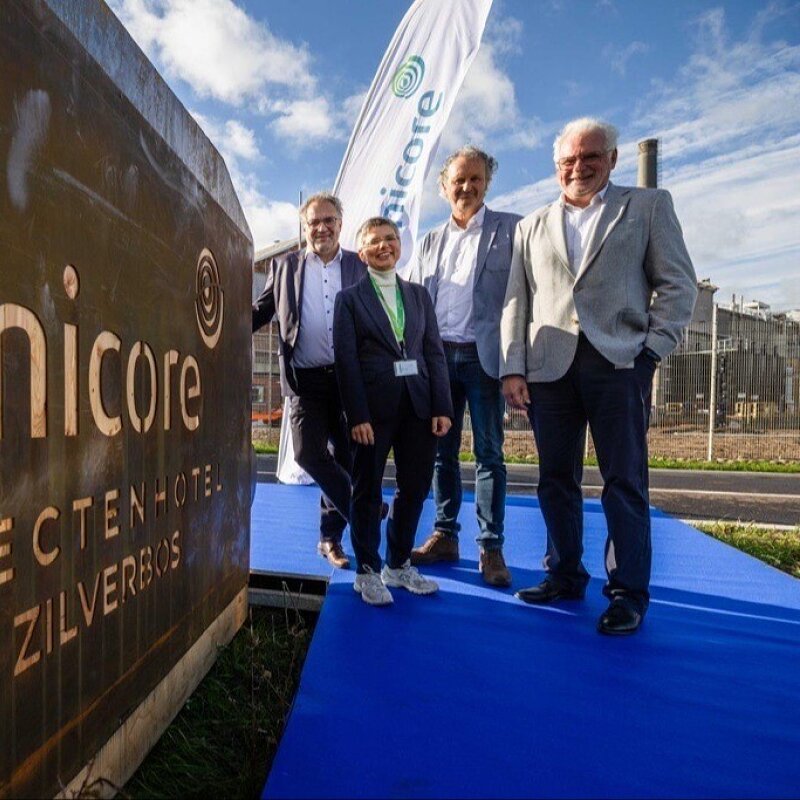
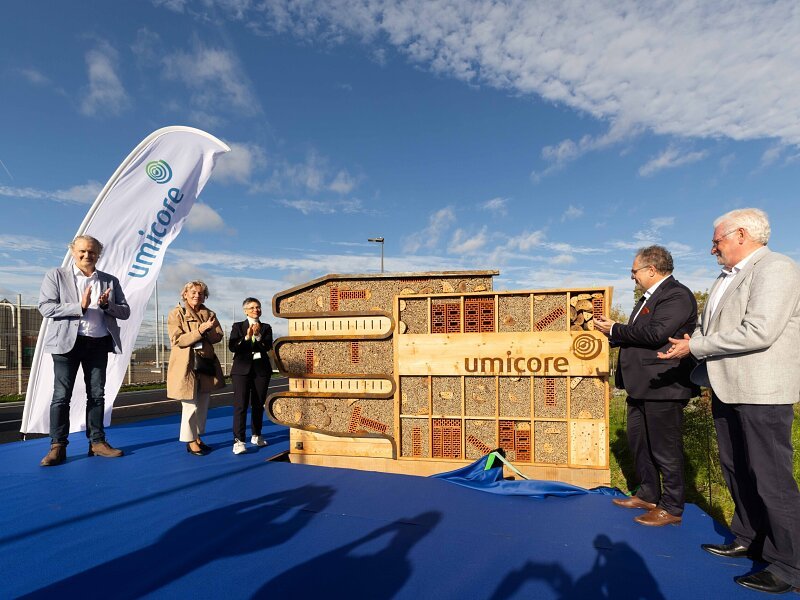
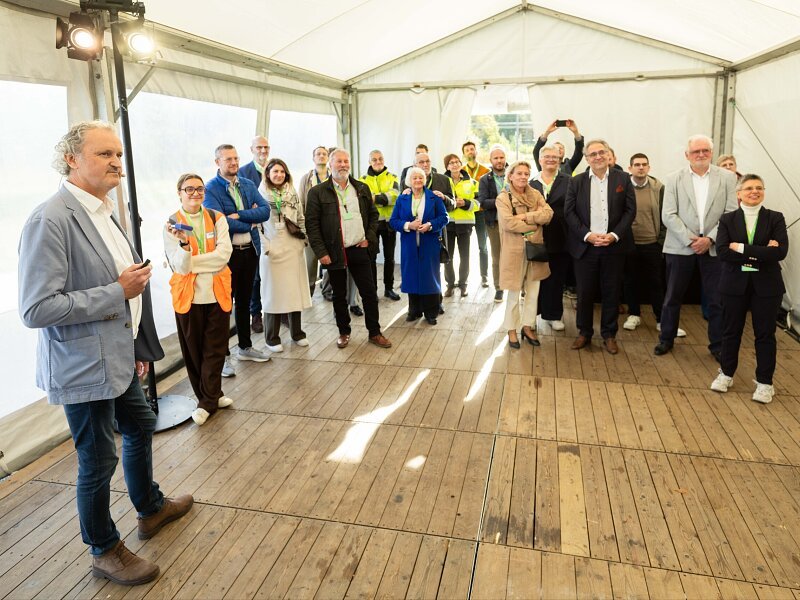
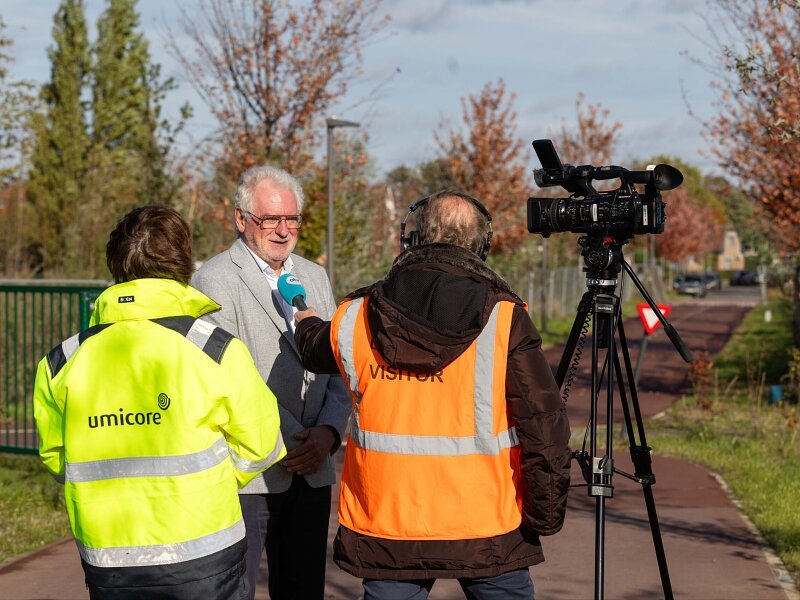
Umicore today inaugurated Zilverbos and the connecting road next to its site in Hoboken, together with Cathy Berx, Governor of the Province of Antwerp, Koen Kennis, Alderman for Mobility of the City of Antwerp, the Hoboken district, the Municipality of Hemiksem and other partners.

Both projects bring an important change to the historically evolved interface between industrial activities and the surrounding residential area. Zilverbos is the green zone that creates greater distance between the industrial site and the Moretusburg residential neighbourhood. The connecting road between Moretusburg and Hemiksem provides a safer and clearer separation between public traffic and the industrial activities on the site.

Both projects are the result of years of preparation and collaboration with the City of Antwerp, the Hoboken district and other partners. Since 2020, Umicore has invested approximately €125 million in the two projects combined.

“With Zilverbos and the connecting road, historically evolved situations around the site have been structurally addressed. Umicore in Hoboken has played an important industrial role for generations, and with that comes our responsibility for the environment in which we operate. We know that these projects have significantly changed the neighbourhood in recent years. We are grateful to residents for their patience and involvement throughout this process,” said Johan Ramharter, Site Director Umicore Hoboken.

Where residential areas, public traffic and industrial activities were located very close to one another for many years, both projects create greater distance and a clearer separation between the site and its surroundings. They form part of Umicore’s broader efforts to further reduce the impact of its activities on the surrounding environment, in cooperation with public authorities and local partners.

Johan Ramharter

Green zone named Zilverbos

During the inauguration, the name of the green zone was announced: Zilverbos. The name has been placed on the new insect hotel at the north-eastern corner of the site. Zilverbos comprises around 11,000 native trees and shrubs across five hectares and will gradually develop further into a wooded area in Moretusburg. The area is not open to the public and has no recreational function.

Zilverbos creates a structural spatial separation between residential areas and industry. The Umicore site dates back to 1887. As industrial and residential development continued, the site and residential area gradually came closer together over time. In Curiestraat, for example, homes were still being built in 1958 just a few metres from the industrial site.

The zone forms part of Umicore’s environmental improvement projects in Hoboken aimed at further reducing exposure to lead and other metals. The twice-yearly blood lead measurements were among the factors underpinning the development of the green zone.

To create the zone, from 2020 onwards Umicore offered residents in the area closest to the site the opportunity to sell their homes voluntarily. In total, 186 homes were acquired. Four homes were retained and integrated into the new surroundings.

“Residential areas and industry both fulfil an important role in our society. The challenge is to enable them to coexist in a responsible way. The green zone, now Zilverbos, contributes to this by literally creating more distance between residential areas and industry. In this way, it gives concrete shape to a future-oriented and balanced development of the area,” said Cathy Berx, Governor of the Province of Antwerp.

The name Zilverbos emerged from proposals by local residents, employees of the Umicore site in Hoboken and the Heemkundige Kring Hoboken. The name refers to “de Zilver”, as the plant and its predecessors have been known locally for generations, thereby linking the industrial history of the location with its new green setting.

New connecting road makes traffic safer and clearer

Together with Zilverbos, the approximately two-kilometre-long connecting road between Moretusburg and Hemiksem was inaugurated. The connecting road is expected to open to traffic on 16 November 2026. Umicore made 3.7 hectares of its own land available for the project.

The connecting road provides a structural solution to a historically evolved situation. Part of Adolf Greinerstraat still runs through the site, where public traffic, cyclists and pedestrians share the route with industrial traffic. After the connecting road opens, this section will be closed as a public road and incorporated into the Umicore site. The new road, with a four-metre-wide segregated two-way cycle path alongside it, directs public traffic along the site and thus provides a clear and safe separation of traffic flows. Both have been integrated into the surroundings, with landscaping and facilities for the collection and infiltration of rainwater.

Umicore developed and financed the connecting road in cooperation with the City of Antwerp and the Hoboken district. The City and the district oversee, among other things, alignment with urban policy, the quality of the execution and safety for the different road users.

“With this connecting road, we are making traffic flows around the industrial area safer and clearer. Cyclists will have a separate and comfortable connection, while public and industrial traffic will no longer get in each other’s way. This project shows what targeted cooperation between a company, the City and the district can concretely deliver for mobility, accessibility and quality of life,” said Koen Kennis, Alderman for Mobility of the City of Antwerp.

The Umicore site in Hoboken recycles hundreds of thousands of tonnes of complex recyclable materials each year and recovers 17 different valuable metals from them, including critical metals that are essential to European industry. Gold, silver, platinum, palladium and rhodium, among others, find their way back into applications that are part of our daily lives and our economy after recycling, from electronics to mobility and advanced technologies. By recovering these metals and bringing them back into circulation, Umicore contributes to a more circular and resilient supply of raw materials in Europe.

Media Relations

Caroline Jacobs

Media Relations Manager

+32 2 227 7129

Email

More news

From molecules to manufacturing: the lasting impact of Nobel Prize-winning chemistry

News October 28, 2026

Manganese: Essential ingredient of the modern world  

News October 21, 2026

Our commitment to mental wellbeing at work

News October 9, 2026

More news

Umicore Homepage

© 2026 Umicore Terms of use General terms & conditions Privacy and cookie notice Supplier zone Integrity line

Menu

return to top of page

Back to Home menu

About

Back to Home menu

Markets & products

Back to Home menu

Sustainability

Back to Home menu

Media

Back to Home menu

Investor relations

Back to Home menu

Join us

Back to About menu

Umicore at a glance

Back to About menu

Business groups

Back to Markets & products menu

Markets

Back to Markets & products menu

Explore our solutions by

Back to Sustainability menu

Our impact

Back to Sustainability menu

Find out more

Back to Media menu

News

Back to Media menu

Other

Back to Investor relations menu

Share information

Back to Investor relations menu

Debt Information

Back to Investor relations menu

Get in touch

Back to Investor relations menu

Publications, events and calendar

Back to Investor relations menu

Corporate governance

Back to Join us menu

Life at Umicore

Back to Join us menu

Our jobs

News

October 21, 2026

Share

Share

Copy link

X

Mail

LinkedIn

Facebook

Many critical raw materials play vital roles in the economy, often enabling niche yet essential high-tech applications. Manganese, however, is different. As a key ingredient in traditional industry and clean mobility, it’s a metal on which the world fundamentally depends.

Unlike many critical raw materials, manganese is not rare; global ore supply is relatively abundant. Yet its importance is irreplaceable. No alternative material performs the same function in steelmaking, where manganese removes oxygen and sulphur, providing strength and workability. In the energy transition, high-grade refined manganese is increasingly essential in EV batteries, helping to improve safety, performance and lowering cost. 

Sourcing concentration

While manganese ore is widely distributed, around 90% of refining capacity – particularly for battery-grade High-Purity Manganese Sulphate Monohydrate (HPMSM) – is concentrated in China. This creates a strategic bottleneck and is a primary reason why refined manganese is considered a critical raw material.

Vincent Braet, Purchase Manager for Manganese at Umicore, explains: “If you look at it geographically, manganese is quite well spread globally. But refining capacity is highly centralized in China, especially for high-purity manganese used in batteries. That’s where the criticality comes from.” 

Manganese in advanced battery chemistries

Umicore makes extensive use of manganese in nickel manganese cobalt (NMC) cathode materials. NMC offers an optimal balance of energy density, stability and cost, making it an attractive chemistry for electric vehicles. By combining nickel for higher energy, manganese for safety and structural stability, and cobalt for power, NMC enables longer driving range while maintaining performance and durability. 

In the context of NMC cathode-active materials, manganese acts as a structural stabilizer, allowing for longer life cycle of the final battery. It also improves thermal stability, for improved battery safety

Pierre-Etienne, Research, Development and Innovation Director

Manganese is also critical for lithium-manganese-rich (LMR) batteries, an area of growing importance for Umicore. LMR is one of the most promising new battery materials for the volume segment of the EV market. With less nickel and cobalt, the manganese-rich chemistry offers lower metal costs at NMC-like energy density. Crucially, it poses an alternative to lithium iron phosphate (LFP) batteries, with equivalent safety, longer driving ranges and good recyclability. As such, LMR is seen as one of the most promising new battery materials. Umicore has developed and protected specific LMR cathode-active materials that can be produced in its sites in Finland and Poland.

As Pierre-Etienne explains: “The biggest advantage of LFP is the lower raw material cost and therefore the lower battery and overall EV price. As a result, our focus is on maximizing the amount of manganese and reducing the use of cobalt and nickel, while preserving performance. As a result, we see manganese playing a crucial role, in the volume segment of the EV battery market. We have developed a large catalogue of NMC and LMR to maximize the use of each technology.”

He adds that an advantage for Umicore is that these technologies do not require separate production facilities. “High-nickel or high-manganese battery materials can be produced in the same factories, allowing us to use the same production capacity for different grades of NMC and LMR technologies.”

Looking ahead, manganese looks set to become even more important in battery technologies as manufacturers seek to reduce material costs, ease reliance on nickel and cobalt, and support more affordable electric vehicles. As Pierre-Etienne says: “I would say there’s an all-round tendency in cathode technology to increase the manganese concentration.” 

Manganese may also feature in future solid-state batteries, which replace a liquid electrolyte with a solid substance. Although not yet on the market, solid-state batteries are expected to offer far higher energy density, thereby extending EV driving ranges beyond what is possible today. Umicore holds key patents for this new battery technology and has developed a specific LMR grade for solid-state batteries.

Broader industrial applications

Within Umicore’s Cobalt and Specialty Materials (CSM) business, manganese is used in products such as manganese acetate and manganese carbonate, primarily as catalysts in the chemical industry. A key example is the production of purified terephthalic acid (PTA), a precursor for polymers such as PET.

Manganese compounds are also used as driers in coatings and inks, fertilizers, animal feed, and agrochemicals. This breadth of applications underlines manganese’s broader industrial relevance: even when it is not the most visible or high-value material, it often performs enabling roles in processes and products that modern economies rely on.

Transparency and sustainability

As well as the concentration of refining capacity in China, transparency is another sourcing challenge for manganese. While manganese may not carry the same level of ESG concern over responsible sourcing as cobalt, nickel and lithium, clearer visibility across the supply chain is still needed. “The visibility on the complete supply chain is still not where we’d like it to be,” says Vincent.

Improving that transparency means looking beyond direct suppliers to understand where material originates, how it is processed, and which risks may exist further upstream.

On the plus side, Vincent adds that “manganese typically has a much lower carbon footprint compared with other battery raw materials.” This is because manganese ore generally contains a relatively high concentration of the metal (40% or more), meaning less material needs to be mined and processed to extract usable metal.  

For battery makers, this means that increasing the manganese content in cathode materials can help reduce the overall carbon footprint of the material mix, as well as lowering raw material costs. As Vincent puts it, this can be “an additional advantage” of manganese-rich battery chemistries

Recycling – limited role, for now

Because manganese is relatively low value, it has not traditionally been a priority material for recovery.

Manganese typically costs $2 per kg, which reduces the incentive for recycling compared to other metals.

Thomas Martens, Commercial & Value Chain Director, Umicore Cobalt & Specialty Materials

EV battery recycling is unlikely to provide a major near-term source of recycled manganese. Vincent notes that batteries entering the recycling stream over the next 10 to 15 years still contain “more cobalt and nickel than manganese,” meaning “the amount of manganese that you will get now from recycling is still limited. However, that could change as future battery chemistries use more manganese.”

A unique position

Manganese occupies a distinctive place among critical raw materials: abundant in nature, yet essential and sometimes irreplaceable in application. Its long-established role in steelmaking underpins modern infrastructure, while its growing use in battery materials positions it as an important enabler of the energy transition.

As demand grows for electric vehicles, renewable energy storage and resilient infrastructure, manganese is set to become increasingly strategic to both industrial production and the energy transition. It may not be the rarest or most expensive material on earth, but manganese is certainly an essential ingredient of the modern world. 

More news
From molecules to manufacturing: the lasting impact of Nobel Prize-winning chemistry

News October 28, 2026
Umicore Hoboken inaugurates “Zilverbos” green zone and connecting road

Press release October 27, 2026

Our commitment to mental wellbeing at work

News October 9, 2026

More news

Umicore Homepage

© 2026 Umicore Terms of use General terms & conditions Privacy and cookie notice Supplier zone Integrity line

Menu

return to top of page

Back to Home menu

About

Back to Home menu

Markets & products

Back to Home menu

Sustainability

Back to Home menu

Media

Back to Home menu

Investor relations

Back to Home menu

Join us

Back to About menu

Umicore at a glance

Back to About menu

Business groups

Back to Markets & products menu

Markets

Back to Markets & products menu

Explore our solutions by

Back to Sustainability menu

Our impact

Back to Sustainability menu

Find out more

Back to Media menu

News

Back to Media menu

Other

Back to Investor relations menu

Share information

Back to Investor relations menu

Debt Information

Back to Investor relations menu

Get in touch

Back to Investor relations menu

Publications, events and calendar

Back to Investor relations menu

Corporate governance

Back to Join us menu

Life at Umicore

Back to Join us menu

Our jobs
Prompts

Umicore SA (ticker UMI), listed in Belgium.

ETFs Holding Umicore SA

ETF Weight in ETF Shares Market value As of
COPY 0.78% 118,377 $ 3.253M Aug 31, 2026
AVDV 0.31% 3,161,227 $ 59.321M Nov 16, 2026
AVDS 0.19% 37,185 $ 697.781K Nov 16, 2026
DFIS 0.17% 487,645 $ 9.773M Nov 12, 2026
SEIE 0.13% 66,008 $ 1.527M Jun 30, 2026
DFSI 0.07% 42,321 $ 848.172K Nov 12, 2026
AVDE 0.05% 560,026 $ 10.509M Nov 16, 2026
AVIV 0.05% 50,216 $ 942.31K Nov 16, 2026
DXIV 0.04% 4,427 $ 88.723K Nov 12, 2026
AVSD 0.03% 6,480 $ 121.598K Nov 16, 2026
DFIC 0.03% 201,966 $ 4.048M Nov 12, 2026
NTSI 0.02% 3,783 $ 87.54K Jun 30, 2026
DFAI 0.02% 137,262 $ 2.751M Nov 12, 2026
DFAX 0.01% 83,623 $ 1.676M Nov 12, 2026