|
Rural Funds Group is an agricultural Real Estate Investment Trust (REIT) listed on the Australian Securities Exchange. The company owns and manages a diversified portfolio of Australian agricultural assets, generating income through leasing to corporate and institutional tenants. Its business segments include almonds, poultry, macadamias, cattle, cropping, viticulture, and water entitlements. The portfolio is located across New South Wales, Queensland, South Australia, Western Australia, and Victoria. Rural Funds Group is managed by Rural Funds Management, which was established in 1997. The company is a stapled security incorporating Rural Funds Trust and RF Active. It focuses on assets where Australia has a comparative advantage, utilizing science-based and precision agricultural management practices to achieve productivity improvements or conversion to higher and better use. Summarised from the company's own disclosures, fiscal year ended Oct 2026 |
Industry Equity Real Estate Investment Trusts (REITs) | Homepage ruralfunds.com.au/rural-funds-group |
| Sector Real Estate | IR page — | |
|
Tags
agricultural reit, farmland, almonds, poultry, macadamias, cattle, cropping, viticulture, water entitlements, asset leasing, Rural Funds Trust, RF Active, Rural Funds Management
|
Press page — |
Metrics
| Valuation | |
|---|---|
| Market cap | A$ 765.806M |
| Market cap (USD) | $ 519.627M |
| P/E | — |
| PEG | — |
| P/BV | — |
| P/S | — |
| P/OCF | — |
| P/FCF | — |
| Dividend yield | — |
| Turnover / mcap | — |
| Returns | |
|---|---|
| ROE | — |
| ROI | — |
| ROIC | — |
| Profit margin | — |
| Growth | |
|---|---|
| Revenue growing | Yes |
| Profits growing | No |
| Revenue up 3y | Yes |
| Revenue up 5y | Yes |
| Earnings growth 3y (net profit CAGR) | -50.0% |
| Quality | |
|---|---|
| Profitable | Yes |
| Margin expanding | No |
| Buying back stock | — |
| Diluting (TTM) | — |
| Debt/Equity | — |
| Podcast bulls (TTM) | Sign up |
| Podcast bears (TTM) | Sign up |
| Podcast sentiment (TTM) | Sign up |
| Podcast sentiment % (TTM) | Sign up |
| News sentiment (TTM) | 0 |
| Quality score | 12.5% |
| Insiders | |
|---|---|
| Buys, 1w | Sign up |
| Buys, 1m | Sign up |
| Buys, 1y | Sign up |
| Sells, 1w | Sign up |
| Sells, 1m | Sign up |
| Sells, 1y | Sign up |
| Figure | FY 2026 | FY 2025 | FY 2024 | FY 2023 | FY 2022 | FY 2021 | FY 2020 | FY 2019 | FY 2018 | FY 2017 | FY 2016 | FY 2015 | FY 2014 | FY 2013 |
|---|---|---|---|---|---|---|---|---|---|---|---|---|---|---|
| Revenue | 138.516M | 128.815M | 109.763M | 95.004M | 81.865M | 67.65M | 66.818M | 55.674M | 51.087M | 41.645M | 26.549M | 22.218M | 16.975K | 8.252K |
| Net profit | — | 26.076M | 80.441M | 94.498M | 209.136M | 119.634M | 48.988M | 33.355M | 29.895M | 43.326M | -483K | 10.153K | 20.126K | 8.641K |
Podcast Mentions
Announcements lodged with ASX, newest first, routine forms (director and substantial-holding notices, daily buy-back and quotation notices) included. The link opens the announcement on ASX. Press releases from the company's own website, newest first.
Page 1 of 2
ASX release
Subject: Revised managed investment trust notice providing estimated
components for distribution for quarter ended 30 September 2026
29 October 2026
Rural Funds Management Limited (RFM), as responsible entity for Rural Funds Group (ASX: RFF), provides revised estimated components for the distribution with a record date of 30 September 2026.
This announcement replaces the estimated distribution component information released on 29 October 2026. The revision relates to a typographical correction on the “Total amounts subject to withholding tax”. There has been no change to the estimated individual components of the distribution.
Rural Funds Management Limited (RFM) as responsible entity for the Rural Funds Group (ASX: RFF) considers RFF is a withholding managed investment trust and an Attribution Managed Investment Trust (AMIT) for the purposes of Subdivision 12-H and Division 12A of the Taxation Administration Act 1953 (Cth) in respect of the financial year ending 30 June 2027.
RFF is a stapled security comprising Rural Funds Trust (RFT) (ARSN 112 951 578) and RF Active (RFA) (ARSN 168 740 805). Set out below are the estimated components of the distribution with a record date of 30 September 2026.
Rural Funds Trust (RFT) These components are provided for the purposes of the Subdivision 12-H of the Taxation Administration Act 1953 (Cth) and should not be used for any other purpose. The components are estimates only – the actual components for the income year ending 30 June 2027 will be provided in the 2027 AMIT Member Annual Statement, to be sent to Unitholders by September 2027.
For the purposes of section 12-395 of Schedule 1 of the Taxation Administration Act 1953 (Cth), this distribution includes “fund payments” in respect of the financial year ending 30 June 2027 of 4.8838 cents per Unit. The components are set out below:
Component Cents per unit Income excluded from Non-Concessional MIT income – Non-primary production 0.0000 Non-Concessional MIT income – Non-primary production 1 1.5588 Discounted capital gain (Taxable Australian Property) 1.6625 AMIT CGT gross up 1.6625 Total fund payments 4.8838 Interest income 0.0106 Total amounts subject to withholding tax 4.8944
Tax deferred – Other non-attributable amounts
Net franked dividend - Total amounts not subject to withholding tax 0.0000
Total cash distribution 2.9325
1 Non-Concessional MIT income is derived from agricultural land assets. A withholding tax rate of 30% is payable by foreign entities on this component.
Page 2 of 2 The total attribution amount 2 exceeds the cash distribution amount due to capital gains on certain asset sales, as announced in the ASX release ‘Asset sales’ dated 10 July 2026, which have been attributed to the period.
RFM notes that according to the AMIT regime, where the attribution amount 2 exceeds the cash distribution, the excess may be used to increase the tax cost base for capital gains tax purposes.
The total distribution is franked at 0% at the corporate tax rate of 30%.
Distribution Total cash distribution
cents per unit
Franking credit
cents per unit
Gross distribution
cents per unit
Rural Funds Trust (RFT) 2.9325 0.0000 2.9325
Australian resident Unitholders should not rely on this notice for the purpose of completing their income tax returns.
More information can be found on the ASX website at www.asx.com.au using the Fund’s ASX code “RFF”, on the Responsible Entity’s website www.ruralfunds.com.au, by calling RFM Investor Services on 1800 026 665, or by emailing [email protected].
Rural Funds Group (ASX: RFF)
Rural Funds Group is an agricultural Real Estate Investment Trust (REIT) listed on the ASX under the code RFF. RFF owns a diversified portfolio
of Australian agricultural assets. RFF’s strategy is to generate capital growth and income from developing and leasing agricultural assets. RFF
targets distribution growth of 4% per annum. Distributions are paid quarterly. RFF is a stapled security, incorporating Rural Funds Trust (ARSN
112 951 578) and RF Active (ARSN 168 740 805).
Rural Funds Management Limited (RFM) Rural Funds Management Limited is the responsible entity and manager of RFF. RFM is an agricultural fund and asset manager established in 1997. The management team includes specialist fund managers, finance professionals, horticulturists, agronomists and other agricultural managers. RFM’s company culture is informed by its long-standing motto “Managing good assets with good people”.
Authorised by: For further information: RFM details:
Tim Sheridan
Chief Operating Officer
Rural Funds Management
T 02 6203 9700
E [email protected]
James Powell
General Manager - Investor
Relations, Corporate Affairs &
Sustainability
Rural Funds Management
T 02 6203 9700
E [email protected]
David Bryant
Managing Director
Rural Funds Management
T 02 6203 9700
E [email protected]
ABN 65 077 492 838
AFSL 226701
Level 2, 2 King St Deakin ACT 2600
PO Box 347 Curtin ACT 2605
T 02 6203 9700
E [email protected]
www.ruralfunds.com.au
2 Includes income such as Australian income, capital gains, foreign income and other non-assessable amounts as shown in the AMIT Member Annual Statement.
Appendix 3A.1 - Notification of dividend / distribution 1 / 5 Update Summary Entity name RURAL FUNDS GROUP Security on which the Distribution will be paid RFF - FULLY PAID UNITS STAPLED SECURITIES Announcement Type Update to previous announcement Date of this announcement 30/10/2026 Reason for the Update Confirmation of payment of distribution Refer to below for full details of the announcement
Appendix 3A.1 - Notification of dividend / distribution Appendix 3A.1 - Notification of dividend / distribution 2 / 5 Announcement Details Part 1 - Entity and announcement details 1.1 Name of +Entity RURAL FUNDS GROUP 1.2 Registered Number Type other Registration Number Rural Funds Trust (ARSN 112 951 578) and RF Active (ARSN 168 740 805) 1.3 ASX issuer code RFF 1.4 The announcement is 1.4a Reason for update to a previous announcement Confirmation of payment of distribution 1.4b Date of previous announcement(s) to this update 1/9/2026 1.5 Date of this announcement 30/10/2026 1.6 ASX +Security Code RFF ASX +Security Description FULLY PAID UNITS STAPLED SECURITIES Part 2A - All dividends/distributions basic details 2A.1 Type of dividend/distribution 2A.2 The Dividend/distribution: relates to a period of one quarter 2A.3 The dividend/distribution relates to the financial reporting or payment period ending ended/ending (date) 30/9/2026 2A.4 +Record Date 30/9/2026 2A.5 Ex Date 29/9/2026 Ordinary Update/amendment to previous announcement
Appendix 3A.1 - Notification of dividend / distribution Appendix 3A.1 - Notification of dividend / distribution 3 / 5 2A.6 Payment Date 30/10/2026 2A.7 Are any of the below approvals required for the dividend/distribution before business day 0 of the timetable? Security holder approval Court approval Lodgement of court order with +ASIC ACCC approval FIRB approval Another approval/condition external to the entity required before business day 0 of the timetable for the dividend/distribution. 2A.8 Currency in which the dividend/distribution is made ("primary currency") AUD - Australian Dollar 2A.9 Total dividend/distribution payment amount per +security (in primary currency) for all dividends/distributions notified in this form AUD 0.02932500 Estimated or Actual? 2A.10 Does the entity have arrangements relating to the currency in which the dividend/distribution is paid to securityholders that it wishes to disclose to the market? 2A.11 Does the entity have a securities plan for dividends/distributions on this +security? 2A.11a If the +entity has a DRP, is the DRP applicable to this dividend/distribution? 2A.12 Does the +entity have tax component information apart from franking? Part 3A - Ordinary dividend/distribution 3A.1 Is the ordinary dividend/distribution estimated at this time? 3A.1a Ordinary dividend/distribution estimated amount per +security AUD 0.02932500 3A.1a(i) Date that actual ordinary amount will be announced 30/10/2026 Estimated or Actual? 3A.1b Ordinary Dividend/distribution amount per security AUD 0.02932500 3A.2 Is the ordinary dividend/distribution franked? 3A.3 Percentage of ordinary dividend/distribution that is No Actual No Yes No We have a Dividend/Distribution Reinvestment Plan (DRP) No Actual No
Appendix 3A.1 - Notification of dividend / distribution Appendix 3A.1 - Notification of dividend / distribution 4 / 5 3A.3 Percentage of ordinary dividend/distribution that is franked 0.0000 % 3A.4 Ordinary dividend/distribution franked amount per +security AUD 0.00000000 3A.5 Percentage amount of dividend which is unfranked 100.0000 % 3A.6 Ordinary dividend/distribution unfranked amount per +security excluding conduit foreign income amount AUD 0.02932500 3A.7 Ordinary dividend/distribution conduit foreign income amount per security AUD 0.00000000 Part 3E - Other - distribution components / tax 3E.1 Please indicate where and when information about tax components can be obtained (you may enter a url). Please see ASX Announcement dated 29 October 2026, titled Revised managed investment trust notice providing estimated components for distribution for quarter ended 30 September 2026 3E.2 Please indicate the following information if applicable. (Refer Annual Investment Income Report specification for further information) Field NameAIIR Specification ReferenceValueEstimated/Actual Interest9.79
Unfranked dividends not declared to be conduit foreign income
9.80
Unfranked dividends declared to be conduit foreign income 9.81
Assessable foreign source income 9.91
Tax-free amounts9.96
Tax-deferred amounts9.97
Managed investment trust fund payments 9.105
Franked distributions from trusts 9.120
Gross cash distribution9.121
Interest exempt from withholding 9.122
9.124
Appendix 3A.1 - Notification of dividend / distribution Appendix 3A.1 - Notification of dividend / distribution 5 / 5 Capital Gains discount method Non-Taxable Australian property Capital gains other Non-Taxable Australian property 9.126
Other income9.130
Royalties9.135
NCMI
Excluded from NCMI
Part 5 - Further information 5.1 Please provide any further information applicable to this dividend/distribution James Powell General Manager - Investor Relations, Corporate Affairs & Sustainability Rural Funds Management Ltd T 02 6203 9700 E [email protected] 5.2 Additional information for inclusion in the Announcement Summary
Page 1 of 2
ASX release
Subject: Managed investment trust notice providing estimated components for
distribution for quarter ended 30 September 2026
29 October 2026
Rural Funds Management Limited (RFM) as responsible entity for the Rural Funds Group (ASX: RFF) considers RFF is a withholding managed investment trust and an Attribution Managed Investment Trust (AMIT) for the purposes of Subdivision 12-H and Division 12A of the Taxation Administration Act 1953 (Cth) in respect of the financial year ending 30 June 2027.
RFF is a stapled security comprising Rural Funds Trust (RFT) (ARSN 112 951 578) and RF Active (RFA) (ARSN 168 740 805). Set out below are the estimated components of the distribution with a record date of 30 September 2026.
Rural Funds Trust (RFT) These components are provided for the purposes of the Subdivision 12-H of the Taxation Administration Act 1953 (Cth) and should not be used for any other purpose. The components are estimates only – the actual components for the income year ending 30 June 2027 will be provided in the 2027 AMIT Member Annual Statement, to be sent to Unitholders by September 2027.
For the purposes of section 12-395 of Schedule 1 of the Taxation Administration Act 1953 (Cth), this distribution includes “fund payments” in respect of the financial year ending 30 June 2027 of 4.8838 cents per Unit. The components are set out below:
Component Cents per unit Income excluded from Non-Concessional MIT income – Non-primary production 0.0000 Non-Concessional MIT income – Non-primary production 1 1.5588 Discounted capital gain (Taxable Australian Property) 1.6625 AMIT CGT gross up 1.6625 Total fund payments 4.8838 Interest income 0.0106 Total amounts subject to withholding tax 4.8894
Tax deferred – Other non-attributable amounts - Net franked dividend - Total amounts not subject to withholding tax 0.0000
Total cash distribution 2.9325 The total attributable amount exceeds the cash distribution amount due to capital gains on certain asset sales, as announced in the ASX release ‘Asset sales’ dated 10 July 2026, which have been attributed to the period. RFM notes that according to the AMIT regime, where the attribution amount 2 exceeds the cash distribution, the excess may be used to increase the tax cost base for capital gains tax purposes.
1 Non-Concessional MIT income is derived from agricultural land assets. A withholding tax rate of 30% is payable by foreign entities on this component. 2 Includes income such as Australian income, capital gains, foreign income and other non-assessable amounts as shown in the AMIT Member Annual Statement.
Page 2 of 2 The total distribution is franked at 0% at the corporate tax rate of 30%.
Distribution Total cash distribution
cents per unit
Franking credit
cents per unit
Gross distribution
cents per unit
Rural Funds Trust (RFT) 2.9325 0.0000 2.9325
Australian resident Unitholders should not rely on this notice for the purpose of completing their income tax returns.
More information can be found on the ASX website at www.asx.com.au using the Fund’s ASX code “RFF”, on the Responsible Entity’s website www.ruralfunds.com.au, by calling RFM Investor Services on 1800 026 665, or by emailing [email protected].
Rural Funds Group (ASX: RFF)
Rural Funds Group is an agricultural Real Estate Investment Trust (REIT) listed on the ASX under the code RFF. RFF owns a diversified portfolio
of Australian agricultural assets. RFF’s strategy is to generate capital growth and income from developing and leasing agricultural assets. RFF
targets distribution growth of 4% per annum. Distributions are paid quarterly. RFF is a stapled security, incorporating Rural Funds Trust (ARSN
112 951 578) and RF Active (ARSN 168 740 805).
Rural Funds Management Limited (RFM) Rural Funds Management Limited is the responsible entity and manager of RFF. RFM is an agricultural fund and asset manager established in 1997. The management team includes specialist fund managers, finance professionals, horticulturists, agronomists and other agricultural managers. RFM’s company culture is informed by its long-standing motto “Managing good assets with good people”.
Authorised by: For further information: RFM details:
Tim Sheridan
Chief Operating Officer
Rural Funds Management
T 02 6203 9700
E [email protected]
James Powell
General Manager - Investor
Relations, Corporate Affairs &
Sustainability
Rural Funds Management
T 02 6203 9700
E [email protected]
David Bryant
Managing Director
Rural Funds Management
T 02 6203 9700
E [email protected]
ABN 65 077 492 838
AFSL 226701
Level 2, 2 King St Deakin ACT 2600
PO Box 347 Curtin ACT 2605
T 02 6203 9700
E [email protected]
www.ruralfunds.com.au
Appendix 3A.1 - Notification of dividend / distribution 1 / 4 Announcement Summary Entity name RURAL FUNDS GROUP Security on which the Distribution will be paid RFF - FULLY PAID UNITS STAPLED SECURITIES Announcement Type New announcement Date of this announcement 1/9/2026 Distribution Amount AUD 0.02932500 Ex Date 29/9/2026 Record Date 30/9/2026 Payment Date 30/10/2026 Refer to below for full details of the announcement
Appendix 3A.1 - Notification of dividend / distribution Appendix 3A.1 - Notification of dividend / distribution 2 / 4 Announcement Details Part 1 - Entity and announcement details 1.1 Name of +Entity RURAL FUNDS GROUP 1.2 Registered Number Type other Registration Number Rural Funds Trust (ARSN 112 951 578) and RF Active (ARSN 168 740 805) 1.3 ASX issuer code RFF 1.4 The announcement is 1.5 Date of this announcement 1/9/2026 1.6 ASX +Security Code RFF ASX +Security Description FULLY PAID UNITS STAPLED SECURITIES Part 2A - All dividends/distributions basic details 2A.1 Type of dividend/distribution 2A.2 The Dividend/distribution: relates to a period of one quarter 2A.3 The dividend/distribution relates to the financial reporting or payment period ending ended/ending (date) 30/9/2026 2A.4 +Record Date 30/9/2026 2A.5 Ex Date 29/9/2026 2A.6 Payment Date 30/10/2026 2A.7 Are any of the below approvals required for the dividend/distribution before business day 0 of the timetable? Security holder approval Court approval Lodgement of court order with +ASIC ACCC approval Ordinary New announcement
Appendix 3A.1 - Notification of dividend / distribution Appendix 3A.1 - Notification of dividend / distribution 3 / 4 ACCC approval FIRB approval Another approval/condition external to the entity required before business day 0 of the timetable for the dividend/distribution. 2A.8 Currency in which the dividend/distribution is made ("primary currency") AUD - Australian Dollar 2A.9 Total dividend/distribution payment amount per +security (in primary currency) for all dividends/distributions notified in this form AUD 0.02932500 Estimated or Actual? 2A.10 Does the entity have arrangements relating to the currency in which the dividend/distribution is paid to securityholders that it wishes to disclose to the market? 2A.11 Does the entity have a securities plan for dividends/distributions on this +security? 2A.11a If the +entity has a DRP, is the DRP applicable to this dividend/distribution? 2A.12 Does the +entity have tax component information apart from franking? Part 3A - Ordinary dividend/distribution 3A.1 Is the ordinary dividend/distribution estimated at this time? 3A.1a Ordinary dividend/distribution estimated amount per +security AUD 0.02932500 3A.1a(i) Date that actual ordinary amount will be announced 30/10/2026 Estimated or Actual? 3A.1b Ordinary Dividend/distribution amount per security AUD 3A.2 Is the ordinary dividend/distribution franked? 3A.3 Percentage of ordinary dividend/distribution that is franked 0.0000 % 3A.5 Percentage amount of dividend which is unfranked 100.0000 % No Estimated Yes No No We have a Dividend/Distribution Reinvestment Plan (DRP) No Estimated No
Appendix 3A.1 - Notification of dividend / distribution Appendix 3A.1 - Notification of dividend / distribution 4 / 4 3A.4 Ordinary dividend/distribution franked amount per +security AUD 0.00000000 3A.6 Ordinary dividend/distribution unfranked amount per +security excluding conduit foreign income amount AUD 0.02932500 3A.7 Ordinary dividend/distribution conduit foreign income amount per security AUD 0.00000000 Part 5 - Further information 5.1 Please provide any further information applicable to this dividend/distribution James Powell General Manager - Investor Relations, Corporate Affairs & Sustainability Rural Funds Management Ltd T 02 6203 9700 E [email protected] 5.2 Additional information for inclusion in the Announcement Summary
21 August 2026
Rural Funds Management Limited (RFM), as responsible entity, today released the Rural Funds Group (ASX: RFF, the Group) Financial Statements for the year ended 30 June 2026 (FY26) as summarised below.
Financial results summary 1
• Earnings of $124.1m, or 31.8 cpu, up $103.8m, primarily driven by contracted sale of assets above book values and market-to-market of interest rate swaps. 2
• Net property income of $100.5m, or $5.4m, up 5.7%, driven by additional rental income
on capital expenditure (primarily macadamia orchards) and indexation.
• Adjusted funds from operations (AFFO) of 11.7 cpu, in-line with forecasts.
• Distributions per unit (DPU) of 11.73 cents in-line with forecasts.
• Adjusted net asset value (NAV) $3.22 per unit, up $0.14 cpu or 4.5%, primarily a result
of property revaluations and mark-to-market of interest rate swaps.
• Full year FY27 forecasts:
o AFFO of 11.7 cpu
o Distributions of 11.73 cpu, representing 100% payout ratio.
Portfolio and strategy update
• Property assets revaluation movement of 1.8%, primarily due to gains on pro forma asset sales. 1
• Divestments (incl. pro forma) of $314.9m at an average 18% premium to prior book
values.
o Includes six properties and water entitlements, reaffirming values and providing
funding for capex.
2
• Pro forma gearing reduced to 31.8%, within RFF target range of 30-35% due to asset divestments. 2
• Staged development of two properties in FY27 to provide future AFFO generation (macadamias and irrigated cropping) in future years. • FY27 forecast capital expenditure of $46.7m fully funded through a pro forma bank debt facility headroom of $300.8m.
Page 2 of 3
Portfolio highlights 2
• Provides exposure to a defensive property sector (food production) with inflationary hedge characteristics. • Quarterly distributions: March, June, September and December. • Long WALE: 14.8 years (pro forma) with predominantly triple-net lease structures. 2
• Diversification: 57 properties across five agricultural sectors and multiple climatic zones. 2
• Quality lessees: approx. 89% of FY27f income from corporate and institutional lessees. 2
• Structural rental growth: Mix of lease indexation mechanisms and market rent reviews.
• Development and leasing pipeline: Productivity improvements and conversion to
higher and better use development opportunities.
Results webinar
A financial results webinar will be held today at 11:00AM AEST. Those wishing to attend the webinar will need to register via the link: https://webcast.openbriefing.com/rff-fyr-2026/
A recording of the webinar will be made available on the RFM website.
For questions, please contact Investor Services by calling 1800 026 665 or via email at [email protected].
Notes:
-
Comparisons are to FY25, unless otherwise stated.
-
Pro forma for contracted Asset Sales – Includes asset sales announced 10 July 2026 including water entitlement 2,500 ML - $21.1m (settled 11 August 2026), Cerberus - $34.1m (settled 30 June 2026), Cobungra - $50.3m (FIRB approval received, contract unconditional), Rewan - $106.6m (contract unconditional), Wyseby - $43.2m (contract unconditional).
Rural Funds Group (ASX: RFF)
Rural Funds Group is an agricultural Real Estate Investment Trust (REIT) listed on the ASX under the code RFF. RFF owns a
diversified portfolio of Australian agricultural assets. RFF’s strategy is to generate capital growth and income from developing and
leasing agricultural assets. RFF targets distribution growth of 4% per annum. Distributions are paid quarterly. RFF is a stapled
security, incorporating Rural Funds Trust (ARSN 112 951 578) and RF Active (ARSN 168 740 805).
Rural Funds Management Limited (RFM) Rural Funds Management Limited is the responsible entity and manager of RFF. RFM is an agricultural fund and asset manager established in 1997. The management team includes specialist fund managers, finance professionals, horticulturists, agronomists and other agricultural managers. RFM’s company culture is informed by its long-standing motto “Managing good assets with good people”.
Authorised by: For further information: RFM details:
Tim Sheridan
Chief Operating Officer
Rural Funds Management
T 02 6203 9700
E
[email protected]
James Powell
GM - Investor Relations,
Corporate Affairs &
Sustainability
Rural Funds Management
T 02 6203 9700
E [email protected]
David Bryant
Managing Director
Rural Funds Management
T 02 6203 9700
E [email protected]
ABN 65 077 492 838
AFSL 226701
Level 2, 2 King St Deakin ACT 2600
PO Box 347 Curtin ACT 2605
T 02 6203 9700
E [email protected]
www.ruralfunds.com.au
21 August 2026 for the financial year ended 30 June 2026 Managed by:
Disclaimer This presentation has been prepared by Rural Funds Management Limited (ACN 077 492 838, AFSL 226 701) (RFM) as the responsible entity of Rural Funds Group (RFF) and has been authorised for release by the Board of RFM. RFF is a stapled security, incorporating Rural Funds Trust (ARSN 112 951 578) and RF Active (ARSN 168 740 805). The information contained in this presentation is not investment or financial product advice and is not intended to be used as the basis for making an investment decision. Please note that, in providing this presentation, RFM has not considered the investment objectives, financial circumstances or particular needs of any particular recipients. This presentation is not, and does not, constitute an offer to sell or the solicitation, invitation or recommendation to purchase any securities, and neither this presentation nor anything contained herein shall form the basis of any contract or commitment. In particular, this presentation does not constitute an offer to sell, or a solicitation of an offer to buy, any securities in the United States. This presentation must not be released or distributed in the United States. Any securities described in this presentation have not been, and will not be, registered under the US Securities Act of 1933 and may not be offered or sold in the United States except in transactions exempt from, or not subject to, registration under the US Securities Act and applicable US state securities laws. RFM has prepared this presentation based on information available to it at the time of preparation. No representation or warranty is made as to the fairness, accuracy or completeness of the information, opinions and conclusions contained in this presentation or any other information that RFM otherwise provides. To the maximum extent permitted by law, RFM, its related bodies corporate and its officers, employees and advisers are not liable for any direct, indirect or consequential loss or damage suffered by any person as a result of relying on this presentation or otherwise in connection with it. This presentation includes ‘forward-looking statements’. These forward-looking statements are based on current views, expectations and beliefs as at the date they are expressed. They involve known and unknown risks, uncertainties and other factors that could cause the actual results, performance or achievements of RFF to be materially different from those expressed or implied by the forward-looking statements. Accordingly, there can be no assurance or guarantee regarding these statements, and you must not place undue reliance on these forward-looking statements. RFM and RFF disclaim any responsibility for the accuracy or completeness of any forward-looking statements.Figures in the presentation are in Australian dollars and are subject to rounding. All information is at 30 June 2026, unless otherwise stated. Disclaimer and glossary of terms Glossary of terms Adjusted NAV – Net asset value (NAV) adjusted for the independent valuation of water entitlements, Adjusted total assets – Total assets adjusted for the independent valuation of water entitlements, ASX – Australian Securities Exchange, AFFO – Adjusted funds from operations, a financial metric used in the REIT sector to measure available cash flow from operations (adjustment relates to non-cash tax expense), AWF – RFM Australian Wine Fund, Capex – Capital expenditure, cpu – Cents per unit, DPU – Distributions per unit, e – End, Earnings – Calculated TCI/weighted average units, EBITDA – Earnings before interest, taxes, depreciation and amortisation, EPU – Earnings per unit (calculated TCI/weighted average units), f – Forecast, Fair value – Value of an asset as determined by an independent valuation, FIRB – Foreign Investment Review Board, FY – Financial year, FY27f revenue – Full-year ending 30 June 2027 forecast revenue, unless otherwise stated includes contribution from farming operations from owner-occupied properties, Gearing – Calculated as external borrowings/adjusted total assets, GL – Gigalitre, Group – Term used for the Rural Funds Group, ha – Hectare(s), ICR – Interest cover ratio, a bank covenant calculated as EBITDA for previous 12 months divided by interest expense for previous 12 months, J&F Australia Guarantee – A security arrangement which supports a cattle finance facility for RFF lessee JBS Australia, LVR – Loan to value ratio, a bank covenant calculated as bank debtand J&F guarantee divided by tangible assets (including water entitlements), ML – Megalitre, m – Million(s), NAV – Net asset value, calculated as assets minus thevalueof liabilities (does not recognise fair value of water entitlements), Owner-occupied properties – Unleased properties which are operated by RFF including macadamia orchards (Swan Ridge, Moore Park, Beerwah and Bauple); cropping properties (Maryborough sugar cane x7, Kaiuroo and Yarra), P&E – Plant and equipment, Pro forma for contracted Asset Sales – Includes asset sales announced 10 July 2026 including water entitlement 2,500 ML - $21.1m (settled 11 August 2026), Cerberus - $34.1m (settled 30 June 2026), Cobungra - $50.3m (FIRB approval received, contract unconditional), Rewan - $106.6m (contract unconditional), Wyseby - $43.2m (contract unconditional). Pro forma WALE – calculation excludes any income from pro forma asset sales, RFA – RF Active, RFF – Rural Funds Group (ASX: RFF), RFM – Rural Funds Management Limited, manager and responsible entity for RFF, RFT – Rural Funds Trust, TCI – Total comprehensive income, Total assets – Total value of assets as presented on the balance sheet (water entitlements recorded at the lower of cost or fair value), Triple net – A lease structure where the lessee is responsible for rent and other property outgoings which can include rates and land tax, insurances and maintenance, TRG JV – Joint venture between TRG (The Rohatyn Group) and a global institutional investor, WALE – Weighted average lease expiry, calculated as the FY27 forecast rent and the year of lease expiry (excludes J&F Australia guarantee fee, income from annual water allocation sales, operating income from owner–occupied properties and other income), x – Times, 1H/2H – First/second-half of relevant financial year. Cover image: Cattle muster at Natal Aggregation, Charters Towers Queensland, April 2026. 2
David Bryant Managing Director Tim Sheridan Chief Operating Officer Daniel Yap Chief Financial Officer James Powell General Manager – Investor Relations, Corporate Affairs and Sustainability Presenters 1.Introduction and overview 2.Financial results 3.Capital management 4.Portfolio and strategy update 5.Forecasts and conclusion 6.Appendices Contents 3 Harvested cotton at Mayneland, central Queensland, August 2025.
Fodder crop at Natal Aggregation, Charters Towers Queensland, April 2026. Natal Aggregation Natal is RFF’s largest property (390,600 ha) and has a carrying capacity of over 37,000 cattle. The property has benefited from productivity-enhancing developments, including the conversion of 4,309 ha to cropping, installation of over 400 km of fencing, and new water infrastructure that has increased carrying capacity. Introduction and overview 1 Scan to learn more about the Natal Aggregation 4
5 Strategy To generate income and capital growth from developing and leasing agricultural assets. Leasing model Maintain a majority of long WALE, triple-net leases of agricultural assets to high-quality lessees. Active management Seek to improve assets by developing for improved productivity or higher and better use. Generate income during development phase by operating assets prior to leasing. Diversification Diversify by agricultural sector and climatic zone. Capital management Target gearing between 30–35%. Investment criteria Preference agricultural sectors where low-cost of production assets can be acquired or developed. Focus on commodities where RFM has operating experience or Australia has a comparative advantage. Portfolio snapshot $1.8b Pro forma adjusted total property portfolio value 1 FY27f pro forma revenue by sector 2 33% 27% 21% 9% 5% 5% Notes: 1.Pro forma for contracted Asset Sales of $255.3m, see Glossary. F or further details see property compendium pages 33-34. State values exclude other assets including water. 2.JBS lessee revenue and sector revenue includes J&F Australia Guarantee fee. The Rohatyn Group logo represents TRG JV, see Glossary. Largest lessees by FY27f revenue (pro forma) 2 5
Fund attributes Diversification 57 properties, 5 sectors, and multiple climatic zones. Defensive property sector Food production with inflationary hedge characteristics. Development pipeline Productivity improvement and conversion to higher and better use opportunities. RFF seeks to generate income throughout developments where possible. Quarterly distributions March, June, September and December record dates. Triple net leases Property leases are largely triple net. Structural rental growth Mix of lease indexation mechanisms and market rent reviews. Quality lessees 89% of FY27f revenue from corporate +3 and institutional lessees. Long WALE 14.8 year pro forma weighted average lease expiry (WALE). $1.79b pro forma adjusted total assets Portfolio metrics as at 30 June 2026 1 $3.22 pro forma adjusted NAV per unit 14.8 yrs FY27f pro forma WALE 5.4% distribution yield 2 80% portfolio leased (pro forma) 3 31.8% pro forma gearing 11.73 cents FY27f DPU Notes: 1.Pro forma for contracted Asset Sales of $255.3m, see Glossary. 2.Based on $2.18 per unit close price on 14 August 2026. 3.Based on asset value. 6
Results
highlights
Results in line with forecasts.
Contracted asset sales collectively
benefit:
•AFFO
•earnings
•gearing
•WALE.
U
nitholders approved the increase to the
J&F Australia Guarantee facility up to
$200m (FY26e $160m).
2
Financials
Portfolio Capital
management
11.7 cpu AFFO and 11.73
cpu distributions
in-line with forecasts
$3.22 adjusted NAV
4.5% increase from 30 June 2025
primarily driven by accretive asset
sales
$124.1m earnings
$103.8m increase from 30 June
2025 primarily driven by accretive
asset sales
FY27 forecasts AFFO 11.7cpu Distributions 11.73cpu
$314.9m earnings accretive
divestments
contracted divestment of 6
properties and water entitlements
average 17.9% premium to prior
book values
14.8 year WALE (pro forma)
1
increased from 13.2 years (as at
31 December 2025) due to sale of
assets with near-term expiries and
macadamia development capex
$37m increase to J&F
guarantee facility
from $123m (FY25e) to $160m,
providing earnings accretion
31.8% pro forma gearing
1
within 30 – 35% target range
4.7% weighted average cost
of debt
benefiting from 69% debt
hedged or fixed (30 June 2025),
increasing to pro forma 82% (30
June 2026)
1
3.3 years weighted average
hedge maturity
maintained broadly in-line with
FY25, providing near-term
insulation from higher interest
rates
Notes:
1.Pro forma for contracted Asset Sales of $255.3m, see
G
lossary.
2.The asset sales announced 10 July 2026 satisfy the
co
ndition precedent (Condition) to increase the Guarantee
to J&F Australia Pty Ltd from $160.0m to $200.0m (Second
Tranche Additional Guarantee) when required by JBS.
FY26 cotton crop, Lynora Downs,
central Queensland, August 2026.
Rewan, central Queensland, February
2020.
Cygnet orchard, Bundaberg, Queensland,
April 2026.
7
Harvesting grow on cotton at Lynora Downs, central Queensland, June 2026. Grow on cotton The grow on cotton production system is being adopted across RFF’s central Queensland cropping properties, where favourable growing conditions and reliable water access support extended production. Grow on cotton has the potential to improve resource efficiency, increase yields and reduce emissions intensity. Scan to learn more about advances in cotton production 2 Financial results 8
Net property income from leased assets increased 5.7%: •driven by additional rental income on capital expenditure (primarily m acadamia orchards) and indexation. Net farming income increased $1.0m: •driven by higher cotton yields on Lynora Downs and Ya rra, offset by macadamia orchard results. 1 Interest on debt increased during FY26 primarily due to a reduction in capitalised interest as developments were completed: •forecast to reduce in FY27 due to lower gearing from asset sales. AF FO of 11.7 cpu in line with full-year forecasts. Earnings higher compared to prior period: •mainly due to realised g ains on sale of assets, revaluation of assets to contracted sales values and interest rate swaps. DPU in line with full-year forecasts. Earnings summary Net property income increased 6% primarily due to rentalised capex deployed on macadamia developments. FY26FY25 Net property income 100.595.1 Net farming income 3.32.3 Other income 2.22.4 Fund expenses (27.2)(26.5) Interest on debt (32.5)(27.8) Other (0.9)(0.8) AFFO $45.4m$44.7m AFFO per unit 11.7 cents11.5 cents Earnings $124.1m$20.3m Earnings per unit 31.83 cents5.22 cents Distributions $45.7m$45.7m Distributions per unit 11.73 cents11.73 cents Payout ratio 100.6%102.2% AFFO, earnings and distributions ($m) 1 2 3 4 5 1 2 3 4 5 6 6 Notes: 1.Macadamia price updated 30 July 2026 revising 2026 notional price from $4.25/kg to $3.80/kg. 9
Property assets (pro forma) decreased as a result of the divestment of six properties and 8,754 ML water entitlement: •sold at an average premium to prior book value of 17.9% •part of a broader strategy to: •fund capital expenditure from proceeds of divestments •reduce gearing, and •provide improved balance sheet flexibility. 1 Adjusted total assets (pro forma) decreased by $150.0m, or 7.3%, primarily due to: •divestments of $314.9m (excl. P&E) •partially offset by capex and revaluation movement of $149 .3m. 1 Adjusted NAV per unit (pro forma) increased $0.14 to $3.22 primarily due to property revaluations and mark-to-market of interest rate swaps. 1 Gearing decreased to 31.8% on a pro forma basis with debt to be repaid with the proceeds from announced asset sales. 1 Balance sheet summary Divestments to fully fund forecast capital expenditure and reduce gearing to within target range. 1 Pro forma 30 June 2026 1 30 June 2026 30 June 2025 Cash 6.16.17.9 Property assets (inc. plant & equipment) 1,793.52,048.81,961.7 Other assets 112.4112.492.4 Adjusted total assets 1,912.02,167.32,062.0 Interest bearing liabilities 607.1862.4811.1 Other liabilities 39.039.039.5 Distribution payable 12.212.212.1 Total liabilities 658.3913.6862.7 Adjusted net assets 1,253.71,253.71,199.3 Units on issue (m) 389.7389.7389.7 Adjusted NAV per unit $3.22$3.22$3.08 Gearing 31.8%39.8%39.3% Adjusted balance sheet summary ($m) 2 3 4 2 3 4 1 1 Notes:
- Pro forma for FY26 contracted Asset Sales of $255.3m, see Glossary. 10
Sector30 Jun 2025 Divestment s Capex Revaluatio n movement 30 Jun 2026 Pro forma divestment s Pro forma balance Cattle597.2-3.047.0647.1(234.2)412.9 Almonds450.4-2.811.1464.3-464.3 Macadamia s 429.6-66.4(10.1)485.8-485.8 Cropping247.8(6.3)27.1(0.7)267.9-267.9 Vineyards58.7-3.5(6.8)55.4-55.4 Other178.1(55.9)11.9(5.9)128.4(21.1)107.3 Total1,961.7(62.2)114.734.62,048.8(255.3)1,793.5 Revaluation movement 1.8% •Independent valuations completed for 60% ($1,169m) of the portfolio across the cattle, almonds, macadamias, cropping, vineyards and water sectors, largely in-line book values: •consistent with policy to independently revalue a ssets at least every two years. •Directors' valuations applied to the remaining portion of t he portfolio ($793m): •resulting in a total property assets ($1,962m) re valuation movement of 1.8% primarily due to gains on pro forma asset sales. 1 •Divestments contracted for $314.9m of assets at an average premium to book value of 18% , including: 1,2 •cattle properties (x4) for $234.2m (25% average premium) •water entitlement (8,754ML) for $74.4m (in-l ine with adjusted book value) •sugarcane (cropping) properties (x2) for $6.3m (11% a verage premium). Valuations overview Independent valuations largely in-line with book values, asset disposals at premium to book values. Pro forma total property assets valuation movements ($m) 3 30 Jun 2025Capex Revaluation movement Values (at valuation date) Independent valuations 1,168.748.4(6.1)1,211.0 Revaluation movement (0.5%) Independent valuations summary ($m) Notes: 1.Pro forma for FY26 contracted Asset Sales of $255.3m, see Glossary. 2.Based on net sales proceeds. D ivestments exclude $2.6m P&E sales and finance lease repayments. 3.“Other” includes water entitlements, finance leases and P&E. K aiuroo and Yarra properties have been reclassified from cattle to cropping following cropping developments. 1 2 3 1 323 11
Cygnet macadamia orchard, planted 2021, Bundaberg Queensland, April 2026. Scan to learn more about the macadamia orchard developments Cygnet Cygnet was developed in 2021 and was RFF’s first greenfield macadamia orchard. Formerly a sugarcane property, it was selected for its quality soils, reliable water supply and location. It features eight macadamia varieties and a dual irrigation system. The orchard has since delivered commercial harvests above original yield forecasts. Capital management 3 12
•Scheduled refinance of syndicated debt facility during the period including two-year extension of $410m debt tranche tenor: •facility r educed by $60m in July 2026 following FY26 asset sales •facility limit expected to be reduced after settlement of re maining pro forma asset sales. •Facility remains well within key covenants: •pro forma LVR 43.7% vs. 60.0% covenant •ICR 3.26x vs. 1.50x covenant. •Undrawn debt headroom ( pro forma) 6 sufficient for FY27f committed capital expenditure: •lower FY27f committed capital expenditure as major d evelopments are complete or well-progressed. Capital management Full funding available for committed development expenditure (FY27f) from bank debt facilities. 30 Jun 2026 Pro forma 6 30 Jun 202630 Jun 2025 Key metrics 2 Gearing31.8%39.8%39.3% Weighted average cost of debt-4.69%4.79% Facilities 3 Total facilities limit $890.5m$890.5m$931.1m Drawn debt$589.7m$845.0m$804.7m Headroom$300.8m$45.5m$126.4m Weighted average debt facility maturity -2.1 years2.1 years Hedging 4 Proportion debt hedged or fixed82.3%57.5%69.2% Weighted average hedge maturity -3.3 years3.4 years Key covenants 5 Loan to Value Ratio (LVR) 7 43.7%50.1%46.2% LVR covenant60.0%60.0%60.0% Interest Cover Ratio (ICR) -3.26x2.21x ICR covenant-1.50x1.50x Debt metrics 1 Notes: 1.Metrics relate to total combined debt facilities unless otherwise stated. 2.Cost of debt reflects FY26 total interest expense (inc. bank margin), cost of hedges, divided by average debt drawn. Includes c apitalised interest. 3.Excludes P&E debt facility of $17.2m. 4.Current hedges ($425.0m) and total fixed debt drawn divided by total debt drawn. Maturity includes forward start hedges. P roportion of debt hedged is 72.1% and proportion of debt fixed is 10.2% on a pro forma basis. 5.Key covenants for core syndicated debt facility ($830.0m). Security: real property mortgages, general security agreement, c ross guarantees between RFF and subsidiaries. LVR calculated as term debt drawn plus guarantee of up to $160.0m, divided by directly secured assets based on independent valuations. 6.Pro forma for FY26 contracted Asset Sales of $255.3m, see Glossary. 7.30 Jun 2026 LVR assumes repayment of loan from the $34.1m Cerberus receivable. Pro forma LVR assumes additional re payment of $221.2m contracted Asset Sales excluding Cerberus and an additional $26.0m increase in the guarantee limit to a total of $186.0m. 130.9 95.2 114.7 46.7
20.0 40.0 60.0 80.0 100.0 120.0 140.0 FY24FY25FY26FY27f $m capital expenditure Actual and committed capital expenditure requirements $m 13
$119.2 $410.0 $60.5 $300.8 $0m $100m $200m $300m $400m $500m FY27FY28FY29FY30FY31 Facility limit ($m) Debt facilities and interest rate hedges Debt facilities limits, maturity (FY) and headroom (pro forma) 1 Interest rate hedging profile and hedge rate (FY27–FY32) 82% debt hedged or fixed at 30 June 2026 (pro forma). 1
Core syndicated debt facility Limit: $890.5m ($589.7m drawn pro forma) pro forma LVR: 43.7% (covenant: 60.0%) ICR: 3.26x (covenant 1.50x) Debt drawnHeadroomFloating rate facilityFixed rate facility $409.3 $410.3 $381.7 $257.5 $230.0$230.0 $8.8 2.72% 2.64% 2.60% 2.33% 2.22%2.22% 2.59% 2.51% 1.00% 1.50% 2.00% 2.50% 3.00% $0m $100m $200m $300m $400m $500m $600m FY27FY28FY29FY30FY31FY32FY33 Hedge rate (%) Hedges ($m) Notes: 1.Pro forma for FY26 contracted Asset Sales of $255.3m, see Glossary. LVR calculated as term debt drawn plus guarantee, divided by directly secured assets based on independent valuations. Pro forma LVR assumes repayment of $255.3m contracted Asset Sales and an additional $26.0m increase in the guarantee limit to a total of $186.0m. 14
Developed water storage at Kaiuroo Aggregation, central Queensland, June 2026. Portfolio and strategy update 4 Kaiuroo Aggregation Developments to improve productivity on the Kaiuroo Aggregation are being conducted in multiple stages. They’ll enable the expansion of irrigated cropping areas that will focus on the ‘grow-on’ cotton production system. Scan to learn about cotton production in Australia 15
Asset sale case study – Rewan A combination of higher land values, the opportunity to form an aggregation with Wyseby, and the RFM-led productivity improvements have supported a sale at a significant premium to book value. •Initial investment into cattle sector: •Rewan was one of the first cattle properties acquired by RFF i n FY16, for $31.2m. •In June 2023 RFF acquired W yseby to aggregate with Rewan. 1
•Both properties have been sold to the same purchaser. •Example of productivity improvement strategy: •Strategy to lift the income-e arning ability and asset value through productivity improvements (pasture improvement, cultivation area and water points). •Improved leasing outcomes: •Rewan was initially leased to a subsidiary of RFM while the p roductivity developments commenced and a long-term third-party lessee was identified. •In October 2019 Rewan was leased to the Australian A gricultural Company (ASX: AAC) for ten-years at a value of $43.1m, an uplift of 38% on its purchase price. AAC has since leased an additional two cattle properties from RFF. Rewan and Wyseby map 22% Internal rate of return 46% Net sale proceeds above book value Notes: 1.A 57% interest in Wyseby w as acquired as a tenants-in-common arrangement. As planned, in FY26 the property was subdivided with the co-owners into West Wyseby (RFF's portion) and East Wyseby. 16
Asset sales Over the past two years RFM has contracted to divest $373m assets. 1
Notes: 1.Pro forma for contracted Asset Sales of $255.3m, see Glossary. •15% average premium ($49m) on FY25 and FY26 divestments (inc pro forma) to prior book values. 1 •102% average premium on FY26 cattle property sales (inc pro forma) to purchase price. 1 •3.9% average passing yield on FY26 asset sales (inc pro forma) providing earnings accretion through the repayment of debt. 1 •Asset sales achieved support RFF valuations and adjusted NAV. •Additional assets sales are planned during FY27 to provide additional balance sheet capacity for potential earnings accretive acquisitions. Mayneland, cropping property, Qld Woodburn cattle property, NSW Maryborough cropping property (sugar cane), Qld Cerberus cattle property, Qld 1H25 Cropping properties (sugar cane) x3 $5.5m Cropping properties (cotton) partial sale (50%) x2 $39.0m 2H25 Cattle property $12.8m 1H26 Water entitlement 2,254 ML $19.3m Cropping properties (sugar cane) x2 $6.3m 2H26 Water entitlement 4,000 ML $34.0m Pro forma Cattle properties x4 $234.2m Water 2,500 ML $21.1m Rewan cattle property, Qld 17
Historical earnings and assets Since FY14, RFF has paid $1.37 total distributions per unit. $1.5b $1.8b $2.0b $1.2b $1.0b $0.9b $0.6b $0.7b $0.4b $0.3b $0.2b RFF historical earnings and assets 1 Poultry Almonds Vineyard Cattle Cropping Macadamias $2.1b Adjusted total assets Adjusted Net Asset Value (NAV) Earnings per unit Distributions per unit Forecast revenue by sector NAV CAGR (FY14-FY26) 10.1% DPU average growth (FY14-FY26) 2.7% IRR - Distributions and NAV (FY14–FY26) 16.7% IRR - Distributions and share price (FY14–FY26) 13.7% Notes: 1.Adjusted NAV and total assets data points are as at 30 June (FY26 pro forma). F Y14 DPU adjusted to reflect the change in units following the merger prior to listing. Forecas t $1.9b 18
Developments update
Staged developments at Rookwood Farms and Kaiuroo Aggregation.
Kaiuroo Aggregation (northern properties) - Cropping
Rookwood Farms - Macadamias
Stage 1
Stage 2
Stage 3
•Water storage - 5,400 ML
•Irrigated cropping area 380
h
a
•Contributed to FY26 AFFO
•Water storage - 3
,600 ML
•Irrigated cropping area 120 ha
(
forecast completion CY26,
expected to generate AFFO in
FY27)
•Water storage - 2
,700 ML
•Irrigated cropping area 1,100
h
a (expected commencement
CY27, aiming for AFFO
generation in FY28)
Stage 1:
Leased portion completed
Stage 2:
Unleased portion
•Water storages x2 - 1,300
ML
•Macadamia orchards
9
98 ha (planted)
•Completed FY25
•Water storages x2 - 2
,947
ML
•Macadamia orchards 293
h
a (planted) and 401 ha
(completion expected CY26)
19
Farm development provides additional income potential and capital growth. Developments update Phase Sector PropertyStateDescription Value $m Farming income contribution 1 Update Development pipeline Cropping Maryborough & Bundaberg properties QLD1,916 ha properties (x8) 35.0 • Held for potential development to macadamia orchards, primarily cropped for sugar cane in the interim. Current developments Cropping Kaiuroo Aggregation QLD27,863 ha property 103.5 • Second-stage developments commenced: 3,600 ML water storage and 120 ha pivot-irrigated cropping area (expected to contribute to FY27 AFFO). • Third-stage developments to commence CY27: 2,700 ML water storage and 1,100 ha cropping area. Macadamias Rookwood Farms (inc water)QLDFor orchard development 61.2 • Unleased area 694 ha: 293 ha planted, 401 ha forecast to be planted CY26. Developed & operated Macadamias Bundaberg Aggregation (Swan Ridge & Moore Park) QLD234 ha orchards 43.4 • Mature orchards (productivity improvements complete). Macadamias Southern Aggregation (Beerwah & Bauple) QLD475 ha orchards 52.6 • Mature orchards (productivity improvements ongoing). Cropping Lynora Downs (50%)
QLD4,963 ha property 25.5 • Fully developed irrigated cropping property. CroppingYarraQLD4,090 ha property 34.5 • Fully developed cattle and irrigated cropping property. Total development/operated assets 355.7 Total property portfolio (pro forma) 2 1,793.5 The first bale of cotton harvested at Kaiuroo’s first-stage cropping developments, central Queensland, June 2026. Earthworks during construction of the water storage for the unleased portion of Rookwood Farms, central Queensland, May 2026. Note:
- D enotes farming income contribution. Harvest at Swan Ridge macadamia orchard, Bundaberg Queensland, August 2026. 20
Sustainability updates Sustainability updates and emissions disclosure published in the FY26 Annual Report. Sustainability policy referenceFY26 annual report updates Environmental Climate change and climate-related risk •Continued progress in line with AASB S2 (mandatory reporting expected FY28) •Implemented carbon accounting software •Kaiuroo soil carbon project approval received •Lynora Downs environmental plantings carbon project Responsible consumption and production •Cotton variety evaluation •Green manure crop trial •Data-driven macadamia orchard management •Integrated pest and disease management adopted at macadamia orchards •Enhance rock weathering trial Protecting land and water •Best management practices (Hort360 Reef and MyBMP certifications) •Turtle species conservation Technology and precision •Autonomous tractor trial expanded •Virtual cattle fencing trial •Remote cattle weighing unit adoption Social Wellbeing and safety •New digital safety platform Diversity, Equity and Inclusion •Disclosure of RFM gender diversification metrics Continuous improvement •New systems across human resources, payroll and safety Community •Continued support of organisations in areas where RFF operates •Engagement with various community groups and industry organisations FY26 scope one and two emissions disclosure •RFM disclosed RFF emissions starting FY23. Disclosure includes Scope 1 and Scope 2 greenhouse gas (GHG) emissions for assets under the Fund’s operational control, consistent with the Greenhouse Gas Protocol. •Scope 1 emissions: 16,540 tonnes of CO₂-e in FY26, 7,109 tonnes of CO₂-e in FY25 (restated – see FY26 Annual Report for further details). •Scope 2 emissions: 8 27 tonnes CO₂-e in FY26, 993 tonnes in FY25 (restated – see FY26 Annual Report for further details).
•Scope 1 and Scope 2 emissions remain modest relative to the overall size of its agricultural portfolio, reflecting the predominance of leased assets outside RFF’s operational control. 21
Autonomous tractor mowing grassed interrows at Glendorf macadamia orchard, Maryborough central Queensland, September 2025. Autonomous tractor Following a successful trial, RFM plans to acquire additional units for both the Maryborough and Fitzroy orchards, with further deployment expected during 2027. The autonomous tractor uses AI based vision systems and is capable of multiple functions including mowing the grassed inter-row areas between macadamia trees. Scan to learn more about technology driving productivity Forecasts and conclusion 5 22
Notes:
1.RFM Australian Wine Fund (AWF) is a subsidiary of Rural Funds Trust (RFT) that has formed its own tax consolidated
g
roup and is forecast to pay additional tax in FY27.
2.Based on $2.18 per unit close price on 14 August 2026.
•FY27 forecasts:
•AFFO of 11.7 cpu unchanged (compared to FY26) primarily due
to forecast results from operated farms:
•lower macadamia price
•yield reduction on dryland wheat and chickpea crops in
c
entral Queensland
•additional tax (which will attract franking credits).
1
•distributions 11.73 cpu, representing a payout ratio of 100% and
forecast distribution yield 5.4%.
2
•FY27 focus areas: •additional asset sales are planned to provide additional balance sheet capacity for potential earnings accretive acquisitions. Forecasts and conclusion FY27 forecast AFFO 11.7 cpu and distributions 11.73 cpu. Cotton crop at Mayneland, central Queensland, August 2025. 23
Retail investor asset tour – Victorian vineyard Unitholders are invited to attend a tour of the Rosebank vineyard in Victoria’s Grampians region. Rosebank Vineyard Departing from Melbourne & Ballarat Location: 1 October 2026 Date: Rosebank vineyard, Grampians Victoria, March 2019. Scan to register your interest in attending, or email [email protected]. 7:00am 8:30am 10:00am 12:00pm 2:30pm Indicative itinerary Melbourne pick up Ballarat pick up Tour Rosebank vineyard with management Lunch Depart for Ballarat and Melbourne Spaces are limited. 24
Kerarbury almond orchard, Darlington Point NSW, August 2025. A.Summarised comprehensive income B. AFFO composition C.Reconciliation of net profit to AFFO D.Summarised balance sheet E.Total assets reconciliation F.Property compendium G.Fund overview H.Revenue overview I.Investment and development strategy Appendices 6 25
Summarised statement of comprehensive income Notes: 1.RFM Australian Wine Fund (AWF) is a subsidiary of Rural Funds Trust (RFT) that has formed its own tax c onsolidated group. 2.Management fees calculated 0.6% and asset management fees calculated 0.45% of adjusted total assets e xcluding acquisition costs of macadamia properties under development, Wyseby, Beerwah and Bauple, Kaiuroo and derivative financial assets. FY26 management fee is 0.92% (FY25: 0.92%) of the average adjusted total assets during the year. •Revenue from farming operations and cost of goods sold relates to sale of farming proceeds (primarily cattle, cropping, sugar and macadamias). •Other income mainly relates to annual allocation sales of unleased water. •Property and other expenses – farming operations increased mainly due to increased farming activities. •Finance costs increased mainly due to a reduction in interest c apitalised as developments are completed. •Depreciation and impairments relates mainly to P&E owned within RF A ctive (RFA). •Change in fair value of biological assets relates to farming operations ( harvested and unharvested) on unleased Maryborough properties (sugar), Beerwah and Bauple (macadamias), Swan Ridge and Moore Park (macadamias), Yarra and Kaiuroo (cropping and cattle). •Property revaluations totalled $21. 5m (including bearer plants, investment property, intangibles and property owner–occupied). •Income tax expense relates to RFA and AWF. 1 RFT treated as a flow- through trust for tax purposes. Appendix A – Summarised comprehensive income 12 months ended12 months ended 30 June 202630 June 2025 $$ Property revenue 113,904,000107,531,000 Revenue from farming operations24,612,00021,284,000 Revenue138,516,000128,815,000 Other income2,577,000 3,651,000 Cost of goods sold – farming operations(24,819,000)(20,536,000) Property expenses(3,422,000)(3,686,000) Other expenses(7,714,000)(7,571,000) Property and Other expenses – farming operations(7,277,000)(6,717,000) Management fees 2 (11,099,000)(10,836,000) Asset management fees 2 (8,357,000)(8,127,000) Finance costs(32,481,000)(27,802,000) Gain/(loss) on sale of assets39,105,000 (211,000) Depreciation and impairments (2,706,000)(2,736,000) Property revaluations – Bearer plants(12,467,000)(11,866,000) Property revaluations – Investment property34,332,000 6,003,000 Property revaluations – Intangible assets(2,497,000)2,402,000 Property revaluations – Property owner–occupied(7,059,000)(1,800,000) Change in fair value of financial assets/liabilities939,000 449,000 Change in fair value of biological assets – farming operations9,993,000 8,281,000 Change in fair value of derivatives12,342,000 (20,274,000) Share of net gain / (loss) in associates and joint ventures356,000 (316,000) Impairment of investments accounted for using the equity method(4,599,000)- Profit before tax113,663,000 27,123,000 Income tax credit/(expense)1,172,000 (1,047,000) Profit after tax114,835,000 26,076,000 Other comprehensive income9,229,000 (5,757,000) Total comprehensive income124,064,000 20,319,000 Weighted average units 389.4m units 389.4m units Earnings per unit31.835.22 26
Composition of AFFO (pre-tax) Notes: 1.Change in fair value of cattle assets includes revaluation of calves on weaning. Change in fair value of cotton assets in FY26 in cludes revaluation of 2026 season cotton harvested in July 2026. 2.Based on the weighted average number of units on issue during the year. •Adjusted funds from operations (AFFO) is pre-tax and excludes fair value adjustments, depreciation and impairment to represent RFF’s operating result. •Property expenses relate to costs directly attributable to the p roperties (eg insurance, rates and taxes on properties and applicable cost recovery). Other expenses relate to non-property overheads (eg ASX, bank, audit, registry fees and cost recovery). •Farming operations relate to operations on unleased Maryborough p roperties, Beerwah and Bauple, Swan Ridge and Moore Park, Kaiuroo and Yarra. Change in fair value of biological assets related to the profit recognised for the harvested crops and cattle sold (or realised) during the year. •Share of profit in joint ventures relates to the operating result from 5 0% investment in Cotton JV Pty Ltd. •Property leases are largely triple net. Appendix B – AFFO composition 12 months ended12 months ended 30 June 202630 June 2025 $$ Property revenue 103,877,000 98,769,000 Property expenses (3,422,000)(3,686,000) Net property income 100,455,000 95,083,000 Other income 2,177,000 2,378,000 Other expenses (7,714,000)(7,571,000) Management fees (11,099,000)(10,836,000) Asset management fees (8,357,000)(8,127,000) Farming operations Revenue from farming operations 24,612,000 21,284,000 Other income - farming operations 400,000 383,000 Cost of goods sold (24,819,000)(20,536,000) Change in fair value of biological assets (realised from harvested crops and cattle) 1 8,297,000 6,351,000 Change in fair value of biological assets (prior year biological assets realised during the year) 1,244,000 946,000 Property and other expenses - farming operations (7,277,000)(6,717,000) Farming cost recovery (TRG cropping)
- 40,000 Share of profit in joint ventures (Cotton JV Pty Ltd) 857,000 524,000 EBITDA 78,776,00073,202,000 Income tax payable (AWF) (862,000)(692,000) Finance costs (32,481,000)(27,802,000) AFFO 45,433,00044,708,000 AFFO per unit 2 11.7 cents11.5 cents DPU 11.73 cents11.73 cents 27
Reconciliation of net profit after tax to AFFO •Non-cash items added back to reconcile net profit after tax to AFFO. •Key adjustments include: •property revaluations (excluding other comprehensive income) i nclude $36.4m in cattle properties, $2.6m in almonds properties, ($1.3m) in macadamias properties. ($2.3m) for water entitlements, ($2.5m) in cropping properties and ($7.3m) in vineyards •depreciation and impairments relates mainly to plant and e quipment held by RF Active •net prepaid rent revenue (TRG) relates to the rent received prior t o lease commencement •rental income recognised on a straight-l ined basis over the term of the lease (under AASB16 for leases with fixed indexation) •interest component of JBS feedlot finance lease reflects i ndexation due to finance lease classification •share of net (profit)/loss in associates and joint ventures relate to the operating result shared from the investments in Cotton JV Pty Ltd and Inform Ag Pty Ltd. Notes: 1.Adjustment to change in fair value of biological assets excludes revaluation of calves on weaning and 2026 cotton h arvested in July 2026. 2.Based on the weighted average number of units on issue during the year. Appendix C – Reconciliation of net profit to AFFO 12 months ended12 months ended 30 June 202630 June 2025 $$ Net profit after income tax 114,835,00026,076,000 Adjusted for: Property related Property revaluations (25,574,000)(7,746,000) Depreciation – Bearer plants11,748,000 12,043,000 Depreciation – property owner–occupied1,565,000 1,012,000 Depreciation and impairment2,706,000 2,736,000 (Gain) / loss on sale of assets(39,105,000)211,000 Revenue items Rental revenue – net prepaid rent (TRG)(628,000)739,000 Lease incentive amortisation (TRG macadamias)424,000 206,000 Straight-lining of rental income(7,387,000)(8,134,000) Interest component of JBS feedlot finance lease(2,436,000)(1,573,000) Share of net (profit) / loss in associates and joint ventures(356,000)316,000 Farming operations Change in fair value of biological assets (prior year unharvested crops realised during the year)1,244,000 946,000 Change in fair value of biological assets (unharvested crops and unsold cattle) 1 (1,696,000)(1,930,000) Contracted farming cost recovery (TRG cropping)- (850,000) Share of profit in joint ventures (Cotton JV Pty Ltd)857,000 524,000 Other Change in fair value of financial assets/liabilities(987,000)(497,000) Change in fair value of interest rate swaps(12,342,000)20,274,000 Impairment of investments accounted for using the equity method4,599,000- FFO 47,467,00044,353,000 Adjusted for income tax expense(2,034,000)355,000 AFFO45,433,00044,708,000 AFFO per unit 2 11.711.5 28
Summarised balance sheet •Water entitlements are recorded as intangible assets and held at the lower of cost less accumulated impairment or fair value in accordance with accounting standards and ASIC guidance. The adjustment for water entitlements shows the difference between book value and fair value (based on current independent valuations). •Water entitlements totalled 181.0 GL and water delivery e ntitlements totalled 21.4 GL, representing a fair value of $321.5m or 15% of total adjusted assets. •See Appendix F for details of valuations. Appendix D – Summarised balance sheet As atAs at 30 June 202630 June 2025 $$ Cash 6,121,000 7,914,000 Property investments 1,923,490,000 1,805,970,000 Plant and equipment 20,042,000 19,345,000 Derivative financial assets 30,812,000 20,451,000 Other assets 60,452,000 58,041,000 Total assets 2,040,917,0001,911,722,000 Interest-bearing liabilities: – Current 33,550,000 46,976,000 – Non-current 828,888,000 764,074,000 Derivative financial liabilities
- 1,982,000 Current tax liabilities 400,000 461,000 Deferred tax liabilities 6,036,000 8,269,000 Other liabilities 44,810,00041,076,000 Total liabilities 913,684,000862,838,000 Net assets 1,127,233,0001,048,884,000 Units on issue 389,722,999 389,722,999 NAV per unit 2.89 2.69 Adjustment for water entitlements fair value per unit 0.330.39 Adjusted NAV per unit 3.223.08 29
Total assets reconciliation Notes: 1.Accounting standards and ASIC guidance require water entitlements to be recorded as intangible assets and held at the lower of co st less accumulated impairment or fair value. The adjustment for water entitlements shows the adjustment to the fair value of the water entitlements held. 2.Relates to water entitlements held as part of the investment in Barossa Infrastructure Limited, Coleambally Irrigation Co-o perative Limited, breeder herd finance lease, straight-lined asset, equipment finance leases and finance lease with JBS Australia for five feedlots, which are accounted for as financial assets. 3.Water entitlements of 180,986 ML and water delivery entitlements of 21,430 ML held by the Group representing a fair value of $321.5m. 4.Asset sale proceeds receivable relates to the Cerberus property. 5.Fair value adjustments as part of valuations for the year ended 30 June 2026. 6.Includes assets held for sale. Appendix E – Total assets reconciliation Investment property 6 Bearer plants Intangible assets 1, 3,6 Property owner– occupied Financial assets (property) 2, 3 Plant and equipment Asset sale proceeds receivable 4 Other assets 6 Total Adjustment for water entitlements at fair value 1 Adjusted total assets $$$$$$$$$$$ Balance as at 30 June 2025 1,064,470,000 247,330,000 207,130,000 164,808,000 122,233,000 19,345,000 -86,406,000 1,911,722,000 150,241,000 2,061,963,000 Additions – Cattle 2,972,000 - - - 1,591,000 - - 4,563,000- 4,563,000 Additions – Cropping 2,519,000 - 232,000 23,906,000 2,906,000 1,470,000 -- 31,033,000 - 31,033,000 Additions – Almond orchards 2,529,000 220,000 - - - - -- 2,749,000 - 2,749,000 Additions – Macadamias 43,549,000 20,551,000 81,000 2,120,000 2,400,000 3,324,000 -- 72,025,000 - 72,025,000 Additions – Vineyards 1,796,000 1,728,000 - - - - -- 3,524,000 - 3,524,000 Additions – Water
-
- 755,000 - - - -- 755,000 - 755,000 A sset sale proceeds receivable 4
-
-
-
-
-
- 34,100,000-34,100,000 - 34,100,000 Transfer
-
-
-
-
-
-
-
- 638,000 (638,000)-- - - - Disposals (27,585,000)(22,550,000)(4,370,000)(779,000)(231,000)-- (55,515,000)(30,609,000)(86,124,000) Depreciation and impairments
-
-
- (11,748,000)- (1,565,000)(133,000)(2,573,000)-- (16,019,000)- (16,019,000) Fair value adjustment 5 34,332,000 6,312,000 (2,497,000)(3,495,000)(48,000)- -987,000 35,591,000 6,730,000 42,321,000 Other movements (200,000)(424,000)--7,676,000(655,000)-9,992,00016,389,000-16,389,000 Balance as at 30 June 2026 1,124,382,000 263,969,000 183,151,000 181,404,000 136,484,00020,042,000 34,100,00097,385,000 2,040,917,000126,362,000 2,167,279,000 30
Policy to conduct independent valuations at least every two years. Appendix F – Property compendium Note: 1.For full details of asset valuation methodology please refer to Financial Statements. Property assets (inc. plant and equipmen t) excludes other receivables $34.8m and cattle other assets $0.3m and excludes pro forma contracted Assets Sales of $255.3m, see Glossary. Value $m is adjusted property asset value as at 30 June 2026. Forecast capex includes rentable and non-rentable amounts. 31
Note: 1.For full details of asset valuation methodology please refer to Financial Statements. Property assets (inc. plant and equipmen t) excludes other receivables $34.8m and cattle other assets $0.3m and excludes pro forma contracted Assets Sales of $255.3m, see Glossary. Value $m is adjusted property asset value as at 30 June 2026. Forecast capex includes rentable and non-rentable amounts. Policy to conduct independent valuations at least every two years. Appendix F – Property compendium (continued) 32
Appendix G – Fund overview Diversified portfolio of agricultural assets generating income primarily from long term leases and capital growth from farm development. $1.79b adjusted total property portfolio value Cattle feedlots Cattle properties Almond properties Macadamia properties Cropping properties Vineyard properties Cattle $413m Portfolio value $27.6m FY27f revenue 100% Leased 2.8yrs WALE Almonds $464m Portfolio value $33.0m FY27f revenue 100% Leased 9.6yrs WALE Macadamias $486m Portfolio value $20.9m FY27f revenue 70% Leased 37.7yrs WALE Vineyards
$55m Portfolio value $5.6m FY27f revenue 96% Leased 10.6yrs WALE Cropping 4 $268m Portfolio value $8.8m FY27f revenue 26% Leased 5.5yrs WALE Other (inc. water) $107m Portfolio value $5.4m FY27f revenue 86% Leased 2.6yrs WALE Notes: 1.For further details see property compendium in Appendix F. Shaded areas denote different climatic zones based on rainfall se asonality (source: BOM). Pro forma for FY26 contracted Asset Sales of $255.3m, see Glossary. 2.Percentage bars denote the proportion of pro forma adjusted total portfolio value for each sector K aiuroo and Yarra have been reclassified from cattle to cropping following developments. Excludes $2.8m forecast revenue and values of pro forma asset sales. Portfolio climatic diversification map (pro forma) 1 3% Portfolio sector metrics (pro forma) 2 For more detailed information, scan to access the interactive portfolio map. 57 properties in the portfolio 14.8yr WALE 6% 26% 27% 23% 15% 33
Note: 1.Pro forma for contracted Asset Sales of $255.3m, see Glossary. 2.JBS lessee revenue and sector revenue (cattle) includes J&F Australia Guarantee fee. T he Rohatyn Group logo represents TRG JV, see Glossary. 3.FY27f pro forma WALE calculation excludes any income from pro forma a sset sales. Pro forma WALE chart dashed boxes show previously reported FY26 forecast income from pro forma contracted Asset Sales of $255.3m. Largest lessees by FY27f revenue (pro forma) 1,2
Appendix H – Revenue overview FY27f pro forma revenue by sector 1 FY27f pro forma revenue by escalation mechanism 1 80% portfolio leased (by asset value) with a pro forma WALE of 14.8 years. Pro forma weighted average lease expiry (WALE) profile 1,3 33% 27% 21% 9% 5% 5% AlmondsMacadamias CattleCropping VineyardsOther FY26f revenue from assets sold 3% 6% 7% 8% 13% 24% 25% 34
Spectrum of investment opportunities 1
Note: 1.The income and growth figures presented in the chart above have been provided to differentiate the profile of income and growth that can be derived from different assets. They are based on RFM’s experience and historical observations of agricultural lease transactions and historical rates of growth. They are neither forecasts nor projections of future returns. Past performance is not a guide to future performance. Productivity developments Development strategies Increasing the amount of the commodity that can be produced which supports increased asset values and rents. Converting agricultural land to produce a more profitable commodity which supports increased asset values and rents.
Higher and better use Appendix I – Investment and development strategy To generate income and capital growth from improving and leasing agricultural assets. 35
Rules 4.7.3 and 4.10.3 ASX Listing Rules Appendix 4G (current at 17/7/2020) Page 1 Appendix 4G Key to Disclosures Corporate Governance Council Principles and Recommendations Name of entity Rural Funds Trust and RF Active, a stapled entity trading as Rural Funds Group (ASX: RFF)
ABN/ARBN Financial year ended:
Rural Funds Trust 58 916 212 858
RF Active 18 611 617 622
30 June 2026
Our corporate governance statement
1
for the period above can be found at:
2
☐ These pages of our annual report:
☒ This URL on our website: https://www.ruralfunds.com.au/about#corporate- governance The Corporate Governance Statement is accurate and up to date as at 21 August 2026 and has been approved by the board. The annexure includes a key to where our corporate governance disclosures can be located. 3
Date:
21 August 2026
Name of authorised officer
authorising lodgement:
Emma Spear
1 “Corporate governance statement” is defined in Listing Rule 19.12 to mean the statement referred to in Listing Rule 4.10.3 which discloses the extent to which an entity has followed the recommendations set by the ASX Corporate Governance Council during a particular reporting period. Listing Rule 4.10.3 requires an entity that is included in the official list as an ASX Listing to include in its annual report either a corporate governance statement that meets the requirements of that rule or the URL of the page on its website where such a statement is located. The corporate governance statement must disclose the extent to which the entity has followed the recommendations set by the ASX Corporate Governance Council during the reporting period. If the entity has not followed a recommendation for any part of the reporting period, its corporate governance statement must separately identify that recommendation and the period during which it was not followed and state its reasons for not following the recommendation and what (if any) alternative governance practices it adopted in lieu of the recommendation during that period. Under Listing Rule 4.7.4, if an entity chooses to include its corporate governance statement on its website rather than in its annual report, it must lodge a copy of the corporate governance statement with ASX at the same time as it lodges its annual report with ASX. The corporate governance statement must be current as at the effective date specified in that statement for the purposes of Listing Rule 4.10.3. Under Listing Rule 4.7.3, an entity must also lodge with ASX a completed Appendix 4G at the same time as it lodges its annual report with ASX. The Appendix 4G serves a dual purpose. It acts as a key designed to assist readers to locate the governance disclosures made by a listed entity under Listing Rule 4.10.3 and under the ASX Corporate Governance Council’s recommendations. It also acts as a verification tool for listed entities to confirm that they have met the disclosure requirements of Listing Rule 4.10.3. The Appendix 4G is not a substitute for, and is not to be confused with, the entity's corporate governance statement. They serve different purposes and an entity must produce each of them separately. 2 Tick whichever option is correct and then complete the page number(s) of the annual report, or the URL of the web page, where your corporate governance statement can be found. You can, if you wish, delete the option which is not applicable. 3 Throughout this form, where you are given two or more options to select, you can, if you wish, delete any option which is not applicable and just retain the option that is applicable. If you select an option that includes “OR” at the end of the selection and you delete the other options, you can also, if you wish, delete the “OR” at the end of the selection. See notes 4 and 5 below for further instructions on how to complete this form.
Appendix 4G Key to Disclosures Corporate Governance Council Principles and Recommendations ASX Listing Rules Appendix 4G (current at 17/7/2020) Page 2 ANNEXURE – KEY TO CORPORATE GOVERNANCE DISCLOSURES
Corporate Governance Council recommendation Where a box below is ticked, 4 we have followed the recommendation in full for the whole of the period above. We have disclosed this in our Corporate Governance Statement: Where a box below is ticked, we have NOT followed the recommendation in full for the whole of the period above. Our reasons for not doing so are: 5
PRINCIPLE 1 – LAY SOLID FOUNDATIONS FOR MANAGEMENT AND OVERSIGHT
1.1 A listed entity should have and disclose a board charter setting
out:
(a) the respective roles and responsibilities of its board and
management; and
(b) those matters expressly reserved to the board and those
delegated to management.
☒
We have disclosed in our Corporate Governance Statement (page
3) under heading ‘Board roles and responsibilities’ and we have
disclosed a copy of our board charter at:
https://www.ruralfunds.com.au/about#corporate-governance
☐ set out in our Corporate Governance Statement OR
☐ we are an externally managed entity and this recommendation
is therefore not applicable
1.2 A listed entity should:
(a) undertake appropriate checks before appointing a director or
senior executive or putting someone forward for election as
a director; and
(b) provide security holders with all material information in its
possession relevant to a decision on whether or not to elect
or re-elect a director.
☒
We have disclosed in our Corporate Governance Statement (page
3) under heading ‘Appointment of directors and management’ and
we have disclosed at:
https://www.ruralfunds.com.au/about#corporate-governance
☐ set out in our Corporate Governance Statement OR
☐ we are an externally managed entity and this recommendation
is therefore not applicable
1.3 A listed entity should have a written agreement with each director
and senior executive setting out the terms of their appointment.
☒
We have disclosed in our Corporate Governance Statement (page
3) under heading ‘Appointment of directors and management’ and
we have disclosed at:
https://www.ruralfunds.com.au/about#corporate-governance
☐ set out in our Corporate Governance Statement OR
☐ we are an externally managed entity and this recommendation
is therefore not applicable
1.4 The company secretary of a listed entity should be accountable
directly to the board, through the chair, on all matters to do with
the proper functioning of the board.
☒
We have disclosed in our Corporate Governance Statement (page 3)
under heading ‘Company Secretary’ and we have disclosed at:
https://www.ruralfunds.com.au/about#corporate-governance
☐ set out in our Corporate Governance Statement OR
☐ we are an externally managed entity and this recommendation
is therefore not applicable
4 Tick the box in this column only if you have followed the relevant recommendation in full for the whole of the period above. Where the recommendation has a disclosure obligation attached, you must insert the location where that disclosure has been made, where indicated by the line with “insert location” underneath. If the disclosure in question has been made in your corporate governance statement, you need only insert “our corporate governance statement”. If the disclosure has been made in your annual report, you should insert the page number(s) of your annual report (eg “pages 10-12 of our annual report”). If the disclosure has been made on your website, you should insert the URL of the web page where the disclosure has been made or can be accessed (eg “www.entityname.com.au/corporate governance/charters/”). 5 If you have followed all of the Council’s recommendations in full for the whole of the period above, you can, if you wish, delete this column from the form and re-format it.
Appendix 4G Key to Disclosures Corporate Governance Council Principles and Recommendations ASX Listing Rules Appendix 4G (current at 17/7/2020) Page 3 Corporate Governance Council recommendation Where a box below is ticked, 4 we have followed the recommendation in full for the whole of the period above. We have disclosed this in our Corporate Governance Statement: Where a box below is ticked, we have NOT followed the recommendation in full for the whole of the period above. Our reasons for not doing so are: 5
1.5 A listed entity should:
(a) have and disclose a diversity policy;
(b) through its board or a committee of the board set
measurable objectives for achieving gender diversity in the
composition of its board, senior executives and workforce
generally; and
(c) disclose in relation to each reporting period:
(1) the measurable objectives set for that period to
achieve gender diversity;
(2) the entity’s progress towards achieving those
objectives; and
(3) either:
(A) the respective proportions of men and women
on the board, in senior executive positions and
across the whole workforce (including how the
entity has defined “senior executive” for these
purposes); or
(B) if the entity is a “relevant employer” under the
Workplace Gender Equality Act, the entity’s
most recent “Gender Equality Indicators”, as
defined in and published under that Act.
If the entity was in the S&P / ASX 300 Index at the
commencement of the reporting period, the measurable objective
for achieving gender diversity in the composition of its board
should be to have not less than 30% of its directors of each
gender within a specified period.
☒
We have disclosed the information referred to in paragraph (c) in our
Corporate Governance Statement (page 3) under heading ‘Diversity’
and we have disclosed a copy of our diversity policy at:
https://www.ruralfunds.com.au/about#corporate-governance
and if we were included in the S&P / ASX 300 Index at the
commencement of the reporting period our measurable objective for
achieving gender diversity in the composition of its board of not less
than 40% of its directors of each gender within a specified period.
☐ set out in our Corporate Governance Statement OR
☐ we are an externally managed entity and this recommendation
is therefore not applicable
1.6 A listed entity should:
(a) have and disclose a process for periodically evaluating the
performance of the board, its committees and individual
directors; and
(b) disclose for each reporting period whether a performance
evaluation has been undertaken in accordance with that
process during or in respect of that period.
☒
We have disclosed in our Corporate Governance Statement (page 4)
under heading ‘Performance assessments’ and we have disclosed
the evaluation process referred to in paragraph (a) and (b) at:
https://www.ruralfunds.com.au/about#corporate-governance
☐ set out in our Corporate Governance Statement OR ☐ we are an externally managed entity and this recommendation is therefore not applicable
Appendix 4G Key to Disclosures Corporate Governance Council Principles and Recommendations ASX Listing Rules Appendix 4G (current at 17/7/2020) Page 4 Corporate Governance Council recommendation Where a box below is ticked, 4 we have followed the recommendation in full for the whole of the period above. We have disclosed this in our Corporate Governance Statement: Where a box below is ticked, we have NOT followed the recommendation in full for the whole of the period above. Our reasons for not doing so are: 5
1.7 A listed entity should:
(a) have and disclose a process for evaluating the performance
of its senior executives at least once every reporting period;
and
(b) disclose for each reporting period whether a performance
evaluation has been undertaken in accordance with that
process during or in respect of that period.
☒
We have disclosed in our Corporate Governance Statement (page 4)
under heading ‘Performance assessments’ and we have disclosed
the evaluation process referred to in paragraph (a) and (b) at:
https://www.ruralfunds.com.au/about#corporate-governance
☐ set out in our Corporate Governance Statement OR
☐ we are an externally managed entity and this recommendation
is therefore not applicable
Appendix 4G Key to Disclosures Corporate Governance Council Principles and Recommendations ASX Listing Rules Appendix 4G (current at 17/7/2020) Page 5 Corporate Governance Council recommendation Where a box below is ticked, 4 we have followed the recommendation in full for the whole of the period above. We have disclosed this in our Corporate Governance Statement: Where a box below is ticked, we have NOT followed the recommendation in full for the whole of the period above. Our reasons for not doing so are: 5
PRINCIPLE 2 - STRUCTURE THE BOARD TO BE EFFECTIVE AND ADD VALUE
2.1 The board of a listed entity should:
(a) have a nomination committee which:
(1) has at least three members, a majority of whom are
independent directors; and
(2) is chaired by an independent director,
and disclose:
(3) the charter of the committee;
(4) the members of the committee; and
(5) as at the end of each reporting period, the number
of times the committee met throughout the period
and the individual attendances of the members at
those meetings; or
(b) if it does not have a nomination committee, disclose that
fact and the processes it employs to address board
succession issues and to ensure that the board has the
appropriate balance of skills, knowledge, experience,
independence and diversity to enable it to discharge its
duties and responsibilities effectively.
☐
We have disclosed in our Corporate Governance Statement (page 5)
under heading ‘Nomination Committee’ the fact that we do not have
a nomination committee and the processes we employ to address
board succession issues and to ensure that the board has the
appropriate balance of skills, knowledge, experience, independence
and diversity to enable it to discharge its duties and responsibilities
effectively at:
https://www.ruralfunds.com.au/about#corporate-governance
☐ set out in our Corporate Governance Statement OR
☒ we are an externally managed entity and this recommendation
is therefore not applicable
2.2 A listed entity should have and disclose a board skills matrix
setting out the mix of skills that the board currently has or is
looking to achieve in its membership.
☐
We have disclosed in our Corporate Governance Statement (page
5) under heading ‘Board matrix’.
☐ set out in our Corporate Governance Statement OR ☒ we are an externally managed entity and this recommendation is therefore not applicable
Appendix 4G Key to Disclosures Corporate Governance Council Principles and Recommendations ASX Listing Rules Appendix 4G (current at 17/7/2020) Page 6 Corporate Governance Council recommendation Where a box below is ticked, 4 we have followed the recommendation in full for the whole of the period above. We have disclosed this in our Corporate Governance Statement: Where a box below is ticked, we have NOT followed the recommendation in full for the whole of the period above. Our reasons for not doing so are: 5
2.3 A listed entity should disclose:
(a) the names of the directors considered by the board to be
independent directors;
(b) if a director has an interest, position, affiliation or
relationship of the type described in Box 2.3 but the board
is of the opinion that it does not compromise the
independence of the director, the nature of the interest,
position or relationship in question and an explanation of
why the board is of that opinion; and
(c) the length of service of each director.
☒
We have disclosed in our Corporate Governance Statement (page
5) under heading ‘Board matrix’ and we have disclosed the names
of the directors considered by the board to be independent directors
at:
https://www.ruralfunds.com.au/about#corporate-governance
and, where applicable, the information referred to in paragraph (b)
at:
pages 35-37 of the Annual Report
https://www.ruralfunds.com.au/investments/rural-funds-
group/publications
and the length of service of each director in the Corporate
Governance Statement (page 5) under heading ‘Board matrix’.
☐ set out in our Corporate Governance Statement
2.4 A majority of the board of a listed entity should be independent
directors.
☒
We have disclosed in our Corporate Governance Statement (page 5)
under heading ‘Board matrix’ and we have disclosed the names of
the directors considered by the board to be independent directors at:
https://www.ruralfunds.com.au/about#corporate-governance
☐ set out in our Corporate Governance Statement OR
☐ we are an externally managed entity and this recommendation
is therefore not applicable
2.5 The chair of the board of a listed entity should be an
independent director and, in particular, should not be the same
person as the CEO of the entity.
☒
We have disclosed in our Corporate Governance Statement (page 5)
under heading ‘Board independence’ and we have disclosed the
names of the directors considered by the board to be independent
directors at:
https://www.ruralfunds.com.au/about#corporate-governance
☐ set out in our Corporate Governance Statement OR
☐ we are an externally managed entity and this recommendation
is therefore not applicable
2.6 A listed entity should have a program for inducting new
directors and for periodically reviewing whether there is a need
for existing directors to undertake professional development to
maintain the skills and knowledge needed to perform their role
as directors effectively.
☒
We have disclosed in our Corporate Governance Statement (page 5)
under heading ‘Director training’ and we have at:
https://www.ruralfunds.com.au/about#corporate-governance
☐ set out in our Corporate Governance Statement OR
☐ we are an externally managed entity and this recommendation
is therefore not applicable
Appendix 4G Key to Disclosures Corporate Governance Council Principles and Recommendations ASX Listing Rules Appendix 4G (current at 17/7/2020) Page 7 Corporate Governance Council recommendation Where a box below is ticked, 4 we have followed the recommendation in full for the whole of the period above. We have disclosed this in our Corporate Governance Statement: Where a box below is ticked, we have NOT followed the recommendation in full for the whole of the period above. Our reasons for not doing so are: 5
PRINCIPLE 3 – INSTIL A CULTURE OF ACTING LAWFULLY, ETHICALLY AND RESPONSIBLY 3.1 A listed entity should articulate and disclose its values. ☐
☒ set out in our Corporate Governance Statement
3.2 A listed entity should:
(a) have and disclose a code of conduct for its directors,
senior executives and employees; and
(b) ensure that the board or a committee of the board is
informed of any material breaches of that code.
☒
We have disclosed in our Corporate Governance Statement (page
6) under heading ‘Directors Code of Conduct’ and we have
disclosed at:
https://www.ruralfunds.com.au/about#corporate-governance
☐ set out in our Corporate Governance Statement
3.3 A listed entity should:
(a) have and disclose a whistleblower policy; and
(b) ensure that the board or a committee of the board is
informed of any material incidents reported under that
policy.
☒
We have disclosed in our Corporate Governance Statement (page 6)
under heading ‘Whistleblower Policy’ and we have disclosed at:
https://www.ruralfunds.com.au/about#corporate-governance
☐ set out in our Corporate Governance Statement
3.4 A listed entity should:
(a) have and disclose an anti-bribery and corruption policy;
and
(b) ensure that the board or committee of the board is
informed of any material breaches of that policy.
☒
We have disclosed in our Corporate Governance Statement (page 6)
under heading ‘Anti-Bribery and Corruption Policy’ and we have
disclosed at:
https://www.ruralfunds.com.au/about#corporate-governance
☐ set out in our Corporate Governance Statement
Appendix 4G Key to Disclosures Corporate Governance Council Principles and Recommendations ASX Listing Rules Appendix 4G (current at 17/7/2020) Page 8 Corporate Governance Council recommendation Where a box below is ticked, 4 we have followed the recommendation in full for the whole of the period above. We have disclosed this in our Corporate Governance Statement: Where a box below is ticked, we have NOT followed the recommendation in full for the whole of the period above. Our reasons for not doing so are: 5
PRINCIPLE 4 – SAFEGUARD THE INTEGRITY OF CORPORATE REPORTS
4.1 The board of a listed entity should:
(a) have an audit committee which:
(1) has at least three members, all of whom are non-
executive directors and a majority of whom are
independent directors; and
(2) is chaired by an independent director, who is not
the chair of the board,
and disclose:
(3) the charter of the committee;
(4) the relevant qualifications and experience of the
members of the committee; and
(5) in relation to each reporting period, the number of
times the committee met throughout the period and
the individual attendances of the members at those
meetings; or
(b) if it does not have an audit committee, disclose that fact
and the processes it employs that independently verify
and safeguard the integrity of its corporate reporting,
including the processes for the appointment and removal
of the external auditor and the rotation of the audit
engagement partner.
☒
We have disclosed in our Corporate Governance Statement (page 7)
under heading ‘Audit Committee’ and we have disclosed a copy of
the charter of the committee at:
https://www.ruralfunds.com.au/about#corporate-
governance and the information referred to in paragraphs
(4) and (5) at:
pages 35-37 of the Annual Report
https://www.ruralfunds.com.au/investments/rural-funds-
group/publications
☐ set out in our Corporate Governance Statement
4.2 The board of a listed entity should, before it approves the
entity’s financial statements for a financial period, receive from
its CEO and CFO a declaration that, in their opinion, the
financial records of the entity have been properly maintained
and that the financial statements comply with the appropriate
accounting standards and give a true and fair view of the
financial position and performance of the entity and that the
opinion has been formed on the basis of a sound system of risk
management and internal control which is operating effectively.
☒
We have disclosed in our Corporate Governance Statement (page 7)
under heading ‘Audit Committee’ and we have disclosed at:
Page 97 of the Annual Report
https://www.ruralfunds.com.au/investments/rural-funds-
group/publications
☐ set out in our Corporate Governance Statement
Appendix 4G Key to Disclosures Corporate Governance Council Principles and Recommendations ASX Listing Rules Appendix 4G (current at 17/7/2020) Page 9 Corporate Governance Council recommendation Where a box below is ticked, 4 we have followed the recommendation in full for the whole of the period above. We have disclosed this in our Corporate Governance Statement: Where a box below is ticked, we have NOT followed the recommendation in full for the whole of the period above. Our reasons for not doing so are: 5
4.3 A listed entity should disclose its process to verify the integrity
of any periodic corporate report it releases to the market that is
not audited or reviewed by an external auditor.
☒
We have disclosed in our Corporate Governance Statement (page 7)
under heading ‘Audit Committee’ and we have disclosed at:
pages 98-104 of the Annual Report
https://www.ruralfunds.com.au/investments/rural-funds-
group/publications
☐ set out in our Corporate Governance Statement
PRINCIPLE 5 – MAKE TIMELY AND BALANCED DISCLOSURE
5.1 A listed entity should have and disclose a written policy for
complying with its continuous disclosure obligations under
listing rule 3.1.
☒
We have disclosed in our Corporate Governance Statement (page 8)
under heading ‘Continuous disclosure’ and we have disclosed our
continuous disclosure policy at:
https://www.ruralfunds.com.au/about#corporate-governance
☐ set out in our Corporate Governance Statement
5.2 A listed entity should ensure that its board receives copies of all
material market announcements promptly after they have been
made.
☒
We have disclosed in our Corporate Governance Statement (page 8)
under heading ‘Continuous disclosure’ and we have disclosed at:
https://www.ruralfunds.com.au/about#corporate-governance
☐ set out in our Corporate Governance Statement
5.3 A listed entity that gives a new and substantive investor or
analyst presentation should release a copy of the presentation
materials on the ASX Market Announcements Platform ahead
of the presentation.
☒
We have disclosed in our Corporate Governance Statement (page
8) under heading ‘Continuous disclosure’ and we have disclosed at:
https://www.ruralfunds.com.au/about#corporate-governance
☐ set out in our Corporate Governance Statement
PRINCIPLE 6 – RESPECT THE RIGHTS OF SECURITY HOLDERS
6.1 A listed entity should provide information about itself and its
governance to investors via its website.
☒
We have disclosed in our Corporate Governance Statement (page
9) under heading ‘Governance for Unitholders’ and we have
disclosed information about us and our governance on our website
at:
https://www.ruralfunds.com.au/about#corporate-governance
☐ set out in our Corporate Governance Statement
Appendix 4G Key to Disclosures Corporate Governance Council Principles and Recommendations ASX Listing Rules Appendix 4G (current at 17/7/2020) Page 10 Corporate Governance Council recommendation Where a box below is ticked, 4 we have followed the recommendation in full for the whole of the period above. We have disclosed this in our Corporate Governance Statement: Where a box below is ticked, we have NOT followed the recommendation in full for the whole of the period above. Our reasons for not doing so are: 5
6.2 A listed entity should have an investor relations program that
facilitates effective two-way communication with investors.
☒
We have disclosed in our Corporate Governance Statement (page
9) under heading ‘Investor Relations’ and we have disclosed at:
https://www.ruralfunds.com.au/about#corporate-governance
☐ set out in our Corporate Governance Statement
6.3 A listed entity should disclose how it facilitates and encourages
participation at meetings of security holders.
☐
☒ set out in our Corporate Governance Statement
6.4 A listed entity should ensure that all substantive resolutions at a
meeting of security holders are decided by a poll rather than by
a show of hands.
☐ ☒ set out in our Corporate Governance Statement
6.5 A listed entity should give security holders the option to receive
communications from, and send communications to, the entity
and its security registry electronically.
☐
☒ set out in our Corporate Governance Statement
PRINCIPLE 7 – RECOGNISE AND MANAGE RISK
7.1 The board of a listed entity should:
(a) have a committee or committees to oversee risk, each of
which:
(1) has at least three members, a majority of whom are
independent directors; and
(2) is chaired by an independent director,
and disclose:
(3) the charter of the committee;
(4) the members of the committee; and
(5) as at the end of each reporting period, the number
of times the committee met throughout the period
and the individual attendances of the members at
those meetings; or
(b) if it does not have a risk committee or committees that
satisfy (a) above, disclose that fact and the processes it
employs for overseeing the entity’s risk management
framework.
☒
We have disclosed in our Corporate Governance Statement (page
10) under heading ‘Risk management’ and we have disclosed the
fact that we do not have a risk committee or committees that satisfy
(a) and the processes we employ for overseeing our risk
management framework at:
https://www.ruralfunds.com.au/about#corporate-governance
☐ set out in our Corporate Governance Statement
Appendix 4G Key to Disclosures Corporate Governance Council Principles and Recommendations ASX Listing Rules Appendix 4G (current at 17/7/2020) Page 11 Corporate Governance Council recommendation Where a box below is ticked, 4 we have followed the recommendation in full for the whole of the period above. We have disclosed this in our Corporate Governance Statement: Where a box below is ticked, we have NOT followed the recommendation in full for the whole of the period above. Our reasons for not doing so are: 5
7.2 The board or a committee of the board should:
(a) review the entity’s risk management framework at least
annually to satisfy itself that it continues to be sound and
that the entity is operating with due regard to the risk
appetite set by the board; and
(b) disclose, in relation to each reporting period, whether
such a review has taken place.
☒
We have disclosed in our Corporate Governance Statement (page
10) under heading ‘Risk management’ and whether a review of the
entity’s risk management framework was undertaken during the
reporting period at:
https://www.ruralfunds.com.au/about#corporate-governance
☐ set out in our Corporate Governance Statement
7.3 A listed entity should disclose:
(a) if it has an internal audit function, how the function is
structured and what role it performs; or
(b) if it does not have an internal audit function, that fact and
the processes it employs for evaluating and continually
improving the effectiveness of its governance, risk
management and internal control processes.
☒
We have disclosed in our Corporate Governance Statement (page
10) under heading ‘Risk management’ the fact that we do not have
an internal audit function and the processes we employ for
evaluating and continually improving the effectiveness of our risk
management and internal control processes at:
https://www.ruralfunds.com.au/about#corporate-governance
☐ set out in our Corporate Governance Statement
7.4 A listed entity should disclose whether it has any material
exposure to environmental or social risks and, if it does, how it
manages or intends to manage those risks.
☒
We have disclosed in our Corporate Governance Statement (page
10) under heading ‘Environmental, social and governance (ESG)’
and we have disclosed whether we have any material exposure to
environmental and social risks, and, if we do, how we manage or
intend to manage those risks at:
https://www.ruralfunds.com.au/sustainability
Further details can be found at:
pages 12-23 of the Annual Report
https://www.ruralfunds.com.au/investments/rural-funds-
group/publications
☐ set out in our Corporate Governance Statement
Appendix 4G Key to Disclosures Corporate Governance Council Principles and Recommendations ASX Listing Rules Appendix 4G (current at 17/7/2020) Page 12 Corporate Governance Council recommendation Where a box below is ticked, 4 we have followed the recommendation in full for the whole of the period above. We have disclosed this in our Corporate Governance Statement: Where a box below is ticked, we have NOT followed the recommendation in full for the whole of the period above. Our reasons for not doing so are: 5
PRINCIPLE 8 – REMUNERATE FAIRLY AND RESPONSIBLY
8.1 The board of a listed entity should:
(a) have a remuneration committee which:
(1) has at least three members, a majority of whom are
independent directors; and
(2) is chaired by an independent director,
and disclose:
(3) the charter of the committee;
(4) the members of the committee; and
(5) as at the end of each reporting period, the number
of times the committee met throughout the period
and the individual attendances of the members at
those meetings; or
(b) if it does not have a remuneration committee, disclose
that fact and the processes it employs for setting the level
and composition of remuneration for directors and senior
executives and ensuring that such remuneration is
appropriate and not excessive.
☐
We have disclosed in our Corporate Governance Statement (page
11) under heading ‘Remuneration Committee’ and we have
disclosed a copy of the charter of the committee at:
https://www.ruralfunds.com.au/about#corporate-governance
☐ set out in our Corporate Governance Statement OR ☒ we are an externally managed entity and this recommendation is therefore not applicable 8.2 A listed entity should separately disclose its policies and practices regarding the remuneration of non-executive directors and the remuneration of executive directors and other senior executives. ☐
☐ set out in our Corporate Governance Statement OR ☒ we are an externally managed entity and this recommendation is therefore not applicable 8.3 A listed entity which has an equity-based remuneration scheme should: (a) have a policy on whether participants are permitted to enter into transactions (whether through the use of derivatives or otherwise) which limit the economic risk of participating in the scheme; and (b) disclose that policy or a summary of it. ☐
☐ set out in our Corporate Governance Statement OR ☐ we do not have an equity-based remuneration scheme and this recommendation is therefore not applicable OR ☒ we are an externally managed entity and this recommendation is therefore not applicable
Appendix 4G Key to Disclosures Corporate Governance Council Principles and Recommendations ASX Listing Rules Appendix 4G (current at 17/7/2020) Page 13 Corporate Governance Council recommendation Where a box below is ticked, 4 we have followed the recommendation in full for the whole of the period above. We have disclosed this in our Corporate Governance Statement: Where a box below is ticked, we have NOT followed the recommendation in full for the whole of the period above. Our reasons for not doing so are: 5
ADDITIONAL RECOMMENDATIONS THAT APPLY ONLY IN CERTAIN CASES 9.1 A listed entity with a director who does not speak the language in which board or security holder meetings are held or key corporate documents are written should disclose the processes it has in place to ensure the director understands and can contribute to the discussions at those meetings and understands and can discharge their obligations in relation to those documents. ☐
☐ set out in our Corporate Governance Statement OR ☒ we do not have a director in this position and this recommendation is therefore not applicable OR ☐ we are an externally managed entity and this recommendation is therefore not applicable 9.2 A listed entity established outside Australia should ensure that meetings of security holders are held at a reasonable place and time. ☐ ☐ set out in our Corporate Governance Statement OR ☒ we are established in Australia and this recommendation is therefore not applicable OR ☐ we are an externally managed entity and this recommendation is therefore not applicable 9.3 A listed entity established outside Australia, and an externally managed listed entity that has an AGM, should ensure that its external auditor attends its AGM and is available to answer questions from security holders relevant to the audit. ☐ ☐ set out in our Corporate Governance Statement OR ☐ we are established in Australia and not an externally managed listed entity and this recommendation is therefore not applicable ☒ we are an externally managed entity that does not hold an AGM and this recommendation is therefore not applicable ADDITIONAL DISCLOSURES APPLICABLE TO EXTERNALLY MANAGED LISTED ENTITIES
- Alternative to Recommendation 1.1 for externally managed
listed entities:
The responsible entity of an externally managed listed entity
should disclose:
(a) the arrangements between the responsible entity and the
listed entity for managing the affairs of the listed entity;
and
(b) the role and responsibility of the board of the responsible
entity for overseeing those arrangements.
☒
and we have disclosed the information referred to in paragraphs (a)
and (b) at:
https://www.ruralfunds.com.au/about#corporate-governance
☐ set out in our Corporate Governance Statement
Appendix 4G Key to Disclosures Corporate Governance Council Principles and Recommendations ASX Listing Rules Appendix 4G (current at 17/7/2020) Page 14 Corporate Governance Council recommendation Where a box below is ticked, 4 we have followed the recommendation in full for the whole of the period above. We have disclosed this in our Corporate Governance Statement: Where a box below is ticked, we have NOT followed the recommendation in full for the whole of the period above. Our reasons for not doing so are: 5
- Alternative to Recommendations 8.1, 8.2 and 8.3 for externally
managed listed entities:
An externally managed listed entity should clearly disclose the
terms governing the remuneration of the manager.
☒
and we have disclosed the terms governing our remuneration as
manager of the entity at:
https://www.ruralfunds.com.au/about#corporate-governance and https://www.ruralfunds.com.au/investments/rural-funds- group#manager ☐ set out in our Corporate Governance Statement
Issued on: 21 August 2026 Cover image: Mustering cattle at Natal Aggregation, Charters Towers, Queensland, April 2026. Adjacent image: Glendorf macadamia orchard, Maryborough, Queensland, September 2025. Contents Rural Funds Group is an agricultural Real Estate Investment Trust (REIT) listed on the ASX under the code RFF. RFF owns a diversified portfolio of Australian agricultural assets. RFF’s strategy is to generate capital growth and income from developing and leasing agricultural assets. RFF targets distribution growth of 4% per annum. Distributions are paid quarterly. RFF is a stapled security, incorporating Rural Funds Trust (ARSN 112 951 578) and RF Active (ARSN 168 740 805). Rural Funds Management Limited (RFM) is the manager and the Responsible Entity of RFF. RFM manages over $2.5 billion (pro forma) of agricultural assets on behalf of retail and institutional investors and has a depth of experience accumulated over 29 years owning, developing and operating Australian farmland, agricultural infrastructure and other assets. The management team includes specialist fund managers, finance professionals, horticulturalists, agronomists and other agricultural managers. RFM’s culture is built on the core principle of ‘managing good assets with good people’. Letter from the Managing Director ........................................4 Portfolio overview ...........................................................................6 Portfolio metrics ............................................................................10 Sustainability ...................................................................................12 ASX additional information ......................................................24 Financial statements ...................................................................26 Investor information and glossary .....................................106
5 4 Almond bloom, Kerarbury orchard, Darlington Point, New South Wales, August 2025. Letter from the Managing Director David Bryant Managing Director Rural Funds Management Limited Dear Unitholder, We are pleased to provide you with the Rural Funds Group (RFF, the Fund) Annual Report for the financial year ended 30 June 2026 (FY26). Financial results
A key feature of the FY26 financial results was earnings of $124.1m (compared to $20.3m in FY25) which was driven by asset revaluations following the contracted sale of several assets at a premium to book value. Also contributing to earnings was net property income, which increased by 5.7%, or $5.4m, to $100.5m. This increase was primarily from additional rental income on capital expenditure (mainly macadamia orchards) and indexation. Net farming income also improved by $1.0m, compared to the prior year, driven by favourable cropping results on two cotton properties. Adjusted funds from operations (AFFO) of $45.4m, or 11.7 cents per unit (cpu), was achieved during FY26. The Fund paid unitholders four distributions during the year, totalling 11.73 cpu, in line with forecasts. RFF’s distribution payout ratio improved for the third consecutive year in FY26, ending the period at 100.6%. On a pro forma basis, the adjusted net asset value (NAV) of units increased 4.5%, or $0.14, to end the year at $3.22 per unit.¹ Portfolio and strategy update Rural Funds Management (RFM) has previously outlined to investors a plan to reduce RFF’s gearing to within its target range of 30–35%, by selling assets at an appropriate time. During the year, RFF completed the sale of two sugar cane properties for $6.3m and a 6,254 ML water entitlement for $53.3m. Importantly, the water entitlements sold were not needed to support RFF’s existing properties and were therefore surplus to portfolio requirements. While these entitlements have delivered strong capital growth since their acquisition, the income from annual allocation sales has been modest in recent years and below RFF’s cost of debt, making their sale accretive to AFFO. In July, RFM announced further contracted sales of a 2,500 ML of water entitlement for $21.1m and four cattle properties for $234.2m. The sale values achieved on the cattle properties represent an average 25.3% increase to their prior book values. The sale of assets will also reduce gearing to 31.8% on a pro forma basis, to within the target range.¹ The divestment of assets with shorter leases extended the pro forma weighted average lease expiry (WALE) to 14.8 years, up from 13.2 years at 31 December 2025. 1 The long WALE supports a stable income profile for investors. The sale of developed cattle properties is an extension of RFF’s strategy to generate capital growth and income through the development and leasing of agricultural assets. From a leasing perspective, RFF is forecast to generate 89% of its revenue from leases to corporate and institutional lessees. Developing agricultural assets is a core part of RFF’s strategy, generating both income and capital growth by bringing underutilised land and water into higher-value production, which lifts potential income generation and value. We are pleased to provide an update on the developments underway within the portfolio. In FY26 planting of an additional 694 ha of macadamias commenced on the unleased portion of Rookwood Farms, supporting future AFFO generation and improving the use of existing infrastructure, land and water. To date, 293 ha has been planted, with the remaining 401 ha expected to be planted during the remainder of the 2026 calendar year. Additionally, stage one of the Kaiuroo Aggregation development was completed in FY26, with the first cotton crop contributing to the FY26 AFFO. Stage two of the development – construction of a 3,600 ML water storage and 120 ha pivot-irrigated cropping area – is forecast to be completed at the start of FY27, and is expected to contribute to FY27 AFFO. A third development stage is scheduled to begin in 2027, comprising the construction of a 2,700 ML water storage and 1,100 ha cropping area. Capital management and forecast RFF’s debt facilities had $45.5m of debt headroom at the end of the period, increasing to $300.8m on a pro forma basis when adjusted for proceeds from contracted asset sales. This is more than the headroom currently required by the Fund, with FY27 forecast capital expenditure of $46.7m. As a consequence, the facility limit is expected to be reduced after the pro forma asset sales have settled.¹ Looking ahead, RFM forecasts RFF will generate AFFO of 11.7 cpu during FY27 and pay distributions of 11.73 cpu, reflecting a forecast payout ratio of 100%.
- Pro forma for contracted Asset Sales of $255.3m, see Glossary.
Sustainability A dedicated section of this Annual Report outlines RFM’s approach and recent activities relating to sustainability. As we prepare for alignment with the Australian Sustainability Reporting Standards, this annual report has been released a month earlier than in previous years. RFF is expected to fall within Group 3 and will therefore be required to align from FY28. In the interim, RFF continues with its current Scope 1 and 2 emissions reporting. Several case studies of sustainability-related initiatives are also presented in this section. Conclusion Divesting selected assets at the right point in their cycle allowed the Fund to realise value and reduce debt, returning gearing to within the target range. RFM will continue to assess further asset sales, and potential acquisition opportunities, that can grow AFFO for unitholders. Other major priorities for the year ahead include continuing the staged development of Rookwood Farms and Kaiuroo Aggregation. We wish to extend an invitation to investors to attend our investor asset tour to Rosebank Vineyard, hosted by management. The tour will depart from Melbourne and Ballarat on 1 October. Details are available via the results presentation released to the ASX or by contacting our Investor Services team. Finally, we look forward to providing further updates as part of the half-year results in February 2027 or via other publications, including our biannual newsletter. Yours faithfully 4
7 6 Diversified portfolio of agricultural assets generating income primarily from long term leases with indexation mechanisms. Capital growth from asset appreciation and developments. Portfolio overview Pro forma revenue by sector (FY27f) 1 Pro forma indexation mechanisms (by FY27f revenue) 1 Pro forma weighted average lease expiry (WALE) 1,2 Portfolio attributes
- Pro forma for contracted Asset Sales of $255.3m, see Glossary.
- FY27f pro forma WALE calculation excludes any income from pro forma asset sales. 7 Diversification 57 properties, five sectors, and multiple climatic zones. 1 Triple net leases Property leases are largely triple net. Defensive property sector Food production with inflationary hedge characteristics. Structural rental growth Mix of lease indexation mechanisms and market rent reviews. Development pipeline Productivity improvement and conversion to higher and better use opportunities. RFF seeks to generate income throughout developments where possible. Quality lessees 89% of FY27f pro forma revenue from corporate and institutional lessees. 1 Quarterly distributions March, June, September and December record dates. Long WALE 14.8 year pro forma weighted average lease expiry (WALE). 1 CattleAlmondsMacadamiasCroppingVineyards Other (including water) FY26f revenue from pro forma asset sale
9 8 Largest lessees by FY27f revenue 2 Values and number of assets by state 1 VIC SA NSW QLD Sectors: Value: $1,059.3m Properties: 41 Value: $52.8m Properties: 5 Sector: Value: $536.6m Properties: 7 Sectors: Value: $2.6m Properties: 1 Sectors: $1.8b Pro forma adjusted total property portfolio value 8 9 WA Value: $35.0m Properties: 3 Sector: Almond bloom, Kerarbury orchard, Darlington Point, New South Wales, August 2025. Notes:
- Pro forma for contracted Asset Sales of $255.3m, see Glossary. State values exclude other assets including water.
- JBS lessee revenue and sector revenue (cattle) includes J&F Australia Guarantee fee. The Rohatyn Group logo represents TRG JV, see Glossary.
11 10 To generate income and capital growth from developing and leasing agricultural assets. Strategy Leasing model Diversification Investment criteria Active management Capital management Diversify by agricultural sector and climatic zone. Preference agricultural sectors where low-cost of production assets can be acquired or developed. Focus on commodities where RFM has operating experience or Australia has a comparative advantage. Seek to improve assets by developing for improved productivity or higher and better use. Generate income during development phase by operating assets prior to leasing. Target gearing between 30–35%. Maintain a majority of long WALE, triple-net leases of agricultural assets to high quality lessees. Portfolio metrics 1 Results highlights FY26 DPU and AFFO consistent with forecasts FY26 distributions per unit (DPU) of 11.73 cpu and adjusted funds from operations (AFFO) of 11.7 cpu, in line with prior forecasts. Increase pro forma WALE to 14.8 years 4 WALE increased from 13.2 years (as at 31 December 2025) due to sale of assets with near-term expiries and macadamia development capex. Pro forma gearing reduced to 31.8%, within target range 4 Following completed and contracted sale of assets, RFF‘s pro forma gearing to reduce to 31.8%, within the target range of 30-35%. Earnings increase of $103.8m FY26 earnings of 31.8 cpu ($124.1m), up from 5.2 cpu ($20.3m) FY25. Earnings increase primarily driven by contracted sale of assets above book values and market-to-market of interest rate swaps. Net property income 5.7% increase Net property income up $5.4m to $100.5m, driven by additional rental income on capital expenditure (primarily macadamia orchards) and indexation. FY27 forecast AFFO payout ratio of 100% Forecast FY27 AFFO of 11.7 cpu and distributions of 11.73 cpu. Divestments (incl. pro forma) of $314.9m at 17.9% premium to prior book values 4 Contracted divestment of six properties and 8,754 ML water entitlements, at an average 17.9% premium to prior book values, reaffirming values and providing funding for capex. Staged development of two other properties during FY26 Additional development programs to provide future AFFO generation (macadamias and irrigated cropping). 11 Cotton harvest, Lynora Downs, central Queensland, June 2026. pro forma adjusted NAV per unit $3.22 of the pro forma portfolio is leased 3 80% 31.8% 11.73 cents pro forma adjusted total assets $1.8b FY27f pro forma weighted average lease expiry (WALE) years 14.8 pro forma gearing 1 FY27f DPU distribution yield 2 5.4%
- Metrics as at 30 June 2026. Pro forma for contracted Asset Sales of $255.3m, see Glossary.
- Distribution yield based on $2.18 per unit close price on 14 August 2026.
- Based on asset value.
- Pro forma for contracted Asset Sales of $255.3m, see Glossary.
13 12 Sustainability The sustainability section has been prepared by Rural Funds Management Limited (RFM) for the Rural Funds Group (RFF, the Fund, the Group). RFM recognises that its operations may have impacts on the environment, its workforce and the communities in which it operates, and it considers these in its governance and management practices. As an externally managed fund, RFF operates in accordance with the Sustainability Policy established by its Responsible Entity, RFM. The Fund’s operations depend on the use of natural systems and resources, so it is important that these assets are protected and their value recognised to ensure sustainable productivity now and into the future. Governance relating to climate-related risk is covered in the following pages. For further information, refer to the Corporate Governance Statement on the RFM website. RFF is expected to fall within Group 3 entity under AASB S2 Climate-related Disclosures, issued by the Australian Accounting Standards Board, and is progressing toward alignment with this standard. This section outlines the Group’s current approach and the ongoing development of its climate-related disclosures. The Group continues to disclose Scope 1 and Scope 2 emissions for all assets over which it has operational control, consistent with the operational control approach to organisational boundaries under the Greenhouse Gas (GHG) Protocol. The following pages also set out RFF’s broader sustainability initiatives, including its approach to social responsibility presented in line with the Sustainability Policy and its supporting sustainability framework (Figure 1). Figure 1: RFM sustainability framework Diversity, equity and inclusion Wellbeing and safety Continuous process improvement Lessees Community Climate change and climate-related risk management Responsible consumption and production Protecting land and water S o c i a l E n v i r o n m e n t a l C o r p o r a t e
G o v e r n a n c e Climate change and climate-related risk management Responsible consumption and production Protecting land and water • Continued disclosure of RFF’s Scope 1 and Scope 2 GHG emissions for the fourth consecutive year. • Implemented carbon accounting software. • Completed baseline sampling for a soil carbon project at Kaiuroo Aggregation, determining initial soil carbon levels. • Completed scoping and planning for an environmental plantings carbon project at Lynora Downs, planned for registration in FY27. • Installed permanent sample plots (PSPs) across macadamia development sites, improving remote monitoring and water-use efficiency and supporting ongoing monitoring of nutrient availability. • Expanded research and development trials across commodities, targeting innovation that supports RFM’s aim of producing more with less. • Secured additional best-practice management certifications across multiple assets, supporting continuous improvement in operational standards. • Supported Traditional Owner and community groups to protect threatened species. FY26 highlights Wellbeing and safety Community • Enhanced worker safety through updated and streamlined systems, including a new safety platform, and improved return-to-work and worker screening processes. • Contributed to stronger regional economies by employing 78% of our workforce in regional areas. • Provided funding and resources to locally driven initiatives. Dryland wheat at Kaiuroo Aggregation, central Queensland, October 2025. 13
15 14 15 Climate-related risk governance The Board of the Responsible Entity is the governance body with ultimate responsibility for oversight of climate-related risks and opportunities. Climate change considerations are embedded within the organisation’s existing governance framework and risk management processes, controls and procedures. The Board is kept informed about climate-related risks and opportunities through established reporting processes. The Board has delegated responsibility for reviewing the risk management framework to the Internal Compliance Committee (ICC), which meets quarterly. The ICC provides periodic reporting to the Board, including risk registers and updates, highlighting any material or emerging risks (including climate-related risks) that exceed defined risk thresholds. Climate-related opportunities are identified and evaluated by the management team and advised to the Board if material. Climate-related matters are also integrated into RFF’s standard decision-making processes. Board approval papers and investment proposals include evaluations of material risks, including relevant climate-related risks, and climate-related opportunities, where appropriate. The Responsible Entity has established risk management policies and procedures that encompass climate-related risk. The ICC monitors the risk register (which includes climate-related risks), ensuring that material climate- related risks are identified and addressed in a timely manner, and escalating significant issues to the Board. RFF is an externally managed fund and does not employ staff. It owns a diversified portfolio of Australian agricultural assets. RFM is the manager and Responsible Entity for RFF and earns a management fee calculated as a percentage of RFF’s adjusted total asset value, which climate-related factors may affect. Climate-related risks and opportunities RFF generates the majority of its income from leasing assets under long-term, triple-net lease arrangements, whereby lessees are generally responsible for operating and insurance costs. As a result, RFF’s primary exposure to climate-related risks arises through its ownership of agricultural assets, including the potential impact of climate-related factors on asset values and long-term productivity. These risks are managed through active asset management and a diversification strategy spanning multiple agricultural commodities, geographic regions and climatic zones. Climate-related considerations form part of the valuation process and are reflected, together with other relevant factors, in independent property valuations. A proportion of assets (FY27f 20%) are directly operated and generate income from agricultural production. The earnings from these assets have the potential to be impacted by climate risks and are the source of the Group’s Scope 1 and Scope 2 GHG emissions. RFM seeks to manage these risks through operational controls, ongoing monitoring and portfolio diversification. RFF recognises that changing market, regulatory and stakeholder expectations relating to climate change may create opportunities across its portfolio, such as through carbon credit generation and renewable energy projects. Where appropriate, these opportunities are assessed in the context of commercial considerations, existing agricultural land use and the potential to support investor value creation. RFM continues to progress initiatives with a sustainability focus that support the management of climate-related risk across the portfolio and the exploration of climate-related opportunities. These include such initiatives as the rollout of an integrated pest and disease management program, an enhanced rock weathering trial, certification under industry-led best management practice programs, and carbon crediting opportunities, among others. This work reflects RFM’s ongoing focus on continuous improvement and building the value of underlying land and assets over time. These topics are covered in more detail in the following pages. In the last annual report, RFM reported on the Oakland Park Human Induced Regeneration project. The project was conditionally approved by the Clean Energy Regulator and progressed to baseline stratification. RFM has decided not to proceed with this project at this stage. Kaiuroo Aggregation soil carbon project
The Clean Energy Regulator approved this project in September 2025. It aims to build soil organic carbon by adopting regenerative farming practices, including changes to grazing management, targeted infrastructure improvements and the establishment of mixed-species, deep-rooted perennial pastures. Soil carbon baseline sampling for the project was completed in November 2025, with 1,052 soil samples analysed. With this baseline established, the development team has commenced implementing regenerative practices to increase soil carbon. These include new water points and fencing for better grazing control, and a shift to time-controlled grazing that gives pastures time to recover and regrow. These practices are expected to improve soil structure, increase carbon sequestration and enhance long-term productivity across the 3,260 ha project area. Lynora Downs environmental plantings carbon project
The project has been approved by the RFM Board to progress towards registration with the Clean Energy Regulator. The project will establish permanent native vegetation on uncropped support land and on selected marginal areas that deliver low cropping yields but are well suited to generating carbon credits. The environmental plantings method involves planting mixed native species endemic to a region, contributing to long-term carbon sequestration and improved biodiversity outcomes. An application for project registration will be submitted to the Clean Energy Regulator. With Board approval in place, ground preparation and planting is planned for F Y 2 7. Carbon projects RFM continues to assess climate-related opportunities through potential carbon credit generation. Interrows at Gendorf macadamia orchard, Maryborough, Queensland, September 2025. Soil carbon project baseline sampling work at Kaiuroo Aggregation, central Queensland, October 2025. Ecologist assessing species for potential environmental plantings carbon project at Lynora Downs, central Queensland, March 2026. 15
17 16 Under Australian Accounting Standards Board Sustainability Standard 2 (AASB S2), RFF is expected to be classified as a Group 3 entity, with mandatory climate-related disclosures applying to reporting periods beginning on or after 1 July 2027. Ahead of this requirement, RFF continues to disclose Scope 1 and Scope 2 emissions. This section sets out the Group’s approach to calculating and reporting greenhouse gas (GHG) emissions. Organisational boundary Consistent with the GHG Protocol the Group applies the operational control approach to determine its organisational boundary for reporting Scope 1 and Scope 2 GHG emissions. Under this approach, operational control exists where the Group has primary authority to establish and approve operating policies at an asset site. RFF’s strategy primarily involves leasing agricultural assets, although the Fund may operate properties, for example during their development. These unleased assets sit within the Group’s operational boundary. Once a lease begins, operational control and responsibility for the associated Scope 1 and Scope 2 emissions transfers to the lessee. In future, in line with AASB S2 requirements, the Fund will report these lessee emissions as Scope 3 emissions (downstream leased assets) as defined by the GHG Protocol. The Group’s Scope 1 and Scope 2 emissions sources for FY26 includes the following assets. Cropping properties • Yarra, located southwest of Rockhampton in central Queensland, 4,090 ha. • Kaiuroo Aggregation, located northwest of Rockhampton in central Queensland, 27,863 ha. • Seven Maryborough sugarcane properties located in Queensland, 1,785 ha. Macadamia orchards • Swan Ridge and Moore Park, located in the Bundaberg region of Queensland, 234 ha. • Beerwah, located in the Glasshouse Mountains of Queensland, and Bauple, located in the Wide Bay region of Queensland, 475 ha. • Rookwood Farms (unleased portion), located in the Fitzroy region of Queensland, under development with 293 ha of newly planted and 401 ha of planned macadamia plantings. Climate-related metrics – GHG emissions disclosure Methodology and emissions sources Scope 1 emissions are direct GHG emissions from sources controlled by the Group. These include emissions from agricultural activities such as enteric fermentation, manure management, urine and dung deposition, nitrogen-based fertiliser application, leaching and run-off, crop residues and atmospheric deposition, calculated with activity data using the Greenhouse Accounting Framework (GAF) tools. Emissions from fuel combustion, also captured in Scope 1, have been calculated with activity data using the Australian National Greenhouse Accounts Factors (NGAF) 2025. Scope 2 emissions are from the generation of purchased electricity used in the Group’s operations. They are presented using the location-based method and calculated with activity data using the NGAF 2025 emissions factors. Scope 1 and Scope 2 emissions RFF’s Scope 1 and Scope 2 emissions for FY26 remain modest relative to the size of the portfolio, reflecting the predominance of leased assets outside the Fund’s operational control. FY25 Scope 1 and Scope 2 inventory has been restated below following the reclassification of one property 1 . RFF reports the following FY25 and FY26 emissions. Figure 2: RFF FY25 restated and FY26 GHG emissions The Fund’s FY26 aggregated Scope 1 and Scope 2 emissions profile remained relatively consistent from FY25. While higher emissions were attributable to Rookwood Farms (unleased portion), Kaiuroo Aggregation and Yarra due to developments and operational changes, these were offset by Baamba Plains and Cerberus being leased (FY25) which removed both properties from the Scope 1 and 2 boundaries. Kaiuroo Aggregation and Yarra were recategorised as cropping in FY26 due to a change in operational focus but retained cattle operations. In FY26, RFM completed an inventory review and implemented carbon accounting software that draws activity data directly from the Group’s financial system and applies the GAF tools to Scope 1 agricultural emissions. This investment improves the accuracy of emissions data and supports more precise application of the Group’s organisational boundary. The Group’s emissions inventory does not currently account for potential carbon sequestration from soils, remnant vegetation or orchard biomass. Macadamia orchards illustrate this gap, whereby as trees mature, carbon accumulates in biomass such as trunks, branches and nuts, and root activity may also contribute to soil carbon. However, this sequestration has not been measured or independently verified across the Group’s macadamia assets, so it is not reflected in the reported emissions. As a result, these assets are reported above as net emitters. 17 Cygnet macadamia orchard, Bundaberg, Queensland, April 2026. Figure 3: RFF FY26 Scope 1 and Scope 2 emissions Emissions FY25 restated (tCO 2 e) FY26 (tCO 2 e) Scope 1 1 7,1 0 9 16,540 Scope 2993 827 79% CH 4 enteric fermentation 18% CH 4 manure management 3% N 2 O urine and dung 45% N 2 O fertiliser application 29% N 2 O fertiliser leaching and runo
23% CO 2 fertiliser application 3% CO 2 lime application 45% Cattle 26% 20% Fertiliser & soil ameliorants 5% 3% 1% CattleFuelFertiliser & soil ameliorantsElectricityCrop residuesAtmospheric deposition
- FY25 Scope 1 and Scope 2 GHG emissions have been restated to reclassify the organisational boundary of Lynora Downs. Lynora Downs is leased by Cotton JV Pty Ltd, a 50:50 joint venture between RFF and RFM in which RFM holds operational control, and therefore is excluded from RFF’s Scope 1 and Scope 2 emissions (previously included in FY25 only).
19
18
Responsible consumption and
production
To pursue its goal of ‘producing more with
less’, RFM focuses on operational efficiency,
aiming to enhance productivity while reducing
resource consumption per unit of output.
Cotton variety evaluation
New cotton genetics need to perform not only
in productivity but also in their suitability to the
environmental conditions of RFM’s growing regions. A
key focus in FY26 was a replicated, randomised cotton
variety trial conducted at Lynora Downs in partnership
with industry collaborators. The trial assessed seven new,
pre-commercial varieties of cotton under field conditions
for their yield, quality, input efficiency and resilience to the
climatic variability within central Queensland.
Early results are encouraging for several varieties, with
performance indicators suggesting possible potential for
commercial adoption.
Green manure crops
RFM has been trialling green manure crops, starting at
Mayneland in 2023 with a winter crop, vetch. Vetch is a
legume, a plant that partners with nitrogen-fixing bacteria
living in nodules on its roots to convert atmospheric
nitrogen into a form plants can use. Green manure crops
such as vetch are grown and then worked back into the
soil, releasing that fixed nitrogen naturally and reducing
reliance on fertiliser. Soil tests have confirmed an increase
in soil nitrogen, rising from 65 kg/ha before the vetch was
sown to 327 kg/ha after it was incorporated into the soil.
Building on previous results, in June 2026 a 500 ha trial
summer crop of lablab, another legume, was grown on
fallow irrigated fields at Lynora Downs and incorporated
once it had reached maximum growth. Soil testing to
measure the nitrogen benefit is underway.
Growing and incorporating legume green manure crops
is a form of regenerative agriculture. It builds soil nitrogen
and organic matter through natural biological processes,
reducing the need for synthetic fertiliser and supporting
long-term soil health. RFM will continue testing the
approach over coming summer fallow periods, with plans
to extend green manure crops into the regular rotation
across its cropping operations where operational timing
allows.
Integrated pest and disease
management
In FY26, staff across RFM macadamia operations
undertook integrated pest and disease management
(IPDM) training.
IPDM is a science-based approach to managing pests
and diseases in crops through a combination of biological,
cultural, physical and chemical methods to minimise
reliance on synthetic pesticides.
IPDM underpins both Bee Friendly Farming and Hort360
best management practice certifications by targeting
pesticide use and supporting sustainable crop production.
Enhanced rock weathering trial
In FY26, RFM hosted a 15 ha trial of enhanced rock
weathering (ERW), an emerging carbon dioxide removal
technology, on one of RFF’s Maryborough sugar cane
properties. The trial aims to support carbon reduction
across the sugar cane supply chain.
ERW speeds up the natural breakdown of silicate minerals
to capture atmospheric carbon dioxide. Finely crushed
silicate rock (typically, basalt) is applied to agricultural
soils, where it reacts with rainwater and carbon dioxide
to store carbon in stable mineral and dissolved forms
for long-term storage. The process has also been shown
to release plant-available minerals, including calcium,
magnesium and potassium, and to raise soil pH, improving
soil health.
RFM identified the trial as an opportunity to test this
emerging technology on an RFF-operated asset. Any
potential soil health benefits will remain with the land
beyond the trial, offering early insight into ERW’s potential
across RFF’s broader portfolio. The trial is run by an
Australian ERW company and funded by a multinational
sugar buyer working to meet its own carbon reduction
targets.
19
Technology
and precision
RFF continues to invest in technology that lifts
precision and efficiency across operations.
Autonomous tractor
Following the initial trial reported in FY25, RFM has
continued to expand its use of autonomous tractors
across RFF’s macadamia orchards, which are leased by
The Rohatyn Group (TRG) and managed by RFM. The
Maryborough unit now operates daily on one macadamia
orchard as part of routine operations.
RFM has plans to acquire a second unit for Maryborough,
along with three more for the Fitzroy orchards.
Remote cattle weighing units
In FY25, RFM introduced portable walk-over livestock
weighing units to monitor cattle weights efficiently and in-
paddock, without the need for yarding. Cattle step onto the
unit’s platform, which records their electronic identification
and measures weight from their front legs, then calculates
each animal’s total body weight and transmits the data
directly to farmers’ devices. This enables daily weight
sampling throughout the backgrounding and finishing
periods, supporting data-driven management decisions.
Virtual cattle fencing trial
RFM is exploring virtual fencing technology with an initial
trial of virtual collars for cattle at Kaiuroo Aggregation.
The solar-powered collars guide cattle using audio and
sensory cues, allowing herd movement to be managed
and sensitive areas excluded without the need for physical
fencing.
At this property, the collars are being trialled as a means
of keeping cattle away from cropping operations. The
conventional alternative would require new fencing, much
of it across flood-prone country where infrastructure
is costly to install and vulnerable to damage. Virtual
fencing offers a way to achieve the same control with
less permanent infrastructure, reducing materials and
maintenance and avoiding the disruption of building
fences on flood-prone land.
Autonomous tractor mowing grassed interrows at Gendorf
macadamia orchard, Maryborough, Queensland, September 2025.
Remote cattle weighing unit at Kaiuroo Aggregation, central
Queensland, May 2025.
Staff undergoing integrated pest and disease management training
at Swan Ridge macadamia orchard, Bundaberg, Queensland,
October 2025.
Cattle at Kaiuroo Aggregation, central Queensland, October 2025.
19
21 20 Permanent sample plot (PSP): Solar-powered PSP sites in orchards collect tree and soil data using sap flow meters, soil moisture probes and dendrometers, alongside climatic and irrigation data. Data-informed decision making: Dashboards with PSP and orchard data for science-based decisions to maximise yields and optimise inputs. Wi-fi: Wi-fi mesh across the orchards enables PSP data transmission, remote infrastructure control, and employee access to an online safety platform, supporting a culture of safety and precision. Circularity principles: Macadamia husks and prunings are composted and applied across the orchards to enhance soil health, carbon levels, and water holding capacity. Remotely controlled dual irrigation systems: Dual, remotely controlled irrigation systems enable precise water application to support trees and interrow grasses, improve soil health, reduce erosion, and manage heat stress. Varietal selection: Higher-yielding cultivars producing quality nuts are planted throughout the orchard, with RFM and the University of Queensland collaborating to develop improved varieties. Environmental certification: Implementation of Hort360 Reef standards for practices to protect sensitive marine environments, such as the Great Barrier Reef, by minimising potential run-off from sediment and fertiliser. Orchard design: Orchard design uses diversion banks, grassed drains, and remnant vegetation to minimise sediment loss, maintain soil integrity, and promote biodiversity. Macadamia trees, remnant vegetation, and soil also act as carbon sinks, supporting environmental sustainability. 1 2 3 4 5 6 7 8 Figure 4: Sustainable macadamia production Protecting land and water Healthy, sustainable and productive land and water resources are essential to RFM’s operations and long-term performance. RFM seeks to implement land and water management practices designed to maintain ecosystem function and support biodiversity. Where applicable, the business participates in voluntary, industry-led best management practice programs, including Hort360, MyBMP and Bee Friendly Farming, to support continuous improvement in natural resource management. In FY26, RFM progressed relevant certifications and continued to support community-based activities aimed at protecting species in the regions where it operates. Best management practice certifications Hort360 Reef Certification: RFM maintained Hort360 Reef certification across the RFF Maryborough, Beerwah and Bauple orchards and achieved full certification for the Rookwood developments in FY26. Hort360 Reef Certification is an industry-led program that assesses farm practices against recognised standards for water quality and environmental management in catchments that flow to the Great Barrier Reef. Maintaining this certification provides an independent assessment that RFM’s horticultural operations meet established benchmarks for nutrient, sediment and chemical management. MyBMP Certification: In FY26, RFM achieved MyBMP certification for its cotton operations on Baamba Plains. RFM is working towards certification on Lynora Downs and Mayneland cotton operations. MyBMP is Australia’s benchmark program for responsible and efficient cotton production, covering ten key areas including water management, integrated pest management, soil health and biodiversity. Certification confirms that RFM’s cotton operations meet the standards set by the industry and supports continuous improvement in on-farm practices. Bee Friendly Farming Certification: RFM achieved Bee Friendly Farming certification across its macadamia operations. The certification requires farms to provide diverse forage, create suitable habitats and minimise the use of chemicals that may impact pollinators. Bee Friendly Farming supports healthy pollinators to enhance crop yields, support biodiversity and contribute to the long-term sustainability and productivity of orchards.
Species conservation In FY26, RFM signed a memorandum of understanding with the Tagalaka Aboriginal Corporation to support monitoring of freshwater turtle populations by Tagalaka rangers at RFF-owned cattle property Oakland Park in Croydon, Queensland. The Tagalaka People are the Traditional Owners of the Croydon region in Queensland and hold a native title determination over parts of the area. Monitoring has taken place in the Tagalaka National Park. The data collected at Oakland Park will extend that work, giving a broader understanding of turtle populations across the Gulf Savannah. In FY26, RFM continued its collaboration with WYLD (Where Youth Live Dreams) Projects, an environmental not-for-profit organisation operating in the Bundaberg and Maryborough regions. This follows RFM’s FY25 support for habitat restoration activities for the white-throated snapping turtle, a critically endangered freshwater species found within the Mary River catchment, where RFF macadamia orchards are located. WYLD Projects undertakes monitoring and protection activities for turtle nesting sites along the Burnett and Mary rivers. Without intervention, turtle clutches are typically subject to high rates of predation. As part of its conservation program, WYLD relocates eggs into protective enclosures to support hatchling survival. During the 2025–26 nesting season, WYLD recorded its highest number of clutches in nine years. RFM’s support contributes to the continuation of these monitoring and protection efforts across the region. WYLD and RFM staff on site at RFF- owned Bidwill macadamia orchard, Maryborough, Queensland, April 2026. Remotely controlled dual irrigation systems 5 Data-informed decision making 2 Varietal selection 6 Orchard design 8 Environmental certification 7 Permanent Sample Plot (PSP) 1 Wi-fi 3 Circularity principles 4 21
23
22
Our people
RFM’s culture is built on the principle of
‘managing good assets with good people’. The
team of 278 professionals includes specialist
fund managers, finance and business experts,
horticulturists, agronomists and other
agricultural specialists.
Acting on behalf of RFF unitholders, RFM
manages the development and operation of
RFF’s assets, with a focus on precision and
science-based decision making.
Continuous improvement
In FY26, RFM replaced or upgraded four systems across
human resources, payroll, safety (incorporating learning
and development) and greenhouse gas (GHG) emissions
calculation. Each reduces manual data handling and
increases transparency, giving managers more timely and
reliable information.
RFM’s digital safety platform provides workers with a
streamlined, user-friendly mobile application that can be
used offline where mobile service is unavailable. Because
safety tasks can be completed where the work is done,
the platform supports more timely and accurate reporting,
better visibility of safety information and more efficient
workflows across sites.
In FY26, RFM introduced an integrated learning and
development platform that supports more structured
and consistent training delivery. The platform allows
for customised training modules, online assessments
and enhanced reporting, strengthening compliance
management and providing clearer insights into workforce
capability.
GHG emissions reporting has also improved. Emissions
calculations are now largely produced using activity data
drawn directly from the business’s financial system, in a
form that supports mandatory climate-related financial
disclosure requirements.
Safety and wellbeing
RFM continued to improve its safety systems, policies and
procedures through FY26, reducing complexity so safety
tasks are simplified across operations.
A key development was the rollout of RFM’s new digital
safety platform, replacing many manual processes with a
single system for audits, certification tracking and
high-risk licence management. This gives site teams
clearer visibility of safety obligations and seeks to reduce
the risk of gaps in oversight.
RFM continued to refine its approach to workers’
compensation and return to work processes, with a
emphasis on increasing the availability of suitable duties
to support early and safe return to work. This approach
helps maintain workforce capability while supporting the
wellbeing and recovery of employees.
Diversity, equity and inclusion
RFM recognises that the organisation benefits from a
workforce with diverse skills and capabilities, which
supports the ongoing strength and stability of its
operations. RFM’s Diversity, Equity and Inclusion Policy,
reviewed and approved by the Board each year, provides
the framework through which diversity and inclusion are
actively supported across the business.
RFM maintains a target of 40% female representation on
its Board. At the date of this report, female representation
is 20%. This target will not be achieved by 31 December
2026. The Board’s current composition reflects stability
and continuity of skills and experience, with progress
toward the target expected as Board renewal opportunities
arise. The target remains an active objective and will
continue to be reported against in each annual report.
As at 30 June 2026, RFM’s leadership team includes two
female leaders, representing 25% of the team. Across
technical, operations and corporate management roles,
three managers are female, representing 20% of that
group. Of the 278 people employed by RFM and its
associated entities, 35% are female. Figure 5 provides
further detail.
Figure 5: RFM workforce profile as at 30 June
23
Community
In FY26, RFM continued its commitment to
community engagement through a range of
initiatives spanning health and wellbeing,
environmental stewardship and the cultivation
of local relationships.
Health and wellbeing initiatives
RFM continued to support organisations that deliver
critical community and health services, including:
• Meg’s Children Nepal, an Australian not-for-profit
charity established in 2005 that supports the
upbringing and education of vulnerable and at-risk
children in Nepal
• Hartley Lifecare, a Canberra-based not-for-profit
organisation providing supported accommodation for
people with disability, their families and carers
• Movember, an annual charity event held in November
to raise money and awareness for men’s health issues
• Karinya House, which provides shelter and support in
Canberra for women who are pregnant or parenting,
the only service of its kind in the region
Environmental stewardship
RFM expanded its collaboration with WYLD Projects in
FY26, as part of its broader approach to sustainable land
management (see earlier pages for further detail).
Community connections
RFM extended its support of grassroots sport and regional
community activities in FY26, sponsoring the Bundaberg
Brothers Bulldogs Australian Football League (AFL) club,
the Dingo Campdraft in central Queensland, and the
Hilston Hook, Line and Sinker Fishing Festival.
Autonomous tractor mowing grassed interrows at Gendorf macadamia orchard,
Maryborough, Queensland, September 2025.
20252026
Employees258278
Regionally based employees
1
80%78%
Female representation on leadership team25%25%
Female representation on board20%20%
Female representation in RFM33%35%
- Regionally based employees are those working outside the Canberra and Sydney offices.
25 24 Additional information required by the ASX Limited (ASX) Listing Rules and not disclosed elsewhere in this report is set out below. This information is effective as at 3 August 2026. Distribution of equity securities Holding sizeUnitholdersClass 1-1,0005,062Ordinary fully stapled securities 1,001-5,0006,067Ordinary fully stapled securities 5,001-10,0002,7 74Ordinary fully stapled securities 10,001-100,0004,278Ordinary fully stapled securities 100,001 and over227Ordinary fully stapled securities Substantial Unitholders 1 UnitholderDate of last notice Number of units% The Vanguard Group, Inc28 November 201932,584,896 9.7% Argo Investments Limited16 September 202424,296,7986.3% Holders of less than marketable parcels The number of holders of less than marketable parcels, being $500 based on the ASX unit closing price of $2.19 as at 3 August 2026 is set out below: Number of UnitholdersNumber of units 88961,159 Voting rights The voting rights attaching to the ordinary units, set out in section 253C of the Corporations Act 2001, are: (i) On a show of hands, each member of a registered scheme has one vote; and (ii) On a poll, each member of the scheme has one vote for each dollar of the value of the total interests they have in the scheme. ASX additional information
- Based on the latest substantial holder notice lodged with the ASX.
- Surpion Pty Ltd <M W Suhr & Co A/C>, National Exchange Pty Ltd and Leendert Hoeksema equal 20th largest unitholders.
- Rural Funds Management Limited (RFM) has three separate holdings in RFF which are consolidated in this table. There has been no increase in RFM’s consolidated holding in the year. Cotton bales, Lynora Downs, central Queensland, August 2026. The 20 largest Unitholders 2 UnitholderNumber of units% J P Morgan Nominees Australia Pty Limited47,769,97512.257% HSBC Custody Nominees (Australia) Limited35,632,5119.143% Argo Investments Limited25,418,1226.522% Citicorp Nominees Pty Limited19,354,9474.966% Rural Funds Management Limited³13 ,15 7, 6593.376% Prudential Nominees Pty Ltd10,000,0002.566% BNP Paribas Noms Pty Ltd7, 6 89,0281.973% National Exchange Pty Ltd4,350,0001.116% BNP Paribas Nominees Pty Ltd <HUB24 Custodial Serv Ltd>3,975,4791.020% Bryant Family Services Pty Ltd <BFS Superannuation Fund A/C>3,768,0120.967% BNP Paribas Nominees Pty Ltd <Ib Au Noms Retailclient>3 ,4 67, 5 760.890% Netwealth Investments Limited <Wrap Services A/C>3,075,1230.789% HSBC Custody Nominees (Australia) Limited - A/C 22,887,2730.741% Safecorp Group Ltd2,060,0000.529% BNP Paribas Nominees Pty Ltd <Agency Lending A/C>2,020,5220.518% Re-Grow Futures Pty Ltd1,663,0730.427% Boskenna Pty Ltd1,353,0440.347% DGMH Super Pty Ltd <Lethbridge Super A/C>1,091,1950.280% Netwealth Investments Limited <Super Services A/C>1,001,8970.257% Surpion Pty Ltd <M W Suhr & Co A/C>1,000,0000.257% National Exchange Pty Ltd1,000,0000.257% Mr Leendert Hoeksema1,000,0000.257% On-market buy-back RFF confirms there is no on-market buy-back facility in operation. Securities exchange The Fund is listed on the ASX. The ASX reserves the right (but without limiting its absolute discretion) to remove Rural Funds Trust (RFT), or RF Active (RFA) from the official list if any of their securities cease to be “stapled” together, or any securities are issued by RFA which are not stapled to equivalent securities in RFT, or any securities are issued by RFT which are not stapled to equivalent securities in RFA.
27 26 Dowlings macadamia orchard, Maryborough, Queensland, June 2026. Contents for the year ended 30 June 2026 Financial statements 27 28 39 40 42 44 45 46 97 98 105
Rural Funds Group
Contents
Corporate Directory 1 Directors’ Report 2 Auditor’s Independence Declaration 13 Consolidated Statement of Comprehensive Income 14 Consolidated Statement of Financial Position 16 Consolidated Statement of Changes in Net Assets Attributable to Unitholders 18 Consolidated Statement of Cash Flows 19 Notes to the Financial Statements 20 Directors’ Declaration 72 Independent Auditor’s Report 73 Additional Information for Listed Public Entities 80
Rural Funds Group
Corporate Directory
1
Registered Office Level 2, 2 King Street
DEAKIN ACT 2600
Responsible Entity Rural Funds Management Limited
ABN 65 077 492 838
AFSL 226701
Level 2, 2 King Street
DEAKIN ACT 2600
Ph: 1800 026 665
Directors Guy Paynter
David Bryant
Michael Carroll
Julian Widdup
Andrea Lemmon
Company Secretary Emma Spear
Custodian Melbourne Securities Corporation Limited ACN 160 326 545 Level 2, 395 Collins Street MELBOURNE VIC 3000
Sub-Custodian Certane CT Pty Ltd
ACN 106 424 088
Level 6, 80 Clarence Street
SYDNEY NSW 2000
Auditors PricewaterhouseCoopers
One International Towers Sydney
Watermans Quay
BARANGAROO NSW 2000
Share Registry Boardroom Pty Limited
Level 8, 210 George Street
SYDNEY NSW 2000
Ph: 1300 737 760
Bankers Australia and New Zealand Banking Group Limited (ANZ) 242 Pitt Street SYDNEY NSW 2000
 Cooperatieve Rabobank UA
 Darling Park Tower 3
 201 Sussex Street
 SYDNEY NSW 2000

 National Australia Bank (NAB)
 Level 6, 2 Carrington Street
SYDNEY NSW 2000
Stock Exchange Listing Rural Funds Group units (Rural Funds Trust and RF Active form a
stapled investment vehicle) are listed on the Australian Securities
Exchange (ASX)
ASX Code RFF
29 28
Rural Funds Group
Directors’ Report 30 June 2026
2
Rural Funds Group (RFF or the Group) comprises the stapled units in two Trusts, Rural Funds Trust (RFT) (ARSN
112 951 578) and RF Active (RFA) (ARSN 168 740 805) (collectively, the Trusts). The Directors of Rural Funds
Management Limited (RFM) (ACN 077 492 838, AFSL 226701), the Responsible Entity of Rural Funds Group
present their report on the Group for the year ended 30 June 2026.
In accordance with AASB 3 Business Combinations, the stapling arrangement referred to above is regarded as a business combination and Rural Funds Trust has been identified as the parent for the purpose of preparing the consolidated financial report.
The Directors’ report is a combined report that covers both Trusts. The financial information for the Group is taken from the Consolidated Financial Statements and notes.
Directors
The following persons held office as Directors of the Responsible Entity during the period and up to the date of this report:
Guy Paynter Non-Executive Chair
David Bryant Managing Director
Michael Carroll Non-Executive Director
Julian Widdup Non-Executive Director
Andrea Lemmon Non-Executive Director
Principal activities and significant changes in state of affairs
The principal activity of the Group during the year was the development and leasing of agricultural properties. The
Group is a lessor of agricultural property with revenue derived from leasing almond orchards, macadamia orchards,
vineyards, cattle properties, cropping properties, agricultural plant and equipment, cattle and water rights. The
Group also carries out farming operations on an interim basis for unleased properties and properties under
development.
The Group also provides a guarantee to J&F Australia Pty Ltd (J&F), a wholly owned subsidiary of RFM, earning a return for RFF equivalent to an equity rate of return calculated on the amount of the guarantee during the year.
The following activities of the Group changed during the year:
In August 2025, the Group completed the sale of 2,254ML of High security Murrumbidgee River water entitlements previously contracted.
In December 2025, the Group completed the sale of two Maryborough cropping properties previously contracted.
In December 2025, the Group increased the J&F guarantee from $123,000,000 to $132,000,000.
In December 2025, the Group extended the term on its core debt facility of $830,000,000 (2025: $830,000,000).
The term on the $420,000,000 tranche remains unchanged at November 2027. The term on the $410,000,000
tranche was extended to November 2028.
In February 2026, the Group completed the sale of 4,000ML of High Security Murrumbidgee River water
entitlements.
In April 2026, the Group increased the J&F guarantee from $132,000,000 to $160,000,000 and obtained unitholder approval for a subsequent increases of up to $200,000,000 contingent on asset sales.
In June 2026, the Group completed the sale of Cerberus with net sale proceeds of $34,100,000 received in early July 2026.
In the opinion of the Directors, there were no other significant changes in the state of affairs of the Group during
the year.
Rural Funds Group
Directors’ Report
30 June 2026
3
Operating results
The consolidated net profit after income tax of the Group for the year ended 30 June 2026 amounted to
$114,835,000 (2025: $26,076,000). The consolidated total comprehensive income of the Group for the year ended
30 June 2026 amounted to $124,064,000 (2025: $20,319,000).
The Group holds investment property, bearer plants, owner-occupied property and derivatives at fair value. The
Group also reports adjusted funds from operations (AFFO) as a performance measure which adjusts profit for the
effects of contracted rent, rental straight-lining, unrealised fair value adjustments, depreciation, impairments, non-
cash tax expense, one-off transaction costs and other transactions. AFFO for the year was $45,433,000 (2025:
$44,708,000) and is reconciled to net profit before income tax below.
Adjusted funds from operations (AFFO)
The adjusted funds from operations (AFFO) calculated below effectively represents the underlying and recurring
cash earnings from the Group’s operations from which distributions are funded:
2026 2025
$'000 $'000
Net profit before income tax 113,663 27,123
Property related
Change in fair value of investment property (34,332) (6,003)
Impairment / (reversal of impairment) of bearer plants 719 (177)
Impairment of property - owner occupied 5,494 788
Impairment / (reversal of impairment) of intangible assets 2,497 (2,402)
Depreciation - bearer plants 11,748 12,043
Depreciation - property - owner occupied 1,565 1,012
Depreciation and impairments - other 2,706 2,736
(Gain)/ loss on sale of assets (39,105) 211
Revenue items
Rental revenue - prepaid rent (TRG macadamias and cropping) -1,201
Prepaid rent recognised (TRG macadamias and cropping) (628)(462)
Lease incentive amortisation (TRG macadamias) 424 206
Straight-lining of rental revenue (7,387) (8,134)
Interest component of JBS feedlot finance lease (2,436) (1,573)
Share of net loss of investments accounted for using the equity
method (356)316
Farming operations
Change in fair value of biological assets
(unharvested crops and unsold cattle)* (1,696) (1,930)
Change in fair value of biological assets
(prior year biological assets realised during the year) 1,244 946
Contracted farming cost recovery (TRG cropping) -(850)
Share of profit in Cotton JV Pty Ltd (AFFO) 857 524
Other
Change in fair value of financial assets (939)(449)
Change in fair value of interest rate swaps (12,342) 20,274
Impairment of investments accounted for using the equity method 4,599 -
Income tax payable (AWF) (862)(692)
AFFO 45,433 44,708
AFFO cents per unit 11.7 11.5
*Excludes 2026 season cotton harvested in July 2026.
31 30
Rural Funds Group
Directors’ Report 30 June 2026
4
Financial position
The net assets of the consolidated Group have increased to $1,127,233,000 at 30 June 2026 from $1,048,884,000 at 30 June 2025. At 30 June 2026, the Group had total assets of $2,040,917,000 (2025: $1,911,722,000).
At 30 June 2026, the Group held total water entitlements (including investments in Barossa Infrastructure Limited
(BIL) and Coleambally Irrigation Co-operative Limited (CICL)) at a book value of $195,135,000 (2025:
$219,114,000). Directors obtain independent valuations on RFF properties ensuring that each property will have
been independently valued at least every two years or more often where appropriate. These valuations attribute a
value to the water entitlements held by the Group. The Directors have taken into account the most recent valuations
on each property and consider that they remain a reasonable estimate of fair value. On this basis the fair value of
water entitlements at 30 June 2026 was $321,497,000 (2025: $369,355,000). The value of water entitlements is
illustrated in the table below:
2026 2025
$'000 $'000
Intangible assets (water entitlements) 174,137 199,003
Intangible assets held for sale 9,014 8,127
Investment in CICL 11,464 11,464
Investment in BIL 520 520
Total book value of water entitlements 195,135 219,114
Revaluation of intangible assets per valuation 126,362 150,241
Adjusted total water entitlements 321,497 369,355
Adjusted net asset value
The following depicts the net assets of the Group following the revaluation of water entitlements comprising
intangible assets and investments in BIL and CICL per these valuations.
2026 2025
$'000 $'000
Net assets per Consolidated Statement of Financial Position 1,127,233 1,048,884
Revaluation of intangible assets per valuation 126,362 150,241
Adjusted net assets 1,253,595 1,199,125
Adjusted NAV per unit ($) 3.22 3.08
Banking facilities
At 30 June 2026 the core debt facility available to the Group was $830,000,000 (2025: $830,000,000), with a drawn balance of $784,505,000 (2025: $703,606,000). The facility is split into two tranches with a $420,000,000 tranche expiring in November 2027 and a $410,000,000 tranche expiring in November 2028. At 30 June 2026, RFF had active interest swaps totalling 54.2% (2025: 65.9%) of the drawn balance on the floating debt facility to manage interest rate risk.
At 30 June 2026 the TRG loan balance was $60,522,000 (2025: $76,660,000). Debt is repaid with interest on a fixed rate over 7 years to March 2030.
Units on issue
389,722,999 units in Rural Funds Trust were on issue at 30 June 2026 (2025: 389,722,999). During the year nil units (2025: 1,479,953) were issued by the Trust and nil (2025: nil) were redeemed.
Rural Funds Group
Directors’ Report 30 June 2026
5
Distributions
Cents Total
per unit $
Distribution declared 02 June 2025, paid 31 July 2025
2.9325 11,428,627
Distribution declared 01 September 2025, paid 31 October 2025
2.9325 11,428,627
Distribution declared 01 December 2025, paid 30 January 2026
2.9325 11,428,627
Distribution declared 02 March 2026, paid 30 April 2026
2.9325 11,428,627
Distribution declared 01 June 2026, paid 31 July 2026
2.9325 11,428,627
Earnings per unit
Net profit after income tax for the year ($'000) 114,835
Weighted average number of units on issue during the year 389,722,999
Basic and diluted earnings per unit (total) (cents) 29.47
Property leasing
At 30 June 2026 the Group held 60 (2025: 63) properties as follows:
• 3 almond orchards (4,068 planted hectares). • 6 vineyards (638 planted hectares). • 19 macadamia orchards (4,009 planted hectares and 411 hectares under development). • 19 cattle properties made up of 14 breeding, backgrounding and finishing properties (678,041 hectares)* and 5 cattle feedlots with combined capacity of 150,000 head. • 13 cropping properties (43,988 hectares).
During the year ended 30 June 2026, the properties held by the Group recorded fair value movements and
deprecation as follows:
2026 2025
$'000 $'000
Change in fair value of investment property 34,332 6,003
(Impairment) / reversal of impairment of bearer plants (719) 177
Revaluation increment / (decrement) - Bearer plants 7,031 (7,121)
Depreciation - bearer plants (11,748) (12,043)
(Impairment) / reversal of impairment of intangible assets (2,497) 2,402
Impairment of property - owner occupied (5,494) (788)
Revaluation increment - property - owner occupied 1,999 1,364
Depreciation - property - owner occupied (1,565) (1,012)
Change in fair value of financial assets - property related (48) (48)
Total property revaluation through total comprehensive income 21,291 (11,066)
Revaluation of water entitlements per Directors' valuation 6,730 5,119
Total property revaluation 28,021 (5,947)
Almond orchards
The three fully established almond orchard properties (including water entitlements) are located in Hillston, NSW
and Darlington Point, NSW and are leased to tenants who make regular rental payments. These encompass a
planted area of 4,068 hectares (2025: 4,068 hectares):
• Yilgah 835 planted hectares (2025: 935 hectares). • Tocabil 603 planted hectares (2025: 603 hectares). • Kerarbury 2,530 planted hectares (2025: 2,530 hectares).
These properties are under lease to the following tenants:
• Select Harvests Limited (SHV) 835 planted hectares (2025: 935 hectares).
• Olam Orchards Australia Pty Limited (Olam) 3,133 planted hectares (2025: 3,133 hectares).
*Kaiuroo and Yarra classified as a cropping properties from 1 July 2025.
33 32
Rural Funds Group
Directors’ Report 30 June 2026
6
Property leasing (continued)
Almond orchards (continued)
For its almond orchards the Group owns water entitlements of 55,525ML (2025: 55,525ML) comprising
groundwater, high security river water, general security river water, supplementary river water, and domestic and
stock river water. In addition, the Group owns 21,430ML (2025: 21,430ML) of water delivery entitlements that
provide access to water delivery through CICL, with a low annual allocation expected to be provided.
Vineyards
The vineyard properties held by the Group include six vineyards, with five located in South Australia, in the Barossa
Valley and Adelaide Hills regions, and one located in the Grampians in Victoria. For its vineyards, the Group owns
909ML of water entitlements (2025: 909ML). Five vineyards are leased to Treasury Wine Estates Limited and
produce premium quality grapes.
Macadamia orchards
Three established macadamia orchards are located near Bundaberg, Queensland:
• Swan Ridge and Moore Park, 234 hectares (2025: 234 hectares), currently operated by the Group. • Bonmac, 27 hectares (2025: 27 hectares), currently leased to RFM Farming.
Beerwah and Bauple, 475 hectares (2025: 475 hectares) located in the Glass House Mountains and Wide Bay
regions of Queensland are currently operated by the Group.
The following properties are leased to a company managed by The Rohatyn Group (TRG):
• Cygnet, located in Bundaberg, Queensland consists of 37 hectares (2025: 37 hectares).
• Nursery Farm, located in Bundaberg, Queensland consists of 41 hectares (2025: 41 hectares) and a
macadamia tree nursery, separately leased to another external party.
• Ten properties, located in Maryborough, Queensland consists of 1,482 hectares (2025: 1,394 hectares) and
10 hectares (2025: 115 hectares) of planned macadamia plantings.
• Riverton, located in the Fitzroy region in Queensland, consists of 422 hectares (2025: 422 hectares)
• Rookwood Farms located in the Fitzroy region in Queensland, consists of 998 hectares (2025: 843
hectares).
An additional portion of Rookwood Farms is under development with 293 hectares of newly planted macadamia
plantings and 401 hectares of planned macadamia plantings, with a long-term tenant being sought.
Cattle properties
Cattle properties held by the Group comprise of cattle breeding, backgrounding and finishing properties and cattle feedlots.
• Rewan located near Rolleston in central Queensland 17,479 hectares (2025: 17,479 hectares), held as an
asset for sale.
• Mutton Hole and Oakland Park located in far north Queensland 225,800 hectares (2025: 225,800 hectares).
• Natal aggregation, consisting of three farms, located near Charters Towers in north Queensland 390,600
hectares (2025: 390,600 hectares).
• Comanche located in central Queensland 7,600 hectares (2025: 7,600 hectares).
• Dyamberin located in the New England region of New South Wales 1,728 hectares (2025: 1,728 hectares).
• Cobungra located in the East Gippsland region of Victoria 6,497 hectares (2025: 6,497 hectares), held as an
asset for sale.
• Petro, High Hill and Willara located in Western Australia 6,196 hectares (2025: 6,196 hectares).
Rural Funds Group
Directors’ Report 30 June 2026
7
Property leasing (continued)
Cattle properties (continued)
• Homehill located north west of Rockhampton in central Queensland 4,925 hectares (2025: 4,925 hectares). • Coolibah and River Block located south west of Rockhampton in central Queensland 724 hectares (2025: 724 hectares). • Thirsty Creek located south west of Rockhampton in central Queensland 503 hectares (2025: 503 hectares). • Prime City, Mungindi, Caroona, Beef City and Riverina, 5 cattle feedlots with a combined capacity of 150,000 head (2025:150,000 head). • Wyseby, located south-west of Rockhampton in Central Queensland adjoining Rewan 14,071 hectares (2025: 14,071 hectares), held as an asset for sale.
The following cattle properties are leased to the following tenants:
• Australian Agricultural Company Limited, leasing Rewan, Comanche and Home Hill. • Cattle JV Pty Limited, a wholly owned subsidiary of RFM, leasing Mutton Hole and Oakland Park. • DA & JF Camm Pty Limited, a member of the Camm Agricultural Group, leasing the Natal aggregation. • Stone Axe Pastoral Company Pty Limited, leasing Dyamberin, Cobungra, Petro, High Hill and Willara. • Mort & Co Lot Feeder Pty Limited, leasing Coolibah, River Block and Thirsty Creek. • Caldwell Family (Milong) Pty Limited, leasing a portion of Wyseby.
In addition to this, JBS Australia Pty Limited (JBS) leases the Prime City, Mungindi, Caroona, Beef City and Riverina feedlots.
The lease arrangement for Natal aggregation includes a $5,000,000 cattle leasing arrangement to fund the
purchase of cattle. The balance as at 30 June 2026 was nil (2025: nil).
Cropping properties
Cropping properties held by the Group comprise of:
• Lynora Downs, a 4,963 hectare (2025: 4,963 hectare) cropping property located near Emerald, QLD is leased
to Cotton JV Pty Limited (Cotton JV), a joint venture between RFM and the Group, until April 2027.
• 7 Maryborough properties located in Queensland totalling 1,785 hectares (2025: 2,059 hectares) which have
potential to be developed into macadamia orchards. These properties are currently being utilised for cropping
purposes.
• Swan Ridge South, located in Bundaberg, Queensland totalling 132 hectares (2025: 132 hectares)
• Baamba Plains (50% share), a 4,130 hectare cropping property located in central Queensland leased to a
company managed by The Rohatyn Group.
• Mayneland (50% share), a 2,942 hectare cropping property, located in central Queensland leased to a
company managed by The Rohatyn Group.
• Yarra, previously classified as a cattle property, located south west of Rockhampton in central Queensland
4,090 hectares (2025: 4,090 hectares).
• Kaiuroo, previously classified as a cattle property, located north west of Rockhampton in central Queensland,
27,863 hectares (2025: 27,879 hectares).
Yarra and Kaiuroo are currently being operated by the Group, allowing for further capital development and
improvement designed to improve productivity while long-term lessees are being sought.
35 34
Rural Funds Group
Directors’ Report 30 June 2026
8
Other activities
The Group provides a $160,000,000 (2025: $123,000,000) limited guarantee to J&F Australia Pty Ltd (J&F). This
The guarantee is currently used to support $160,000,000 of J&F’s debt facility which is used for cattle purchases,
feed and other costs associated with finishing the cattle on the feedlots, enabling J&F to supply cattle to JBS
Australia Pty Limited (JBS) for its grain fed business and the funding of grain in JBS’ pork business. The guarantee
earns a return for RFF equivalent to an equity rate of return which is calculated on the amount of the guarantee
during the period.
Breeder herd assets under finance lease of $20,485,000 (2025: $19,613,000) are leased to Cattle JV.
Agricultural plant and equipment with a net book value of $1,426,000 (2025: $1,092,000) is owned by the Group
and leased to RFM Farming, RFM Macadamias and Cattle JV. Agricultural plant and equipment with a net book
value of $18,616,000 (2025: $18,253,000) is used for the Group’s farming operations and macadamia
developments.
Risks and opportunities
Climate-related risk
As the Responsible Entity for the Group, RFM acknowledges the potential risk of climate change. RFM implements
the Group’s climate diversification strategy to mitigate these risks within the portfolio. In accordance with the
Group's Sustainability Policy, RFM manages portfolio risk within its existing Risk Management Framework.
Extreme weather events have the potential to damage assets and disrupt operations. The majority of assets are subject to triple-net leases where the lessee is responsible for operations and insurance costs. RFM considers that climate change may present risks for the Group primarily in the form of residual risk of the Group's assets at the end of the lease term. These risks may be mitigated by how the assets are managed. External valuations consider these types of factors as well as other risks when determining the valuations of the assets.
The Group is working towards climate-related risk disclosure to align with the Australian Sustainability Reporting
Standards. Based on current guidance, RFF is expected to be classified within Group 3 under AASB S2, with
mandatory reporting set to commence from the 30 June 2028 reporting period. RFM monitors Scope 1 and Scope
2 emissions, focusing on carbon dioxide, methane, and nitrous oxide from assets operated by the Group.
The Group’s assets produce these emissions through its agricultural infrastructure and machinery, cattle
operations, fertiliser application, and grid power consumption. RFM is enhancing internal systems to enable more
transparent and comprehensive reporting in line with these disclosures. This approach will support the Group in
managing climate related risks while improving asset management practices.
Capital and funding requirements
Volatility in capital markets and debt markets will impact on the Group’s ability to access capital. RFM continues to
manage capital and funding requirements through managing debt levels in line with the Group's internal target
gearing of between 30-35%. The optimal capital structure is reviewed periodically with reference to prevailing
market conditions.
Likely developments and expected results of operations
The Group expects to continue to derive its core future income from the holding and leasing of agricultural property and water entitlements. A key part of the Group’s strategy is the continued development of macadamia orchards in Queensland in addition to identifying opportunities for the Group to enter into leases for the assets that the Group is currently operating. Management continues to look for growth opportunities in agricultural and related industries.
Environmental regulation
The Group operates under various Commonwealth and State-based environmental laws, including those which
regulate water use and irrigation. Tenants who lease land and water assets from the Group must comply with
legislation relating to their use of the asset. The Group also complies with broader environmental laws covering
waste, emissions, and biodiversity. No environmental breaches have been recorded. The Group actively manages
risks and monitors compliance to ensure ongoing adherence.
Rural Funds Group
Directors’ Report 30 June 2026
9
Indirect cost ratio
The indirect cost ratio (ICR) is the ratio of the Group’s management costs over the Group’s average net assets for the year, expressed as a percentage.
Management costs include management fees and other expenses such as corporate overheads in relation to the Group, but do not include transactional and operational costs such as brokerage. Management costs are not paid directly by the unitholders of the Group.
The ICR for the Group for the year ended 30 June 2026 is 1.72% (2025: 1.72%).
Indemnity of Responsible Entity and Custodian
In accordance with its constitution, Rural Funds Group indemnifies the Directors, Company Secretary and all other
officers of the Responsible Entity and Custodian when acting in those capacities, against costs and expenses
incurred in defending certain proceedings.
Matters subsequent to the end of the year
In July, 2026 the Group announced the sales of Rewan, Wyseby, Cobungra and 2,500ML of High security
Murrumbidgee River water entitlements, with settlements expected in the second half of 2026.
In July 2026, the Group received the net proceeds from the sale of Cerberus, which has been classified as asset sale proceeds receivable at 30 June 2026.
In July 2026, the Group increased the J&F guarantee from $160,000,000 to $186,000,000, with the expected
completion of the sale of assets satisfying the condition precedent to further increase the guarantee to up to
$200,000,000.
In July 2026, the Group decreased its core debt facility limit from $830,000,000 to $770,000,000 following the
announced asset sales in the second half of 2026.
In August 2026, the Group completed the sale of 2,500ML of High security Murrumbidgee River water entitlements as announced in July 2026, for net proceeds of $21,100,000.
No other matter or circumstance has arisen since the end of the year that has significantly affected or could
significantly affect the operations of the Group, the results of those operations or the state of affairs of the Group
in future financial years.
Rounding of amounts
The Group is an entity to which ASIC Corporations (Rounding in Financial/Directors’ Reports) Instrument 2026/183 applies and accordingly amounts in the consolidated financial statements and Directors’ report have been rounded to the nearest thousand dollars.
Information on Directors of the Responsible Entity
Guy Paynter Non-Executive Chair
Qualifications Bachelor of Laws from The University of Melbourne
Experience Guy is a former director of broking firm JB Were. Guy brings to RFM more
than 30 years of experience in corporate finance. Guy is a former member
of the Australian Securities Exchange (ASX) and a former associate of the
Securities Institute of Australia (now known as the Financial Services
Institute of Australasia). Guy’s agricultural interests include cattle breeding
in the Upper Hunter region in New South Wales.
Special responsibilities
Member of Remuneration Committee.
Directorships of other listed entities
in the last three years
None
37 36
Rural Funds Group
Directors’ Report 30 June 2026
10
Information on Directors of the Responsible Entity (continued)
David Bryant Managing Director
Qualifications Diploma of Financial Planning from the Royal Melbourne Institute of
Technology and Masters of Agribusiness from The University of
Melbourne.
Experience David Bryant established RFM in February 1997 and leads the RFM team.
David focuses on strategic planning, maintaining key commercial
relationships and sourcing new business opportunities.
Special responsibilities
Managing Director Directorships of other listed entities in the last three years None
Michael Carroll Non-Executive Director
Qualifications Bachelor of Agricultural Science, La Trobe University and Master of
Business Administration from the University of Melbourne’s Melbourne
Business School. Michael has completed the Advanced Management
Program, Harvard Business School, Boston, and is a Fellow of the
Australian Institute of Company Directors.
Experience Michael is Chair of Viridis Ag Pty Ltd, a Director of Paraway Pastoral
Company Ltd and Dyno Nobel Ltd.
Former board positions include the Australian Rural Leadership
Foundation, Genetics Australia, Regional Investment Corporation, RFM
Poultry, Select Harvests Ltd, Elders Ltd, Sunny Queen Australia Pty Ltd,
Tassal Group Ltd, the Australian Farm Institute, Warrnambool Cheese and
Butter Factory Company Holdings Ltd, Queensland Sugar Ltd, Rural
Finance Corporation of Victoria, Meat and Livestock Australia and the
Geoffrey Gardiner Dairy Foundation.
Michael’s executive experience includes establishing and leading the
National Australia Bank’s Agribusiness division and as a Senior Adviser in
NAB’s internal investment banking and corporate advisory team. Prior to
that Michael worked for Monsanto Agricul
tural Products and a
biotechnology venture capital company.
Special responsibilities
Chair of Audit Committee and Remuneration Committee
Directorships of other listed entities in the last three years Dyno Nobel Ltd
Julian Widdup
Non-Executive Director
Qualifications Bachelor of Economics (Australian National University) and Master of
Business Administration (Australian National University), Senior Executive
Leadership Program (Harvard Business School), Decision Making (Yale
School of Management) and Critical Reasoning and Theory of Knowledge
(Oxford). Fellow of the Institute of Actuaries of Australia and Fellow of the
Australian Institute of Company Directors.
Experience Current directorships include Equipsuper, Australian Catholic University
and Catholic Schools NSW. Previous directorships include major financial
services, timberland, livestock exchanges, airports, port, utility, hospital
and defence corporations.
Special responsibilities
Member of Audit Committee and Remuneration Committee Directorships of other listed entities in the last three years None
Rural Funds Group
Directors’ Report 30 June 2026
11
Information on Directors of the Responsible Entity (continued)
Andrea Lemmon
Qualifications Diploma in Financial Planning from Deakin University
Experience Andrea was employed by RFM from its inception in 1997 until her
retirement in October 2018. During her tenure with RFM, Andrea held a
variety of executive roles and was responsible for overseeing RFM’s
investment into the macadamia industry.
From August 2020 until
November 2022, Andrea was Chair of Marquis Macadamias Ltd,
Australia’s largest macadamia processor and a non-executive Director of
Marquis Marketing, the company responsible for marketing around 25% of
the global macadamia crop.
Andrea’s extensive experience includes
previously serving as a non-executive director of Perth Markets Ltd and
Market City Operator.
Special responsibilities
Member of Audit Committee and Remuneration Committee Directorships of other listed entities in the last three years None
Interests of Directors of the Responsible Entity
Guy Paynter David Bryant*
Michael
Carroll
Julian
Widdup
Andrea
Lemmon
Units Units Units Units Units
Balance at 30 June 2024 2,044,710 16,944,462 284,094 148,481 183,357
Additions - - 66,510 - -
Balance at 30 June 2025 2,044,710 16,944,462 350,604 148,481 183,357
Additions - - - - -
Balance at 30 June 2026 2,044,710 16,944,462 350,604 148,481 183,357
*Includes interests held by Rural Funds Management Limited as the Responsible Entity.
Company Secretary of the Responsible Entity
Emma Spear is RFM’s company secretary. Emma joined RFM in 2008, is a member of CPA Australia and is
admitted as a Legal Practitioner of the Supreme Court of the ACT.
Meetings of Directors of the Responsible Entity
During the financial year 18 meetings of Directors (including committees of Directors) were held. Attendances by each Director during the year were as follows: Directors meetings Audit Committee meetings Remuneration Committee meetings
No. eligible
to attend
No.
attended
No. eligible
to attend
No.
attended
No. eligible
to
attend
No.
attended
Guy Paynter 15 13 - - 1 1
David Bryant 15 14 - - - -
Michael Carroll 15 15 2 2 1 1
Julian Widdup 15 15 2 2 1 1
Andrea Lemmon 15 15 2 2 1 1
Non-audit services
Fees of $55,168 (2025: $53,501) were paid or payable to PricewaterhouseCoopers for compliance audit services provided for the year ended 30 June 2026.
39 38 12 Rural Funds Group Directors’ Report 30 June 2026 Auditor’s i ndependence d eclaration The auditor’s independence declaration in accordance with section 307C of the Corporations Act 2001 for the year ended 30 June 2026 has been received and is i ncluded on page 39 of the financial report. The Directors’ report is signed in accordance with a resolution of the Board of Directors of Rural Funds Management Limited. David Bryant Director 21 August 2026 PricewaterhouseCoopers, ABN 52 780 433 757 One International Towers Sydney, Watermans Quay, BARANGAROO NSW 2000, GPO BOX 2650 SYDNEY NSW 2001 T: +61 2 8266 0000, F: +61 2 8266 9999, www.pwc.com.au pwc.com.au Liability limited by a scheme approved under Professional Standards Legislation. Auditor’s Independence Declaration As lead auditor of Rural Funds Group's financial report for the year ended 30 June 2026, I declare that, to the best of my knowledge and belief, there have been: a)no contraventions of the auditor independence requirements of the Corporations Act 2001 in relation to the audit of the financial report; and b)no contraventions of any applicable code of professional conduct in relation to the audit of the financial report. Marc Upcroft Sydney Partner 21 August 2026 PricewaterhouseCoopers
41 40
Rural Funds Group
Consolidated Statement of Comprehensive Income
For the year ended 30 June 2026
The accompanying notes form part of these financial statements.
14
2026 2025
Note $'000 $'000
Revenue B3 138,516 128,815
Other income B3 2,577 3,651
Management fee (11,099) (10,836)
Asset management fee (8,357) (8,127)
Property expenses (3,422) (3,686)
Other expenses (7,714) (7,571)
Finance costs (32,481) (27,802)
Cost of goods sold - farming operations (24,819) (20,536)
Property and other expenses - farming operations (7,277) (6,717)
Change in fair value of biological assets - farming operations F5 9,993 8,281
Change in fair value of investment property C2 34,332 6,003
(Impairment) / reversal of impairment of bearer plants C3 (719) 177
Depreciation - bearer plants C3 (11,748) (12,043)
(Impairment) / reversal of impairment of intangible assets C5 (2,497) 2,402
Impairment of property - owner occupied C6 (5,494) (788)
Depreciation - property - owner occupied C6 (1,565) (1,012)
Depreciation and impairments - other (2,706) (2,736)
Change in fair value of interest rate swaps 12,342 (20,274)
Change in fair value of financial assets 939 449
Share of net loss of investments accounted for using the equity
method F4 356 (316)
Impairment of investments accounted for using the equity method (4,599) -
Gain / (loss) on sale of assets 39,105 (211)
Net profit before income tax 113,663 27,123
Income tax credit / (expense) D1 1,172 (1,047)
Net profit after income tax from continuing operations 114,835 26,076
Other comprehensive income:
Items that will not be reclassified to profit or loss
Revaluation increment - bearer plants C3 7,031 (7,121)
Revaluation increment - property - owner occupied C6 1,999 1,364
Income tax credit relating to these items D1 199 -
Other comprehensive income for the year, net of tax 9,229 (5,757)
Total comprehensive income attributable to unitholders 124,064 20,319
Rural Funds Group
Consolidated Statement of Comprehensive Income
For the year ended 30 June 2026
The accompanying notes form part of these financial statements.
15
2026 2025
Note $'000 $'000
Total net profit after income tax for the year attributable to
unitholders arising from:
Rural Funds Trust 101,173 31,456
RF Active (non-controlling interest) 13,662 (5,380)
Total 114,835 26,076
Total comprehensive income for the year attributable to
unitholders arising from:
Rural Funds Trust 110,402 25,699
RF Active (non-controlling interest) 13,662 (5,380)
Total 124,064 20,319
Earnings per unit
Basic and diluted earnings per unit attributable to the unitholders:
Per stapled unit (cents) 29.47 6.70
Per unit of Rural Funds Trust (cents) 25.96 8.08
Per unit of RF Active (cents) 3.51 (1.38)
43 42
Rural Funds Group
Consolidated Statement of Financial Position As at 30 June 2026
The accompanying notes form part of these financial statements.
16
2026 2025
Note $'000 $'000
ASSETS
Current assets
Cash and cash equivalents F1 6,121 7,914
Trade and other receivables F2 20,951 19,053
Other current assets F3 3,840 1,768
Assets held for sale C8 209,114 13,806
Asset sale proceeds receivable C9 34,100 -
Biological assets F5 11,929 11,974
Inventories F6 5,299 1,782
Financial assets C4, E2 20,485 1,000
Derivative financial assets E3 862 320
Total current assets 312,701 57,617
Non-current assets
Investment property C2 924,282 1,058,791
Plant and equipment - bearer plants C3 263,969 247,330
Financial assets C4, E2 126,640 131,799
Intangible assets C5 174,137 199,003
Property - owner occupied C6 181,404 164,808
Plant and equipment - other C7 20,042 19,345
Investments accounted for using the equity method F4 5,684 8,927
Derivative financial assets E3 29,950 20,131
Other assets F3 2,108 3,971
Total non-current assets 1,728,216 1,854,105
Total assets 2,040,917 1,911,722
LIABILITIES
Current liabilities
Trade and other payables F7 15,576 10,194
Unearned income F8 803 1,916
Current tax payable D2 400 461
Interest bearing liabilities E1 33,550 46,976
Distributions payable E8 12,165 12,071
Total current liabilities 62,494 71,618
Non-current liabilities
Interest bearing liabilities E1 828,888 764,074
Deferred tax liabilities D2 6,036 8,269
Unearned income F8 13,060 13,689
Other non-current liabilities F9 3,206 3,206
Derivative financial liabilities E3 - 1,982
Total non-current liabilities 851,190 791,220
Total liabilities (excluding net assets attributable to
unitholders) 913,684 862,838
Net assets attributable to unitholders 1,127,233 1,048,884
Total liabilities 2,040,917 1,911,722
Water entitlements are held at cost less accumulated impairment in the Consolidated Statement of Financial Position in accordance with accounting
standards. Refer to note B1 Segment information, for disclosure of the Directors’ valuation of water entitlements, which are supported by
independent property valuations.
Rural Funds Group
Consolidated Statement of Financial Position As at 30 June 2026
The accompanying notes form part of these financial statements.
17
2026 2025 Note $'000 $'000 NET ASSETS ATTRIBUTABLE TO UNITHOLDERS
Unitholders of Rural Funds Trust
Issued units E7 419,335 409,006
Asset revaluation reserve F10 109,749 101,201
Retained earnings 596,707 550,897
Parent entity interest 1,125,791 1,061,104
Unitholders of RF Active
Issued units E7 7,018 7,018
Retained earnings (5,576) (19,238)
Non-controlling interest 1,442 (12,220)
Total net assets attributable to unitholders 1,127,233 1,048,884
45 44
Rural Funds Group
Consolidated Statement of Changes in Net Assets Attributable to Unitholders For the year ended 30 June 2026
The accompanying notes form part of these financial statements.
18 2026 Note Issued units
Asset revaluation reserve
Retained
earnings Total
Non-
controlling
interest Total
$'000 $'000 $'000 $'000 $'000 $'000
Balance at 1 July 2025 409,006 101,201 550,897 1,061,104 (12,220) 1,048,884
Other comprehensive income,
net of tax - 9,229 - 9,229 - 9,229
Net profit after income tax - - 101,173 101,173 13,662 114,835
Total comprehensive
income for the year - 9,229 101,173 110,402 13,662 124,064
Transfer on disposal of
property - owner occupied to
retained earnings - (681) 681 - - -
Distributions to unitholders E7 10,329 - (56,044) (45,715) - (45,715)
Balance at 30 June 2026 419,335 109,749 596,707 1,125,791 1,442 1,127,233
2025 Note Issued units
Asset revaluation reserve
Retained earnings Total Non- controlling interest Total $'000 $'000 $'000 $'000 $'000 $'000 Balance at 1 July 2024
424,533 106,979 546,700 1,078,212 (6,895) 1,071,317
Other comprehensive income,
net of tax - (5,757) - (5,757) - (5,757)
Net profit after income tax - - 31,456 31,456 (5,380) 26,076
Total comprehensive
income for the year - (5,757) 31,456 25,699 (5,380) 20,319
Transfer on disposal of
property - owner occupied
to retained earnings - (21) 21 - - -
Issued units
Units issued during the year 2,885 - - 2,885 55 2,940
Total issued units 2,885 - - 2,885 55 2,940
Distributions to unitholders E7 (18,412) - (27,280) (45,692) - (45,692)
Balance at 30 June 2025 409,006 101,201 550,897 1,061,104 (12,220) 1,048,884
Rural Funds Group
Consolidated Statement of Cash Flows For the year ended 30 June 2026
The accompanying notes form part of these financial statements.
19
2026 2025
Note $'000 $'000 Cash flows from operating activities
Receipts from customers (inclusive of GST) 123,970 127,106
Payments to suppliers (inclusive of GST)
(63,788) (56,060)
Interest received B3 598
554
Finance income 14,502 12,868
Finance costs
(32,481) (27,802)
Income tax paid D2
(923) (936)
Net cash inflow from operating activities 41,878
55,730
Cash flows from investing activities
Payments for investment property (51,410) (46,964)
Payments for plant and equipment - bearer plants (21,772) (16,487)
Payments for financial assets - property related
(6,897) (3,815)
Payments for intangible assets C5 (1,068) (3,004)
Payments for property - owner occupied C6
(26,026) (17,221)
Payments for plant and equipment
(4,616) (5,341)
Payments for financial assets - other
(32)
Payments for other assets
(596) (2,126) Payments for financial assets - convertible note
(2,000)
Payment for investments accounted for using the equity method - (8,242)
Proceeds from sale of investment property - 13,841
Proceeds from financial assets - property related 2,927
3,655
Proceeds from sale of intangible assets
34,010 35
Proceeds from sale of property - owner occupied C6
61 611
Proceeds from sale of plant and equipment
313 2,277
Proceeds from assets held for sale 25,514
48,846
Distributions received 210 198
Net cash outflow from investing activities (49,382) (35,737)
Cash flows from financing activities
Proceeds from issue of units - 2,940
Proceeds from borrowings 213,138
223,489
Repayment of borrowings
(161,806) (200,182)
Distributions paid
(45,621) (45,569)
Net cash inflow/(outflow) from financing activities 5,711
(19,322)
Net (decrease)/increase in cash and cash equivalents held
(1,793) 671
Cash and cash equivalents at the beginning of the year
7,914 7,243
Cash and cash equivalents at the end of the year
6,121 7,914
47
46
Rural Funds Group
Notes to the Financial Statements
30 June 2026
20
A.REPORT OVERVIEW
General information
This financial report covers the consolidated financial statements and notes of Rural Funds Trust and its Controlled
Entities including RF Active (Rural Funds Group, the Group or collectively the Trusts). Rural Funds Group is a for
profit entity incorporated and domiciled in Australia. The Directors of the Responsible Entity authorised the
Financial Report for issue on 21 August 2026 and have the power to amend and reissue the Financial Report.
Items included in the financial statements of each of the Group entities are measured using the currency of the
primary economic environment in which the entity operates (functional currency). The consolidated financial
statements are presented in Australian dollars which is the parent entity’s functional and presentation currency.
The separate financial statements and notes of the parent entity, Rural Funds Trust, have not been presented
within this financial report as permitted by amendments made to the Corporations Act 2001. Parent entity
information is included in section G3.
Basis of preparation
The Trusts have common business objectives and operate collectively as an economic entity known as Rural Funds
Group. The financial statements are general purpose financial statements that have been prepared in accordance
with Australian Accounting Standards, Australian Accounting Interpretations, and other authoritative
pronouncements of the Australian Accounting Standards Board, the Corporations Act 2001 and the Trusts’
Constitution. The report has been prepared on a going concern basis.
The material accounting policies used in the preparation and presentation of these financial statements are
provided below and are consistent with prior reporting periods unless otherwise stated. The financial statements
are based on historical cost, except for the measurement at fair value of selected non-current assets, financial
assets and financial liabilities.
These financial statements are consolidated financial statements and accompanying notes of both Rural Funds
Trust and RF Active.
Rounding of amounts
The Group is an entity to which ASIC Corporations (Rounding in Financial/Directors’ Reports) Instrument 2026/183
applies and accordingly amounts in the consolidated financial statements and Directors’ report have been rounded
to the nearest thousand dollars.
Principles of consolidation
The consolidated financial statements include the financial position and performance of controlled entities from the
date on which control is obtained until the date that control is lost.
Intragroup assets, liabilities, income, expenses and cash flows relating to transactions between entities in the
consolidated Group have been eliminated in full for the purpose of these financial statements.
Appropriate adjustments have been made to the controlled entity’s financial position, performance and cash flows
where the accounting policies used by that entity were different from those adopted by the consolidated entity. All
controlled entities have a 30 June financial year end.
Rural Funds Group
Notes to the Financial Statements
30 June 2026
21
Principles of consolidation (continued)
Controlled entities
In accordance with AASB 3 Business Combinations, Rural Funds Trust is deemed to control RF Active from the
stapling date of 16 October 2014. Rural Funds Trust is considered to be the acquirer of RF Active due to the size
of the respective entities and as the stapling transaction and capitalisation of RF Active was funded by a distribution
from Rural Funds Trust that was compulsorily used to subscribe for units in RF Active.
Significant accounting judgements, estimates and assumptions
The preparation of the financial statements requires management to make judgements, estimates and assumptions
that affect the reported amounts in the financial statements. Management continually evaluates its judgements,
estimates and assumptions in relation to assets, liabilities, contingent liabilities, revenue and expenses.
Management bases its judgements, estimates and assumptions on historical experience and on other various
factors it believes to be reasonable under the circumstances, the result of which form the basis of the carrying
values of assets and liabilities that are not readily apparent from other sources. Actual results may differ from these
estimates under different assumptions and conditions and may materially affect financial results or the financial
position reported in future periods.
The following are areas for which significant judgements, estimates or assumptions are made:
Valuation of property related assets
Independent valuations on the Group’s properties are obtained, ensuring that each property will have been
independently valued every two financial years or more often where appropriate. Independent valuation reports
assess and provide value for properties in their entirety.
Significant judgement is applied in order to allocate the total property value, as disclosed in the independent
valuation reports where applicable, to investment property, bearer plants and water entitlements. The allocation
technique will vary depending on the nature of the lease arrangement.
Where information is available, each component of the property, meaning the land and infrastructure, the trees and
any water assets, disclosed in the financial statements as investment property, bearer plants and water
entitlements, will be allocated on an encumbered (subject to lease) basis.
If this information is not available, the valuation report may provide additional information, such as the summation
basis of the unencumbered (vacant possession) value, evidence of other market transactions and the analysis of
those component parts, which along with other sources, including the nature of capital expenditure on the property,
is used to determine the encumbered allocation to components. Significant judgement is applied as part of these
allocations, which vary from property to property, given the individual circumstances of the leasing arrangements.
The allocation technique may change to reflect the best estimate of fair value attributable to each component at
reporting date. Allocation techniques are disclosed in Note C1.
Estimation of useful lives of bearer plants
The useful lives of bearer plants have been estimated by assessing industry data. The useful lives of bearer plants
are disclosed in Note C3.
Comparative amounts
Comparative amounts have not been restated unless otherwise noted.
49 48 Rural Funds Group
Notes to the Financial Statements 30 June 2026
22
B. RESULTSB1 Segment information
The chief operating decision maker, who is responsible for allocating resources and assessing performance of the operating segments, has been identified as the Directors of the Responsible Entity. During the year ended 30 June 2026, the Group held property in agricultural sectors presented in five segments (2025: five segments) each holding and leasing agricultural property and equipment. Segment revenue includes rental income, finance income and interest income. Segment property assets include investment property, bearer plants, intangible assets, property – owner occupied, financial assets and plant and equipment. Revenue and property assets not categorised in these sectors are managed at a corporate level. Liabilities and direct or indirect expenses are not allocated to individual segments as these are reviewed by the chief operating decision maker on a consolidated basis.
Segment revenue and revaluation movements Almonds
Cattle
Vineyards
Cropping
Macadamias
Other*
Total
2026
$'000
$'000
$'000
$'000
$'000
$'000
$'000
Rental revenue
32,585 24,085 5,000 4,113 20,429 2, 565
88, 777
Rental revenue
prepaid rent (TRG)
345 283
628 Lease incentive amortisation
(424)
(424) Rental revenue
straight
lining
(1,482)
(252) 133
9,043 (55) 7,387 Revenue from farming operations
24, 612 24, 612 Interest received
373 6 31
188 598 Finance income
16 , 024
60 791 63 16, 938 Total revenue
31,103 40,230 5, 139
4,549 30,122 27, 373
138,516 Other income
2, 577 2, 577
Gain on sale of assets
7 , 747
595 20 30,743 39, 105
Depreciation
bearer plants
(5,609)
(1,253)
(4,886)
(11,748) Depreciation
property (owner occupied)
( 1,073 )
(492)
(1,565)
Change in fair value through profit or loss (property related)
2,584 36,388 (7,387)
( 2,471 )
(1,270)
(2,270)
25, 574
Revaluation increment/(decrement) through other comprehensive income
9,802
(662) 1, 999
(2,109)
9,030 Total revaluation per statutory accounts
12,386 36,388 (8,049)
(472) (3,379) (2,270)
34, 604
Revaluation of water entitlements per director's valuation
4,349 203
2,508 691
(871) (150) 6,730 Total revaluation including water entitlements
16,735 36,591 (5,541)
219 (4,250)
(2,420)
41, 334
*Other rental revenue includes the lease of water entitlements . Rural Funds Group
Notes to the Financial Statements 30 June 2026
23
B1 Segment information (continued)
Segment revenue and revaluation movements (continued)
Revaluation for almond segment relates to the external valuations for the Kerarbury, Tocabil and Yilgah. Net revaluation incr ements are largely due to the indexation of rent . This has been offset by market movements supported by comparable sale transactions and an increase to discount rates for certain properties.
Revaluation for cropping segment relates to external valuation for Kaiuroo, Yarra, Mayneland, Baamba Plains and Maryborough cropping properties with market movements supported by comparable sales transactions.
Revaluation for macadamia segment relates to the external valuations for macadamia properties that are under development and leased to a company managed by The Rohatyn Group (TRG ). Movements are supported by rent forecasts, capital expenditure deployment and comparable sales transactions.
Revaluation for cattle segment largely relates to the Director’s valuation of Rewan, Wyseby and Cobungra to the estimated net sale proceeds . This has been offset by valuation decrement s from e xternal valuations of Mutton Hole and Oakland Park due to market movements which are supported by comparable sales transactions.
Revaluation for vineyard segment relates to the external valuations for Geier, Kleinig, Mundy and Murphy, Rosebank and Hahn properties. Revaluation movements are due to increase to discount and terminal capitalisation rates for certain properties and market movements supported by comparable sales transactions . Refer to section C1 for details on properties valued during the year.
51 50 Rural Funds Group
Notes to the Financial Statements 30 June 2026
24
B1 Segment information (continued)
Segment revenue and revaluation movements (continued)
Almonds
Cattle
Vineyards
Cropping
Macadamias
Other*
Total
2025
$'000
$'000
$'000
$'000
$'000
$'000
$'000
Rental revenue **
33,882
22,555
4,702
4,366
17,332
2,510
85,347
Rental revenue
prepaid rent (TRG)
(538)
(201)
(739)
Lease incentive amortisation
(206)
(206)
Rental revenue
straight
lining
(124)
328
38
7,869
23
8,134
Revenue from farming operations
21,284
21,284
Interest received
55
275
7
217
554
Finance income
13,610
709
122
14,441
Total revenue
33,813
36,768
4,747
3,828
25,503
24,156
128,815
Other income
3,651
3,651
Gain
/
(loss) on sale of assets
136
(289)
(58)
(211)
Depreciation
bearer plants
(6,365)
(1,081)
(4,597)
(12,043)
Depreciation
property (owner occupied)
(618)
(14)
(380)
(1,012)
Change in fair value through profit or loss
1,568
172
3,915
(1,364)
3,455
7,746
Revaluation increment through other comprehensive income
(8,768)
3,011
(5,757)
Total revaluation per statutory accounts
(7,200)
172
3,915
1,647
3,455
1,989
Revaluation of water entitlements per director's valuation
5,278
142
340
(641)
5,119
Total revaluation including water entitlements
(1,922)
314
3,915
1,987
2,814
7,108
*Other rental revenue relates to lease of water entitlements. **Includes Rental revenue – prepaid rent (TRG).
Rural Funds Group
Notes to the Financial Statements 30 June 2026
25
B1 Segment information (continued)
Segment assets
Almonds
Cattle
Vineyards
Cropping
Macadamias
Unallocated
Total
2026
$'000
$'000
$'000
$'000
$'000
$'000
$'000
Investment property
179,229
339,217
30,858
103,561
271,417
924,282
Plant and equipment
bearer plants
115,271
17,333
131,365
263,969
Financial assets
property related
9,984
91, 124
937
2,745
31,692
2
136,484
Intangible assets (water)
66,707
4,595
500
25,994
25,199
51,142
174,137
Property
owner occupied
135,796
45,608
181,404
Plant and equipment
41
40
8,641
11,174
146
20,042
Assets held for sale
200,100
9,014
209,114
Asset sale proceeds receivable
34,100
34,100
Total property assets per statutory accounts
371,232
669,176
49,628
276,737
516,455
60, 304
1,943,532
Revaluation of intangible assets per director's valuation
91,578
203
6,187
2,543
12,218
13,633
126,362
Total adjusted property assets at director's valuation
462,810
669,379
55,815
279,280
528,673
73, 937
2,069,894
Other assets per statutory accounts
97,385
97,385
Total adjusted assets
462,810
669,379
55,815
279,280
528,673
171,322
2,167,279
53 52 Rural Funds Group
Notes to the Financial Statements 30 June 2026
26
B1 Segment information (continued)
Segment assets
Almonds
Cattle
Vineyards
Cropping
Macadamias
Unallocated
Total
2025
$'000
$'000
$'000
$'000
$'000
$'000
$'000
Investment property
174,116
526,244
35,730
93,854
228,847
1,058,791
Plant and equipment
bearer plants
110,859
18,239
118,232
247,330
Financial assets
property related
11,466
88,098
804
21,807
58
122,233
Intangible assets (water)
66,707
22,488
500
7,774
25,408
76,126
199,003
Property
owner occupied
101,818
19,009
43,981
164,808
Plant and equipment
other
94
5,049
3,320
10,714
168
19,345
Assets held for sale
5,679
8,127
13,806
Total property assets per statutory accounts
363,242
743,697
55,273
129,636
448,989
84,479
1,825,316
Revaluation of intangible assets per director's valuation
87,229
142
3,679
1,710
13,089
44,392
150,241
Total adjusted property assets at director's valuation
450,471
743,839
58,952
131,346
462,078
128,871
1,975,557
Other assets per statutory accounts
86,406
86,406
Total adjusted assets
450,471
743,839
58,952
131,346
462,078
215,277
2,061,963
Rural Funds Group
Notes to the Financial Statements 30 June 2026
27 B1 Segment information (continued)
Net asset value adjusted for water rights
The chief operating decision maker of RFF assesses the segments on property asset values adjusted for water
rights. RFF owns permanent water rights and entitlements which are recorded at historical cost less accumulated
impairment losses. Such rights have an indefinite life and are not depreciated. The carrying value is tested annually
for impairment as well as for possible reversal of impairment. If events or changes in circumstances indicate
impairment, or reversal of impairment, the carrying value is adjusted to take account of impairment losses.
The book value of the water rights (including investments in BIL and CICL recognised as financial assets) at 30 June 2026 is $195,135,000 (2025: $219,114,000).
Independent valuations on the Group’s properties are obtained, ensuring that each property will have been
independently valued every two years or more often where appropriate. Independent valuation reports assess and
provide value for properties in their entirety. The independent valuation reports contain information with which
judgement is applied in order to allocate values to investment property, bearer plants and water entitlements. The
Directors have taken into account the most recent valuations on each property and consider that they remain a
reasonable estimate and, on this basis, the fair value of water entitlements before deferred tax adjustments at 30
June 2026 was $321,497,000 (2025: $369,335,000) representing the value of the water rights of $126,362,000
(2025: $150,241,000) above cost.
The following is a reconciliation of the book value at 30 June 2026 to an adjusted value based on the Directors’ valuation of the water rights which are assessed by the chief operating decision maker.
Per Statutory
Consolidated
Statement of
Financial
Position
Revaluation
of water
entitlements
per
Directors'
valuation
Directors'
valuation
(Adjusted)
$'000 $'000 $'000
Assets
Total current assets 312,701 - 312,701
Total non-current assets 1,728,216 126,362 1,854,578
Total assets 2,040,917 126,362 2,167,279
Liabilities
Total current liabilities 62,494 - 62,494
Total non-current liabilities 851,190 - 851,190
Total liabilities (excluding net assets attributable to
unitholders)
913,684 - 913,684
Net assets attributable to unitholders 1,127,233 126,362 1,253,595
Net asset value per unit ($) 2.89 0.33 3.22
55 54
Rural Funds Group
Notes to the Financial Statements 30 June 2026
28 B1 Segment information (continued)
2026
Adjusted
2025
Adjusted
Most Recent Independent
Valuation
Area
1
property
value
property
value Date
Valuation 2026 $'000 $'000
$'000
Almonds
Yilgah (NSW)
835 ha 94,960 98,890
May 2026
95,000
Tocabil (NSW)
603 ha 63,527 63,863
May 2026
63,500
Kerarbury (NSW)
2,530 ha 305,766 287,625
May 2026
306,000
Cattle
Rewan (QLD)
2
17,479 ha 106,600 72,749 Jul 2024 72,600
Mutton Hole (QLD) 140,300 ha 17,400 19,700 Jun 2026 17,400
Oakland Park (QLD) 85,500 ha 8,700 10,150 Jun 2026 8,700
Natal Aggregation (QLD) 390,600 ha 188,219 186,000 May 2025 186,000
Comanche (QLD) 7,600 ha 37,000 36,239 Apr 2026 37,000
Cerberus (QLD)
2
8,280 ha - 26,177 May 2024 25,900
Dyamberin (NSW) 1,728 ha 23,300 23,235 Dec 2025 23,300
JBS Feedlots Finance Lease Receivable
(NSW/QLD)
150,000 hd 69,169 66,733 N/A N/A
Cobungra (VIC)
2
6,497 ha 50,300 52,854 Feb 2024 52,700
Petro (WA) 2,942 ha 17,030 16,850 Jan 2025 16,850
High Hill (WA) 1,601 ha 9,240 9,240 Jan 2025 9,240
Willara (WA) 1,653 ha 8,770 8,770 Jan 2025 8,770
Homehill (QLD) 4,925 ha 21,472 20,825 Apr 2026 21,400
Coolibah aggregation (QLD) 724 ha 7,287 5,660 Apr 2026 7,280
Thirsty Creek (QLD) 503 ha 5,330 6,997 Apr 2026 5,330
Wyseby (QLD)
2
14,100 ha 43,200 34,974 Jul 2024 34,951
Cropping
Lynora Downs (QLD) 4,963 ha 51,089 50,719 Jul 2024 50,000
Mayneland (QLD) 2,942 ha 20,098 16,933 Nov 2025 18,625
Baamba Plains 4,130 ha 23,771 23,341 Nov 2025 23,650
Maryborough - Cropping (QLD) 1,785 ha 32,968 35,031 Oct 2025 30,410
Swan Ridge South (QLD) 132 ha 2,037 2,002 Sep 2024 2,000
Kaiuroo (QLD) 27,863 ha 103,470 84,938 Oct 2025 94,350
Yarra (QLD) 4,090 ha 34,462 34,867 Apr 2026 34,500
Macadamias
Swan Ridge (QLD) 130 ha 27,149 26,049 Sep 2024 22,350
Moore Park (QLD) 104 ha 16,259 16,651 Sep 2024 16,950
Bonmac (QLD) 27 ha 4,188 4,310 Sep 2024 4,400
Cygnet and Nursery Farm - TRG (QLD) 78 ha 10,246 10,431 Apr 2026 10,256
Riverton - TRG (QLD) 422 ha 57,977 53,289 Apr 2026 56,814
Maryborough - TRG (QLD) 1,496 ha 165,145 151,242 Apr 2026 163,044
Rookwood Farms - TRG (QLD) 998 ha 103,107 95,859 Apr 2026 101,805
Rookwood Farms (QLD) 694 ha 49,086 16,275 Apr 2025 15,655
Beerwah (QLD) 340 ha 33,831 35,975 Sep 2024 37,300
Bauple (QLD) 135 ha 18,814 19,473 Sep 2024 20,000
Valuations are encumbered unless not applicable (for example where a property is not subject to lease or at acquisition) 1 Unless otherwise denoted, the almond, vineyard and macadamia areas refer to planted and planned development areas. 2 Assets held for sale or disposed – external valuations not required.
Rural Funds Group
Notes to the Financial Statements 30 June 2026
29
2026
Adjusted
2025
Adjusted
Most Recent Independent
Valuation
property
value
property
value Date
Valuation 2026 $'000 $'000
$'000
Vineyards
Kleinig (SA) 206 ha 20,500 21,753 Jun 2026 20,500
Geier (SA) 244 ha 25,100 24,676 Jun 2026 25,100
Hahn (SA) 50 ha 2,300 3,892 Jun 2026 2,300
Mundy and Murphy (SA) 55 ha 4,900 4,673 Jun 2026 4,900
Rosebank (VIC) 83 ha 2,600 3,676 Jun 2026 2,600
Water rights
River water (NSW)* 2,500 ML 21,100 74,408 Jun 2025 74,408
River water (QLD) 8,061 ML 12,786 14,335 Apr 2026 13,297
Ground water (NSW) 8,338 ML 39,902 39,902 Jun 2025 39,902
Total property and water assets
1,960,155 1,912,231
1,878,704
Cattle finance leases and other assets 20,751 20,078
Plant and equipment - other
20,042 19,345
Other receivables and equipment leases
34,846 23,903
Asset sale proceeds receivable
34,100 -
Total adjusted property assets
2,069,894
1,975,557
*6,254 ML of River water (NSW) was sold during the year ended 30 June 2026.
Revaluations from external valuations
All of the Group’s properties have been valued by an independent valuer within the last 24 months with the
exception of properties that have been classified as held for sale which have been revalued to the estimated net
sale proceeds. Further information on the significant unobservable inputs adopted by the external valuer in the fair
value measurement of the properties is described in note C1.
The Group’s unleased macadamia properties have been valued on an unencumbered (vacant possession) basis.
Adjusted property values movements after the most recent independent valuation
Increases to the adjusted property value from the last valuation are primarily due to capital expenditure subsequent
to the valuation designed to improve an asset’s productivity and value and revaluations to estimated net sale
proceeds.
Decrease to adjusted property value from last valuation for properties is primarily a result of depreciation on owner occupied property and bearer plants (where relevant).
57 56
Rural Funds Group
Notes to the Financial Statements 30 June 2026
30 B2 Adjusted funds from operations (AFFO)
The following presents the components of adjusted funds from operations (AFFO) and provides a reconciliation
from AFFO to Net profit after income tax which is assessed by the chief operating decision maker.
2026 2025
$'000 $'000
Revenue 113,904 107,531
Other income 2,177 2,378
Management fee (11,099) (10,836)
Asset management fee (8,357) (8,127)
Property expenses (3,422) (3,686)
Other expenses (7,714) (7,571)
Finance costs (32,481) (27,802)
Income tax payable (AWF) (862) (692)
Revenue adjustments
Rental revenue - prepaid rent (TRG macadamias and TRG cropping) - 1,201
Prepaid rent recognised (TRG macadamias and TRG cropping) (628) (462)
Lease incentive amortisation (TRG macadamias) 424 206
Straight-lining of rental revenue (7,387) (8,134)
Interest component of JBS feedlot finance lease (2,436) (1,573)
Farming operations
Revenue from farming operations 24,612 21,284
Other income - farming operations 400 383
Cost of goods sold - farming operations (24,819) (20,536)
Change in fair value of biological assets (realised from harvested crops and
cattle)*
8,297 6,351
Change in fair value of biological assets (prior year biological assets
realised during the year)
1,244 946
Property and other expenses - farming operations (7,277) (6,717)
Share of profit - Cotton JV Pty Ltd 857 524
Farming cost recovery (TRG cropping) - 40
Adjusted Funds From Operations (AFFO) 45,433 44,708
Property related
Change in fair value of investment property 34,332 6,003
(Impairment) / reversal of impairment of bearer plants (719) 177
Impairment of property - owner occupied (5,494) (788)
(Impairment) / reversal of impairment of intangible assets (2,497) 2,402
Depreciation - bearer plants (11,748) (12,043)
Depreciation - property owner occupied (1,565) (1,012)
Depreciation and impairments - other (2,706) (2,736)
Impairment of investments accounted for using the equity method (4,599) -
Gain/ (loss) on sale of assets 39,105 (211)
Revenue items
Rental revenue - prepaid rent (TRG macadamias and TRG cropping) - (1,201)
Prepaid rent recognised (TRG macadamias and TRG cropping) 628 462
Lease incentive amortisation (TRG macadamias) (424) (206)
Straight-lining of rental revenue 7,387 8,134
Interest component of JBS feedlot finance lease 2,436 1,573
Share of net profit / (loss) of investments accounted for using the equity
method
356 (316)
Farming operations
Change in fair value of biological assets (unharvested crops and unsold
cattle)*
1,696 1,930
Change in fair value of biological assets (prior year biological assets realised
during the year)
(1,244) (946)
Farming cost recovery (TRG cropping) - 850
Share of profit - Cotton JV Pty Ltd (857) (524)
Other
Change in fair value of financial assets/liabilities 939 449
Change in fair value of interest rate swaps 12,342 (20,274)
Income tax credit / (expense) 2,034 (355)
Net profit after income tax 114,835 26,076
AFFO cents per unit 11.7 11.5
*2026 season cotton harvested in July 2026 was recognised as harvested crops in AFFO.
Rural Funds Group
Notes to the Financial Statements 30 June 2026
31
B3 Revenue
2026 2025
$'000 $'000
Rental income 96,368 92,536
Sale of agricultural produce - farming operations 19,412 16,447
Sale of livestock and agistment income 5,200 4,837
Finance income 16,938 14,441
Interest received 598 554
Total 138,516 128,815
The Group’s revenue is largely comprised of income under leases and finance income. All revenue is stated net of the amount of goods and services tax (GST).
Rental revenue primarily arises from the leasing of property assets at commencement and is accounted for on a
straight-line basis over the period of the lease. The respective leased assets are included in the Consolidated
Statement of Financial Position based on that nature.
Sale of agricultural produce and livestock is recognised when the performance obligation of passing control of
agricultural produce and livestock at an agreed upon delivery point to the customer has been satisfied.
Finance income arises from the provision of financial guarantees and working capital loans, finance leases on cattle feedlots and cattle breeders and leased agricultural plant and equipment and recognised on an accrual basis using the effective interest rate method.
Other Income
2026 2025
$'000 $'000
Sale of temporary water allocations 1,898 2,084
Other income 679 1,567
Total 2,577 3,651
Lease and sale of temporary water allocations is recognised when the annual water allocations are received by the customer.
Expenses
Expenses such as Responsible Entity fees, property expenses and overheads are recognised on an accruals basis. Interest expenses are recognised on an accrual basis using the effective interest method.
B4 Earnings per unit
2026 2025
Per stapled unit
Net profit after income tax for the year ($'000) 114,835 26,076
Weighted average number of units on issue during the year (thousands) 389,723 389,401
Basic and diluted earnings per unit (total) (cents) 29.47 6.70
Per unit of Rural Funds Trust
Net profit after income tax for the year ($'000) 101,173 31,456
Weighted average number of units on issue during the year (thousands) 389,723 389,401
Basic and diluted earnings per unit (cents) 25.96 8.08
59 58
Rural Funds Group
Notes to the Financial Statements 30 June 2026
32 B4 Earnings per unit (continued)
2026 2025
Per unit of RF Active
Net profit / (loss) after income tax for the year ($'000) 13,662 (5,380)
Weighted average number of units on issue during the year (thousands) 389,723 389,401
Basic and diluted earnings per unit (cents) 3.51 (1.38)
Basic earnings per unit are calculated on net profit attributable to unitholders of the Group divided by the weighted average number of issued units.
B5 Distributions
The Group paid and declared the following distributions during the year:
Cents Total
per unit $
Distribution declared 02 June 2025, paid 31 July 2025 2.9325 11,428,627
Distribution declared 01 September 2025, paid 31 October 2025 2.9325 11,428,627
Distribution declared 01 December 2025, paid 30 January 2026 2.9325 11,428,627
Distribution declared 02 March 2026, paid 30 April 2026 2.9325 11,428,627
Distribution declared 01 June 2026, paid 31 July 2026 2.9325 11,428,627
Rural Funds Group
Notes to the Financial Statements 30 June 2026
33 C. PROPERTY ASSETS
This section includes detailed information regarding RFF’s properties, which are made up of multiple lines on the Consolidated Statement of Financial Position including Investment property, Plant and equipment – bearer plants, Financial assets – property related, Intangible assets, Property – owner occupied and Plant and equipment – other.
C1 RFF property assets
2026 2025
$'000 $'000
Investment property
C2
924,282 1,058,791
Plant and equipment - bearer plants C3 263,969 247,330
Financial assets - property related
C4
136,484 122,233
Intangible assets
C5
174,137 199,003
Property - owner occupied
C6
181,404 164,808
Plant and equipment - other
C7
20,042 19,345
Assets held for sale
C8
209,114 13,806
Assets sale proceeds receivable
C9
34,100 -
Total 1,943,532 1,825,316
Leasing arrangements
Minimum lease payments receivable under non-cancellable operating leases of investment properties, bearer
plants, water rights and plant and equipment not recognised in the financial statements, are receivable as follows:
2026 2025
$'000 $'000 Within 1 year
74,601 78,955
Between 1 and 2 years
66,776 70,843
Between 2 and 3 years
64,138 65,116
Between 3 and 4 years
62,486 61,438
Between 4 and 5 years
55,783 55,378
Later than 5 years
1,166,526 1,040,532
Total
1,490,310 1,372,262
Key changes to the property portfolio during the year:
• In August 2025, the Group completed the sale of 2,254ML of High security Murrumbidgee River water
entitlements previously contracted.
• In December 2025, the Group completed the sale of two Maryborough cropping properties previously
contracted.
• In February 2026, the Group completed the sale of 4,000ML of High security Murrumbidgee River water
entitlements.
• In June 2026, the Group completed the sale of the Cerberus property with net proceeds of $34,100,000,
received in early July 2026.
• The Group has reclassified Rewan, Wyseby, Cobungra and 2,500ML of High security Murrumbidgee River
water entitlements as assets held for sale.
Macadamia development
The Group is developing macadamia orchards across a number of properties located in Queensland, Australia. As part of the development, costs relating to the acquisition, construction and development of macadamia orchards will be capitalised to the respective asset class that the cost relates to. The asset classes identified are investment property, bearer plants and water entitlements.
Investment Property
This includes costs associated with the acquisition for land, buildings, orchard and irrigation infrastructure and any costs directly attributable to bringing the asset to the condition necessary for it to be capable of operating in the manner intended by management.
61 60
Rural Funds Group
Notes to the Financial Statements 30 June 2026
34 C1 RFF property assets (continued)
Macadamia development (continued)
Bearer Plants
This includes costs associated with the acquisition of macadamia trees, planting costs, growing costs incurred for
the trees to reach maturity including fertiliser and watering costs and costs associated with establishing the
macadamia trees in the orchard and bringing the asset to the condition necessary for it to be capable of operating
in the manner intended by management.
Water entitlements
This includes costs associated with the purchase of water entitlements. Water entitlements are deemed ready for use on acquisition.
Borrowing costs
Borrowing costs may be capitalised on qualifying assets up until the property is deemed ready for use. Borrowing
costs relating to the acquisition, construction and development of properties are capitalised to the respective asset
classes up until the property is deemed ready for use. Properties could be deemed ready for use when the property
has been leased or when the property is operating in a manner as intended by management, for example, a
macadamia orchard may be deemed operational when the orchard is fully planted and the plantings have been
established.
Total borrowing costs capitalised during the year ended 30 June 2026 was $7,190,000 (2025: $10,672,000).
Valuations
Independent valuations on the Group’s properties are obtained, ensuring that each property will have been
independently valued every two financial years or more often where appropriate. Independent valuers engaged
hold recognised and relevant professional qualifications with experience in agricultural properties.
The following existing properties had relevant independent valuations during the year ended 30 June 2026:
Almond properties Kerarbury, Tocabil, Yilgah
Cattle properties Dyamberin, Coolibah Aggregation, Comanche, Oakland Park, Mutton Hole
Macadamia properties Cygnet - TRG, Nursery Farm - TRG, Riverton - TRG, Maryborough - TRG,
Rookwood Farms - TRG
Cropping properties Baamba Plains, Mayneland, Maryborough - Cropping, Kaiuroo, Yarra
Vineyard properties Geier, Kleinig, Mundy and Murphy, Rosebank, Hahn
Water allocations River water (QLD)
The fair value adopted for the following properties was updated based on information available to Directors as at 30 June 2026:
Cattle properties Rewan, Wyseby, Cobungra
The Directors have considered independent valuations and market evidence where appropriate to determine the
appropriate fair value to adopt. The Directors have adopted all valuations from independent valuers in the periods
where valuations have been obtained. Rewan, Wyseby and Cobungra have been revalued to the estimated net
sale proceeds.
The Directors have deemed that independent valuations were not required on the remaining properties as there
have been no material changes to the industry, physical and geographical conditions of these properties in which
the independent valuers have previously assessed. For these properties, the Directors have performed internal
assessments, considering the latest valuation reports, that the carrying amount is still reflective of the fair value of
the properties at reporting date.
The Group’s properties, including those under development, are carried at fair value excluding the value of water
rights. Water rights are treated as intangible assets, which are held at historical cost less accumulated impairment
losses. Independent valuation reports assess and provide value for properties in its entirety. The independent
valuation reports contain information with which judgement is applied in order to allocate values to investment
property, bearer plants, property – owner occupied and water entitlements, where relevant.
Judgement is applied in order to allocate the total property value, as disclosed in the independent valuation reports, to each component; investment property, bearer plants and water entitlements. The allocation technique will vary depending on the nature of the underlying lease arrangement.
Rural Funds Group
Notes to the Financial Statements 30 June 2026
35 C1 RFF property assets (continued)
Valuations (continued)
Where information is available, such as when provided by the external valuer, each component of the property,
meaning the land and infrastructure, the trees and any water assets, disclosed in the financial statements as
investment property, bearer plants and water entitlements, will be allocated on an encumbered (subject to lease)
basis. Conditions associated with individual assets are considered as part of the valuation allocation.
If this information is not available, the valuation report may provide additional information, such as the summation
basis of the unencumbered (vacant possession) value, which along with other sources, including the nature of
capital expenditure on the property, is used to determine the encumbered allocation to components.
Judgement is applied as part of these allocations which vary from property to property given the individual
circumstances of the leasing arrangements. The allocation technique may change to reflect the best estimate of
fair value attributable to each component at reporting date.
Significant accounting judgements, estimates and assumptions in relation to valuation of property assets
At the end of each reporting period, the Directors update their assessment of fair value of each property, considering
the most recent independent valuations. The Directors determine a property’s value using reasonable fair value
estimates from the most recent independent valuer’s valuation reports.
Independent valuation reports assess and provide fair values for properties in their entirety. Judgement is applied
in order to allocate the total property values as disclosed in the independent valuation reports, to investment
property, bearer plants, property – owner occupied and water entitlements. The independent valuation reports
contain information with which judgement is applied to allocate values to investment property, bearer plants,
property – owner occupied and water entitlements.
Investment property, Bearer plants and Property – owner occupied
The main level 3 inputs used by the Group include discount rates, terminal capitalisation rates, rate per area of
land, adult equivalent rates and carrying capacity estimated in the respective valuations based on comparable
transactions and industry data.
At the end of each reporting period, the directors update their assessment of the fair value of each property.
Changes in level 3 fair values are analysed at each reporting date and during discussions with the independent
valuers.
63 62 Rural Funds Group
Notes to the Financial Statements 30 June 2026
36
C1 RFF property assets (continued)
Valuations (continued)
The following table summarises the quantitative information about the significant unobservable inputs used in recurring level 3 fair value measurement:
Description Fair value at
Primary valuation technique
Allocation technique
Unobservable inputs*
Range of inputs (excludes water assets)
2026
2025
2026
2025
$'000
$'000
%
%
Almond orchard property 294,500 284,975 Discounted Cash Flow
(encumbered) Discounted Cash Flow (unencumbered)
Rental base
Com ponent based
Discount rate (%)
Terminal Capitalisation Rate (%) 7.25
25
7.75 - 8.75 7.25
14.50
7.75 - 8.00
Cattle property and infrastructure**
539,317
628,062 Summation assessment
Productive unit Component based
$ per adult equivalent (AE) carrying capacity (Backgrounding properties) $ per adult equivalent (AE) carrying capacity (Breeder properties) $6,117
$13,086
$1,698 - $3,510 $6,128
$12,174
$1,654 - $3,509 Vineyard property and infrastructure 48,191 53,969 Discounted Cash Flow
Summation assessment Component based
Discount rate (%)
Terminal Capitalisation rate (%) 8.00
9.00
8.30 - 10.00 8.25
8.50 - 9.00 Cropping property and infrastructure** 239,357 126,669
Summation assessment
Component based
$ per irrigated hectare per property
Average $ per plantable hectare (Maryborough) $ 13,000
$29,275
$23,027 $16,190
$21,090
$20,883
Macadamia orchard property
448,390
391,060
Discounted Cash Flow
Summation assessment Rental base
Com ponent based Discount rate (%)
Terminal Capitalisation rate (%) Average $ per planted hectare (Orchard > 5 years) Average $ per planted/plantable hectare (Orchard < 5 years) 8.25
6.50 - 6.75 $128,829 $1 11 , 269 8.25
6.50 - 6.75 $133,218 $95,992 Total
1,569,755
1,484,735 *There were no significant inter -relationships between unobservable inputs that materially affect fair values. Unobservable inputs are based on assessments by external valuers.
**Cattle property and infrastructure include the Kaiuroo and Yarra property as at 30 June 2025, classified as Cropping property and infrastructure as at 30 June 2026.
Yilgah valued on an encumbered basis as at 30 June 2026 following the completion of the rent review. Yilgah fair value was valued on an unencumbered (vacant possession) basis at 30 June 2025 as the Group was in discussions with the tenant as part of the rent review process.
Rural Funds Group
Notes to the Financial Statements 30 June 2026
37 C1 RFF property assets (continued)
Valuations (continued)
Primary valuation technique
External valuations typically assess property values using a combination of different valuation techniques.
Discounted cash flow
(encumbered)
Valuation based on future net rental cash flows discounted to the present value.
The terminal value (as determined by the terminal capitalisation rate) is typically
assessed and discounted in these types of valuations. The valuer may also use
comparative sales and market rents as supporting information.
Discounted cash flow
(unencumbered)
Valuation based on future net cash flows discounted to the present value. The
terminal value (as determined by the terminal capitalisation rate) is typically
assessed and discounted in these types of valuations.
Summation assessment Assessment of the property on an asset-by-asset basis based on comparative
sales evidence and typically driven by a rate per productive hectare and
assessment of other components such as water and supporting buildings.
Productive unit
Assessment on the property driven by the value per adult equivalent head that is supported by the property and carrying capacity of the property. Rent capitalisation Valuation based on market or passing rent applied against a capitalisation rate.
Allocation technique
Independent valuation reports assess and provide value for properties in their entirety. Component allocation
techniques are adopted to allocate the total property value to investment property, bearer plants, property – owner
occupied and water entitlements. The component allocation technique applied is assessed on each external
valuation to ensure that the allocation technique is consistent with the nature and characteristics of the property
including any lease encumbrances. The allocation technique may change to reflect the best estimate of fair value
attributable to each component at reporting date.
The following allocation techniques have been applied:
Rental base Applied for properties with long term indexed leases by allocating value to
component assets using the rental base. The rental base is identifiable and
generally determined by the cost of the assets. The allocation by rental base
reflects the encumbered nature of the assets where rental incomes are not
affected by short term market fluctuations in the value of the assets due to lack
of rental review mechanism.
Component based The encumbered value is allocated based on information in the valuation report
which enables the allocation by components on an encumbered basis.
Conditions associated with individual assets are considered as part of the
valuation allocation.
To determine the allocation of components on an encumbered basis, the
external valuer will assess various factors such as market indicators,
comparable sales data of encumbered assets, comparable rental data and other
relevant information such as replacement cost concepts.
Component based –
Almonds, Vineyards and
Macadamias
Applied for properties where leases include rental reviews. Information is
provided in the valuation to allocate the encumbered value of the property to
water assets, investment property and bearer plants on an encumbered basis.
Firstly, the approach allocates value to water assets based on comparable
encumbered rental data. The value of land is determined based on comparable
sales data. Orchard infrastructure including irrigation is determined based on a
replacement cost assumption adjusted for an estimate of the age of the assets.
Bearer plants are identified as being the residual value of the total encumbered
value of the property.
65 64
Rural Funds Group
Notes to the Financial Statements 30 June 2026
38 C1 RFF property assets (continued)
Valuations (continued)
Unobservable inputs
Unobservable inputs are assumptions based on the assessments and determinations made by external valuers in their capacity as qualified experts which are key inputs in the valuation techniques utilised.
Discount rate (%) The higher the discount rate the lower the fair value
Terminal capitalisation rate (%) The higher the terminal capitalisation rate the lower the fair value
$ per irrigated/planted hectare The higher the value per irrigated/planted hectare, the higher the fair value
Average $ per plantable hectare The higher the value per plantable hectare, the higher the fair value
$ per adult equivalent carrying
capacity
The higher the value per adult equivalent carrying capacity, the higher the
fair value
Rural Funds Group
Notes to the Financial Statements 30 June 2026
39 C2 Investment property
2026
Almond property Cattle property Vineyard property Cropping property Macadamia property
Total
$'000 $'000 $'000 $'000 $'000 $'000
Opening net book amount 174,116 526,244 35,730 93,854 228,847 1,058,791
Additions 2,529 2,972 1,796 2,435 42,199 51,931
Capitalisation of borrowing costs - - - 84 1,350 1,434
Classified as held for sale - (200,100) - - - (200,100)
Disposal
- (26,215) - - - (26,215)
Transfer from property - owner
occupied - - - 4,309 - 4,309
Amortisation of lease incentives - (200) - - - (200) Fair value adjustment 2,584 36,516 (6,668) 2,879 (979) 34,332
Closing net book amount 179,229 339,217 30,858 103,561 271,417 924,282
2025
Almond property Cattle property Vineyard property Cropping property Macadamia property
Total
Opening net book amount 167,334 535,575 33,253 71,372 195,707 1,003,241
Acquisitions - - - - 524 524
Additions
5,214 3,322 2,477 2,285 30,039 43,337
Capitalisation of borrowing costs
-
-
- 1,556 2,616 4,172
Classified as held for sale
- 1,556 2,616 4,172
-
-
-
- (5,679) - (5,679) Disposal
-
- (12,540) - (1,229) - (13,769)
Transfer from property - owner
occupied - - - 21,162 - 21,162
Amortisation of lease incentives - (200) - - - (200)
Fair value adjustment
1,568 87 - 4,387 (39) 6,003
Closing net book amount 174,116 526,244 35,730 93,854 228,847 1,058,791
Investment properties comprise land, buildings and integral infrastructure including shedding, irrigation and
trellising.
Macadamia properties under development during the year include Maryborough – Macadamias and Rookwood
Farms. Development costs for these properties have been capitalised.
Investment properties are held for long-term rental yields and capital growth and are not occupied by the Group.
RFF measures and recognises investment property at fair value where the valuation technique is based on
unobservable inputs. Changes in fair value are presented through profit or loss in the Consolidated Statement of
Comprehensive Income.
Capital expenditure that enhances the future economic benefits of the assets are capitalised to investment property. Incentives provided are capitalised to the investment property and amortised on a straight-line basis over the term of the lease as a reduction to rental revenue.
67 66
Rural Funds Group
Notes to the Financial Statements 30 June 2026
40 C3 Plant and equipment – bearer plants
2026
Bearer
Plants -
Almonds
Bearer
Plants -
Vineyards
Bearer
Plants -
Macadamias
Total
$'000 $'000 $'000 $'000
Opening net book amount 110,859 18,239 118,232 247,330
Additions 220 1,728 8,647 10,595
Capitalisation of borrowing costs - - 130 130
Lease incentive - - 11,774 11,774
Amortisation of lease incentive - - (424) (424)
Depreciation (5,610) (1,253) (4,885) (11,748)
Fair value adjustment - profit and loss - (719) - (719)
Fair value adjustment - other comprehensive
income 9,802 (662) (2,109) 7,031
Closing net book amount 115,271 17,333 131,365 263,969
2025
Bearer Plants - Almonds Bearer Plants - Vineyards Bearer Plants - Macadamias Total
$'000 $'000 $'000 $'000
Opening net book amount 125,899 17,946 104,997 248,842
Additions 94 1,374 8,213 9,681
Capitalisation of borrowing costs - - 242 242
Lease incentive - - 7,758 7,758
Amortisation of lease incentive - - (206) (206)
Depreciation (6,365) (1,081) (4,597) (12,043)
Fair value adjustment - profit and loss - - 177 177
Fair value adjustment - other comprehensive
income (8,769) - 1,648 (7,121)
Closing net book amount 110,859 18,239 118,232 247,330
Bearer plants are solely used to grow produce over their productive lives and are accounted for under AASB 116 Property, Plant and Equipment.
RFF initially measures and recognises bearer plants at cost, including planting costs and direct costs associated with establishing these plants to maturity. After initial measurement, the Group adopts the revaluation model and bearer plants are carried at fair value less any accumulated depreciation and accumulated impairment losses.
Bearer plants are subject to revaluations based on the Group’s valuation policies. Increases in the carrying amounts arising from revaluation of bearer plants are recognised in other comprehensive income and accumulated in net assets attributable to unitholders under asset revaluation reserve. Revaluation increases which reverse a decrease previously recognised in profit and loss are recognised in profit or loss. Revaluation decreases which offset previous increases are recognised in other comprehensive income in the asset revaluation reserve. Any other decreases are recognised in profit and loss.
Lease incentives relate to orchard establishment costs incurred by the Group subsequent to lease commencement. Lease incentives are capitalised to bearer plants and amortised on a straight-line basis over the term of the lease as a reduction of rental revenue.
Rural Funds Group
Notes to the Financial Statements 30 June 2026
41 C3 Plant and equipment – bearer plants (continued)
Bearer plants are subject to depreciation over their respective useful lives calculated on a straight-line basis on the carrying amount. Depreciation commences when bearer plants are assumed ready for use which is considered to be when the trees reach maturity or on the commencement of lease. The useful lives and maturity assumptions used for each class of depreciable asset are shown below:
Fixed asset class: Useful life:
Almond bearer plants 30 years
Vineyard bearer plants 40 years
Macadamia bearer plants 45 - 55 years
At the end of each annual reporting period, the useful life, maturity assumptions and carrying amount of each asset is reviewed. Any revisions are accounted for prospectively as a change in estimate.
Bearer plants as stated on a historical cost basis is as follows:
2026 2025
$'000 $'000
Cost
217,379 206,595
Accumulated depreciation
(49,656) (41,258)
Accumulated impairment
(4,556) (2,333)
Bearer plants at historical cost less accumulated impairment
163,167 163,004
C4 Financial assets – property related 2026 2025 $'000 $'000 Financial Assets - property related
Current
Finance Lease - Breeders 20,485 -
Total 20,485 -
Non-current
Finance Lease - Breeders - 19,613
Investment - BIL 520 520
Investment - CICL 11,464 11,464
Finance Lease - Feedlots 69,169 66,733
Finance Lease - Equipment 14,055 10,498
Other receivables - straight-line asset 20,791 13,405
Total 115,999 122,233
Barossa Infrastructure Ltd (BIL) is an unlisted public Company supplying non-potable supplementary irrigation
water for viticulture in the Barossa. The Group holds a minority interest in BIL.
Coleambally Irrigation Co-operative Limited (CICL) is one of Australia’s major irrigation companies and is wholly owned by its farmer members. CICL’s irrigation delivery system delivers water to 400,000 hectares of area across the Coleambally Irrigation District, in the Riverina, near Griffith, NSW. The Group holds a minority interest in CICL.
Finance Lease – Breeders is comprised of breeders owned by the Group which have been leased to Cattle JV, a
wholly-owned subsidiary of Rural Funds Management Limited, on a 6-month rolling basis to June 2031. As part of
the arrangement, the lessee is required to maintain the breeder herd and maintain an active breeding program.
The expected credit loss on the finance lease is assessed on the value of the breeder herd secured against the
finance lease. This assessment involves the monitoring of the value of the breeder herd through a bi-annual
mustering process conducted by the lessee, Cattle JV and an annual valuation process. There has been no
expected credit loss recognised at 30 June 2026 (2025: nil).
Finance Lease – Feedlots is comprised of feedlots leased to JBS Australia Pty Limited (JBS) for a term of ten years ending in 2028 with a repurchase call option exercisable by JBS and a sale put option exercisable by the Group. The call option held by JBS can be exercised from year six but will incur a break fee if exercised before year ten.
69 68
Rural Funds Group
Notes to the Financial Statements 30 June 2026
42 C4 Financial assets – property related (continued)
Finance Lease – Equipment largely comprises of plant and equipment leased to a company managed by TRG used for the operation of the leased macadamia orchards.
Other receivables relate to recognition of rental revenue on a straight-line basis in accordance with AASB 16
Leases.
Significant accounting judgements in the valuation of Coleambally Irrigation Co-operative and Barossa
Infrastructure Limited shares
The investments in BIL and CICL are treated the same as water rights, that is, recorded at historical cost less
accumulated impairment losses and not revalued.
Finance leases
Finance leases are measured at amortised cost. Each lease payment was allocated as a reduction to the finance lease receivable and as finance income. The finance income was charged to profit or loss over the lease period so as to produce a constant periodic rate of interest on the remaining balance of the receivable for each period. These represent leases of property or biological assets where all the risks and benefits incidental to the ownership of the asset, but not the legal ownership, are substantially transferred from the lessor.
Minimum lease payments receivable under non-cancellable finance leases of feedlots, breeders and equipment
not recognised in the financial statements, are receivable as follows:
2026 2025
$'000 $'000
Within 1 year 30,276 28,803
Between 1 and 2 years 8,688 6,911
Between 2 and 3 years 75,327 6,479
Between 3 and 4 years 3,830 67,545
Between 4 and 5 years 1,714 562
Later than 5 years 1,119 14
Total 120,954 110,314
Rural Funds Group
Notes to the Financial Statements 30 June 2026
43
C5 Intangible assets
Intangible assets are made up of water rights and entitlements. Refer to note B1 for Directors’ valuation of water rights and
entitlements.
2026
Almonds
Cattle
Vineyards
Cropping
Macadamias
Unallocated
Total
$'000
$'000
$'000
$'000
$'000
$'000
$'000
Non
current
Opening net book amount
66,707
22,488
500
7,774
25,408
76,126
199,003
Additions
23
23
Capitalisation of borrowing costs
232
58
755
1,045
Transfer
(17,813)
17,845
(32)
Classified as held for sale
(9,014)
(9,014)
Disposals
(14,423)
(14,423)
Impairment
(80)
143
( 290 )
(2,270)
( 2,497 )
Closing net book amount
66,707
4,595
500
25,994
25, 199
51,142
174,137
Cost
67,462
5,547
500
26,122
26, 803
53,445
179,879
Accumulated impairment
(755)
( 952 )
( 128 )
(1, 604 )
( 2,303 )
( 5,742 )
Net book amount
66,707
4,595
500
25,994
25, 199
51,142
174,137
2025
Almonds
Cattle
Vineyards
Cropping
Macadamias
Unallocated
Total
$'000
$'000
$'000
$'000
$'000
$'000
$'000
Non
current
Opening net book amount
66,707
21,437
500
6,831
26,251
79,998
201,724
Additions
507
875
43
1,425
Capitalisation of borrowing costs
419
70
368
757
1,614
Classified as held for sale
(8,127)
(8,127)
Disposals
(35)
(35)
Reversal of impairment/(impairment)
125
33
(1,211)
3,455
2,402
Closing net book amount
66,707
22,488
500
7,774
25,408
76,126
199,003
Cost
67,462
23,360
500
8,045
26,722
76,159
202,248
Accumulated impairment
(755)
(872)
(271)
(1,314)
(33)
(3,245)
Net book amount
66,707
22,488
500
7,774
25,408
76,126
199,003
71 70
Rural Funds Group
Notes to the Financial Statements 30 June 2026
44 C5 Intangible assets (continued)
Water rights
Permanent water rights and entitlements are recorded at historical cost less accumulated impairment losses. Such rights have an indefinite life and are not depreciated. The carrying value is tested annually for impairment as well as for possible reversal of impairment. If events or changes in circumstances indicate impairment, or reversal of impairment, the carrying value is adjusted to take account of impairment losses.
C6 Property – owner occupied
2026 Land Building Irrigation Total
$'000 $'000 $'000 $'000
Opening net book amount
134,106 15,468 15,234 164,808
Additions 2,852 9,180 9,412 21,444
Capitalisation of borrowing costs 3,841 310 431 4,582
Transfer to investment property (4,309) - - (4,309)
Disposals (61) - - (61)
Depreciation - (920) (645) (1,565)
Fair value adjustment – profit and loss (1,713) (3,783) 2 (5,494)
Fair value adjustment - other comprehensive
income 1,768 102 129 1,999
Closing net book amount
136,484 20,357 24,563 181,404
2025
Land Building Irrigation Total
$'000 $'000 $'000 $'000
Opening net book amount 140,612 12,580 16,604 169,796
Additions 2,832 6,043 3,702 12,577
Capitalisation of borrowing costs 4,277 123 244 4,644
Transfer to investment property (14,417) (2,131) (4,614) (21,162)
Disposals (94) (98) (419) (611)
Depreciation - (626) (386) (1,012)
Fair value adjustment – profit and loss (341) (452) 5 (788)
Fair value adjustment - other comprehensive
income
1,237 29 98 1,364
Closing net book amount
134,106 15,468 15,234 164,808
Property – owner occupied relates to owner occupied property that is being used to conduct farming operations by
the Group and accounted for under AASB 116 Property, Plant and Equipment. Property – owner occupied are held
under the revaluation model. As at 30 June 2026, this included properties that were operated by the Group including
the Maryborough properties (cropping), Beerwah, Bauple, Swan Ridge, Moore Park (macadamias), Yarra (cropping
and cattle) and Kaiuroo (cropping and cattle).
These assets are subject to revaluations based on the Group’s valuation policies. Increases in the carrying amounts
arising from revaluation of Property are recognised in other comprehensive income and accumulated in net assets
attributable to unitholders under asset revaluation reserve. Revaluation increases which reverse a decrease
previously recognised in profit and loss are recognised in profit or loss. Revaluation decreases which offset previous
increases are recognised in other comprehensive income in the asset revaluation reserve. Any other decreases
are recognised in profit and loss.
Rural Funds Group
Notes to the Financial Statements 30 June 2026
45 C6 Property – owner occupied (continued)
Elements of Property – owner occupied are subject to depreciation over their respective useful lives calculated on a straight-line basis on the carrying amount. The useful lives and for each class of depreciable asset are shown below:
Fixed asset class: Useful life:
Land Not applicable
Buildings 20 years
Irrigation 40 years
At the end of each annual reporting period, the useful life of each asset is reviewed. Any revisions are accounted for prospectively as a change in estimate.
Property – owner occupied as stated on a historical cost basis is as follows:
2026 Land Building Irrigation Total $'000 $'000 $'000 $'000 Cost 128,944 27,879 22,111 178,934 Accumulated depreciation and impairment (3,770) (7,826) (911) (12,507) Net book amount 125,174 20,053 21,200 166,427
2025 Land Building Irrigation Total $'000 $'000 $'000 $'000 Cost 125,702 18,400 12,404 156,506 Accumulated depreciation and impairment (2,219) (2,808) (345) (5,372) Net book amount 123,483 15,592 12,059 151,134
C7 Plant and equipment – other
2026 2025
$'000 $'000
Opening net book amount 19,345 29,001
Additions 4,866 5,368
Transfers to finance lease - equipment (638) (8,636)
Disposals (231) (2,530)
Depreciation (2,573) (2,724)
Depreciation capitalised to developments (727) (1,134)
Closing net book amount 20,042 19,345
Cost 40,611 37,390
Accumulated depreciation (19,247) (16,723)
Accumulated impairment (1,322) (1,322)
Net book amount 20,042 19,345
Classes of plant and equipment other than bearer plants are measured using the cost model as specified below.
The asset is carried at its cost less any accumulated depreciation and any impairment losses. Costs include
purchase price, other directly attributable costs and the initial estimate of the costs of dismantling and removing the
asset, where applicable.
Subsequent costs are included in the asset’s carrying amount or recognised as a separate asset, as appropriate, only when it is probable that future economic benefits associated with the item will flow to the Group and the cost of the item can be measured reliably. The carrying amount of any component accounted for as a separate asset is derecognised when replaced. All other repairs and maintenance are charged to profit or loss during the reporting period in which they are incurred.
73 72
Rural Funds Group
Notes to the Financial Statements 30 June 2026
46 C7 Plant and equipment – other (continued)
The Group manages and monitors its leased assets and physically attends to properties where assets are located on a regular basis.
The useful lives and for each class of depreciable asset are shown below :
Fixed asset class: Useful life:
Capital works in progress Not applicable
Plant and equipment 2-16 years
Farm vehicles and equipment 2-16 years
At the end of each annual reporting period, the depreciation method, useful life and residual value of each asset is reviewed. Any revisions are accounted for prospectively as a change in estimate.
Gains and losses on disposals are determined by comparing proceeds with carrying amount. These are included in profit and loss.
C8 Assets held for sale
Note 2026 2025
$'000 $'000
Investment property
C2
200,100 5,679
Intangible assets
C5
9,014 8,127
Total
209,114 13,806
During 2026, the Group committed to the sale of Rewan, Wyseby, Cobungra and 2,500ML of High security
Murrumbidgee River water entitlements.
C9 Asset sale proceeds receivable
Note 2026 2025
$'000 $'000 Asset sale proceeds - Cerberus
34,100 -
Total
34,100 -
At 30 June 2026, the Group had completed the sale of Cerberus with net proceeds of $34,100,000, received in early July 2026.
C10 Capital commitments
Capital expenditure across all properties largely relates to macadamia developments and cropping property
developments. These commitments are contracted to be incurred over several years but not recognised as
liabilities.
2026 2025
$'000 $'000
Investment property
27,083 77,856
Bearer plants
50,246 59,583
Plant and equipment
109 803
Total
77,438 138,242
Rural Funds Group
Notes to the Financial Statements 30 June 2026
47 D. TAX
Since 1 July 2014, Rural Funds Trust (a subsidiary of Rural Funds Trust at the time) became a flow through trust for tax purposes. As a result, it is no longer probable that a tax liability will be incurred in these entities in relation to future sale of assets for a gain or through trading. Rural Funds Trust is an attribution managed investment trust (AMIT). RFM Australian Wine Fund (a subsidiary of Rural Funds Trust) is the head of a separate tax consolidated group, taxed in its own right. RF Active (a subsidiary of Rural Funds Trust) is a public trading trust and is taxed as a company. All entities within the Group are tax residents in Australia.
D1 Income tax expense
The charge for current income tax expense is based on the profit adjusted for any non-assessable or disallowed items. It is calculated using the tax rates that have been enacted or are substantially enacted by the balance sheet date.
Deferred tax is accounted for using the balance sheet method in respect of temporary differences arising between the tax bases of assets and liabilities and their carrying amounts in the financial statements.
No deferred income tax will be recognised from the initial recognition of an asset or liability, excluding in a business combination, where there is no effect on accounting or taxable profit or loss.
Deferred tax is calculated at the tax rates that are expected to apply to the period when the asset is realised or
liability is settled. Deferred tax is charged/credited in the Consolidated Statement of Comprehensive Income except
where it relates to items that may be credited directly to net assets attributable to unitholders, in which case the
deferred tax is adjusted directly against net assets attributable to unitholders.
Deferred income tax assets are recognised to the extent that it is probable that future tax profits will be available against which deductible temporary differences can be utilised.
The amount of benefits brought to account or which may be realised in the future is based on management’s
judgement, the assumption that no adverse change will occur in income taxation legislation and the anticipation
that the consolidated group will derive sufficient future assessable income to enable the benefit to be realised and
comply with the conditions of deductibility imposed by the law.
The major components of income tax expense comprise:
2026 2025
$'000 $'000
Current tax 862 692
Deferred tax (2,276) 41
Adjustments in respect of deferred income tax of previous years 242 314
Income tax expense reported in the Statement of Comprehensive
Income (1,172) 1,047
Income tax expense is attributable to:
Profit from continuing operations (1,172) 1,047
Total (1,172) 1,047
Deferred income tax expense included in income tax expense comprises:
(Decrease) /increase in deferred tax liabilities (2,233) 355
Total (2,233) 355
Amounts charged or credited directly to equity
Change in fair value taken through asset revaluation reserve (199) -
Total (199) -
75 74
Rural Funds Group
Notes to the Financial Statements 30 June 2026
48 D1 Income tax expense (continued)
Numerical reconciliation of income tax expense to prima facie tax payable
2026 2025
$'000 $'000
Net profit before income tax
113,663 27,123
At the statutory income tax rate of 30% (2025: 30%)
34,099 8,137
Tax effect of amounts that are not taxable in determining taxable income
(31,172) (8,704)
Derecognition of tax losses
417 1,300
Adjustments in respect of tax of previous years
242 314
Utilisation of capital tax losses
(311) -
General capital gain tax discount on the sale of capital assets
(4,447) -
Total
(1,172) 1,047
Tax losses
2026 2025
$'000 $'000
Unused tax losses for which no deferred tax asset has been recognised 23,953 22,563
Potential tax benefit @ 30% 7,186 6,769
The unused tax losses relate to RF Active and can be carried forward indefinitely.
Franking credits
At 30 June 2026 there were $3,150,000 of franking credits available to apply to future income distributions (2025: $2,227,000).
D2 Deferred tax and current tax
2026 2025
$'000 $'000 Deferred tax liabilities
Bearer plants
1,989 2,779
Plant and equipment
(587) 1,132
Fair value investment property
4,506 4,820
Other assets
1,870 1,786
Gross deferred tax liabilities
7,778 10,517
Set off of deferred tax assets
(1,742) (2,248)
Net deferred tax liabilities
6,036 8,269
Deferred tax assets
Investments
1,478 (222)
Intangible assets
11 12
Other
80 157
Unused income tax losses
173 2,301
Gross deferred tax assets
1,742 2,248
Set off of deferred tax liabilities
(1,742) (2,248)
Net deferred tax assets
The deferred tax assets include an amount of $173,000 which relates to carried-forward tax losses in RF Active. The group expects to be able to recover these losses against taxable income over the following few years.
Rural Funds Group
Notes to the Financial Statements 30 June 2026
49 D2 Deferred tax and current tax (continued)
Recognised tax assets and liabilities Current income tax Deferred income tax
2026 2025 2026 2025
$'000 $'000 $'000 $'000 Opening balance (461) (705) (8,269) (7,914) Charged to income (862) (692) 2,034 (355) Credited to equity
-
- 199 -
Tax payments 923 936 - -
Closing balance (400) (461) (6,036) (8,269) Tax expense in the Consolidated Statement of Comprehensive Income (1,172) 1,047
Amounts recognised in the Consolidated Statement of Financial Position:
Deferred tax asset
- 199 -
-
Deferred tax liability
(6,036) (8,269)
77 76
Rural Funds Group
Notes to the Financial Statements 30 June 2026
50 E. CAPITAL STRUCTURE AND FINANCIAL RISK MANAGEMENT
RFM, the Responsible Entity of RFF, is responsible for managing the policies designed to optimise RFF’s capital
structure. This is primarily monitored through an internal gearing ratio target range of 30-35% calculated as interest
bearing liabilities as a proportion of adjusted total assets. The optimal capital structure is reviewed periodically,
although this may be impacted by market conditions which may result in an actual position which may differ from
the desired position.
E1 Interest bearing liabilities
2026 2025
$'000 $'000 Current
Equipment loans (ANZ)
17,171 6,145
Wyseby facility
- 24,454
TRG loan 16,139 16,192
J&F Guarantee - Borrowing loss provision 240 185
Total 33,550 46,976
Non-current
Borrowings (ANZ)
289,150 283,372
Borrowings (Rabobank)
317,019 280,422
Borrowings (NAB)
178,336 139,812
TRG loan
44,383 60,468
Total
828,888 764,074
Interest bearing liabilities are initially recognised at fair value less any related transaction costs. Subsequent to
initial recognition, interest bearing liabilities are stated at amortised cost. Any difference between cost and
redemption value is recognised in the Consolidated Statement of Comprehensive Income over the entire period of
the borrowings on an effective interest basis. Interest-bearing liabilities are classified as current liabilities unless
the Group has an unconditional right to defer the settlement of the liability for at least twelve months from the
balance sheet date.
J&F Guarantee
Subsequent to initial recognition, financial guarantee contracts are measured as financial liabilities at the higher of
any loss allowance calculated and the amount initially recognised. A loss allowance is recognised for expected
credit losses on a financial guarantee contract. The expected credit loss is assessed based on the probability of
default and whether there has been a significant increase in credit risk on an ongoing basis throughout each
reporting period. To assess whether there is a significant increase in credit risk, the risk of default at the reporting
date is compared to the risk of default at the date of initial recognition. Consideration is made to factors that could
impact the financial guarantee such as actual or expected significant adverse changes in business, financial or
economic conditions, and any material / adverse changes to the operating results of the associated parties of the
financial guarantee.
The J&F Guarantee is a $160.0 million (2025: $123.0 million) limited guarantee provided by the Group to J&F
Australia Pty Ltd (J&F), a wholly owned subsidiary of Rural Funds Management Limited, for a period of ten years
from August 2018. From the provision of this guarantee, the Group earns a guarantee fee classified as finance
income as noted in B3, paid on a monthly basis. The guarantee is currently used to support $160,000,000 of J&F’s
debt facility which is used for cattle purchases, feed and other costs associated with finishing the cattle on the
feedlots, enabling J&F to supply cattle to JBS Australia Pty Limited (JBS) for its grain fed business and the funding
of grain in JBS’ Pork business. Given J&F’s primary source of income is from payments from JBS, a J&F default is
only likely to occur in the event of a JBS default. In the event of a JBS default, J&F would cease buying cattle and
commence selling cattle in the feedlots. As cattle are sold, J&F bank loans would be repaid. Given that lot-fed cattle
can gain up to 2kgs per day, and are sold on a per kg basis, a material fall in the cattle price would be required for
there to be a shortfall. The guarantee would be called to cover any shortfall between J&F borrowings and cattle
sales but limited to $160.0 million. In July 2026, the Group increased the J&F guarantee from $160,000,000 to
$186,000,000, with the expected completion of the sale of assets satisfying the condition precedent to further
increase the guarantee to up to $200,000,000.
Rural Funds Group
Notes to the Financial Statements 30 June 2026
51 E1 Interest bearing liabilities (continued)
J&F Guarantee (continued)
The guarantee fee received from J&F during the year was $7,134,000 (2025: $5,750,000). The annualised net
return to the Group relating to the guarantee fee arrangement for the year was 5.3% (2025: 4.7%). There was no
event of default during the year, and as a result, the guarantee has not been called.
The financial guarantee was recognised at fair value at inception, which was nil. Subsequently, it is carried at the
value of the expected credit loss. The credit loss has been calculated considering the likelihood of the financial
guarantee being triggered and its financial impact on the Group. In calculating the allowance, consideration is given
to counterparty risk associated with the arrangement, with JBS being the ultimate counterparty. The credit risk of
JBS was determined not to have increased significantly since initial recognition, therefore the loss allowance for
the guarantee has been recognised at an amount equal to 12-month expected credit losses. Consideration is also
given to the value of cattle in assessing any potential shortfall should the guarantee be called by the Group.
As part of the JBS transaction, the Group purchased five feedlots from JBS Australia Pty Limited (JBS) and leased them back to JBS. The feedlots are classified as a finance lease with a repurchase call option exercisable by JBS and a sale put option exercisable by the Group as noted in C4. The call option held by JBS can be exercised from year six but will incur a break fee if exercised before year ten in 2028.
Borrowings
At 30 June 2026 the syndicated debt facility available to the Group was $830,000,000 (2025: $830,000,000), with a drawn balance of $784,505,000 (2025: $703,606,000). The facility is split into two tranches, with a $420,000,000 tranche expiring in November 2027 and a $410,000,000 tranche expiring in November 2028.
As at 30 June 2026 RFF had active interest rate swaps totalling 54.2% (2025: 65.9%) of the drawn balance on the floating debt facility to manage interest rate risk. Hedging requirements under the terms of the borrowing facility may vary with bank consent.
As at 30 June 2026 the TRG loan balance was $60,522,000 (2025: $76,660,000) with the balance to be repaid with interest on a fixed rate to March 2030.
Loan covenants
Under the terms of the updated borrowing facility, the Group was required to comply with the following financial
covenants for the year ended 30 June 2026:
• maintain a maximum Loan to Value Ratio of 60% (2025: 60%);
• maintain Net Tangible Assets (including water entitlements) in excess of $400,000,000; and
• an Interest Cover Ratio for the Group not less than 1.50:1.00 (2025: 1.50:1.00) with distributions
permitted if the Interest Cover Ratio is not less than 1.65:1.00 (2025: 1.65:1.00).
The loan to value ratio calculation includes the actual amount guaranteed under the J&F guarantee of an amount of up to $160.0 million (2025: $123.0 million).
Rural Funds Group has complied with the financial covenants of its borrowing facilities during the year.
The Group has received approval from the banking syndicate to continue the reduced Interest Cover Ratio financial covenant to 1.50:1.00 with distributions permitted if the Interest Cover Ratio is not less than 1.65:1.00 to 30 June 2027.
Loan amounts are provided at the Bankers’ floating rate, plus a margin. For bank reporting purposes, the Group’s property assets are valued at market value based on the latest external valuation report. Refer to section B1 for Directors’ valuation of water rights and entitlements.
79 78
Rural Funds Group
Notes to the Financial Statements 30 June 2026
52 E1 Interest bearing liabilities (continued)
Borrowings with Australian and New Zealand Banking Group (ANZ), Cooperatieve Rabobank UA (Rabobank) and National Australia Bank (NAB) are secured by:
• a fixed and floating charge over the assets held by Certane CT Pty Limited (Certane) as custodians for Rural
Funds Trust, RFM Australian Wine Fund (a subsidiary of Rural Funds Trust) and RF Active; and
• registered mortgages over all property owned by the Rural Funds Trust and its subsidiaries provided by
Certane as custodians for Rural Funds Trust and its subsidiaries.
The following assets are pledged as security over the loans:
2026
Investment
property
Water
licences
Plant and
equipment
- Bearer
Plants
Financial
assets
Property -
owner
occupied
Assets
held for
sale
Total
$'000 $'000 $'000 $'000 $'000 $'000 $'000
Mortgage:
Properties 924,282 113,982 263,969 81,154 181,404 209,114 1,773,905
Other assets - 60,155 - 34,539 - - 94,694
Total 924,282 174,137 263,969 115,693 181,404 209,114 1,868,599
2025
Investment
property
Water
licences
Plant and
equipment
- Bearer
Plants
Financial
assets
Property -
owner
occupied
Assets
held for
sale
Total
$'000 $'000 $'000 $'000 $'000 $'000 $'000
Mortgage:
Properties 1,058,791 114,751 247,330 78,718 164,808 13,806 1,678,204
Other assets - 84,252 - 30,110 - - 114,362
Total 1,058,791 199,003 247,330 108,828 164,808 13,806 1,792,566
E2 Financial assets– other (non-property related)
2026 2025
$'000 $'000
Current
Convertible note - Inform Ag Pty Limited - 1,000
Total - 1,000
Non - current
Investment - Marquis Macadamias Limited 5,888 5,478
Investment - Almondco Australia Limited 4,753 4,088
Total 10,641 9,566
The Group’s investments in Marquis Macadamias Limited and Almondco Australia Limited are held at fair value through profit and loss. Fair value has been assessed based on the latest financial information and an assessment of net realisable value.
Rural Funds Group
Notes to the Financial Statements 30 June 2026
53
E3 Derivative financial instruments measured at fair value
2026 2025
$'000 $'000
Assets
Current
Interest rate swaps
862 320
Total other assets 862 320
Non-current
Interest rate swaps
29,950 20,131
Total other assets 29,950 20,131
Liabilities
Non-current
Interest rate swaps
- 1,982 Total other liabilities - 1,982
The Group’s derivative financial instruments are held at fair value (level 2 - see section E4).
E4 Fair value measurement of assets and liabilities
This note explains the judgements and estimates made in determining fair values of Investment property, Plant
and equipment – bearer plants and financial assets and liabilities that are recognised and measured at fair value
in the financial statements. To provide an indication about the reliability of the inputs used in determining fair value,
the Group has classified each item into the three levels prescribed under Australian Accounting Standards as
mentioned above.
Level 1 Fair value based on unadjusted quoted prices in active markets for identical assets or liabilities that the
entity can access at the measurement date (such as publicly traded equities).
Level 2 Fair value based on inputs other than quoted prices included within level 1 that are observable for the
asset or liability, either directly or indirectly.
Level 3 One or more significant inputs to the determination of fair value is based on unobservable inputs for the
asset or liability.
RFF’s financial assets and liabilities relating to interest rate swap derivatives are level 2.
At 30 June 2026, cattle biological assets are level 2, and all other non-financial assets are level 3.
RFF’s unlisted equity investments, BIL, CICL, Marquis Macadamias Ltd and Almondco are level 3.
The Group’s policy is to recognise transfers into and out of fair value hierarchy levels at the end of the reporting period. There were no transfers in the current year (2025: nil).
Valuation techniques used to determine fair values
Specific valuation techniques used to value financial instruments via level 2 inputs include: • the use of quoted market prices or dealer quotes for similar instruments; • the fair value of interest rate swaps is calculated as the present value of estimated future cash flows based on observable yield curves
Specific valuation techniques used to value financial assets, investment property and bearer plants via level 3 are discussed in section C1.
81 80
Rural Funds Group
Notes to the Financial Statements 30 June 2026
54 E5 Financial instruments
Financial instruments are recognised initially using trade date accounting, i.e. on the date that the Group becomes party to the contractual provisions of the instrument.
On initial recognition, all financial instruments are measured at fair value plus transaction costs (except for
instruments measured at fair value through profit or loss where transaction costs are expensed as incurred).
a. Financial assets
Financial assets are divided into the following categories which are described in detail below:
• financial assets at amortised cost; and • financial assets at fair value through profit or loss.
Financial assets are assigned to the different categories on initial recognition, depending on the characteristics of the instrument and its purpose. A financial instrument’s category is relevant to the way it is measured and whether any resulting income and expenses are recognised in profit or loss or in other comprehensive income.
b. Financial assets at amortised cost
Financial assets held with the objective of collecting contractual cash flows are recognised at amortised cost. After initial recognition these are measured using the effective interest method, less provision for expected credit loss. Any change in their value is recognised in profit or loss.
Discounting is omitted where the effect of discounting is considered immaterial.
For trade receivables, finance lease receivables and loans receivables, impairment provisions are recorded in a
separate allowance account with the loss being recognised in profit or loss. Subsequent recoveries of amounts
previously written off are credited against other income in profit or loss.
c. Financial assets at fair value through profit or loss
The group classifies the following financial assets at fair value through profit or loss:
• debt investments that do not qualify for measurement at either amortised cost • equity investments for which the entity has not elected to recognise fair value gains and losses through other comprehensive income
The Group’s derivatives, investments in Marquis Macadamias Ltd and Almondco are held at fair value through
profit or loss.
Assets included within this category are carried in the Consolidated Statement of Financial Position at fair value with changes in fair value recognised in profit or loss.
Any gain or loss arising from derivative financial instruments is based on changes in fair value, which is determined by direct reference to active market transactions or using a valuation technique where no active market exists.
d. Financial liabilities
Financial liabilities are recognised when the Group becomes a party to the contractual agreements of the
instrument. All interest-related charges are reported in profit or loss and are included in the Consolidated Statement
of Comprehensive Income line item titled "finance costs".
Financial liabilities that are measured at fair value through profit or loss include the Group’s derivatives. All other financial liabilities are measured at amortised cost.
Rural Funds Group
Notes to the Financial Statements 30 June 2026
55 E6 Financial risk management
The Group is exposed to a variety of financial risks through its use of financial instruments. The Group‘s overall risk management plan seeks to minimise potential adverse effects due to the unpredictability of financial markets. The Group does not speculate in financial assets.
The most significant financial risks which the Group is exposed to are described below:
• Market risk - interest rate risk
• Credit risk
• Liquidity risk
The principal categories of financial instrument used by the Group are:
• Loans and receivables • Finance lease receivables • Cash at bank • Bank overdraft • Trade and other payables • Floating rate bank loans • Interest rate swaps
a. Financial risk management policies
Risks arising from holding financial instruments are inherent in the Group’s activities and are managed through a
process of ongoing identification, measurement and monitoring. The Responsible Entity is responsible for
identifying and controlling risks that arise from these financial instruments.
The risks are measured using a method that reflects the expected impact on the results and net assets attributable to unitholders of the Group from changes in the relevant risk variables. Information about these risk exposures at the reporting date, measured on this basis, is disclosed below.
Concentrations of risk arise where a number of financial instruments or contracts are entered into with the same counterparty, or where a number of counterparties are engaged in similar business activities that would cause their ability to meet contractual obligations to be similarly affected by changes in economic, political or other conditions.
b. Interest rate risk and swaps held for hedging
Interest rate risk is managed by using a floating rate debt and through the use of interest rate swap contracts. The Group does not speculate in the trading of derivative instruments.
Interest rate swap transactions are entered into by the Group to exchange variable to fixed interest payment
obligations to protect long-term borrowings from the risk of increasing interest rates. The economic entity has
variable interest rate debt and enters into swap contracts to receive interest at variable rates and pay interest at
fixed rates.
The notional principal amounts of the swap contracts approximate 54.2% (2025: 65.9%) of the Group's floating rate debt at 30 June 2026.
At balance date, the details of the effective interest rate swap contracts are:
Effective average interest rate payable Balance
2026 2025 2026 2025
% % $'000 $'000 Maturity of notional amounts
Settlement - between 0 to 3 years
3.20 3.37 240,000 338,000
Settlement - 3 to 5 years
3.19 3.11 45,000 77,000
Settlement - greater than 5 years
2.09 2.39 140,000 65,000
Total
425,000 480,000
83 82
Rural Funds Group
Notes to the Financial Statements 30 June 2026
56 E6 Financial risk management (continued)
b. Interest rate risk and swaps held for hedging (continued)
The following interest rate swap contracts that have been entered into but are not yet effective as at 30 June 2026 are:
Effective average interest rate payable Balance
2026 2025 2026 2025
% % $'000 $'000 Maturity of notional amounts
Settlement - 3 to 5 years
3.26 3.26 90,000 90,000
Settlement - greater than 5 years
2.46 2.17 90,000 165,000
Total
180,000 255,000
The net gain recognised on the swap derivative instruments for the year ended 30 June 2026 was $12,342,000 (2025: $20,274,000 loss).
At 30 June 2026 the Group had the following mix of financial assets and liabilities exposed to variable interest
rates:
2026 2025
$'000 $'000
Cash
6,121 7,914
Interest bearing liabilities (current)
- (24,454) Interest bearing liabilities (non-current) (784,505) (703,606) Total (778,384) (720,146)
At 30 June 2026, 9.01% (2025: 10.21%) of the Group’s debt is fixed, excluding the impact of interest rate swaps.
c. Interest rate risk (sensitivity analysis)
At 30 June 2026, the effect on profit before tax and net assets attributable to unitholders as a result of changes in
the interest rate, including the effect of interest rate swaps, finance income and revaluation of derivatives, with all
other variables remaining constant, would be as follows:
2026 2025
$'000 $'000
Change in profit before income tax:
Increase in interest rate by 1% 10,980 16,145
Decrease in interest rate by 1% (11,814) (16,196)
Change in equity:
Increase in interest rate by 1% 10,980 16,145
Decrease in interest rate by 1% (11,814) (16,196)
d. Credit risk
The maximum exposure to credit risk (excluding the value of any collateral or other security) at balance date to recognised financial assets is the carrying amount, net of any provisions for impairment of those assets. This has been disclosed in the Consolidated Statement of Financial Position and notes to the financial statements.
Credit risk and associated impacts are also managed through security, in the form of guarantees, security deposits and property security in favour of the group. Counterparty credit risk for finance leases and term loans have also been assessed and accounted for through the recognition of credit loss provisions.
All the entity’s debt investments at amortised cost are considered to have low credit risk and the loss allowance recognised during the year was therefore limited to 12 months’ expected losses. Management considers the credit risk to be low where the counterparty does not have material outstanding repayments and has capacity to meet its contractual debt obligations. Debt investments are secured against collateral which is monitored by management. In recognising any potential credit loss provisions, management also assesses the collateral held. Where the fair value of such collateral is greater than the debt investment, a lower loss allowance amount is recognised. Rural Funds Group
Notes to the Financial Statements 30 June 2026
57
E6 Financial risk management (continued)
e. Liquidity risk and capital management
The Responsible Entity of the Group defines capital as net assets attributable to unitholders. The Group's objectives when managing capital are to safeguard the going concern of the Group and to maintain an optimal capital structure. The Group manages liquidity risk by monitoring forecast cash flows and ensuring that adequate headroom on borrowing facilities are maintained. The Group is able to maintain or adjust its capital by divesting assets to reduce debt or adjusting the amount of distributions paid to unitholder s. The table below reflects all contractually fixed repayments and interest resulting from recognised financial liabilities as at 30 June 2026. The amounts disclosed in the table are the contractual undiscounted cash flows which have been estimated using interest rates applicable at the reporting date. For interest rate swaps, the undiscounted cash flows have been estimated using forward interest rates applicable at the end of the reporting period.
Less than 6 months
6 months to 1 year
1 to 3 years
3 to 5 years
Over 5 years
Total
2026
2025
2026
2025
2026
2025
2026
2025
2026
2025
2026
2025
$'000
$'000
$'000
$'000
$'000
$'000
$'000
$'000
$'000
$'000
$'000
$'000
Financial liabilities
Interest bearing liabilities
32,255
52,914
31,985
27,835
862,255
776,907
12,468
29,935
938,963
887,591
Trade and other payables
15,576
10,194
15,576
10,194
Equipment loans
1,933
825
1,917
695
7,328
2,502
1,809
2,911
12,987
6,933
Interest rate swaps
59
1,923
1,982
Total
49,764
63,933
33,902
28,530
869,583
779,409
14,277
32,905
1,923
967,526
906,700
85 84
Rural Funds Group
Notes to the Financial Statements 30 June 2026
58 E7 Issued units 2026 2025
No. $'000 No. $'000
Units on issue at the beginning of the year
389,722,999 416,024 388,243,046 431,496
Units issued during the year
-
- 1,479,953 2,940
Distributions to unitholders
- 1,479,953 2,940
- 10,329 - (18,412)
Units on issue
389,722,999 426,353 389,722,999 416,024
The holders of ordinary units are entitled to participate in distributions and the proceeds on winding up of the Group. On a show of hands at meetings of the Group, each holder of ordinary units has one vote in person or by proxy, and upon a poll each unit is entitled to one vote. Voting is determined based on the closing market value of each unit.
The Group does not have authorised capital or par value in respect of its units.
Distributions totalling $45,715,000 were declared during the year. Distributions are allocated to the components of equity which is comprised of issued units and retained earnings. An increase to the value of units on issue is the result of retained earnings distributed to unitholders exceeding the amount of the distribution for the period.
E8 Distributions payable
2026 2025
$'000 $'000
Distributions payable
12,165 12,071
Total 12,165 12,071
Rural Funds Group
Notes to the Financial Statements 30 June 2026
59 F. OTHER INFORMATION
F1 Cash and cash equivalents
2026 2025
$'000 $'000
Cash at bank
6,121 7,914
Total
6,121 7,914
Reconciliation of cash
Cash and cash equivalents reported in the Consolidated Statement of Cash Flows are reconciled to the equivalent items in the Consolidated Statement of Financial Position as follows:
2026 2025
$'000 $'000 Cash and cash equivalents 6,121 7,914
F2 Trade and other receivables
2026 2025
$'000 $'000 Current
Trade receivables
14,313 11,957
Sundry receivables
4,913 5,158
Receivables from related parties
1,725 1,938
Total
20,951 19,053
Trade receivables are initially recognised at fair value and subsequently measured at amortised cost using the
effective interest method, less any allowance for expected credit losses. Trade receivables are generally due for
settlement within 30 days.
The Group has applied the simplified approach to measuring expected credit losses, which uses a lifetime expected
loss allowance. To measure the expected credit losses, trade receivables have been grouped based on days
overdue with no significant overdue amounts.
F3 Other assets
2026 2025
$'000 $'000 Current
Prepayments
3,548 1,730
Other
292 38
Total
3,840 1,768
Non-current
Deposits
2,084 3,955
Other
24 16
Total
2,108 3,971
87 86
Rural Funds Group
Notes to the Financial Statements 30 June 2026
60 F4 Investments accounted for using the equity method
Cotton JV Inform Ag Total
2026 2025 2026 2025 2026 2025
$'000 $'000 $'000 $'000 $'000 $'000 Summarised financial information for associates
Summarised balance sheet
Total current assets
11,995 9,812 1,303 5,077 13,298 14,889
Total non-current assets
8,389 7,746 5,070 2,262 13,459 10,008
Total current liabilities
(3,322) (2,493) (182) (1,560) (3,504) (4,053)
Total non-current liabilities
(11,429) (10,166) (456) (1,021) (11,885) (11,187)
Net assets 5,633 4,899 5,735 4,758 11,368 9,657
Reconciliation to carrying amounts
Opening net assets
4,899 - 4,758 - 9,657 -
Net assets at date of gaining significant influence
- 4,835 - 4,433 - 9,268
Profit for the year 734 64 (23) (675) 711 (611) Convertible note -
- 1,000 1,000 1,000 1,000
Closing net assets 5,633 4,899 5,735 4,758 11,368 9,657
Group's share in % 50% 50% 50% 47%
Group's share in $'000 2,817 2,450 2,867 1,733 5,684 4,183 Goodwill
- 1,000 1,000 1,000 1,000
-
-
- 4,744 - 4,744 Carrying value of investment 2,817 2,450 2,867 6,477 5,684 8,927
-
Summarised statement of comprehensive income
Revenue
6,674 5,816 5,994 5,062 12,668 10,878
Net profit / (loss) after income tax
734 64 (23) (675) 711 (611)
Total comprehensive income for the year
734 64 (23) (675) 711 (611)
At 30 June 2026, the Group holds a 50% joint venture shareholding in Cotton JV Pty Limited (Cotton JV). The
carrying amount of the investment at 30 June 2026 in Cotton JV was $2,817,000.
The Group holds an investment in Inform Ag Pty Limited (Inform Ag) comprising equity interests of 50% treated as an associate. The carrying amount of the investment in Inform Ag at 30 June 2026 was $2,867,000. During the year ended 30 June 2026, an impairment of $4,599,000 was recognised on the investment in Inform Ag.
Joint ventures
Interests in joint ventures are accounted for using the equity method after initially being recognised at cost in the consolidated statement of financial position.
Associates
Associates are all entities over which the group has significant influence but not control or joint control. This is generally the case where the group holds between 20% and 50% of the voting rights. Investments in associates are accounted for using the equity method of accounting after initially being recognised at cost.
Rural Funds Group
Notes to the Financial Statements 30 June 2026
61 F5 Biological assets
Sugar Macadamias Cropping Cattle Total
2026
$'000 $'000 $'000 $'000 $'000
Opening net book amount 2,738 421 1,242 7,573 11,974
Additions 3,335 5,592 7,955 1,119 18,001
Increases due to biological
transformation (13) 748 4,970 4,288 9,993
Decreases due to sales (4,712) (6,187) (12,045) (5,095) (28,039)
Closing net book amount 1,348 574 2,122 7,885 11,929
Sugar Macadamias Cropping Cattle Total
2025
$'000 $'000 $'000 $'000 $'000
Opening net book amount 1,808 2,149 2,489 6,461 12,907
Additions 2,713 4,781 4,012 1,225 12,731
Increases/(decrease) due to
biological transformation 2,136 (566) 2,270 4,441 8,281
Decreases due to sales (3,919) (5,943) (7,529) (4,554) (21,945)
Closing net book amount 2,738 421 1,242 7,573 11,974
Biological assets relate to the Group’s farming operations. In accordance with AASB 141 Agriculture. The Group’s
cropping biological assets have been recognised at fair value as determined based on the present value of
expected net cash flows from the crops.
Cattle biological assets relates to livestock recognised at fair value as determined based on sales for similar cattle in active markets.
Fair value has been based on expected net cash flows from the crops discounted from the time of harvest. The main level 3 inputs used by the Group includes estimates based on production costs (including input and harvest costs) and the estimated time of harvest adjusted for the risks of the cash flows.
Significant estimates used in determining the expected net cash flows:
Sugar from cane planted (tonnes per ha) The higher the sugar from cane planted, the higher the fair value Yield The higher the yield, the higher the fair value Price ($ per tonne) The higher the net price, the higher the fair value
Changes in the fair value of biological assets are recognised in the Consolidated Statement of Comprehensive
Income in the year they arise.
89 88
Rural Funds Group
Notes to the Financial Statements 30 June 2026
62 F5 Biological assets (continued)
Judgements and estimates are made in determining the fair values of the biological assets that are recognised and
measured at fair value in the financial statements. To provide an indication about the reliability of the inputs used
in determining fair value, the Group has classified its biological assets into three levels prescribed under the
accounting standards.
Level 1 Level 2 Level 3 Total
2026 $'000 $'000 $'000 $'000
Sugar - - 1,348 1,348
Macadamias - - 574 574
Cropping - - 2,122 2,122
Cattle - 7,885 - 7,885
Total biological assets - 7,885 4,044 11,929
Level 1 Level 2 Level 3 Total
2025 $'000 $'000 $'000 $'000
Sugar - - 2,738 2,738
Macadamias - - 421 421
Cropping - - 1,242 1,242
Cattle - 7,573 - 7,573
Total biological assets - 7,573 4,401 11,974
Farming Fair value at Unobservable inputs Range of inputs
operations
2026
2025
2026 2025
$'000 $'000 $'000 $'000 Sugar 1,348 2,738 Sugar from cane planted (tonnes per ha) (+/- 10%) 2.5 – 5.9 tonnes per ha 2.6 - 5.5 tonnes per ha Net price ($ per tonne) (+/- 10%) $429 - $524 per tonne $567 - $693 per tonne Macadamias 574 421 Macadamia yield (tonnes) (+/- 10%)
287.1 – 234.9 tonnes 196.5 - 236.5 tonnes Farmgate NIS price ($ per tonne) (+/-10%)
$3,420 - $4,180 per tonne $3,800 - $4,640 per tonne Cropping (cotton) 796 - Cotton yield (bale per ha) (+/-10%) 10.6 -12.9 bales per ha
Cotton lint price ($ per bale) (+/-10%) $540 - $660 per bale
Cropping
(other crops)
1,326 1,242 Cost approximates fair
value less costs to sell
Total 4,044 4,401
Rural Funds Group
Notes to the Financial Statements 30 June 2026
63 F6 Inventories
2026 2025
$'000 $'000 Current
Agricultural produce - farming operations
4,173 1,039
Other
1,126 743
Total
5,299 1,782
F7 Trade and other payables
2026 2025
$'000 $'000
Trade payables
12,866 8,862
Accruals
2,614 1,170
Sundry creditors
96 162
Total
15,576 10,194
F8 Unearned income
2026 2025
$'000 $'000 Current
Unearned lease income
803 1,916
Total
803 1,916
Non-current
Unearned lease income
13,060 13,689
Total
13,060 13,689
Unearned lease income in relation to prepaid rent is subsequently recognised on a straight-lined basis over the term of the lease upon lease commencement.
F9 Other non-current liabilities
2026 2025
$'000 $'000
Lessee deposits
3,206 3,206
Total
3,206 3,206
F10 Asset revaluation reserve
2026 2025
$'000 $'000
Opening balance 101,201 106,979
Transfer from property - owner occupied to investment property (681) (21)
Property - owner occupied - revaluation 1,999 1,364
Plant and equipment - bearer plants - revaluation 7,031 (7,121)
Total comprehensive income 8,349 (5,778)
Income tax applicable 199 -
Closing balance 109,749 101,201
91 90
Rural Funds Group
Notes to the Financial Statements 30 June 2026
64 G. ADDITIONAL INFORMATION
G1 Key management personnel
Related parties are persons or entities that are related to the Group as defined by AASB 124 Related Party
Disclosures. These include directors and other key management personnel and their close family members and
any entities they control as well as subsidiaries and associates of the Group. The following provides information
about transactions with related parties during the year as well as balances owed to or from related parties as at 30
June 2026.
Directors
The Directors of RFM are considered to be key management personnel of the Group. The Directors of the
Responsible Entity in office during the year and up to the date of this report are:
Guy Paynter
David Bryant
Michael Carroll
Julian Widdup
Andrea Lemmon
Interests of Directors of the Responsible Entity
Units in the Group held by Directors of RFM or related entities controlled by Directors of RFM as at 30 June 2026
are:
Guy Paynter
David
Bryant*
Michael
Carroll
Julian
Widdup
Andrea
Lemmon
Units Units Units Units Units
Balance at 30 June 2024
2,044,710 16,944,462 284,094 148,481 183,357
Additions
-
- 66,510 - -
Balance at 30 June 2025 2,044,710 16,944,462 350,604 148,481 183,357
Additions
- 66,510 - -
Balance at 30 June 2026
2,044,710 16,944,462 350,604 148,481 183,357
*Includes interests held by Rural Funds Management Limited as the Responsible Entity.
Other key management personnel
In addition to the Directors noted above, RFM, as Responsible Entity of the Group is considered to be key
management personnel with the authority for the strategic direction and management of the Group.
The constitutions of Rural Funds Trust and RF Active (the stapled entities forming the Group) are legally binding documents between the unitholders of the Group and RFM as Responsible Entity. Under the constitutions, RFM is entitled to the following remuneration:
• Management fee: 0.6% per annum (2025: 0.6%) of adjusted total assets; and, • Asset management fee: 0.45% per annum (2025: 0.45%) of adjusted total assets.
Compensation of key management personnel
No amount is paid by the Group directly to the Directors of the Responsible Entity. Consequently, no compensation
as defined in AASB 124 Related Party Disclosures is paid by the Group to the Directors as key management
personnel. Fees paid and payable to RFM as Responsible Entity are disclosed in note G2.
Rural Funds Group
Notes to the Financial Statements 30 June 2026
65 G2 Related party transactions
Responsible Entity (Rural Funds Management) and related entities
Transactions between the Group and the Responsible Entity and its associated entities are shown below:
2026 2025
$'000 $'000
Management fee 11,099 10,836
Asset management fee 8,357 8,127
Total management fees 19,456 18,963
Expenses reimbursed to RFM 9,970 9,936
Expenses and capital expenditure reimbursed to RFM Macadamias 25,133 20,425
Costs reimbursed to Cotton JV 67 -
Purchases from Cattle JV 341 -
Expenses reimbursed to RFM Farming 2,203 6,791
Dividends declared to the Responsible Entity 1,543 1,543
Total amount paid to RFM and related entities 58,713 57,658
Rental income received from RFM 56 68
Rental income received from RFM Farming 763 1,031
Rental income received from Cattle JV 1,439 1,272
Rental income received from Cotton JV 1,838 1,761
Finance income from Cattle JV 1,832 1,698
Interest income from Cattle JV 55 60
Finance income from J&F Australia 7,134 5,750
Expenses charged to RFM Macadamias 3,166 1,042
Expenses charged to RFM Farming 132 197
Expenses charged to and income from Cattle JV 255 -
Costs charged to Cotton JV 156 23
Total amounts received from RFM and related entities 16,826 12,902
The terms and nature of the historical transactions between the Group and related parties have not changed during the year ended 30 June 2026. Transactions entered between related parties during the year have been reviewed.
Expenses reimbursed to RFM relates to expenses incurred or paid by RFM on behalf of the Group which are
subsequently reimbursed by the Group. Examples of these expenses include corporate overheads, professional
service fees such as legal, audit and tax matter costs, and regulatory fees and charges.
RFM Macadamias and RFM Farming perform management activities, including capital development, farming
operations and farm management on behalf of the Group. Expenses include service recharge cost recoveries,
costs relating to farm management and capital development costs. These costs incurred by RFM Macadamias and
RFM Farming are subsequently reimbursed by the Group.
Rental income from RFM Farming largely relates to rental income from the Bonmac property.
Rental income from Cattle JV largely relates to rental income from Mutton Hole and Oakland Park properties.
Finance income from Cattle JV relates to breeder herds under finance.
Rental income from Cotton JV relates to rental income from Lynora Downs property.
Finance income from J&F Australia Pty Limited (J&F) relates to the $160.0 million (2025: $123.0 million) limited guarantee provided to J&F, a wholly owned subsidiary of Rural Funds Management Limited. From the provision of this guarantee, the Group earns a guarantee fee classified as finance income.
93 92
Rural Funds Group
Notes to the Financial Statements 30 June 2026
66 G2 Related party transactions (continued)
Expenses charged to RFM Macadamias, RFM Farming, Cattle JV and Cotton JV relate to farm management
operating costs and property rates, land taxes and charges that are incurred by the Group and subsequently
reimbursed to the Group.
Debtors and loans
2026 2025
$'000 $'000
Rural Funds Management Limited 7 2
RFM Farming Pty Limited 4 146
RFM Macadamias Pty Limited 1,309 171
Cattle JV Pty Limited 20,820 20,596
Cotton JV Pty Limited 1 -
Total 22,141 20,915
Receivables are not secured and have terms of up to 30 days. Interest is charged on overdue amounts. Finance lease receivables are secured by the Group's ownership of the relevant assets. Outstanding balances are settled through payment.
Finance lease receivable from Cattle JV relates to the breeders and agricultural plant and equipment leased to
Cattle JV.
Creditors
2026 2025
$'000 $'000
Rural Funds Management Limited 999 1,885
RFM Farming Pty Limited 243 590
RFM Macadamias Pty Limited 2,348 1,623
Cattle JV Pty Limited 17 -
Total 3,607 4,098
Custodian fees
2026 2025
$'000 $'000
Certane CT Pty Limited 576 565
Total 576 565
Financial Guarantee
The Group provides a $160,000,000 (2025: $123,000,000) limited guarantee to J&F Australia Pty Ltd (J&F). The guarantee is currently used to support $160,000,000 of J&F’s debt facility which is used for cattle purchases, feed and other costs associated with finishing the cattle on the feedlots, enabling J&F to supply cattle to JBS Australia Pty Limited (JBS) for its grain fed business and the funding of grain in JBS’ pork business. The guarantee earns a return for RFF equivalent to an equity rate of return which is calculated on the amount of the guarantee during the year.
Rural Funds Group
Notes to the Financial Statements 30 June 2026
67 G2 Related party transactions (continued)
Entities with influence over the Group 2026 2025 Units % Units % Rural Funds Management 13,157,659 3.38 13,157,659 3.38
David Bryant is a director of Marquis Macadamias Limited. Marquis Macadamias Limited provides processing and
selling services for the Group’s macadamia operations on the Beerwah, Bauple, Swan Ridge and Moore Park
properties. The Group also holds shares in Marquis Macadamias Limited. Marquis Macadamias Limited is not a
related party as defined by AASB 124 Related Party Disclosure. Procedures are in place to manage any potential
conflicts of interest.
G3 Parent entity information
The Group was formed by the stapling of the units in two trusts, Rural Funds Trust and RF Active. In accordance
with Accounting Standard AASB 3 Business Combinations, the stapling arrangement referred to above is regarded
as a business combination and the Rural Funds Trust has been identified as the parent for preparing Consolidated
Financial Reports. RFM Australian Wine Fund and Agricultural Income Trust Fund 1, holding the Group’s vineyard
assets, are wholly owned subsidiaries of Rural Funds Trust. The financial information of the parent entity, Rural
Funds Trust has been prepared on the same basis as the consolidated financial statements, except as set out
below.
Investments in subsidiaries and associates
Investments in subsidiaries and associates are accounted for at historical cost less any accumulated impairment.
Distributions received from equity investments are recognised in the parent entity’s profit or loss when its right to
receive the distribution is established.
The individual financial statements of the parent entity, Rural Funds Trust, show the following aggregate amounts:
2026 2025
$'000 $'000
Statement of Financial Position
ASSETS
Current assets 151,057 160,114
Non-current assets 1,846,462 1,727,964
Total assets 1,997,519 1,888,078
LIABILITIES
Current liabilities 21,171 19,561
Non-current liabilities 878,947 838,999
Total liabilities 900,118 858,560
NET ASSETS ATTRIBUTABLE TO UNITHOLDERS
Issued units 419,336 409,007
Asset revaluation reserve 91,791 84,098
Retained earnings 586,274 536,413
Total equity 1,097,401 1,029,518
Statement of Comprehensive Income
Net profit after income tax 105,904 30,375
Other comprehensive income for the year, net of tax 7,012 (7,141)
Total comprehensive income attributable to unitholders 112,916 23,234
95 94
Rural Funds Group
Notes to the Financial Statements 30 June 2026
68 G4 Cash flow information
Reconciliation of net profit after income tax to cash flow from operating activities
2026 2025
$'000 $'000
Net profit after income tax 114,835 26,076
Cash flows excluded from profit attributable to operating activities
Non-cash flows in profit
Change in fair value of investment property (34,332) (6,003)
Change in fair value of bearer plants 719 (177)
Impairment / (reversal of impairment) of intangible assets 2,497 (2,402)
Impairment of investments accounted for using the equity method 4,599 -
Impairment of property - owner occupied 5,494 788
Depreciation - bearer plants 11,748 12,043
Depreciation - property - owner occupied 1,565 1,012
Depreciation and impairments - other 2,706 2,736
(Gain) / loss on sale of assets (39,105) 211
Amortisation of lease incentives 624 406
Finance income - lease receivable (2,436) (1,573)
Straight-lining of rental revenue (7,387) (8,134)
Change in fair value of financial assets (939) (449)
Change in fair value of biological assets (9,993) (8,281)
Change in fair value of interest rate swaps (12,342) 20,274
Dividend income classified as investing cash flows (210) (198)
Share of net (profit) / loss of investments accounted for using the equity
method
(356) 316
Changes in operating assets and liabilities
(Decrease) / increase in trade and other receivables (1,897) 1,484
(Decrease) / increase in inventories (3,517) 440
Increase in biological assets 10,038 9,214
(Decrease) / increase in other current assets (2,226) 418
Decrease in trade and other payables 5,382 3,411
(Increase) / decrease in unearned income (1,494) 4,517
(Increase) / decrease in net tax liabilities (2,095) 111
Increase in other liabilities - (510)
Net cash inflow from operating activities 41,878 55,730
Net debt reconciliation
This section sets out an analysis of net debt and the movements in net debt for each of the years presented.
Reconciliation of net debt is presented below:
2026 2025
$'000 $'000
Cash and cash equivalents
6,121 7,914
Borrowings - repayable within one year
(33,310) (46,791)
Borrowings - repayable after one year
(828,888) (764,074)
Net debt
(856,077) (802,951)
Cash and cash equivalents
6,121 7,914
Gross debt - fixed interest rates
(77,693) (82,805)
Gross debt - variable interest rates
(784,505) (728,060)
Net debt
(856,077) (802,951)
Rural Funds Group
Notes to the Financial Statements 30 June 2026
69 G5 Remuneration of auditors
During the year the following fees were paid or payable for services provided by the auditor of the Group:
2026 2025
$ $
PricewaterhouseCoopers Australia:
Audit and review of financial statements 618,208 621,379
Compliance audit 55,168 53,501
Total 673,376 674,880
G6 Other accounting policies
Cash and cash equivalents
Cash and cash equivalents comprise cash on hand, demand deposits and short-term investments with less than 3 months of original maturity which are readily convertible to known amounts of cash and which are subject to an insignificant risk of change in value.
Bank overdrafts also form part of cash equivalents for the purpose of the Consolidated Statement of Cash Flows and are presented within current liabilities on the Consolidated Statement of Financial Position.
Goods and services tax (GST)
Revenue, expenses and assets are recognised net of the amount of goods and services tax (GST), except where the amount of GST incurred is not recoverable from the Australian Taxation Office (ATO).
Receivables and payables are stated inclusive of GST.
The net amount of GST recoverable from, or payable to, the ATO is included as part of trade and other receivables or payables in the Consolidated Statement of Financial Position.
Cash flows in the Consolidated Statement of Cash Flows are included on a gross basis and the GST component of cash flows arising from investing and financing activities which is recoverable from, or payable to, the taxation authority is classified as operating cash flows.
Leases
Leases of fixed assets or biological assets where substantially all the risks and benefits incidental to the ownership of the asset, but not the legal ownership, are transferred from the lessor, are classified as finance leases.
Lease payments for operating leases, where substantially all of the risks and benefits have not been transferred from the lessor, are charged as expenses on a straight-line basis over the life of the lease term.
Lease incentives under operating leases are recognised as part of the property assets and amortised on a straight- line basis over the life of the lease term.
Provisions
Provisions are recognised when the Group has a legal or constructive obligation, as a result of past events, for
which it is probable that an outflow of economic benefits will result, and that outflow can be reliably measured.
Provisions are measured at the present value of management's best estimate of the outflow required to settle the obligation at the end of the reporting period. The discount rate used is a pre-tax rate that reflects current market assessments of the time value of money and the risks specific to the liability. The increase in the provision due to the unwinding of the discount is taken to finance costs in the Consolidated Statement of Comprehensive Income.
Provisions for distributions
Provision is made for the amount of any distribution declared, being appropriately authorised and no longer at the discretion of the Group, on or before the end of the reporting period but not distributed at the end of the reporting period.
97 96
Rural Funds Group
Notes to the Financial Statements 30 June 2026
70 G7 Events after the reporting date
In July 2026 the Group announced the sales of Rewan, Wyseby, Cobungra and 2,500ML of High security
Murrumbidgee River water entitlements, with settlements expected in the second half of 2026.
In July 2026, the Group received the net proceeds from the sale of Cerberus, which has been classified as asset sale proceeds receivable at 30 June 2026.
In July 2026, the Group increased the J&F guarantee from $160,000,000 to $186,000,000, with the expected
completion of the sale of assets satisfying the condition precedent to further increase the guarantee to up to
$200,000,000.
In July 2026, the Group decreased its core debt facility limit from $830,000,000 to $770,000,000 following the
announced asset sales in the second half of 2026.
In August 2026, the Group completed the sale of 2,500ML of High security Murrumbidgee River water entitlements as announced in July 2026, for net proceeds of $21,100,000.
No other matter or circumstance has arisen since the end of the year that has significantly affected or could
significantly affect the operations of the Group, the results of those operations or the state of affairs of the Group
in future financial years.
G8 Contingent liabilities
In June 2023, a civil claim was filed in the Supreme Court of Queensland against Australian Executor Trustees
Limited as custodian of the Rural Funds Group, RFM Farming Pty Ltd (RFMF) and an employee of RFMF relating
to alleged spray drift from the Baamba Plains property in Queensland. RFM was added as a defendant in October
2024. RFM is defending this claim and based on the relevant facts and an indemnity provided by RFM Farming to
the Rural Funds Group, there is no material exposure expected to the Group.
Other than what has been disclosed, there are no contingent liabilities as at 30 June 2026.
Rural Funds Group
Directors’ Declaration
30 June 2026
71
In the Directors of the Responsible Entity’s opinion:
1 The financial statements and notes of Rural Funds Group set out on pages 40 to 96 are in accordance
with the Corporations Act 2001, including:
a.complying with Accounting Standards, the Corporations Regulations 2001 and other mandatory
professional reporting requirements; and
b.giving a true and fair view of the Group’s financial position as at 30 June 2026 and of its
performance for the year ended on that date; and
2 There are reasonable grounds to believe that the Group will be able to pay its debts as and when they
become due and payable.
The Directors have been given the declarations by the persons performing the chief executive officer and chief
financial officer functions as required by section 295A of the Corporations Act 2001.
This declaration is made in accordance with a resolution of the Board of the Directors of Rural Funds Management
Limited.
David Bryant
Director
21 August 2026
99 98 PricewaterhouseCoopers, ABN 52 780 433 757 One International Towers Sydney, Watermans Quay, Barangaroo NSW 2000, GPO BOX 2650 Sydney NSW 2001 T: +61 2 8266 0000, F: +61 2 8266 9999, www.pwc.com.au pwc.com.au Liability limited by a scheme approved under Professional Standards Legislation. Independent auditor’s report To the stapled security holders of Rural Funds Group Report on the audit of the financial report Our opinion In our opinion, the accompanying financial report of Rural Funds Trust (RFT) and its controlled entities, which includes RF Active (RFA), (together the Group) is in accordance with the Corporations Act 2001, including: a)giving a true and fair view of the Group’s financial position as at 30 June 2026 and of its financial performance for the year then ended; and b)complying with Australian Accounting Standards and the Corporations Regulations 2001. What we have audited For the purpose of consolidation accounting, RFT is the deemed parent entity and acquirer of RFA. The financial report represents the consolidation financial results of RFT and includes RFT and its controlled entities and RFA. The financial report comprises: •the consolidated statement of financial position as at 30 June 2026; •the consolidated statement of comprehensive income for the year then ended; •the consolidated statement of changes in net assets attributable to unitholders for the year then ended; •the consolidated statement of cash flows for the year then ended; •the notes to the consolidated financial statements, including material accounting policy information and other explanatory information; and •the directors’ declaration. Basis for opinion We conducted our audit in accordance with Australian Auditing Standards. Our responsibilities under those standards are further described in the Auditor’s responsibilities for the audit of the financial report section of our report. We believe that the audit evidence we have obtained is sufficient and appropriate to provide a basis for our opinion. Independence We are independent of the Group in accordance with the auditor independence requirements of the Corporations Act 2001 and the ethical requirements of the Accounting Professional & Ethical Standards Board’s APES 110 Code of Ethics for Professional Accountants (including Independence Standards) (the Code) that are relevant to our audit of the financial report in Australia. We have also fulfilled our other ethical responsibilities in accordance with the Code. Our audit approach An audit is designed to provide reasonable assurance about whether the financial report is free from material misstatement. Misstatements may arise due to fraud or error. They are considered material if individually or in aggregate, they could reasonably be expected to influence the economic decisions of users taken on the basis of the financial report. We tailored the scope of our audit to ensure that we performed enough work to be able to give an opinion on the financial report as a whole, taking into account the geographic and management structure of the Group, its accounting processes and controls and the industry in which it operates. The structure of Rural Funds Group is commonly referred to as a “stapled group”. In a stapled group the securities of two or more entities are 'stapled' together and cannot be traded separately. In the case of the Group, the units in RFT have been stapled to the units in RFA. For the purposes of consolidation accounting, RFT is 'deemed' the parent and the Group financial report reflects the consolidation of RFT and its controlled entities, including RFA. Audit scope Key audit matters •Our audit focused on where the Group made subjective judgements; for example, significant accounting estimates involving assumptions and inherently uncertain future events. •Amongst other relevant topics, we communicated the following key audit matters to the Audit and Risk Committee: -Valuation of agricultural properties; and
- Related party transactions.
101
100
Audit scope Key audit matters
•The audit of the Group was performed by a
team which included individuals with
industry expertise, as well as property
valuation experts, who assisted in our
assessment of the reasonableness of some
of these subjective judgements.
•These are further described in the Key audit
matters section of our report.
Key audit matters
Key audit matters are those matters that, in our professional judgement, were of most significance in our
audit of the financial report for the current period. The key audit matters were addressed in the context of
our audit of the financial report as a whole, and in forming our opinion thereon, and we do not provide a
separate opinion on these matters. Further, any commentary on the outcomes of a particular audit
procedure is made in that context. We communicated the key audit matters to the Audit and Risk
Committee.
Key audit matter How our audit addressed the key audit
matter
Valuation of agricultural properties, which
comprise: Investment property, Bearer
plants, Intangibles (water entitlements)
and Property – owner occupied (Refer to
notes C2, C3, C5 and C6)
The Group holds agricultural properties for long-
term leasing or for further development.
Each agricultural property held for leasing or
development comprises one or more of the
following three components:
• investment property (including land and
infrastructure attached to land)
• bearer plants (including almond trees,
macadamia trees and wine grape vines)
• water entitlements.
Agriculture properties on which cropping
operations are currently conducted by the Group
are classified as property owner occupied.
For a selection of external valuations obtained by
the Group, together with PwC real estate property
valuation experts we performed the following
procedures, amongst others:
• assessed the competency, qualifications,
experience and objectivity of the external valuers
• read the external valuers’ terms of engagement to
identify any terms that might affect their
objectivity or impose limitations on their work
relevant to the valuation
• interviewed external valuers in relation to
properties subject to valuation and on the rationale
behind the chosen allocation techniques and key
assumptions
• compared inputs used in the valuation and
allocation models, such as rental income and lease
terms, to the relevant lease agreements and/or
other supporting documents
• assessed the appropriateness of certain inputs
including, where applicable, comparable sales,
Key audit matter How our audit addressed the key audit
matter
External valuations provide an aggregate value for
each agricultural property. Key variables and
considerations in the valuations can include
discount rates, terminal capitalisation rate, market
rent, cattle carrying capacity. Factors such
as associated lease agreements, comparable sales,
prevailing market conditions, and the individual
nature, condition and location of these properties
impact these variables, and overall valuations.
The aggregate value of each agricultural property is
allocated across the components of investment
property (carried at fair value), bearer plants
(carried under revaluation model), water
entitlements (carried at cost less accumulated
impairment), and property – owner occupied
(carried under revaluation model).
The directors, or external valuers where
appropriate, determined the suitable allocation
technique to be applied to each agricultural
property, considering the nature and
characteristics of the property including any lease
encumbrances.
This was a key audit matter because:
• agricultural properties are fundamental to the
Group’s business model. Investment properties,
bearer plants and water entitlements, and property
– owner occupied form the majority of the Group’s
assets in the consolidated statement of financial
position
• by nature the agricultural property valuations are
inherently subjective due to the use of assumptions
and estimates in the valuation model
• the selection and application of allocation
techniques are inherently subjective due to the
unique characteristics of each property
• the valuations and allocation outcomes are
sensitive to key inputs/assumptions in the model
such as the discount rate and terminal
capitalisation rates, the utilisation of comparable
sales data and to allocation techniques.
market rents, discount rate, terminal capitalisation
rate, $ per irrigated or planted hectare, average $
per plantable hectare, $ per adult equivalent (AE)
carrying capacity used in the valuation and
allocation models, for a sample of properties based
on benchmark market data.
• inspected the final valuation reports and
compared the fair value as per the valuation to the
value recorded in the Group’s accounting records.
For properties not subject to external valuations in
the current year, we evaluated the directors’
internal assessment of the fair value of the
properties. This included assessing the valuation
methodologies and key assumptions; or the
assertion that the properties are carried at fair
value as per the latest external valuation report,
adding any capital expenditure made during the
intervening period.
We assessed the reasonableness of the disclosures
in Notes C1, C2, C3, C5 and C6 of investment
property, bearer plants, water
entitlements and property-owner occupied
considering the requirements of Australian
Accounting Standards.
103
102
Key audit matter How our audit addressed the key audit
matter
Related party transactions (refer to note
G2)
The Group’s Responsible Entity, along with other
funds for which it is the Responsible Entity, are
considered related parties of the Group.
Key transactions with these parties include:
• rental income from the lease of agricultural
properties
• finance income from the lease of cattle
• management fees and asset management fees
paid
• distributions from investments
• reimbursement of operating expenses and capital
expenditure
• provision of a limited financial guarantee and
receipt of associated finance income.
Related party transactions were a key audit matter
due to the significant impact of these transactions
on the results of the Group.
Additionally, because of their nature, they are
pervasive and material to t he presentation of and
disclosures within the financial report.
We performed the following procedures over
related party transactions, amongst others:
Developed an understanding of the Group’s
relevant controls and processes for identifying
related parties and related party transactions.
For significant contracts entered into during the
year, we verified that the transactions were
approved.
For a sample of lease income recorded during the
year, we compared the lease income to the relevant
supporting documents including the lease
agreements and bank statements.
For a sample of cropping expenses/macadamia
development costs recharged, we obtained and
agreed to relevant supporting documents including
invoices.
For management fees and asset management fees,
we compared the rates used to determine fees to
the rates disclosed in the explanatory
memorandum issued on formation of the Group.
We inquired with management to develop an
understanding of the business rationale for the
related party transactions.
In relation to the financial guarantee, we developed
an understanding of the arrangement from reading
the historic Explanatory memorandum,
subsequent amendments and from discussions
with management and others of the purpose, terms
and conditions, and substance of the arrangement.
For a sample of guarantee income recorded we
agreed to relevant supporting documents including
invoices and bank statements.
We assessed the reasonableness of the disclosures
in Note G2, o f related party relationships and
transactions considering the requirements of
Australian Accounting Standards.
Other information
The directors of the Responsible Entity are responsible for the other information. The other information
comprises the information included in the annual report for the year ended 30 June 2026, but does not
include the financial report and our auditor’s report thereon.
Our opinion on the financial report does not cover the other information and we do not and will not
express an opinion or any form of assurance conclusion thereon through our opinion on the financial
report.
In connection with our audit of the financial report, our responsibility is to read the other information and,
in doing so, consider whether the other information is materially inconsistent with the financial report or
our knowledge obtained in the audit, or otherwise appears to be materially misstated.
If, based on the work we have performed on the other information that we obtained prior to the date of
this auditor’s report, we conclude that there is a material misstatement of this other information, we are
required to report that fact. We have nothing to report in this regard.
Responsibilities of the directors of the Responsible Entity for the financial report
The directors of the Responsible Entity are responsible for the preparation of the financial report in
accordance with Australian Accounting Standards and the Corporations Act 2001, including giving a true
and fair view, and for such internal control as the directors of the Responsible Entity determine is
necessary to enable the preparation of the financial report that is free from material misstatement,
whether due to fraud or error.
In preparing the financial report, the directors of the Responsible Entity are responsible for assessing the
ability
of the Group to continue as a going concern, disclosing, as applicable, matters related to going
concern and using the going concern basis of accounting unless the directors of the Responsible Entity
either intend to liquidate the Group or to cease operations, or have no realistic alternative but to do so.
105 104
Rural Funds Group
Additional Information for Listed Public Entities 30 June 2026
79 Unitholder information
Additional information required by the ASX Limited listing rules and not disclosed elsewhere in this report is set out below. The information is effective as at 30 June 2026.
Distribution of equity securities
Analysis of number of unitholders by size of holding:
Unitholders
2026
1 - 1,000
5,113
1,001 - 5,000
6,177
5,001 - 10,000
2,827
10,001 - 100,000
4,418
100,001 and over
236
RFM considers that there are 1,177 holders of a less than marketable parcel of units at 30 June 2026.
Substantial unitholders
The number of substantial unitholders and their associates are set out below: Units held % J P Morgan Nominees Australia Pty Limited 44,665,316 11.46% HSBC Custody Nominees (Australia) Limited 34,036,126 8.73% Argo Investments Limited 25,418,122 6.52%
Voting rights
Ordinary units
All ordinary units carry one vote per unit without restriction.
Twenty largest unitholders at 30 June 2026 Units held % J P Morgan Nominees Australia Pty Limited 44,665,316 11.46% HSBC Custody Nominees (Australia) Limited 34,036,126 8.73% Argo Investments Limited 25,418,122 6.52% Citicorp Nominees Pty Limited 15,531,669 3.99% Rural Funds Management Limited 13,157,659 3.38% Prudential Nominees Pty Limited 10,000,000 2.57% BNP Paribas Noms Pty Limited 7,435,744 1.91% National Exchange Pty Limited 4,350,000 1.12% BNP Paribas Nominees Pty Limited - Hub24 Custodial Service Ltd 3,888,737 1.00% Bryant Family Services Pty Limited 3,768,012 0.97% Netwealth Investments Limited - Wrap Services A/C 3,362,819 0.86% BNP Paribas Nominees Pty Limited - IB AU Noms Retail Client 3,290,332 0.84% HSBC Custody Nominees (Australia) Limited - A/C 2 3,131,908 0.80% Safecorp Group Limited 2,060,000 0.53% BNP Paribas Nominees Pty Limited - Agency Lending A/C 1,819,864 0.47% Re-grow Futuers Pty Limited 1,663,073 0.43% Boskenna Pty Limited 1,353,044 0.35% HSBC Custody Nominees (Australia) Limited - Gsco Eca 1,209,588 0.31% Finclear Services Pty Limited 1,149,723 0.30% DGMH Super Pty Limited 1,091,195 0.28% Total 182,382,931 46.82%
Securities exchange
The Group is listed on the Australian Securities Exchange (ASX). Auditor’s responsibilities for the audit of the financial report Our objectives are to obtain reasonable assurance about whether the financial report as a whole is free from material misstatement, whether due to fraud or error, and to issue an auditor’s report that includes our opinion. Reasonable assurance is a high level of assurance, but is not a guarantee that an audit conducted in accordance with the Australian Auditing Standards will always detect a material misstatement when it exists. Misstatements can arise from fraud or error and are considered material if, individually or in the aggregate, they could reasonably be expected to influence the economic decisions of users taken on the basis of the financial report. A further description of our responsibilities for the audit of the financial report is located at the Auditing and Assurance Standards Board website at: https://auasb.gov.au/media/bwvjcgre/ar1_2024.pdf. This description forms part of our auditor’s report. PricewaterhouseCoopers Marc Upcroft Sydney Partner 21 August 2026
107 106 Investor information and glossary The RFM Investor Services team aims to provide Unitholders quality service with up-to-date information about their investment. Distribution payments Distribution payments are forecast to be made quarterly for the three-month periods to 30 September, 31 December, 31 March and 30 June each year. Distribution statements are available in print and electronic formats. Distributions are paid only by direct credit into nominated bank accounts. To update the method of receiving documents please visit the investor portal of our external registry, Boardroom Limited, at www.investorserve.com.au. Unclaimed distribution income If a distribution has been withheld due to an incorrect bank account or no bank account on file, payment of that distribution will be made on or around the 22nd of the month after the registry receives updated banking information. If a distribution has an amount withheld due to no tax file number or Australian business number on file, this amount must be claimed via the Australian Taxation Office. Reporting calendar 1H27 financial results reporting dateFebruary 2027 FY27 financial results reporting dateAugust 2027 Almond tree in bloom at Kerarbury orchard, Darlington Point, New South Wales, August 2025. Forecast distribution calendar for financial year ending 30 June 2027 Distribution Reinvestment Plan (DRP) On 20 December 2024, the RFM Board resolved to suspend the DRP. While the DRP is suspended, participants will receive cash distributions via direct credit. Unitholders can update bank details with RFF’s registry, Boardroom Pty Limited, by either: • logging-in to InvestorServe at www. investorserve.com.au (if not registered, click on ‘Register Now’ and follow the instructions), or • completing the Direct Credit Facility form available at boardroomlimited.com.au/ investor-forms and returning it to the registry, Boardroom Limited. The suspension remains in place until further notice. Should the suspension of the DRP be lifted, each unitholder’s existing DRP status will be reinstated. In accordance with Plan rules, any residual fractional amounts remain in Participant’s DRP accounts, to be carried forward for use in respect of the next distribution. When participation in the Plan ceases, any balance in the Participant’s DRP account becomes part of the Funds' assets. Making contact If Unitholders have questions regarding their holding or wish to update their details, they can phone RFM Investor Services on 1800 026 665, or the external registry, Boardroom Limited on 1300 737 760. For timeliness and to reduce environmental impact, Unitholders can opt to receive all or some communications electronically. Communication preferences can be changed at any time by emailing [email protected] or logging in to www.investorserve.com.au. Period end30 September 202631 December 202631 March 202730 June 2027 Ex-distribution date 29 September 202630 December 202630 March 202729 June 2027 Record date 30 September 202631 December 202631 March 202730 June 2027 Payment date31 October 202630 January 202730 April 202731 July 2027 Glossary Adjusted NAV – Net Asset Value (NAV) adjusted for the independent valuation of water entitlements, Adjusted total assets – Total assets adjusted for the independent valuation of water entitlements, ASX – Australian Securities Exchange, AFFO – Adjusted funds from operations, Capex – Capital expenditure, CO 2 -e – Carbon dioxide equivalent, f – Forecast, FY – Financial year, FY25 – Full- year ended 30 June 2025, FY26 – Full-year ended 30 June 2026, Gearing – Calculated as external borrowings/adjusted total assets, ha – Hectare(s), J&F Australia Guarantee – A security arrangement which supports a cattle finance facility for RFF lessee JBS Australia, m – Million(s), NAV – Net asset value, calculated as assets minus the value of liabilities (does not recognise fair value of water entitlements), Pro forma for contracted Asset Sales – Includes asset sales announced 10 July 2026 including water entitlement 2,500 ML - $21.1m (settled 11 August 2026), Cerberus - $34.1m (settled 30 June 2026), Cobungra - $50.3m (FIRB approval received, contract unconditional), Rewan - $106.6m (contract unconditional), Wyseby - $43.2m (contract unconditional), Pro forma WALE – Calculation excludes any income from pro forma asset sales, RFF – Rural Funds Group (ASX: RFF), RFM – Rural Funds Management Limited, manager and responsible entity for RFF, Total assets – Total value of assets as presented on the balance sheet (water entitlements recorded at the lower of cost or fair value), TRG JV – A company managed by The Rohatyn Group (TRG) on behalf of a joint venture between TRG and a global institutional investor, WALE – Weighted average lease expiry, calculated as the FY27 forecast rent and the year of lease expiry (excludes J&F Australia guarantee fee, income from annual water allocation sales, operating income from owner–occupied properties and other income). 106
109 108 Cotton harvest, Lynora Downs, central Queensland, June 2026. Disclaimer and important information This publication has been prepared by Rural Funds Management Limited (ACN 077 492 838, AFSL 226 701) (RFM) as the responsible entity of Rural Funds Group (RFF) and has been authorised for release by the Board of RFM. This publication is not an offer of investment or product financial advice. RFM has prepared this publication based on information available to it. Although all reasonable care has been taken to ensure that the facts and opinions stated herein are fair and accurate, the information provided has not been independently verified. Accordingly, no representation or warranty, expressed or implied, is made as to the fairness, accuracy or completeness or correctness of the information and opinions contained within this document. Whilst RFM has taken all reasonable care in producing the information herein, subsequent changes in circumstance may at any time occur and may impact on the accuracy of this information. Neither RFM, nor its directors or employees, guarantee the success of RFM’s funds, including any return received by investors in the funds. Past performance is not necessarily a guide to future performance. The information contained within this document is a general summary only and has been prepared without taking into account any person’s individual objectives, financial circumstance or needs. Before making any decisions to invest, a person should consider the appropriateness of the information to their individual objectives, financial situation and needs, and if necessary seek advice from a suitably qualified professional. Financial information in this publication is as at 30 June 2026, unless stated otherwise. Figures presented are in Australian dollars and may be subject to rounding. RFM is the Responsible Entity and Manager for Rural Funds Group (ASX: RFF). RFF is a stapled entity incorporating Rural Funds Trust ARSN 112 951 578 and RF Active ARSN 168 740 805. Certane CT Pty Limited is the custodian for the Rural Funds Group. To read more about Certane CT Pty Limited‘s privacy principles, please visit www.msc.group/privacy-policy. Responsible Entity and Manager Rural Funds Management Limited ABN 65 077 492 838 AFSL 226 701 Level 2, 2 King Street Deakin ACT 2600 PO Box 347 Curtin ACT 2605 Phone: 1800 026 665 Email: [email protected] Website: www.ruralfunds.com.au Registry Boardroom Pty Limited GPO Box 3993, Sydney NSW 2001 Phone: 1300 737 760 Website: www.boardroomlimited.com.au Custodian Melbourne Securities Corporation Limited ACN 160 326 545 AFSL 428289 as custodian has appointed its related body corporate, Certane CT Pty Ltd ACN 106 424 088, to hold the assets of the fund as sub-custodian. Level 6, 80 Clarence Street SYDNEY NSW 2000 108 109
110 Managed by:
This is an updated profile on the cattle property Rewan and details of its recent sale.

1
August 2026

Reading time
4
min
mins

Download newsletter
Download article
Download
Download
Download
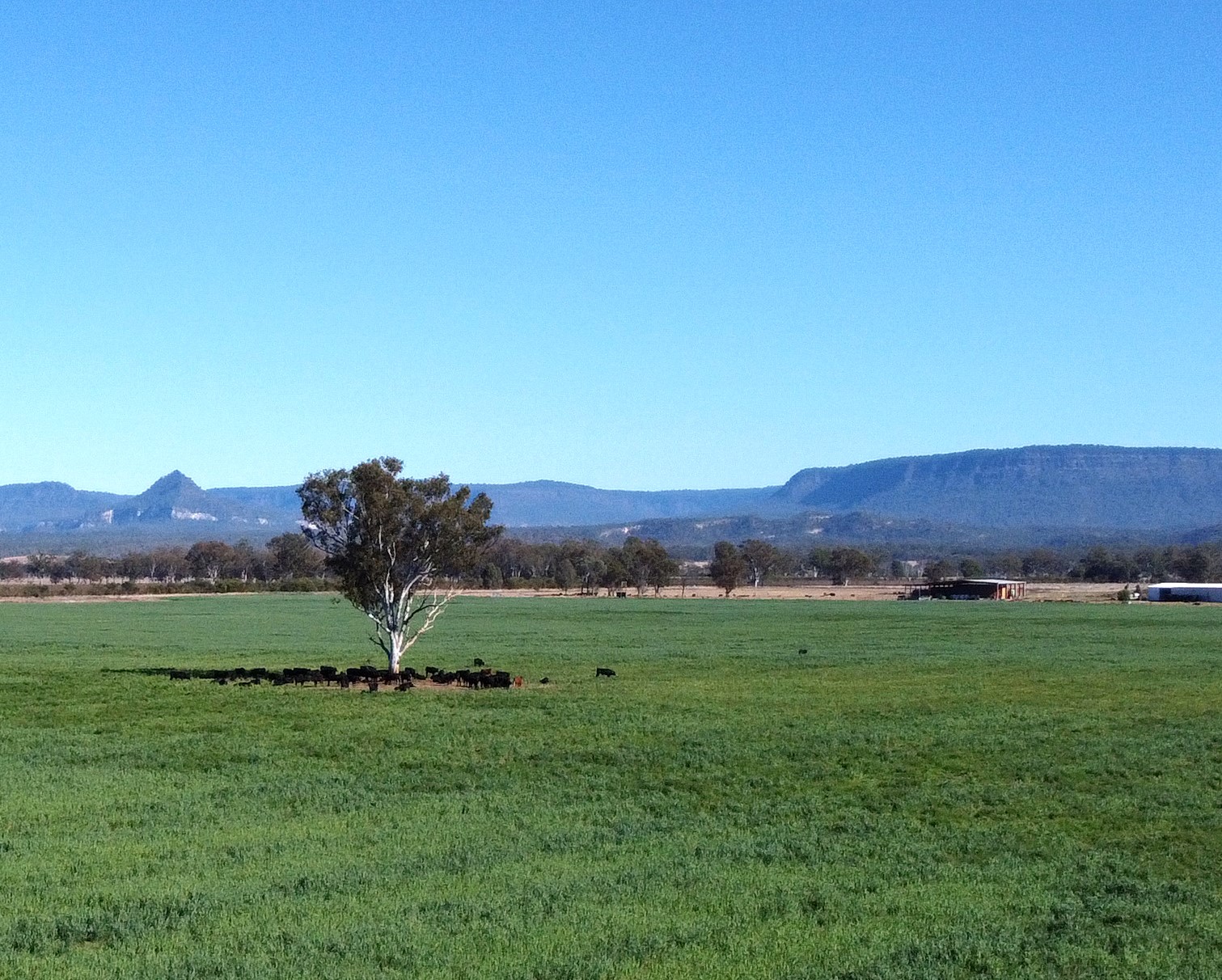
Current article
Property profile: Rewan
Table of contents
Acquisition, development and lease
Natural and historical significance
Cattle grazing on developed cultivation area with Carnarvon National Park in the background, Rewan central Queensland, August 2023.

| Location | Location | Central Queensland | |
| Size | Size | 17,479 ha | |
| Lessee | Lessee | Australian Agricultural Company (ASX: AAC) | |
| Acquisition date | Acquisition date | August 2016 | |
| Adjusted property value | Adjusted property value | $72.8m (31 December 2025) | |
Rewan is a 17,479 ha cattle backgrounding and finishing property located about 60 km south of Rolleston in central Queensland. It was one of the first cattle properties acquired by RFF when it was purchased in July 2016 for $31.2m.1 In July 2026 Rewan was contracted for sale, with net sale proceeds of $106.9m.2
Acquisition, development and lease
At acquisition, RFM articulated a strategy to lift the value and income-earning potential of Rewan through productivity improvements, including pasture improvement, expanded cultivation area and new watering points. Over the past ten years, these improvements have seen an increase in adult equivalents (AE), a measure of cattle-carrying capacity.
Rewan was initially leased to a subsidiary of RFM while the productivity developments were implemented, and a long-term third-party lessee was identified.
In October 2019, the property was leased to the Australian Agricultural Company (ASX: AAC) under a ten-year lease after being independently valued at $43.1m, an uplift of 38% on its purchase price. Rewan was the first property AAC leased from RFF, introducing another high-quality lessee into the portfolio. AAC has since leased an additional two cattle properties from RFF; Comanche and Homehill, also in central Queensland.

Cattle grazing on Rewan in February 2020.
Property sale
On 10 July 2026, RFM announced it had exchanged contracts for the sale of Rewan for $106.9m, 47% above its 31 December 2025 book value, and 243% above its purchase price. The property generated an internal rate of return (IRR) of 22% for RFF Unitholders during the period of ownership.
The premium to book value reflected the higher underlying land value, the productivity improvements made by RFM since acquisition, and the opportunity to aggregate Rewan with the neighbouring property Wyseby, which was acquired by RFF in June 2023 for that purpose. As planned, in FY26 Wyseby was subdivided with the co-owners into East Wyseby and West Wyseby, RFF's portion. Both properties have been sold to the same purchaser.
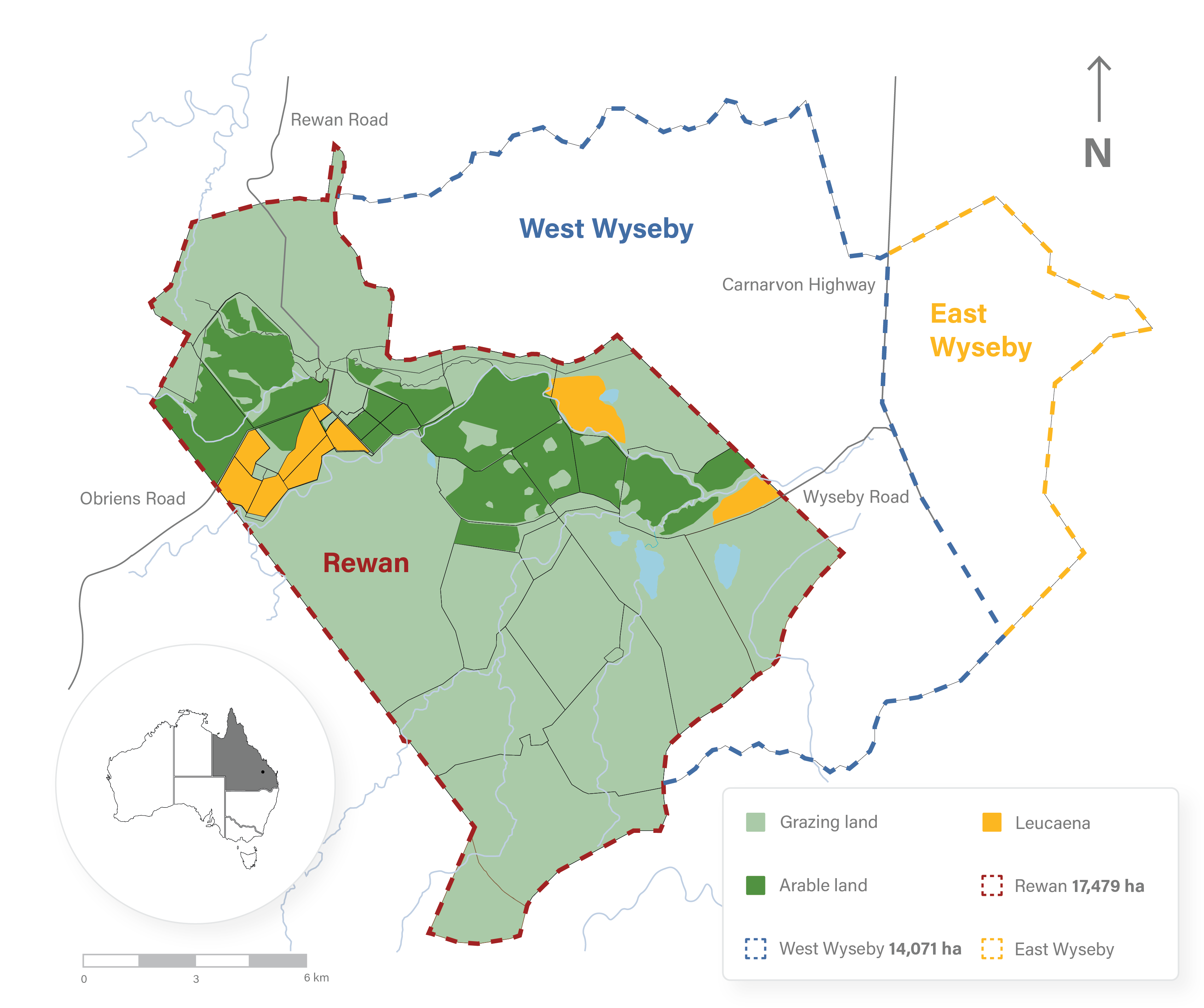
Rewan development map with adjoining Wyseby subdivision.
The decision to invest into the sector was also part of RFF's broader productivity improvement strategy, to seek higher returns from assets by undertaking productivity developments.
Natural and historical significance
Located next to Rewan is the Carnarvon Gorge, which is nationally recognised for its natural and cultural significance. The gorge features sandstone cliffs, coloured side gorges, diverse flora and fauna and Aboriginal rock art. The gorge is accessed via a road which runs through Rewan itself.
In the early 20th century, Rewan was owned and operated by the Queensland Police Service. The property served as a stud farm for breeding police horses. By 1912, 69 Rewan remounts had been bred for police work. The stud farm was closed in 1933. However, some of the original buildings remain on the property, including the Police Hut, which is now heritage listed.

The horse "Brisbane" from Rewan, was sent to London in the charge of Constable Fenwick Wilson (astride the horse) as a gift from the Queensland Government to King George V, July 1911. Source: Queensland Police

The stallion “Libertine” sent to Rewan as one of the initial breeding stock, 1910. Source: Queensland Police .
During the Second World War (November 1943), a Dakota C-47 aircraft, en route from Darwin to Brisbane, crashed on Rewan during a storm. Nineteen United States and Australian military personnel were killed. A memorial, which consists of the aircraft’s engines, wings and undercarriage, was erected near the crash site in 2004.

Dakota C-47 air crash memorial, Rewan, central Queensland, December 2020.
Notes:
- Acquisition value includes transaction costs. Figure subject to rounding.
- Sales values are net of estimated transaction costs. Figures subject to rounding. See ASX announcement
1 Managed by: Corporate Governance Statement as at 30 June 2026
2
3
Cover image: Cattle muster, Natal Aggregation, Charters Towers, Queensland, April 2026.
Image: Cotton harvest at Lynora Downs, central Queensland, June 2026.
Rural Funds Group (the Fund) comprises Rural
Funds Trust ARSN 112 951 578 and RF Active
ARSN 168 740 805, both registered managed
investment schemes under the Corporations Act
2001 (Cth) (the Corporations Act). Units in Rural
Funds Trust are stapled to Units in RF Active.
The Fund is listed on the ASX.
Rural Funds Management Limited (RFM, the
Company) ACN 077 492 838 is the Responsible
Entity for the Fund. RFM has established and
oversees the Fund’s corporate governance. The
Responsible Entity holds an Australian Financial
Services Licence (AFSL 226701) authorising
it to operate the Fund. It has a duty to act in
the best interests of unitholders of the Fund
(Unitholders).
The RFM Board of Directors (Board) provides
leadership and direction for the Fund that
aligns with the Responsible Entity’s corporate
governance responsibilities. The Board is
comprised of five directors with a mix of
experience and skills necessary to oversee
the corporate governance requirements of
the Responsible Entity. This ensures that the
Responsible Entity operates with integrity, is
accountable and acts responsibly and ethically.
Board members work together using their
collective ability to make decisions that lead to
a profitable and efficient business.
To the extent that they are applicable for an
externally managed fund, the Responsible
Entity has adopted and complies with the ASX
Corporate Governance Council’s Corporate
Governance Principles and Recommendations
4th edition. This Corporate Governance
Statement sets out the ASX Corporate
Governance Council’s eight principles of
corporate governance, and how these apply to
RFM, in accordance and compliance with ASX
Listing Rule 4.10.3. This statement applies to the
period 1 July 2025 to 30 June 2026 (Financial
Year).
This Corporate Governance Statement is
current as at 21 August 2026 and has been
approved by the Board of Directors of the
Responsible Entity.
Copies of the Responsible Entity’s corporate
governance policies are located on the
Responsible Entity’s website at
www.ruralfunds.com.au.
Principle 1
Lay solid foundations for management
and oversight
A listed entity should clearly delineate the
respective roles and responsibilities of its board and
management and regularly review their performance.
As an externally managed scheme, recommendations 1.1, 1.2,
1.3, 1.4, 1.5, 1.6 and 1.7 do not apply to the Fund.
The Fund has elected to apply the alternative recommendation
for 1.1 and provides the following responses to the
recommendations.
The business of the Fund is managed by RFM as the
Responsible Entity of the Fund. The arrangements between the
Responsible Entity and the Fund are governed by the
Constitution of the Fund and the Corporations Act. The conduct
of the Board of RFM as Responsible Entity when managing the
affairs of the Fund are outlined in the Corporate Governance
Charter.
Board roles and responsibilities
The Responsible Entity has a Corporate Governance Charter
that outlines the corporate governance practices, functions and
responsibilities of the Board. The Corporate Governance Charter
is located on the Corporate Governance page of the Responsible
Entity’s website.
Board functions include:
• setting the direction, strategy and financial objectives for
the RFM Group,¹ including the Fund
• monitoring the implementation and execution of strategy
and financial objectives
• monitoring compliance with regulatory requirements,
ethical standards and external commitments
• appointing, and reviewing the performance of, the
Managing Director and Company Secretary, and
• taking an effective leadership role in relation to the RFM
Group.
Board conduct is governed by the Fund’s Constitution and the
Corporations Act.
Chair
The Chair leads the Board and ensures the efficient organisation
and conduct of Board members. Responsibilities of the Chair are
listed in the Corporate Governance Charter.
Managing Director
The Board has delegated responsibility for the day-to-day
management of the Fund to the Managing Director of the
Responsible Entity, subject to financial and other limits.
The Managing Director is supported by the Chief Operating
Officer, Chief Financial Officer, Company Secretary and
managers in the leadership, operational, technical and corporate
management teams.
Appointment of directors and management
Before appointment, appropriate checks are completed for
potential directors and managers, including police, bankruptcy
and reference checks. Employment history, experience,
education, directorships and related personal interest are also
assessed.
All directors of the Responsible Entity receive letters of
appointment setting out the key terms and conditions of their
appointment.
Managers of the Responsible Entity enter into an employment
agreement setting out the key terms and conditions of their
employment, including a position description, duties, rights,
responsibilities, remuneration and entitlements on termination.
Succession planning within the Responsible Entity is reviewed
by the Internal Compliance Committee annually. This ensures
depth of skills and experience exist within the key functions.
Company Secretary
The Company Secretary of the Responsible Entity is
accountable to the Board, through the Chair, on all matters to do
with the proper functioning of the Board. Directors have access
to the Company Secretary for advice.
Diversity
The Responsible Entity has a Diversity, Equity and Inclusion
Policy, approved annually by the Board, and recognises that
employees are one of its greatest assets. It has employees with
a range of skills and capabilities to ensure the ongoing strength,
continuity and stability of the Responsible Entity. The Diversity,
Equity and Inclusion Policy provides the framework that actively
manages and encourages diversity and inclusion and attracts a
diverse pool of suitably skilled candidates.
RFM maintains a target of 40% female representation on its
Board. At the date of this report, 20% of directors are female.
This target will not be achieved by 31 December 2026. The
Board’s current composition reflects stability and continuity of
skills and experience, with progress toward the target expected
as Board renewal opportunities arise. The target remains an
active objective, and RFM will continue to report against it in
each annual report.
At 30 June 2026, there were two females in the Responsible
Entity’s leadership team, representing 25% of the team. In
addition, there were three female managers within our technical,
operations and corporate management teams, representing 23%
of the team. Of the 278 employees RFM and associated entities
employ, 35% are female.
The Workplace Gender Equality Act 2012 (Cth) (WGE Act)
applies to RFM and its associated entities. The WGEA annual
compliance report was approved on 16 April 2026. The Diversity,
Equity and Inclusion Policy is available on the Responsible
Entity’s website.
- RFM Group includes the Responsible Entity and all entities that are owned and/or managed by RFM.
4 5 Performance assessments The Corporate Governance Charter is located on the Corporate Governance page of the Responsible Entity’s website and provides guidance on annual reviews of director performance. The performance of the Board, its committees and individual directors may be reviewed and assessed each year collectively by the Board and/or the Managing Director. Performance feedback will be provided to directors if their performance is unsatisfactory.
RFM has a Performance Management Policy that provides guidelines to review the performance of managers. Managing the performance of our people is critical to our success, and in most cases, we choose to do this informally through regular one-on-one discussions between employees and their manager, or formally where either party prefers this approach. Autonomous tractor at Maryborough macadamia orchard, Queensland, September 2025. Principle 2 Structure the board to be effective and add value The board of a listed entity should be of an appropriate size and collectively have the skills, commitment and knowledge of the entity and the industry in which it operates, to enable it to discharge its duties effectively and to add value. As an externally managed scheme, recommendations 2.1, 2.2, 2.4, 2.5 and 2.6 do not apply to the Fund. Nomination Committee The Responsible Entity has not established a Nomination Committee. Due to the size of the Board and the nature of the business, the Board has determined this function should remain with the Board. Advice is sought from external experts including specialist tax, legal or business advisers when required. Board matrix The Responsible Entity’s Board comprises five members, four of whom are independent non-executive directors. All directors must act with the utmost integrity and objectivity, striving to enhance the reputation and performance of the RFM Group. Directors must comply with the Director’s Code of Conduct and the RFM Code of Conduct in exercising their duties. Guy Paynter and Michael Carroll have more than 15 years of service as directors of the Responsible Entity. It remains RFM’s opinion that both Guy and Michael have an independence of mind and a strong element of objectivity regarding the affairs of RFM and the Fund. The Board recognises the value of diversity in its composition and succession planning, including diversity of thought, experience and perspectives. It is in the best interests of the Fund to have a combination of different director tenures, as longer terms provide an innate understanding of the business whilst shorter durations offer a fresh approach. All members of the RFM Board advocate their professional views as part of robust discussions. The RFF Annual Report and the Responsible Entity’s website each provide further information on the background, qualifications and expertise of the directors. Board independence The Chair of the Responsible Entity’s Board is responsible for its leadership, organisation and conduct. The Chair, Guy Paynter, is considered independent as defined in the Corporate Governance Charter. Director training New directors are selected and appointed in accordance with the Corporate Governance Charter. New directors are provided with an induction relevant to the Responsible Entity and the Fund and are provided opportunities to extend their skills and knowledge, through informal and formal means. Lynora Downs, central Queensland, September 2025. DirectorDirector sinceIndependent Guy Paynter (Chair)15 April 2010Ye s David Bryant17 February 1997No Michael Carroll15 April 2010Ye s Julian Widdup15 February 2017Ye s Andrea Lemmon1 November 2021Ye s
6 7 Principle 3Principle 4 Instil a culture of acting lawfully, ethically and responsibly Safeguard the integrity of corporate reports A listed entity should instil and continually reinforce a culture across the organisation of acting lawfully, ethically and responsibly. ‘Managing good assets with good people’ The Responsible Entity’s objectives regarding the Fund are to operate profitably, maximise investor return and identify opportunities for growth. The Responsible Entity's core values, which all employees are expected to follow, underpin the culture and reputation implements by management. • Employees are to act honestly, ethically, in good faith and in the best interests of the Responsible Entity and its managed entities. • Employees have a duty to use due care and diligence and must not make improper use of information acquired. • Personal interests are not to conflict with the interests of RFM or the Fund’s Unitholders. • Employees must adhere to the continuous disclosure protocol and privacy principles adopted by RFM. • Employees are not to engage in conduct likely to bring discredit upon RFM and not knowingly breach any law under which RFM operates. The Responsible Entity has a general Code of Conduct that applies to directors and employees. Employees are required to act in a manner that is consistent with the best interests of the Company and its investors. Managers lead their teams to ensure company values and culture are modelled by all employees. Directors’ Code of Conduct The Responsible Entity has a Directors’ Code of Conduct. The Code seeks to give directors guidance on how best to perform their duties, meet their obligations and understand RFM’s corporate governance practices. The Code focuses on the directors’ obligations to comply with codes and law, general duties and application of business judgment including personal interests and conflicts, conduct and complaints. The Company Secretary will advise the Board and Internal Compliance Committee of any material breaches of the Directors’ Code of Conduct. Whistleblower Policy The Whistleblower Policy supports and protects employees should they wish to make a protected disclosure. All corporate employees complete annual compliance training in respect of the Policy.
The Responsible Entity has an established structure for reporting incidents under the Whistleblower Policy. The Company Secretary will confidentially advise the Board of any material incidents. A listed entity should have appropriate processes to verify the integrity of its corporate reports. Audit Committee The Board of the Responsible Entity has an established Audit Committee to assist the Board with integrity of financial reporting, controls and independence of the Fund’s external auditors. The Audit Committee is comprised of three members. All are independent non-executive directors of RFM. Audit Committee Michael Carroll (Chair) Julian Widdup Andrea Lemmon The Audit Committee has a formal charter that details its responsibilities and obligations. The Audit Committee’s role is to assist the Board in discharging its oversight responsibilities. The Audit Committee will: • oversee the financial reporting process to ensure balance, transparency and integrity of published financial information, review the effectiveness of the entities’ internal controls and financial risk management, and monitor their implementation • oversee the independent audit process, including recommending the appointment and assessing the performance of the external auditor • oversee the entities’ process for monitoring compliance with laws, regulations, internal policies and expectations of key stakeholders.
Anti-Bribery and Corruption Policy The Responsible Entity has an established Anti-Bribery and Corruption Policy, which was implemented to monitor, detect, report and manage any bribery, corruption or related activities. The Responsible Entity has a robust structure for reporting breaches of the Anti-Bribery and Corruption Policy. All employees are encouraged to address any unlawful events or unethical behaviour. This can be completed either via their immediate manager or directly to the Board. The Company Secretary will advise the Board of any material breaches. The Internal Compliance Committee will also be advised at its quarterly meeting. Securities Trading Policy The Securities Trading Policy implements a regime to prevent the misuse of Insider Information. The Policy ensures that dealings in securities comply with legal and regulatory requirements. The Company Secretary will advise the Board of any material breaches. The Internal Compliance Committee is also advised at its quarterly meeting. Conflict of Interest Management Policy The Conflict of Interest Management Policy identifies the arrangements that are in place to manage any actual or potential conflicts of interests that may arise between the Responsible Entity and the Fund it manages. The Policy details how conflicts should be managed and reported to the Board and Internal Compliance Committee. The Corporate Governance Charter (incorporating the Directors’ Code of Conduct), Whistleblower Policy, Anti-Bribery and Corruption Policy, Securities Trading Policy and Conflict of Interest Management Policy are all available on the Responsible Entity’s website. Two meetings of the Audit Committee were held during the Financial Year. Both meetings were attended by all committee members. The Audit Committee will routinely invite others to attend meetings, including management of the Responsible Entity and the Auditor of the Fund. The Audit Committee reviews the financial reports and provides commentary to the Board as required. Pursuant to s295A of the Corporations Act, the Chief Financial Officer and Managing Director have each declared in their opinion and in writing to the Board that the half-year and full- year financial statements: • have been properly maintained in accordance with s286 of the Corporations Act • [and the notes referred to in paragraph 295(3)(b)] comply with the accounting standards • [and notes] give a true and fair view of the financial position and performance of the Fund under s297 of the Corporations Act • satisfy any other prescribed regulation matter. Such opinion has been formed on the basis of a sound system of risk management and internal control that is operating effectively. The Fund’s corporate reporting was reviewed by external auditors, who attended both Audit Committee meetings this Financial Year. The Audit Committee Charter, included in the Corporate Governance Charter, is available on the Responsible Entity’s website. Wheat harvest at Kaiuroo, central Queensland, October 2025.
8
9
Principle 5
Make timely and balanced
disclosure
A listed entity should make timely and balanced
disclosure of all matters concerning it that a
reasonable person would expect to have a
material effect on the price or value of its securities.
Continuous disclosure
The Responsible Entity is committed to promoting a fair market
in the Fund’s units through honest management and timely, full
and fair disclosure. This conduct will ensure the Fund meets
its disclosure obligations under the Corporations Act and ASX
Listing Rules.
The Responsible Entity has adopted a Continuous Disclosure
Policy that applies to all directors and employees of the RFM
Group. Regular training on the Policy, and continuous disclosure
obligations generally, is provided for officers of the Responsible
Entity. Responsibility for compliance with the Continuous
Disclosure Policy lies with the Company Secretary.
The Responsible Entity will ensure information that a reasonable
person would expect to have a material effect on the price of the
Fund’s securities will be disclosed pursuant to ASX Listing Rule
3 .1.
The Board is promptly made aware of market announcements
released on the ASX Market Announcement Platform.
Any new or substantive investor or analyst presentations are
released on the ASX Market Announcement Platform ahead of
the scheduled presentation time.
All announcements released in respect of the Fund can be
viewed at www.asx.com.au.
The Continuous Disclosure Policy is available on the
Responsible Entity’s website.
Almond bloom, Kerarbury orchard, Darlington Point, New South Wales, August 2025.
Principle 6
Respect the rights of security
holders
A listed entity should provide its security holders with
appropriate information and facilities to allow them to
exercise their rights as security holders effectively.
Governance for Unitholders
The Fund aims to provide timely, precise and accessible
information of a consistently high standard to its Unitholders.
This information is conveyed in the Fund’s annual reports, half
yearly reports, ASX announcements, newsletters and on the
Responsible Entity’s website. Recordings of full and half-year
financial results presentations, and additional information
relevant to the Fund, are located on the Responsible Entity’s
website.
Investor Relations
The Investor Relations (IR) team regularly engages with
Unitholders, potential investors, external analysts and the Fund’s
registry service provider, Boardroom. The IR team’s primary
objective is to ensure Unitholders are well informed regarding
the Fund. The Fund’s website has information available to
Unitholders to facilitate two-way communication with investors
and provides all relevant information regarding the Fund.
Unitholders are encouraged to contact the Responsible Entity’s
IR team using any of the following methods:
Email: [email protected] Website: www.ruralfunds.com.au/contact Phone: 1800 026 665 In person by visiting the Responsible Entity’s office. Unitholders may receive Fund communications either electronically, at a physical address or not at all. Communication election is made by communication type. Unitholders are also able to communicate with the share registry and the Responsible Entity electronically. Unitholder meetings As an externally managed scheme, the Fund does not hold periodic meetings. When Unitholder meetings are required, webcasting and/or an audio conference facility for remote Unitholders is used. Unitholders who are unable to attend meetings can vote via proxy, in accordance with the Fund’s Constitution. The Fund’s Constitution provides that Extraordinary Resolutions and any other properly demanded resolutions, directed by the Chair, are to be decided by a poll. Boardroom, the Fund’s registry service provider, provides the option for Unitholders to receive their communications electronically. The Responsible Entity encourages all investors to communicate electronically and provides regular correspondence advising Unitholders of this option. Cattle in yards, Mutton Hole, Carpentaria, Queensland, May 2026.
10
11
Principle 7
Principle 8
Additional recommendations
Recognise and manage
risk
Remunerate fairly and
responsibly
As an externally managed scheme, recommendations 9.1, 9.2 and 9.3 do not apply to the Fund
A listed entity should establish a sound risk management
framework and periodically review the effectiveness of that
framework.
Risk management
A Risk Committee has not been established by the Responsible
Entity. The Board has determined that due to the size of the
Board and the nature of the business, the risk oversight function
should be managed by the Board, supported by the Internal
Compliance Committee (ICC).
The Board has ultimate responsibility for overseeing the risk
management framework and approving and monitoring
compliance within the framework. The Board receives regular
reports on material business risks in relation to the Fund which
includes a quarterly report of risks rated extreme or high.
Ongoing management of the identified risks is provided by
the relevant managers of each business area. These risks are
reported to the Board and the ICC and include details regarding
the effectiveness of mitigation measures.
A Risk Management Policy has been established by the
Responsible Entity. The Policy considers the management of
material business risks and the Board’s risk appetite for the
Fund and associated entities.
The Responsible Entity’s risk management framework and Risk
Management Policy are reviewed annually. The risk review
consists of re-evaluating all risks, assessing whether the existing
risk rating is appropriate, and assessing the suitability of existing
and additional mitigation measures. During this Financial Year,
an annual risk review was performed.
The Risk Management Policy is located on the Corporate
Governance page of the Responsible Entity’s website.
Internal Compliance Committee (ICC)
The Responsible Entity has an ICC that assists the Board in
evaluating the risk management framework and material
business risks on an ongoing basis. While not an internal audit
committee, the ICC reports to the Board quarterly and may
make recommendations to the Board for changes to processes
and systems to ensure compliance with legal and regulatory
requirements.
A listed entity should pay director remuneration sufficient
to attract and retain high quality directors and design its
executive remuneration to attract, retain and motivate high
quality senior executives and to align their interests with the
creation of value for security holders and with the entity’s
values and risk appetite.
As an externally managed scheme, recommendations 8.1,
8.2 and 8.3 do not apply to the Fund.
The Responsible Entity has elected to apply alternative
recommendations for 8.1, 8.2 and 8.3 and provide the following
responses.
As an externally managed listed entity, the remuneration of the
Responsible Entity, as disclosed in its Constitution, is:
• Fund Management Fee – up to 1.0% p.a. of the adjusted
gross asset value of the Fund
• Asset Management Fee – up to 1.0% p.a. of the adjusted
gross asset value of the Fund
• Termination Fee – 1.5% of the adjusted gross asset value of
the Fund.
The fees listed above represent the maximum allowed under the
Fund’s Constitution.
Typically, the Responsible Entity charges total fees (fund
management and asset management fees) of 1.05% of the
adjusted gross asset value of the Fund.
The ICC is comprised of managers who are specialists in their
field. Committee Members are:
• Manager – Compliance and Risk (Chair)
• Company Secretary
• Chief Financial Officer
• National Manager – People and Safety
• Senior Business Manager
The ICC extends the invitation to other managers to routinely
attend meetings to offer insight into their relevant field and the
effect of managing risk in their business units.
This broad representation ensures the ICC is fully informed of
governance, risk and internal control processes across the Fund
and associated RFM entities.
Environmental, social and governance (ESG)
The Responsible Entity’s approach to managing material
exposures is outlined in the RFF FY26 Annual Report. The
Responsible Entity continues to strengthen the management of
environmental (including climate-related impacts) and social
risks. The Responsible Entity publishes a Modern Slavery
Act Statement, in accordance with the Modern Slavery Act
2018 (Cth) and is committed to addressing modern slavery
risks within its operations and supply chains. The Board is
responsible for overseeing the risk management framework,
with the internal management of the framework delegated to the
ICC.
The Annual Report and Modern Slavery Act Statement are
available on the Responsible Entity’s website.
In FY26, actual fees were 0.92% of the adjusted total assets of
the Fund.
Remuneration Committee
The Remuneration Committee has a formal charter that details
its responsibilities and obligations and sets out the powers of
the Remuneration Committee along with the meeting procedure
framework.
The Remuneration Committee comprises four members. All are
independent non-executive directors.
Remuneration Committee
Michael Carroll (Chair)
Guy Paynter
Julian Widdup
Andrea Lemmon
The Remuneration Committee’s scope, responsibilities and
associated policies and procedures can be viewed in the
Corporate Governance Charter, located on the Corporate
Governance page of the Responsible Entity’s website.
Kerarbury almond orchard, Darlington Point, New South Wales, August 2025.
12 Rural Funds Management Limited ABN 65 077 492 838 AFSL 226701 Level 2, 2 King Street Deakin ACT 2600 PO Box 347 Curtin ACT 2605 Phone: 1800 026 665 Email: [email protected] Website: www.ruralfunds.com.au
This profile contains details of the Rural Funds Group (ASX: RFF) owned Natal Aggregation, a cattle property located near Charters Towers in northern Queensland.
1
May 2026
Reading time
3
min
mins
Download newsletter
Download article
Download
Download
Download
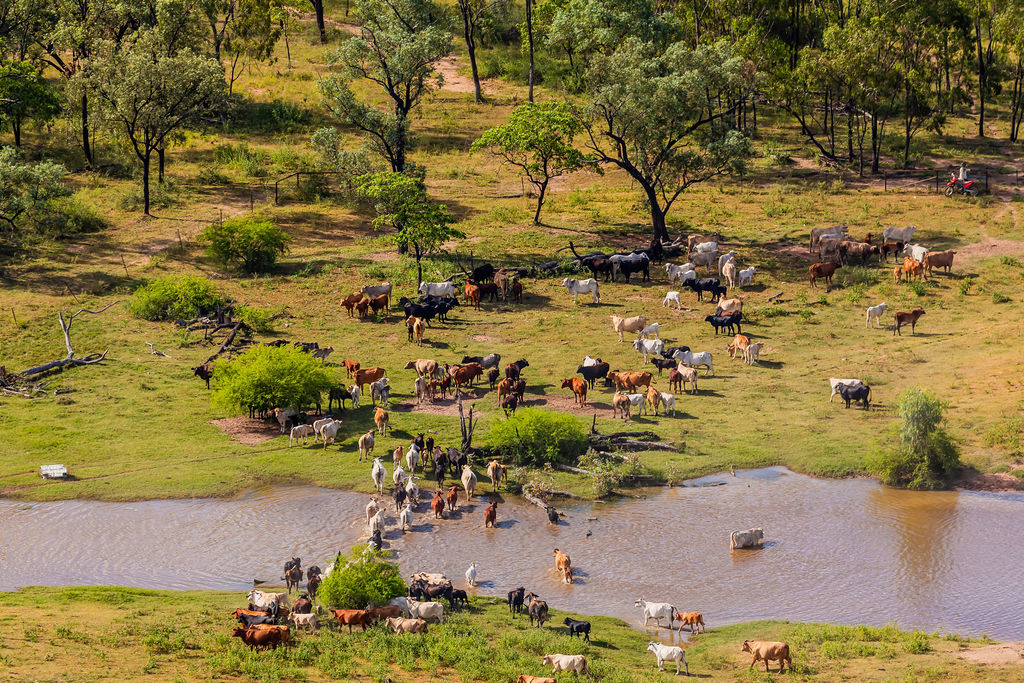
 Property profile: Natal Aggregation
Current article
Property profile: Natal Aggregation
Table of contents

Natal Aggregation, April 2026.

| Location | Location | Charters Towers, Queensland | |
| Size | Size | 390,600 ha | |
| Lessee | Lessee | DA and JF Camm Pty Ltd | |
| Acquisition date | Acquisition date | December 2017 | |
| Adjusted property value | Adjusted property value | $187.2m (31 December 2025) | |
The property aggregation of Natal Downs, Longton and Narellan, referred to as Natal Aggregation, is the largest property of the Rural Funds Group (ASX: RFF) portfolio by size. Natal Aggregation encompasses an area of 390,600 hectares and has a carrying capacity of over 37,000 head of cattle. It is situated approximately 100km southwest of Charters Towers, a region suited for cattle breeding and backgrounding.

Natal Aggregation map
The aggregation was acquired in 2017 for $63 million under a sale and lease-back arrangement, with a 10-year lease to DA & JF Camm Pty Ltd (Camm), part of the Camm Agricultural Group (CAG), a family enterprise that has operated the property for more than 25 years. CAG is Queensland based and its integrated operating model spans the full beef cattle supply chain from breeding and backgrounding through to finishing. The group also holds cropping interests across Queensland, complementing its beef operations. Central to the business is one of Australia's longest-running feedlot operations, established by the Camm family in southern Queensland in 1972.
The purchase of Natal Aggregation built on RFF’s cattle assets acquired in 2016 and formed part of the strategy to acquire natural resource predominant assets with the potential for capital growth through productivity improvements.

Natal Aggregation, April 2026.
Developments and lease
Since acquisition, RFF invested in developments and infrastructure to boost productivity, converting over 4,309 hectares of dryland cultivation into fodder and cash crops as well as installing more than 400 km of new fencing. The lease is structured to generate additional rent on capital expenditure, directly linking RFF's investment activity to rental income growth.
Water infrastructure development included the installation of 46 new water points from 2018 to 2023. An ongoing project for the installation of an additional 39 water points is currently underway, 10 are completed with the remainder to be installed by the year end. These new water points have unlocked underutilised dry-season areas on Longton and Narellan.
These developments have increased the property’s carrying capacity materially. To enable the lessee to utilise the increased carrying capacity of the properties, RFF provided a livestock lease facility of $5 million to the lessee as part of the acquisition.
Natal’s property value was $187.2 million as at 31 December 2025.
Natal Aggregation, April 2026.
Environmental initiatives
In FY21, RFF funded the installation of 11 solar-powered water pumps. Solar-powered water pumps utilise power from solar panels, pumping water from nearby water sources such as a dam or bore.
These systems have replaced existing diesel-powered pumps, as well as being utilised in new installations. The pumps provide a direct reduction in emissions, not only through reduced diesel usage, but also in the reduction of the vast travel requirements for farm staff as regular refuelling of the pumps is no longer necessary.
History
Natal Downs, the core of the Natal aggregation, traces its origins to the early 1860s, when it was first taken up by Robert Kellett and partners as part of the wave of North Queensland pastoral expansion. The pastoral frontier in this region was driven by squatters seeking new grazing land, leading to the rapid establishment of large sheep and cattle stations across the Cape and Burdekin districts. Natal Downs initially operated as a sheep station before transitioning to beef cattle and in time became a local social hub, known for hosting picnic race meetings with the original dance hall still standing today.
William Chatfield purchased Natal Downs in 1865 and was quoted as saying that the success of Natal Downs during his tenure, was due to the work of the local Gudjal people, whose country includes the Cape River area. Chatfield spent time recording the language of the Gudjal people and his notes include vocabulary such as ‘boboro’ (tree), ‘goondi’ (flying fox) and ‘kom-mo’ (water), as well as place names like ‘Moonya moonya’, meaning ‘bats’, which was said to have been retained from an earlier tribe.1

Original dance hall used after picnic races, last used shortly after WWII, April 2026.
Notes:
- Henry Reynolds (ed.), Race Relations in North Queensland, new ed. (Townsville: James Cook University Department of History and Politics, 1993).
Share this post:


You may also like...
[
Video
\
Property profile: Rewan](https://www.ruralfunds.com.au/resources/news/property-profile-rewan-updated)
[
Video
\
RFM Newsletter Edition 25 - 2026](https://www.ruralfunds.com.au/resources/news/rfm-newsletter-edition-25---2026)
[
Video
\
RFM Newsletter Edition 24 – 2026](https://www.ruralfunds.com.au/resources/news/rfm-newsletter-edition-24---2026)

About Resources Sustainability Videos Careers Contact
Invest
Connect with us:
© 2026 Rural Funds Management Limited
Designed and developed by Tiny Giants
This profile contains details of the Rural Funds Group (ASX: RFF) owned cattle property, Comanche, located near Rockhampton in central Queensland.
27
November 2025
Reading time
5
min
mins
Download newsletter
Download article
Download
Download
Download

Current article
Property profile: Comanche
Table of contents
Mustering cattle, February 2022.

| Location | Location | Central Queensland | |
| Size | Size | 7,600 ha | |
| Lessee | Lessee | Australian Agricultural Company (ASX: AAC) | |
| Acquisition date | Acquisition date | July 2018 | |
| Adjusted property value | Adjusted property value | $36.2m | |
Comanche is a cattle breeding and backgrounding property acquired by the Rural Funds Group (ASX: RFF) in July 2018. It is located approximately 65km west of Rockhampton, central Queensland with frontage on the Fitzroy River.
The region is recognised as one of the Australia’s premier beef-producing regions, supported by fertile soils, favourable land types and a subtropical climate. Cattle enterprises in the region are primarily focused on breeding and backgrounding. Areas within these properties may include a mix of dryland cropping of cereals and fodder, and irrigation located along major watercourses.
Prior to leasing the property, Comanche was operated by Rural Funds Management (RFM). RFM implemented a substantial development program to drive productivity improvements that saw the carrying capacity increase from 2,850 adult equivalent (AE) to 4,500 AE.

Cattle grazing with pivot irrigation in the background, May 2021.
Developments
Comanche comprises highly productive soils that support extensive cattle pastures. However, when acquired in 2018, the property lacked adequate irrigation infrastructure and water points. As cattle generally graze no more than two kilometres from a water source, limited access can lead to overgrazing. To maximise pasture utilisation, RFF installed an additional 30 water points, incorporating remote monitoring technology on key sites to improve efficiency and reduce labour requirements.
RFM also expanded dryland cropping at Comanche with the development of approximately 500 ha for forage crops, including oats, lablab and forage sorghum, to support cattle weight gains and reduce seasonal feed gaps. To fully utilise the property’s 864 ML water entitlement from the Fitzroy River, additional irrigation infrastructure was installed. Major upgrades included a new pump station, recommissioning of an existing 88-hectare centre pivot, and the installation of three new large pivots, increasing the total irrigable area to approximately 280 hectares.
These upgrades support higher and more reliable beef production, sustainable year-round output, and increased profitability and asset value for the lessee.

Pivot irrigation, February 2022.
Lease
Comanche was leased to Australian Agricultural Company (ASX: AAC) in May 2022 for 10-years. AAC is Australia’s oldest, continuously operating company in Australia and are the largest integrated cattle and beef producer, specialising in grain fed and wagyu beef production. AAC owns and operates Australia’s largest cattle herd with around 433,000 head spread over 6.5 million hectares of properties across Queensland and the Northern Territory. Comanche is one of three properties which AAC lease from RFF.

Sorghum crop under pivot irrigation, February 2021.
Conclusion
Improved productivity is a driver for higher profitability and contributes to higher valuations. As a result of the productivity improvements that RFF deployed, the carrying capacity on Comanche has increased, as has the property’s value.
Comanche demonstrates RFM’s capability to deliver farm productivity initiatives, increasing both cattle carrying capacity and asset value through targeted development activities.
Notes:
Share this post:
You may also like...
[
Video
\
Property profile: Rewan](https://www.ruralfunds.com.au/resources/news/property-profile-rewan-updated)
[
Video
\
RFM Newsletter Edition 25 - 2026](https://www.ruralfunds.com.au/resources/news/rfm-newsletter-edition-25---2026)
[
Video
\
Property profile: Natal Aggregation](https://www.ruralfunds.com.au/resources/news/property-profile-natal-aggregation)
About Resources Sustainability Videos Careers Contact
Invest
Connect with us:
© 2026 Rural Funds Management Limited
Designed and developed by Tiny Giants
Prompts
Click prompts to add them under the company line, click again to take one out, then copy the result into your AI chat. Shared by Asian Century Stocks and Uncovered Thai Stocks. Thank you.
ETFs Holding Rural Funds Group
Exchange-traded funds whose newest published daily portfolio holds one of the company's listings, largest weight first.
| ETF | Weight in ETF | Shares | Market value | As of |
|---|---|---|---|---|
| AVRE | 0.00% | 266 | $ 350.43 | Nov 16, 2026 |